Osaka Food Guide: What to Eat and Where to Look
From octopus-filled batter to broth and pressed sushi: a practical way to eat across Osaka.
- 7 dishes to recognise
- 3 flexible food outings
- Yen budgets explained
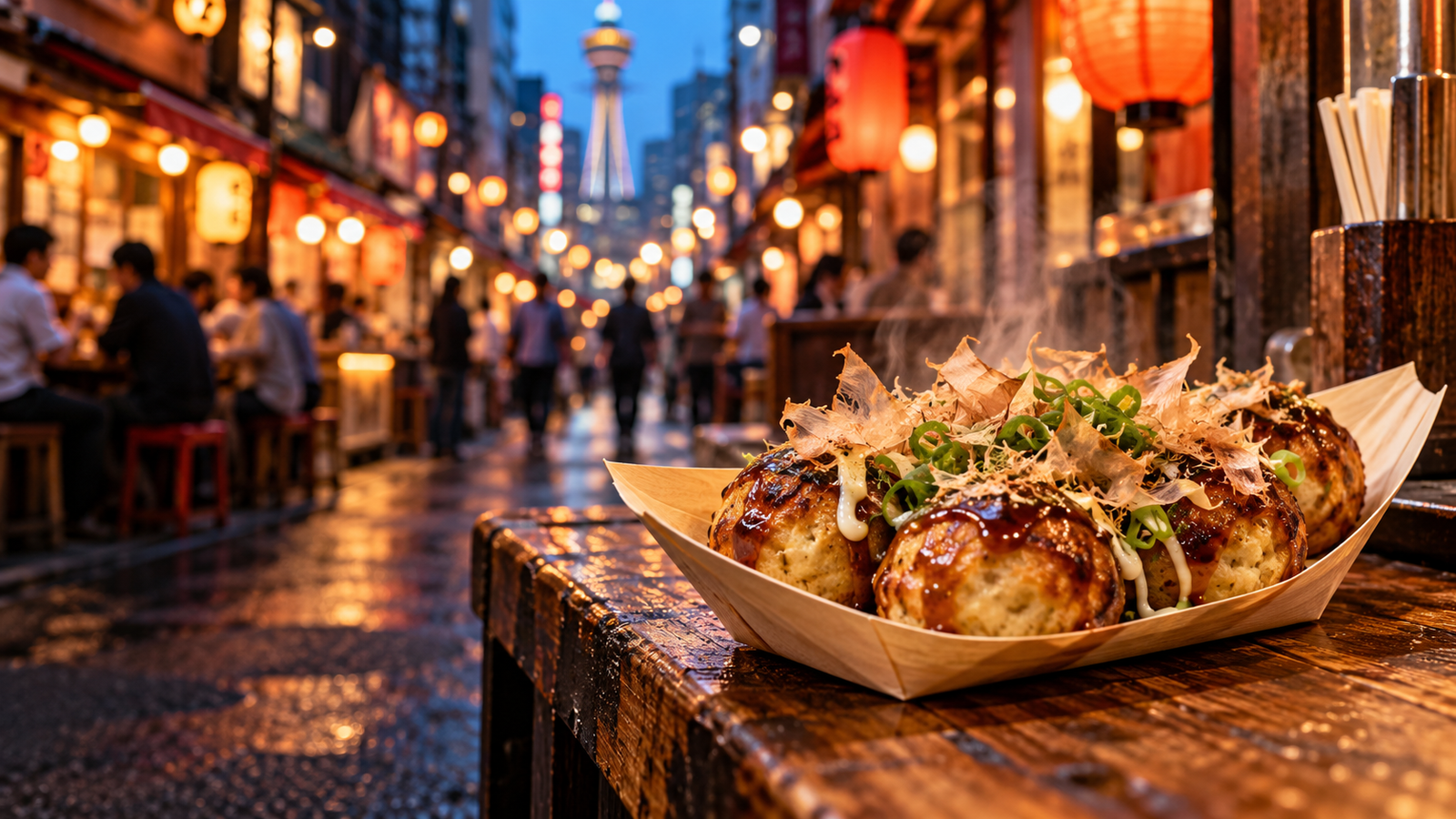
AI-generated illustration inspired by Osaka’s food culture; it does not depict a verified restaurant or a personal visit.
An Osaka food guide should help you recognise what you are ordering before a giant sign or a queue makes the decision for you. A tray of takoyaki, a whole okonomiyaki and a succession of fried skewers can all be appealing, but treating each as a small snack leaves little room for Osaka’s broth-based dishes or pressed sushi.
This guide groups foods by how they fit a meal, then places them into manageable outings. Restaurant examples are starting points selected for a clear dish or location, using tourism, market and merchant information. The routes and spending plans are original editorial suggestions, with no claim of personal tasting or restaurant inspection.
Osaka food guide: seven dishes to recognise
These are useful starting points, not a compulsory checklist. Osaka’s flour-based cooking is often described as konamon; dashi stock helps explain why dishes with similar-looking batter can have more savoury depth than expected. [2]
Swipe the table sideways to compare all columns.
| Dish | What to expect | How to fit it into an outing |
|---|---|---|
| Takoyaki | Griddled batter balls containing octopus, often finished with sauce. [2] | Choose a small tray for a first tasting. Open one and let its hot centre cool before eating. |
| Okonomiyaki | A savoury griddle-cooked pancake with cabbage and a batter base, commonly with pork or seafood. Sauce and mayonnaise are familiar toppings. [1] [2] | Treat a whole portion as a main meal. Check the filling and whether noodles or extras are included. |
| Kushikatsu | Breaded, deep-fried skewers of ingredients such as meat and vegetables. [1] | Order an initial selection, then add more if wanted. Several rounds can turn a snack into dinner. |
| Kitsune udon | Soft udon noodles in dashi, topped with seasoned fried tofu. The standard dish can contain fish stock. [3] | A broth-based main meal offers a useful change after fried food. |
| Hako-zushi / battera | Vinegared rice and toppings pressed into shape. Battera commonly pairs mackerel with a layer of pickled kelp. [4] | Choose this when you want to explore Osaka’s sushi tradition rather than add another griddle dish. |
| Ikayaki | In this Osaka context, a squid-and-flour pancake. Hanshin’s version combines squid, wheat flour and dashi. [2] | Useful as a small Umeda tasting; check the actual dish rather than assuming it means a whole grilled squid. |
| Butaman | A steamed pork bun. 551 Horai’s filling includes diced pork and onion inside a slightly sweet dough. [5] | A practical takeaway choice when you want something substantial without a full restaurant meal. |
Choose with your appetite as well as curiosity. Two people can share takeaway portions where practical, while seated restaurants may have their own minimum-order rules. Ask before planning to occupy two seats with a single dish.
Build a meal with contrast
Use one main meal as the anchor of each outing, then leave room for one or two smaller tastes. This is a planning method, not a rule about the correct way to eat Osaka food. It limits duplicate spending and helps you notice different textures and cooking styles.
Swipe the table sideways to compare all columns.
| If your main meal is… | Add contrast with… | Save for another outing |
|---|---|---|
| Okonomiyaki | A small sweet or fruit portion after a break | A second large batter-based meal |
| Kushikatsu | Tea and a walk before deciding on anything else | Another substantial fried-food stop |
| Kitsune udon | A small takoyaki tasting at a separate stop | An automatic extra full noodle bowl |
| Market seafood | One inexpensive bun or sweet only if still hungry | An expensive seafood bowl bought simply because it is nearby |
For a solo traveller, the main constraint is portion size: a small tray is still yours to finish. For a couple, divide a tasting budget between you and agree which purchase replaces lunch. For a group with different tastes, a food hall can be easier than persuading everyone to order the same speciality.
Decide your first main meal before joining a queue. If a wait would use the time you wanted for browsing or a second taste, choose another suitable restaurant in the same area. A queue alone does not establish that a meal suits your budget or dietary needs.
Where to look: four useful food groupings
Dotonbori and Namba: a first introduction
Dotonbori is part of Osaka’s Minami entertainment and dining area, with many restaurant types concentrated around its busy streets. It works well when you want to see menus before committing to one meal. [6] Mizuno is a specific okonomiyaki option at 1-4-15 Dotonbori; Dotonbori Imai’s kitsune udon offers a different direction. These are research starting points, not a tasted ranking. [11] [12]
Kuromon Market: browse before buying
The covered market in Nipponbashi lists seafood, meat, fruit, sweets and prepared-food sellers. Its official directory shows different shop hours, so a single market opening time is not a reliable promise that every stall will be trading. Plan a daytime visit and check any must-visit seller individually. [7]
Walk through the options before spending. Compare the size and price of one chosen seafood purchase with a complete meal elsewhere; the word “market” does not set a price ceiling.
Shinsekai: make skewers the main event
The area around Tsutenkaku and Janjan Yokocho has a concentration of kushikatsu restaurants. It provides a coherent setting for a skewers-based outing without needing to combine it with every other southern Osaka food stop. Ebisucho and Dobutsuen-mae are useful station references. [8]
Umeda: an indoor alternative
Hanshin Umeda’s B1 Snack Park lists ikayaki, noodles and other quick meals. It is a standing-food area; the building also has separate restaurant and food-hall floors, including the ninth floor. Check the particular venue when a seat matters. [9] [10]
Three food outings you can adapt
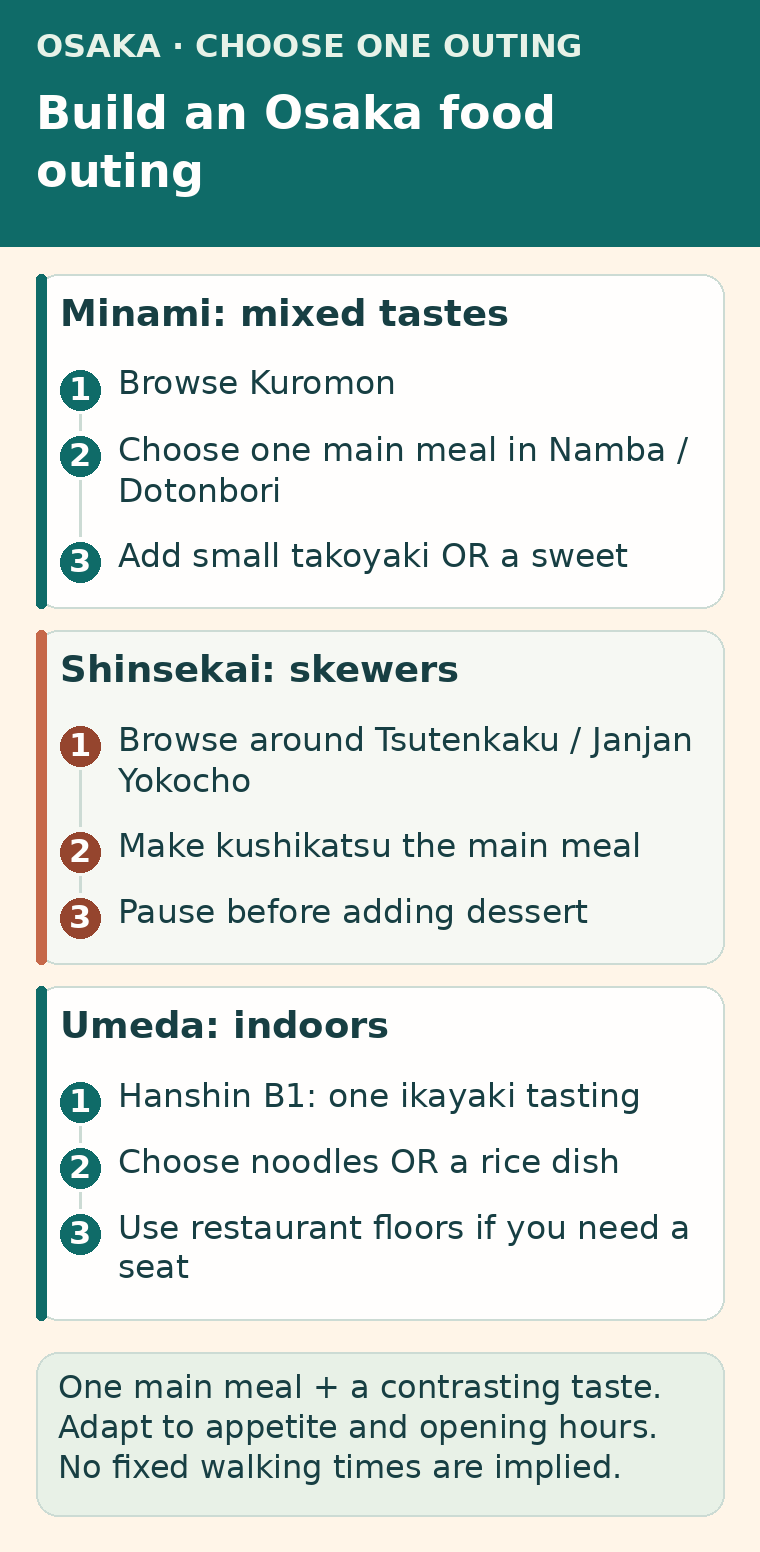
These are alternative groupings, not a timed route to complete in one day. Build in time for queues, sitting down and an appetite break. Check your chosen businesses before setting out; no precise walking time or current availability is assumed.
Mixed tastes in Minami
Begin with a daytime browse at Kuromon. If one seafood item catches your attention, decide whether it is a small tasting or your lunch before buying it. Continue your Minami outing towards Namba and Dotonbori, using a map for the individual businesses rather than following an arbitrary circuit. [6] [7]
Choose an okonomiyaki or udon meal, then add takoyaki only if you have room. A market splurge can replace that restaurant lunch, leaving the sit-down meal for the evening. The main advantage is flexibility: you have a food plan without an obligation to eat continuously.
A Shinsekai meal with time to browse
Look around the streets by Tsutenkaku and Janjan Yokocho, then choose one kushikatsu restaurant with a clear menu. [8] Begin with a manageable mix of ingredients, confirm the price and order a second round only after eating the first. Keep dessert optional.
This grouping suits someone who wants a proper meal and neighbourhood atmosphere. It is less suitable if your real priority is seafood browsing or if the group cannot comfortably eat at the same skewer restaurant. In that case, choose Minami or an indoor food hall instead.
A Umeda food stop around another plan
Use Hanshin Umeda when your day already brings you to the area, or when you want food choices under one roof. Try a small ikayaki serving, then decide whether noodles or a rice dish would make a better main meal. The official directory helps you distinguish Snack Park counters from the building’s separate restaurant floors. [9] [10]
Do not treat a takeaway food counter as a promise of somewhere to sit. If the group needs chairs, check the restaurant floors first and let the available seating determine the order of the visit.
How much to allow for food
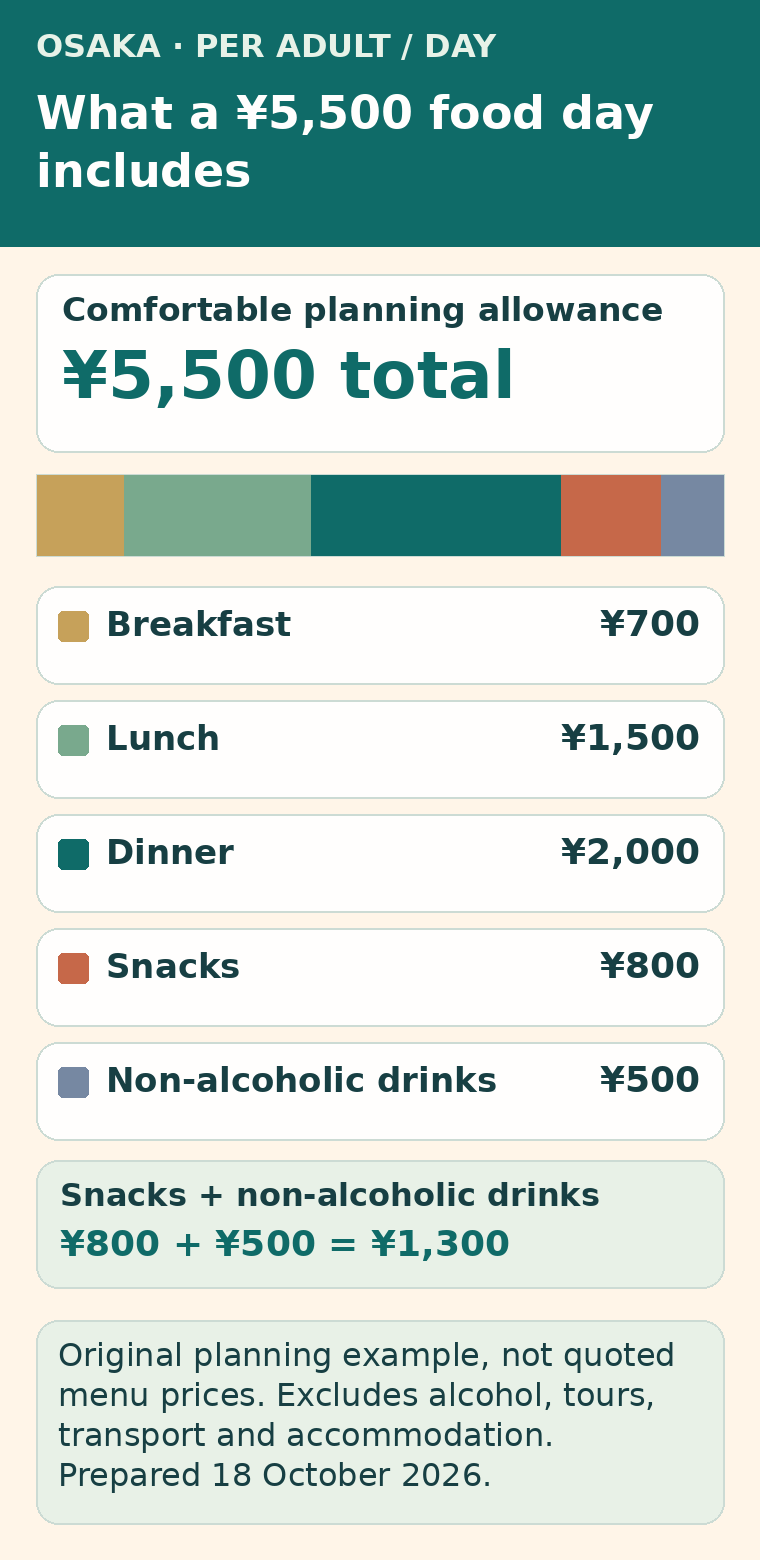
The table is an original spending model per adult for one day, prepared on 18 October 2026. Its amounts are allocations you can adjust, not surveyed averages, guaranteed prices or live restaurant quotes. Alcohol, guided tours, transport and accommodation are excluded.
Swipe the table sideways to compare all columns.
| Daily allocation | Keep it simple | Comfortable variety | More food spending |
|---|---|---|---|
| Breakfast | ¥500 | ¥700 | ¥900 |
| Lunch | ¥1,000 | ¥1,500 | ¥2,400 |
| Dinner | ¥1,300 | ¥2,000 | ¥3,400 |
| Snacks | ¥400 | ¥800 | ¥1,200 |
| Non-alcoholic drinks | ¥300 | ¥500 | ¥600 |
| Total per adult | ¥3,500 | ¥5,500 | ¥8,500 |
The simple plan requires choosing menus that fit the allowances and limiting extra purchases. The middle plan leaves more room for a speciality meal and separate snacks. The higher column offers flexibility for market seafood or a more expensive dinner; it does not cover every premium restaurant.
As a concrete reference, 551 Horai’s official product page advertised two takeaway butaman for ¥500 when checked on 18 October 2026. It states that eat-in and mail-order prices differ. That supports a useful small purchase, not a claim that all Osaka snacks cost the same. [5]
For two adults using the middle plan, allow ¥11,000 for the day. If a market purchase costs ¥1,200 more than your lunch allocation, your revised allowance becomes ¥6,700 per adult unless you reduce another purchase. This is why market snacks should have a line in the budget.
Keep the working budget in yen. Your eventual sterling cost depends on the exchange rate and payment fees when you pay. For the wider holiday budget, use the Japan trip cost guide for UK travellers alongside these meal allowances.
Order clearly and follow the shop’s system
Before paying at a stall, confirm whether the displayed price buys one piece, one skewer, a whole tray or a portion measured by weight. At a restaurant, ask whether a set includes rice, drinks or sides, and whether any seating or service charge applies. A short price check is more useful than guessing from a photograph.
- At an okonomiyaki table, let the staff explain who cooks and turns the food before touching the hot plate.
- Where kushikatsu is served with a shared dipping container, dip before biting and do not return a bitten skewer to it. Follow the actual sauce arrangement and posted instructions at your table. The no-double-dipping convention is closely associated with Osaka kushikatsu. [1]
- Ask where to eat takeaway food and where its packaging should go. Keep entrances and busy passageways clear while you stop.
- Carry a payment alternative and check the shop’s accepted methods before ordering; this guide does not assume every stall accepts your card.
- Keep a second nearby option when a particular meal matters. A famous name is not a reservation.
A useful distinction is between buying a takeaway taste and entering a restaurant for a meal. Taking a table commits time and may involve house ordering rules. Choose the format that matches your appetite rather than trying to turn every sit-down venue into a one-bite tasting counter.
Check dietary needs before choosing the route
A vegetable topping does not establish that the whole dish is vegetarian. JNTO highlights animal ingredients in stocks and sauces and advises explaining dietary requirements specifically. Osaka’s familiar batter and noodle dishes can involve dashi, toppings and seasonings that are not obvious from a menu photograph. [13]
Ask about the complete dish: batter, stock, filling, sauce and garnish. Dotonbori Imai, for example, describes its kitsune udon broth as using kombu with fish flakes; the tofu topping does not make that standard dish meat-and-fish-free. [12]
For an allergy, ask whether the kitchen can check ingredients and shared preparation equipment. Japan’s Consumer Affairs Agency provides a Food Allergy Communication Sheet in English with Japanese wording for use with staff. Download it before you need it; the agency notes that its interactive boxes require a downloaded copy. [14]
If a seller cannot confirm whether a dish meets your needs, choose another option. A food photograph, translation app or tour booking is not confirmation of safe ingredients or preparation.
Make a suitable main meal the fixed point of your day and treat additional stalls as optional. For vegetarian, vegan or religious requirements, contact a chosen restaurant before making a detour. For a mixed group, agree that some people can buy a separate taste without expecting everyone to share it.
When a food tour or a convenient base helps
Pay for guidance when it solves a problem
A food tour can be worthwhile if you want someone to handle ordering, explain dishes and structure an outing. Independent eating suits a tighter budget, a variable appetite or a traveller who wants to choose every stop. Compare the route, walking and seating arrangements, food inclusions, group size and cancellation terms, rather than judging value by the advertised dish count alone.
Arigato Travel’s Shinsekai daytime tour is listed on GetYourGuide as a three-hour outing. It is a specific option for someone who wants a guided introduction to that area. Check the current departure and inclusions for your date, and raise dietary needs before paying. [15]
For comparison, Osaka Food Tours’ Shinsekai itinerary on Viator visits several eateries. Its published conditions exclude vegan and gluten-free/allergy requirements and state that it is not wheelchair accessible. It therefore will not suit every traveller, regardless of how appealing the menu sounds. [16]
Let the evening meal influence your base
If your main food plans are around Namba and Dotonbori, look for accommodation convenient to those actual restaurants. For a trip centred on Umeda’s dining and other plans, start your room search there. Check the route from the property to the meal, rather than relying on an “Osaka” label alone. This is a location judgement based on the food groupings above, not a hotel ranking.
Use the map views on Agoda’s Osaka accommodation search and Booking.com’s Osaka accommodation search to compare suitable locations. Both links open city searches, not a selected hotel or a pre-filtered neighbourhood. Compare the final total, room type and cancellation terms for your dates. [17] [18]
Questions before you go
Do I need to book every meal in Osaka?
Choose the actual businesses first, then check their reservation or queue system. A casual tasting day can stay flexible, while a particular restaurant, larger group or dietary arrangement may need advance planning. This guide does not assume a booking policy applies across a whole district.
Is Kuromon the right place for dinner?
Plan it primarily as a daytime market visit. The official directory lists individual shop hours, with many food businesses closing in the afternoon, alongside some later options. Check a specific restaurant before relying on it for an evening meal. [7]
Should I choose one food tour and still plan a full dinner?
Check exactly how much food the tour includes before reserving another meal. A substantial tasting tour can occupy the place of dinner; a walk with food purchased separately may work differently. Keep the later meal flexible until you understand the product you are booking.
Can I cover the main Osaka dishes in one day?
You can try a selection, but appetite is the limiting factor. Choose a main meal, a small takeaway taste and something different later. Splitting griddle dishes, skewers and broth or sushi across two days usually gives each meal more room without requiring extra sightseeing journeys.
Karen’s planning takeaway
For a first visit, build one Minami outing around an okonomiyaki or udon meal and a small takoyaki tasting. Choose a separate Shinsekai meal if kushikatsu matters to you; keep Hanshin Umeda as a useful indoor option. You will learn more about Osaka’s cooking by leaving room for contrasting dishes than by ordering every famous food at the first stop.
Sources and further reading
The numbered sources identify official and provider information relevant to the facts in this guide. Recheck changing prices, timetables and opening rules for your trip; routes, allowances and decision tools are editorial planning examples.
- Osaka Convention & Tourism Bureau — Osaka local cuisine
- Discover Osaka — Japan Konamon Association guide to flour-based dishes
- Osaka Convention & Tourism Bureau — Osaka udon
- Osaka Convention & Tourism Bureau — Osaka pressed sushi
- 551 Horai — Butaman ingredients and advertised prices (Japanese)
- Osaka Convention & Tourism Bureau — Dotonbori
- Kuromon Market — Official shop directory and market information
- Osaka Convention & Tourism Bureau — Shinsekai
- Hanshin Umeda Main Store — Restaurant and café directory
- Hanshin Umeda Main Store — B1 Snack Park (Japanese)
- Mizuno — Official restaurant information
- Dotonbori Imai — Kitsune udon ingredients (Japanese)
- Japan National Tourism Organization — Vegetarian and vegan guide
- Consumer Affairs Agency — Food labelling and allergy communication sheet
- GetYourGuide — Arigato Travel’s Osaka Shinsekai daytime food tour
- Viator — Osaka Food Tours’ Shinsekai itinerary and participation conditions
- Agoda — Osaka accommodation search
- Booking.com — Osaka accommodation search
Illustrations in this article were created for Taylor’s Trailblazing Travels. Third-party photographs, where used, are credited beside the image or in the source list.