Japan · Kyoto · Shrine walk
Fushimi Inari Shrine Guide: How Far to Walk and When to Go
Three worthwhile stopping points, a realistic return-time plan and the difference between open grounds and open services.
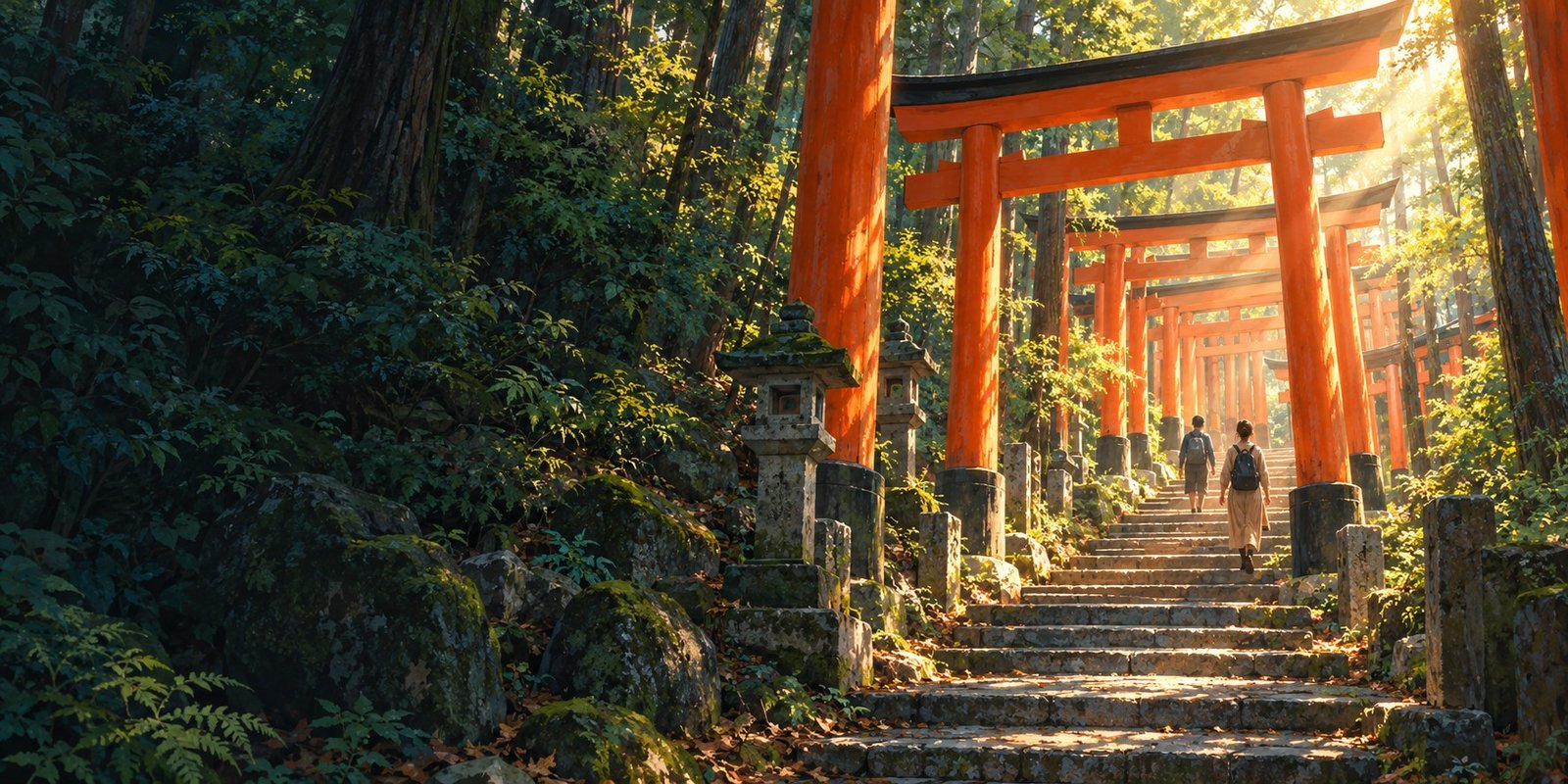
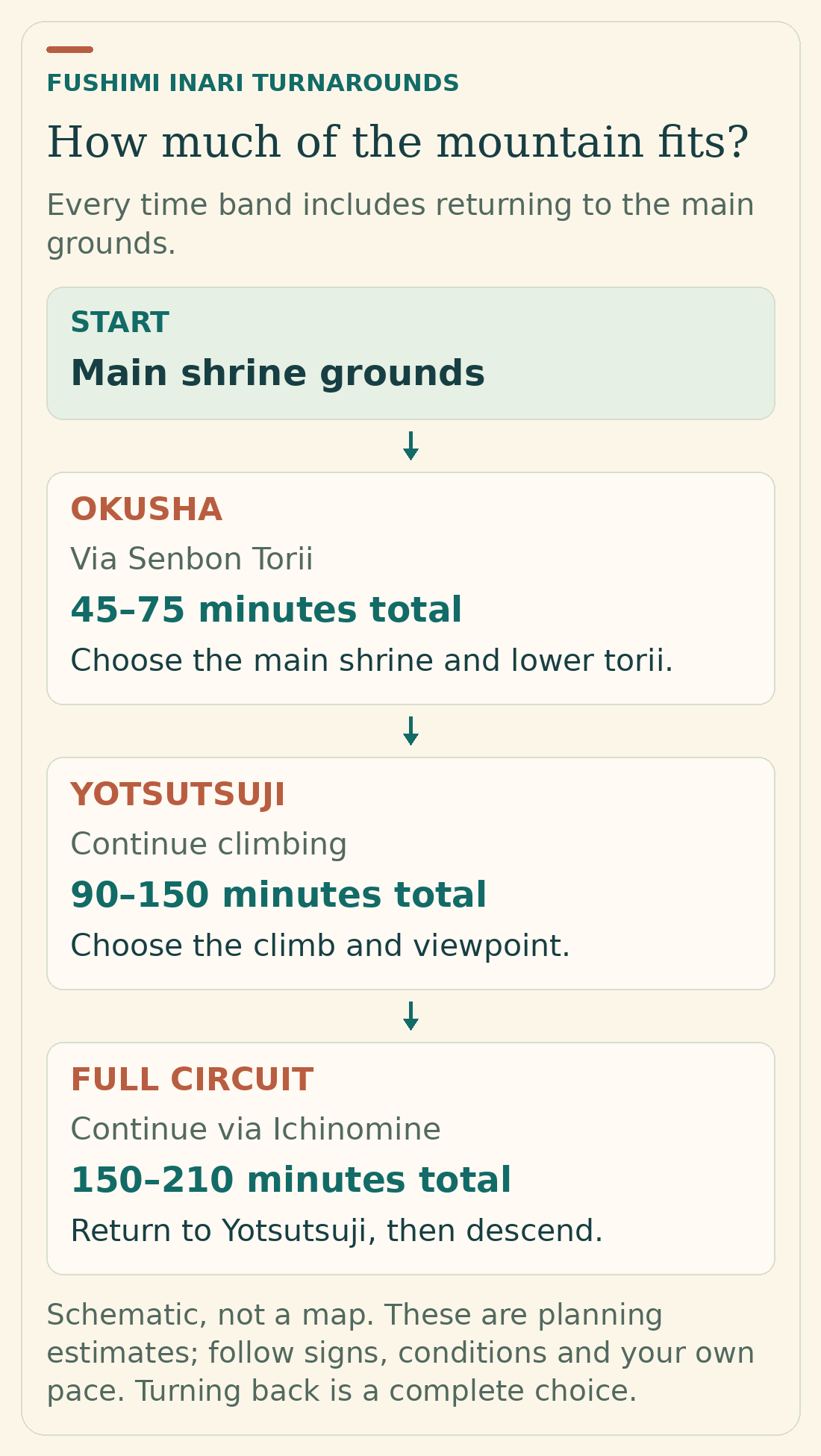
You can enjoy Fushimi Inari without completing the mountain circuit. The famous Senbon Torii passage leads to Okusha Hohaisho, also called Okuno-in, which makes a meaningful stopping point before the longer climb.[1] The useful question is how much walking you want to add after that: a climb to a viewpoint, or a circuit through more of the mountain’s sacred sites.
This Fushimi Inari Shrine guide starts with that decision. Choose an initial turnaround, leave room to shorten the walk, and set the time you need to be back at the main shrine. That approach works for a quick visit between other plans, a family with uneven energy levels, or a morning devoted to the mountain.
Taylor’s Trailblazing Travels may earn a commission when you book or buy through an affiliate link in this guide, at no extra cost to you. This helps fund the research and upkeep of the site.
The lower visit counts
Walking to Okusha lets you experience the principal torii passage without committing to the upper mountain. Turn back when that is the visit your time and energy support.
Yotsutsuji is a decision point
Aim for the viewpoint if you want a climb and an outlook. Assess the remaining time, conditions and your legs before adding the upper circuit.
Protect the journey down
A summit arrival is only part of the visit. Reserve descent time and a margin before filling the remaining time with photographs or another section of the walk.
Buy interpretation if useful
Independent walking is the flexible option. A guided visit can add context or structure, but confirm its actual route and finish time before booking.
How far to walk: choose your turnaround
The three options below start and finish at the main shrine area. Their time ranges are original visitor-planning allowances, including brief worship, photographs and rest. They exclude travel from your accommodation, station access, a sit-down meal and prolonged queues. They are not measured walking times or promises.
Swipe or scroll sideways to read every column.
| Your turnaround | Allow on site | Choose it for | Main trade-off |
|---|---|---|---|
| Okusha Hohaisho / Okuno-in | 45–75 minutes, returning to the main grounds | The main shrine and Senbon Torii, with a manageable limit | You leave the mountain viewpoint and upper circuit for another visit |
| Yotsutsuji | 90–150 minutes, including the descent | A longer torii walk, a sustained climb and a view | Stairs and the return walk require more energy than the lower visit |
| Full mountain circuit via Ichinomine | 150–210 minutes, including the descent | Making the mountain pilgrimage the main activity | Less flexibility for another fixed booking immediately afterwards |
Kyoto’s official guide describes the mountain circuit as approximately four kilometres and about two hours; JNTO suggests two to three hours to tour the mountain.[2][3] The allowances here add room for a visitor who stops and makes decisions along the way. The four-kilometre figure is for the circuit as a whole, not the remaining distance when you reach a junction.
A useful default is to choose the shortest option that delivers what you came for. If that is walking beneath the torii, Okusha is enough. If a view makes the climb worthwhile, aim for Yotsutsuji. If you particularly enjoy walking between shrines and sacred sites, protect a morning for the full route. A lower turnaround is also the better starting plan when you are uncertain how your knees or companions will handle the stairs.
Follow the main route and reassess at each stopping point
Main grounds to Okusha: the short visit
Begin with the main shrine, then follow the signed route towards Senbon Torii. Its gateways lead to Okusha Hohaisho, a place to pray towards the sacred mountain.[1] Worshippers have donated torii in gratitude and prayer since the Edo period; the passage is part of a religious precinct with people using it for worship.[6]
At Okusha, decide whether the group wants more climbing. For the short visit, follow the posted return directions to the main grounds. Follow any current one-way instructions through the narrow torii passages rather than stopping against the flow for a photograph. Leave time to pause at the shrine itself instead of spending the entire allowance trying to obtain an empty image.
Okusha to Yotsutsuji: a useful middle choice
The main approach continues by Kumatakasha towards Yotsutsuji; this sequence also appears in the local preservation association’s account of its shrine walk.[7] Follow shrine signs for the mountain and Yotsutsuji junction. Kyoto’s official trail account identifies Yotsutsuji as the point where the onward Kyoto Trail branches north, and describes the outlook from here.[4]
Pause clear of the path and check the time. Reaching the viewpoint can be the purpose of the walk in its own right. If you are returning, follow signs towards the main shrine and check the next junction instead of assuming that every downhill path leads to your original station.
Beyond Yotsutsuji: the upper circuit
Continue on the shrine’s mountain circuit if you still have the time and energy for its return. Ichinomine is the highest peak, at an altitude of 233 metres; that number is not the total ascent from the entrance.[5] Kyoto’s official account describes visiting Ichinomine and returning to Yotsutsuji before choosing an onward route.[4]
For this visit, return from Yotsutsuji towards the main shrine. The Kyoto Trail branch towards Sennyu-ji is a separate onward walk. Choose the upper circuit because you want to spend longer on the mountain; the viewpoint you have already reached is a sensible place to finish the climb. Use the official maps and signs on site, and obey any closure or diversion even when a saved route suggests continuing.
When to go: start with daylight and a return deadline
Early morning is a practical first choice if the walk is your priority. Kyoto’s official tourism site recommends an early visit to Fushimi Inari as a way to improve the chance of lighter crowds.[8] An arrival around 7–8am, once it is light, is a useful planning target rather than a quiet-period guarantee. Choose a later start if an early departure would leave your group tired or unprepared.
The grounds have no closing gate, but that does not make services available all night. Kyoto’s current listing gives prayer and reception hours of 8.30am–4.30pm and the amulet counter as 8am–6pm.[2] Check separately if a particular service matters. A mountain walk can go first, with the counter visit after returning.
For an unfamiliar full circuit, plan to descend in daylight. If you arrive in the afternoon, work backwards from the daylight and the time you must leave. Shorten the route if either allowance is tight. Festival days can change the character of the visit, so consult the shrine’s calendar when selecting a date.[9]
A three-hour visit, with an explicit decision at Yotsutsuji
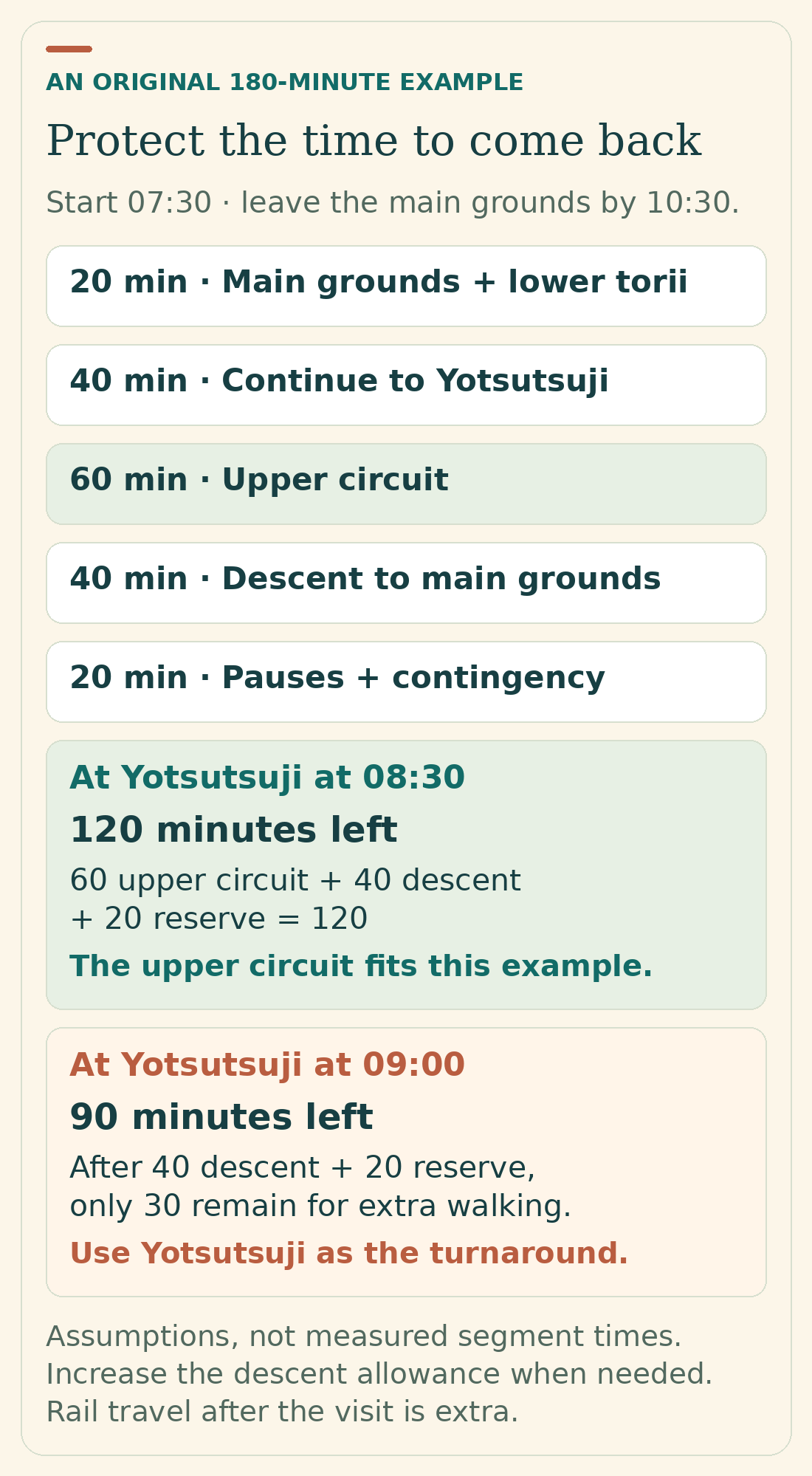
Suppose you arrive at the main grounds at 7.30am and need to leave them by 10.30am. The following allocation shows how those 180 minutes might be used. Each component is an assumption for planning, not a surveyed segment time; replace it with a longer allowance if your actual pace requires it.
Swipe or scroll sideways to read every column.
| Part of the visit | Minutes allocated |
|---|---|
| Main grounds and lower torii to Okusha | 20 |
| Continue to Yotsutsuji | 40 |
| Upper circuit via Ichinomine | 60 |
| Yotsutsuji back to the main grounds | 40 |
| Pauses and contingency | 20 |
| Total | 180 |
Reaching Yotsutsuji at 8.30am leaves 120 minutes: the example’s 60-minute upper circuit, 40-minute descent and 20-minute reserve just fit. Reaching it at 9am leaves 90 minutes, so use Yotsutsuji as the turnaround. The useful habit is to protect the return allowance before deciding how much more to walk. If the climb has already felt harder than expected, increase that allowance and descend earlier.
Keep the next fixed appointment separate from this calculation. A 10.30am departure from the shrine grounds still requires time to reach the station, wait for a train and travel to your next destination. Lunch, shopping and a guided experience would also need their own allocation.
The Japan travel guide for first-time visitors helps place this Kyoto visit within the rest of your trip.
Arrive by the right railway and keep the approach simple
From Kyoto Station
Use the JR Nara Line to Inari Station. The shrine’s own directions describe the station as immediately beside the shrine, with a five-minute train ride from Kyoto Station.[10] Add your walk through Kyoto Station and the wait for the train when planning an early start.
Older advice to take only a local train is out of date. JR West added Inari stops for Miyakoji Rapid and Regional Rapid services in the timetable revision effective 14 March 2026; Kyoto’s current access guide confirms these services and local trains stop there.[11][12] Check the departure board for Inari when you travel.
From the Gion and Shijo area
The Keihan line offers a direct route from Gion-shijo to Fushimi-inari Station, followed by about five minutes’ walk east. Keihan Limited Express trains do not stop at Fushimi-inari, so check the service before boarding.[12] JR Inari and Keihan Fushimi-inari are different stations: save the one you intend to use for the return.
Save your station, meeting point and a map before leaving. Mobile data is useful for rail changes and translation, especially if companions choose different walk lengths. If your existing plan does not cover Japan, browse Airalo and select Japan to compare its data options.[13] Check that your phone is eSIM-compatible and network-unlocked before purchasing.[14] A downloaded map remains useful even when you have data; on the mountain, follow the signed public route rather than treating an app shortcut as permission to enter a path.
Match the climb to your group, the weather and the place
Stairs, children and step-free access
The mountain options involve sustained uphill walking and stairs. Japan Guide Agency’s access survey records steps and uneven surfaces, a lift between the main shrine and the torii entrance, and an inaccessible summit path for wheelchair users.[15] A visit to the lower grounds needs its own access plan: contact the shrine about the current route and lift arrangements rather than assuming that the entire short walk in this guide is step-free.
For children or anyone whose stamina is uncertain, make Okusha the first decision. Continue only while the return still looks comfortable. Descending can be demanding on tired knees, so do not spend every remaining reserve on the climb. Wear shoes with grip and carry a small bag; leave large luggage stored before the visit. A pushchair should not be the plan for the upper route.
Let conditions shorten the route
Carry drinking water and take breaks. Kyoto’s tourism authority highlights the heatstroke risk for visitors who spend long periods outdoors.[16] In hot conditions, reduce the walking objective instead of trying to preserve a full circuit at any cost. Wet or icy steps also justify a lower turnaround. In severe weather, postpone the mountain walk and follow current local advice and on-site instructions.
Keep a little of your allowance uncommitted. A slower descent, a child’s rest or a slippery section should change the plan, without forcing you to rush towards the exit.
Photographs and breaks should leave room for worship
The shrine prohibits blocking narrow paths for photographs, entering restricted areas, drones, smoking, littering and approaching or feeding wildlife. Eating and drinking belong in its designated rest areas; do not eat while walking through the precinct.[17] Take a photograph when there is space, then let others pass.
A September 2026 shrine notice specifically asks visitors to avoid obstructive photography, dancing and other performances that disturb worship.[18] The opportunity to photograph a gate tunnel is not a reason to stop the flow of people. Follow posted photography restrictions at individual shrines and buildings as well as the general rules.
When is a guided Fushimi Inari visit worth booking?
Walk independently when choosing your own start and turnaround matters most. The ordinary visit needs no admission ticket; a paid tour buys its specified guiding or included experience. This distinction matters when a booking page uses a general label such as “entrance fees”.
A short introduction with Kagura
Kyoto City Tourism Association’s shrine-supported tour is an approximately one-hour programme combining English guiding through the lower shrine and Senbon Torii with a Kagura performance. The tourism association publishes a fee of ¥4,000 per person and normally lists 10am and 11.30am starts, excluding certain festival and event days. Photography and video are prohibited during Kagura.[19]
This suits someone who wants to understand the worship and customs while keeping the visit compact. Check the one-hour shrine and Kagura tour on GetYourGuide. Its listing identifies the meeting point at Counter No. 1 in the amulet office beside the main shrine, asks participants to arrive ten minutes early and marks the tour unsuitable for wheelchair users.[20] Treat this as a separate timed activity if you also want to climb.
A longer walk with a guide
TripGuru’s Fushimi Inari walking tour on GetYourGuide advertises lower and upper options over two to three hours, with about an extra hour of walking in the upper option.[21] Its Fushimi Inari tour on Viator is listed at approximately three hours, with moderate fitness expected and a meeting point at the Daily Yamazaki beside JR Inari Station.[22]
Compare the option, meeting point, finish time and total price for your date. Ask whether Yotsutsuji or Ichinomine is actually included if either is essential to you. A duration alone does not establish a summit itinerary, and a group booking gives you less freedom to change the turnaround. The cited listings advertise cancellation up to 24 hours before the activity for a refund; read the terms attached to your chosen booking.[20][21][22]
Choose a guide for interpretation or a defined walking programme. If you mainly want an unhurried lower visit or need to decide the length as you go, the independent route remains the more flexible choice.
Questions before you go
Can members of the same group choose different walk lengths?
Yes, with a clear reunion plan. Agree on a named place in the main grounds, a time and what to do if someone is delayed before separating. The people climbing should retain their own map, water and return plan. Do not leave a companion waiting indefinitely at a mountain junction.
Is a late-evening visit a good substitute for an early start?
The grounds have no gate-closing time, but that is different from having staffed services or a suitable mountain-walking plan.[2] For a first mountain circuit, choose daylight. If an evening visit is your only option, keep the objective modest and assess the actual visibility and conditions without assuming that a quieter path is safer.
Can I bring a dog?
The shrine prohibits bringing pets for walks or visits, with an exception for guide dogs and other assistance animals needed for the visit. Check the shrine directly if your circumstances need clarification.[17]
Will there be breakfast or a shop open for an early climb?
Do not make the walking plan depend on it. Check the hours of any particular business you want to use, eat beforehand if necessary and bring water. Keep breakfast and shopping outside the on-site walking allowance.
Make your choice
Choose Okusha for a short torii visit, Yotsutsuji for a climb with a clear intermediate goal, and the full circuit when the mountain is the main event. Start with the option you can complete comfortably, then use your actual pace to decide whether to extend it. A useful Fushimi Inari plan includes the moment you turn back and the time you reach the main grounds again.
Sources
Official visitor information and the identified booking listings were consulted for this guide. Prices and dated operating information were checked on 18 October 2026; recheck the relevant venue and your selected ticket before travelling.
- Fushimi Inari Taisha: Okusha Hohaisho
- Kyoto City Official Guide: Fushimi Inari Taisha — visitor information
- Japan National Tourism Organization: Fushimi Inari Taisha Shrine
- Kyoto Official Tourism: Kyoto Trail, Higashiyama course — Fushimi Inari route
- Fushimi Inari Taisha: Ichinomine, the highest peak
- Fushimi Inari Taisha: Senbon Torii
- Kyoto City Official Guide: Fukakusa–Inari Preservation Association walks
- Kyoto City Official Guide: early-morning advice from a local sightseeing driver
- Fushimi Inari Taisha: festivals and events
- Fushimi Inari Taisha: official access directions
- JR West: timetable revision effective 14 March 2026
- Kyoto City Official Guide: comfortable access to Fushimi Inari
- Airalo: Japan eSIM plans
- Airalo: device requirements for using a Japan eSIM
- Japan Guide Agency: Fushimi Inari accessibility survey
- Kyoto City Official Guide: summer heatstroke prevention
- Fushimi Inari Taisha: requests for all visitors
- Fushimi Inari Taisha: 7 September 2026 request concerning visitor behaviour
- Kyoto City Tourism Association: shrine guided tour and Kagura
- GetYourGuide: Kyoto City Tourism Association Fushimi Inari tour and Kagura
- GetYourGuide: TripGuru Fushimi Inari guided walking options
- Viator: TripGuru Fushimi Inari small-group guided walking tour
Illustrations in this article were created for Taylor’s Trailblazing Travels. Third-party photographs, where used, are credited beside the image or in the source list.