Kansai Airport to Osaka: Train and Bus Choices
Match the airport service to your hotel’s actual station, then weigh the fare, the wait and the walk.
- Namba or Umeda?
- Train and bus fares
- Terminal 2 explained
AI-generated editorial illustration combining an airport journey and Osaka city scenery; it does not depict a verified train service or station.
The best way from Kansai Airport to Osaka depends on which part of Osaka you need. Nankai trains deliver you to Namba; JR serves Tennoji, Osaka Station and, on Haruka, Shin-Osaka. Airport buses reach particular terminals and hotel-area stops. Those arrival points can matter more than a small difference in the advertised journey time. [4][7][13][14]
Start with your hotel’s address and nearest useful station exit. This guide then compares the fare, seat arrangements and final walk, with separate advice for Terminal 2 and late arrivals. The examples below are planning calculations using stated assumptions, so you can replace them with your own hotel and departure time.
Some links in this guide are affiliate links. If you book or buy through them, Taylor’s Trailblazing Travels may earn a commission at no extra cost to you.
Nankai trains arrive at Nankai Namba; the OCAT bus serves the JR Namba side.
Osaka Station is in Umeda. Shin-Osaka is a separate station.
Use the free shuttle for trains, or a bus departure that serves your terminal.
Compare the next arrival time as well as the fare before choosing an express.
Kansai Airport to Osaka at a glance
These are adult one-way fares in Japanese yen, checked on 18 October 2026. Times cover the ride from Kansai-Airport Station or Terminal 1 bus stop, excluding immigration, ticket collection, waiting and the walk to your hotel. Frequencies describe the main daytime service; check your actual departure.
| Service | Useful arrival | Ride time | Adult fare | Daytime pattern |
|---|---|---|---|---|
| Nankai Airport Express | Nankai Namba | About 45–50 minutes | ¥970 | About 4 an hour [4][5][6][12] |
| Nankai Rapi:t | Nankai Namba | About 35–40 minutes; fastest 34 | ¥1,410 Regular-seat digital bundle; ¥1,670 regular fare plus standard supplement | About 2 an hour [1][2][5][6][12] |
| JR Airport Rapid | Tennoji / Osaka Station | 53 / 71 minutes in the checked sample | ¥1,060 / ¥1,180 | About 4 an hour [8][10][11][12] |
| JR Haruka | Tennoji / Osaka / Shin-Osaka | 34 / 47 / 52 minutes in the checked sample | Eligible visitor offer: ¥1,300 / ¥1,800 / ¥1,800 | About 2 an hour [7][8][9] |
| Osaka/Umeda airport bus | Specific Umeda stops | About 60 minutes to the first central stop; many Herbis journeys take 70 | ¥1,800; separate late-night fare | Often every 10–15 minutes [13] |
| Namba/OCAT airport bus | OCAT, by JR Namba | About 50 minutes | ¥1,400 | Usually every 15–30 minutes in the main daytime period [14] |
The JR examples are the 13:14 Haruka and 13:17 Airport Rapid on 18 October 2026; other departures vary. The Haruka offer requires a foreign passport and Temporary Visitor status. It is a specific discounted product, with ordinary reserved seating available, rather than the standard station fare. [7][9][10]
Choose the arrival point nearest your hotel
Namba is the natural starting point for a Nankai comparison. Both Nankai services finish at Nankai Namba, convenient if that is your hotel’s side of the district. The OCAT bus arrives beside JR Namba, farther west. “Namba” on a booking screen does not mean these are the same terminal: compare the final walking route before paying for the coach. [4][14]
Tennoji is directly served by both JR choices. Osaka Station is in the Umeda district, while Shin-Osaka is a separate station; use the latter if your accommodation or onward Shinkansen actually requires it. Haruka serves all three. The Airport Rapid serves Tennoji and Osaka directly, but a trip to Shin-Osaka needs a change. [7][10]
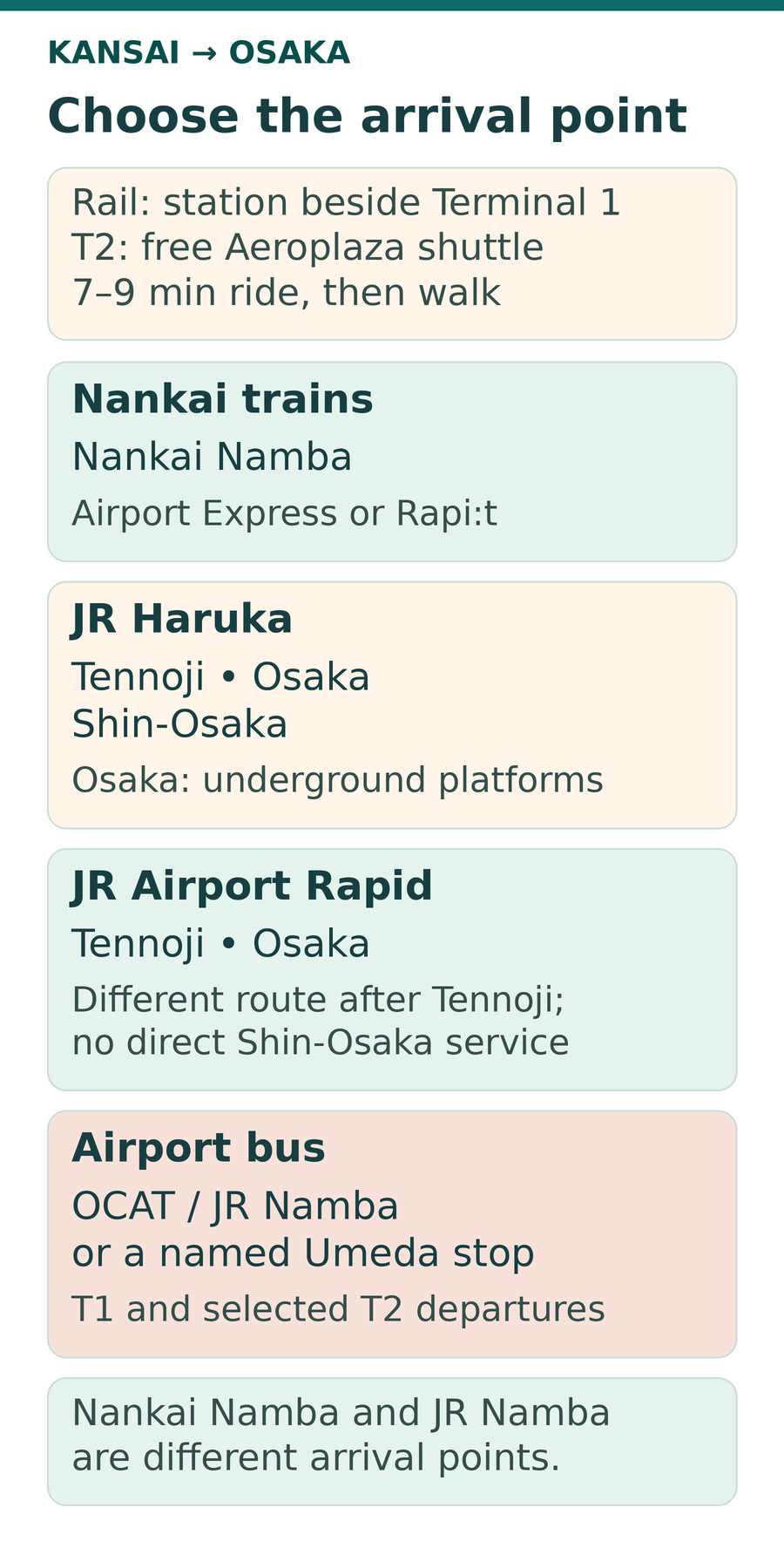
At Osaka Station, Haruka uses the underground Umekita platforms, shown as platforms 21–24 on JR’s station map. Include the walk from there to your chosen exit. Umeda buses also have different arrival points: current services use Hankyu Sanban Gai or Hotel Hankyu RESPIRE Osaka/Yodobashi Umeda Tower, with many continuing to Herbis Osaka and selected journeys to Dojima. Read the exact timetable row; a blank or arrow is not a stop. [13][20]
For Uehommachi, the direct coach costs ¥1,800 and many current timetable journeys take 61 minutes from Terminal 1. Only selected services continue to Hotel Nikko Osaka in Shinsaibashi. Do not assume every bus on the “Uehommachi/Shinsaibashi” route reaches Shinsaibashi. Otherwise compare a Nankai arrival in Namba with the local connection or walk to your accommodation. [15]
If your room is still undecided, compare Osaka hotels on Agoda and Osaka hotels on Booking.com, then check each property’s map against the arrival points here. Both links open Osaka city searches; the useful comparison is the specific hotel entrance and station exit.
When is Rapi:t worth the extra fare?
For Namba, the simplest price comparison is ¥970 for Airport Express versus ¥1,410 for the Regular-seat Rapi:t Digital Ticket. The digital premium is ¥440 each way. For two adults making a return journey, that is ¥1,760 extra across four rides. These totals assume the same fares in each direction and no connecting travel. [2][12]
Rapi:t’s reserved seat and luggage space can justify that difference after a flight. Its speed advantage depends on the departures you can actually catch. Consider an example with a 38-minute Rapi:t ride and a 45-minute Airport Express ride. Those are assumed ride times for the comparison, not a promise for every service.
| At the platform | Arrival after you reach it | Practical result |
|---|---|---|
| Airport Express leaves now; Rapi:t in 15 minutes | Express: 45 minutes. Rapi:t: 53 minutes. | The cheaper train arrives 8 minutes earlier. |
| Airport Express leaves in 10 minutes; Rapi:t in 5 | Express: 55 minutes. Rapi:t: 43 minutes. | Rapi:t saves 12 minutes and provides your reserved seat. |
With these assumptions, Rapi:t can depart no more than seven minutes after the Airport Express and still arrive at least as early. Check both arrival times on the board. If comfort is your priority, book the reserved seat even when the cheaper train would arrive first; just recognise what the premium buys. Nankai lists luggage storage and wheelchair space on Rapi:t. [1]
A faster train can still mean a later hotel arrival
For Umeda, compare the whole journey from the public arrivals hall. This worked example assumes Terminal 1, a daytime departure, an eligible Haruka ticket and a hypothetical hotel five minutes from the bus’s first central stop. Allow 15 minutes for finding the service and dealing with the ticket in all three cases. The waits and hotel walks below are assumptions; the train rides come from the checked JR departures and the bus ride from KATE’s timetable. [9][10][13]
| Part of journey | Haruka | Airport Rapid | Umeda bus |
|---|---|---|---|
| Find service / ticket | 15 min | 15 min | 15 min |
| Assumed wait | 15 min | 8 min | 10 min |
| Ride | 47 min | 71 min | 60 min |
| Assumed platform/stop-to-hotel walk | 20 min | 15 min | 5 min |
| Total | 97 min | 109 min | 90 min |
| Adult fare | ¥1,800 eligible offer | ¥1,180 | ¥1,800 |
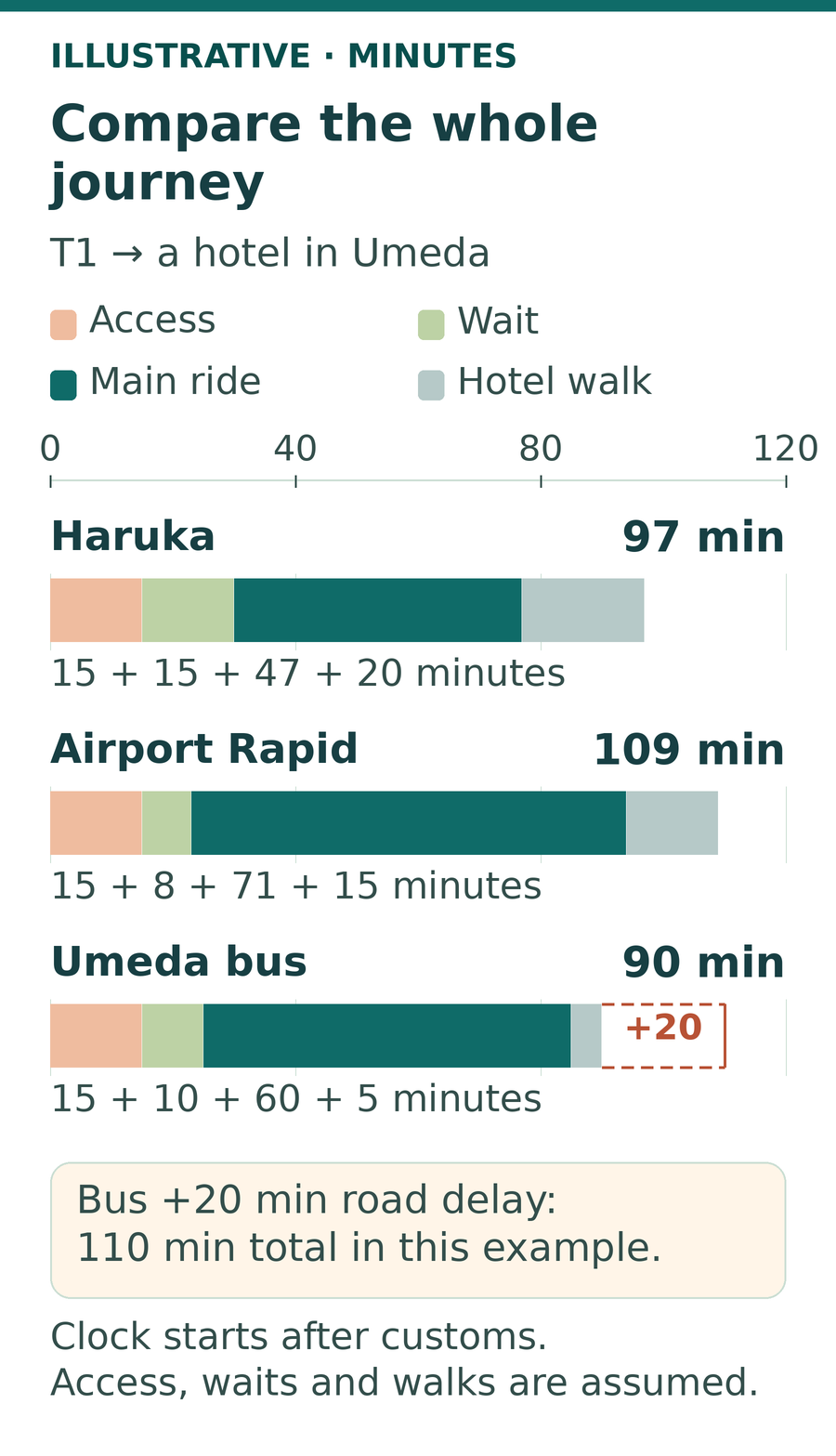
The bus wins this particular example because the hotel is close to its stop. Add a hypothetical 20-minute road delay and its total becomes 110 minutes, behind Haruka. Move the hotel so its walk from the bus is 25 minutes instead of five and the same reversal occurs without any traffic delay. A hotel only five minutes from Haruka’s platform would cut that train’s model total to 82 minutes.
For two adults, the Rapid saves ¥1,240 against two eligible ¥1,800 Haruka tickets, while adding 12 minutes in this model. That may be an easy saving with manageable bags; the answer changes if the longer train ride or unreserved seating is tiring. Replace the assumed walks with your hotel’s real route and compare the next departure. [7][11][12]
Buy the correct fare and reservation
Nankai: distinguish a bundle from a supplement
The ¥1,410 Rapi:t Digital Ticket combines the railway fare and Regular-seat limited-express ticket. After purchase, select the travel date, train and seat, then use its QR code at a compatible gate. Reservation and train-change procedures close five minutes before departure; the product permits two train changes within its rules. Buying the bundle alone does not assign a seat. [2]
The standard Regular-seat Rapi:t supplement rose to ¥700 on 1 April 2026, making ¥1,670 with the ¥970 fare. Nankai’s separate Limited Express Ticketless Service discounts the supplement to ¥550, giving ¥1,520 in total. That product is different from the ¥1,410 digital bundle. If you pay the base fare with a reloadable transport IC card, the limited-express supplement is still separate. [1][3][12]
JR: the visitor discount is a separate product
The Haruka One-way Ticket costs ¥1,300 to Tennoji or ¥1,800 to Osaka/Shin-Osaka for eligible visitors. Arrange it through JR-West’s online system or an authorised overseas seller and follow the collection instructions. You need a foreign passport and Temporary Visitor status. For JR-West online collection, bring the physical payment card, passport, reservation number and chosen identification number; virtual and numberless cards are excluded. Ordinary reserved seating is available with this offer. [7]
Without that discount, ordinary non-reserved Haruka totals are ¥1,820 to Tennoji, ¥2,380 to Osaka and ¥2,540 to Shin-Osaka. Standard reserved-seat prices depend on the date and ticket; request the complete fare for your departure. Airport Rapid only needs the ordinary fare or a valid IC-card payment. [12][18]
You can also compare Kansai Airport–Osaka tickets on 12Go as a booking comparison. Read the individual listing’s arrival station, collection method and cancellation rules. A route labelled “Osaka” may offer different arrival points, so compare it with the exact operator product you intend to use.
From the arrivals hall to your train or bus
- Clear immigration, collect checked luggage and pass customs before committing to a train departure you cannot change comfortably. Open your hotel address and check the service’s destination.
- At Terminal 1, follow railway signs to the second floor and cross the bridge to Kansai-Airport Station. JR’s signs and ticket area are blue; Nankai’s are red. Use the operator named on your ticket. [18]
- At Terminal 2, take the free shuttle to Aeroplaza for the station. The shuttle ride takes about seven to nine minutes. For planning, add 20–30 minutes before your intended train to cover waiting, walking and lifts; this is an allowance, not the shuttle’s published journey time. [19]
- Collect any required paper ticket, complete the seat reservation where applicable, and check the platform board. Keep the destination and seat details available until you leave the station.
- For a coach, use the ground-level bus stops outside your terminal. Selected services pick up at Terminal 2 directly: if your timetable row includes it, use that departure instead of shuttling to Terminal 1. Check the named city stop and retain your luggage receipt. [13][14][17][19]
Mobile tickets and the final walk are easier with working data. If your existing roaming does not suit the trip, compare data plans at Airalo and select Japan on the site. Check that your phone supports eSIM and is network-unlocked, along with the plan’s activation rules; install with a reliable internet connection. [21]
Choose for the bags and mobility needs you actually have
Rapi:t provides reserved seating, luggage space and a wheelchair area. Airport Express and JR Airport Rapid do not give you an assigned seat with the ordinary fare. With a large case, the practical issue is whether you can manage it through the station and keep it out of aisles throughout the journey. [1][12]
KATE’s hold allowance is two bags per person, together no more than 30 kg and 0.25 cubic metres, with a maximum length of two metres. Keep valuables, fragile items and power banks out of the hold. Confirm unusual luggage with the operator before choosing a bus. [17]
A coach with luggage storage is not automatically an accessible transfer. Standard coaches have steps; KATE asks passengers with electric wheelchairs to contact it with dimensions and weight. Lift-equipped departures exist on selected routes and require arrangements. Confirm the specific route and departure with the operating company. For trains, arrange assistance and check the lift route at both stations, including Osaka’s underground platforms. [17][20]
Late arrivals and the return to Kansai Airport
There is no all-night train service. The timetables checked for this guide show the last Nankai Airport Express from Kansai Airport to Namba at 23:55. JR’s 18 October timetable shows a 23:09 Rapid through to Osaka, followed by later trains terminating at Hineno. A late train leaving the airport is not necessarily a train to central Osaka. Recheck the operator’s timetable for your date and direction. [5][6][8]
KATE currently lists one later Umeda departure: Terminal 2 at 00:02, then Terminal 1 at 00:15, reaching Hankyu Sanban Gai at about 01:13. It costs ¥2,700 per adult, accepts cashless payment only and does not call at Herbis Osaka. The operator warns that no extra bus runs if it fills. Its June 2026 notice continues the service until further notice, so check again before travel. [13][16]
Plan from the time you can leave customs, not the flight’s scheduled landing. Save an alternative before you fly: a confirmed late check-in, an airport-area room or a prebooked car. A bus to Umeda may still leave a separate overnight journey to a hotel in Namba; price that final leg when comparing alternatives.
For a group, a hotel away from the main stops or an arrival after public transport, compare the KIX–Osaka city private transfer on GetYourGuide with the KIX–Osaka private transfer on Viator. Enter the exact terminal, accommodation, passenger count and bags. Their waiting rules differ: the Viator listing includes 90 minutes from actual landing and adds a ¥2,000 night fee for 22:00–07:00, payable in cash. Both linked listings state that they are unsuitable for wheelchair users or are not wheelchair accessible. Confirm the total and waiting terms for your selected vehicle. [22][23]
On the way back: check the front of the JR train
When taking an airport-bound JR Airport Rapid, use one of the first four cars: the train separates at Hineno. Check that your carriage is marked for Kansai Airport before boarding. This warning concerns the Rapid, rather than Haruka. [18]
Work backwards from your airline’s check-in deadline, allowing for your hotel-to-station journey and a missed departure. If flying from Terminal 2 after arriving by train, include the airport shuttle. When using a bus, check the return stop separately and allow for road delays; outbound and inbound boarding points can differ.
Questions before you travel
Can I reserve an Umeda or OCAT airport bus seat?
These routes normally operate first come, first served. A purchased ticket or reseller voucher does not by itself guarantee a seat on your preferred departure. Allow for the next bus if the queue is long; the late-night service has no additional bus if full. [13][14]
Is a return bus ticket worth buying?
If both journeys fit the same route and validity period, the ordinary adult return costs ¥3,300 for Umeda or ¥2,500 for OCAT. Each saves ¥300 compared with two single fares and is valid for 14 consecutive days from first use. The special late-night service has different fare conditions, so do not assume an ordinary ticket covers it in full. [13][14][16]
Do children pay the same fares?
No. Examples are ¥710 for a child’s Regular-seat Rapi:t Digital Ticket, ¥650 for the eligible Haruka offer to Tennoji and ¥900 to Osaka/Shin-Osaka. Ordinary Umeda and OCAT bus child fares are ¥900 and ¥700 respectively. Check the operator’s age and separate-seat rules for younger children before booking. [2][7][13][14]
Should I buy a rail pass just for the airport journey?
Start with the one-way fares in this guide and price the rest of your itinerary before buying a pass. If you already hold one, check its operator and service coverage, the dates it is valid and whether you still need a reservation. The airport transfer alone does not establish that a larger pass will save money.
Make your transfer choice
For a hotel by Nankai Namba, take Airport Express when keeping the fare down matters, or choose the Rapi:t Digital Ticket for a reserved seat. For Tennoji, the short direct JR journey makes the Rapid–Haruka comparison straightforward. For Osaka/Umeda, use your hotel entrance to decide between the train platforms and a named bus stop. Choose direct Haruka for Shin-Osaka. [1][2][4][7][10][13]
Save the exact station or bus-stop name alongside your hotel address. Check the next workable departure after customs, then choose the fare and seat arrangement that suit your group. The right Osaka arrival point will keep the final part of the journey manageable.
Sources and editorial method
Editorial review: 18 October 2026. Core fares and routes have been cross-checked against official transport information. Timetables, ticket eligibility and commercial listing terms can change; confirm your travel date, terminal and selected option before paying.
Hotel-area recommendations are editorial judgements. The illustrated time comparisons and party-cost calculations are original planning tools, with their inputs and assumptions stated beside them; they are not observed or guaranteed journeys. Private-transfer terms describe the named listing and option, rather than every car service.
- Nankai: Rapi:t services, facilities and current supplements
- Nankai: Rapi:t Digital Ticket
- Nankai: supplement revision effective 1 April 2026
- Kansai International Airport: rail access
- Nankai: Kansai Airport departures, weekdays
- Nankai: Kansai Airport departures, weekends and holidays
- JR-West: Haruka One-way Ticket
- JR-West: Kansai-Airport Station timetable
- JR-West: Haruka 26, 18 October 2026
- JR-West: Airport Rapid sample, 18 October 2026
- JR-West: current fare table
- Japan-guide: current Kansai Airport transport fares
- KATE: Osaka Station/Umeda timetable and fares
- KATE: Namba/OCAT timetable and fares
- KATE: Uehommachi/Shinsaibashi timetable and fares
- KATE: continued operation of late-night buses
- KATE: boarding, baggage and accessibility instructions
- JR-West: using trains from Kansai Airport
- Kansai International Airport: buses and terminal shuttle
- JR-West: Osaka Station map
- Airalo: how its eSIM service works
- GetYourGuide: KIX–Osaka city private transfer
- Viator: Kansai Airport private transfer to or from Osaka/Kyoto
Illustrations in this article were created for Taylor’s Trailblazing Travels. Third-party photographs, where used, are credited beside the image or in the source list.