Hiroshima Peace Memorial Park and Museum: Planning a Respectful Visit
Book the gallery entry, leave room to pause, and choose the memorials you can give your attention to.
- Standard adult museum entry ¥200
- Four-hour planning model
- Rules checked 18 October 2026
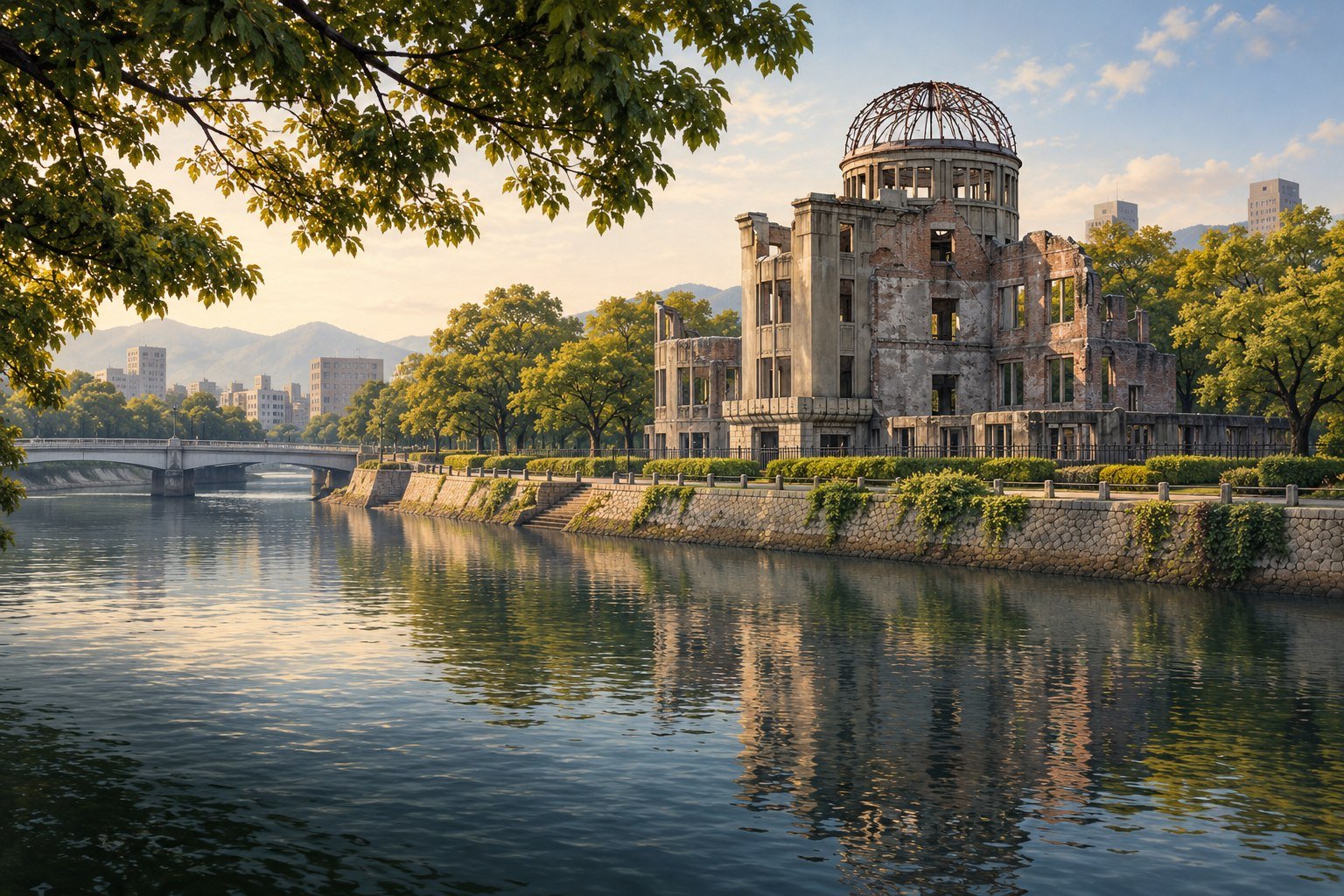
AI-generated original editorial illustration of the present-day memorial landscape; it is not a historical or documentary photograph.
Hiroshima Peace Memorial Park and Museum deserves a plan with room in it. The museum documents the atomic bombing through personal belongings, testimony and the lives disrupted by nuclear war. The surrounding memorials create further opportunities to read, remember and reflect. A visit works better when its success is measured by attention rather than the number of stops completed. [3]
For a first visit, protect roughly half a day, arrange museum admission before fixing the rest of the schedule, and include an unhurried pause after the galleries. The four-hour model below is a starting allowance, not a required route. It can become shorter if you deliberately select fewer places, or longer if the exhibitions, a talk or someone in your group needs more time.
Taylor’s Trailblazing Travels may earn a commission when you book or buy through links in this guide, at no extra cost to you. This helps support the site’s research and upkeep.
Book a workable museum slot
Choose a time that leaves space on both sides. Do not place a non-refundable train or tour immediately after the galleries.
Protect the pause
Treat twenty minutes after the museum as part of the visit. Cut an optional detour before removing that breathing space.
Choose your interpretation
Decide whether you want independent reading, an audio guide, an available free park tour or a pre-arranged private guide.
Agree an exit plan
For children, sensitive visitors or mixed interests, decide where to meet if someone wants to stop before the others.
Arrange museum admission before the rest of the day
Start on the museum’s official website and follow its current individual-ticket link. Read the selected date, entry conditions and cancellation terms before paying. The museum warns that crowd management can delay entry even with a web ticket; the printed time is not a promise of immediate access. [1]
| Period | Open | Evening web-only entry |
|---|---|---|
| March–July; September–November | 07:30–19:00 | 17:30–18:30 |
| August | 07:30–20:00 | 18:30–19:30 |
| December–February | 07:30–18:00 | 16:30–17:30 |
Swipe or scroll sideways to read the full table.
Early entry, 07:30–08:30, also requires a web ticket. Final admission is thirty minutes before closing. On 5–6 August, closing is 21:00. Annual closures include 30–31 December. Check special-day booking and February closure notices. Hours were verified on 18 October 2026. [1]
A last-entry slot leaves only half an hour before closing. That may suit a deliberately short return visit, but it does not fit the two-hour gallery allowance used here. Work backwards from closing when choosing an evening booking. If your preferred time is unavailable, reconsider the sequence or date before committing to transport that makes the visit rushed.
Build a visit with enough time to stop
Use four hours on site as a planning envelope for the museum, several park memorials and a short visit to the National Memorial Hall. This excludes transport, a meal and major queues. It assumes you want to read selectively rather than examine every display.
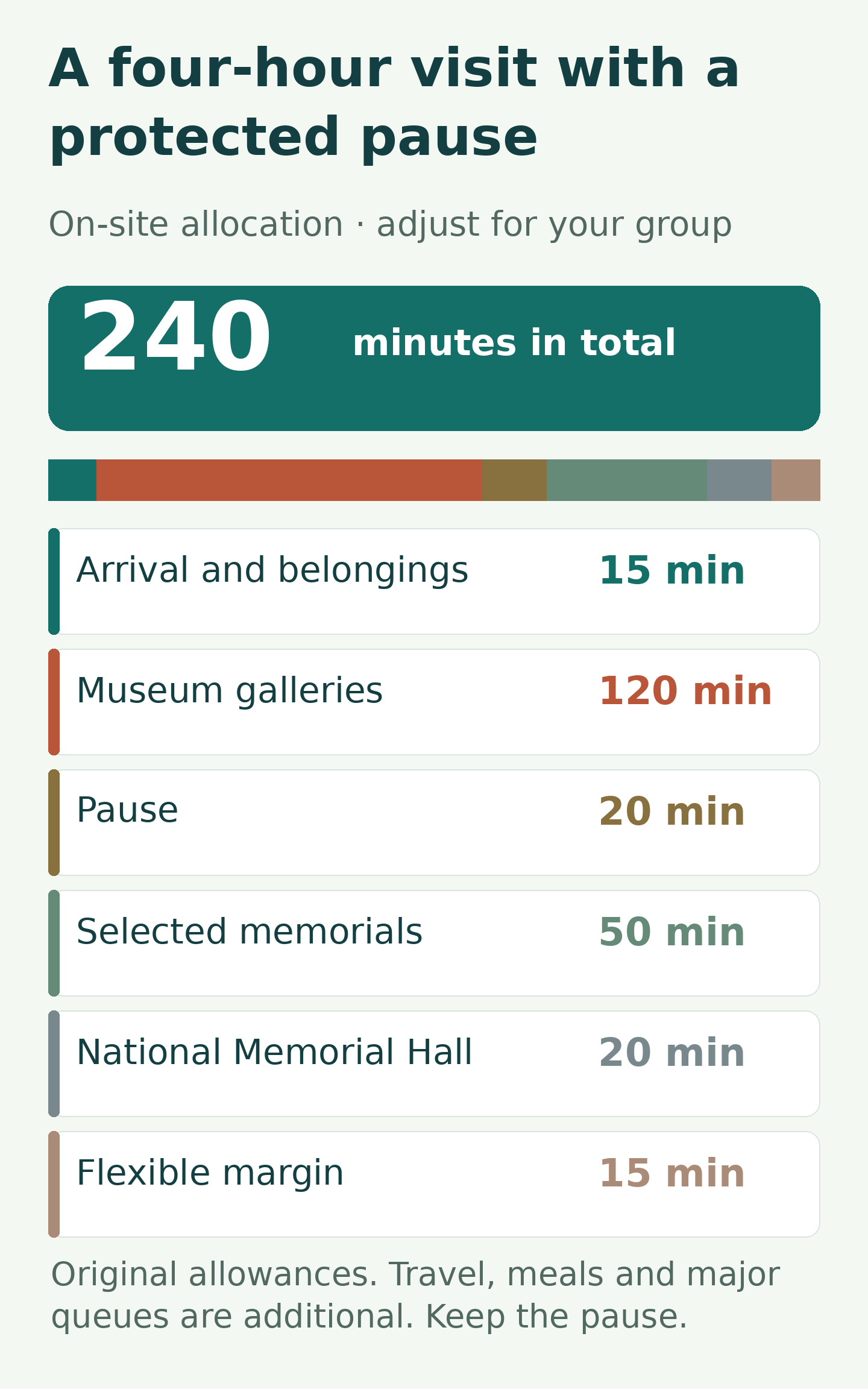
The arithmetic is 15 + 120 + 20 + 50 + 20 + 15 = 240 minutes. The final fifteen minutes absorbs small delays; the twenty-minute pause is separate. If you spend another half-hour in the museum, the same plan becomes four and a half hours. A one-hour programme added without removing anything makes it five hours. Neither adjustment is a failure to keep pace.
The gallery allowance also gives the audio guide room to be useful. Its complete commentary runs for about seventy minutes, with tracks you can skip or repeat. Do not treat the recording’s length as the duration of your whole visit: you may also stop to read, pause or return to a display. [4]
Which should come first: museum or park?
Let the booking and the needs of your group decide. Starting inside can give the memorials more context; starting outdoors can provide orientation or a gentler decision point before entering the galleries. Neither sequence measures how seriously someone is engaging.
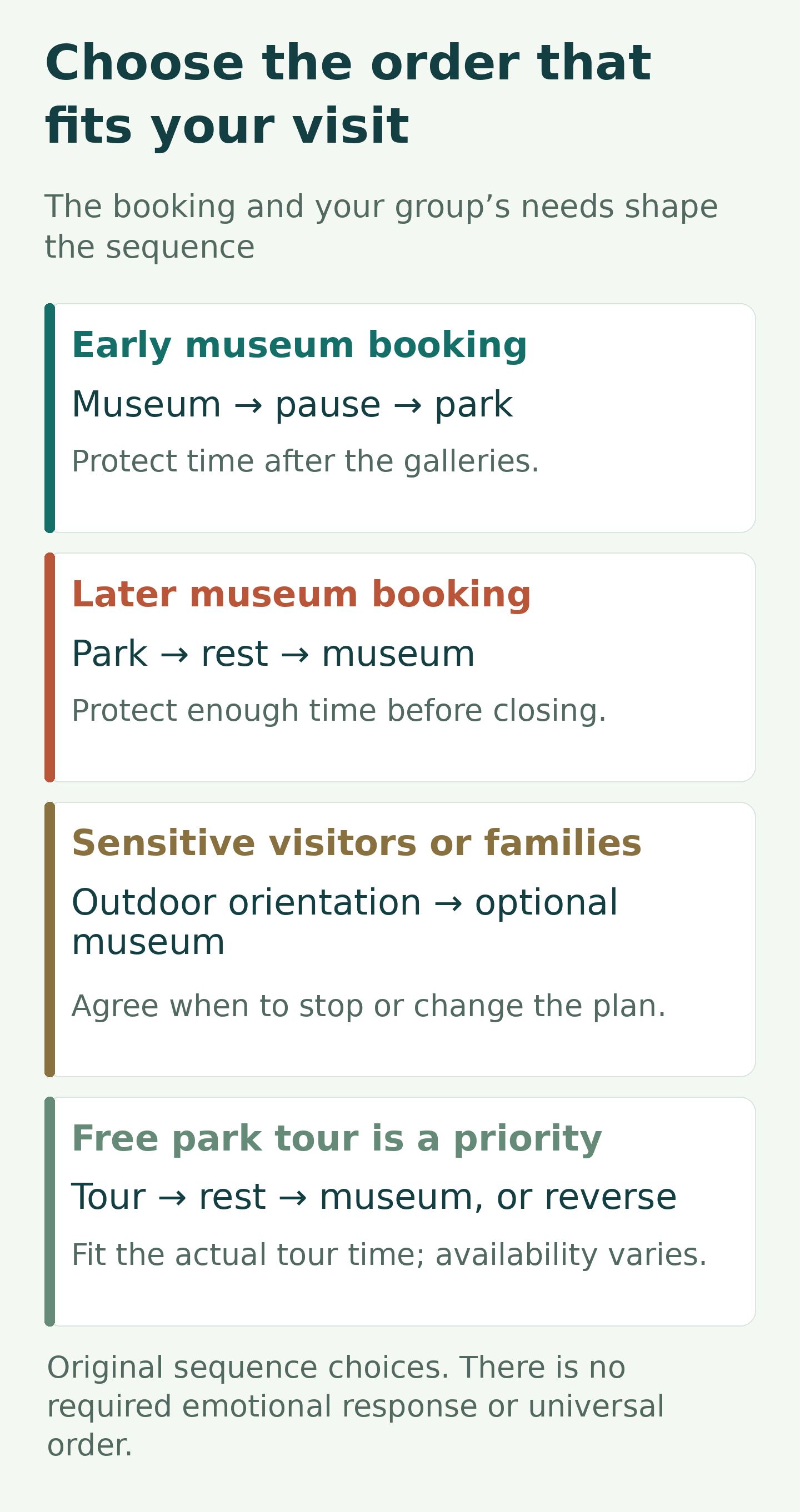
For a shorter visit, decide what to omit before arriving. Museum plus a pause and two memorials is a coherent choice. So is a park visit with time for the National Memorial Hall. Trying to preserve every stop while compressing each one leaves little room for the people and stories encountered along the way.
Give the park’s memorials their own attention
After a pause, choose a small group of places to read carefully. The sequence below is an editorial selection, not a requirement to visit every monument. Follow the local signs between stops and keep space around people praying, leaving offerings or attending a ceremony.
The Cenotaph
The Cenotaph for the Atomic Bomb Victims was completed in 1952. Its form was intended to shelter the victims, and the register includes known victims regardless of nationality. This is a place to pause over the purpose of the memorial before moving on. [10]
The Children’s Peace Monument
The monument grew from the campaign following Sadako Sasaki’s death from leukaemia in 1955 and commemorates all children who died because of the atomic bombing. Read that wider purpose alongside her story. Visitors can leave folded paper cranes in the designated display booths; bringing cranes is optional. If preparing a bundle, follow Hiroshima City’s instructions on size and secure stringing rather than leaving loose paper around the park. [11]
The Atomic Bomb Dome
The Genbaku Dome preserves the ruined remains of the former Hiroshima Prefectural Industrial Promotion Hall near the hypocentre of the bombing on 6 August 1945. The UNESCO property is viewed from outside its surrounding fence. Give its survival and preservation their context instead of treating the building as an isolated photograph. [9]
The National Peace Memorial Hall
The Hiroshima National Peace Memorial Hall for the Atomic Bomb Victims is a separate institution, roughly 180 metres from the museum. Its focus includes victims’ and survivors’ words, memoirs and bereaved families’ accounts. It complements the museum; it should not be described as an emotionally neutral substitute. [8]
Admission is free. Regular opening is 08:30–18:00 in March–July and September–November, 08:30–19:00 in August, and 08:30–17:00 in December–February; 30–31 December are closed, with special hours on 5–6 August. An evening museum booking can therefore fall after the Hall has shut. The model’s twenty minutes is a short orientation allowance: reading accounts in depth needs more. [7]
Choose independent, free or booked interpretation
Independent visiting gives you control over pace and silence. The museum’s English audio guide can add explanation without tying the whole group to one speed. Guided interpretation is most useful when you want to ask questions, need help relating different memorials, or would value a pre-arranged meeting and route. [4]
Free Hiroshima Peace Volunteer park tours
The current English park tours are scheduled for 10:45–12:15 and 14:00–15:30. Check in fifteen minutes beforehand at the Peace Volunteers’ desk near the East Building’s first-floor information desk. Places are first come, first served, with up to ten participants; advance reservations are not accepted. [12]
Fixed tours do not operate in July, August or September, on 1–3 January or 29 December, or when the applicable heatstroke alert is issued. Weather, disruption and guide availability can also cancel them. Museum gallery tours by these volunteers are currently suspended. A park tour does not provide paid gallery admission. Use the current volunteer page to decide whether this option fits your date. [12]
A free English legacy talk
The museum currently lists an English talk at 13:00–14:00 in the East Building’s basement Temporary Exhibition Room, free without reservation. The programme uses trained A-bomb Legacy Successors and Hibakusha Family Member Legacy Successors to carry forward testimony. It is not a guarantee that an eyewitness survivor will be speaking. Check the programme for your date, including closure and special-day changes. [13]
When a paid guide adds something useful
If a confirmed meeting or a tailored discussion matters, compare this Peace Memorial Park historical walking tour on GetYourGuide. The current listing has different duration and group options. It is a park-focused product; do not assume it supplies a museum gallery ticket or a full gallery visit. Confirm the selected option’s meeting point and finish before booking the museum. [16]
For a private visit, check Viator’s four-hour Hiroshima City tour with a government-licensed guide. It is a walking-based, customisable visit; entrance charges and transport are excluded. Ask the organiser to prioritise the museum and park, and state the gallery time you want. A headline four-hour tour does not automatically reproduce this article’s four-hour independent plan. [17]
A useful enquiry is specific: “We would like time for the permanent galleries, a pause afterwards and discussion at selected memorials. Which costs and reservations are included, and how much time will we have inside?” Confirm the answer before paying. A guide’s value here is interpretation and practical support, not permission to enter a space more quickly.
Prepare for the content and respect other visitors
The permanent exhibition includes personal belongings, accounts of injury and radiation, bereavement, and the deaths of children. Review its official overview before deciding how to approach it with your group. You do not need to seek graphic images online to prepare. [3]
With children, explain in plain language what the museum is about and that they may ask to stop. Agree a meeting point with accompanying adults before entering. Different family members may want different levels of detail; taking turns or selecting a shorter visit is a reasonable planning choice. Do not make completing every gallery a test of respect.
Keep voices and camera sounds low. Personal photography and video without flash are permitted in the museum; tripods and selfie sticks are not. Photography involving flash or intended for publication needs an advance application. Keep phones off voice calls in the exhibition rooms, avoid touching displays and follow staff instructions. Food and drink belong in designated areas. [2]
Permission to photograph an exhibit does not settle whether a particular picture is considerate. Avoid including identifiable visitors who are visibly distressed or engaged in remembrance without their consent. Leave prayer spaces, offerings and ceremonies room to function. In the park, a quiet pause may be more appropriate than trying to compose a posed group image.
After the galleries, allow people to be quiet without expecting a particular reaction or an immediate discussion. If someone needs to stop, choose where to sit or leave together before negotiating another attraction. Planning a pause is practical; it does not predict how the visit will affect every person.
Make arrival and accessibility part of the plan
Hiroden’s current map sends travellers from Hiroshima Station to Genbaku Dome-mae on tram 2 or 6, or to Hondori on tram 1. Its examples show about fifteen minutes on the tram, subject to conditions, with a further walk to the park. Allow more than that for finding the stop, waiting, walking to the museum and locating the entrance; a 30–45-minute station-to-museum planning allowance is more useful than treating the ride alone as the whole transfer. [14]
At the museum, the ticket and information facilities are in the East Building. Use the official floor map and follow the current exhibition route from there. The museum’s own basement rooms and the separate National Peace Memorial Hall are different places, despite the similar names. [6][8]
The museum provides lifts and accessible toilets. Wheelchairs and pushchairs are permitted, and limited free loans are available without a reservation. Staff offer priority-entry assistance to eligible visitors, including disabled visitors and accompanying helpers; ask at the entrance about your needs and the correct procedure. Do not assume this replaces a ticket or the rules for the chosen time. [5]
Large bags cannot enter the museum. Leave bulky luggage at your accommodation or another suitable facility before coming. Museum lockers use a refundable ¥100 coin, but the available sizes and number are limited. If a specific mobility aid, transfer or resting arrangement is essential, contact the museum before the visit. Staff can also help if someone becomes unwell. [2][5]
The National Memorial Hall has lifts and free wheelchair loans. Its indoor accessibility does not tell you how long your group will need between outdoor memorials. Add your own walking, resting and weather margin to the model, and reduce the number of stops if that creates a more comfortable visit. [7][8]
Budget for the visit and choose a practical base
| Visitor | Admission |
|---|---|
| Adult, including university students | ¥200 |
| High-school student | ¥100 |
| Junior-high-school age or younger | Free |
| Age 65 or over, with passport | ¥100 |
Swipe or scroll sideways to read the full table.
These are the museum’s individual charges, checked on 18 October 2026. [2]
A simple adult local-cost calculation is ¥200 admission + ¥500 audio guide + two ¥240 tram rides = ¥1,180. Omitting the audio guide gives ¥680. Meals, long-distance travel and accommodation are outside this calculation; the refundable locker coin is a temporary deposit rather than an admission cost. The park memorials and National Memorial Hall can be visited without buying the museum audio guide. [2][4][5][7][10][15]
A Hiroshima overnight stay is useful if it frees an early museum slot or removes pressure to continue travelling immediately afterwards. Search Hiroshima accommodation on Booking.com or compare Hiroshima accommodation on Agoda, then check the actual map location, cancellation terms and luggage arrangements. These are city searches, not endorsements of every property returned. Choose walking access to the park if the visit anchors your day; choose station access if an early onward journey is the tighter constraint. [18][19]
If you are coming from Osaka, compare Osaka–Hiroshima transport options on 12Go before fixing the museum slot. Check the departure and arrival stations, travel date, ticket format and total payable cost in the selected offer. The comparison page is not evidence that any particular train seat or departure is available. Build the visit around a confirmed journey, not a generic route estimate. [22]
Combining the museum with Miyajima requires two separate plans. Aqua Net’s direct Peace Park–Miyajima boat is listed at about forty-five minutes, but tide-related cancellations or route changes can affect it. Give the shrine’s tide and ferry constraints their own space; do not turn the museum’s closing time into a race to the next destination. [23]
Make the final checks before you travel
On the evening before, confirm the museum’s opening notice, the ticket date and entry conditions, and any talk or volunteer tour you intend to join. Save the booking details and map where you can retrieve them without a connection. Allow time to store luggage and agree where your group will meet if it separates.
Mobile data can help with transport changes, booking messages and maps, but compare it with any Japan roaming you already have. If you need a plan, check Airalo for a suitable Japan eSIM. That link opens Airalo’s general store: select Japan and compare allowance and validity. Your device must support eSIMs and be free of carrier restrictions. Download essential admission details regardless of the option you choose. [20][21]
Immediately before entering, settle the practical questions that otherwise interrupt the visit: toilet, water in an allowed place, phone sound, belongings and a meeting point. Then give the galleries the time you have set aside. A plan should make that attention easier.
Questions before you go
What if the museum is closed on my date?
Check the park and National Memorial Hall separately rather than assuming that a museum closure applies to the entire area. The Hall has its own calendar. If the permanent exhibition is the main purpose of your journey, changing the date is more useful than expecting an outdoor visit to provide the same material. [7]
Choose a visit you can give your attention to
If this is your first visit and the permanent exhibition matters to you, secure a workable entry time and protect the half-day around it. Add a guide or talk when it helps you understand the place, and fewer memorials when that gives you more time to read. The aim is a considered visit that accommodates the people in your group, with enough flexibility to stop.
Sources and research
Sources checked on 18 October 2026. Recheck opening times, prices, access arrangements and booking conditions for your travel date.
- Hiroshima Peace Memorial Museum: current admission notices, hours and closures
- Hiroshima Peace Memorial Museum: admission charges and visitor guidelines
- Hiroshima Peace Memorial Museum: permanent exhibition overview
- Hiroshima Peace Memorial Museum: audio guide services and current rental charge
- Hiroshima Peace Memorial Museum: accessibility and visitor facilities
- Hiroshima Peace Memorial Museum: floor map
- Hiroshima National Peace Memorial Hall: visiting information
- Hiroshima National Peace Memorial Hall: frequently asked questions and relationship to the museum
- UNESCO: Hiroshima Peace Memorial (Genbaku Dome)
- Hiroshima Peace Tourism: Cenotaph for the Atomic Bomb Victims
- City of Hiroshima: paper cranes and the Children’s Peace Monument
- Hiroshima Peace Memorial Museum: Hiroshima Peace Volunteers and current exclusions
- Hiroshima Peace Memorial Museum: A-bomb Legacy Successor talks
- Hiroden: current English streetcar route map and access guide
- Hiroden: streetcar fares
- GetYourGuide: Hiroshima Peace Memorial Park historical walking tour listing
- Viator: Hiroshima City half-day private tour with government-licensed guide
- Booking.com: Hiroshima accommodation search
- Agoda: Hiroshima accommodation search
- Airalo: device compatibility requirements
- Airalo: Japan eSIM plans
- 12Go: Osaka to Hiroshima transport comparison
- Aqua Net: World Heritage Sea Route between Peace Memorial Park and Miyajima
How this guide was researched
This research-led guide uses the museum, memorial institutions, local authorities and transport operators for rules and practical facts, checked on 18 October 2026. The four-hour allocation, sequence choices and cost calculations are original planning judgements. They assume selective reading, ordinary walking and no major queue; travel, meals and individual access needs require additional allowances.
Illustrations in this article were created for Taylor’s Trailblazing Travels. Third-party photographs, where used, are credited beside the image or in the source list.