Things to Do in Osaka Beyond Dotonbori
Trade another neon-photo stop for riverside architecture, everyday shopping, temples and a better-paced Osaka day.
- Seven distinct choices
- Pair places by area
- Free and paid options
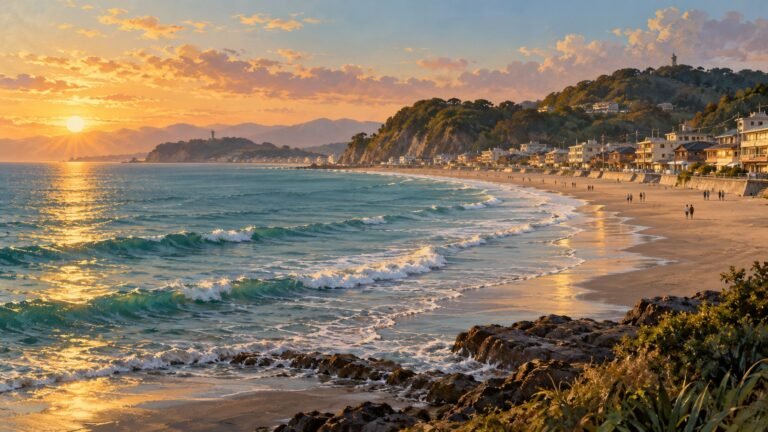
Original Osaka-inspired illustration; the geometry is conceptual, not a precise view or a walking map.
Dotonbori is one part of Osaka, not the whole reason to visit. Once you have enjoyed the canal-side spectacle, another day can have a very different rhythm: a river walk, a shopping arcade used for ordinary errands, a quiet temple visit or an outdoor art evening.
The useful question is not which places are “secret”. Several choices here are well known. It is which combination gives you a contrast without spending the day changing trains. The suggestions below are selected for distinct experiences and practical pairings, not for a claim that locals alone know them.
This article contains affiliate links. If you book or buy through them, Taylor’s Trailblazing Travels may earn a commission at no extra cost to you.
Low-pressure choice
Nakanoshima + a manageable section of Tenjinbashisuji.
History choice
Osaka Castle, with a decision on the museum before arrival.
Different atmosphere
Sumiyoshi Taisha or Shitenno-ji, with site rules respected.
Pacing rule
A third major stop costs its visit time and another transfer.
Choose the Osaka you want to spend time in
| Place | Choose it for | Allow / main trade-off |
|---|---|---|
| Nakanoshima | Riverside architecture and open space | 60–90 minutes; exposed to weather |
| Tenjinbashisuji and Tenma | Everyday shopping and a meal | 90–150 minutes; do not try to inspect every shop |
| Nakazakicho | Small shops and cafés in older streets | 60–120 minutes; individual business hours matter |
| Osaka Castle | Moats, architecture and museum history | 2–3 hours with the tower; more walking than the station name suggests |
| Shitenno-ji | Temple buildings and a different urban rhythm | 60–90 minutes; paid sections have opening hours |
| Sumiyoshi Taisha | Shrine architecture and a southern-city outing | 60–90 minutes plus travel; not a quick stop beside Umeda |
| teamLab Botanical Garden Osaka | Outdoor art after dark | An evening block; separate ticket, weather and access checks |
Each choice earns a different role. If your previous day was crowded and highly scheduled, do not automatically fill the next one with three paid timed-entry experiences. If a rainy day makes open-air walking unattractive, choose one suitable indoor attraction and a shorter shopping stop rather than pretending a covered arcade removes every outdoor transfer.
Nakanoshima: see the city at walking speed
Nakanoshima Park sits between the Dojima and Tosabori rivers. Osaka’s tourism bureau identifies its rose garden and nearby classical buildings, including Osaka City Central Public Hall and the prefectural library, as part of its appeal. The park itself is open at all times. [1]
Begin with a river-level walk and look at the architecture from the public paths. Treat the park as a place to spend time, not just a connection between indoor bookings. Flowers are seasonal, so the route should still appeal when the rose beds are not at their best.
Make it a northern-city half-day
Use Nakanoshima as the unhurried first part, then move towards a chosen section of Tenjinbashisuji for lunch and browsing. Check your actual walking route and crossing before setting out. If an exhibition interests you, inspect its own current calendar and admission arrangements and shorten the shopping element; “near a museum” is not the same as having time to visit one.
This is a good choice for travellers who want a day with frequent opportunities to stop. It is less suitable as an entirely outdoor plan during persistent heavy rain or oppressive heat. Keep a seated indoor break available rather than building the whole outing around perfect weather.
Tenjinbashisuji and Tenma: browse, eat, then stop
The tourism bureau describes Tenjinbashisuji as a shopping street stretching about 2.6 kilometres, with access from stations including Minamimorimachi, Ogimachi, Tenjinbashisuji Rokuchome and JR Tenma. Shops have their own opening and closing days. [2] Its length is a reason to select a section, not an obligation to walk it all.
For a food-led visit, choose where you want lunch, then browse the surrounding stretch. Let a shop selling something you actually use take precedence over a photogenic counter you would otherwise ignore. Look at serving sizes and menu prices before ordering several dishes just to sample everything.
Tenma is a useful place to investigate for an evening meal as well, but day and evening businesses need not keep the same hours. Check the specific venue, any seating charge and the order expected of each guest. A full shopping walk followed by an ambitious restaurant crawl can be more tiring than either sounds separately.
This is still a working shopping environment. Stop clear of the moving lane for photos or navigation, and follow individual sellers’ rules for eating and disposing of packaging. Do not describe every modest restaurant as a hidden gem, or assume every older shop welcomes unrestricted filming.
Nakazakicho: small-scale shops rather than another giant mall
Osaka’s official visitor information describes Nakazakicho’s cafés, independent shops and second-hand clothing businesses in older residential buildings, reached from Nakazakicho Station and within walking distance of the Umeda area. [3]
It is a good match for travellers who enjoy looking slowly and choosing a café once they arrive. It is a weaker fit for someone who expects a fixed list of large attractions with predictable all-day access. Check priority shops individually and keep residential doorways, narrow lanes and customers out of intrusive photographs.
Pair Nakazakicho with a north-side arrival or departure, rather than crossing the whole city solely for a short coffee stop. Give it a real hour or two if that is the experience you want. If the group is not interested in browsing, choose a different anchor instead of trying to sell the neighbourhood as universally essential.
Osaka Castle: decide whether you want the museum
The main tower is a paid museum visit, distinct from enjoying views around the castle grounds. The official visitor page lists 09:00–18:00, last entry at 17:30, a 28 December–1 January closure and an adult admission of ¥1,200. These arrangements were checked on 18 October 2026; the ticket queue can be restricted earlier on busy days. [4]
Budget two to three hours for a visit that includes moving through the grounds and spending time in the tower. That is an editorial allowance, not an official queue prediction. If you mainly want the exterior and moats, make that decision early; do not buy a museum ticket merely because the tower is famous.
The official guide says the usual lift arrangement takes visitors up to the fifth floor, with stairs above and on the way down. Visitors with walking difficulties or wheelchairs can use lifts to all floors under staff guidance. [4] Ask for the appropriate route rather than treating a general lift description as an accessibility guarantee for the whole park.
Choose the station and entrance that fit your intended route and mobility needs. Arrival at a station named for the park does not mean arrival at the tower door. On a history-focused day, the museum should be the substantial visit; a relaxed meal afterwards may add more than a second museum squeezed into the remaining time.
Shitenno-ji and Sumiyoshi Taisha: choose a religious-site outing
Shitenno-ji for a temple-focused stop
Shitenno-ji distinguishes access to the outside of its halls from the opening hours of halls, the central precinct and garden. Its published ordinary visiting hours for those sections are 08:30–16:30 from April to September and 08:30–16:00 from October to March, with exceptions for specified dates. [5]
A late arrival may therefore permit an exterior visit but not the paid interior or garden experience you had imagined. Decide which part matters before travelling. A 60–90-minute allowance is sensible for a selective visit; a specialist interest or special opening needs a longer block.
Sumiyoshi Taisha for a different part of the city
Sumiyoshi Taisha’s official material describes its distinctive shrine architecture and arched Sorihashi bridge. Its FAQ states that entrance is free and asks visitors not to eat, drink or smoke in the grounds. [6][7] This makes it a cultural outing, not a picnic stop.
Plan it as a southern-city choice and check the current route from your accommodation. Do not force it into the same short afternoon as Nakanoshima simply because both are within Osaka. If steep steps or bridges are difficult, ask about the appropriate accessible approach rather than assuming the most photographed crossing is mandatory.
At either site, follow the posted instructions, keep conversations quiet where worship takes place and avoid interrupting ceremonies. You do not need to imitate a ritual you do not understand to appreciate the buildings and setting.
An outdoor art evening at Nagai
teamLab Botanical Garden Osaka is an outdoor, nighttime art experience in Nagai Botanical Garden. Check the operator’s current calendar and visitor notes: this is not the same ticket or timetable as an ordinary daytime garden visit. [8]
Use it as your evening anchor. Have an early meal, travel with enough time for the entrance and keep clothing suitable for outdoor conditions. Do not assume every path will be as comfortable as a brightly lit indoor gallery; readers with mobility or sensory concerns should check the detailed visitor guidance before booking.
Skip this choice if the group prefers a free evening, dislikes outdoor art environments or would be too tired to enjoy another journey. Its role is to provide a different experience, not to fill a compulsory final slot.
Three workable combinations — and the cost of adding a third stop
| Style of day | Core pairing | What to keep flexible |
|---|---|---|
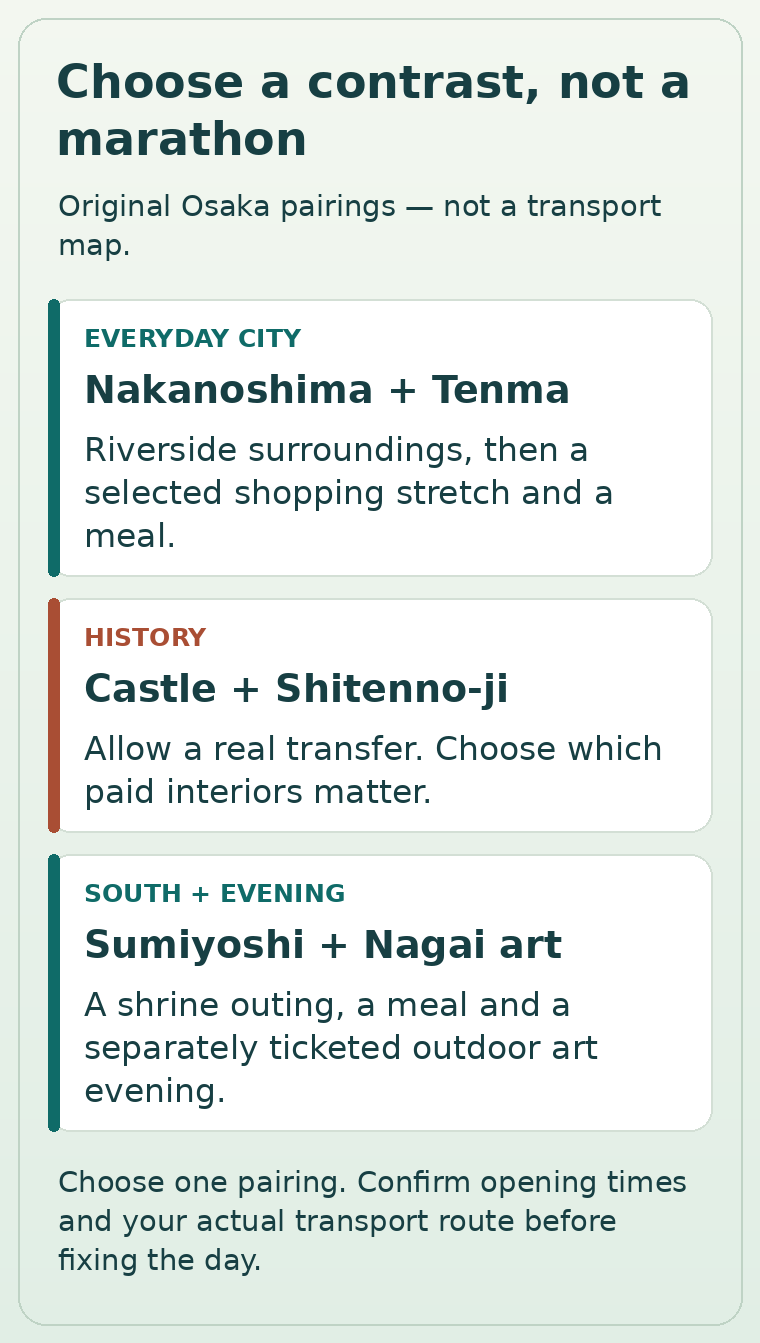
| Everyday Osaka | Nakanoshima + Tenjinbashisuji/Tenma | How much arcade you walk and where you eat |
| History and reflection | Osaka Castle + a selective Shitenno-ji visit | The transfer and whether both paid interiors are worthwhile |
| Southern city and evening art | Sumiyoshi Taisha + an early meal + Nagai art evening | The rest period; the art ticket time is the anchor |
The second and third combinations require an actual transport plan; they are not presented as continuous short walks. If a route crosses the city, cost it in time as well as fares.
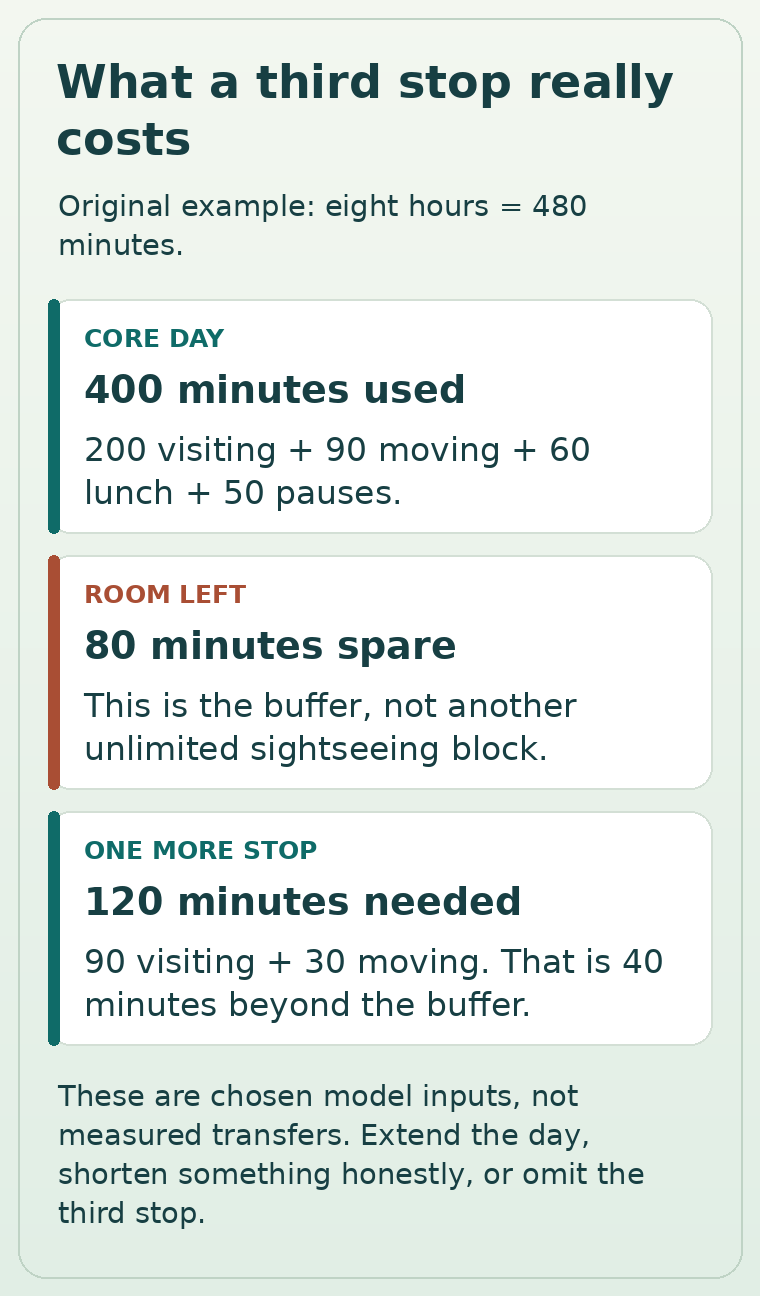
Here is an eight-hour example. Two substantial visits of 100 minutes each use 200 minutes. Add 90 minutes for movement, 60 for lunch and 50 for pauses: 400 minutes are assigned and 80 remain. A third 90-minute visit plus another 30-minute transfer requires 120 minutes, exceeding that spare time by 40 minutes.
You can extend the day, shorten something honestly, or omit the third visit. What does not work is counting only the attraction’s time and pretending the extra journey disappears. These are chosen model inputs, not measured travel times between the places above.
Choose your base and arrival around the experiences
For a north-side day, compare accommodation whose actual transport links suit Nakanoshima, Tenma and Umeda. For repeated southern outings, compare the journey to Tennoji and your onward rail connection. A familiar neighbourhood name on a booking page is less useful than the station entrance you will really use.
If Osaka is a stop between Tokyo and another region, protect at least one genuine sightseeing day rather than treating the arrival afternoon as a full day. Keep your first local activity flexible until the intercity journey and hotel arrangements are clear.
Questions before you fill the day
Are these places less crowded than Dotonbori?
Not necessarily. Famous sights, shopping streets and seasonal events can be busy. The advantage is variety and better choices, not a crowd-free guarantee. Pick a calmer activity or shorten the plan when conditions on the day call for it.
Can a pass make this cheaper?
Only compare a pass after choosing the actual sights and transport. Add the separate prices of things you would visit anyway, check the pass’s exclusions and validity, and avoid adding unwanted attractions merely to justify its cost.
What is the simplest inexpensive day?
Start with a public riverside walk, browse a chosen shopping stretch and buy a meal you want. Set your own food and transport budget. A free-to-enter location does not make the whole day free, but it avoids buying multiple admissions by default.
Should Universal Studios Japan be squeezed into the same day?
Treat a major theme-park visit as a different planning task. Combining it with these substantial neighbourhood outings would remove the time that makes either worthwhile.
The better Osaka day
Choose the experience you missed in Dotonbori, pair it with one sensible contrast and leave room for a meal. Osaka becomes more interesting when you stop treating it as one illuminated canal — and more enjoyable when you stop trying to cover every district at once. For the wider route, browse the Japan travel guide hub or begin with the first-time Japan planning guide.
Sources and further checking
Source pages checked on 18 October 2026. Recheck date-sensitive visitor arrangements and booking terms before committing.
- Osaka tourism bureau — Nakanoshima Park
- Osaka tourism bureau — Tenjinbashisuji
- Osaka tourism bureau — Nakazakicho
- Osaka Castle Museum — official visitor guide
- Shitenno-ji — official access and visiting arrangements
- Sumiyoshi Taisha — official introduction
- Sumiyoshi Taisha — official FAQ
- teamLab — Botanical Garden Osaka
- GetYourGuide — teamLab Botanical Garden ticket
- 12Go — Tokyo to Osaka comparison page
Illustrations in this article were created for Taylor’s Trailblazing Travels. Third-party photographs, where used, are credited beside the image or in the source list.