Kanazawa Travel Guide: Gardens, Old Districts and Day Plans
Group neighbouring sights, choose a practical base and leave room for the garden, a craft stop and a change of weather.
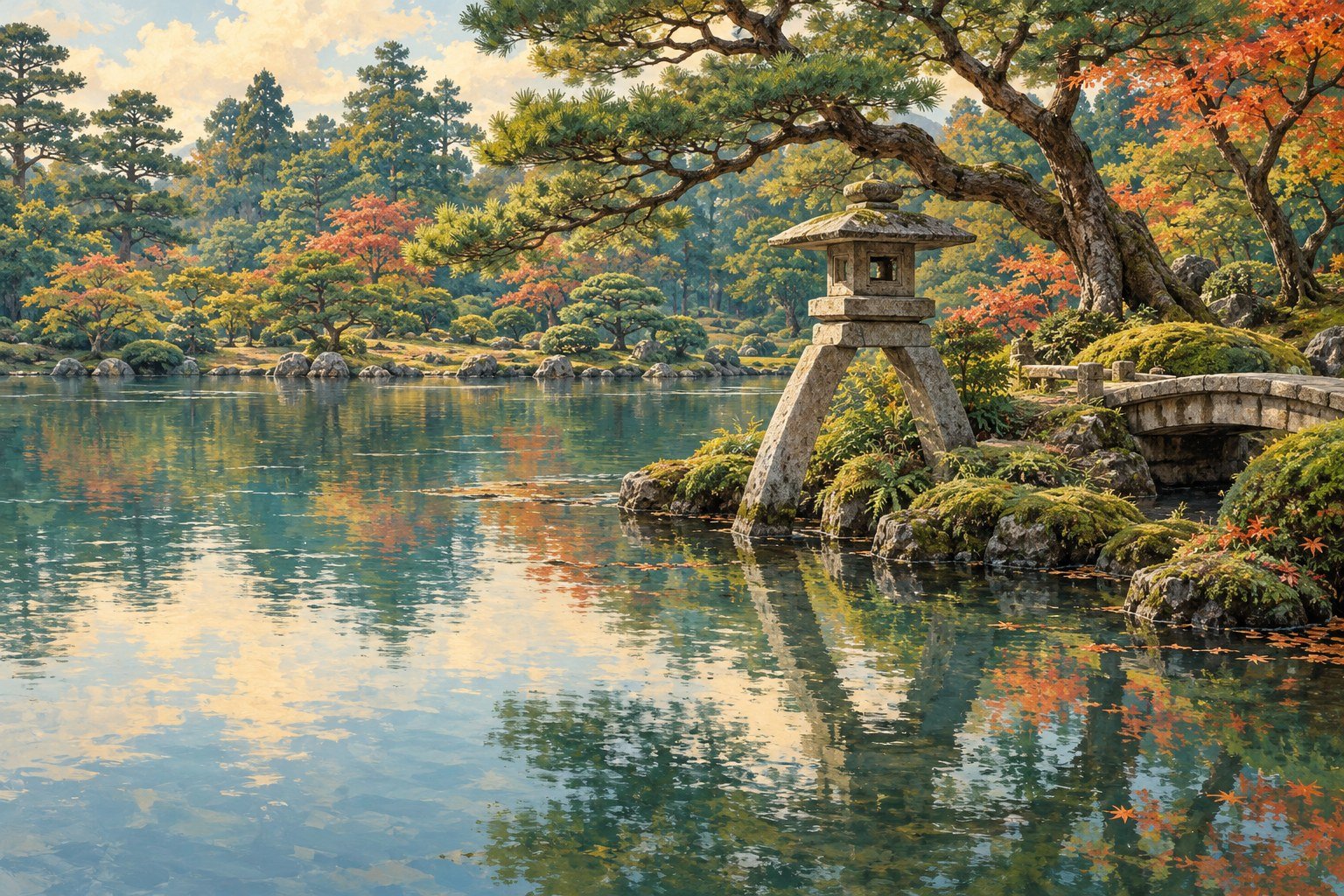
AI-created editorial illustration inspired by the pond, stone lantern and pines of Kenrokuen Garden in Kanazawa; not a photograph.
A good Kanazawa visit leaves time to notice the garden beyond its famous view and to enter an old house rather than only photograph its street. Kenrokuen, the castle, the chaya districts and Nagamachi offer different experiences, so the useful question is which places fit together in the time you have. [1]
This Kanazawa travel guide combines official visitor information with original daily groupings, base choices and a transparent local budget. It is research-led; the suggested timings are editorial planning allowances.
This article contains affiliate links. If you make a booking or purchase through them, Taylor’s Trailblazing Travels may receive a commission at no extra cost to you.
One full day
Garden, castle and one district; two nights allow more depth.
Station or centre
Prioritise your repeated journey, then compare rooms.
Walk in groups
Use a bus for the longer link between sightseeing areas.
Plan your Kanazawa stay around three groups
Kanazawa suits travellers who want gardens, historic interiors, crafts and street wandering in the same city. Its key sights form useful groups: Kenrokuen and the castle; Higashi Chaya and Kazue-machi beside the Asano River; and Nagamachi beside Korinbo. Omicho Market sits on the approach from the station. Grouping these places saves repeated journeys across the centre. [1]
Allow one full sightseeing day for the garden, castle and one district. Two nights give you a complete day between travel days, plus room for the other district, a workshop or an exhibition. One night works if you arrive early enough for an afternoon out and leave after lunch the following day. A late arrival followed by an early train leaves little usable city time.
On a phone, swipe the diagram sideways to read its labels.
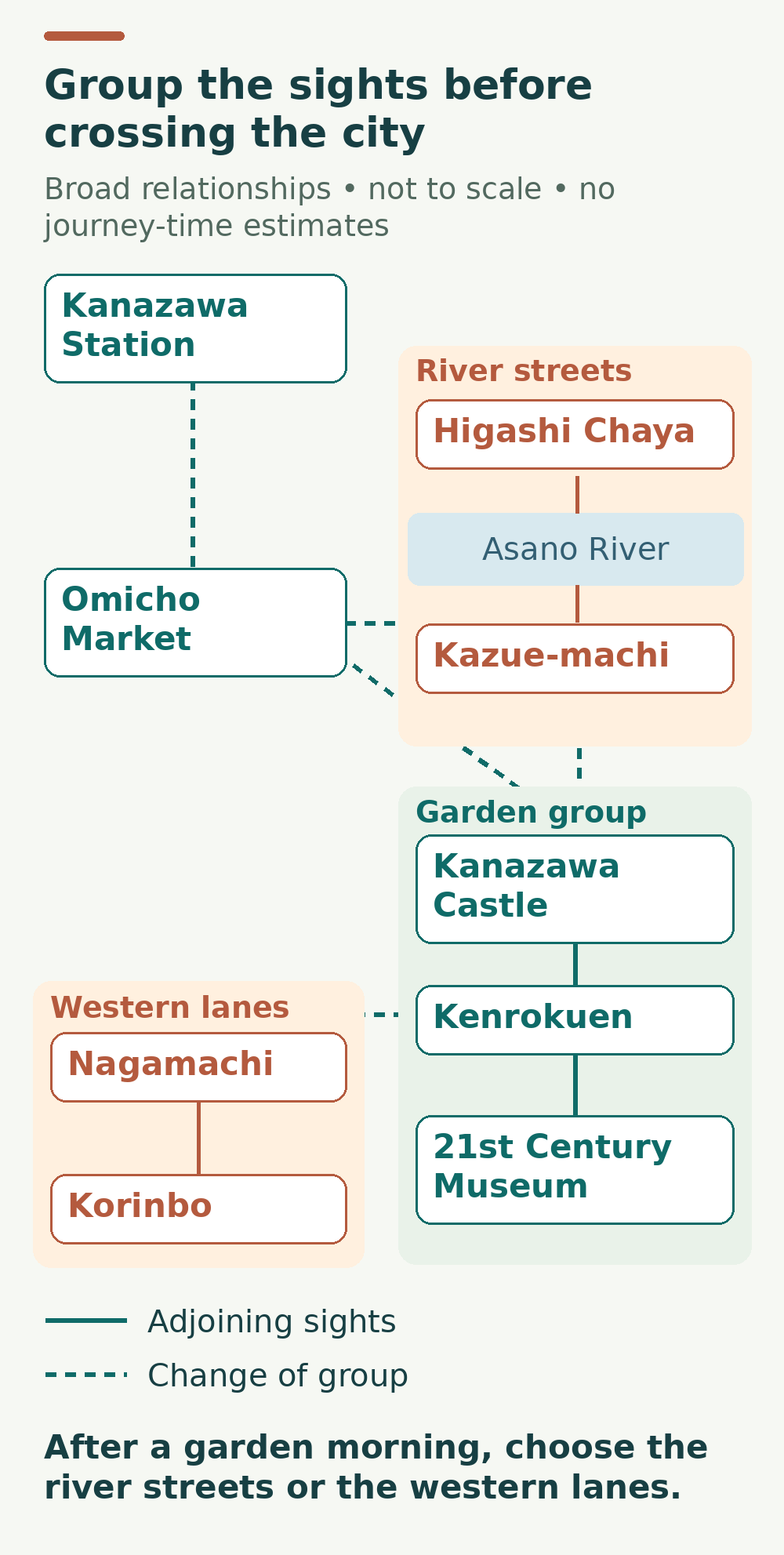
Choose a base for the journeys you will repeat
The following choices are editorial judgements based on the city map, rather than hotel rankings. Compare your route to the station, your first morning sight and dinner before comparing room photographs.
Scroll sideways to see all columns.
| Base | Choose it when | Check before booking |
|---|---|---|
| Kanazawa Station | You have a short stay, heavy bags or an early onward train. | The hotel’s actual exit and walking approach; sightseeing still involves a journey into the centre. |
| Musashigatsuji / Omicho | You want a compromise between the station, market and castle-side walking. | Evening food options and street noise; a market address does not guarantee late dining. |
| Korinbo / Katamachi | Nagamachi, central restaurants and the museum area shape your visit. | The transfer back to the station with luggage. |
| Higashi Chaya / Asano River | You value time around the traditional streets and have a less hurried stay. | Check-in arrangements, steps and the route from the bus stop, especially for a small townhouse property. |
Use Agoda’s Kanazawa accommodation search and Booking.com’s Kanazawa listings to compare the same dates, guests, meals and cancellation terms. These are city searches; use their maps to check each address rather than treating every Kanazawa result as central.
Kenrokuen and the castle: decide what to enter
Give Kenrokuen an unhurried 75–90 minutes as a planning allowance. Its ponds, paths and planted views repay a circuit beyond one photograph. Spring blossom, autumn foliage and the winter yukitsuri ropes supporting tree branches create different reasons to visit; flowering dates, colour and snow cover are not guaranteed by a calendar month. [4]
Cross to Kanazawa Castle Park afterwards. The grounds are free, while the Hishi-yagura and Gojikken-nagaya complex is a separate paid interior. Ninomaru Palace reconstruction is active: follow the signed visitor routes and do not expect a finished palace tour. [5] [6] [8]
Scroll sideways to see all columns.
| Visit | Admission | Normal opening pattern |
|---|---|---|
| Kenrokuen | ¥320 | 07:00–18:00, 1 March–15 October; 08:00–17:00, 16 October–end of February. [3] |
| Castle grounds | Free | The same normal seasonal hours as above. [5] |
| Hishi-yagura / Gojikken-nagaya complex | ¥320 | 09:00–16:30; last admission 16:00. [6] |
| Kenrokuen Plus One | ¥500 | Garden plus one participating cultural facility, including the specified castle complex; check each opening day. [7] |
If you want both paid visits, the ¥500 combination saves ¥140 against two ¥320 admissions. Choose it before entering. If your castle visit is just the grounds, the ¥320 garden ticket is the relevant purchase. Concessions may change that comparison. [3] [6] [7]
Early entry or a normal morning?
Kenrokuen offers free early entry through designated gates, starting at different times by season. Visitors must leave 15 minutes before normal opening. You cannot remain all morning on that free entry; normal paid admission is easier for the garden-and-castle sequence. [3]
For a contrasting historic interior, Seisonkaku is beside the garden. Standard admission for visitors aged 19 and over is ¥700 for rotating exhibitions or ¥1,000 for special exhibitions. It opens 09:00–17:00, last entry 16:30, normally closing Wednesdays, the following Thursday when Wednesday is a national holiday, and 29 December–2 January. Check the exhibition and date before making it your indoor substitute. [1] [13]
Old districts and Omicho: pick a useful pairing
Higashi Chaya and Kazue-machi: streets, shops and river views
Choose this pair for wooden façades, a craft stop and time beside the Asano River. The district streets have no entry ticket; individual houses, shops and experiences have their own arrangements. Many shops open around 10:00–17:00, so a dawn walk and an afternoon shopping visit are different experiences. Cross the river to include Kazue-machi without adding another distant district. [9]
Allow about two hours for the pair, longer with a workshop or a seated meal. A chaya district has a history of geisha entertainment; the name does not mean every traditional building is a public tea café. Read the sign before entering. Eat where the shop directs you, keep doorways clear and ask before photographing people or interiors. [9]
Nagamachi and Nomura: choose an interior as well as a street
Nagamachi’s enclosed lanes offer a different visit from Higashi Chaya’s shopping streets. Pair a wander with Nomura Residence if you want to see rooms and a small garden. Allow 60–90 minutes for the combination, with extra time for a break around Korinbo. [25] [10]
Nomura’s adult admission is ¥550 at the October 2026 check. Opening is 08:30–17:30 from April to September and until 16:30 from October to March; the tourism listing records closures on 26–27 December and 1–2 January. The residence has announced a ¥750 adult rate from 1 April 2027, also applying to high-school pupils. [10] [11]
Omicho: put the market into the daytime
Omicho is a working food market with restaurants, not simply an evening food hall. The tourism authority lists roughly 09:00–16:00, with individual hours varying and New Year closures. Give it a late-morning or lunchtime slot; check a chosen restaurant directly if you want breakfast or dinner. [12]
Keep 45–60 minutes for browsing and food, and more if you want a particular sit-down restaurant. Look at the menu and queue before committing your lunch break. Keep shopping aisles clear and use the vendor’s eating space. If seafood does not suit you, make lunch a separate restaurant choice rather than forcing the market to meet every dietary need.
Art, craft and a weather plan
For light rain, shorten the outdoor circuit and keep a nearby indoor stop. In sustained bad weather, choose the indoor visit first, then add streets only if conditions improve. Carry rain protection and leave time to dry off; a historic district is still largely an outdoor activity.
Use the museum calendar before building the day
The 21st Century Museum of Contemporary Art has free public areas and separately ticketed exhibitions. Normal exhibition hours are 10:00–18:00, extended to 20:00 on Fridays and Saturdays; exhibitions normally close Mondays, or the following weekday when Monday is a national holiday. Public-zone hours are usually 09:00–22:00, with separate closure arrangements. Exhibition prices depend on the programme. [14] [15]
Planning notices checked 17 October 2026: The Swimming Pool is closed from 19 to 30 October 2026 for an exhibition change. Separately, the whole museum is scheduled to close for major renovation from 6 May 2027 to March 2028; no precise reopening day is announced in that notice. Check the museum calendar for your date. [17] [18]
When the Pool’s underground area is operating, access requires both the relevant exhibition ticket and registration on the same-day waiting list. The current system has no advance Pool reservations, and the underground visit is limited to five minutes. Buying an exhibition ticket does not by itself secure that visit. Decide whether the exhibition interests you even if the waiting list is full. [16]
Choose a craft stop that fits the district
A booked workshop can give a wet afternoon a purpose. The gold leaf craft workshop in Higashi Chaya on GetYourGuide advertises up to one hour applying leaf to an object, with materials and the finished item included. Simpler objects may take less time. Travel and meals are excluded, and the venue is on a townhouse’s second floor; ask about access before booking if stairs are a concern. [19]
Choose this for making something during your Higashi visit. For help interpreting several places, Viator’s customised Kanazawa walking tour with a licensed guide offers four- and six-hour options. Pickup is on foot; transport, entry fees and lunch are extra, and a private vehicle is not included. Agree a small selection of sights that fits your interests and walking ability. [20]
If exhibitions are closed, consider Seisonkaku on an open day or a confirmed craft session. In winter, Kenrokuen’s shorter normal hours and Nomura’s earlier closing make it sensible to put the essential outdoor visit first. [3] [10] [13]
Getting to Kanazawa and moving around
Tokyo is direct; Kyoto and Osaka require a change
From Tokyo, take the Hokuriku Shinkansen to Kanazawa. Faster journeys are around 2½ hours; check the service you select. Kagayaki trains have reserved seats only, while Hakutaka services include non-reserved cars. [21] [23]
From Kyoto or Osaka, take the Thunderbird to Tsuruga, then change to the Hokuriku Shinkansen. The Thunderbird is entirely reserved seating. As broad planning allowances, expect about two hours from Kyoto and roughly two to 2½ hours from Osaka, depending on the connection; these are not live departure promises. Book the whole journey together and follow the transfer shown on your tickets. [22] [23]
For a Tokyo arrival, you can compare Tokyo–Kanazawa transport options on 12Go alongside JR’s own booking channels. Check the actual departure station, seat category, ticket collection or exchange process and cancellation terms. A listed option is not confirmation that seats have been issued for your date. [28]
For a one-way journey from Kansai, check JR West’s Hokuriku One-way Ticket before assuming a multi-day rail pass is worthwhile. It has foreign-passport and Temporary Visitor conditions, is purchased through selected overseas agencies and requires exchange in Japan; arrange reserved seats too. Compare the complete journey and eligibility. [24]
Walk within groups; use a bus for the longer link
The tourism authority gives indicative walks of 15 minutes from the station to Omicho, three minutes from Kenrokuen’s Mayumizaka gate to the museum, and 20 minutes from the garden’s Katsurazaka gate to Higashi Chaya. These exclude sightseeing and waiting at crossings; a different entrance changes the walk. [2]
At the 17 October 2026 check, the Loop Bus costs ¥220 per adult ride and accepts nationwide transport IC cards and contactless credit cards. Payment options differ on other bus services. The ¥800 One Day Pass covers the Loop Bus and designated additional services for one date; it is not sold onboard and excludes the Light-Up Bus. [2] [25]
On a phone, swipe the diagram sideways to read its labels.
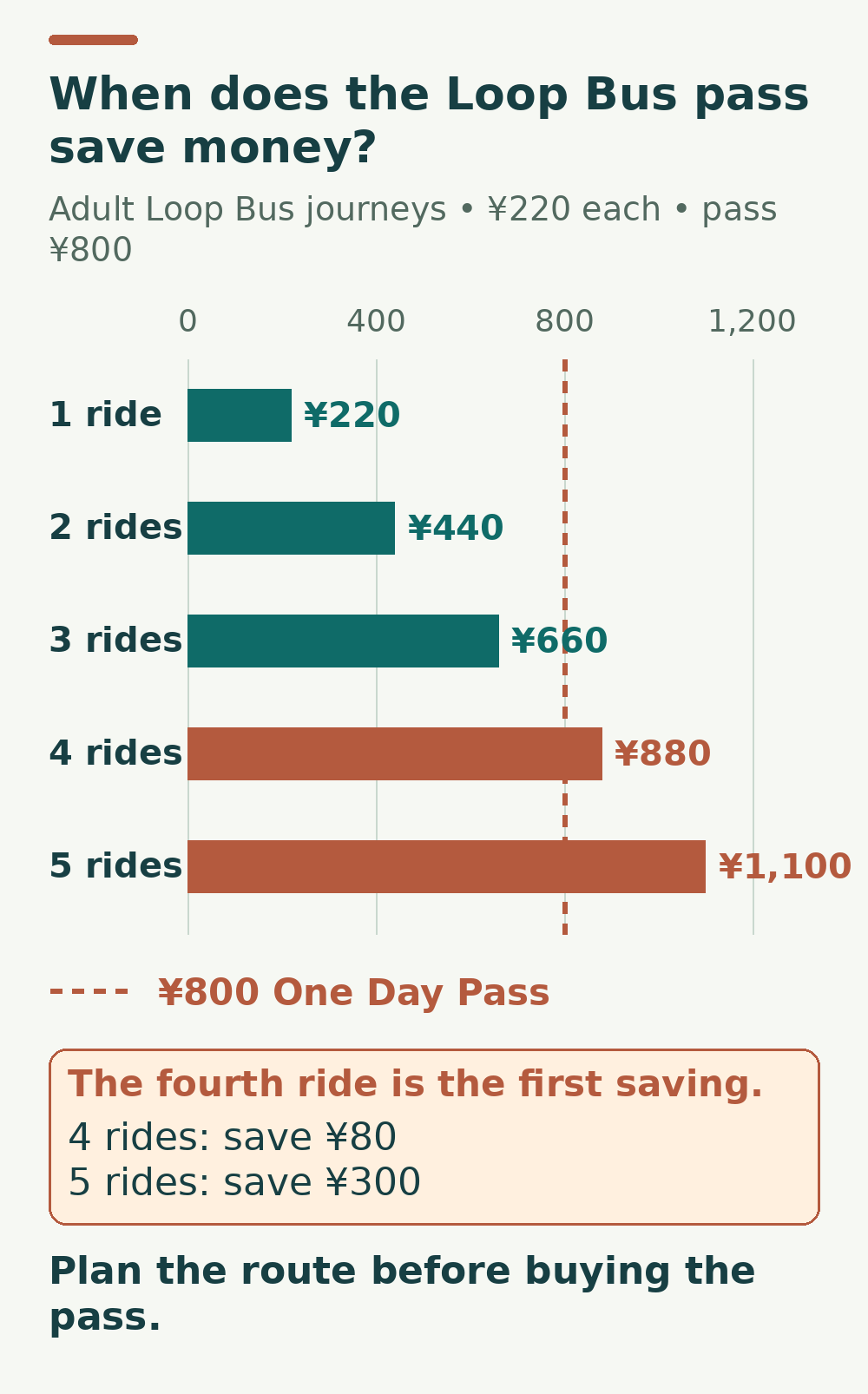
Three Loop Bus rides cost ¥660, while four cost ¥880: the pass starts saving on the fourth ride, before any attraction discounts. Choose your route first. Two paid rides plus walking may suit this guide’s groupings better than buying a pass and adding journeys to use it. [2] [25]
For travel on 25 October 2026, check the specific Kanazawa Marathon restrictions: the tourism authority warns of extensive traffic controls and congestion. Allow more time to reach your train than on an ordinary day. [26]
One-day and two-day Kanazawa plans
These are original pacing plans for adults comfortable with repeated walks, with bags already stored. The times are allowances, not opening guarantees or measured personal journeys. Check the date-specific closures above and protect your booked departure.
One full day: garden, castle and one district
Scroll sideways to see all columns.
| Time | Plan | Decision |
|---|---|---|
| 09:00–10:30 | Kenrokuen | Use the first substantial block for the garden. |
| 10:30–11:30 | Walk across to the castle and explore | Choose the grounds or one paid complex, allowing for the approach. |
| 11:30–12:30 | Lunch nearby | Keep the meal close; do not add a market detour just for the name. |
| 12:30–13:00 | Transfer towards your chosen district | Walk or use transport according to weather and pace. |
| 13:00–15:00 | Higashi Chaya with Kazue-machi, or Nagamachi with Nomura | Use one group well. A workshop belongs inside this allowance only if its start time fits. |
| 15:00–16:00 | Return, collect bags and keep a buffer | Leave earlier if your hotel or booked train needs more time. |
The trade-off is deliberate: this day does not cover every district, Omicho and a major exhibition. If art is your priority, replace the afternoon district with the museum on an open day. If you move more slowly, shorten the castle visit before sacrificing lunch or your return buffer.
One night: use the arrival afternoon
Arrive early afternoon, store bags, then visit Higashi Chaya and Kazue-machi while shops are open. The next morning, see Kenrokuen and the castle, have lunch and leave. This gives two substantial groups without pretending a night itself equals a full sightseeing day. If arrival slips late, drop the shopping expectations.
Two days: split the groups
With two full sightseeing days, use the first for Kenrokuen, the castle and Nagamachi. On the second, start at Omicho in mid-morning, then give Higashi Chaya and Kazue-machi an afternoon with a craft session or a longer meal. Art enthusiasts can substitute a museum afternoon for some district time on an open day.
Many two-night stays instead give an arrival afternoon, one full day and a departure morning. Put Omicho on arrival if you reach it in time, the garden and one district on the middle day, then the other district before departure. Allow for opening times when booking the final train. A workshop replaces some wandering rather than extending an already full route.
Shirakawa-go belongs in a separate excursion day or an onward travel plan. Adding it to a two-night stay usually means giving up some Kanazawa time; keep a full city day if gardens and old districts are the reason you came. Reserve the excursion’s transport before building the rest of the stay around it.
What a day costs
A useful budget separates the small admission bills from accommodation, intercity travel and optional guided experiences. This example follows the garden, paid castle interior and Nagamachi version of the day, using standard adult rates without concessions.
Scroll sideways to see all columns.
| Item | Amount |
|---|---|
| Kenrokuen Plus One, selecting the castle complex | ¥500 [7] |
| Nomura Residence | ¥550 [10] |
| Two Loop Bus rides | ¥440 [2] |
| Admissions and local transport subtotal | ¥1,490 |
| Illustrative allowance for lunch, dinner and a drink or snack | ¥3,000 |
| Illustrative local total | ¥4,490 |
The food figure is an editorial allowance, not a researched restaurant quote. The total excludes breakfast, accommodation, intercity tickets, shopping, taxis and workshops or guides. From 1 April 2027, Nomura’s announced ¥200 increase would make the same model ¥4,690 if the other inputs stayed unchanged. [11]
For hotels, compare the full room bill and how local tax is collected. Kanazawa’s accommodation tax uses the lodging charge per person per night, excluding food and taxes: below ¥5,000 is exempt; ¥5,000 to under ¥20,000 attracts ¥200; ¥20,000 or more attracts ¥500. Ask the property how your package is apportioned if meals are included. These thresholds were checked on 17 October 2026. [30]
Booking priorities and final checks
Book accommodation and important rail journeys first, then any fixed workshop or guide. Leave ordinary street wandering flexible. Before setting off, check the venue calendar, weather, luggage arrangements and route back to the station. Kanazawa’s tourism site links local luggage services and live cameras, which can help you adjust the day. [29]
Save the hotel address and essential booking details offline. If you need mobile data for bus routes or the museum waiting list, compare your existing roaming with Airalo eSIM options. Confirm Japan coverage, activation terms and your device model before paying: an Airalo eSIM requires a compatible, network-unlocked device. [27]
Is a car necessary for the city sights?
For the central groups in this guide, walking and public transport provide a workable plan. A car adds parking and another approach to each stop; it becomes a separate decision if your stay includes places outside the centre. [1]
How should the plan change for limited mobility?
Choose fewer entrances and longer breaks rather than relying on the walking estimates. Kenrokuen’s operator warns of slopes despite wheelchair availability. Confirm the suitable entrance, room access and any craft venue’s stairs directly; the small townhouse workshop described above is on the second floor. [3] [19]
For a first visit, the strongest balance is two nights with one complete city day: garden and castle together, one district at a time, and an indoor choice that is actually open. Choose the station for simpler travel days or a central base for the walks you most want to repeat.
Sources and planning notes
This is a research-led guide. Official tourism bodies, transport operators and attraction information inform the factual advice; base choices, pacing and explicitly labelled budget examples are editorial planning judgements. Sources checked on 17 October 2026. Recheck current prices, conditions and operating notices for your travel dates.
- Kanazawa City Tourism Association: official city map
- Visit Kanazawa: getting around the city
- Ishikawa Prefecture: Kenrokuen visitor information
- Visit Kanazawa: Kenrokuen Garden
- Ishikawa Prefecture: Kanazawa Castle Park visitor information
- Ishikawa Prefecture: castle opening hours and ticket prices
- Ishikawa Prefecture: Kenrokuen Plus One ticket leaflet
- Ishikawa Prefecture: Ninomaru Palace reconstruction
- Visit Kanazawa: Higashi Chaya district guide
- Visit Kanazawa: Nomura Samurai Residence
- Nomura Residence: admission change from April 2027
- Visit Kanazawa: Omicho Market
- Seisonkaku: visiting information
- 21st Century Museum: visitor information
- Visit Kanazawa: 21st Century Museum of Contemporary Art
- 21st Century Museum: Swimming Pool entry arrangements
- 21st Century Museum: Swimming Pool closure, October 2026
- 21st Century Museum: planned closure, May 2027–March 2028
- GetYourGuide: Gold Leaf Craft Workshop in Higashi Chaya
- Viator: customised Kanazawa walking tour with a licensed guide
- JR East: Hokuriku Shinkansen route and train information
- JR West: trains with all reserved seats
- Visit Kanazawa: arriving from Tokyo, Kyoto and Osaka
- JR West: Hokuriku One-way Ticket
- Hokutetsu: Kanazawa sightseeing buses and One Day Pass
- Visit Kanazawa: marathon traffic restrictions, 25 October 2026
- Airalo: device compatibility requirements
- 12Go: Tokyo–Kanazawa transport listings
- Visit Kanazawa: thoughtful travel, luggage services and live cameras
- Kanazawa City: accommodation tax
Illustrations in this article were created for Taylor’s Trailblazing Travels. Third-party photographs, where used, are credited beside the image or in the source list.