Where to See Mount Fuji: Viewpoints and Weather-Sensitive Choices
Choose a viewing region, protect time on the ground and make a plan that still works when the mountain disappears.
- First decision · Choose one region
- Viewing priority · A clear morning
- Weather strategy · Keep a useful alternative
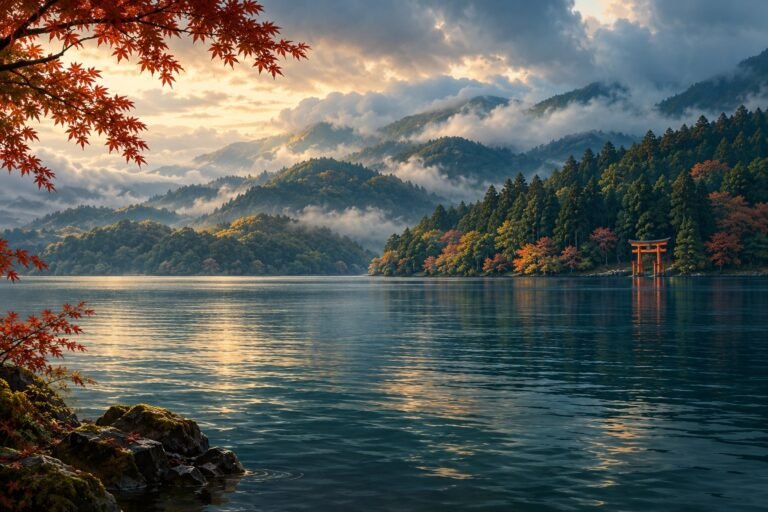
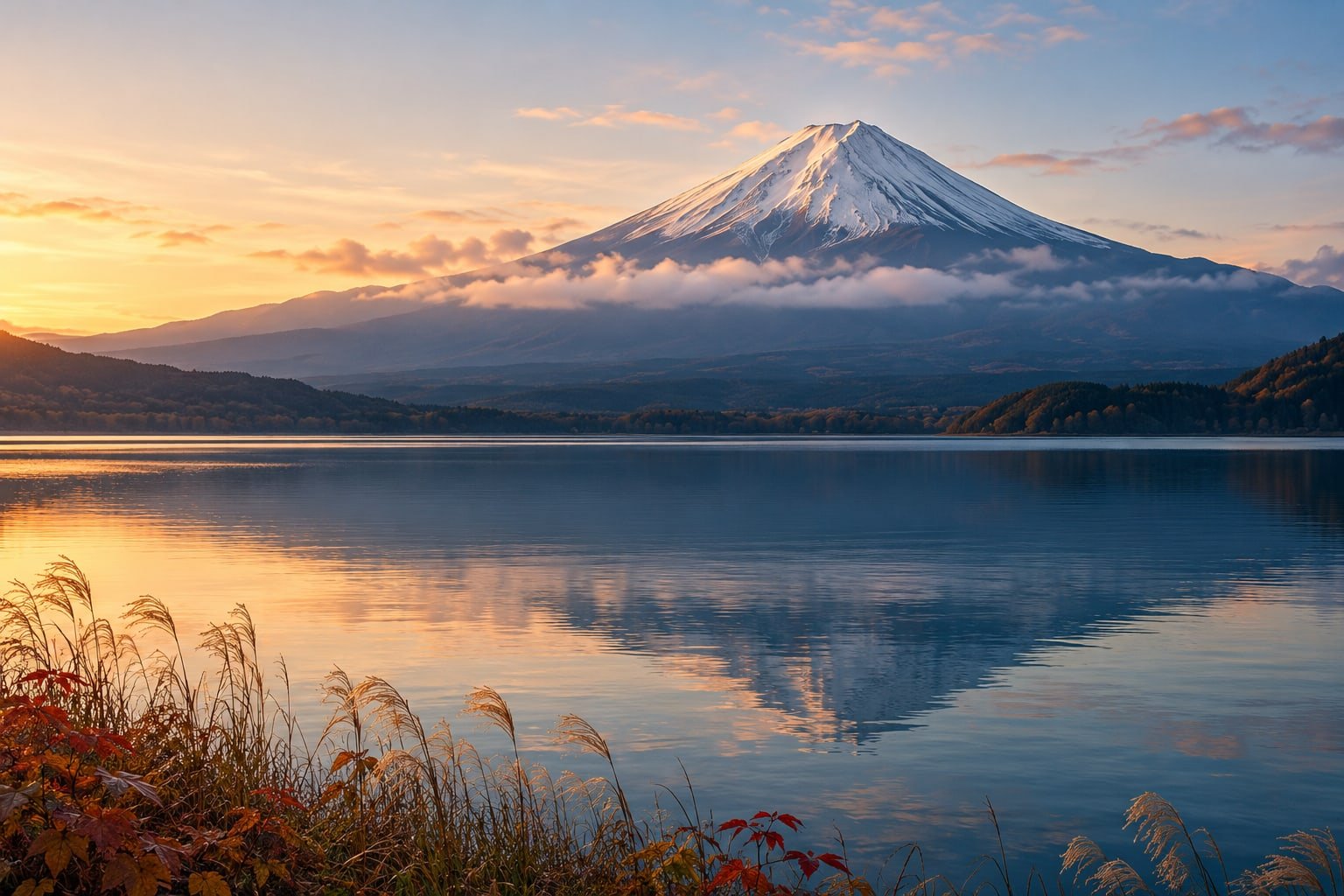
AI-generated editorial illustration inspired by the Fuji Five Lakes; an imagined lakeshore view, not a documentary photograph or promise of visibility.
The best place to see Mount Fuji is the place that fits both the picture you want and the journey you can afford to make. A pagoda foreground, a wide lake, coastal pines and a distant city panorama involve different travel decisions. Clear weather can improve any of them; an ambitious route cannot create a view through cloud.
This guide compares accessible viewing outings around the mountain and lower-commitment opportunities along an existing Japan itinerary. Start with one region, then choose a particular viewpoint and a weather decision you can act on before leaving.
This guide contains affiliate links. If you book or buy through them, Taylor’s Trailblazing may earn a commission at no extra cost to you.
Want the familiar lake or pagoda view?
Choose Kawaguchiko or Fujiyoshida first. Add the other only after checking the local journey and the time left for queues.
Already visiting Hakone?
Treat Fuji as a possible bonus. The lake and volcanic landscape should be enough reason to make the journey.
Travelling through Shizuoka?
Miho and Nihondaira fit that side of the mountain. Allow local transport beyond the intercity railway.
Cloud would spoil the whole day?
Keep the booking flexible or use an existing Tokyo or rail viewpoint. Spend the extra travel time only when the outlook justifies it.
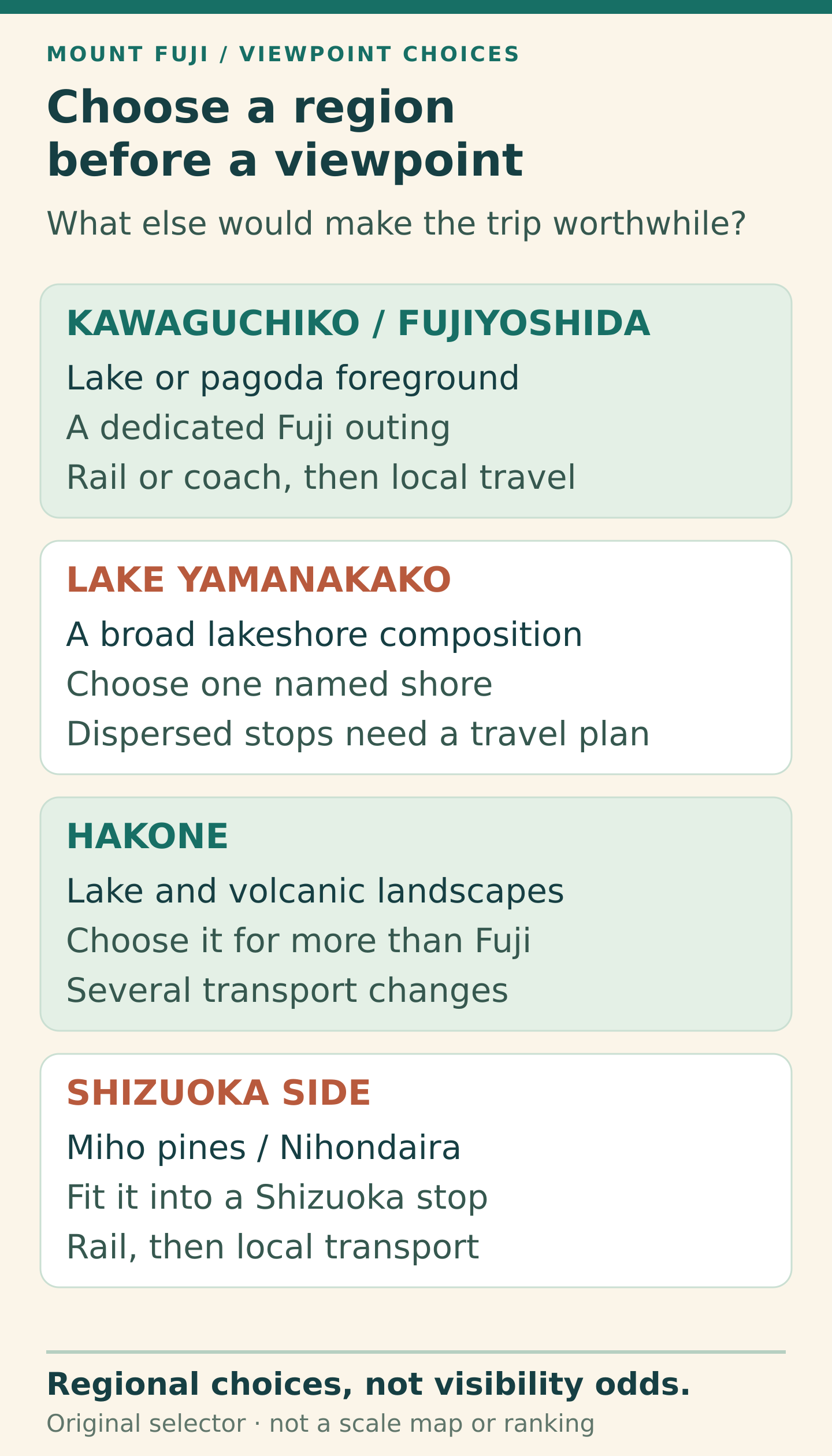
Choose the region before collecting viewpoints
Use the foreground and the rest of the day to make the first choice. The following recommendations are our interpretation of the official attraction and access information, rather than a ranking of guaranteed visibility.
| Region and starting viewpoint | Choose it for | Main planning constraint |
|---|---|---|
| Kawaguchiko: Oishi Park; Fujiyoshida: Arakurayama Sengen Park | A lake foreground or the red Chureito Pagoda | These are separate local journeys; the pagoda approach involves a substantial climb |
| Lake Yamanakako: Nagaike Waterfront Park | A broad view across the lake | Choose the precise shore and bus stop, rather than booking to “Yamanakako” in general |
| Hakone: the ropeway above the volcanic landscape | A scenic transport outing with a possible Fuji view | Several interchanges and potential weather or gas restrictions |
| Shizuoka: Miho Matsubara or Nihondaira | Coastal pines or a high panorama over Suruga Bay | Both require local travel after reaching the railway corridor |
The locations and access characteristics are documented by their official visitor organisations and operators.[1][2][3][4][5][6] Our practical recommendation is to choose one of these regions for a day outing. Being able to name several viewpoints does not make the journeys between them disappear.
On a narrow screen, swipe the diagram sideways to read the details.
Use the weather evidence without promising yourself a view
What the seasonal records actually show
Fuji City observes the mountain from its municipal building at 08:00, 12:00 and 16:00. In its 2025 record, the entire mountain was visible at 08:00 on 22 of February’s 28 days, compared with three of August’s 31 days. The observations distinguish a complete view, a partial view and a hidden mountain.[7]
The same annual report recorded a complete view on 37.3% of morning observations, compared with 26.3% at midday and 24.9% at 16:00.[8] That supports a preference for mornings and cooler-season dates when you have a choice. It is one city’s record for one year, not a probability forecast for Kawaguchiko, a claim that summer never works or evidence that the second day of a stay is independent of the first.
A three-stage weather decision
- When choosing dates, give a Fuji-focused outing some room within the wider itinerary. Avoid making one distant viewpoint the only reason for an inflexible hotel change.
- Before the cancellation deadline, read the regional forecast for the side you intend to visit. Consider rain, low cloud and strong wind as well as the simple weather symbol.
- Before departure, check a nearby live camera and its timestamp. Look again before paying for an extra viewpoint journey; a clear image from another side of Fuji is only one piece of evidence.
Yamanashi’s official camera directory includes Kawaguchiko, Fujiyoshida and Yamanakako, although individual feeds may be unavailable or require a compatible device. The Japan Meteorological Agency provides the regional forecasts to use alongside them.[9][10]
A live image shows what the camera can see now. It cannot tell you whether that view will remain clear after your train, coach and local transfer. If you would dislike the destination without Fuji, the sensible response to a poor outlook may be to keep the day in Tokyo.
Kawaguchiko or the Chureito Pagoda?
Oishi Park: start with the lakeshore
Oishi Park sits on Kawaguchiko’s north shore, with the lake between the visitor and Mount Fuji. Its flower path gives the foreground a seasonal character; lavender is typically associated with late June and early July. Flowers and a clear mountain are separate conditions, so choose a summer visit for the garden as well as the hoped-for view.[1]
For a first outing, make the lake the main activity and allow time to stay in one place. Photographing, walking and sitting beside the water can fill the time that a crowded multi-stop list would spend waiting for another bus. The red sightseeing-bus route serves the Kawaguchiko Natural Living Center by Oishi Park; check the current timetable for the return. The operator’s wider sightseeing-bus ticket costs ¥1,500 for one day or ¥2,000 for two days for an adult. Compare it with your actual local rides rather than buying it solely because you arrived in Kawaguchiko.[12]
Arakurayama Sengen Park: choose it for the pagoda composition
The familiar pagoda-and-Fuji view is in Fujiyoshida, not beside Kawaguchiko Station. The official access guide allows about 25 minutes on foot from Shimoyoshida Station to Chureito Pagoda and identifies 398 steps up to the observation area.[2] Add pauses and a possible queue. Our suggested visit allowance is 60–90 minutes after reaching the station, with more time at busy periods; this is a planning allowance, not a maximum.
The city did not hold its cherry-blossom festival in spring 2026 and introduced specific crowd and traffic controls during the blossom period.[11] That does not establish the arrangements for 2027. Check the next dated notice before booking a cherry-blossom trip, and do not assume that cancelling a festival removes the crowds from a public viewpoint.
If stairs are a concern, prioritise the lakeshore and check the precise path and transport access you need. Around Fujiyoshida, keep pavements, crossings and residential entrances clear. A photograph is optional; other people still need to use the neighbourhood.
Yamanakako: name the shore before booking the journey
Nagaike Waterfront Park, also called Nagaike Shinsui Park, gives a view across Lake Yamanakako towards Fuji. It is a useful choice when the broad lake setting matters more to you than collecting several famous foregrounds.[3] A reflection additionally needs suitable water conditions; a visible summit alone does not produce one.
The official access description places the park on the north shore and identifies the Nagaike Shinsui Koen-mae local bus stop. Its guidance also shows a roughly 30-minute walk from the Fujisan Yamanakako highway-bus stop.[13] A ticket with “Yamanakako” in its destination is therefore not the end of the journey.
Write the arrival stop, shore walk and return stop into the plan before buying. For a short day, settle on one lakeside area; for a longer stay, compare local bus departures before adding another. Dispersed stops can be attractive precisely because they give you space to linger, but that benefit disappears if you spend the day repeatedly solving the next transfer.
Hakone or the Shizuoka side: fit Fuji into a wider day
Hakone: choose the landscape even without the mountain
The Hakone Ropeway operator identifies clear-weather Fuji views around the Owakudani–Ubako section and part of the approach from Sounzan. Owakudani is a transfer point between the two ropeway sections.[4] Choose this outing for the volcanic terrain and Lake Ashi as well as Fuji. It is a weaker fit when your only goal is a single uninterrupted mountain portrait.
Check operating status and the operator’s health restrictions before committing to the upper route; a working train to Hakone does not establish that the ropeway will run or be suitable for everyone.[4] Keep the detailed loop and its ticket calculation as a separate planning task. Trying to add Kawaguchiko to the same ordinary day reduces the time available in both places.
Miho Matsubara: pines, shore and cultural context
Miho’s pine grove and shoreline frame Fuji from the Shizuoka side and form part of its World Heritage setting. There is no admission charge for the grove. The usual public-transport approach is a bus of about 25 minutes from JR Shimizu Station to Miho Matsubara Iriguchi, followed by roughly 15 minutes on foot.[5]
The nearby, free Mihoshirube interpretation centre explains the pine grove’s cultural significance, legends and artistic connections.[25] That gives the stop a reason to exist when the mountain is hidden. Our recommendation is to combine the grove and centre before deciding whether another substantial transfer would improve the day.
Nihondaira: a panorama with a recently changed entry charge
Nihondaira Yume Terrace looks across the Shimizu and Suruga Bay landscape towards Fuji. Current official access guidance uses a bus from JR Higashi-Shizuoka Station to Nihondaira Yume Terrace Entrance, followed by about five minutes on foot.[6] Check the actual departure before travelling uphill.
Since 1 October 2026, the terrace building’s admission has been ¥100 for adults and high-school students; its outdoor observation gallery remains free. The normal building hours are 09:00–17:00, extended to 21:00 on Saturdays, with closures including the second Tuesday of the month and 26–31 December.[6][14] Older descriptions calling every part free are now incomplete.
Miho and Nihondaira offer different foregrounds. For a short stop between cities, choose the one you most want rather than assuming that both fit between two reserved trains.
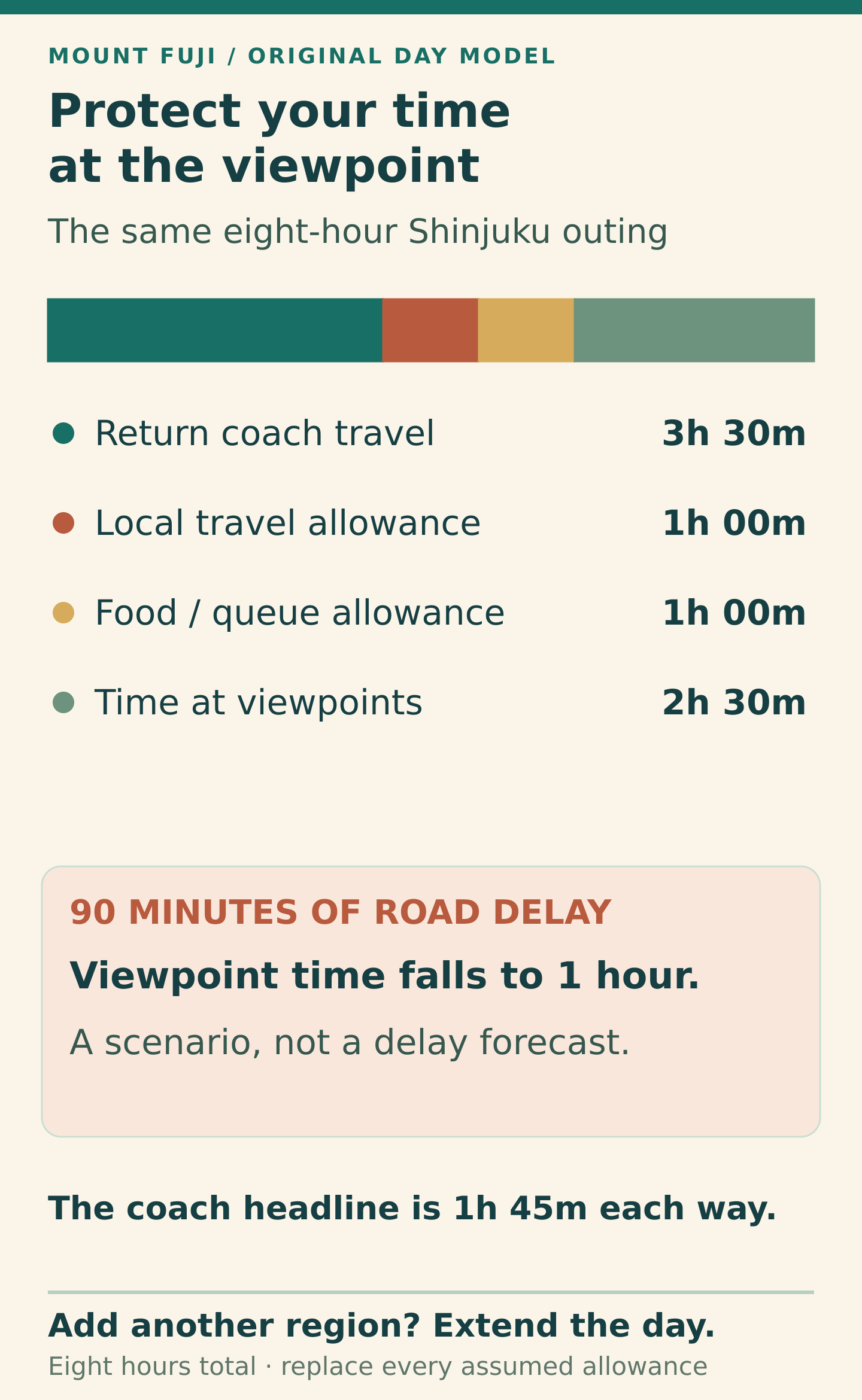
What an eight-hour Fuji day actually leaves
A transport headline is only one part of the outing. The official coach site advertises about one hour 45 minutes from Shinjuku to Kawaguchiko.[15] Use that as an approximate input, then add the time your chosen viewpoint needs beyond the station.
| Part of the day | Baseline | With 90 minutes of total road delay |
|---|---|---|
| Return intercity coach journey | 3 hours 30 minutes | 5 hours |
| Local travel allowance | 1 hour | 1 hour |
| Food and queue allowance | 1 hour | 1 hour |
| Time left at viewpoints | 2 hours 30 minutes | 1 hour |
| Total outing | 8 hours | 8 hours |
The baseline is 480 − 210 − 60 − 60 = 150 minutes at viewpoints. The delay is a hypothetical stress test, not a traffic forecast. The local and queue allowances are our assumptions; a busy pagoda visit or a missed local bus can need more. Your Tokyo hotel journey also sits outside this Shinjuku-start model.
The practical consequence is to choose the main scene before leaving. If the lake matters most, spend your useful window there. If the pagoda matters most, make its climb and queue the priority. Add another stop only with an identified journey and enough return margin. For the wider holiday, compare the days available in your Japan itinerary before making a second region compete for the same afternoon.
On a narrow screen, swipe the diagram sideways to read the details.
Choose the transport that matches your flexibility
Coach or direct train from Tokyo
The Shinjuku–Kawaguchiko coach is listed at ¥2,200 one way for an adult, with the approximate one-hour-45-minute journey used above. The same operator publishes separate Yamanakako journeys of roughly two hours 20–25 minutes to its different stops.[15] Check the named stop and return service before purchase.
Fuji Excursion trains run directly from Shinjuku to Kawaguchiko. The current operator page lists ¥4,200 for the adult one-way journey, including the basic fare and limited-express charge. Timings vary by train and are around two hours. There are no ordinary non-reserved-seat cars: reserve a seat where available and read the conditions carefully if offered a ticket without an assigned seat.[16]
Rail avoids dependence on the intercity road journey, but you still need the local connection. A coach may suit your chosen stop or budget better. Compare Tokyo–Kawaguchiko transport on 12Go as another search option alongside the operators, checking the actual departure station, arrival stop, total price and change conditions. Its route page is a transport marketplace, not a local sightseeing-bus pass.[24]
When an organised outing helps
A shared coach trip can remove the work of linking several stops. The Tokyo-start Fuji coach outing on GetYourGuide combines several Fuji-area sights; check the exact meeting place, planned stops and selected lunch option before booking.[21] It suits someone who values coordination more than control over the time at each viewpoint. A fixed departure still travels in the day’s weather, so inspect the cancellation deadline rather than assuming poor visibility guarantees a refund.
For more control after arriving in the area, the Kawaguchiko-start private guide on Viator offers a customisable visit starting locally. Its walking and vehicle options differ; do not assume that an ordinary guide booking includes a private car or travel from Tokyo.[22] Tell the guide which single view matters most and agree a useful alternative if it is obscured.
Decide whether an overnight stay buys something you value
One night in the Fuji Five Lakes area can give you a local evening and a morning before travelling onwards. Two nights add a full day and more freedom to respond to changing conditions. Those are extra opportunities to look, not independent chances that can be multiplied into a reliable success rate.
For a Kawaguchiko stay, compare the station area’s arrival convenience with the particular lakeshore you want to reach early. Verify a claimed Fuji view for the actual room category and direction. “Mountain view”, a hotel photograph and a view from every room are different things.
Once the area is chosen, search Fujikawaguchiko accommodation on Agoda and compare Fujikawaguchiko stays on Booking.com. Both links open destination searches. Compare the same dates, room occupancy, meals, cancellation deadline and final total, then read the precise access instructions. A convenient room with flexible terms may serve a weather-sensitive visit better than a remote room selected only for one promotional photograph.[19][20]
If cloud arrives during a Kawaguchiko stay, the Itchiku Kubota Art Museum offers an indoor visit focused on the artist’s dyed textile works.[27] Adult admission is ¥1,500; check its published opening calendar before using it as your fallback.[26] Choose it because the art interests you, with the lake walk remaining optional.
For live maps and operator checks, use your existing roaming plan or open Airalo and select Japan. Before buying, confirm that your phone supports eSIMs and is carrier-unlocked, then inspect the Japan package’s data allowance, activation trigger and validity.[23] Keep essential return details available even if mobile service or a camera feed is unavailable.
See Fuji without creating a separate excursion
On an existing Tokaido Shinkansen journey, JR Central identifies seat E in an ordinary car and seat D in a Green Car for the Fuji side.[17] A glimpse remains weather-dependent and brief; it is a bonus on the journey rather than a substitute for time at a viewpoint.
In Tokyo, the Metropolitan Government Building’s free observation decks offer a distant Fuji view when conditions permit.[18] This suits someone who would rather keep a city day flexible than spend several hours travelling solely for the mountain. If you are still choosing the wider route, start with the first-time Japan travel guide and fit Fuji around the experiences you most want.
Your Mount Fuji viewpoints questions answered
Where should I go for a first Mount Fuji view from Tokyo?
Kawaguchiko is our starting recommendation for a dedicated lakeside outing; choose Arakurayama Sengen Park instead when the pagoda composition is the main aim. Check weather and local travel before combining them. Neither can promise a clear view.
What is the best time of day to see Mount Fuji?
A clear morning is the useful planning preference. Fuji City’s observation record supports that pattern, but its data comes from one viewing location and does not predict your chosen day. Check a nearby current camera before travelling.[7][8][9]
Can I see Mount Fuji in summer?
Yes, but summer should not be booked as a guarantee of visibility. Fuji City recorded both visible and hidden days in summer 2025. Choose a lakeside or cultural visit you would still value if cloud covers the summit.[7]
Can I combine Kawaguchiko and Hakone in one day?
It is a poor default for an ordinary day outing. You would spend a larger share of the useful daylight connecting regions, with less freedom to wait at the viewpoint you care about. Choose one region, or give the combination a separate longer itinerary with verified transfers.
Do I need to climb Mount Fuji to get a good view?
No. The outings here look towards the mountain from lakes, parks, transport routes and observation areas. Choose by foreground and access; a climbing trip has a different purpose, preparation and seasonal framework.
Choose the plan that fits your trip
Choose the region that fits your journey, identify one main viewpoint and keep the return workable. Use the forecast and a current camera to decide how much time and money to commit. The strongest Fuji plan leaves you with a worthwhile day even when the mountain keeps its cloud.
How this guide was researched
This guide is based on official tourism, attraction, weather and transport information checked on 17–18 October 2026. Merchant pages verify the booking destinations described, without implying a tested tour or hotel. The author does not claim a personal visit. Regional recommendations, suggested time allowances and the eight-hour model are original planning analysis. Historical visibility data is labelled by observation site and year; it is not presented as a forecast for your journey.
Sources and checks
Official, operator and relevant booking information checked on 17 October 2026 and 18 October 2026. Opening arrangements, fares and availability can change; recheck the linked source for your travel dates.
- Yamanashi Tourism — the flower path at Oishi Park
- Fujiyoshida Tourism — Arakurayama Sengen Park
- Yamanakako Tourism — Nagaike Waterfront Park
- Hakone Navi — Hakone Ropeway visitor information
- Shizuoka City Tourism — Miho Matsubara
- Shizuoka City Tourism — Nihondaira Yume Terrace
- Fuji City — Mount Fuji visibility observation results
- Fuji City — 2025 detailed visibility report
- Yamanashi Tourism — Mount Fuji live-camera directory
- Japan Meteorological Agency — regional weather forecasts
- Fujiyoshida Tourism — spring 2026 blossom-period arrangements
- Fujikyu Bus — Fuji Five Lakes sightseeing buses
- Yamanashi Tourism — Nagaike lakeshore viewpoint access
- Nihondaira Yume Terrace — admission introduced from 1 October 2026
- Official highway-bus guide — Fuji Five Lakes access
- Fujikyu Railway — Fuji Excursion trains
- JR Central — Fuji views from the Tokaido Shinkansen
- GO TOKYO — Metropolitan Government No. 1 Building
- Booking.com — Fujikawaguchiko accommodation search
- Agoda — Fujikawaguchiko accommodation search
- GetYourGuide — Tokyo-start Fuji-area coach outing
- Viator — private Fuji-area tour from Kawaguchiko
- Airalo — how the eSIM marketplace works
- 12Go — Tokyo to Kawaguchiko transport search
- Shizuoka City Tourism — Mihoshirube
- Itchiku Kubota Art Museum — visitor information
- Itchiku Kubota Art Museum — exhibition room
Illustrations in this article were created for Taylor’s Trailblazing Travels. Third-party photographs, where used, are credited beside the image or in the source list.