Kansai Airport to Kyoto: Direct Train or Bus?
Compare the ticket you qualify for, the terminal you land in and the final journey from Kyoto Station to your hotel.
- Direct train or coach
- Visitor fares explained
- Plan the final hotel leg
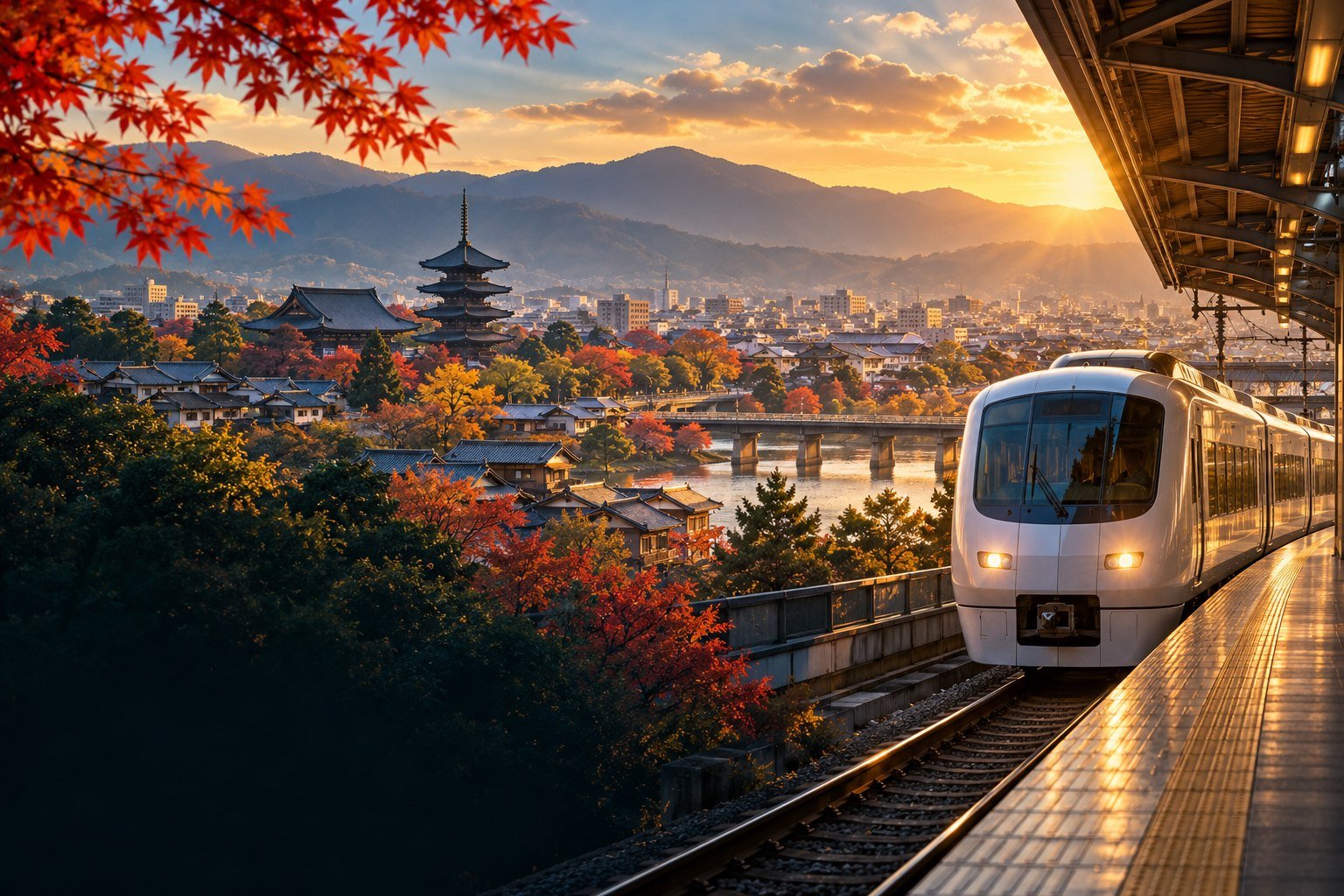
AI-generated editorial illustration of a journey towards Kyoto; the railway and city scene are a composite, not a photograph of a specific service or location.
For Kansai Airport to Kyoto, the HARUKA train is a strong starting choice: it reaches Kyoto Station directly, and the discounted one-way ticket for eligible overseas visitors costs ¥2,200. The airport limousine bus costs ¥2,800 and also reaches Kyoto Station without a change. [1] [3]
The useful question is what happens either side of that ride. A Terminal 2 arrival, a south-side station hotel or a bus leaving shortly can alter the decision. A guesthouse in Gion creates an onward journey with either option. Compare the complete arrival, including your bags and hotel entrance, before choosing.
Some links in this guide are affiliate links. If you book or buy through them, Taylor’s Trailblazing Travels may earn a commission at no extra cost to you.
HARUKA ¥2,200. Check passport, entry status and advance-purchase rules.
Bus ¥2,800. The Kyoto stop is on the station’s Hachijo side.
Two adults and two children aged 8 and 10 save ¥1,800 using eligible rail fares.
Reserve the Kyoto-to-airport bus. Arrival-direction boarding works differently.
Kansai Airport to Kyoto: compare the direct options
Both main choices avoid an interchange in Osaka. HARUKA is a conventional limited-express train, not a Shinkansen. You do not need to add a bullet-train connection at Shin-Osaka to reach Kyoto. [5]
| Decision | JR HARUKA | Airport limousine bus |
|---|---|---|
| Adult fare used here | ¥2,200 discounted visitor One-way Ticket; eligibility and purchase conditions apply | ¥2,800 ordinary one-way fare |
| On-board time | Typically around 80 minutes; select the actual departure | About 85–90 minutes from Terminal 1; traffic can add time |
| Departure point | Kansai-airport Station, by Terminal 1/Aeroplaza | Terminal 1; selected services also pick up at Terminal 2 |
| Kyoto arrival | JR Kyoto Station: choose the exit for your hotel | Kyoto Station Hachijo side, south of the tracks |
| Typical daytime service | Generally two departures an hour | Often around every 20 minutes, with variations and wider early gaps |
| Seat certainty | Reserve an ordinary seat when obtaining the appropriate ticket | From KIX: first come, first served; full buses may mean waiting |
| Main trade-off | Station access and ticket collection take time | Road delays and the precise stop may outweigh an easy boarding process |
Fare, frequency and boarding sources: JR West and Kansai Airport Transportation. The train discount is not the ordinary walk-up fare. [1] [2] [3] [6]
If you are ineligible or have not bought the visitor offer correctly, price an ordinary HARUKA ticket for your date and seat type before deciding: do not expect staff to sell everyone the ¥2,200 product at the airport. Equally, a bus ticket bought through a reseller can include charges beyond the operator fare.
Choose by your hotel’s entrance, not just “Kyoto”
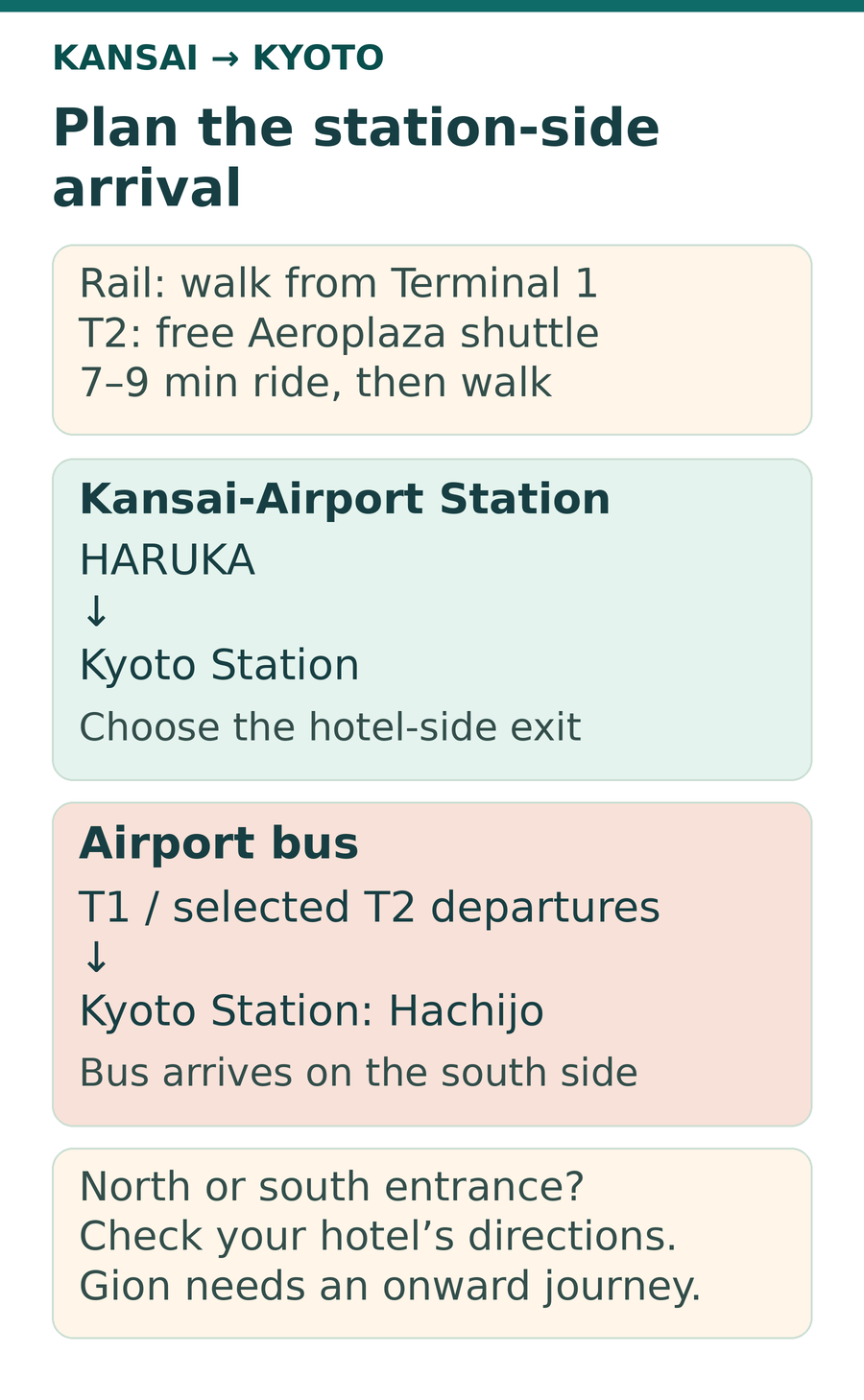
Save the hotel’s full address, nearest useful station and entrance before flying. “Near Kyoto Station” covers different sides of a large railway complex. Asking the hotel for its recommended arrival exit is more useful than measuring the distance to the station’s map pin.
| Your base | Starting choice | Why the final leg matters |
|---|---|---|
| Hachijo / south of Kyoto Station | Compare the next direct bus with HARUKA | The bus stop may be close to your entrance; rail still works if the fare or departure is better |
| North / Karasuma side of Kyoto Station | Start with HARUKA | Use the appropriate station exit; a bus arrival on the south side may leave an extra walk |
| Shijo / Karasuma corridor | HARUKA, then check the Karasuma subway | Choose the nearest accessible exit to the hotel, with space for the walk and transfer |
| Gion / eastern Kyoto | Direct train or coach, then plan a separate final leg | A taxi can be easier with several cases; rail via Tofukuji and Keihan can suit some addresses |
| Arashiyama or another outer district | Plan the onward local journey before buying | Kyoto Station is a connection point, not the end of the trip |
Kyoto’s official transport advice favours rail connections where they reduce exposure to city traffic and suggests the JR Nara Line/Keihan connection at Tofukuji for suitable Gion and eastern-city destinations. This is a route option, not a guarantee that it beats a taxi for your particular hotel. [7]
If you are still choosing accommodation, compare the transfer to the exact property while searching: Search Kyoto stays on Agoda or Compare Kyoto stays on Booking.com. These are city searches, not preselected station hotels; enter your dates, children and room needs, then inspect the map and cancellation terms.
A useful comparison starts after customs
Headline travel times begin at the platform or bus stop. They exclude disembarkation, immigration, baggage reclaim and customs. Those stages vary too much for a single reliable arrival guarantee. Make your transfer comparison from the point at which you are ready to leave the arrivals hall.
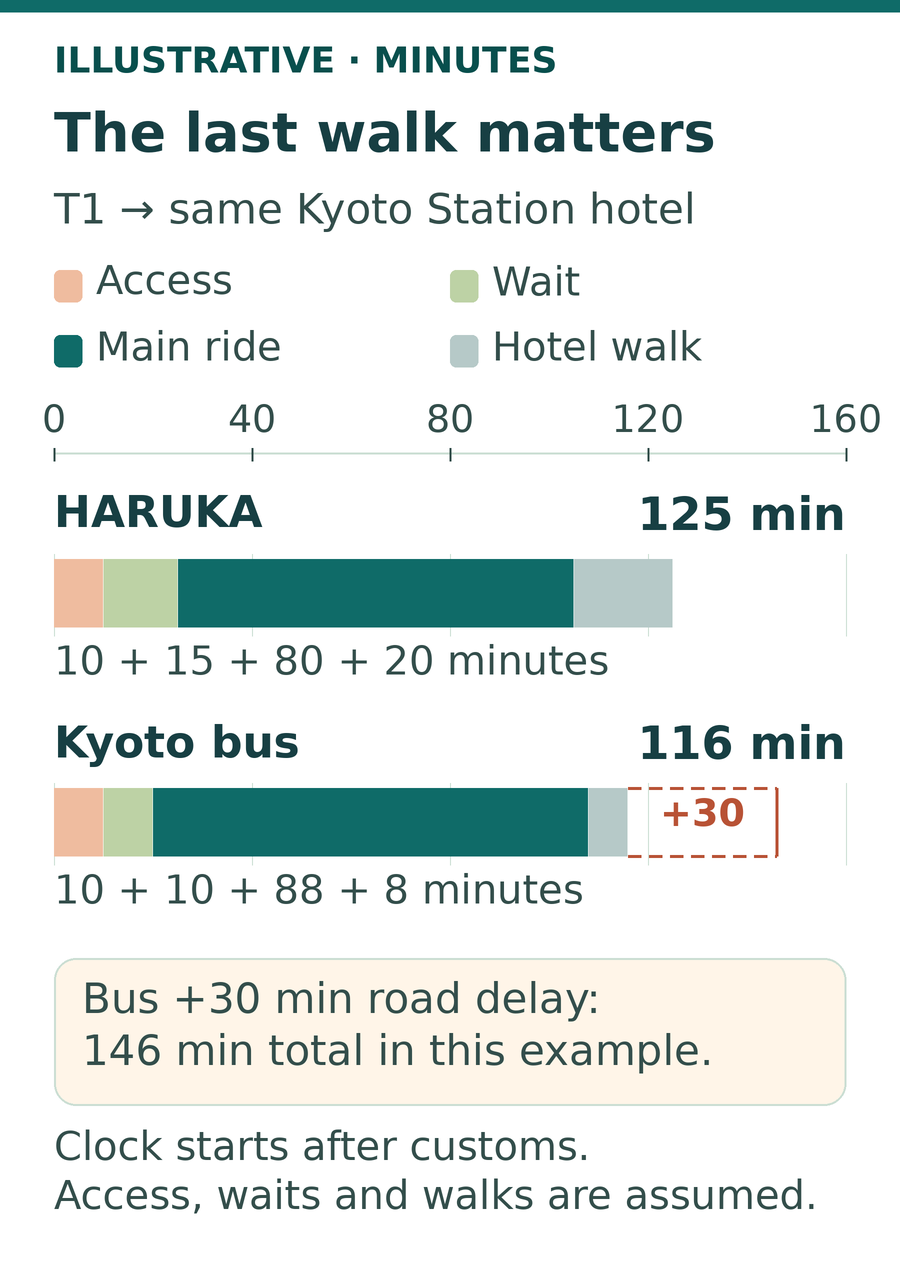
Here is an original worked example for a traveller arriving at Terminal 1 and staying a short walk from the south side of Kyoto Station. The access, wait and walking minutes are planning assumptions. The 80-minute rail example follows HARUKA 26’s checked timetable, and the 88-minute bus ride is within the operator’s published daytime timings. [3] [13]
| Part of the journey | HARUKA | Bus |
|---|---|---|
| Get to departure point / obtain ticket | 10 | 10 |
| Wait for departure | 15 | 10 |
| Ride to Kyoto | 80 | 88 |
| Leave station / collect bags and walk | 20 | 8 |
| Total | 125 minutes | 116 minutes |
In this example the bus wins by nine minutes. Add a hypothetical 30-minute road delay and its total becomes 146 minutes, so the train wins by 21 minutes. Conversely, a long rail-ticket queue could shift the result back. The example is useful because it shows which variables to check; it does not rank every arrival.
At Terminal 2, add the shuttle, waiting and walking needed to reach the rail station. The airport publishes 7–9 minutes for the shuttle ride itself; allocating about 20 extra minutes for the whole station-access step is an editorial allowance, not an airport guarantee. If the next listed Kyoto bus starts at Terminal 2, compare its actual departure there. [4]
Tickets, eligibility and a family cost check
Buy the correct HARUKA product
The discounted One-way Ticket requires a foreign passport and Temporary Visitor status. JR West says to buy the offer before arrival; the product page states that it is not available for purchase within Japan. Ticket collection needs the required passport and booking details. For its online reservation route, follow the payment-card instructions too, including the restriction on virtual and numberless cards. [1]
Ordinary HARUKA travel needs the base fare and the appropriate limited-express entitlement. Tapping an ICOCA card alone does not buy the extra limited-express ticket. Some digital products have their own gate and seat procedures, so use the instructions for the exact ticket you bought. [5]
Compare the whole party
| Party | Eligible HARUKA | Bus | Rail saving |
|---|---|---|---|
| One adult | ¥2,200 | ¥2,800 | ¥600 |
| Two adults | ¥4,400 | ¥5,600 | ¥1,200 |
| Two adults + children aged 8 and 10 | ¥6,600 | ¥8,400 | ¥1,800 |
The family calculation is 2 × ¥2,200 + 2 × ¥1,100 for rail, against 2 × ¥2,800 + 2 × ¥1,400 for the bus. Do not apply it to infants, older teenagers or a party that cannot all use the visitor ticket. Children needing their own seats and special luggage can alter the comparison.
Compare Kansai Airport–Kyoto options on 12Go if you want another booking channel alongside the official operators. Check the actual departure terminal, Kyoto stop, ticket-collection process, eligibility and total price. A broad route search can mix trains, buses and private vehicles; its “from” price need not describe the service you intend to use.
From the arrivals hall to your seat
If you choose HARUKA
- Check that the flight has arrived at KIX and note Terminal 1 or Terminal 2.
- From Terminal 1, follow the railway signs to the second-floor connection and cross to Kansai-airport Station. From Terminal 2, take the free shuttle towards Aeroplaza first. [4] [5]
- Use the JR West side of the station. Nankai is a separate railway serving different routes.
- Collect or buy the correct ticket, check the designated train and obtain a seat reservation where needed. Keep your passport accessible for a visitor ticket.
- Follow the departure board to the platform and board the correct carriage. Keep the ticket needed to leave the station.
- At Kyoto, follow the exit for your hotel or onward transport, instead of following the largest crowd.
If you choose the bus
- Look up the Kyoto Station service for your terminal and travel day. Not every listed departure stops at Terminal 2.
- Check the airport stop displayed by the operator and the destination on the vehicle. Buy or validate the fare using the method accepted on that departure.
- Join the correct queue. KIX-to-Kyoto is first come, first served; holding a ticket does not guarantee a place on the next full bus. [6]
- Hand over permitted luggage, retain its claim ticket and keep valuables and essential medicines with you.
- At Kyoto’s Hachijo-side stop, check the luggage tag before leaving and take the final route to your hotel. [3] [6]
Luggage, children and step-free travel
The coach can feel easier when you want to stow cases and sit down for most of the journey. KATE’s published allowance is up to two checked bags per person, with a combined weight of 30 kg, combined volume of 0.25 m³ and maximum length of 2 m. Ask about unusual items before travelling. Keep valuables, fragile items and power banks out of the hold. [6]
Ease with luggage is different from wheelchair access. KATE states that its ordinary coaches require passengers to transfer into a bus seat; a folding wheelchair can be stored. Its listed lift-equipped routes do not establish an accessible Kyoto service. If you need to remain in your wheelchair, arrange the route with the operator in advance and confirm the specific vehicle. [6]
For rail, request assistance and check lifts, wheelchair spaces and the final hotel approach before committing. A station with a lift somewhere in the building does not prove the shortest hotel exit is step-free. Allow time to reach the appropriate entrance and ask for help before boarding.
For a family, compare the number of bags as well as seats. Paying for a reserved rail seat can reduce uncertainty, while a coach avoids handling cases during the ride. Neither solves a long final walk in rain or an awkward staircase at a guesthouse.
Kyoto offers luggage storage and station-to-accommodation delivery services. Check opening hours, the receiving property, deadlines and delivery timing before relying on same-day forwarding; keep medication and overnight essentials with you. [8]
Late arrivals and the return to Kansai Airport
A late flight needs two checks: the last usable airport service and the journey after arriving in Kyoto. On the 18 October 2026 JR timetable, the last direct HARUKA leaves KIX at 22:16. Later JR departures shown from the airport are not later direct trains to Kyoto. Treat that as a checked-day example, then recheck your own date. [2]
The checked KATE timetable lists a last Kyoto bus from Terminal 1 at 23:20, with the preceding Terminal 2 pick-up at 23:07 and Kyoto arrival at 00:45. This can be a useful later alternative, but it is still subject to operating changes, capacity and road conditions. Confirm late check-in and the final trip from the bus stop. [3]
Do not book a tight final departure using the aircraft’s scheduled landing time as your station-arrival time. If you miss both workable options, ask airport staff about current services and compare an airport-area overnight stay with a confirmed private transfer. Avoid arriving in Osaka on a last train without first checking that your onward Kyoto journey still exists.
The return bus has different rules
Kyoto-to-KIX is a reservation route. Reserve ahead, use the precise boarding point and choose an arrival time that satisfies your airline’s check-in guidance, with extra allowance for road delays and your terminal. The earliest bus shown is not automatically the right choice for every early flight. [3] [6]
When a private transfer earns its extra cost
A private vehicle deserves consideration for a late arrival, an address awkward from Kyoto Station or a party whose luggage makes transfers difficult. Obtain a whole-vehicle quote with the exact hotel address, flight number, terminal, passenger ages and case sizes. Compare that figure with the complete rail or bus cost, including the final taxi if you would need one.
View the Kyoto transfer option on GetYourGuide. This listing serves Osaka or Kyoto: select the Kyoto option deliberately. The checked description includes a 60-minute airport waiting period, with overtime and out-of-area charges listed separately. Its age guidance is inconsistent: one panel excludes people over 75, while another says they must travel with younger adults. If that affects your party, obtain confirmation before booking. Confirm how waiting time is measured and whether your party and luggage fit the chosen vehicle. [9]
Compare the Kyoto arrival transfer on Viator for another operator’s offer. The checked listing describes pick-up from the arrivals hall at either terminal and asks travellers with oversized luggage to confirm acceptance. Its published operating hours are 05:00–22:30; arrange a different confirmed service if your pick-up falls outside that window. Its child-seat and accessibility descriptions need direct confirmation for individual requirements; do not infer a suitable wheelchair vehicle or guaranteed infant seat from a general listing label. [10]
These are researched booking options, not personally tested services. Check the current cancellation deadline, night supplements, delay policy, driver contact method and permitted waiting time before paying. A marketed seat count does not necessarily leave enough room for the same number of large suitcases.
A five-minute check before the flight
- Save the flight’s KIX terminal and the hotel’s Japanese address, entrance and late check-in contact.
- Confirm the exact ticket product, its purchase location, collection needs and refund conditions.
- Look up an ordinary arrival option and a workable late fallback for your own travel date.
- Keep essential booking details accessible without airport Wi-Fi. Follow digital-ticket instructions rather than assuming a screenshot is always valid.
- Check the final station exit or bus-stop walk, including lifts and bags.
If you want mobile maps and a way to contact the hotel after landing, Browse Airalo and select a Japan plan. Check that your phone is unlocked and eSIM-compatible and read the selected plan’s activation, coverage and call/data terms. The link opens the store, so choose Japan and confirm the product before buying. [11]
You can also add the arrival day and first hotel night to the Trip Itinerary Planner. Use it to organise the trip; confirm transport timings with the operators.
Questions before you travel
Does HARUKA go straight to central Kyoto?
It goes directly to Kyoto Station. That is a useful transport hub, but a hotel in Gion, Shijo or Arashiyama may still need another journey. Check the hotel address rather than treating the station name as the whole city. [5] [7]
Can I buy the ¥2,200 ticket after landing?
Do not rely on that. JR West’s discounted One-way Ticket page requires an eligible foreign passport and Temporary Visitor status and says this product is not available for purchase within Japan. Buy through an authorised advance route and follow its collection instructions. Ordinary tickets are a different purchase. [1]
Is the airport bus cheaper than the train?
Not when comparing the checked ¥2,800 bus fare with the eligible ¥2,200 HARUKA offer. If you cannot use the offer, compare the ordinary rail fare for your seat and date. Add the final hotel journey before choosing. [1] [3]
Can I board a Kyoto bus at Terminal 2?
Yes, on the departures with a Terminal 2 time in KATE’s timetable. Blank cells mean that departure does not stop there. For HARUKA, take the free shuttle towards Aeroplaza and continue to the rail station. [3] [4]
Can a Nankai route suit a Kyoto hotel?
Yes, particularly for some Kyoto-Kawaramachi or Gion-Shijo addresses. Kyoto’s official access guide routes these journeys through Tengachaya, with further changes towards Hankyu or Keihan services. For a first arrival with cases and a Kyoto Station hotel, HARUKA or the direct coach is normally simpler; compare the complete journey to your address. [12]
Make your transfer choice
Start with the eligible HARUKA ticket for a direct, good-value journey to Kyoto Station. Move the bus ahead when its next departure, Terminal 2 pick-up or Hachijo-side arrival makes the complete trip easier. If the hotel lies well beyond the station, decide the final leg first: it can matter more than a small difference in the airport ride.
Sources and editorial method
Editorial review: 18 October 2026. Core fares and routes have been cross-checked against official transport information. Timetables, ticket eligibility and commercial listing terms can change; confirm your travel date, terminal and selected option before paying.
Hotel-area recommendations are editorial judgements. The illustrated time comparisons and party-cost calculations are original planning tools, with their inputs and assumptions stated beside them; they are not observed or guaranteed journeys. Private-transfer terms describe the named listing and option, rather than every car service.
- JR West — HARUKA One-way Ticket: current price, eligibility and collection
- JR West — Kansai-airport Station departure timetable
- Kansai Airport Transportation — Kyoto timetable, stops and fares
- Kansai International Airport — Terminal 2 shuttle
- JR West — using trains from Kansai International Airport
- Kansai Airport Transportation — reservations, baggage and accessibility
- Kyoto City Official Guide — getting around Kyoto
- Kyoto City Official Guide — luggage services
- GetYourGuide — Kansai Airport private transfer options for Osaka or Kyoto
- Viator — private Kansai Airport arrival transfer to Kyoto City
- Airalo — Japan eSIM plans and compatibility information
- Kyoto City Official Guide — getting to Kyoto
- JR West — HARUKA 26 timetable, 18 October 2026
Illustrations in this article were created for Taylor’s Trailblazing Travels. Third-party photographs, where used, are credited beside the image or in the source list.