How to Plan a Second Trip to Japan Beyond the Golden Route
Choose a new experience, give it enough time and build the route around how you actually like to travel.
- Four regional directions
- A ten-night Kyushu framework
- Interests before checklists
Original editorial illustration of an imagined regional Japanese harbour; not a photograph or a verified viewpoint.
The most useful starting point for a second trip to Japan is not a map of everything you missed. It is a small account of what stayed with you: a neighbourhood you wanted to revisit, an unexpectedly absorbing museum, a long meal, a bath or a day when you were happy simply walking.
Use those clues to choose one new regional focus. Here, going beyond the Golden Route means putting a new region or deeper interest at the centre instead of automatically repeating Tokyo and Kansai. This guide compares different kinds of second visit, explains the transport checks that matter beyond the main corridor, and turns those decisions into an original ten-night northern Kyushu framework. It is for travellers who already have some sense of Japan and now want greater depth rather than a longer checklist.
This guide contains affiliate links. If you book or buy through them, Taylor’s Trailblazing Travels may earn a commission at no extra cost to you.
Choose a theme
Name what you want more of, not simply where you have not been.
Test the last mile
The connection beyond the main station often decides whether a plan works.
Stay long enough
Give the unfamiliar region several days without hotel changes.
Keep a familiar anchor
A return to a favourite city is not a failure to explore.
Decide what the second trip should change
Write three sentences before comparing regions: “I want more…”, “I want less…” and “This time I am willing to…”. Be specific. More coastal walking and less packing points towards longer stays. More specialist food and a willingness to take a local bus may suggest a different plan from a photography trip that depends on clear mountain views.
A useful contrast changes the experience, not necessarily every place name. You might return to Tokyo but spend your days in a different district, travel in another season or book a workshop that needs more time than a first visit allowed. Shibamata, for example, has a distinct old-town setting around Taishakuten and Yamamoto-tei within Tokyo itself.[1]
Give the trip one main purpose and, at most, a small set of supporting interests. “History and city evenings in Kyushu” is a workable brief. “Kyushu, Hokkaido, every art island and a return to Kyoto” is several holidays competing for the same nights.
Match a region to the experience, not a popularity list
The regional characteristics below draw on official destination guidance. The recommended trip shapes and trade-offs are editorial judgements; none implies that a region is empty, uniformly cheap or straightforward in every season.
| Regional focus | A good fit for | Start with this trip shape | The check that matters |
|---|---|---|---|
| Northern Kyushu | Urban history, food evenings and rail-linked cities.[2] | Fukuoka, Nagasaki and Kumamoto, with a deliberate final-airport plan. | Distinguish the Nagasaki rail connection from a through Shinkansen. |
| Tohoku | Regional cities, cultural interests and a landscape-led contrast.[3] | Choose a northern rail corridor or one coastal area—not all six prefectures. | Check the separate bus, local train or driving requirement for rural stops.[4] |
| Setouchi islands | Art, small islands and time spent travelling by sea.[5] | Use one gateway and give selected islands whole days. | Match museum opening days with both outward and return ferries. |
| A focused part of Hokkaido | A seasonal city-and-nature trip, rather than another central-Honshu circuit.[6] | Choose a compact cluster before adding long-distance outliers. | Check distances and onward transport; a station name need not mean walkable access.[7] |
When two options appeal equally, choose the one whose daily logistics fit your preferred pace. A region that looks less dramatic in a photograph may produce the better holiday if it gives you more time for the activity you came to do.
Apply four tests before committing to a remote stop
This is an original screening method for turning inspiration into a usable shortlist. A destination does not pass merely because there is a train to the nearest city. Write an answer to each test; an unanswered item is a planning task, not an automatic reason to reject the place.
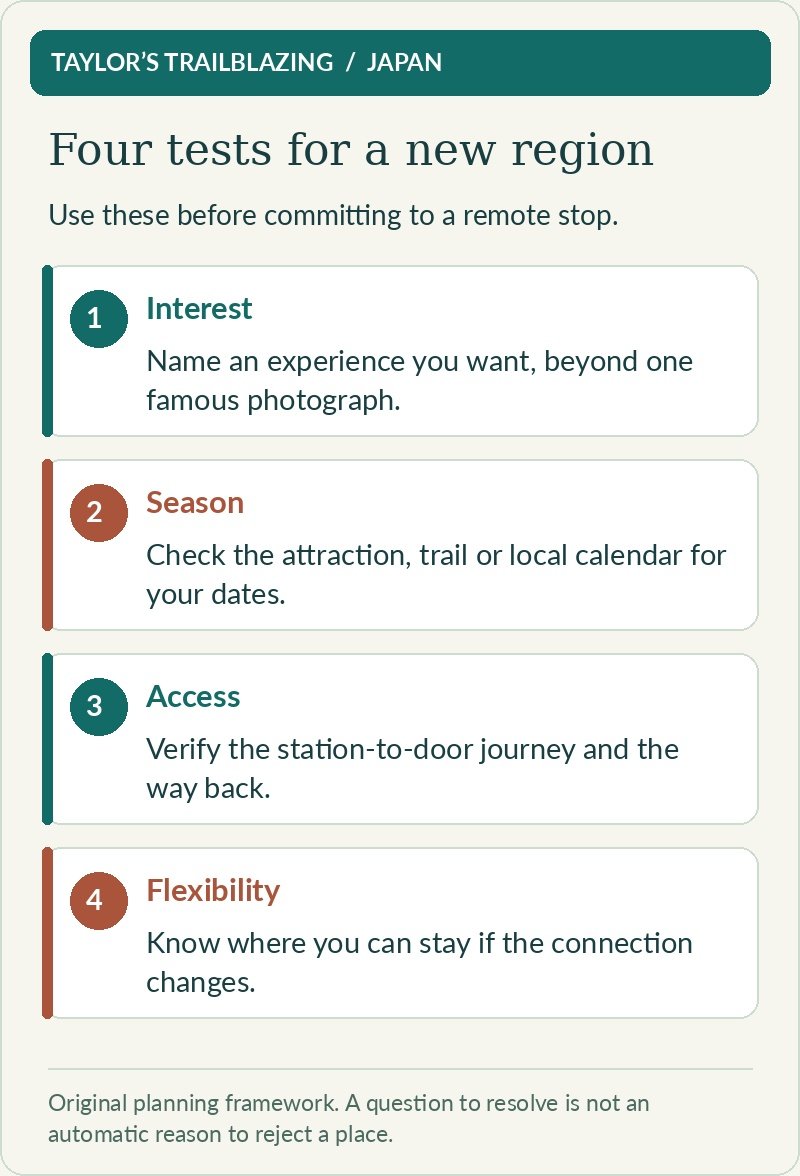
Interest: would you still go without the famous photograph?
Name a half-day experience you would genuinely enjoy there. A workshop, collection, waterfront walk or slow meal is a stronger reason for staying than a single viewpoint that may be obscured. For a weather-dependent place, identify a worthwhile alternative nearby.
Season: is the experience available on your dates?
Read the attraction or local tourism calendar for the actual month and weekday. Treat a snowy landscape, blossom view, island opening or mountain trail as a dated proposition. Use official weather and disaster information when conditions affect the visit.[8]
Access: can you complete the last mile and the return?
Record the main arrival station, local connection, walking distance with bags and last practical return. At Noboribetsu, the hot-spring area is separate from the JR station; the official guide identifies the onward connection. That is exactly the kind of detail a national rail map can conceal.[7]
Flexibility: what happens when one connection fails?
A remote overnight may still be worth it. The important question is whether you can absorb an extra night, taxi or missed activity without endangering the international departure. Reserve a final night near a suitable gateway when that protects the journey; do not treat all return travel as waste.
Adapt this ten-night northern Kyushu framework
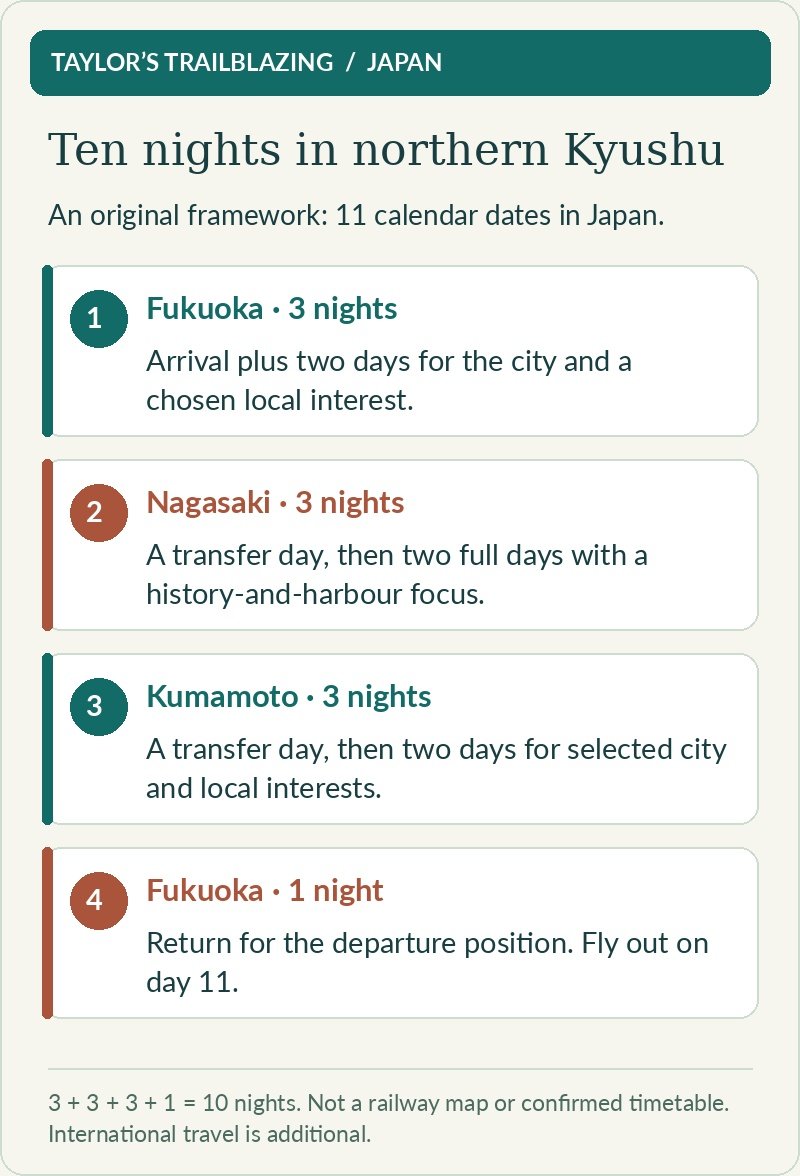
This example is an original planning framework for eleven calendar dates in Japan and ten paid nights, starting and ending in Fukuoka. International travel time is additional. It assumes interest in city history and local exploration, travel without a car, and willingness to use ordinary local transport. It is not a live bookable itinerary or a promise of exact journey times.
| Dates in Japan | Overnight allocation | Purpose and pacing |
|---|---|---|
| Days 1–3 | Fukuoka · 3 nights | Arrive and settle in, then use two days for the city and one optional local interest. Keep the arrival evening easy. |
| Days 4–6 | Nagasaki · 3 nights | Transfer on day 4. Use two full days to separate the Peace Park and Atomic Bomb Museum area from harbour-side history.[2] |
| Days 7–9 | Kumamoto · 3 nights | Make day 7 a transfer day with a light evening. Reserve the next days for the castle area and a deliberately chosen, separately checked outing.[2] |
| Day 10 | Fukuoka · 1 night | Return and position for the departure airport. This is a new hotel stay even if you use the original hotel. |
| Day 11 | Departure | Allow the real airport journey and airline check-in time; do not assume a sightseeing morning. |
For the Hakata–Nagasaki rail journey, JR Kyushu describes a Relay Kamome connection at Takeo-onsen onto the Nishi Kyushu Shinkansen Kamome, with a transfer across the same platform. Do not read an attractive rail map as evidence of a single through train. Price the whole connection and check the dated itinerary for the onward Nagasaki–Kumamoto journey too.[9]
The framework deliberately leaves three nights in each main city. Remove a city and give its nights to the others for a gentler version. Add a specialist rural overnight only after its transport and accommodation arrangements pass the four tests—not because there is an empty-looking space on the route.
Choose rooms for the days you will actually spend there
On a second visit, the hotel can support a slower rhythm: enough space to unpack, a convenient laundry option, an easy evening meal nearby and a manageable walk from local transport. These may matter more than being immediately beside the intercity platform.
Check the exact room category rather than assuming the property description applies to every room. For a traditional inn, confirm meal times, dietary requests, private-bath arrangements and arrival deadlines directly. For step-free access, ask about the whole path from the station or drop-off point to the room, not only the presence of a lift.
If the initial city is expensive on one of your dates, test the reverse order of the main stays before changing the whole region. Keep the gateway night tied to the actual flight, rather than moving it just to obtain a neater sequence.
Price the unfamiliar parts, not only the long-distance trains
Start a cost sheet with rooms, meals, intercity travel, local connections, admissions and an explicit reserve. The second-trip surprises often sit in the last-mile column: a taxi where a bus runs infrequently, luggage storage, a separately ticketed ferry or the cost of keeping an arrival day light.
Compare a rail pass only against journeys it actually covers on the dates you will use it. JR Kyushu sells different geographical versions with their own conditions; “Kyushu pass” is not permission to include every railway, ferry or other service in the saving.[10]
A worked convenience comparison—not a market quotation
Suppose an accessible-to-you hotel costs ¥2,000 more per room per night for three nights: the premium is ¥6,000. Suppose a cheaper alternative would require two extra ¥2,500 taxi journeys over the stay: ¥5,000 in additional transfers. On these invented comparison inputs, the better-located room costs only ¥1,000 more overall. Replace both room prices and both taxi estimates with real quotes; the example shows the calculation, not typical Japanese prices.
Repeat that calculation for your group rather than automatically multiplying every cost per person. A room or taxi may be shared; train tickets and many admissions are individual. Be equally clear about what is not priced yet.
Questions worth settling before you book
Does a second trip need to avoid Tokyo and Kyoto completely?
No. A familiar starting point can make a more adventurous regional visit easier. Revisit deliberately: choose a new neighbourhood, season or interest rather than automatically repeating the first itinerary.
Is a car essential beyond the Golden Route?
Not for the city-based Kyushu framework above. For rural and coastal extensions, research the local journey separately. The right answer depends on the exact stop and your mobility needs, not whether a region is labelled “off the beaten track”.[4]
Can you combine two distant regions in a fortnight?
It can be possible, but write out the flights, airport journeys, hotel changes and actual nights first. Choose the combination only when both regions retain enough time for their purpose. A domestic flight is a travel day component, not a free connection.
What changes for a solo traveller?
Compare single-occupancy room rates, the cost of unshared taxis and whether an organised activity offers a practical way to reach a specialist interest. Keep the same freedom to choose a simple city-based route rather than treating remoteness as a badge of experience.
Make the second trip more personal, not just bigger
Keep one sentence that describes why this trip is different. Choose a region that serves it, verify the final connections and give the places time to become more than stops. The strongest second visit may involve fewer famous sights and one familiar city; its value lies in spending more of the holiday doing what you actually enjoy.
The region selector, four tests, ten-night allocation and convenience calculation are original editorial planning tools. Official tourism and transport sources were reviewed on 17 October 2026. No route was personally travelled or accommodation personally inspected for this guide; dated operating arrangements need checking for your journey.
Sources
Source information reviewed on 17 October 2026. Recheck operating arrangements, prices and advice for your travel dates. Booking links do not establish live availability or guarantee a particular outcome.
- GO TOKYO — Shibamata neighbourhood guide
- JNTO — Kyushu culture by train
- JNTO — Tohoku regional overview
- JNTO — Getting to Sanriku Fukko National Park
- JNTO — Setouchi islands
- JNTO — Hokkaido regional overview
- JNTO — Noboribetsu, Upopoy and surrounding areas
- Japan Tourism Agency — Safety tips and official warning links
- JR Kyushu — Relay Kamome and the Takeo-onsen connection
- JR Kyushu — Regional rail-pass coverage and conditions
Illustrations in this article were created for Taylor’s Trailblazing Travels. Third-party photographs, where used, are credited beside the image or in the source list.