Shirakawa-go Travel Guide: Village Visit and Access Choices
Thatched farmhouses, a manageable village walk and an onward journey that deserves as much planning as the view.
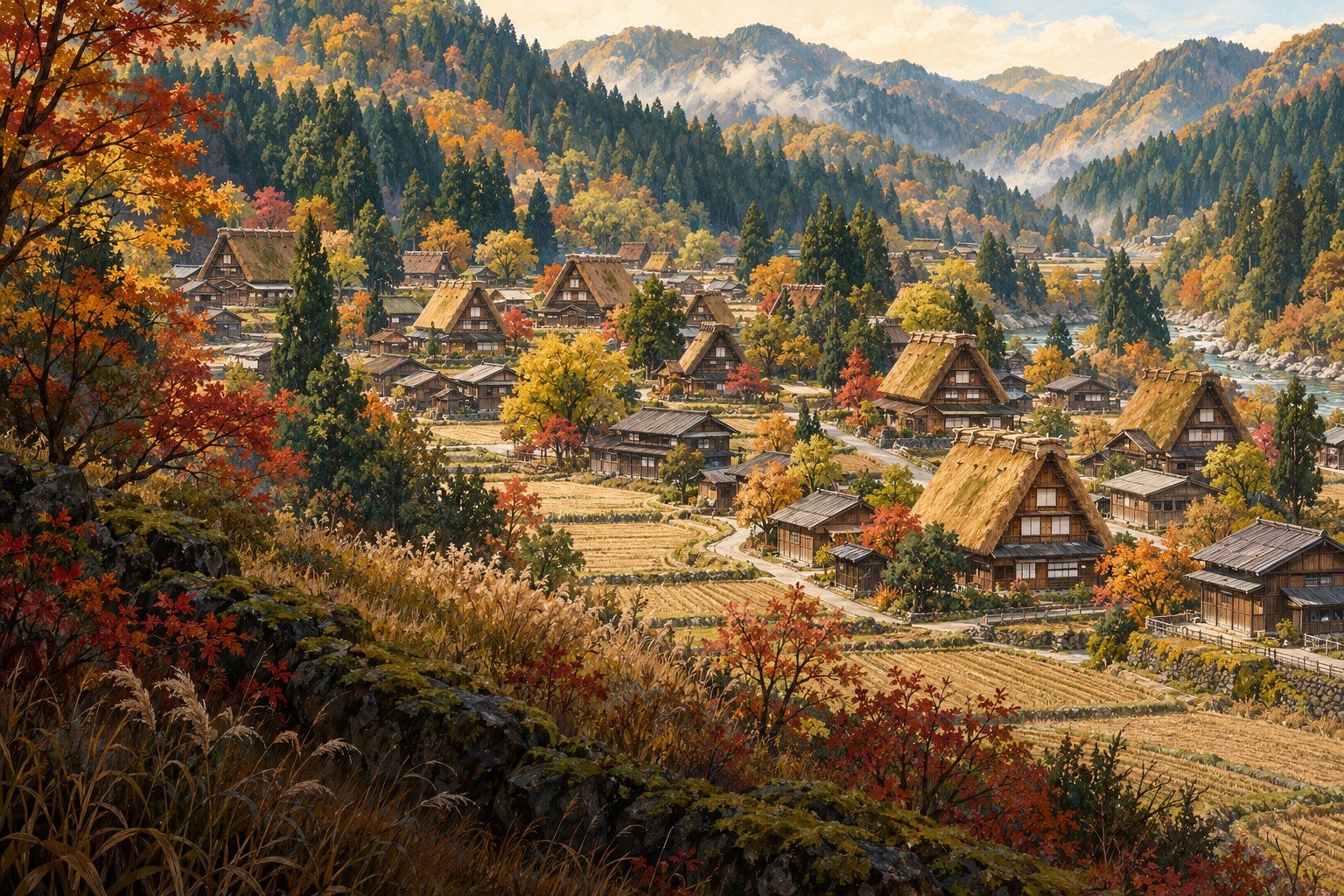
AI-created editorial illustration inspired by Ogimachi’s gassho-zukuri houses and mountain setting in autumn; not a photograph or a promise of seasonal conditions.
Shirakawa-go fits best when its village visit and its bus journeys are planned together. For most first-time visitors, three to four hours in Ogimachi gives enough room for the lanes, one farmhouse interior, food and a viewpoint if conditions allow. That is an editorial allowance after arrival, with transport to the village additional.
The destination’s character comes from a settlement that people maintain and inhabit. Ogimachi forms part of the UNESCO-listed Historic Villages of Shirakawa-go and Gokayama; Ainokura and Suganuma are separate villages in the Gokayama area. A visit to one does not automatically cover the others. [1]
This article contains affiliate links. If you make a booking or purchase through them, Taylor’s Trailblazing Travels may receive a commission at no extra cost to you.
3–4 hours
An editorial starting point for Ogimachi after arrival; give a museum-focused visit longer.
Wada House
Adult admission is ¥400, checked 17 October 2026; irregular closing days apply. [7]
Choose a visit that fits the rest of your trip
Start with where you will sleep before and after the visit. Moving hotels solely to shave a little time off a bus journey can add more work than it saves. The following choices use three criteria: luggage handling, the number of transport commitments and whether time outside the daytime visiting window matters to you.
Scroll sideways to see all columns.
| Visit shape | Best fit | What makes it work | Main compromise |
|---|---|---|---|
| Return day trip | You already have a base in Takayama, Kanazawa or Toyama | Arrange both directions and travel with a day bag | You retrace the bus journey |
| Stop between Takayama and Kanazawa | Both cities are already on your route | Two tickets, adequate village time and a luggage plan | A delayed first bus can reduce sightseeing time |
| One village night | A small inn or farmhouse stay is a priority | Choose the precise district and confirm meals and arrival rules | Less choice and flexibility than a city base |
| Organised excursion | You want transport coordinated or want to include Gokayama | Check the actual stops, free time and return point | The group timetable decides the pace |
For a first visit with no strong preference for a particular inn, favour a daytime visit that fits your existing route. An overnight stay earns its place when you want the stay itself, rather than merely an extra chance to photograph the same houses.
Get to Ogimachi through the right gateway
Shirakawa-go has no railway station. Highway buses arrive at Shirakawago Bus Terminal in Ogimachi, close to the village. Do not buy a train ticket to a different place called Shirakawa and assume it serves the thatched-roof settlement. [5]
Scroll sideways to see all columns.
| Starting point | Bus journey | Fare | Booking point |
|---|---|---|---|
| Takayama Nohi Bus Center | About 50–67 minutes | ¥2,800 | Reserved and non-reserved departures both exist; check the specific service. [2] |
| Kanazawa Station, west exit | About 75–85 minutes | ¥2,800 | Reserve a seat; confirm the departure stand. [2][3] |
| Toyama Station | About 80 minutes | ¥2,400 | Reserved services; compare both directions before committing. [2] |
| Nagoya, Meitetsu Bus Center | About 2 hours 40–45 minutes on the direct services shown | Date-dependent fare | Use the operator’s fare calendar and seasonal timetable. [4] |
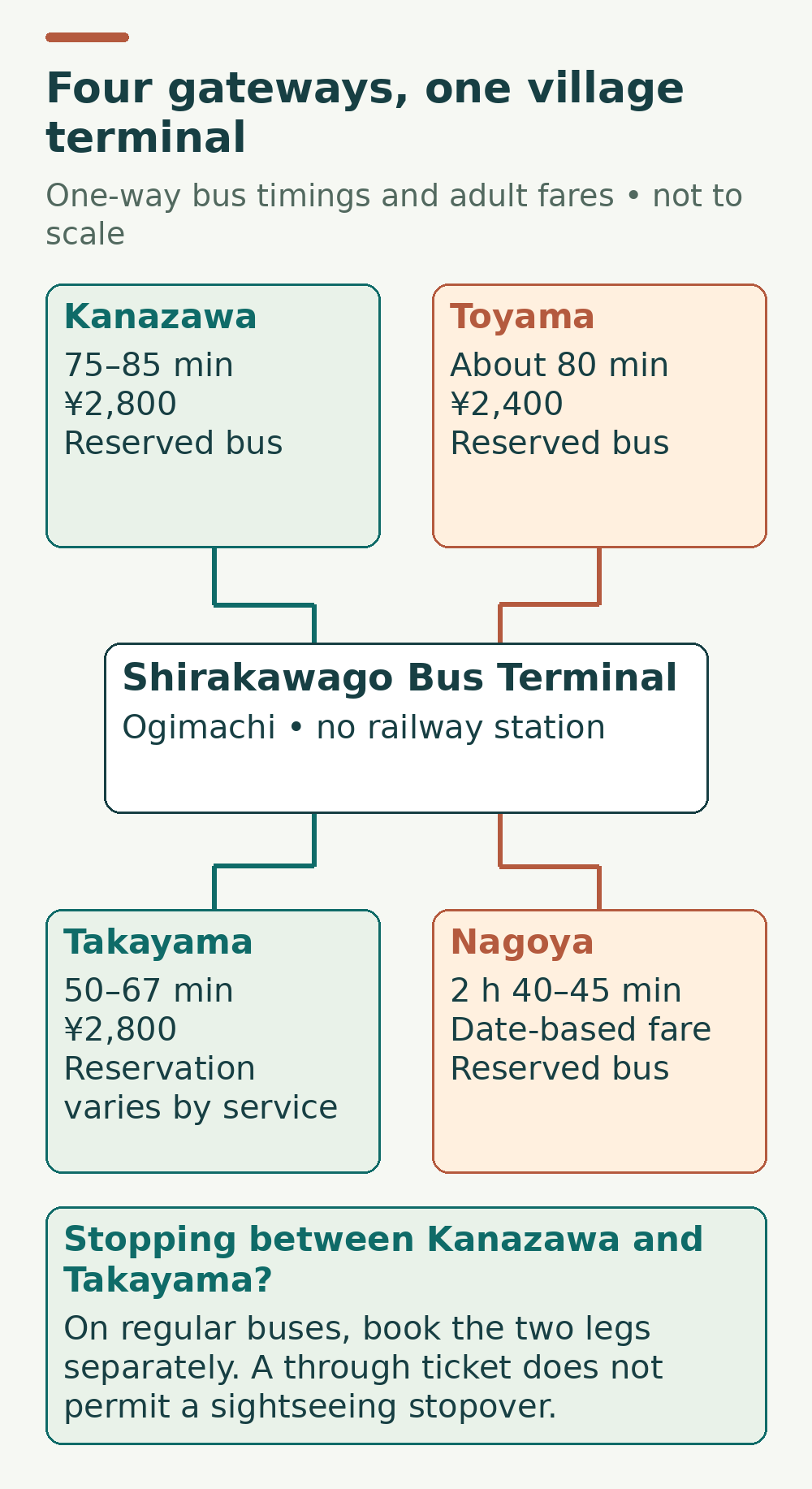
Takayama offers the shortest common approach. Kanazawa works well when a garden-and-old-district stay is already part of the holiday. Toyama is a useful rail gateway when the wider journey favours the Hokuriku route. Nagoya is possible as a return day trip, but the bus travel alone uses more than five hours: choose an early outward service and make Shirakawa-go the day’s main purpose.
From Tokyo or the Kyoto–Osaka area, reach a suitable gateway by rail and continue by bus. Treat that as a substantial travel day when building the itinerary, rather than a quick detour. Exact connections, traffic and your starting hotel can change the practical result. [5]
Book both legs and understand the stopover cost
The regular reserved route’s booking window opens on the same date in the preceding month. A date outside that window is not evidence that the service is sold out. Japan Bus Online requires separate one-way purchases for outward and return journeys; a sightseeing stop between Takayama and Kanazawa also needs two separate tickets. [20]
- Choose the outward service and a viable return or onward departure together.
- For a stopover, search Takayama–Shirakawa-go and Shirakawa-go–Kanazawa separately, or reverse both legs.
- Check whether each departure requires a reservation. A ticket for a non-reserved service does not guarantee that you can board your preferred departure.
- Save the tickets, stop names and booking conditions offline. Keep a margin before any later train, dinner booking or accommodation check-in.
Nohi says passengers may have to wait for another departure if non-reserved buses and any additional vehicles fill. Holding the Takayama-Hokuriku Area Tourist Pass does not itself reserve a seat: Nohi currently directs pass holders to telephone reservations for covered reserved-seat services. Check the pass’s exact bus coverage before paying separately online. [6][18]
What a four-hour stopover adds
Using standard adult fares, Takayama–Shirakawa-go plus Shirakawa-go–Kanazawa costs ¥2,800 + ¥2,800 = ¥5,600. The direct Takayama–Kanazawa fare is ¥4,200, so breaking the journey adds ¥1,400 before village spending. [2][3]
For a simple time model, allow 50 minutes on the first bus, 240 minutes between arrival and departure, and 75 minutes on the second bus: 365 minutes, or 6 hours 5 minutes. A faster through service takes around 2 hours 15 minutes, making the stopover about 3 hours 50 minutes longer in this example. These are calculated planning allowances using published journey times, not a matched bookable connection; actual departures and delays may require more time. [2][3]
Use the operator-linked Japan Bus Online route search for reserved services. You can also compare Takayama Nohi Bus Center–Shirakawago bus listings on 12Go if comparing a reseller’s payment and cancellation options helps. Confirm the exact terminal names, ticket type, total price and whether a seat is reserved; use the operator’s timetable for the journey plan. [2][21]
Choose the village sights with a clear purpose
Walk the lanes and look at how the houses work
Begin with the public village lanes and the relationship between houses, fields and waterways. The steep roofs and large interiors belong to a building tradition shaped by the mountain environment and livelihoods including silkworm rearing. A farmhouse interior gives context that an elevated photograph cannot. [1]
Wada House: a useful first interior
Wada House is around a three-minute walk from the bus terminal. Adult admission is ¥400, payable in cash; published hours are 09:00–17:00 with irregular closing days. The first and second floors are open to visitors, with English explanations upstairs. Prices and hours checked 17 October 2026. [7]
Allow about 35–45 minutes as a planning estimate. Choose it for a straightforward introduction to the house form, rather than assuming every attractive building in the village is open to the public. A convenient location does not mean every floor is step-free.
Ogimachi Castle Ruin Observation Area: the wider view
The public viewing area is a useful way to understand the settlement’s scale. Official village guidance gives around 15 minutes uphill on foot, or a paid shuttle costing ¥300 each way in cash. Private cars cannot access the viewing areas. Shuttle operation depends on weather and road conditions, and the published service has a midday gap: check it on the day. [9]
Use the public castle-ruins viewpoint as the independent-visit plan. Neighbouring Tenshukaku has different arrangements for tour vehicles; do not assume a tour’s access or winter event ticket rules apply to an ordinary walk. If the slope is unsuitable or visibility poor, the village-level visit remains worthwhile.
Gasshozukuri Minkaen: more time with the buildings
The outdoor museum is across the river near the main car park. Its current Japanese price list gives adult admission at ¥800; older English pages still show the previous fee. March–November hours are 08:40–17:00; December–February hours are 09:00–16:00. Last entry is 20 minutes before closing. It closes on Thursdays from December to March, or the preceding Wednesday when Thursday is a public holiday. Checked 17 October 2026. [8]
Choose the museum if architectural detail matters more than the panoramic photograph. Allow 75–90 minutes as an editorial estimate, including the walk and bridge crossing. It is an outdoor collection, so rain still affects the visit. For a short stay, substitute it for other stops rather than adding it automatically.
Give four hours a realistic job
This example allocates 240 minutes between arrival at the bus terminal and your booked departure. It assumes comfortable village walking, one farmhouse interior, a straightforward meal and a usable viewpoint route. It is a time budget, so change the order for openings, weather and shuttle operation.
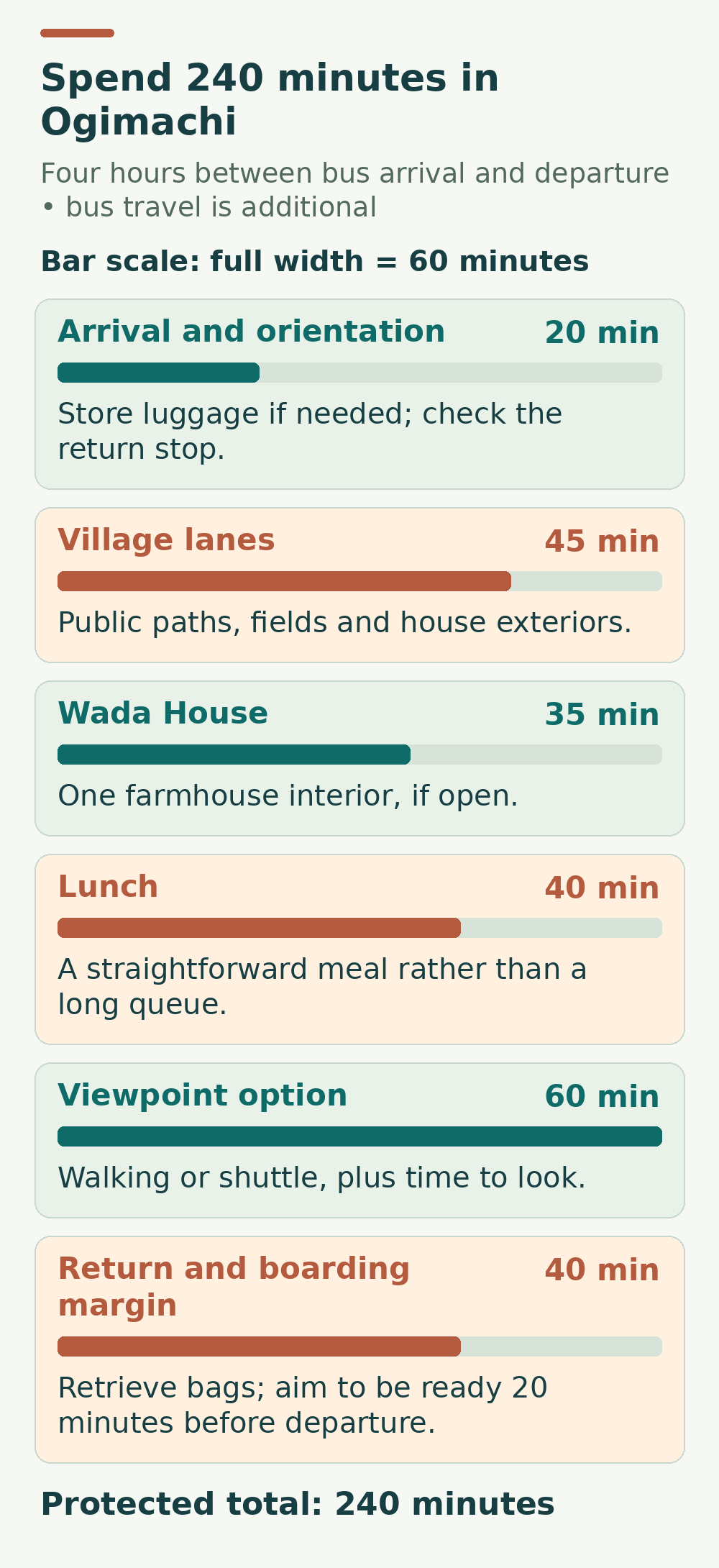
The final 40 minutes include returning to the terminal, retrieving luggage and being ready to board 20 minutes before departure. That margin is an editorial recommendation, not a published boarding deadline. Protect it before deciding on another shop or photograph.
If you prefer Minkaen, replace the 35-minute Wada visit and 60-minute viewpoint block with an 80-minute museum visit; this releases 15 minutes for slower walking. If your arriving bus is substantially late, remove the viewpoint block first. The easiest part of the plan to shorten is an optional stop, rather than the time needed to retrieve your belongings.
With only three hours, keep the village walk, one interior and a short meal, then assess the remaining time. With five hours, give the existing stops more time or take a slower lunch. With six hours, there is room to add the museum while retaining the other blocks. Extra time is most useful when it buys a different experience; it need not become a second circuit of the same lanes.
Stay in the right part of Shirakawa-go
A booking labelled “Shirakawa” or “Shirakawago” can cover more than the World Heritage village. The tourist association distinguishes Ogimachi from districts such as Iijima, Hatogaya and Hirase. Its accommodation directory also separates gassho houses, ryokan, minshuku and other stay types. A traditional-looking hotel is not automatically a historic thatched farmhouse. [11]
Scroll sideways to see all columns.
| Location or stay type | Choose it for | Check before paying |
|---|---|---|
| Ogimachi farmhouse or small inn | The accommodation experience and proximity to the village lanes | Exact building type, shared facilities, stairs, meals and arrival deadline |
| Iijima or Hatogaya accommodation | A particular property whose facilities suit you | Walking distance, luggage transfer and any shuttle timetable |
| Hirase accommodation | A stay focused on that district or its hot-spring setting | The separate journey to Ogimachi; avoid treating it as a central village address |
| A Takayama or Kanazawa base | A wider choice of accommodation and an organised day visit | Both bus legs and the cost of returning |
For a gassho-house stay, start with the tourist association’s accommodation directory. For broader comparison, compare Shirakawago-area stays on Agoda or compare stays in Shirakawa, Gifu, on Booking.com. Both searches cover the surrounding area as well as central options, so check the property map, room type, meal plan and cancellation terms. No room price or date-specific availability is assumed here. [12][13]
Confirm dietary needs before choosing a meal-inclusive plan. If you need a flexible dinner time, private bathroom or step-free access, make those selection criteria from the start. A small traditional inn may be a poor fit even when its exterior is exactly the one you hoped to see.
Use a tour when its structure solves a problem
An organised trip can remove several transport decisions, especially when more than one village is involved. Compare actual village time and the final drop-off point before comparing the headline duration.
A focused visit from Kanazawa
The Kanazawa departure: Shirakawa-go morning tour on GetYourGuide is listed as roughly five hours, including transport and time in Shirakawa-go. The published itinerary finishes at Kenrokuen Garden rather than returning to the station; check the selected departure’s final drop-off. It is useful if that finish suits your afternoon. Check the selected date’s arrangements, meal exclusions and meeting point before booking. [14]
Two villages from Takayama
The Takayama departure: Nohi’s Shirakawa-go and Ainokura tour on Viator combines Ogimachi with Ainokura in Gokayama, with museum and observation-point elements listed. It returns to the Takayama meeting point and occupies most of the day. Choose it if seeing the contrast between settlements matters more than having a long independent visit in one village. Check seasonal substitutions and what the selected ticket includes. [15]
An onward transfer with a shorter village stop
LIMON’s coordinated transfers on GetYourGuide run from Takayama to Kanazawa via Shirakawa-go and Kanazawa to Takayama via Shirakawa-go. They include luggage storage and transport while you explore independently, without a guide. This can simplify a journey with bags, but the fixed village stop is shorter than this guide’s three-to-four-hour visit. Confirm the exact stop length for your departure: sections of the current listings give different durations. The vehicle may be a coach, van or taxi. Choose ordinary separate bus legs if more village time matters most. [22][23][24]
These ordinary daytime listings do not provide a winter light-up booking. If you need an accessible vehicle or cannot manage steps, confirm that requirement with the operator before purchase; the presence of a coach or guide does not establish accessibility.
Plan winter and light-up visits separately
Spring and autumn suit a visit built around walking, while summer needs shade, water and a plan for rain or heat. Winter changes the practical question: allow for slippery surfaces and disrupted transport, and choose the visit for the conditions actually forecast. The village publishes webcams and road information that are more useful than assuming a particular snow scene will appear. [9]
The announced 2027 light-up dates
The official 2027 event is scheduled for 11, 17, 24 and 31 January, 17:30–19:30. Advance reservations and admission tickets are required; there are no same-day event ticket sales. Ordinary event admission does not include the observation deck. Deck access requires a qualifying accommodation or operator tour plan that specifically includes its ticket. Severe winter conditions may lead to cancellation. [16]
Day visitors on those dates must also read the event-day restrictions. The organiser says regular-bus visitors without an event ticket must arrive by 15:20; an entry gate is set up from 15:30. Do not plan to arrive late and wait in the village until the lights come on. Regular buses do not run a return service after the light-up, so arrange event transport or a qualifying overnight stay as part of the booking. Use the official 2027 event overview for your actual visit type and its booking process. Information checked 17 October 2026. [16]
A normal village stay on another winter date is a separate experience. If your main aim is the light-up, book the event arrangements first, then fit the rest of the holiday around the confirmed date. If your aim is architecture and village life, an ordinary daytime visit is easier to adapt.
Handle luggage, spending and village etiquette
Travel light and budget for the choices you make
The tourist association lists bus-terminal lockers available 08:00–17:00 at ¥500 for small or medium lockers and ¥1,000 for large lockers, plus a nearby staffed storage option until 17:00. Capacity is not guaranteed. Checked 17 October 2026. A return day trip with a day bag avoids depending on finding a locker; a stopover needs a workable fallback. [10]
Scroll sideways to see all columns.
| Item | Amount | Basis |
|---|---|---|
| Two bus singles | ¥5,600 | ¥2,800 each way. [2] |
| Wada House | ¥400 | Current adult admission. [7] |
| Food and a drink | ¥1,800 | Planning allowance; choose your own meal budget |
| Example total | ¥7,800 | Excludes travel to Takayama, accommodation and shopping |
| Optional additions | According to use | Viewpoint shuttle ¥600 return; Minkaen ¥800; locker ¥500–1,000. [8][9][10] |
Carry some cash even if your main transport ticket is paid online. If travelling by car, official standard-car parking is ¥2,000 at the designated car park, normally 08:00–17:00 with last entry 16:30. Village staff may direct vehicles elsewhere when it is full. Include rental, fuel, tolls and parking time in any bus-versus-car comparison. [5][17]
Keep the visit compatible with village life
Use public paths and signed entrances, respect closed doors and do not enter fields or private yards for a photograph. The village’s published guidance prohibits drones, stresses the fire risk around thatched buildings and asks visitors to take their rubbish away or return shop waste to the relevant shop. Daytime visitors should leave by 17:00; village accommodation guests have different access to quieter hours. [9][17]
For winter walking, prioritise warm layers and footwear that suits the surface. For reduced mobility, ask about the exact bus, the viewpoint slope and the floors open inside a house. Nohi says wheelchair arrangements vary by service and may require transferring to a bus seat; contact the operator in advance. [6]
Save the village map, bus confirmations and accommodation directions offline. If you need mobile data, compare mobile-data options with Airalo and select a suitable Japan plan. Check that your phone is unlocked and eSIM-compatible, then check the plan’s activation and data rules. A data plan is useful for directions and messages but is not a promise of coverage everywhere in the valley. [19]
Resolve the final planning questions
Is two hours enough?
It can cover a short village walk and one clear priority. It is a poor allowance for luggage storage, a leisurely meal, a farmhouse, the viewpoint and the museum together. If your available window is tight, remove choices before booking the buses rather than expecting to walk faster.
Can I visit from Tokyo in one day?
It is a demanding fit. The official access overview puts a Tokyo–Toyama–Shirakawa-go approach at around four hours one way before a generous connection margin or hotel travel. A village visit between regional overnight stays usually makes better use of a first Japan trip. [5]
Can I combine Shirakawa-go and Gokayama independently?
They are separate settlements, not adjoining sections of one village. A multi-village day needs its own bus plan, including the return; the ordinary Kanazawa highway services have seasonal and directional restrictions at Suganuma. Do not infer that every passing bus can be used for every village-to-village leg. [1][2][3]
What if the viewpoint is closed or the weather is poor?
Keep the village walk and an available interior as the core visit. Use the spare time for a meal or a deeper architectural visit if conditions suit, or leave on your booked bus without trying to replace every missed photograph. The useful decision is whether your main reason for coming still holds.
For most first visits, choose three to four hours in Ogimachi and settle the return or onward transport before adding extras. Choose an overnight stay for the accommodation and quieter hours, and choose a two-village tour when that broader comparison is worth giving it the day.
Sources and planning notes
This is a research-led guide. Official tourism bodies, transport operators and attraction information inform the factual advice; base choices, pacing and explicitly labelled budget examples are editorial planning judgements. Sources checked on 17 October 2026. Recheck current prices, conditions and operating notices for your travel dates.
- UNESCO — Historic Villages of Shirakawa-go and Gokayama
- Nohi Bus — Takayama, Shirakawago and Hokuriku route
- Hokutetsu — Shirakawa-go and Takayama highway bus
- Meitetsu Bus — Nagoya, Shirakawa-go and Kanazawa
- Shirakawa-go Tourist Association — Access
- Nohi Bus — Frequently asked questions
- Shirakawa-go Tourist Association — Wada House
- Gasshozukuri Minkaen — Current prices and opening hours (Japanese)
- Shirakawa Village — SHIRAKAWA-Going visitor guidance
- Shirakawa-go Tourist Association — Visitor questions
- Shirakawa-go Tourist Association — Accommodation directory
- Booking.com — Shirakawa in Gifu accommodation search
- Agoda — Shirakawago accommodation search
- GetYourGuide — Kanazawa departure, Shirakawa-go morning tour
- Viator — Nohi Bus, Shirakawa-go and Ainokura excursion
- Shirakawa-go Tourist Association — Official 2027 light-up event overview
- Shirakawa Village — Responsible tourism
- JR Central and JR West — Takayama-Hokuriku Area Tourist Pass
- Airalo — Staying connected in Japan
- Japan Bus Online — Route booking rules
- 12Go — Takayama Nohi Bus Center to Shirakawago Bus Terminal
- GetYourGuide — LIMON one-way Takayama to Kanazawa via Shirakawa-go
- GetYourGuide — LIMON one-way Kanazawa to Takayama via Shirakawa-go
- LIMON Tours — Golden Route operator network
Illustrations in this article were created for Taylor’s Trailblazing Travels. Third-party photographs, where used, are credited beside the image or in the source list.