Where to Stay in Kanazawa: Station or Historic Districts
Choose the station for repeated rail journeys, the historic centre for local outings, or a townhouse when the room itself is part of the trip.
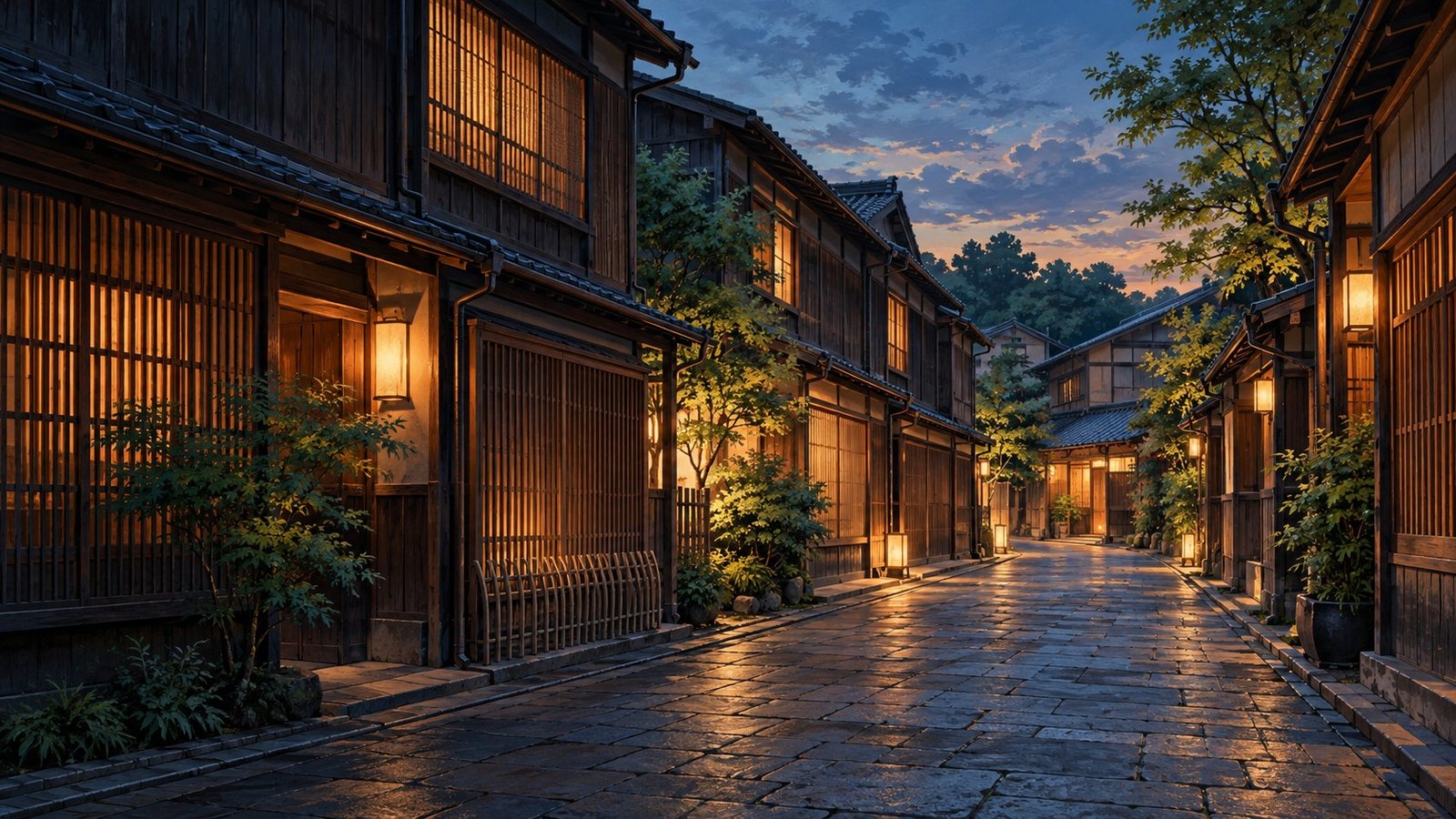
An original AI-generated illustration inspired by Kanazawa; the street and accommodation are imagined, not a photograph of a named property.
Where to stay in Kanazawa depends on what happens after you put down your suitcase. A room beside the station makes a late arrival or early train simpler. A hotel around Omicho, Oyama Shrine or Korinbo can make more sense when you will spend your days in the city and return between outings. Kanazawa’s official tourism guide identifies the station, Omicho Market and Korinbo as its principal accommodation areas.[1]
The historic districts are several different places, so choosing “old Kanazawa” still leaves a decision to make. This guide compares five useful search areas and five real properties, then tests the station-versus-centre choice against two travel patterns. Hotel selection uses the linked room and access information; it does not draw on personal stays or date-specific room quotes.
Some links in this guide are affiliate links. Taylor’s Trailblazing Travels may earn a commission if you book or buy through them, at no extra cost to you.
Rail-led itinerary
Station East or West
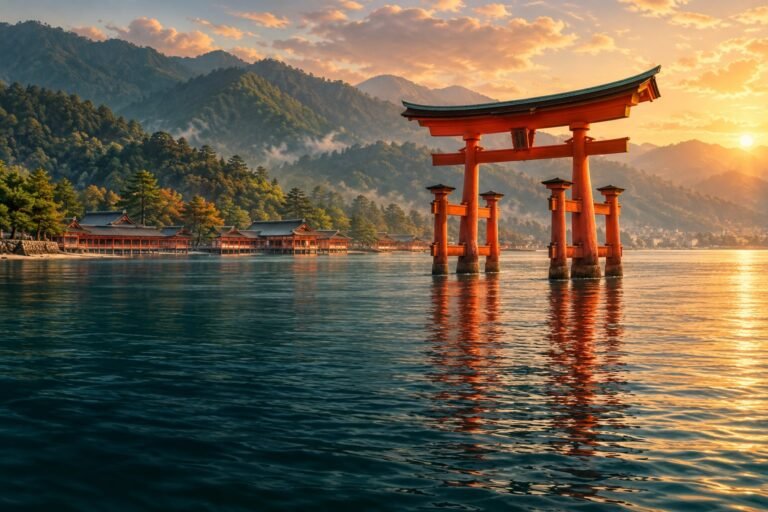
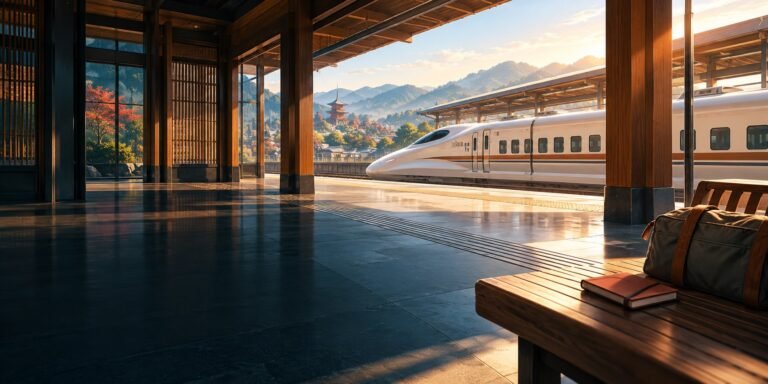
Use the exit and transport terminal that match your actual arrival and onward journey.
Mixed city stay
Omicho–Oyama
A useful first search between the market and the central sightseeing streets.
Repeated local outings
Korinbo / Nagamachi
Put the hotel near the streets where you will begin and end your days.
Traditional setting
Higashi Chaya
Check stairs, bedding, reception hours and the final approach before booking.
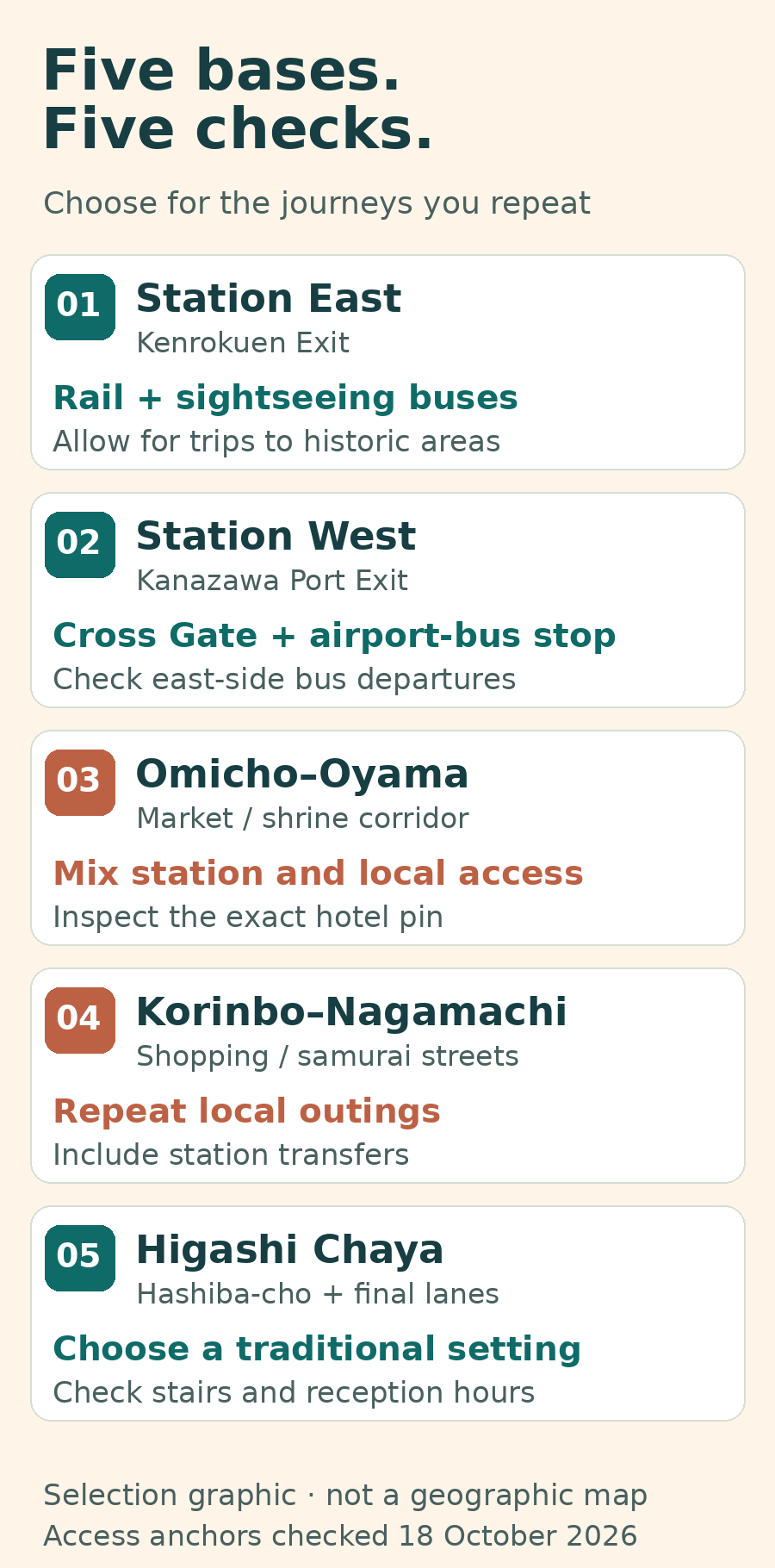
Where to stay in Kanazawa: five useful bases
Use these as hotel-search areas rather than rigid neighbourhood boundaries. Omicho and Oyama form a useful corridor; Korinbo and Nagamachi overlap as a practical accommodation search, although the shopping streets and preserved residential lanes have different characters. The operator’s bus guide connects Omicho with Musashigatsuji, Nagamachi with Korinbo, and Higashi Chaya with Hashiba-cho.[2]
Swipe across the table to compare →
| Base | Put it first when… | Useful anchor | Compromise |
|---|---|---|---|
| Station East · Kenrokuen Exit | Rail arrivals and sightseeing-bus departures both matter. | Tsuzumi-mon Gate and the eastern bus terminal. | You still need to reach the historic districts for most local outings. |
| Station West · Kanazawa Port Exit | The exact room or a west-side transport connection suits you. | Cross Gate and the West Gate airport-bus stop.[5][20] | Check the route across the station for east-side departures. |
| Omicho–Oyama corridor | You want a compromise between station access and sightseeing on foot. | Musashigatsuji–Omicho Market or Minamicho–Oyama Shrine. | A hotel near Oyama is not necessarily next door to the market. |
| Korinbo / Nagamachi | Local sightseeing, shopping and hotel breaks dominate your stay. | Korinbo and the approach to Nagamachi. | Allow for the station transfer on arrival, departure and any day trips. |
| Higashi Chaya / Higashiyama | A traditional-street setting is a priority. | Hashiba-cho and the specific lane leading to the property. | Small-property layouts, stairs and reception arrangements need checking. |
Swipe sideways to read the full planning graphic.
Use your itinerary to break a tie
For a brief rail stop, shortlist station hotels first. For a couple staying three nights with no day trips, compare one Omicho–Oyama hotel with one Korinbo hotel before paying for station proximity. For a family needing laundry or cooking facilities, inspect the room category before choosing the neighbourhood: useful configurations exist on both sides of this decision.
Higashi Chaya is the more deliberate choice. It suits travellers who want time around those streets, rather than a universally convenient base for every Kanazawa sight. A room in a traditional building can be a highlight, but assess its physical layout with the same care as its photographs.
Open the hotel map when comparing city-wide results; the word “Kanazawa” covers all these areas and more.
Compare Kanazawa stays on Agoda Compare Kanazawa stays on Booking.com
Count journeys before paying for convenience
A convenient arrival is worth having, but it happens once. Count the journeys between your hotel and the places you will repeatedly use, including any return for a rest or a change of clothes.
One pair of rooms, two different answers
This original model uses two adults sharing a room for three nights. Station room S costs an assumed ¥18,000 per night; historic-centre room H costs an assumed ¥19,000. These are invented comparison inputs, not advertised prices or claims about either area’s usual cost. Both quotes include all taxes and provide equivalent bedding and meal terms.
Assume a short hotel-to-anchor walk takes five minutes. A longer transfer takes 25 minutes: five walking, eight waiting and twelve on a bus. S has the short station walk and longer local transfer; H has the reverse. The local anchor represents your chosen sightseeing or evening meeting point, not every historic district. Replace these assumed door-to-door times with your actual hotel routes.
Each longer transfer uses one ¥220 adult bus ride, the published Kanazawa Loop Bus fare checked on 18 October 2026.[3] The two travellers move together, so minutes below are elapsed time, not person-minutes. Walking during sightseeing, train journeys, meals and other costs common to both choices are excluded.
Swipe across the table to compare →
| Trip pattern | Station room S | Centre room H | What changes the decision? |
|---|---|---|---|
| Three local outings: 2 station legs + 6 local legs | 160 minutes; ¥54,000 room + ¥2,640 buses = ¥56,640. | 80 minutes; ¥57,000 room + ¥880 buses = ¥57,880. | H saves 80 minutes for ¥1,240 more across the stay. |
| Two rail day trips and one local outing: 6 station legs + 2 local legs | 80 minutes; ¥54,000 room + ¥880 buses = ¥54,880. | 160 minutes; ¥57,000 room + ¥2,640 buses = ¥59,640. | S saves 80 minutes and ¥4,760. |
Swipe sideways to read the full planning graphic.
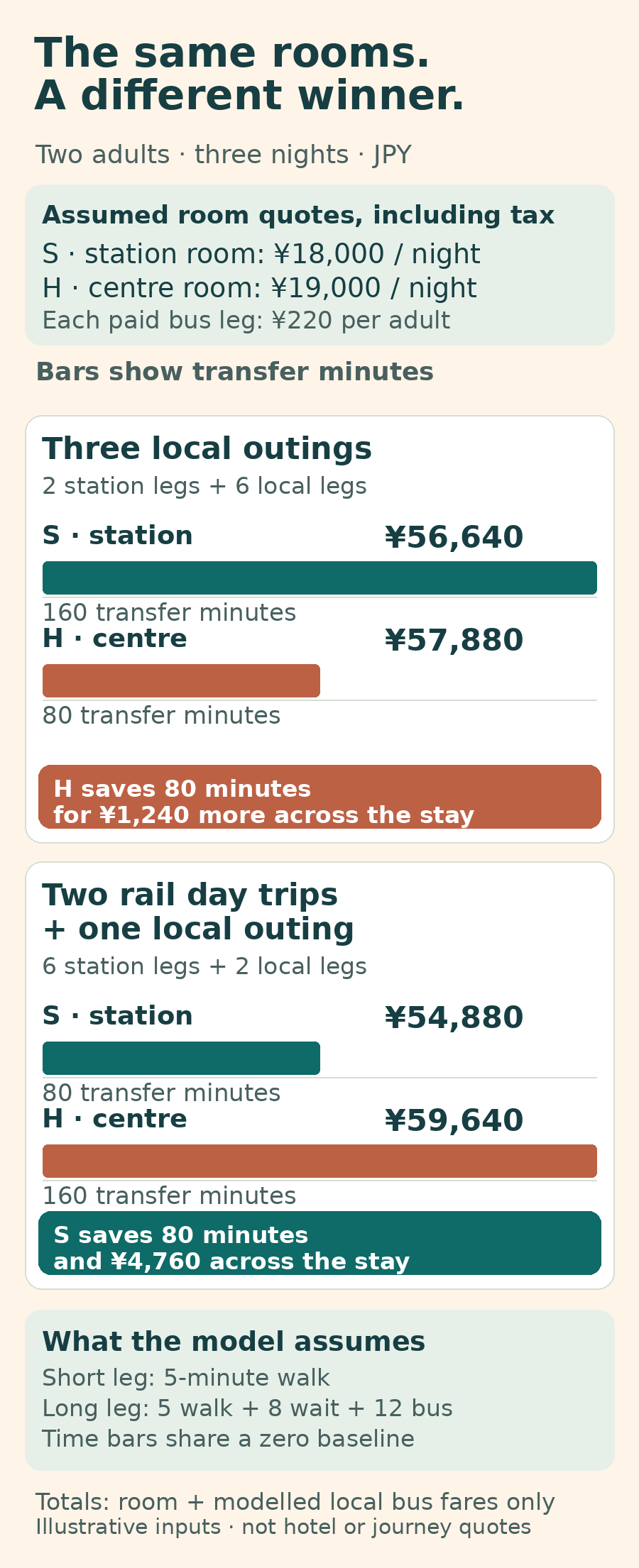
Each outing has an outward and return leg. The first pattern includes three local outings across the stay; the second replaces two of them with rail day trips. Arrival and departure contribute the first two station legs in both cases. No day in either pattern requires four of the modelled bus rides per person.
For the local-outings pattern, H avoids ¥1,760 in bus fares. Divided by three nights, that offsets roughly ¥587 of extra room cost per night. Its assumed ¥1,000 premium is higher, leaving the ¥1,240 difference. You can decide whether saving 80 minutes is worth that amount.
The time advantage reverses when station journeys dominate. With these symmetrical assumptions, equal numbers of station and local legs produce equal transfer time. This is a way to compare your own plans, not a measured ranking of Kanazawa hotels.
Five hotel examples, with the room details that matter
The shortlist illustrates different locations, bedding and useful facilities. It is not a ranking by popularity, star rating or untested value. Published floor areas include bathrooms and circulation space; they do not describe the free space available once beds, furniture and luggage are in the room.
Swipe across the table to compare →
| Property and base | Room example | Why compare it? | Do not assume… |
|---|---|---|---|
| Hyatt House Kanazawa · Station West | Kitchen Studio: 41 m², twin beds and sofa bed.[4] | Cooking facilities close to the railway. | That its 28 m² King room also has a kitchen. |
| Hotel Nikko Kanazawa · Station East | Comfort Double: 22 m²; Comfort Twin: 31 m².[6] | A short station approach with a larger twin-room alternative. | That all rooms have the same bed width or layout. |
| Tokyu Stay Kanazawa · Oyama corridor | Residential Twin: 23 m², two 110 cm-wide beds, two guests.[9] | In-room washer/dryer and kitchenette. | That every double includes a kitchenette. |
| Kanazawa Tokyu Hotel · Korinbo | Twin on Standard floors: 23 m², two 114 cm-wide beds, one or two guests.[11] | A Korinbo base with several bedding choices. | That Tokyu Stay and Kanazawa Tokyu are the same hotel. |
| UTAIMACHI · Higashi Chaya | Niju: 38.34 m², up to three guests on futons, ground floor.[13] | A traditional-building stay with a kitchen and washer/dryer. | That ground-floor accommodation guarantees step-free access. |
Hyatt House Kanazawa: choose the kitchen category deliberately
The hotel gives a two-minute walk from the Kanazawa Port/West Exit. Its self-service laundry room is useful for longer trips; only selected suites have their own washing machine.[5] The 41 m² Kitchen Studio includes cooking facilities, while the 28 m² King room has no kitchen equipment. The 54 m² Specialty Suite specifically includes a washing machine and accommodates up to four adults and two children.[4]
This is a strong first comparison when cooking, laundry and station access matter together. However, confirm the exact sleeping arrangement for your party. The current hotel FAQ says breakfast is not provided at Hyatt House; it points to takeaway items at H Market and a paid buffet at adjacent Hyatt Centric.[5] Factor in the breakfast you will actually use.
Check Hyatt House Kanazawa on Agoda
Hotel Nikko Kanazawa: station access with a meaningful twin upgrade
Nikko publishes a three-minute walk from the Kenrokuen/East Exit and an underground approach from the station.[7] Its Comfort Double has one 150 cm-wide bed; the Comfort Twin has two 120 cm-wide beds and nine additional square metres.[6] Compare those configurations before accepting the lowest double-room quote for two adults with cases.
Check Hotel Nikko Kanazawa on Booking.com
Tokyu Stay Kanazawa: a practical laundry base near Oyama
Its location is by Oyama Shrine, on the corridor towards Omicho. The hotel gives about ten minutes by bus from Kanazawa Station, then a one-minute walk from Minamicho–Oyama Shrine; its published Omicho walk is ten minutes.[10] This is a city base rather than a station-front hotel.
The Residential Twin combines a kitchenette and washer/dryer. The 19 m² Moderate Double keeps the washer/dryer but has no kitchenette. For three people, the 34 m² Deluxe Twin accepts an extra bed and separates the bath from the toilet.[9][10] Housekeeping also differs from a conventional daily full clean: simple cleaning is on request, with a fuller weekly clean for stays of seven nights or more.[9]
Check Tokyu Stay Kanazawa on Agoda
Kanazawa Tokyu Hotel: put Korinbo at the centre of your stay
The Standard-floor Twin suits one or two guests; its 27 m² Superior Twin offers two 120 cm-wide beds, with an extra bed possible for a third guest. Connecting rooms are also listed for the Superior Twin, with direct enquiry required.[11][12]
The hotel’s published approach is a ten-minute bus ride from Kanazawa Station to Korinbo Atrio-mae, followed by a two-minute walk.[11] Waiting and traffic sit outside that advertised ride time. Choose it when you will repeatedly use the Korinbo side of the city, and compare the larger room if three people need separate sleeping places.
Check Kanazawa Tokyu Hotel on Booking.com
UTAIMACHI: the room is part of the reason to stay in Higashi Chaya
Niju is a ground-floor room with three futons and no Western bed. Upstairs, Sen is 39.77 m² for up to four guests, using one king-size bed and two futons; it has its own kitchen, washer/dryer, bathroom and toilet.[13][14] These are specific room choices, not interchangeable versions of a generic “Japanese-style suite”.
The operator warns that sound carries in the traditional timber structure and asks guests to respect neighbours. Arrival after 19:00 needs advance contact.[15] Its directions finish with several turns through the lanes from Hashiba-cho; save those instructions before arriving.[16] It suits a considered townhouse stay better than an arrival where you want to improvise late at night.
Check the arrival, luggage and evening return
Rail arrivals and onward journeys
Tokyo connects with Kanazawa by Hokuriku Shinkansen. Journeys from Kyoto or Osaka use a Thunderbird–Shinkansen connection at Tsuruga, so an old description of a direct Thunderbird to Kanazawa is no longer the right planning basis.[19] Choose your onward train before judging how valuable a station hotel will be.
For a Tokyo-bound departure, compare Kanazawa–Tokyo options on 12Go, alongside the rail operator’s booking information. The route page offers transport comparisons; inspect the actual station, train, seat and ticket-collection conditions for your selected option.[22] A city-name search is not confirmation of a particular service or travel-date availability.
Komatsu Airport: the west exit is not the only possible stop
Hokutetsu lists the Kanazawa Station West Gate, Musashigatsuji–Omicho Market and Korinbo among its Komatsu Airport Line stops, with a published adult fare of ¥1,400 to these city stops. Check the timetable for your date and direction: do not assume every service continues beyond the station. Airport-bound city stops are for boarding; city-bound stops are for alighting.[20]
If a suitable service reaches your chosen central stop, it may remove a station transfer. If it does not, include the last leg in your comparison rather than automatically moving the hotel search to the west side.
Use the right bus, and count actual rides
The sightseeing loops depart from the station’s East Gate area. Their published operating window ends around 18:00, so they should not be treated as a late-evening hotel shuttle.[2][3] Check ordinary local services or a taxi for a later return.
The adult One Day Pass is ¥800 for its participating services and valid area, purchased before boarding; it does not cover the Light-Up Bus.[2] At the ¥220 loop fare, three single rides cost ¥660 and four cost ¥880. The pass saves ¥80 at four such rides, but a short walk from a central hotel may leave you needing only two. Count the rides you will really take before buying.
Large cases need their own plan
Kanazawa Station’s tourist information centre offers same-day luggage delivery, but the official guidance excludes accommodation without a reception desk, including some whole-house rentals. Delivery times cannot be specified, and road or weather conditions can affect the service.[18] Confirm that your exact property can receive the bags and ask about the day’s acceptance deadline; the information centre’s opening hours are not a promise of late luggage dispatch.
For a small historic property, save its entrance instructions and ask how far a taxi can bring you. A postcode or a broad map pin does not answer that final few minutes with luggage.
Compare the full stay price, including tax and meals
Ask for the same dates, guest ages, bedding, meal plan and cancellation terms at each hotel. A cheaper quote for a narrow double, a non-refundable rate or a room without breakfast is not yet a like-for-like alternative. Use the Japan trip-budget guide to set this stop alongside the rest of your route.
Kanazawa’s accommodation tax
Checked on 18 October 2026, the city tax is charged per person per night: no tax below a taxable ¥5,000; ¥200 from ¥5,000 to under ¥20,000; and ¥500 at ¥20,000 or more. The taxable amount includes the room and related service charge, excluding meals and consumption tax.[17]
Two adults staying three nights at a taxable ¥12,000 each per night therefore incur ¥1,200 in accommodation tax. At ¥20,000 each, the total becomes ¥3,000. These are calculations from the published bands, not hotel quotes. Check whether the displayed booking total includes the charge or whether it is payable at the property.
Breakfast should fit the first departure
UTAIMACHI lists breakfast from 07:30, whereas Tokyu Stay Kanazawa publishes a 06:30 start.[16][10] Those times can matter more than an attractive breakfast photograph if you have an early train or meeting point. Confirm the booked plan’s inclusions and whether an early-departure alternative is available; do not assume an unused breakfast is refundable.
A kitchen can reduce the need to buy every breakfast out, but only if you intend to shop and cook. Laundry is similarly useful when it replaces a task you would otherwise need to fit into the trip. Compare the room premium with your actual habits.
Make the chosen base work for your first day
For a station stay, aim to leave your luggage and make one coherent outing into the historic centre, rather than repeatedly returning across town. For a central stay, arrange the arrival transfer first, then enjoy the benefit of a nearby room between local plans. Save a flexible period for the neighbourhood around the hotel instead of treating it only as a place to sleep.
Match a guided introduction to the hotel location
A guided walk can help make sense of the districts during a short stay. Compare the start and finish with your base, as well as the advertised duration:
- Kanazawa Highlights with a taxi link on GetYourGuide is currently a three-hour small-group tour starting at the Kenrokuen Information Center. Its listed inclusions cover Kenrokuen and Nomura House entry and one taxi leg from Nagamachi to Higashi Chaya. Hotel pickup is excluded, and the listing says it is unsuitable for wheelchair users.[23]
- A customised Kanazawa tour with a licensed guide on Viator offers four- or six-hour options, with two or three selected sites for the four-hour version. Meeting the guide is on foot within the designated area; the walking tour does not include a private vehicle, and transport, admission and meals cost extra.[24]
The first is useful for a planned introduction ending on the Higashi Chaya side; the second is worth comparing when you want to agree a route around your hotel and interests. Confirm the final meeting point and itinerary before fixing other bookings. Neither option is a substitute for checking whether its walking demands suit your party.
Keep the entrance and return route available
Save the hotel’s address in Japanese, entrance instructions and a route screenshot. For live maps and translation, Airalo offers Japan data plans; check that your device supports eSIMs, is network-unlocked and meets the provider’s compatibility requirements before buying.[25][26] Compare data plans on Airalo and select Japan, then check the chosen plan’s activation and coverage details.
Useful questions
Is one night enough in Kanazawa?
It can work for a focused stop if you arrive early and leave late, but the arrival and departure hours become decisive. Two nights usually create one uninterrupted full day, making it easier to choose a central hotel and explore without carrying luggage. Add a third night when you want slower local days or a separate excursion; the number of nights alone does not guarantee usable sightseeing time.
Should I split a short stay between a station hotel and a historic property?
Usually only if the second property is an experience you actively want, or a very early departure changes the practicalities. For a two- or three-night stay, packing, storing bags and waiting for another check-in can consume the convenience gained. Price one well-chosen base with the necessary transfers before arranging a move.
Which option deserves a closer look for wheelchair access?
Hyatt House publishes a specific 41 m² accessible room with bathroom grab bars, a shower seat and an accessible entrance; it says a rollaway bed cannot be used in that category.[4] Confirm your chair dimensions, bathroom-transfer needs and the complete station-to-room route directly. A ground-floor townhouse room, large floor area or nearby bus stop is insufficient evidence of an accessible stay.
Does bad weather make a station hotel the better choice?
It can make a covered arrival especially useful: Nikko publishes an underground station approach, while Hyatt House describes access through the station retail area and Cross Gate.[7][5] However, the journeys during your stay still matter. If rain or snow is forecast, compare covered entrances, exposed walking sections and workable transfers for your actual plans, rather than choosing by distance alone.
Choose the Kanazawa base that fits your daily plans
Choose Kanazawa Station when the railway shapes the stay. Choose the Omicho–Oyama corridor or Korinbo when you will repeatedly return from local outings. Choose Higashi Chaya when the traditional setting and the particular room justify the more considered arrival. The best decision is the property whose room, entrance and daily journeys fit together at a total price you are happy to pay.
Sources and checks
Research-led accommodation guidance with original planning comparisons. Linked operator and tourism sources provide the starting evidence; confirm current room categories, access and booking terms directly for your dates.
- VISIT KANAZAWA: Essential Kanazawa for the First Time Visitor
- Hokuriku Railroad: sightseeing buses and One Day Pass
- VISIT KANAZAWA: getting around Kanazawa
- Hyatt House Kanazawa: rooms and suites
- Hyatt House Kanazawa: frequently asked questions
- Hotel Nikko Kanazawa: Comfort rooms
- Hotel Nikko Kanazawa: station access
- Hotel Nikko Kanazawa: current works, power-outage and room-name notices
- Tokyu Stay Kanazawa: room categories and housekeeping
- Tokyu Stay Kanazawa: access, breakfast and hotel information
- Kanazawa Tokyu Hotel: Twin on Standard floors
- Kanazawa Tokyu Hotel: Superior Twin on Standard floors
- UTAIMACHI: Niju room
- UTAIMACHI: Sen room
- UTAIMACHI: frequently asked questions and stay restrictions
- UTAIMACHI: arrival directions and breakfast hours
- Kanazawa City: accommodation-tax rates and taxable charges
- VISIT KANAZAWA: same-day baggage delivery
- VISIT KANAZAWA: getting to Kanazawa
- Hokuriku Railroad: Komatsu Airport Line
- Kanazawa Tokyu Hotel: 25 October 2026 marathon traffic restrictions
- 12Go: Kanazawa to Tokyo transport comparison
- GetYourGuide: Kanazawa Highlights — Garden, Castle, Samurai and Geisha with taxi
- Viator: Kanazawa customised tour with a licensed local guide
- Airalo: Japan eSIM plans
- Airalo: device compatibility requirements
Illustrations in this article were created for Taylor’s Trailblazing Travels. Third-party photographs, where used, are credited beside the image or in the source list.