Where to Stay in Asakusa: Ryokan, Hotels and Quiet Streets
Choose the right side of Asakusa, then the room, bath and arrival route that suit your stay.
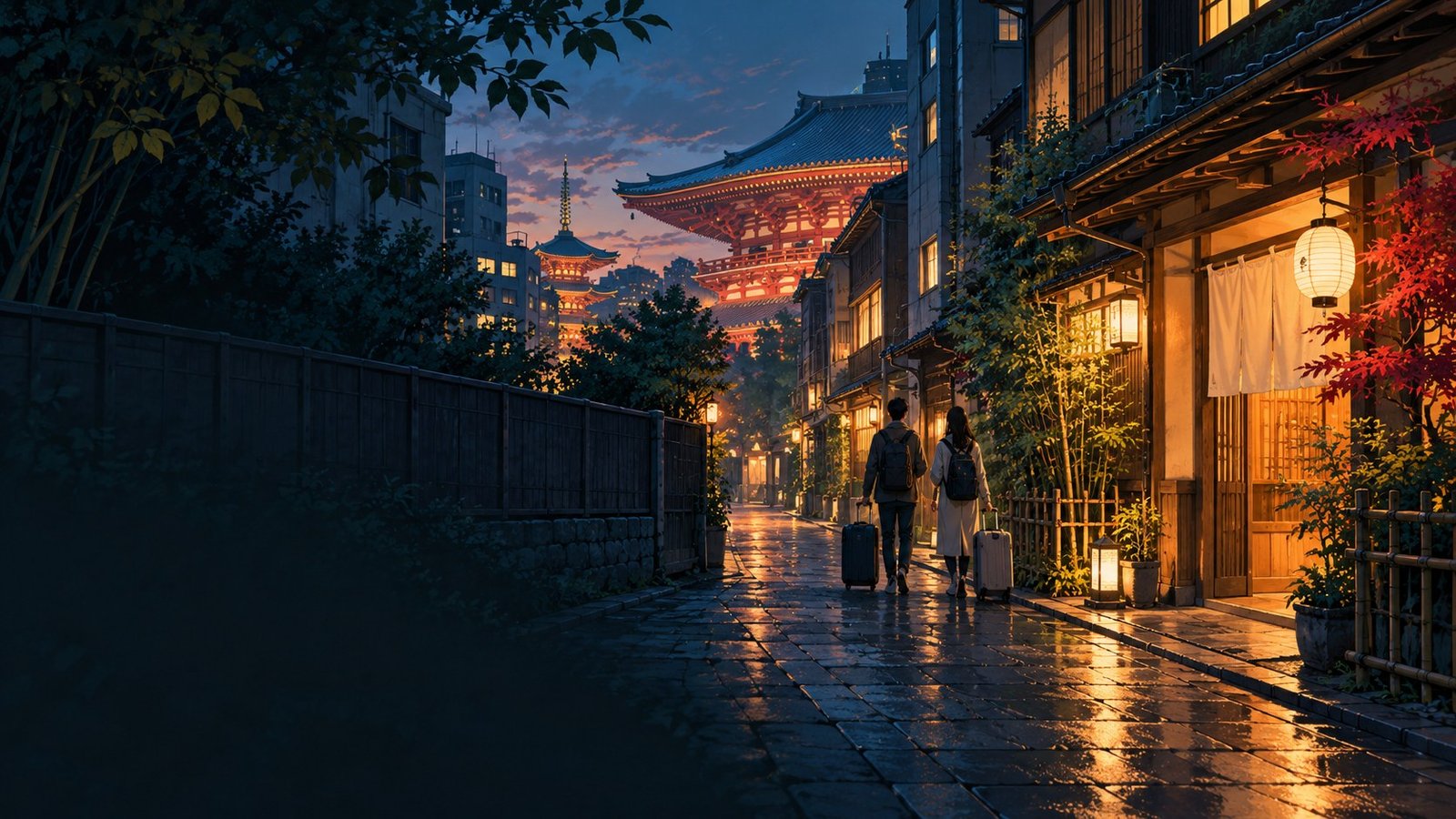
An original AI illustration inspired by Asakusa’s side streets; it does not depict a named hotel or a documentary scene.
Where to stay in Asakusa depends on two decisions: which station you will actually use, and what you mean by a traditional stay. A futon room beside Nakamise, a modern room with an outdoor bath and an apartment by the river offer quite different trips.
Asakusa puts Sensō-ji, shopping streets and the Sumida riverfront around your base.[1] The useful choice is how much of that activity you want outside your door. This guide selects properties for different practical needs, using published room details and transport information. It does not rank hotels by untested comfort or assume a room is available for your dates.
Some links in this guide are affiliate links. Taylor’s Trailblazing Travels may earn a commission if you book or buy through them, at no extra cost to you.
First visit
Name your station
Check the railway and exit, not just “Asakusa Station”.
Traditional stay
Choose the room type
Futons, raised beds and bathroom privacy vary.
Quieter search
Look north and inward
Try northern side streets; ask about room facing and noise.
Family comfort
Count sleeping places
Capacity, bed sharing and extra bedding are different.
Where to stay in Asakusa: choose your area first
Use the table to shortlist two zones, then check a real hotel door against your main railway. The two Asakusa locations are easy to confuse: Tokyo Metro’s Ginza Line, the Toei Asakusa Line and Tobu are towards the river; Tsukuba Express is west of the temple district in Nishi-Asakusa. Changing between them involves a street walk.[2][3][4]
Swipe across the table to compare →
| Search zone | Choose it when… | Trade-off to check |
|---|---|---|
| Kaminarimon / east-side stations | You will use the Ginza or Toei lines frequently, or arrive with luggage. | Road-facing rooms and crowds around the main approach; select the actual exit. |
| Nakamise / central temple streets | A traditional room and easy temple walks are the point of the stay. | Shopping activity near the door; check daytime room access and bath arrangements. |
| Kannon-ura / Asakusa 3-chome | You prefer a small-inn stay north of the busiest approach. | More walking to airport trains; avoid assuming a side street is silent. |
| Rokku / Tsukuba Express | Your plans suit TX towards Akihabara and you want nearby dining. | The short advertised station walk may be to TX, not your airport railway. |
| Tawaramachi / Komagata / Kuramae edge | You will trade immediate temple proximity for another room or price option. | These are different pockets. Check the right Ginza, Asakusa or Oedo Line station. |
For example, Richmond Hotel Premier Asakusa quotes one minute from TX exit A1 but eight minutes from the Ginza/Toei Asakusa stations. That distinction matters more than a booking page’s broad “central Asakusa” label.[20]
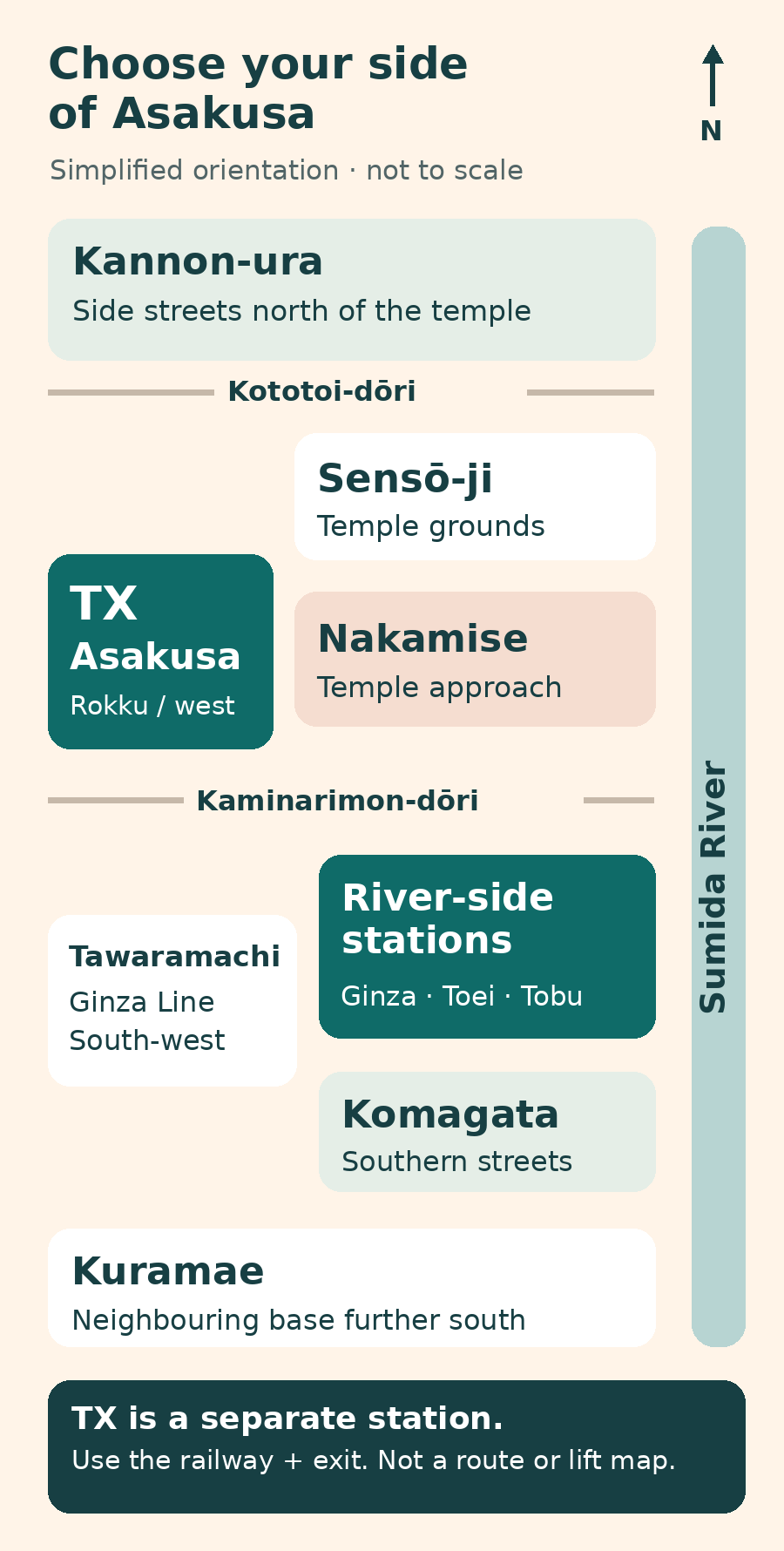
Asakusa also makes geographical sense for a trip continuing to Nikko: Tobu advertises limited express journeys from Asakusa taking approximately two hours. That is a railway journey, not the time to Nikko’s sights.[30] If your evenings and most daytime plans are around western Tokyo, compare the extra cross-city travel before committing to this base.
Finding quieter streets without sacrificing the right station
Begin north of the temple, then inspect the frontage
Kannon-ura is the area behind Sensō-ji’s main hall. Its local cultural council describes a calmer townscape with traditional restaurants and inns. Taito City also identifies the Senzoku-dori area beyond Kototoi-dōri with the names Kannon-ura and Oku-Asakusa.[5][6] Start your search among the smaller streets north of Kototoi-dōri, rather than treating the avenue itself as a quiet address.
Cyashitsu at 3-32-12 Asakusa provides a concrete northern reference point. Its published walks are nine minutes from Ginza/Tobu Asakusa, seven from TX and thirteen from Toei Asakusa.[16] These are the property’s estimates; luggage, crossings and your exit can change them. This location rewards travellers staying locally more than those returning to the room repeatedly between train journeys.
Separate a lively lane from a quiet bedroom
On the west side, check whether a room faces a dining street. The merchants’ association lists terrace seating and late-evening trading for a bar on Hoppy Street.[7] That supports asking about nearby venues; it does not establish what can be heard inside any particular hotel.
For a southern alternative, look inward from the main roads around Komagata, or investigate Kuramae as its own base. Taito’s tourism guide describes Kuramae’s converted cafés, craft character and access to both Toei lines.[8] A café district still has deliveries, traffic and active businesses.
Ryokan, private bathrooms and onsen are different choices
A ryokan describes a style of accommodation; the experience varies between properties. Japanese-style rooms commonly use tatami and futons, while some urban inns offer beds as well.[10][13] Do not infer dinner, a large room or a private outdoor bath from the word alone.
Swipe across the table to compare →
| Listing wording | What to establish | Why it matters |
|---|---|---|
| Japanese-style / tatami | Futons, low beds or conventional beds? | Getting up from the floor and luggage space affect comfort. |
| Private bathroom | Toilet and shower only, or a bath too? | It need not be the large bath shown in the hotel photographs. |
| Private-use bath | A shared facility booked by time slot, or attached to your room? | A reservable bath does not give you unlimited exclusive access. |
| Open-air / semi-open-air bath | Which room includes it, and how is privacy screened? | This describes the setting, not proof of natural hot-spring water. |
Onsen involves natural hot-spring water. A beautiful soaking bath can be worthwhile without that distinction; ask for the water-source description if it matters to you. For shared bathing, check the property’s tattoo, family and gender policies before paying. Wash before entering the soaking bath, and leave phones and cameras outside bathing areas.[9]
Choose comfort before the most photogenic room. If kneeling, floor sleeping or steps are difficult, request the bed height, bathroom threshold and lift route in writing. A hotel-level accessibility label is less useful than the dimensions and layout of the room you will receive.
Four ryokan options with meaningful differences
These are researched examples chosen for different combinations of location, sleeping arrangement and bath privacy. Room facts and operating notices were checked on 18 October 2026; rates and availability for your dates were not checked.
Ryokan Kamogawa Asakusa: futons near the central approach
Kamogawa’s Japanese-style rooms have their own bathroom and toilet, and guests can use a larger Japanese-style bath privately. Its Deluxe category is described for two to four people.[11] It is a useful shortlist choice when you want traditional sleeping arrangements with bathroom privacy close to the main sights.
Check the operating calendar before planning the stay: the homepage currently lists Monday–Wednesday closure and says it is not serving breakfast, lunch or dinner.[12] Treat this as a room-and-location choice, then budget for meals outside. Do not assume a multi-night booking can bridge the advertised closed days.
Check Kamogawa room options on Booking.com
Ryokan Asakusa Shigetsu: central location with futon or bed choices
Shigetsu offers Japanese-style rooms plus Western and Japanese-Western alternatives. The Japanese-Western category has two single beds, with a futon for a third guest; private bathrooms vary between bath and shower layouts. The observation bath is shared and cannot be reserved for private use.[13]
Its practical limitation is significant for afternoon naps: its published cleaning policy prevents daytime room use until 15:00; confirm the morning start time directly. It also locks the entrance from 23:00 to 07:00, asking guests to arrange access at check-in.[13] Confirm that those terms suit your schedule before choosing it as a rest-between-outings base.
Compare Shigetsu rooms on Agoda
Cyashitsu Ryokan Asakusa: a compact tea-room experience in the north
Cyashitsu makes the traditional-room concept a deliberate part of the stay. Its 9–10 m² category uses shared toilet facilities; the larger Cyashitsu Suites include a shower and toilet. The rooftop bath is reserved by time slot. Futons are laid on tatami, and the designed tea-room entrance is only 67 cm high.[14] Ask about a suitable entrance arrangement if stooping or kneeling is difficult.
This suits travellers who value the design enough to accept compact space and careful room selection. It is less suitable for spontaneous late nights: the FAQ gives a midnight curfew and says entry afterwards may be unavailable. Last check-in is 22:00, with advance contact required if delayed.[15]
Check Cyashitsu categories on Booking.com
Prostyle Ryokan Tokyo Asakusa: beds, tatami and selected private baths
Prostyle at 2-12-11 Hanakawado is an option for travellers who want Japanese styling with beds. Its room list distinguishes the 18 m² Double from categories offering open-air or semi-open-air baths. The King Bed Room is listed at 26 m², with a semi-open-air bath and capacity for two.[17][18]
Book the bathing feature explicitly. A Double reservation does not promise the bath shown for a suite, and two double beds do not automatically mean four adults are permitted: several twin categories are listed for two.[17] Check the precise occupancy and view as well as the room name.
Hotel and apartment alternatives for beds and usable space
Richmond Hotel Premier Asakusa: a conventional hotel near TX
Richmond Premier’s Double is 18 m² with a 150 cm-wide bed. Its View Twin is 27 m² with two 120 cm-wide beds; a third guest uses an additional smaller bed. Selected view categories separate the bathroom, toilet and washbasin.[19]
That makes the twin layout worth comparing for friends or parents who prefer beds and a conventional hotel routine. The west-side location suits TX better than an airport-train arrival, so price the room alongside the actual walk. Check the full name: Richmond Hotel Premier Asakusa and Richmond Hotel Asakusa are separate properties.[20]
Compare Richmond Premier layouts on Agoda
MIMARU Tokyo Asakusa Station: a practical family apartment
MIMARU’s Family Apartment is 35 m², with two single beds, one bunk bed, a bathroom and a furnished kitchen and dining area. The property lists coin laundry rather than an in-room washer-dryer for that category. Its advertised access is one minute from Ginza exit 4 and two from Toei exit A5.[21]
This is a strong starting point for four people who want separate sleeping places and breakfast flexibility. Add every traveller’s age when searching: MIMARU treats guests aged seven and over as adults, while its young-child allowance means bed sharing rather than extra beds.[21] Compare the total apartment quote with two hotel rooms; neither arrangement is always cheaper.
Airport arrivals and the station walk that follows
Choose the correct airport train
From Haneda, selected Keikyu trains continue onto the Toei Asakusa Line. From Narita, selected Keisei services continue through to Asakusa. Check the departure board and destination for your train; the line connection does not mean every departure is direct. The Skyliner goes towards Nippori and Ueno and does not continue onto the Toei Asakusa Line.[22]
Keisei’s Asakusa guide advertises a 50-minute journey from Narita Terminal 2·3 on the indicated route, excluding transfer time. Waiting for the appropriate departure and the final hotel walk are additional.[23] For a northern ryokan, compare the whole arrival against a door-to-door transfer, especially with large cases or a late landing.
For a wider comparison, check Haneda-to-Tokyo options on 12Go or Narita-to-Tokyo options on 12Go.[25][26] These are Tokyo-wide results: select the actual stop or a transfer accepting your Asakusa address. A ticket terminating at Ueno or Tokyo Station still leaves another journey.
When a private transfer earns its extra cost
A car is worth pricing when the group, luggage or arrival hour makes the final street walk awkward. Viator’s Haneda one-way transfer includes hotel pickup or drop-off, with published waiting allowances of 60 minutes for airport arrivals and 30 for hotel pickups.[27] Confirm your terminal, address, bags and how extra waiting is charged.
For either airport, this GetYourGuide private airport transfer advertises service to hotels within Tokyo’s 23 wards.[28] Choose Haneda or Narita and the correct direction, and confirm luggage capacity and child-seat requirements before booking. A vehicle’s advertised passenger maximum does not establish how many large cases fit.
Check the accessible route separately
A nearby exit is not necessarily a straightforward step-free route. Tokyo Metro’s Asakusa facilities page lists a surface lift outside the gates and stairlifts for parts of the platform route.[24] Consult the current station diagram or staff for the complete journey if you use a wheelchair, have a pushchair or cannot manage stairs. Include the path from platform to street in your hotel decision.
An original room-price versus walking comparison
Consider two fictional three-night offers for the same party and equivalent room facilities. The station-near room costs ¥24,000 per night and is a four-minute walk from the exit you need. A side-street room costs ¥18,000 and takes twelve minutes. These are modelling assumptions, not advertised rates, measured routes or promises that northern rooms cost less.
Swipe across the table to compare →
| Measure | Station-near room | Side-street room |
|---|---|---|
| Nightly room cost | ¥24,000 | ¥18,000 |
| Three-night total | ¥72,000 | ¥54,000 |
| One-way station walk | 4 minutes | 12 minutes |
| Walking over 14 station legs | 56 minutes | 168 minutes |
Two return outings per day over three days produce twelve station legs. Add arrival and departure for fourteen. The saving is ¥18,000, in exchange for 112 additional walking minutes across the stay. This is elapsed time for the travelling party, not multiplied by the number of people.
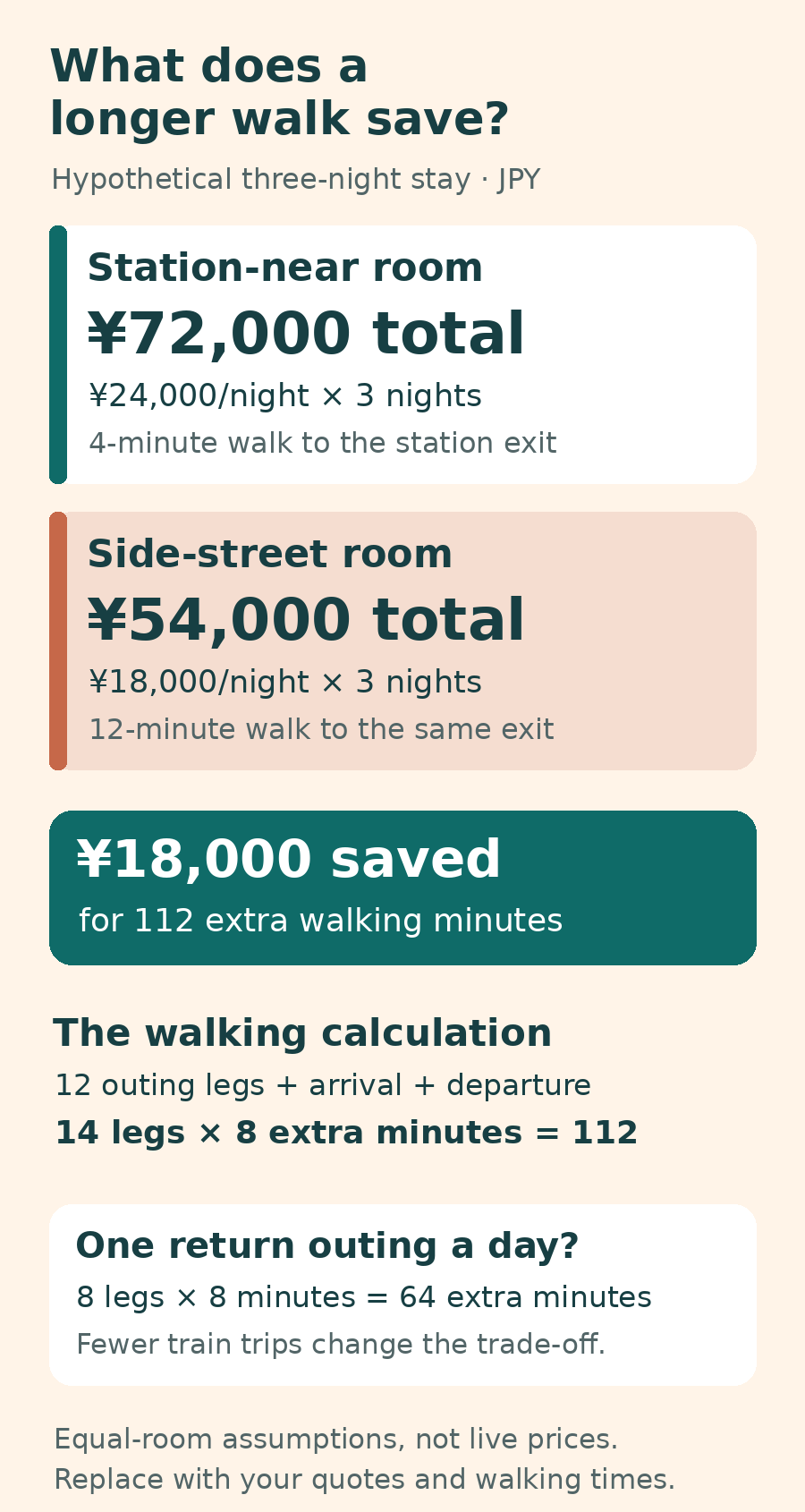
With only one return outing per day, the total becomes eight station legs and the extra walking falls to 64 minutes. A plan centred on Asakusa itself may use fewer trains still. Conversely, pushchairs, heat, rain or a slower pace can make the same distance a bigger burden.
Swipe across the table to compare →
| Traveller pattern | First priority | How to decide |
|---|---|---|
| Two adults out all day | The actual room and total price | Compare the eight-leg scenario; the longer walk may be an acceptable saving. |
| Family returning for naps | Room access, beds and short repeat journeys | Reject unsuitable daytime-access rules first, then test fourteen or more legs. |
| Travellers wanting a private soak | An explicitly included private bath | Eliminate the wrong bath categories before comparing location premiums. |
| Reduced walking or mobility needs | A usable complete route and room | Confirm access first; a cheap nominally short walk cannot compensate for unusable steps. |
Use your own quotes in the calculation. Add any transport costs that differ between the two options, including taxis you would realistically use. Pay for proximity when it protects the way you want to spend the day, rather than automatically choosing either the cheapest room or the shortest advertised walk.
Before booking: five details to settle
- Confirm the complete property name, railway and exit. Save the Japanese address and the route to the actual entrance.
- Check every sleeping place. Ask whether additional guests receive futons, extra beds or permission to share an existing bed, and include children’s ages.
- Read the room’s bathroom details. Establish private toilet, shower or tub, any shared facilities, bath reservation rules and meal inclusions.
- Align arrival and daytime plans with check-in, curfew and room-cleaning policies. For early arrival or late departure, ask when luggage storage is available and whether charges apply.
- Compare the full stay total and cancellation terms. Keep the confirmed room description and any agreed accessibility or quiet-facing arrangements with the reservation.
For a small inn reached through unfamiliar streets, save the address offline before travelling. If you need mobile maps and translation, check Airalo’s eSIM options and select Japan. Its Japan page offers data plans with a device-compatibility check; compare the package’s validity, activation rules and data allowance with your existing roaming.[29]
Useful questions
Is one ryokan night enough, or should the whole Tokyo stay be in Asakusa?
One night can suit a stay focused on a particular room or bath, provided arrival leaves time to enjoy it. Moving hotels also creates packing, luggage storage and check-in work. For a short Tokyo trip, keeping one suitable base is often more useful than adding a second hotel solely for variety. Choose several ryokan nights only when the bedding and daily access arrangements suit your routine.
Can I leave luggage at a ryokan before check-in?
Ask the specific property. Cyashitsu publishes luggage storage before check-in and after checkout, with limits and charges for longer storage.[15] That is not a policy for every Asakusa inn. Confirm the handover time and label any forwarded luggage with the booking name and arrival date.
Does staying near Asakusa Station put me on the JR network?
No. The local Asakusa stations discussed here are served by Tokyo Metro, Toei, Tobu or Tsukuba Express.[2][3] You can connect to JR elsewhere, but do not assume a JR pass covers the first leg from your hotel. If frequent JR departures are central to your plan, compare that extra connection with another Tokyo base.
Should I book a river-view room to get a quieter stay?
Book it for the view you want. A river-facing description tells you neither the glazing standard nor whether traffic, neighbouring activity or an event will be audible. Ask about the actual room floor and facing, and check the cancellation terms if an essential request cannot be confirmed.
Choose the room and street together
For the most straightforward first stay, begin with a hotel close to the Ginza or Toei station you will use. Move north when the smaller-inn atmosphere is worth the extra walking; choose a central ryokan when the room itself and early temple walks are priorities. Families should settle beds, space and daytime room access before paying for a view.
The best Asakusa booking is the one whose precise room, street and railway fit the same plan. Shortlist two realistic options, compare their complete totals, and resolve the one detail that could make the stay uncomfortable before committing.
Sources and checks
Research-led hotel and neighbourhood guidance with original planning comparisons. Sources below were consulted on the dates shown. Check room details, access notices, transport and booking conditions for your own travel dates.
- GO TOKYO: Asakusa area guide
- Tsukuba Express: Asakusa station and facilities
- Tokyo Metro: Asakusa station, Ginza Line
- Taito City sightseeing map: Asakusa sheet
- Asakusa Edo Atmosphere Creation Council: Kannon-ura area
- Taito City: Senzoku-dori and local shopping streets
- Asakusa Merchants Association: Roku-ku Sakaba on Hoppy Street
- Taito City tourism: distinctive stays around Asakusa and Kuramae
- Japan National Tourism Organization: understanding onsen and bathing etiquette
- Japan National Tourism Organization: Japanese ryokan guide
- Ryokan Kamogawa Asakusa: guest rooms
- Ryokan Kamogawa Asakusa: current operating notices
- Ryokan Asakusa Shigetsu: rooms and facility policies
- Cyashitsu Ryokan Asakusa: room categories and bath reservations
- Cyashitsu Ryokan Asakusa: facilities, check-in and luggage FAQ
- Cyashitsu Ryokan Asakusa: access and address
- Prostyle Ryokan Tokyo Asakusa: room categories
- Prostyle Ryokan Tokyo Asakusa: official location and access
- Richmond Hotel Premier Asakusa: official room specifications
- Richmond Hotel Premier Asakusa: official station access
- MIMARU Tokyo Asakusa Station: apartments, facilities and access
- Toei Transportation: airport access and through trains
- Keisei Electric Railway: Narita Airport to Asakusa
- Tokyo Metro: Asakusa barrier-free facilities
- 12Go: Haneda Airport to Tokyo transport comparison
- 12Go: Narita Airport to Tokyo transport comparison
- Viator: private one-way Haneda Airport transfer, product 405101P97
- GetYourGuide: Tokyo private airport transfer, activity 678130
- Airalo: Japan data eSIMs and device compatibility
- Tobu Railway: travelling from Asakusa to Nikko
- Tokyo Metropolitan Government: accommodation tax for guests and April 2027 changes
Illustrations in this article were created for Taylor’s Trailblazing Travels. Third-party photographs, where used, are credited beside the image or in the source list.