14 Days in Japan: Classic Route with Hakone and Hiroshima
Five bases, a hot-spring night and a full island day: a two-week journey with its travel time accounted for.
- 14 days · 13 nights
- Tokyo in · Osaka out
- Hakone + Miyajima
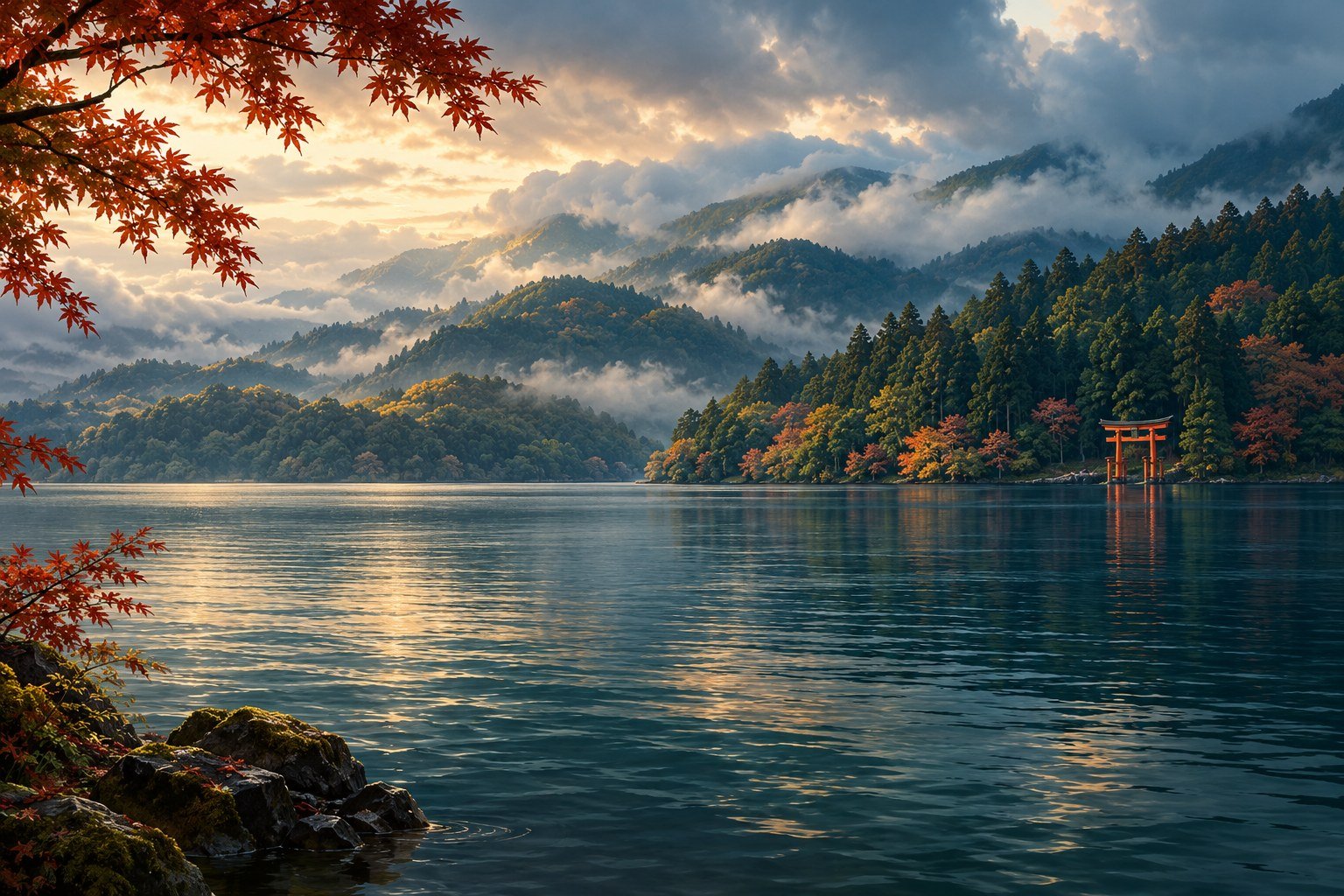
AI-generated editorial illustration inspired by Lake Ashi in Hakone; scenery and weather are imagined, and visibility varies.
For 14 days in Japan, this route gives Tokyo and Kyoto proper stays, adds one night in Hakone, and leaves enough time to visit Hiroshima and Miyajima separately. It finishes in Osaka so that your final sightseeing day stays in the city you are departing from.
The plan counts arrival as day 1 and departure as day 14. It suits a first trip focused on city neighbourhoods, historic sights and one ryokan stay, provided you are comfortable changing accommodation four times. Travellers who want mostly unstructured days should use the simpler variation below.
A varied first trip with cities, a ryokan and Hiroshima’s history.
Four hotel changes; arrival and departure are included in the 14 days.
¥550,000 for two adults before international flights, using stated assumptions.
One full day for Miyajima, plus room to change Hakone plans for the weather.
Your 14 days in Japan: the route and overnight stops
Search flights arriving in Tokyo and leaving from Kansai International Airport before committing to hotels. Compare the total fare with a Tokyo return ticket, including the extra rail journey and final Tokyo hotel if needed. “Two weeks away” can include overnight flights; the schedule here means 14 calendar days in Japan.
| Days | Sleep in | Nights | Main purpose |
|---|---|---|---|
| 1–4 | Tokyo | 4 | Arrival, eastern Tokyo, western Tokyo and a flexible day |
| 5 | Hakone | 1 | Scenery and a ryokan or hot-spring stay |
| 6–9 | Kyoto | 4 | Three separate sightseeing days after the transfer |
| 10–11 | Hiroshima | 2 | Peace Memorial Park and museum; Miyajima on its own day |
| 12–13 | Osaka | 2 | A final city stay with time before the flight |
| 14 | Depart Osaka | 0 | Airport transfer and international departure |
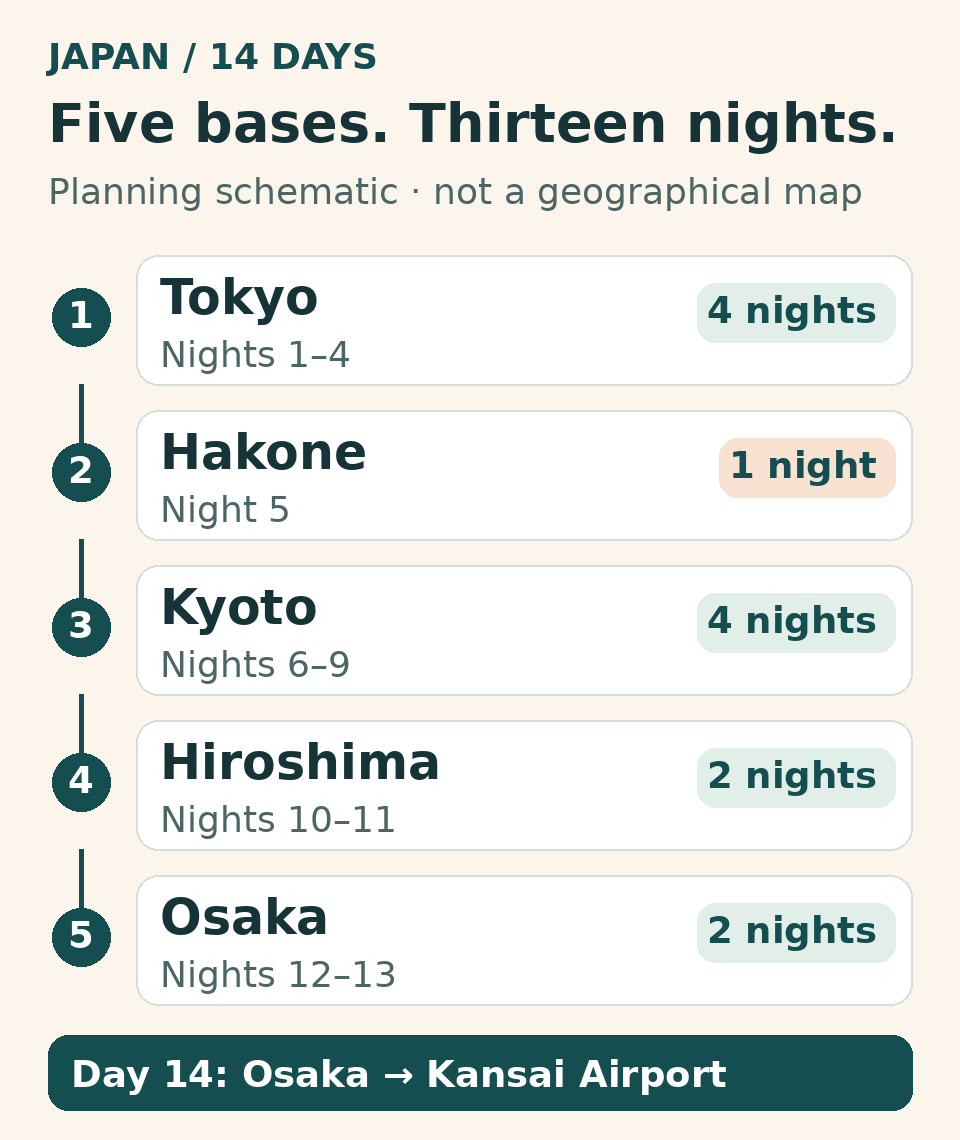
The route travels west to Hiroshima, then returns to Osaka for the flight. That final eastward leg is intentional: it places the longest remaining train journey two days before departure. Moving Hiroshima into an Osaka day trip would remove a hotel change, but make both the memorial visit and Miyajima much harder to give adequate time.
If you are still deciding how much time to take, compare the broader options in how many days to spend in Japan. This itinerary is the operational plan for travellers who have settled on a fortnight.
Days 1–4: settle into Tokyo before travelling west
Day 1: arrival and one easy local outing
Travel to your hotel, leave luggage if check-in is later, and keep the afternoon optional. A neighbourhood walk and an early dinner are enough. Avoid a prepaid attraction on arrival day: immigration, the airport journey and jet lag can all change the usable time.
Day 2: Asakusa and the eastern side
Start with Sensō-ji and the streets around Asakusa, then choose either the Sumida riverside or Ueno’s museums and park. Allow a proper lunch break. Asakusa is a useful introduction to Tokyo’s older streets and temple setting; there is no need to cross the city for another headline sight that evening. [1]
Day 3: Meiji Jingū, Harajuku and Shibuya
Group the western neighbourhoods together. Begin around Meiji Jingū, continue through Harajuku, and finish in Shibuya. If you want an observation deck, book its actual entry time and make that the final anchor of the day. Save Shinjuku for another evening if adding it would turn the whole day into a march. [2]
Day 4: choose one interest and prepare for Hakone
Use the day for a museum, shopping, a food-focused walk or a neighbourhood you want to revisit. It also provides recovery time if arrival was tiring. Pack an overnight bag and confirm the Hakone hotel’s meal arrangements and latest arrival time.
For these four nights, choose a hotel near a station with a straightforward airport route. Compare Tokyo stays on Agoda or Tokyo stays on Booking.com, checking the map, room size, cancellation terms and the walk from the station. A marginally cheaper room with awkward transfers can be poor value when you are carrying luggage.
Day 5: make Hakone an overnight stay
Leave Tokyo in the morning and approach Hakone through Odawara. A Tokyo–Odawara Shinkansen ticket followed by local transport works well when you will continue to Kyoto the next day. Hakone-Yumoto is the entrance to the area, rather than the end of every journey; reaching a hotel higher in the hills takes longer. [3]
Make the hotel the anchor of the day. For a stay near Gora, a sensible sequence is the mountain railway, luggage drop, and a choice of the Open-Air Museum or the cable-car and ropeway side of Hakone. With a Lake Ashi hotel, plan your sightseeing towards the lake instead. Avoid completing a full sightseeing circuit simply to justify a transport pass.
Allow for clear skies and for poor visibility
In settled weather, use the ropeway and Lake Ashi area for a landscape-focused afternoon. Mount Fuji is visible from parts of Hakone when conditions allow; an overnight reservation is not a guarantee of a Fuji view. [4] Check the operator’s live service information before setting out, especially when wind or poor weather could alter the plan.
With rain or cloud, shorten the outdoor route and spend more time at the accommodation. The Pola Museum of Art is an indoor alternative, subject to its exhibition-change closures. Its current access information gives a shuttle from Gora; do not rely on an old description of a direct bus from Hakone-Yumoto. [5] [24]
Choose the room and meal plan together
Hakone-Yumoto is useful for simpler onward access; Gora works for the mountain railway and nearby sights. Before paying, check whether dinner and breakfast are included, whether the quoted price is per room or person, and whether the bathing arrangement suits you. If you need a private bath, beds rather than futons, lift access or particular dietary arrangements, ask the property to confirm them.
Use the map on Hakone stays on Agoda or Hakone stays on Booking.com to compare the same dates and meal plans. Do not assume every Hakone hotel includes hot-spring bathing or a mountain view.
Days 6–9: three distinct days in Kyoto
Day 6: Hakone to Kyoto
Have breakfast, return to Odawara and take the booked westbound train. Treat this as a transfer day. After checking in or dropping your bags, choose a nearby dinner and a gentle riverside walk. Do not build the day around a distant temple with a last-entry deadline.
Day 7: southern Higashiyama
Begin with Kiyomizu-dera, then walk through the surrounding lanes towards Yasaka Shrine and Gion. Keep this as one connected part of the city, with time for quieter side streets and a sit-down break. Kyoto’s official itinerary places these sights in the same walking course. [7]
Day 8: Arashiyama
Give western Kyoto its own day. Combine the bamboo grove area with one temple or garden and time by the river, rather than adding several far-flung sights. A walk beyond the busiest central streets is more useful than immediately crossing back to the opposite side of the city. [8]
Day 9: Fushimi Inari and a flexible afternoon
Visit Fushimi Inari, deciding how far to walk up the hillside according to heat, weather and energy. Its shrine and torii-lined route are in southern Kyoto. [9] Keep the afternoon for a booked cultural experience, shopping or rest. A Nara day trip can replace this day’s programme if it matters more to you; do not add it on top.
Kyoto Station is practical for the onward train; central Shijō or Kawaramachi suits travellers who value evening dining and walking. Compare Kyoto stays on Agoda or Kyoto stays on Booking.com with the transfer and sightseeing days beside you. Four nights should mean one hotel booking, not a second move within Kyoto.
Days 10–11: Hiroshima and Miyajima deserve separate time
Day 10: Hiroshima’s memorials
Take a morning train from Kyoto, leave luggage at your hotel and dedicate the afternoon to the Peace Memorial Museum, Peace Memorial Park and the Atomic Bomb Dome. Allow around three to four hours across the museum and park as a planning allowance, with space afterwards to reflect.
The City of Hiroshima recommends buying museum web tickets in advance because ticket queues can be long; some extended opening periods require a reservation. Choose your ticket using the current calendar, with a buffer after the train. The museum includes victims’ belongings and accounts of the bombing, so families should decide how much their children are ready to take in. [10]
If historical context is a priority, check the Hiroshima Peace Memorial Park historical walking tour as a replacement for the independent park walk. The listing offers different durations; verify the chosen option, starting point and whether museum entry is included. Leave space for the museum rather than booking a long tour that absorbs the entire afternoon. [11]
Day 11: a full day on Miyajima
Travel to Miyajimaguchi and take the ferry. The crossing is about ten minutes, but the hotel-to-island journey also includes the train, walking and waiting. Budget roughly 75–100 minutes each way from a central Hiroshima hotel as a generous planning allowance. [12]
Visit Itsukushima Shrine, pause for lunch and explore the town before deciding on another walk. Use the tourist association’s tide information for your actual date: high water changes the shrine’s appearance, while a walk towards the great torii depends on sufficiently low water. Both experiences are not available on every day. [13]
Do not make a summit walk compulsory after the shrine. A slower waterfront day still makes the journey worthwhile. Return to the same Hiroshima hotel, without luggage or a Shinkansen deadline dictating your island visit.
Choose between the station area for rail convenience and the Peace Park or central shopping area for evening walking. Search Hiroshima stays on Agoda or Hiroshima stays on Booking.com, making sure the result is in Hiroshima city if that is the base you intend.
Days 12–14: return to Osaka and finish without a long final transfer
Day 12: Hiroshima to Osaka
Travel to Shin-Osaka, continue to your hotel and keep the afternoon light. Namba and the Dōtonbori area make a practical evening for dinner and a walk. A stop at Himeji is possible only if you deliberately budget extra time and arrange luggage storage; the default plan goes straight to Osaka.
Day 13: one full Osaka day
Make this a compact food-and-neighbourhood day: begin around Kuromon Market, continue through nearby Namba and return to Dōtonbori for dinner. These districts can be joined on foot, with a lunch break and a hotel rest in the afternoon. [25] A theme park would replace the entire day and needs its own ticket planning. Keep any activity recovered from an earlier day within the same area.
Day 14: departure
Choose the airport route from your actual hotel. Nankai serves Namba, while JR offers services through other Osaka stations; check the terminal as well as the airport name. Add the airline’s requested check-in buffer to the ground journey. [14]
Compare Osaka stays on Agoda or Osaka stays on Booking.com for these final two nights. Namba helps with evening dining and Nankai airport access; an Osaka Station-area hotel may be a better fit for a JR-based journey. The best choice depends on the hotel’s precise location.
Transport: buy the route you need, then test the pass
| Travel day | Route | Allow | What the allowance protects |
|---|---|---|---|
| 5 | Tokyo → Odawara → Hakone hotel | 3–4 hours | The local journey after the fast train; hotel location matters |
| 6 | Hakone hotel → Odawara → Kyoto | 4–5 hours | Mountain transport and a sensible connection before Kyoto |
| 10 | Kyoto → Hiroshima | 3½–4½ hours | Station access, a possible Shin-Osaka change and bag drop |
| 12 | Hiroshima → Shin-Osaka → Osaka hotel | 3–4 hours | Shin-Osaka is separate from the central hotel districts |
These allowances total 13½–17½ hours across the four hotel changes, excluding sightseeing and airport journeys. They explain why transfer afternoons stay light. Exact trains and station changes should be chosen for your travel dates.
A useful regional-pass comparison
The Kansai–Hiroshima Area Pass is ¥17,000 for five consecutive days per eligible adult, checked 18 October 2026. Starting it on day 10 fits the Hiroshima journey, return to Osaka, JR Miyajima ferry and an eligible JR airport journey on day 14. Use conventional JR trains from Kyoto to Shin-Osaka: the pass does not cover the Tokaido Shinkansen between those stations. It also does not cover Nankai or city subways; Miyajima’s ¥100 visitor tax is separate. Check the foreign-passport and Temporary Visitor eligibility conditions. [15]
For a benchmark, the currently published SmartEX regular-season adult reserved Nozomi fares are ¥11,740 Kyoto–Hiroshima and ¥10,750 Hiroshima–Shin-Osaka: ¥22,490 combined. The regional pass is ¥5,490 below that benchmark, before included local JR journeys, but changes the Kyoto departure route and has its own conditions. Other ticket products or dates can change the comparison. [16]
Buy Tokyo–Odawara and Odawara–Kyoto separately. The same SmartEX table lists ¥3,610 and ¥12,100 respectively for adult regular-season reserved Hikari/Kodama travel: ¥15,710 combined. Treat these as dated reference fares, not a quote for every date or connecting service. Conventional city transport is separate from SmartEX tickets. [16] [17]
Why a nationwide pass is not the default
Official online Ordinary adult Japan Rail Pass prices are ¥50,000 for seven days and ¥80,000 for fourteen days; overseas agency prices are ¥53,000 and ¥84,000 respectively. Nozomi and Mizuho require an additional special ticket with the nationwide pass. [18] A seven-day pass starting on day 6 would cover the main later rail days, but the three headline point-to-point benchmarks total only ¥34,590. Pay attention to actual covered journeys rather than buying a fourteen-day pass because the holiday is fourteen days long.
For a separate retailer comparison on the western leg, compare Kyoto–Hiroshima tickets on 12Go. Match the exact stations, class, train, final total, ticket-collection method and change conditions against the operator option. Do not buy another ticket for a journey already covered by a pass. [19]
A transparent two-week budget for two adults
This worked example uses two adults sharing one room, ordinary rail travel, twelve city-hotel nights and one Hakone night. These are adjustable planning inputs, not surveyed average prices or live hotel quotations. All amounts are Japanese yen; international flights are excluded.
| Item | Calculation | Total for two |
|---|---|---|
| City accommodation | 12 nights × ¥18,000 per room | ¥216,000 |
| Hakone accommodation | 1 night × ¥42,000 per room for two | ¥42,000 |
| Transport | 2 adults × ¥55,000 allowance | ¥110,000 |
| Food | 14 days × 2 adults × ¥4,500 | ¥126,000 |
| Admissions and activities | 2 adults × ¥18,000 allowance | ¥36,000 |
| Accommodation taxes and contingency | Shared allowance | ¥20,000 |
| Total before flights | ¥216,000 + ¥42,000 + ¥110,000 + ¥126,000 + ¥36,000 + ¥20,000 | ¥550,000 |
That is ¥275,000 per person when sharing the stated rooms. The transport allowance includes the main route, the suggested Hakone and Kansai passes, airport transfers and a local-transport margin. The food line remains a full daily allowance even if the Hakone room includes meals; subtract the relevant meals if you want a tighter estimate.
A ¥5,000 increase in the city-room rate adds ¥60,000 to the pair’s total. An extra ¥1,000 per person per day for food adds ¥28,000. These choices can matter more than small ticket savings. Solo travellers should price single occupancy directly rather than simply halving room costs.
Kyoto changed its accommodation-tax bands in March 2026. If the model’s ¥18,000 shared room rate is the taxable lodging fee, each adult’s ¥9,000 share falls in the ¥400-per-night band: 4 nights × 2 adults × ¥400 = ¥3,200. This fits within the shared tax and contingency allowance. Confirm the taxable amount and avoid counting tax twice if the quote already includes it. [20]
Shopping, insurance, connectivity, major theme parks and premium private tours need additional provision if they exceed the relevant allowance. For wider context, use the Japan trip-cost guide for UK travellers.
When to change the hotels, and when to drop a stop
| Your priority | Adjustment | What changes |
|---|---|---|
| More time at a ryokan | Tokyo 3, Hakone 2, Kyoto 4, Hiroshima 2, Osaka 2 | A full Hakone day; one fewer Tokyo sightseeing day |
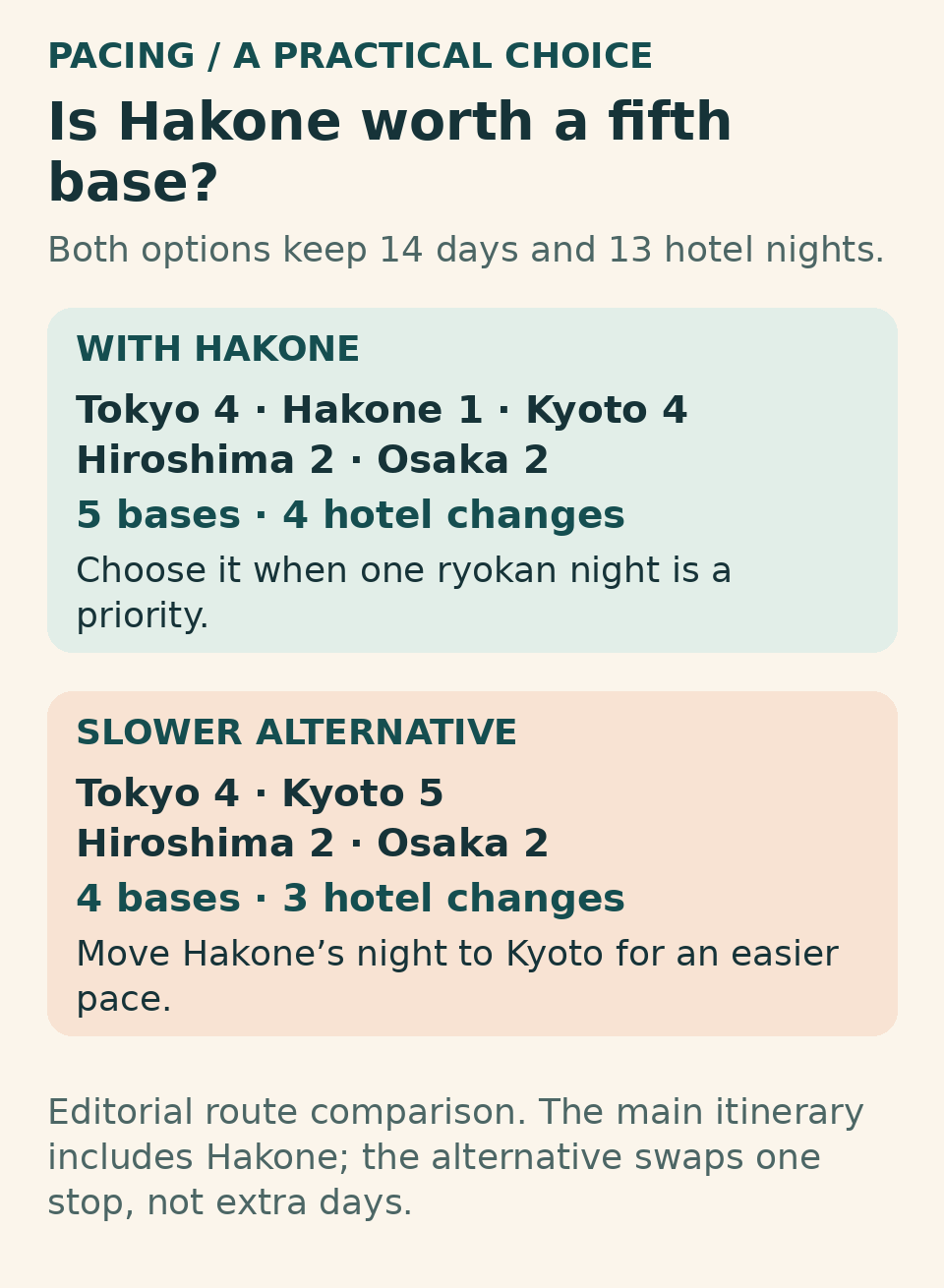
| Fewer moves, keeping Hiroshima | Tokyo 4, Kyoto 5, Hiroshima 2, Osaka 2 | Drop Hakone; add a Kyoto night and reduce hotel changes to three |
| A Tokyo return flight | Tokyo 4, Hakone 1, Kyoto 4, Hiroshima 2, Osaka 1, Tokyo 1 | Travel Osaka–Tokyo on day 13; lose the full Osaka day |
| Slower travel with children | Tokyo 5, Hakone 2, Kyoto 4, Osaka 2 | Drop Hiroshima and Miyajima, protecting the remaining stays |
If your overriding goal is relaxation, simply adding a second Hakone night without removing another stop does not solve the pace problem. Make the night count balance before booking. Equally, returning from Hiroshima to Tokyo on the morning of an international departure removes much of the resilience this route was designed to provide.
For a Tokyo return ticket, allow an additional rail fare and compare the revised hotel total. Stay in the Tokyo area on night 13 and select the next day’s airport journey for the actual airport. If an early flight makes that awkward, consider an airport-area final night.
Book in the order that makes the route easier
- Confirm the Japanese arrival and departure dates, airports and whether a Tokyo–Osaka flight pairing offers good overall value.
- Check Hakone accommodation first, including meals, bath type and latest arrival. Then reserve the four city stays with appropriate cancellation terms.
- Compare point-to-point rail tickets and the regional pass for the exact journeys. Reserve the train and baggage arrangements you need.
- Choose museum and optional tour times around the actual travel day, leaving room for delays.
- Recheck Hakone services, the Miyajima ferry and the airport route shortly before travelling.
Travel with a manageable case and keep the Hakone night’s essentials separate. If forwarding luggage from Tokyo to Kyoto, ask both properties to confirm acceptance and the expected delivery date. Keep medication, valuables and enough clothing with you until the bag is due. Check the rail operator’s current oversized-baggage reservation rules before choosing a seat. [21]
Mobile data is useful for station exits, translation and revised connections. Browse Airalo eSIMs and select Japan, checking device compatibility, validity, data allowance and activation instructions before purchase. Airalo offers Japan plans; an unlocked, compatible device is required, and a data-only plan does not supply ordinary voice calls. [22] [23]
Put your confirmed stops and nights into the Trip Itinerary Planner, then check each transport booking separately. Before paying for the trip, review Japan entry requirements for British travellers for the current document checks.
Questions before you book
Should the Hakone night be on day 5 or at the end of the trip?
Day 5 fits the westbound journey between Tokyo and Kyoto. A final Hakone stay is more useful when you are returning to Tokyo and can allow another transfer before departure. For the Osaka departure plan, moving it to the end creates unnecessary eastward travel.
Is staying on Miyajima better than two nights in Hiroshima?
An island stay may suit travellers who particularly want a quieter evening there, but it introduces another hotel change. In this 13-night plan, keeping both nights in Hiroshima makes the museum visit and the onward Osaka journey simpler. If you switch one night to the island, confirm dinner, luggage handling and the ferry connection before booking.
Can this itinerary work without a ryokan?
Yes. Choose a conventional Hakone hotel and book any bathing experience separately if you want one. The room price, bathing facilities and meal plan need checking regardless of the accommodation label. You can also remove Hakone and give that night to Kyoto for fewer moves.
Can I include Universal Studios Japan?
Use day 13 as the theme-park day instead of the Osaka city programme, allowing for your ticket and any timed-entry requirements. Do not also keep a full sightseeing list for the same day. The Tokyo-return variation loses this full Osaka day unless you reallocate another night.
Make the itinerary your own
Keep the full route if the Hakone night and Hiroshima are both meaningful priorities. Protect the Miyajima day, choose hotels for the journeys you will actually make, and leave the final long rail leg before your last Osaka day. If the four hotel changes already sound tiring, remove one stop before booking. The Japan travel hub can help with the next planning decisions.
Sources and research
Research checked on 18 October 2026. The route and pacing choices are editorial planning recommendations. Journey estimates and cost allowances are identified where used; check current operators before booking.
- GO TOKYO: Asakusa neighbourhood guide.
- GO TOKYO: things to do and suggested district groupings.
- Japan National Tourism Organization: Hakone and access.
- Japan National Tourism Organization: Owakudani and clear-day Fuji views.
- Pola Museum of Art: visiting information and closures.
- Odakyu: Hakone Freepass prices and coverage.
- Kyoto City: sample itineraries including southern Higashiyama.
- Kyoto City: Saga and Arashiyama.
- Kyoto City: Fushimi.
- City of Hiroshima: Peace Memorial Museum visitor information.
- GetYourGuide: Hiroshima Peace Memorial Park historical walking tour.
- JR West Miyajima Ferry: timetable.
- Miyajima Tourist Association: date-specific tide information.
- Kansai International Airport: rail access.
- JR West: Kansai–Hiroshima Area Pass.
- SmartEX: published reserved-seat fare table.
- SmartEX: service conditions and seasonal fares.
- Japan Rail Pass: current official online and agency prices.
- 12Go: Kyoto–Hiroshima route comparison.
- Kyoto City: accommodation-tax changes from March 2026.
- SmartEX: taking baggage onboard.
- Airalo: Japan eSIM plans.
- Airalo: device compatibility requirements.
- Pola Museum of Art: current access and Gora shuttle.
- OSAKA-INFO Experience: Kuromon Market and walking onwards to Namba and Dōtonbori.
Illustrations in this article were created for Taylor’s Trailblazing Travels. Third-party photographs, where used, are credited beside the image or in the source list.