Hakone Ropeway, Lake Ashi and Owakudani: Planning the Classic Loop
Connect the mountain railway, cable car, ropeway and lake cruise with the right ticket and a workable return.
- Full-loop allowance · Seven to eight hours
- Key interchange · Change at Owakudani
- Before departure · Check every operating leg
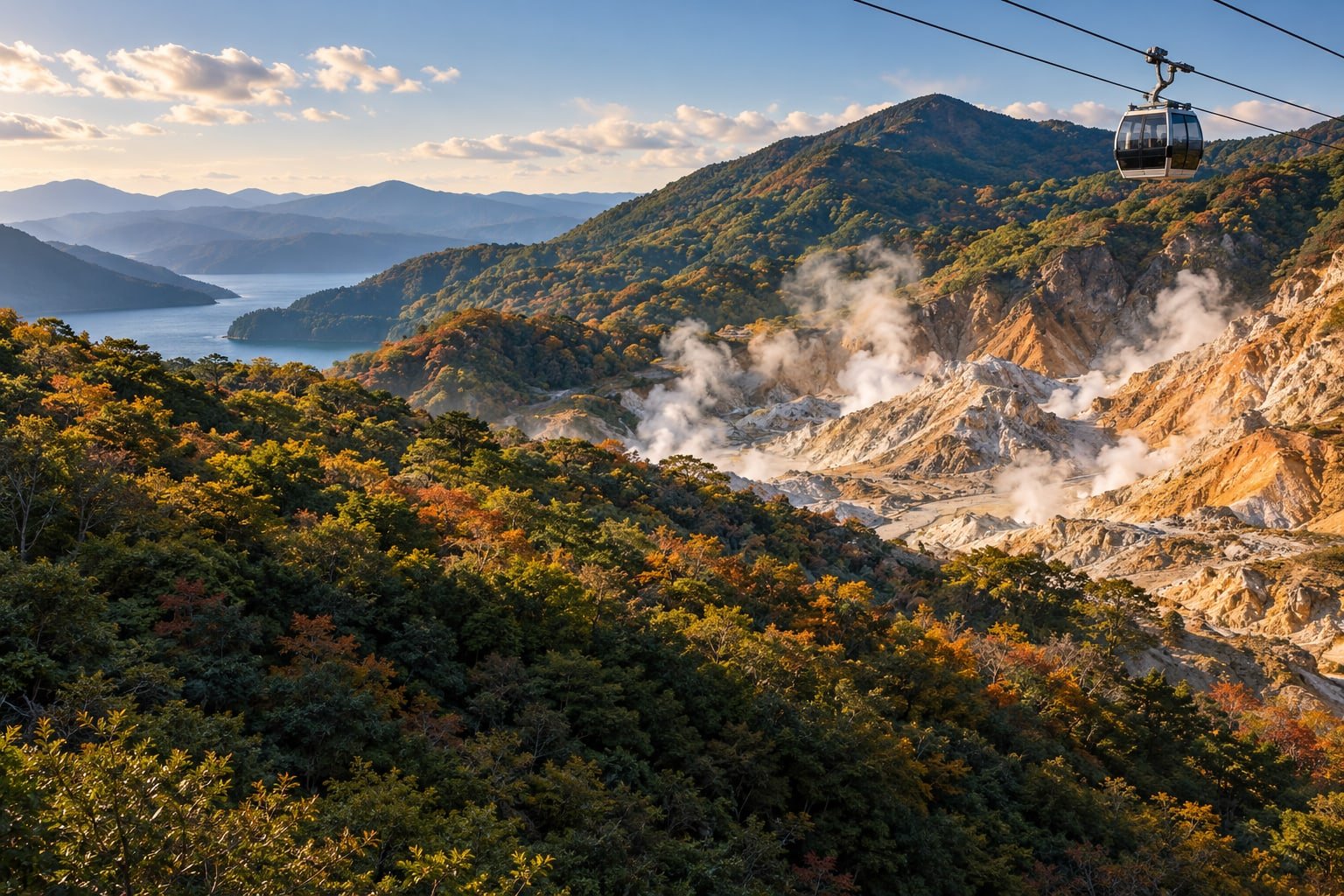
AI-generated editorial illustration inspired by Hakone’s volcanic landscape; the viewpoint and transport details are illustrative, not a geographic map or current operating-status report.
The Hakone classic loop works because the transport is part of the visit: a mountain railway, a steep cable car, gondolas over volcanic terrain and a cruise across Lake Ashi. It works less well when the published ride times are mistaken for the length of the whole day.
Start with the sequence and your entry station, then choose the ticket. Keep the Owakudani health restrictions, the ropeway’s operating window and the actual lake departures in view throughout the plan. Completing the circle is an option; a shorter day can be the better result when conditions change.
This guide contains affiliate links. If you book or buy through them, Taylor’s Trailblazing may earn a commission at no extra cost to you.
Only one full day?
Start early in Hakone and make the loop the main outing. Extra museums and long photo queues need their own time.
Arriving at Odawara?
Compare the local Freepass with the complete Odawara circuit. Starting at Yumoto produces a different fare total.
Ropeway partly closed?
Read the dated notice. Planned-maintenance buses have specific arrangements; an unscheduled closure may require a different outing.
Health or mobility concerns?
Read the Owakudani restrictions before paying. A transport pass or private guide does not override the operator’s access rules.
Follow the loop through the correct interchanges
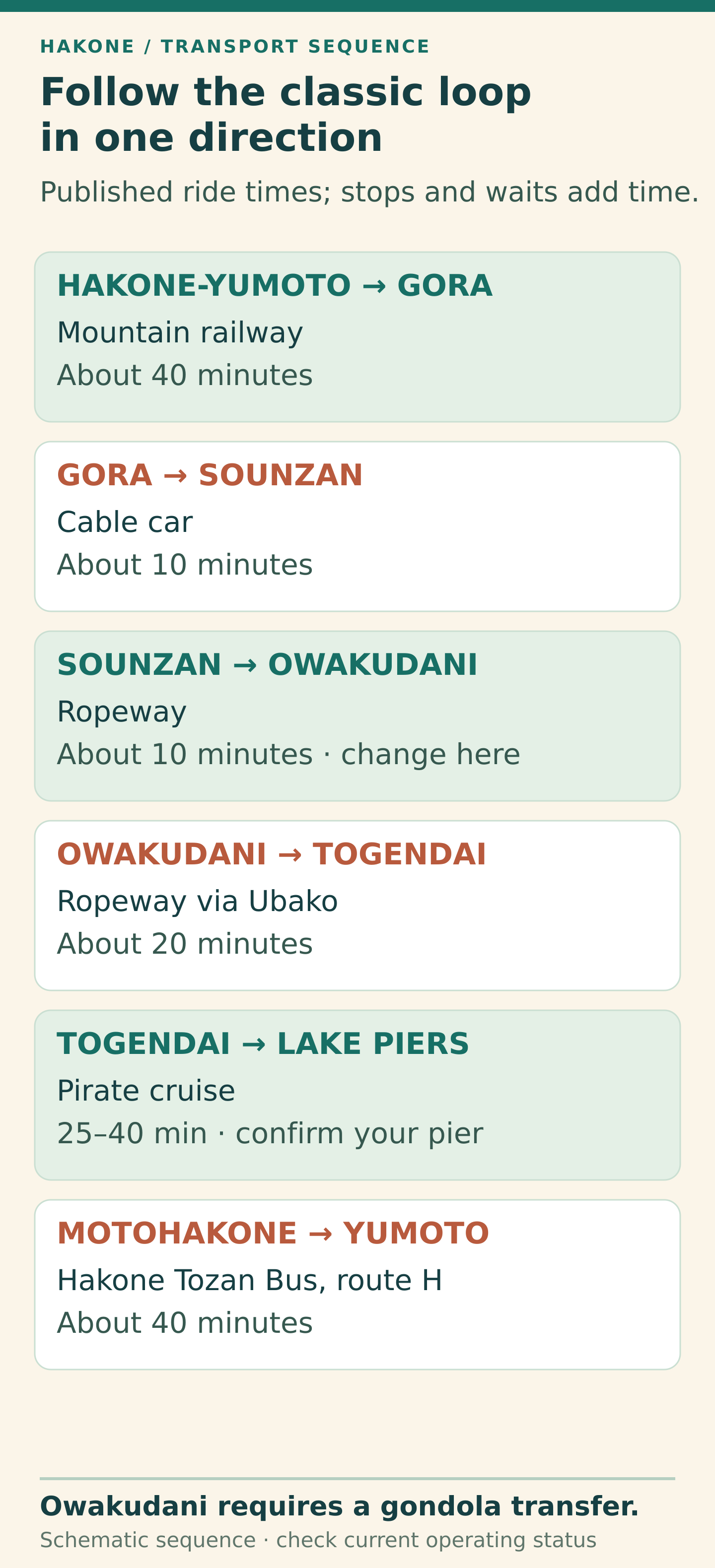
The route below starts at Hakone-Yumoto and finishes there. If you arrive at Odawara, add the railway journey to Yumoto before joining the mountain section, or continue on a service as directed by the departure board. Gora and Sounzan are separate stations reached by different forms of transport.[1]
| Leg | Transport and ride time | What to do next |
|---|---|---|
| Hakone-Yumoto → Gora | Hakone Tozan mountain railway; about 40 minutes | Change to the cable car at Gora |
| Gora → Sounzan | Hakone Tozan cable car; about 10 minutes | Change to the ropeway |
| Sounzan → Owakudani | Ropeway; about 10 minutes | Get off; change gondolas here even if you are continuing |
| Owakudani → Ubako → Togendai | Ropeway; about 20 minutes overall | Follow signs to the pirate-cruise pier |
| Togendai → Hakonemachi-ko / Motohakone-ko | Hakone pirate cruise; about 25–40 minutes | Confirm the particular sailing’s calling pattern and your intended pier |
| Motohakone-ko → Hakone-Yumoto | Hakone Tozan Bus, route H; about 40 minutes | Allow for road traffic before a reserved onward train |
The operator publishes the railway, cable-car, ropeway, cruise and bus timings used here.[1][2][4][6] The two southern lake piers are different places: this guide’s final bus and fare calculation start at Motohakone-ko. If you disembark at Hakonemachi-ko, plan the walk or onward connection explicitly.
At Owakudani, keep your ticket and follow signs for Togendai after visiting the volcanic area.[2]
On a narrow screen, swipe the diagram sideways to read the details.
Does the Hakone Freepass save money on this exact loop?
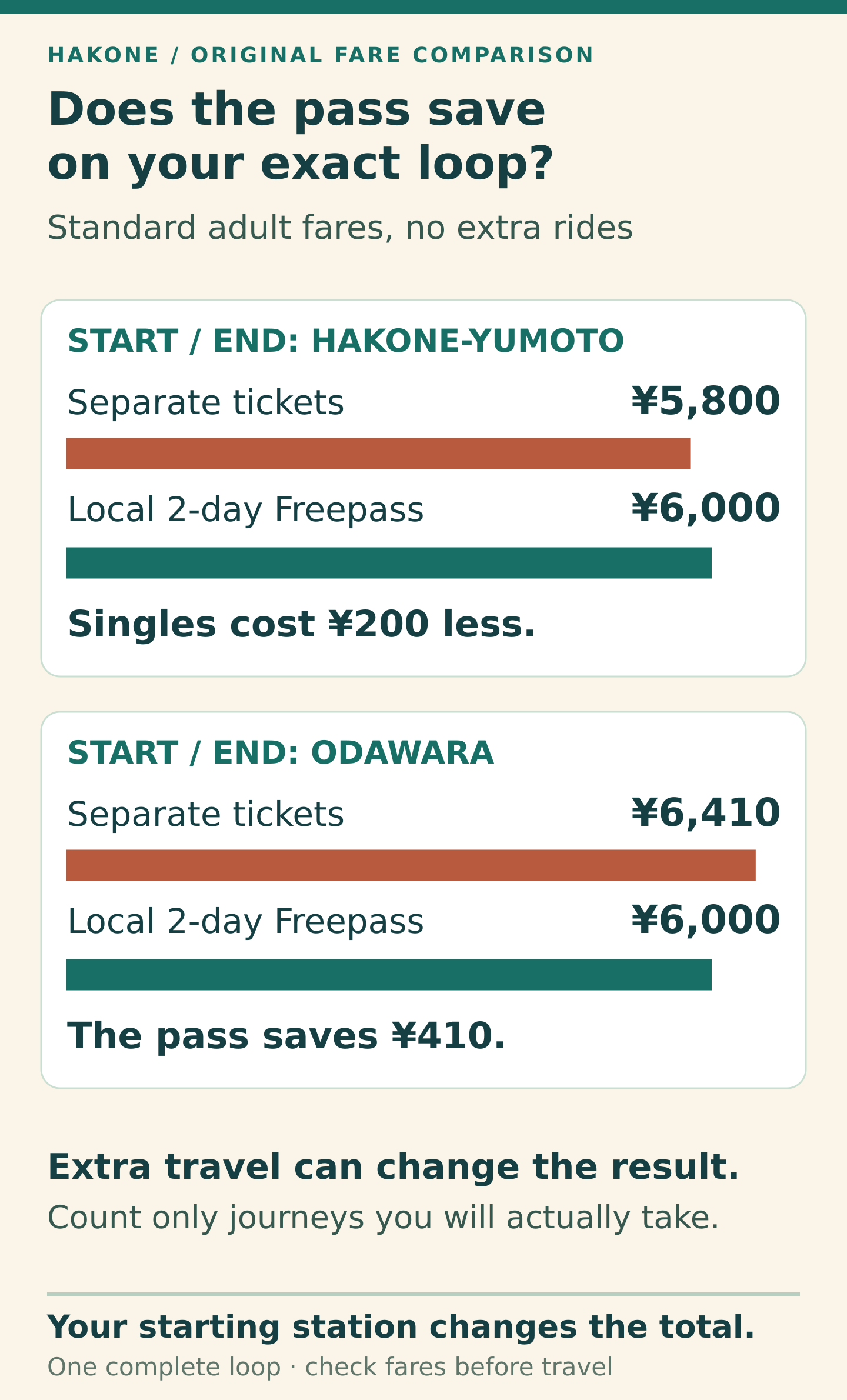
The useful comparison depends on where the circuit begins. These are standard adult fares checked on 17 October 2026, using a single one-way journey on each leg and the ordinary pirate-cruise cabin.
| Fare component | Start and finish at Hakone-Yumoto | Start and finish at Odawara |
|---|---|---|
| Railway to Gora | ¥460 | ¥770 |
| Cable car: Gora → Sounzan | ¥430 | ¥430 |
| Ropeway: Sounzan → Togendai via Owakudani | ¥2,000 | ¥2,000 |
| Pirate cruise: Togendai → Motohakone-ko | ¥1,700 | ¥1,700 |
| H-route bus from Motohakone-ko | ¥1,210 | ¥1,510 |
| Separate-fare total | ¥5,800 | ¥6,410 |
| Local two-day Hakone Freepass | ¥6,000 | ¥6,000 |
The individual components come from the current railway, ropeway, cruise and bus fare tables; the Freepass price is from its official sales guide.[1][3][4][5][7] The ropeway’s one-way fare allows the Owakudani stop; do not charge yourself a second ¥2,000 ticket simply because you change gondolas.[3]
Our arithmetic gives a modest but meaningful distinction: separate fares cost ¥200 less from Yumoto, while the pass saves ¥410 on the Odawara circuit. Extra eligible rides, a second day or a discount at an attraction you genuinely want can change that result. So can an altered route after a closure. The table compares this itinerary, not every possible ticket combination.
What the pass includes, and what it does not
The local Freepass covers the designated railway, cable car, ropeway, pirate cruise and eligible bus routes used in this circuit. It has a minimum standard validity of two consecutive days, even if you use it for one. Izu Hakone Bus is excluded, and the pass is not a seat reservation.[7] Match the operator as well as the destination on the bus you board.
Premium travel costs extra: the pirate ship’s special cabin has a supplement, and the Romancecar requires its own limited-express ticket.[4][13] Ordinary loop travel is already enough to enjoy the changing landscape; pay for an upgrade only when the particular seating matters to you.
Shorter outings have other options. The Owakudani ticket covers the railway, cable car and ropeway for two days and costs ¥5,000 from Odawara, but does not cover the full cruise-and-bus circle.[23] The separate ship-and-ropeway one-day pass is also ¥5,000 and lacks the railway and bus legs.[24] Neither replaces the full-loop calculation above; compare them when your actual day uses their narrower coverage.
On a narrow screen, swipe the diagram sideways to read the details.
Build a day around stops and the last useful connection
The six ride-time entries add up to about two hours 25 minutes to two hours 40 minutes. That is moving time under the published approximations. It leaves out changing platforms, getting tickets, waiting for a sailing, eating, visiting Owakudani and walking beside the lake.
| Component | Allowance |
|---|---|
| Published approximate rides | 145–160 minutes |
| Transfers and ordinary queues | 75 minutes |
| Owakudani stop | 60 minutes |
| Lakeshore visit | 60 minutes |
| Meal | 45 minutes |
| Additional contingency | 45 minutes |
| Illustrative total | 430–445 minutes: about 7¼ hours |
All allowances after the ride-time row are editorial assumptions. Reserve seven to eight hours and increase that if you move slowly, want a longer visit or expect substantial queues. An extra attraction needs extra time; it should not quietly consume the return margin.
The ropeway’s normal operating window is 09:00–17:00 from February to November, and 09:00–16:15 in December and January. Weather and maintenance can shorten or remove service.[2] Plan to reach your final required ropeway section comfortably before its closing time. For the ship and bus, use the dated timetable and the departure information on the day, not a generic closing time copied from another season.
For the direction shown, place your reserved train after a generous buffer at Yumoto. A 45–60-minute allowance beyond the planned bus arrival is our starting suggestion, with more when traffic is expected; it is not protection against every delay. Hakone Navi specifically warns that evening road congestion can extend the return.[8]
If you reach Gora much later than planned, decide there whether a shorter upper-route outing is enough. Removing a stop early is easier than discovering at the lake that the connection you need has already departed.
Owakudani access: the viewing stop and the restricted trail are different
Read the ropeway’s health conditions first
The operator prohibits travel between Sounzan and Ubako for people with allergic asthma, bronchial or respiratory/lung disease, heart disease, a cardiac pacemaker, or who are feeling unwell. The operator also advises considering an alternative for pregnant travellers, infants, older visitors and others with heightened sensitivity, because even low gas concentrations can cause problems.[10]
Those are the operator’s categories, not an individual medical assessment. Read the complete guidance before paying and seek advice from your clinician if you are uncertain about a relevant condition. A day based on the lake or the lower railway can be a practical alternative. Operating status alone does not mean the upper route is suitable for every traveller.
The Nature Research Trail is an optional, restricted addition
The approximately 700-metre Owakudani Nature Research Trail takes around 40 minutes with an official escort and advance reservation. It is separate from an ordinary stop around the station’s permitted visitor areas.[11] Do not enter an off-limits path because it appears on an older walking map.
The trail requires understanding Japanese safety explanations. Its exclusions include preschool children, pregnancy, relevant respiratory or heart conditions, feeling unwell, using a walking stick and being unable to run unaided for an emergency evacuation. The current charge is ¥800 per person, payable by cashless methods; weather and gas conditions can cancel entry.[12]
This guided access is not a standard inclusion in the loop or a promise attached to a commercial tour. If you are eligible and choose it, add its check-in time and visit to the day instead of squeezing it into the ordinary Owakudani allowance. Follow the current boundaries and staff instructions everywhere in the area.
Published maintenance and useful alternatives when services stop
A ropeway closure may affect one section rather than all access to Owakudani. The operator’s notice published in July 2026 confirms the following periods; these are announced dates, including the 2027 work, rather than an assumption that last winter’s pattern will repeat.[9]
| Dates | Suspended section | Announced replacement |
|---|---|---|
| 7–24 December 2026 | Sounzan ↔ Owakudani | Bus; approximately 10 minutes |
| 12 January–26 February 2027 | Owakudani ↔ Ubako ↔ Togendai | Bus between Owakudani and Togendai; approximately 15 minutes |
The notice gives roughly 15-minute bus intervals during the ropeway’s normal operating hours and accepts relevant ropeway tickets and the Hakone Freepass. Road conditions and crowding can add time; check the notice again before travelling.[9]
Choose a response that matches the actual disruption
| Situation | Useful response | What to verify |
|---|---|---|
| One section under the announced maintenance | Use its replacement bus and the working ropeway section, or shorten the outing | That date’s bus arrangements, queues and return connection |
| Upper ropeway stopped by wind, gas or another incident | Choose the lake by bus, or remain on the lower railway route | Road access, H/T bus status and whether a cruise still operates |
| Pirate cruise suspended | Make an upper-route return, or choose one shore and travel by operating buses | How to return from the shore you actually reach |
| Several modes disrupted | Replace the circuit with a shorter local visit | The safe route back to your accommodation or onward station |
H-route buses connect Yumoto and Motohakone; the T route connects the Yumoto side with Togendai.[6][15] These can support an alternative when they are running. Do not assume that an unscheduled ropeway stoppage comes with the maintenance notice’s replacement bus, or that a road remains usable because a ferry is working.
Check the operator’s current service information before setting out and again at a major interchange if conditions are changing.[14] A paid pass gives permitted travel rights, not a guarantee that every mode will operate.
Choose your lake pier, and consider reversing the loop
Togendai is the ropeway-and-cruise interchange. Hakonemachi-ko and Motohakone-ko are separate southern ports, and the ship’s calling pattern determines which journey you are taking.[4] Confirm the pier when boarding and watch the announcement before getting off. “Lake Ashi” is too broad a destination for planning a return bus.
If Hakone Shrine is your chosen lakeside visit, its official access page gives a walk of about ten minutes from Motohakone-ko. The shrine entrance bus stop is not served between 10:00 and 16:00; the shrine directs visitors to Motohakone-ko during that period.[26] Add the actual shrine visit and any photo queue to that walk. Visiting a working shrine need not depend on waiting for one particular photograph.
You can reverse the circuit: H bus to Motohakone, cruise to Togendai, then ropeway, cable car and railway down to Yumoto. Our reason to consider this direction is that the road section comes earlier, leaving the railway at the end. It does not guarantee fewer queues, and you must still reach the upper transport before it closes.
Choose the direction after checking your starting point, operating notices and priorities. If the volcanic view is your main interest, an early upper-route start may be more valuable. If the lakeside visit is the priority, begin there and decide whether the rest still fits.
Getting to the start, and deciding whether to stay
From Shinjuku or through Odawara
The Shinjuku version of the two-day Freepass costs ¥7,100 for an adult and adds one Odakyu return journey between the departure area and Odawara to the designated Hakone travel.[7] A JR journey to Odawara is separate; compare that approach if it fits your existing route better.
If you prefer a marketplace purchase, compare the Shinjuku-start Hakone Freepass voucher on Viator with the official option. Its two- or three-day product includes the Odakyu return journey, but requires physical-pass collection at the Odakyu Sightseeing Service Center, Shinjuku West during opening hours. The voucher itself cannot be used for boarding or exchanged at Hakone-Yumoto. Its main booking policy is non-refundable with no changes, and the Romancecar supplement remains separate. Check the selected duration, collection arrangements and final price before paying. Use the Shinjuku pass price for this comparison; the ¥6,000 table is for local travel.[27]
The direct Romancecar to Hakone-Yumoto has reserved seats and requires a limited-express supplement as well as the basic fare or valid pass. The standard Shinjuku–Yumoto supplement is ¥1,200 one way; the operator currently gives a ¥50 reduction when purchasing an express e-ticket through EMot Online Tickets.[13] Two standard supplements plus the Shinjuku Freepass therefore total ¥9,500, or ¥9,400 with the stated e-ticket reduction in both directions. Confirm the purchase channel and selected trains.
Check the full door-to-door journey before treating Hakone as a short Tokyo outing. Compare Tokyo–Odawara transport on 12Go if the Odawara approach suits your itinerary, comparing the actual station, train, ticket terms and final price with the operator. This link searches intercity transport; it does not purchase the local Hakone loop.[18]
When a night makes the loop easier
An overnight stay can separate the arrival journey from the full sightseeing day. Our practical choice is Yumoto for a straightforward entry and departure, or the Gora area when starting near the upper transport matters. Check the actual walk and slope from the station rather than relying on a broad area label.
For a planned stay, search Hakone accommodation on Agoda and compare Hakone stays on Booking.com. These open Hakone destination searches. Compare the precise location, room occupancy, meals, cancellation terms and final bill; a fixed dinner time also becomes a deadline for your return.[19][20] If you use a hot spring during an overnight stay, Hakone’s ordinary bathing tax is ¥150 per person per night; confirm its treatment and any applicable exemption with the property.[25]
Use the Japan trip-cost guide for UK travellers to judge the overnight choice against the whole holiday. The extra night buys time and a different evening, not assured Fuji visibility or guaranteed ropeway operation.
Choose guided help for the decisions it actually solves
A guide can help a group adapt the day, interpret the places visited and manage unfamiliar interchanges. The Hakone hotel-start private day on GetYourGuide describes a private visit beginning at a local hotel and using public transport; confirm the meeting area, pass and admission arrangements for your selected booking.[16]
The customisable Hakone walking tour on Viator offers different durations and a selection of stops with a licensed guide. A private vehicle is not included in its ordinary walking-tour booking, and transport and admissions need separate budgeting.[17] Compare it when you want a flexible selection of sights, rather than assuming every advertised Hakone tour completes this exact circle. Neither booking bypasses Owakudani’s official restrictions.
For an independent outing, keep the load manageable, wear footwear suitable for slopes and choose layers that work outside as well as in vehicles. Ask the operators about the precise boarding assistance and route you require if you use a wheelchair or have limited mobility; a generic tour label does not establish that every path or transfer meets your needs.
A working phone helps with live departures, maps and digital tickets. Use existing roaming or open Airalo and select Japan, checking eSIM compatibility, carrier-unlocked status and the Japan package’s activation and validity terms before purchase.[21] The ropeway’s digital ticket instructions require the usable ticket screen rather than a screenshot of its QR code.[3] Have a battery plan and keep the return details separately accessible.
For a wider first visit, start with the first-time Japan guide before adding further destinations. This circuit already contains a full day’s worth of changes and stops.
Your Hakone loop questions answered
Can I do the Hakone classic loop in one day from Tokyo?
Yes, if the operating conditions and an early arrival support it, but it becomes a long day. Our seven-to-eight-hour allowance begins at Hakone-Yumoto and excludes the journey from your Tokyo hotel. Choose a shorter circuit if the arrival or return leaves too little room.
Is the Hakone Freepass always cheaper than separate tickets?
No. In the single-loop model here, separate adult fares total ¥5,800 from Yumoto and ¥6,410 from Odawara, compared with the ¥6,000 local pass. Extra eligible travel and a second day can change the result; price the itinerary you will actually use.
Can I walk freely along the Owakudani Nature Research Trail?
No. It has a separate reservation and official-escort system with language, health and emergency-evacuation requirements. Check those rules before planning it; an ordinary Owakudani stop does not include trail entry.[11][12]
Will I see Mount Fuji from the loop?
Possibly, if the sightline is clear. The ropeway operator identifies Fuji-view sections, but cloud can hide the mountain.[22] Choose the day for the lake, volcanic landscape and transport experience as well as the possibility of Fuji.
Choose the plan that fits your trip
Build the day from your actual starting station, choose the ticket with the arithmetic in front of you and protect the final connection. Check Owakudani’s suitability and the dated operating notices before departure. The loop is most rewarding when there is enough time to step off the transport and enjoy where it has brought you.
How this guide was researched
This guide uses official operator, tourism, attraction and municipal information checked on 17–18 October 2026, with merchant listings used to verify described booking options. It does not claim a personal visit or tested tour. The fare totals are original arithmetic using stated adult ticket components; the whole-day allowances, buffers and alternative-plan decisions are editorial recommendations. Published ride times, planned maintenance and real-time operating status are treated separately. Recheck the linked sources for the date you travel.
Sources and checks
Official, operator and relevant booking information checked on 17 October 2026 and 18 October 2026. Opening arrangements, fares and availability can change; recheck the linked source for your travel dates.
- Hakone Tozan Railway — routes and current fares
- Hakone Ropeway — stations, ride times and hours
- Hakone Ropeway — current tickets and conditions
- Hakone Sightseeing Cruise — routes and fares
- Hakone Tozan Bus — fare tables from 1 October 2025
- Hakone Navi — Motohakone area and bus access
- Hakone Freepass — current official prices and coverage
- Hakone Navi — classic-route travel and return congestion
- Hakone Ropeway — announced 2026–27 maintenance PDF
- Hakone Ropeway — volcanic-gas health restrictions
- Hakone Tourism Association — Nature Research Trail reservations
- Hakone Tourism Association — Nature Research Trail safety and payment conditions
- Odakyu — Romancecar ticket details
- Hakone Navi — current transport operating information
- Hakone Navi — pirate-cruise access from Hakone-Yumoto
- GetYourGuide — Hakone hotel-start private day
- Viator — customisable Hakone tour with a licensed guide
- 12Go — Tokyo to Odawara transport search
- Agoda — Hakone accommodation search
- Booking.com — Hakone accommodation search
- Airalo — how its eSIM marketplace works
- Hakone Navi — clear-weather Fuji views from the ropeway
- Hakone Navi — Owakudani railway/cable-car/ropeway ticket
- Hakone Navi — ship-and-ropeway unlimited pass
- Hakone Town — bathing-tax visitor leaflet
- Hakone Shrine — official access instructions
- Viator — Shinjuku-start Hakone Freepass voucher and redemption terms
Illustrations in this article were created for Taylor’s Trailblazing Travels. Third-party photographs, where used, are credited beside the image or in the source list.