
Japan Entry Requirements for British Travellers: What to Check Before You Fly
A practical preflight check for passports, tourist eligibility, arrival forms and medicines.
- British citizen tourist visits
- Initial stay: up to 90 days
- Rules checked 17 October 2026
AI-generated editorial illustration of Japan travel preparation; the airport setting and distant view are imagined, and the objects are not official travel documents.
Japan entry requirements for British travellers start with the passport you will use and the purpose of your visit. Living in the UK does not, by itself, make you eligible for Japan’s British citizen visa exemption. [3]
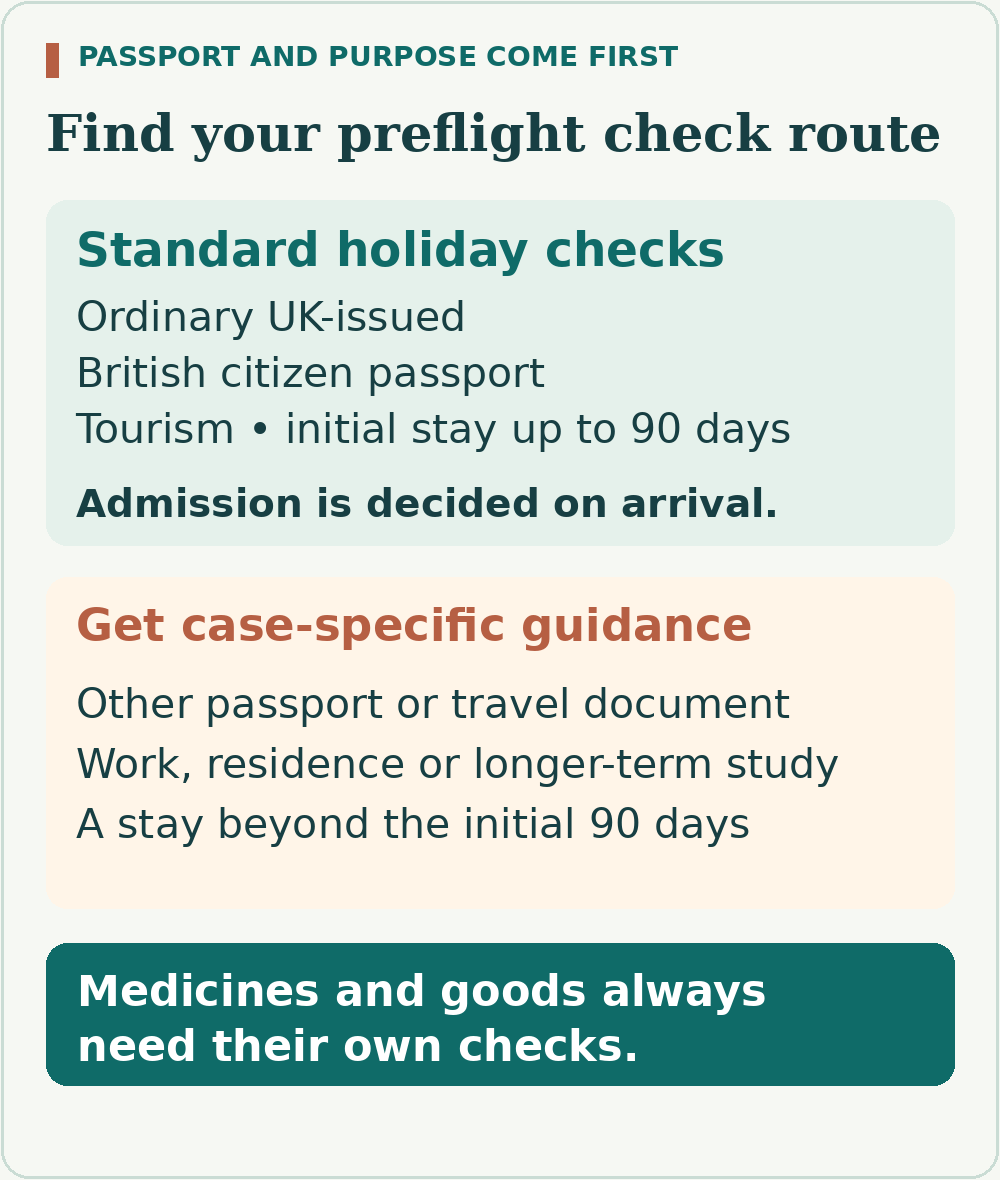
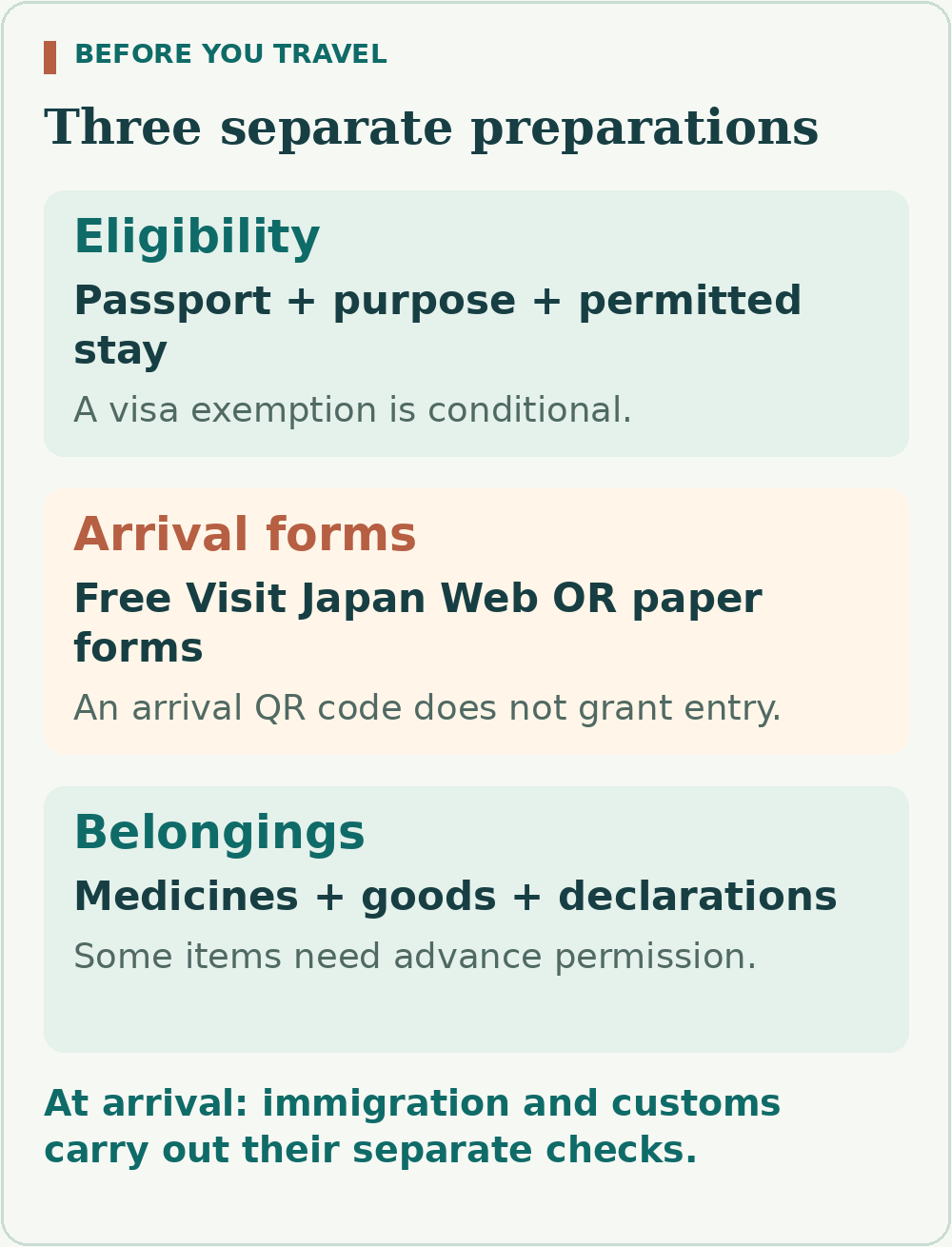
This guide covers an ordinary UK-issued passport showing British citizen, used for a short tourist visit. Work through the passport and eligibility checks first, then organise arrival forms and anything you need permission to bring. Resolve exceptions before committing to a trip you cannot change.
Passport
Valid throughout your stay, with a blank page for the entry stamp. [1]
Visa position
An ordinary tourist visit is normally visa-exempt; check the permitted stay on arrival. [2][4]
Start early
Different documents, longer stays and medicines can require extra preparation.
Confirm which passport and trip the rules cover
Check the nationality wording and the issuing authority in your passport. The Japanese Embassy in the UK specifically excludes several other British passport categories from the ordinary British citizen exemption. [3]
| Your situation | What to do before booking |
|---|---|
| Ordinary UK-issued British citizen passport; short tourist holiday | Use this guide, then confirm the current official rules shortly before departure. [2][4] |
| British Overseas Citizen, British Subject, British Overseas Territories Citizen, or a passport issued by a British Overseas Territory | Contact the Japanese Embassy about obtaining a visa. Its warning also covers territory-issued passports that say British citizen. [3] |
| Convention Travel Document, emergency passport or temporary passport | Ask the Embassy which requirements apply to the actual document. [3][4] |
| A different nationality with permission to live in the UK | Check Japan’s rules for that passport. UK residence is not the basis of visa exemption. [3] |
British National (Overseas) passports have a separate provision in Japan’s visa-exemption list, linked to the right of residence in Hong Kong. Check that specific provision instead of assuming the ordinary British citizen rule applies. [2]
Paid work, a working holiday, longer-term study or a move to Japan needs a separate assessment of the appropriate immigration route. A tourist exemption does not authorise paid activities. If your plans combine a holiday with work, describe the actual activity to the Embassy before relying on tourist entry. [4]
Check your passport against the whole journey
Japan’s stated requirement for this visit is a passport valid for the length of your stay, with a blank page. There is no additional six-month validity requirement for Japan in the current GOV.UK advice. A passport reported lost or stolen cannot be used to enter. [1]
For example, a passport expiring one month after your planned return meets Japan’s stated duration rule. That does not settle the requirements of another country on the same itinerary. Check every stop, especially a connection involving an overnight stay outside the airport, a separate ticket or a baggage collection.
Ask the airline to check the documents against the full route, including any transit countries. GOV.UK also advises checking travel-document requirements with your provider. [1] Keep some practical validity margin for a delayed return where possible, even when no extra period is legally required.
If you renew after making reservations, review the passport details held by the airline and in any arrival registration. Carry the physical travel document; a scan is useful as a backup record but cannot replace it.
Build a small arrival document bundle
The Japanese Embassy advises carrying evidence of your intention to leave, your planned activities and sufficient funds. Immigration officers decide what they need to see in an individual case. [5]
A useful bundle contains:
- Your passport and any visa or other permission relevant to your circumstances.
- Your return flight, or genuine onward booking showing how you will leave Japan.
- The name, address and contact details of your first accommodation or host, plus a simple outline of the trip.
- Accessible evidence of how you will pay for the stay, such as relevant account information and your means of payment.
This is an editorial preparation checklist based on the Embassy’s advice, not a promise that every document will be requested. Keep the material consistent with the trip you describe. If you are staying with friends, for instance, record their address and contact details so you can explain that arrangement clearly.
Store useful copies where you can retrieve them without an unreliable airport connection. On arrival, check the status and permitted period on your landing permission. Use that permission when confirming your latest departure date. [7]
Choose Visit Japan Web or paper arrival forms
Visit Japan Web prepares immigration and customs information online. Registration is optional; a paper arrival form remains an alternative. [7] The customs declaration itself is required for arriving passengers, and Japan Customs explicitly continues to accept its paper form. [8]
| Choice | Useful when | Preparation |
|---|---|---|
| Visit Japan Web | You prefer to enter details at home and can display the arrival code. | Create an account, register your passport and trip, complete the arrival information and locate the QR code before travelling. [6] |
| Paper forms | You prefer paper or cannot use the online service. | Keep your passport, flight and accommodation details handy. Obtain the relevant forms and follow the airport’s instructions. [7][8] |
Use the official Digital Agency link above. Visit Japan Web is free; Japan Customs has warned about imitation sites and businesses charging to create codes. Customs duties or taxes on declarable goods are a separate matter. [9] Completing the online form can reduce writing on arrival, but it does not remove immigration checks or possible baggage inspection. [8]
What about JESTA?
JESTA is a separate electronic travel-authorisation system under development. Japan’s 2026 legislation establishes the system, but its commencement date is to be set by government order and must be no later than 31 March 2029. [16] It is not part of the current tourist application process described in the official guidance reviewed for this October 2026 article. Recheck the Embassy’s instructions for your departure date, particularly for a trip in a later year. [4] An arrival QR code from Visit Japan Web is not a visa or a JESTA authorisation.
Check medicines before you pack
Start with the active ingredient, strength, daily dose and total quantity of each medicine, including anything bought over the counter. A UK prescription does not establish that a medicine can be imported into Japan; some prescribed substances are prohibited and others have specific permission requirements. [11]
Check the category before the quantity
For general prescription medicines that are neither prohibited nor specially controlled, up to one month’s supply can normally be brought for personal use without Import Confirmation. The general allowance for other medicines and quasi-drugs is up to two months. These are category-specific exceptions, not blanket permission for every product. [10]
For example, lisdexamfetamine, including Elvanse, falls under a category requiring advance permission. Amphetamine, including dexamfetamine, is prohibited for individual travellers even when prescribed. The Narcotics Control Department sets out these distinctions and separate rules for psychotropics. Check the precise substance rather than treating all ADHD, pain or sleep medicines alike. [11]
For a longer trip through several countries, count everything you will bring across the Japanese border. A three-week Japan stay does not turn a two-month supply carried for the whole journey into a one-month allowance. Assess the full quantity against the rules for that medicine. [10]
Arrange the right paperwork
If you exceed the general prescription quantity allowance, apply for Import Confirmation before travelling. The Ministry of Health, Labour and Welfare’s application guidance asks for prescription or doctor documentation and evidence of your arrival details. Its medicine enquiries guidance explains what ingredient, strength, form and quantity information to supply. [12]
Controlled-medicine permission is a separate process. The Narcotics Control Department asks applicants to apply at least 14 days before travel; allow longer to resolve questions. Check whether permission is also needed to take remaining medicine out of Japan, and follow the instructions for the office covering your arrival airport. [11]
For an uncertain medicine, use the contacts on the Ministry’s personal medicine guidance and speak to your prescriber early. Keep the medicine identifiable in its labelled packaging and carry the relevant documentation. Resolve a restriction with your clinician; avoid changing or stopping treatment simply to fit a packing plan.
Finish the health and customs checks
COVID-19 documents
The requirement to show a pre-departure COVID-19 test or vaccination certificate was removed on 29 April 2023; the official border guidance consulted for this review does not require either. [13] Recommended travel vaccinations and health precautions are a separate planning question. Use the health guidance linked from GOV.UK and check any additional countries on your route.
Food and other belongings
Check snacks and gifts as well as obvious valuables. Japan’s Animal Quarantine Service says most meat and animal products cannot be brought in without meeting its conditions; shop-bought, cooked or vacuum-packed packaging does not create an exemption. Leave meat snacks at home unless you have confirmed they are permitted and hold the necessary certification. [14]
Read the customs questions carefully and declare relevant goods, even if you bought them at an airport. Ask an officer about anything uncertain. Completing the ordinary declaration is still required when you have nothing taxable to declare. [8]
Large amounts of cash
If the combined value of cash and other covered means of payment you carry exceeds ¥1,000,000, or the equivalent in other currencies, a separate declaration is required. This includes foreign cash and specified instruments such as travellers’ cheques. Check the official list if it applies to you. [15]
Resolve longer stays and connections separately
Staying for more than 90 days
The UK arrangement allows eligible visitors to apply for an extension beyond the initial 90 days, up to the arrangement’s six-month limit. You must apply to the relevant immigration office before your existing permitted stay expires. An extension requires approval; six months is not automatically granted on arrival. [2] Your passport must remain valid for the extended stay. [1]
If a longer visit is central to your plans, ask about the procedure before buying inflexible transport. Build a plan that can accommodate the permission actually granted. Travelling as a resident, working or studying long term requires the appropriate separate route.
A flight connection can still involve entry
Ask your airline whether you remain airside, collect baggage, change airports or sleep outside the international transit area. If you must pass immigration, complete the entry checks for the passport you will use. The Embassy confirms that an ordinary British citizen passport holder eligible for exemption does not need a visa for an overnight stay near Narita between flights. [5]
For a connection in another country, consult that country’s official transit and entry guidance as well. A booking labelled as a connection does not answer whether your particular transfer requires you to cross its border.
Use this preflight check sequence
The order below puts the potentially slow decisions ahead of routine form filling. It is an editorial planning sequence; official application deadlines and your own circumstances take priority.
| When | Action | What should be resolved |
|---|---|---|
| Before non-refundable bookings | Check the actual passport, purpose, trip length and connection requirements. | You know which immigration route applies, or have obtained case-specific advice. |
| As soon as the route is settled | Review medicines and any documents needing advance permission. | You have allowed time for the appropriate applications and questions. |
| Before packing | Prepare the arrival document bundle; choose online or paper forms; check food and cash declarations. | Your details and belongings match what you will declare. |
| Shortly before departure | Reopen the official entry guidance and airline instructions; check for changes. | Your passport, permissions, bookings and arrival information are ready to show. |
For a two-week holiday on an ordinary British citizen passport with no exceptional documents or medicines, this is largely a checking and organising exercise. A different passport, work-related plans, a lengthy stay or a controlled medicine changes the preparation required. Settle that issue first so a simple online form does not become a distraction from the decision that matters.
Questions that can change your plan
Why does Visit Japan Web warn if my passport has less than six months left?
The Digital Agency says its registration form may display a warning depending on the remaining validity when it is under six months. [6] Japan’s current requirement for this British citizen tourist visit remains validity throughout the stay. [1] Check your dates, the airline’s document assessment and any transit-country requirements. A form warning does not establish a new six-month Japanese entry rule.
What if I also hold another nationality's passport?
Assess the Japan part of the trip using the passport you intend to present, and keep the relevant airline and arrival details consistent. Check the rules for returning to the UK and for every transit country separately before choosing which documents to carry. Using one passport for Japan does not settle the requirements for the rest of the journey.
Make the decision that fits your trip
Begin with the passport and the actual purpose of the trip. Once those fit the tourist route, organise your departure evidence, accommodation details and arrival declarations, then check everything you intend to bring. Use the official links again close to departure. If a passport exception, medicine restriction or longer stay remains unresolved, obtain the appropriate answer before relying on the standard holiday process.
How this guide was researched
This guide was researched against UK and Japanese government guidance on 17 October 2026. The comparison tables, document bundle and preflight sequence are editorial planning tools. Individual admission and import-permission decisions remain with the relevant authorities.
Sources
Official guidance and operator information reviewed on 17 October 2026. Recheck time-sensitive details for your own travel dates.
- GOV.UK — Japan: entry requirements
- Ministry of Foreign Affairs of Japan — Exemption of Visa (Short-Term Stay)
- Embassy of Japan in the UK — Visa: General Information
- Embassy of Japan in the UK — Temporary Visitor Visa
- Embassy of Japan in the UK — Visa: Frequently Asked Questions
- Digital Agency — How to use Visit Japan Web
- Embassy of Japan in the Czech Republic — Immigration procedures (English section)
- Japan Customs — Declaration of Accompanied Articles and Unaccompanied Articles
- Japan Customs — Beware of Fake Websites Related to Customs Procedures
- Ministry of Health, Labour and Welfare — Bringing medicines for personal use into Japan
- Narcotics Control Department — Application guidance for travellers carrying controlled medicines
- Ministry of Health, Labour and Welfare — Questions and answers about importing medicines
- Ministry of Foreign Affairs of Japan — COVID-19 border measures
- Animal Quarantine Service — Bringing animal products into Japan
- Japan Customs — Export/import of means of payment
- Immigration Services Agency — 2026 immigration-law amendments and JESTA commencement
Illustrations in this article were created for Taylor’s Trailblazing Travels. Third-party photographs, where used, are credited beside the image or in the source list.