Where to Stay Near Tokyo Station: Marunouchi and Yaesu
A station hotel earns its place when the entrance, room and next journey work together. Start with the gate you will actually use.
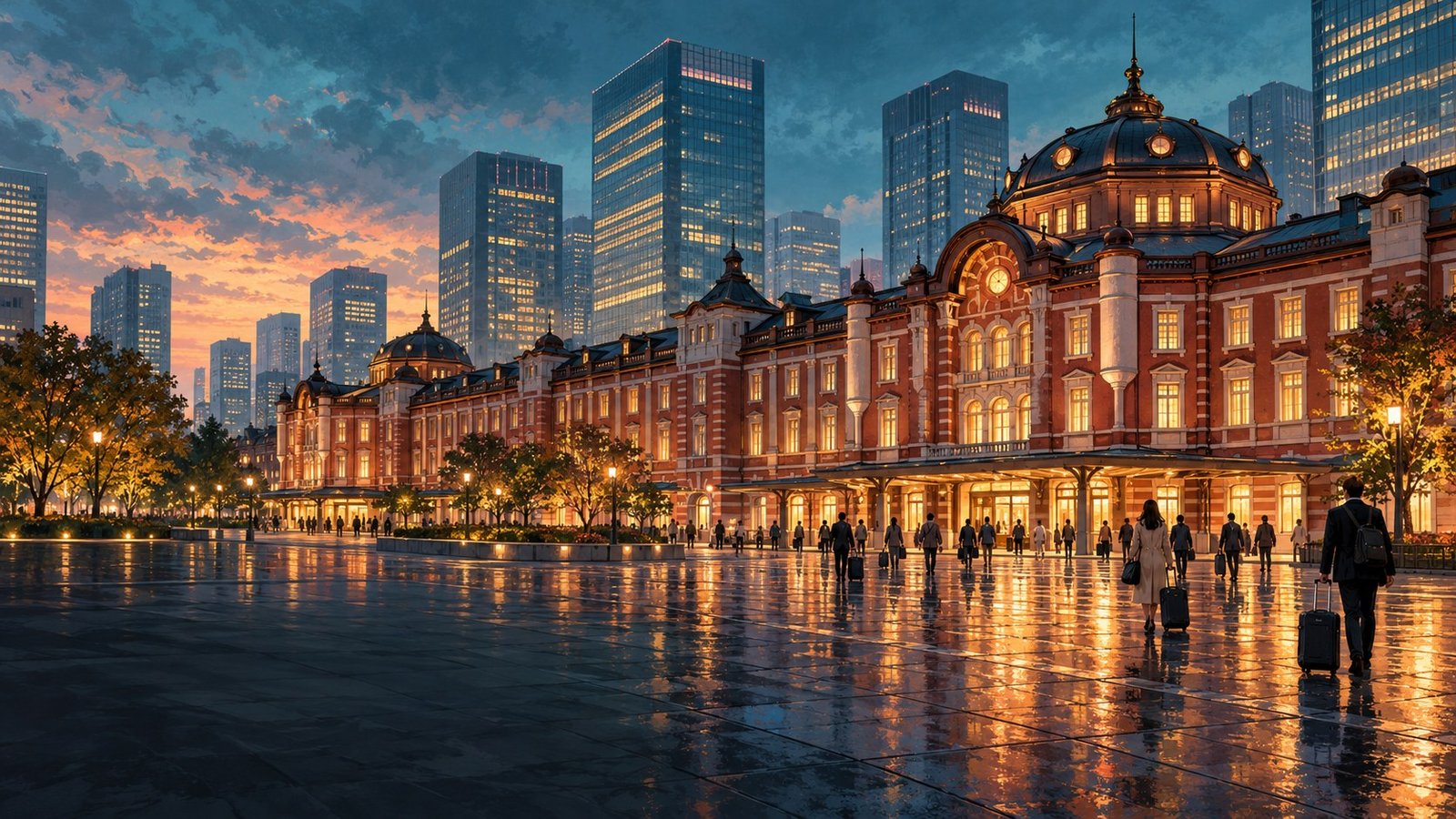
AI-generated editorial illustration of Tokyo Station and Marunouchi; not a photograph or a verified hotel-room view.
When deciding where to stay near Tokyo Station, the most useful question is often “near which entrance?” A Marunouchi South connection, a northern Sapia Tower approach and a short walk from a Yaesu shopping-mall exit solve different journeys.
This area makes particular sense when your stay is shaped by an airport arrival, an early train or onward travel across Japan. Tokyo Station combines major rail connections with substantial shopping and dining.[1] Yet staying nearby does not make every platform equally close, or turn a compact room into a comfortable family base.
This guide compares four approaches and five hotel examples, then works backwards from a hypothetical morning departure to show what belongs in your time budget.
Some links in this guide are affiliate links. Taylor’s Trailblazing Travels may earn a commission if you book or buy through them, at no extra cost to you.
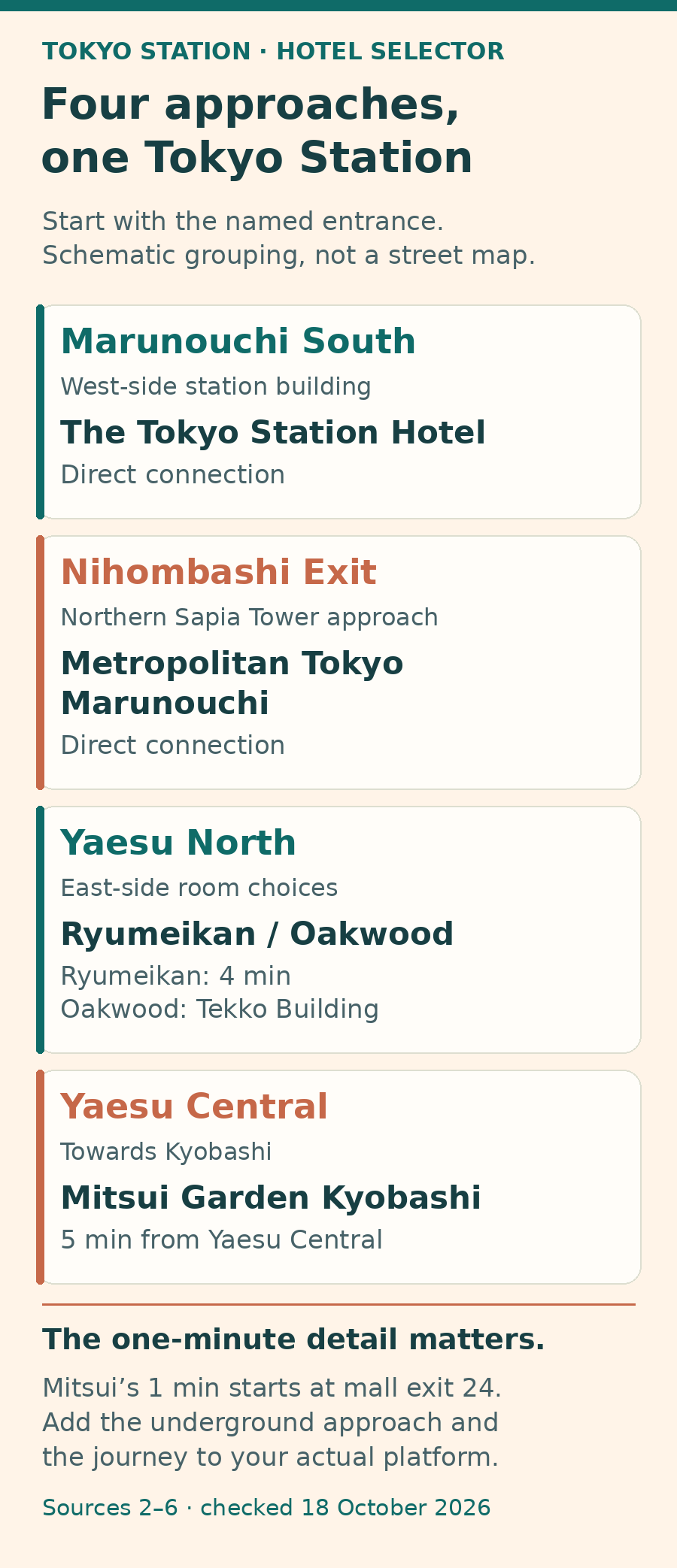
WEST SIDE
Marunouchi South
Station-building stay at The Tokyo Station Hotel; choose the room outlook.
NORTHERN APPROACH
Nihombashi Exit
Metropolitan uses Sapia Tower, despite the Marunouchi name.
ROOM CHOICE
Compact or apartment
Yaesu North offers different room functions; compare the exact category.
EARLY TRAIN
Work backwards
Hotel walk, internal station travel and platform margin are separate.
Where to stay near Tokyo Station: choose the approach first
Marunouchi is the west side, facing towards the Imperial Palace; Yaesu is the east side, towards Nihonbashi and Ginza. Marunouchi’s office buildings, Naka-dori shops and station square provide a different setting from the shopping and coach connections around Yaesu.[1] Treat those as starting areas, then narrow the search to a named entrance.
This is an editorial decision matrix, based on published hotel approaches and room details. It gives priority to the journey you must make, then the room you need. It does not rank hotels by price, measured noise or walking speed.
Swipe across the table to compare →
| Approach | Strongest reason to start here | Hotel test | Trade-off |
|---|---|---|---|
| Marunouchi South / station building | A station-building stay and evenings on the west side | The Tokyo Station Hotel connects to Marunouchi South. | An internal station journey remains; a Classic room does not provide a view.[2][7] |
| Nihombashi Exit / Sapia Tower | A northern station approach without a street-based hotel search | Metropolitan connects to Nihombashi Exit, with another approach from Yaesu North. | Its Marunouchi name does not mean the west-side forecourt; lifts and current works matter.[3][10] |
| Yaesu North / nearby streets and Tekko | A choice between compact hotel rooms and serviced apartments | Compare Ryumeikan’s four-minute approach with Oakwood’s apartment facilities. | Check the actual entrance and room; neither the district nor the building name promises the same walk.[4][6][15] |
| Yaesu Central / Kyobashi edge | Tokyo Station departures plus useful local Metro access | Mitsui Garden Kyobashi lists five minutes from Yaesu Central and two from Kyobashi exit 7. | Its one-minute claim begins at mall exit 24, after the underground walk.[5] |
For an early train, give the correct entrance more weight than a skyline view. For five nights with washing and simple meals, the apartment layout may matter more than a few minutes of walking. Price two suitable rooms against those priorities before expanding the search.
Marunouchi South: stay in the station building deliberately
The Tokyo Station Hotel is the clearest choice when the station building itself is part of the appeal. It connects directly to Marunouchi South Exit.[2] This suits a special stay with a rail arrival or departure attached, but the room’s location inside the building and your train’s platform still belong in the travel plan.
The entry-level Classic Queen is 23m², while the Classic Comfort Queen is 26m²; Classic rooms have no view.[7] A Palace Side Comfort King or Twin is 34m² and faces the station square and Marunouchi cityscape.[8] The category names therefore describe a meaningful choice, rather than minor wording differences. Palace Side should not be read as a guarantee of the separately named Palace View category.[7]
Compare The Tokyo Station Hotel on Agoda with the same hotel on Booking.com, matching the room, breakfast and cancellation terms. A low headline price for a Classic room is not a like-for-like comparison with a larger outward-facing room.
The hotel also offers platform meet-and-greet for guests arriving by Narita Express or Shinkansen, with advance reservation required.[2] Ask whether it can be arranged for your particular arrival before relying on it. That service may be more useful after a long flight than saving another minute on a hotel listing.
Nihombashi Exit and Yaesu North: three different room decisions
Metropolitan: follow the entrance, not the hotel’s district name
Hotel Metropolitan Tokyo Marunouchi uses the Sapia Tower approach at the station’s northern end. Its official directions specify direct connection to Nihombashi Exit, two minutes from Yaesu North Gate and one minute from the Shinkansen Nihombashi Gate.[3] Do not walk automatically towards the western Marunouchi forecourt because “Marunouchi” appears in the name.
The UTSUROI Queen No View is 17m² for one or two guests, with a 160cm-wide bed and an internal-courtyard window. The 20m² UTSUROI Queen Train View is a separate category.[9] Choose whether the view matters before comparing Metropolitan Tokyo Marunouchi rooms on Booking.com.
The Otemachi approach also needs care: ordinary exit B7 is closed, and the hotel’s replacement Sapia access route operates from 07:00 to 23:00 and includes steps and an escalator.[11] It is not a blanket step-free or round-the-clock connection.
Ryumeikan: a compact room near Yaesu North
Hotel Ryumeikan Tokyo’s current access page gives a four-minute walk from JR Tokyo Station’s Yaesu North Exit.[4] Use that named approach when weighing its location; shorter figures elsewhere can use different assumptions.
Its Standard room is 17.5m² for one or two people, with one 140cm-wide bed and a modular bathroom.[12] It is a useful candidate for a solo stop or a couple travelling light. Two-person occupancy does not provide twin beds or guarantee space for two open large cases.
Check Hotel Ryumeikan Tokyo on Agoda and its Booking.com listing with the full party entered. Decide first whether you can share that bed comfortably; a different room category can change the comparison more than a small walking-time difference.
Oakwood: pay for apartment functions you will use
Oakwood Premier Tokyo is in the Tekko Building near Yaesu North.[6] It is the apartment option in this shortlist, useful when Tokyo Station remains important but you also want a base for several nights.
The named Studio Superior Twin has a full kitchen, washing machine and dryer, twin beds and the operator’s published maximum of two guests. Its bathroom is shower-only; the operator distinguishes it from Studio Deluxe and Executive categories with a bathtub.[15] Compare the exact Oakwood Premier Tokyo apartment on Booking.com, rather than assuming all serviced apartments have the same bathroom or accommodate a family.
Save the property’s own entrance instructions and ask for the vehicle drop-off if arriving by car. A pin for the wider office building is less useful than the entrance that reaches reception. For a brief overnight stop, the kitchen and laundry may add little; for repeated meals and washing, they can become the main reason to choose it.
Yaesu Central and Kyobashi: useful if the extra approach fits
Mitsui Garden Hotel Kyobashi / Tokyo Station is a useful boundary case: close enough to consider for rail departures, with a separate local Metro advantage. It advertises five minutes from Yaesu Central Entrance, one minute from Yaesu underground-mall exit 24 and two minutes from Kyobashi Station exit 7 on the Ginza Line.[5]
Those figures start at three different places. The one-minute mall approach excludes the walk through the station and shopping passages. Choose this hotel if its full route and Kyobashi connection suit your days, rather than treating “one minute” as room-to-platform time.
The current Superior, three-bed category is 31.7m² with three 111cm-wide beds, giving three travellers a concrete alternative to sharing a double or adding an unconfirmed extra bed.[13] There is a shared coin laundry and microwave on the third floor.[14] These are useful facilities, but they serve a different need from Oakwood’s equipment inside the apartment.
Compare Mitsui Garden Hotel Kyobashi rooms on Agoda
For families, confirm every guest’s age and the exact bed arrangement. For a very early departure, walk the route at a comparable time beforehand where practical, checking which underground passages and lifts you can actually use. A familiar surface approach may be preferable when the underground route is uncertain.
Match the hotel entrance to the train you will take
Separate three things on your booking notes: the hotel entrance, the station gate and the platform for your specific service. “Tokyo Station” is too broad for the last two. JR East provides separate maps for the main floors, Keiyo Line area and Sobu Line area, so check the section relevant to your journey.[16]
Before settling on a hotel, write one concrete route in each direction: arrival platform to reception, and reception to your onward train. A hotel that suits the first may be less convenient for the second. Do the same for a coach: copy its terminal, stop number and level from the operator’s confirmation.
- For Shinkansen travel, note the train, destination and operator’s gate instructions. A generic “bullet train entrance” pin is insufficient.
- For an airport rail arrival, allow for finding the correct exit before starting the advertised hotel walk.
- For step-free travel, ask for the route from your named line, including lift locations and opening restrictions. Check the bedroom and bathroom requirements separately.
- For a late arrival, confirm both the hotel’s entrance procedure and any underground route you expect to use.
This short exercise usually produces a better shortlist than sorting every nearby hotel by distance to a single station pin. It also gives reception a precise question they can answer.
A 07:30 train: build the morning backwards
The following model compares two hypothetical hotels before an example 07:30 train. It is not a real service recommendation, a tested route or a guarantee that either allowance will be enough. Tickets are already ready, bags are packed and breakfast is excluded.
Assume ten minutes from the room through lifts and checkout, either five or fifteen minutes to the chosen station gate, twelve minutes inside the station and fifteen minutes ready on the correct platform before departure.
Swipe across the table to compare →
| Part of the morning | Shorter gate walk | Longer gate walk |
|---|---|---|
| Room to street: lift and checkout | 10 min | 10 min |
| Hotel entrance to the chosen station gate | 5 min | 15 min |
| Gate to the correct platform | 12 min | 12 min |
| Margin while ready on the platform | 15 min | 15 min |
| Total before the example train | 42 min | 52 min |
| Leave the room for a hypothetical 07:30 departure | 06:48 | 06:38 |
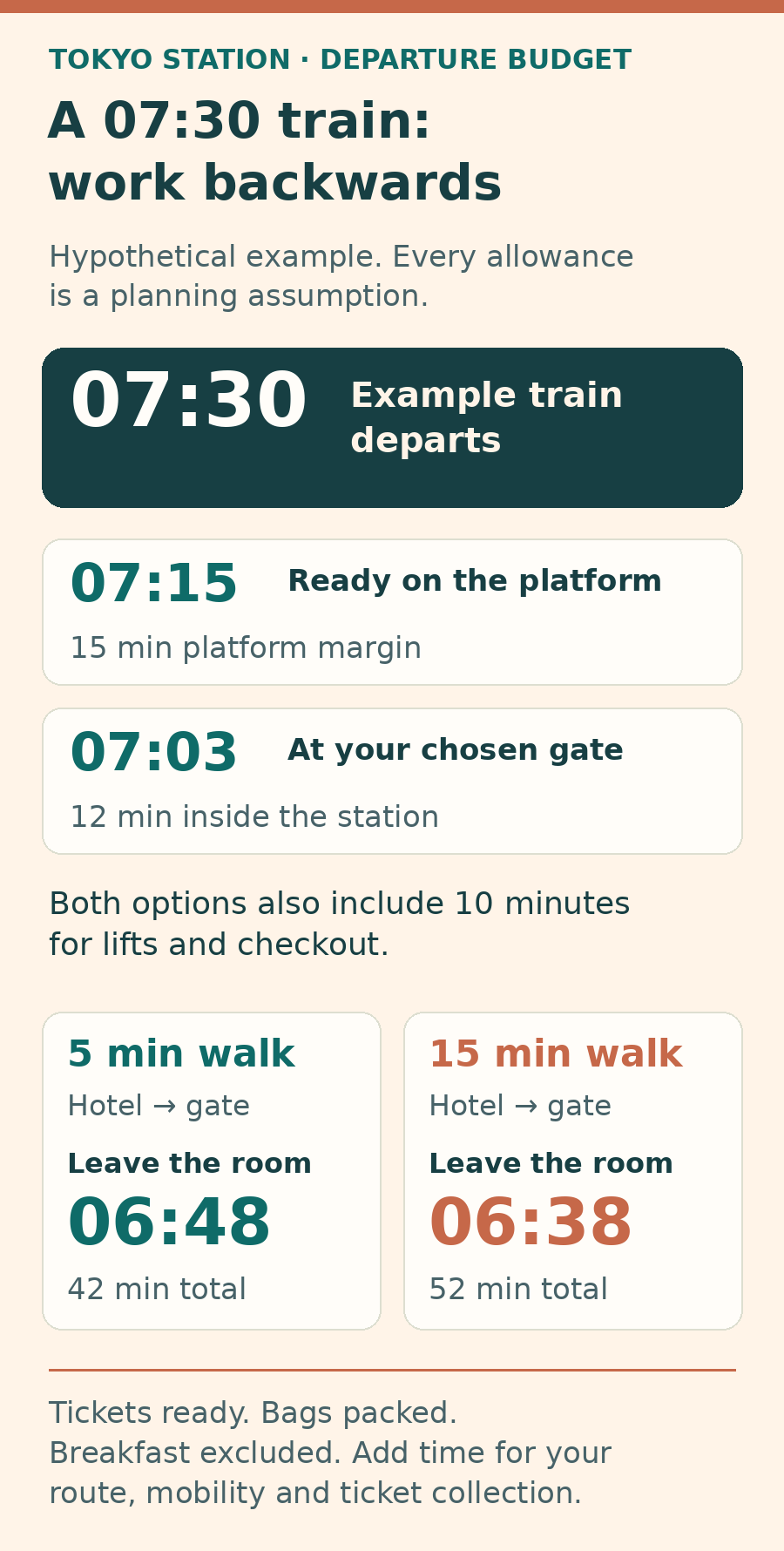
Both versions reach the gate at 07:03 and the platform at 07:15. Only the assumed hotel walk changes, so the longer approach moves room departure ten minutes earlier. This is why a short advertised walk helps but does not remove checkout, internal movement or a sensible margin.
Replace each input with your own route. Add time for ticket collection, breakfast, children, lift queues or a less familiar station layout. If a twelve-minute internal allowance is inadequate for your line or mobility needs, increase it; do not squeeze the platform margin to make the hotel look more convenient.
For a single morning, leaving ten minutes earlier may be acceptable. If you have several departures, limited mobility or luggage that makes every transfer tiring, a more suitable entrance can justify paying more. Make that judgement using the actual complete-stay price, rather than an assumed premium for every station-connected hotel.
Airport and onward travel: book the actual stopping place
Narita Express or a Yaesu-side airport coach?
Narita Express runs directly between Narita Airport and Tokyo Station. JR East advertises 53 minutes for the fastest airport-to-Tokyo service, which is a train time rather than a hotel-arrival estimate.[20] Add airport formalities, the wait for your selected train and the final station approach when planning check-in.
During the affected services around 6–8 November 2026, tunnel works alter onward operation beyond Tokyo towards Shinjuku and Ofuna; the airport–Tokyo section continues operating. Check the dated notice for your train.[21]
TYO-NRT provides a useful road alternative: the regular adult one-way fare is ¥1,500, rising to ¥3,000 on designated early-morning or late-night services. Tokyo departures currently operate without reservations or assigned seats; from Narita, passengers normally buy a ticket for a specific bus, with seating unassigned.[17]
At Tokyo Station, TYO-NRT uses surface JR express-bus stops 7 and 8 outside Yaesu South.[18] That makes the correct Yaesu hotel approach relevant. Allow for queues, the selected service and road delays; a nearby bus stop does not remove flight check-in requirements.
Haneda and private transfers
A rail option from Haneda is the Tokyo Monorail to Hamamatsucho, then a JR Yamanote or Keihin-Tohoku service to Tokyo Station.[2] Compare that transfer and the final hotel walk with a road option for your terminal and arrival time.
If a car solves a real luggage or arrival problem, H.I.S.’s Tokyo airport transfer on GetYourGuide covers Haneda or Narita and hotels within Tokyo’s 23 wards.[22] This Narita-to-central-Tokyo transfer on Viator is an arrival-only alternative with stated suitcase limits and a 60-minute driver-wait allowance after actual landing; its listing says it is not wheelchair accessible.[23]
Confirm the selected vehicle, all passengers and bags, child seats, waiting extensions and your hotel’s entrance before payment. Compare the total vehicle quote with the whole party’s public-transport journey; there is no universal group size at which a private car becomes better value.
Leaving Tokyo by rail or coach
For onward Shinkansen reservations, the operator’s Smart EX service is a direct booking option.[25] You can also compare Tokyo–Osaka transport on 12Go, whose city-to-city listing includes trains, coaches and flights.[24] Verify the actual departure and arrival stations or terminals: a Tokyo label does not mean every option leaves beside your hotel.
Bus Terminal Tokyo Yaesu now distinguishes A in TOFROM Yaesu from B in Tokyo Midtown Yaesu. These are separate from the surface JR stops, and underground access has early- and late-hour restrictions.[19] Match the letter, floor and stop on your ticket before choosing the hotel’s approach.
Save the Japanese hotel name, entrance pin and tickets offline. If you need mobile data, browse Airalo and select Japan; check the plan’s activation rules and use an eSIM-compatible, network-unlocked phone.[26][27]
Turn the shortlist into a booking
Swipe across the table to compare →
| Your stay | First priority | Useful starting point | Final test |
|---|---|---|---|
| One night before an early train | The correct gate and a predictable checkout | Start with the two station-connected examples, then compare a suitable Yaesu room. | Check breakfast timing and use the backward budget; do not buy a view you will scarcely see. |
| Three travellers, several nights | Three confirmed beds, then the approach | Mitsui Kyobashi’s named three-bed category is worth comparing. | Bed count must fit the party; shared laundry needs time in the schedule.[13][14] |
| A longer stay with cooking and washing | Useful apartment equipment | Start with Oakwood’s exact apartment category. | A studio with a kitchen is still limited by its published occupancy.[15] |
| A special station-building stay | The building and guaranteed room outlook | Compare Classic and Palace Side categories at The Tokyo Station Hotel. | Pay for the room experience deliberately, then check its route to your train.[7][8] |
For the final comparison, enter every guest and age, match the beds and room category, then compare the complete stay including breakfast, payment timing, cancellation deadlines and locally payable charges. None of the examples establishes availability or a price for your dates.
Until 31 March 2027, Tokyo’s accommodation tax is ¥100 per person per night at a taxable room charge of ¥10,000 to below ¥15,000, or ¥200 at ¥15,000 and above; charges below ¥10,000 are exempt. The taxable charge includes room-related service charges but excludes meals and consumption tax.[29]
For stays from 1 April 2027, Tokyo has confirmed a 3% accommodation-tax rate, with an exemption below a taxable room charge of ¥13,000 per person per night.[28] Check how the chosen booking displays the applicable tax rather than assuming the first search total includes everything.
Before the cancellation deadline, recheck current works and entrance notices. Send the hotel your actual arrival time if it changes; Mitsui Kyobashi specifically asks guests to notify it about late arrivals.[14] Save the reply with your booking so the useful details remain available offline.
These examples were selected from official property and transport information for distinct room-and-route decisions. The comparisons are research-based and do not represent personal stays, sound tests or measured station walks.
Useful questions
Does “one minute from Tokyo Station” mean one minute from the train?
No. Mitsui Garden Kyobashi’s one-minute figure starts at Yaesu underground-mall exit 24; its published Yaesu Central approach is five minutes. Neither includes every possible platform journey. Read the starting point attached to the number.[5]
Is a no-view hotel room necessarily windowless?
No. Metropolitan’s UTSUROI Queen No View has an internal-courtyard window. Its separately named Train View category provides a different outlook. Check the exact room description if natural light or an outward view is important to you.[9]
Should I move here only for the night before a train?
Consider the whole move: packing, checkout, luggage handling and a second check-in. If your existing hotel has a straightforward route and you can leave earlier, moving may add more work than it saves. A station-area final night becomes more persuasive when it also improves the room, luggage arrangements or a very early departure.
Can an underground hotel approach be assumed step-free and always open?
No. Metropolitan’s replacement route from Otemachi includes steps and an escalator and has stated operating hours. Bus Terminal Tokyo Yaesu also restricts some underground passages early and late. Ask for an accessible route for your exact arrival time, rather than relying on “connected” alone.[11][19]
Choose the entrance before the hotel name
Start with the journey that matters most, shortlist a hotel on the appropriate approach, and then choose the room. Marunouchi South, Nihombashi Exit, Yaesu North and Kyobashi each offer a useful answer to a different stay. The right choice is the one whose entrance, sleeping arrangement and complete price fit your plans—and whose morning route you can describe before you arrive.
Sources and checks
Research-led hotel and neighbourhood guidance with original planning comparisons. Sources below were consulted on the dates shown. Check room details, access notices, transport and booking conditions for your own travel dates.
- GO TOKYO: Tokyo Station, Marunouchi and Yaesu orientation
- The Tokyo Station Hotel: Marunouchi South access and platform meeting service
- Hotel Metropolitan Tokyo Marunouchi: Nihombashi and Yaesu North approaches
- Hotel Ryumeikan Tokyo: current access directions
- Mitsui Garden Hotel Kyobashi: named station and underground-mall approaches
- Oakwood Premier Tokyo: location and apartment overview
- The Tokyo Station Hotel: Classic room sizes and outlook
- The Tokyo Station Hotel: Palace Side room categories
- Hotel Metropolitan Tokyo Marunouchi: room categories, beds and outlooks
- Hotel Metropolitan Tokyo Marunouchi: November 2026–March 2027 renovation notice
- Hotel Metropolitan Tokyo Marunouchi: Otemachi B7 closure and alternative approach
- Hotel Ryumeikan Tokyo: Standard room size, bed and occupancy
- Mitsui Garden Hotel Kyobashi: Superior rooms and three-bed layout
- Mitsui Garden Hotel Kyobashi: guest services, laundry and arrival conditions
- Oakwood Premier Tokyo: Studio Superior Twin facilities and bathroom
- JR East: Tokyo Station maps, including Keiyo and Sobu areas
- TYO-NRT: fares and different boarding procedures by direction
- Keisei Bus Group: Tokyo Station bus terminals and TYO-NRT stops
- Bus Terminal Tokyo Yaesu: A and B locations and restricted underground access
- JR East: Narita Express routes, seating and luggage facilities
- JR East: November 2026 tunnel works and altered Narita Express services
- GetYourGuide: H.I.S. Tokyo Private Airport Transfer Service, product 678130
- Viator: Narita Airport to central Tokyo private transfer, product 8653P311
- 12Go: Tokyo–Osaka transport comparison
- JR Central: Shinkansen tickets and Smart EX booking
- Airalo: Japan eSIM plans
- Airalo: eSIM-compatible and network-unlocked devices
- Tokyo Metropolitan Government: accommodation-tax changes from April 2027
- Tokyo Metropolitan Government: current accommodation-tax bands and taxable charges
- Oakwood Premier Tokyo: accommodation-provided power-outage notice on Ikyu
Illustrations in this article were created for Taylor’s Trailblazing Travels. Third-party photographs, where used, are credited beside the image or in the source list.