Where to Stay in Shinjuku: Hotel Areas and Station Exits
Make the station work for your stay: choose the side, confirm the exit, and map the final approach.
- Four distinct hotel zones
- Station names are not interchangeable
- Platform-to-door beats map distance
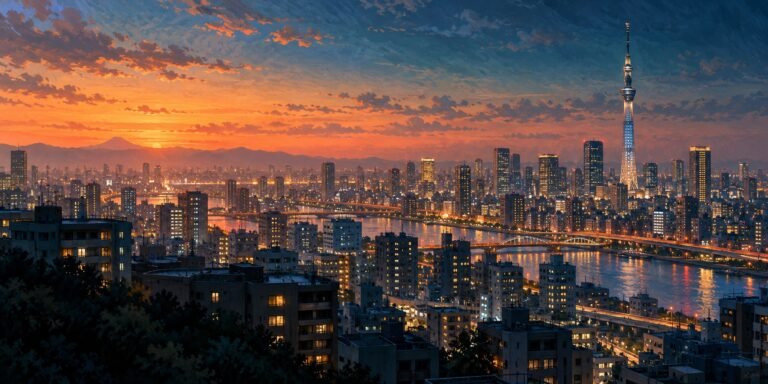
An original Shinjuku-inspired urban illustration, not the documented entrance or view of a named property.
A Shinjuku hotel can be close to a station entrance and still awkward for the train on which you arrive. The district’s reputation as a transport hub is deserved, but its convenience is not evenly distributed. The useful question is not simply “How far from Shinjuku?” but “From which operator, gate and street exit?”
This guide assumes you have decided that Shinjuku suits your Tokyo trip. It focuses on hotel micro-areas, access examples and the final arrival with luggage—not another list of Tokyo neighbourhoods or a general sightseeing itinerary.
This article contains affiliate links. If you book or buy through them, Taylor’s Trailblazing Travels may earn a commission. Recommendations are chosen for their relevance to the trip.
South-side start
Useful when your planned arrival naturally uses JR’s southern side.
West-side alternative
Check the hotel’s Shinjuku and Tochomae approaches separately.
East-side choice
Choose Kabukicho for the evening location, not by accident.
Sanchome distinction
A nearby subway exit is not a nearby JR platform.
Where to stay in Shinjuku: choose the side first
| Micro-area | Why choose it | Main trade-off |
|---|---|---|
| South / south-west | A useful JR-oriented shortlist with hotels on the Yoyogi side | South-side gates, crossings and the actual street still need checking |
| West / Nishi-Shinjuku towers | Larger hotels and an office-district setting | The walk to some hotels is longer; Tochomae may be a different useful station |
| East / Kabukicho | Dining and entertainment close to the room | The surrounding evening environment may not suit a light sleeper |
| Shinjuku-sanchome | A subway-oriented base near shopping and dining | Proximity to its exits does not mean proximity to the JR platforms |
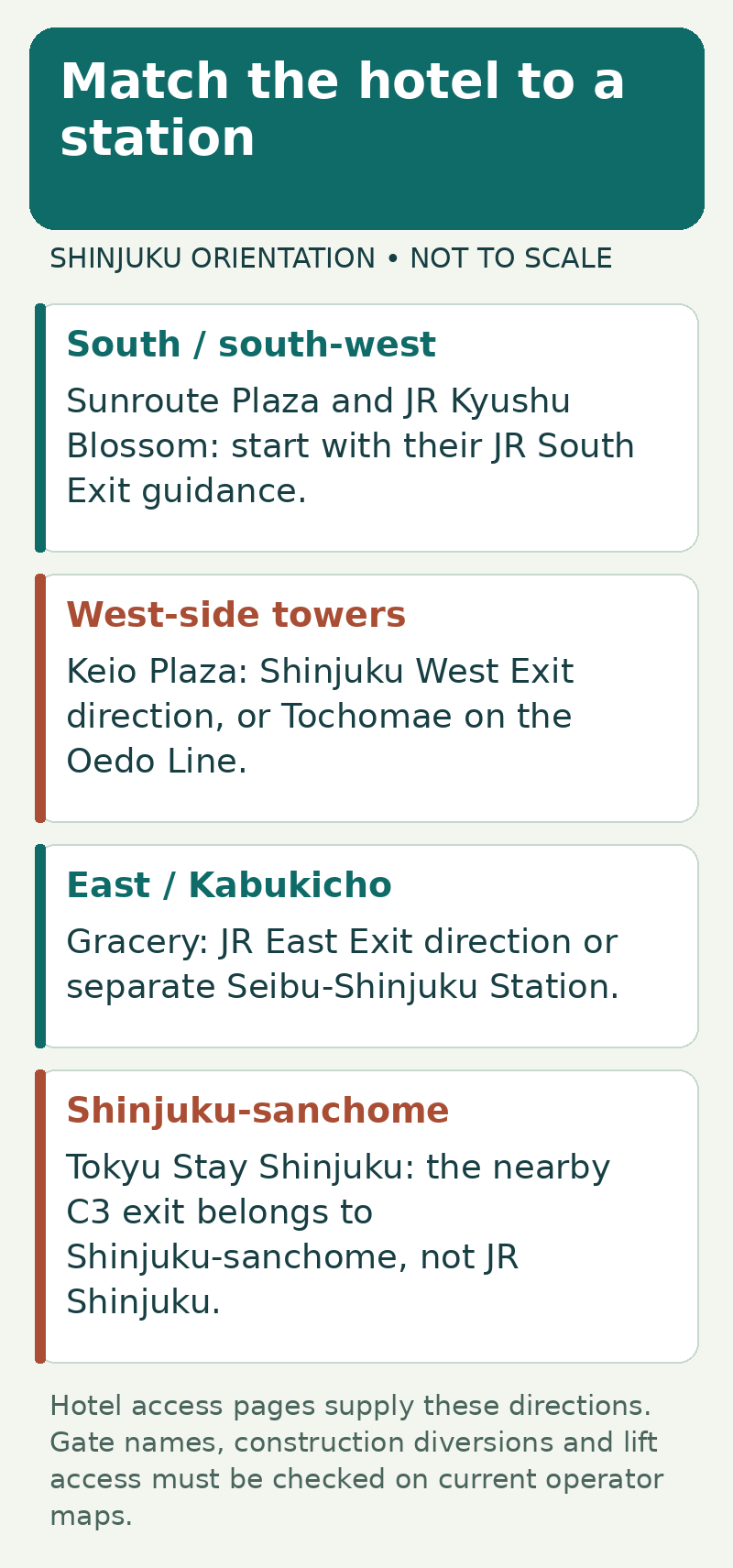
For a first Shinjuku stay, begin with the south/south-west shortlist when you want access to the main station without choosing the centre of the entertainment district. Then compare it with a west-side hotel that offers a suitable room and a clear access route. Choose Kabukicho because its evenings appeal, not because an attractive photograph concealed the address.
Shinjuku-sanchome can be the better fit when its lines serve your plans directly. There is no advantage in repeatedly walking back to JR simply to justify a familiar station name if the nearer subway is the useful route.
Keep four parts of the address separate
Record the arrival station and operator, the relevant paid-area gate, the street exit, and the hotel entrance. These can be four different steps. A hotel’s walking time normally describes an external approach from a named exit, not the time required to reach that exit from every platform.
JR Shinjuku, Seibu-Shinjuku, Shinjuku-sanchome and Tochomae are not interchangeable station names. Tokyo Metro’s station page identifies Shinjuku-sanchome’s subway lines and facilities, while JR provides its own Shinjuku maps. [7][8] Use the operator relevant to your train rather than following the first similarly named entrance.
South Exit, New South-area gates and an east or west street approach should not be treated as synonyms. Follow the signs that match the hotel’s current directions. When construction, a closed passage or a lift requirement changes the route, the shortest dotted line on a phone may no longer be the most useful walk.
Keep the complete hotel name and address offline. Some well-known south-side Shinjuku hotels have Yoyogi addresses in Shibuya City: Sunroute Plaza and JR Kyushu Blossom are examples. [2][3] A different ward name does not by itself mean that you have booked a hotel near Shibuya Station.
South and south-west: two access-led examples
Hotel Sunroute Plaza Shinjuku
Tokyo Tourist Information lists Sunroute Plaza at about three minutes on foot from JR Shinjuku South Exit and about one minute from the Toei Oedo Line’s Shinjuku Exit A1. [2] Those are different starting points. The shorter number is useful only when that subway approach matches your journey.
This example belongs on a south-side shortlist when you want a clearly named station approach. Check the exact room, luggage arrangements and arrival route directly; do not assume a station-level one-minute claim means a completely step-free one-minute walk from the train.
JR Kyushu Hotel Blossom Shinjuku
Blossom publishes a roughly three-minute South Exit approach and an illustrated route along the south-west side of the station. [3] Use that route when comparing it with hotels that advertise similar distances from different exits.
Its location is a practical reason to investigate the property, not proof that it is the best room for every traveller. Look at bed configuration, floor area, cancellation and the location of reception. In a large station, two hotels with the same headline walking time can serve different arrival patterns.
West-side towers: compare Shinjuku with Tochomae
Keio Plaza’s access page gives a West Exit route through the underground passage towards the Tokyo Metropolitan Government Building, with the hotel to the left after leaving the passage. The hotel quotes about five minutes for that approach. It separately describes access from Tochomae: an A1 stair approach and an A4 lift option for wheelchair or pushchair users. [4]
That distinction is more useful than simply saying the hotel is beside a large station. A traveller already using the Oedo Line may make a different arrival decision from someone arriving on a JR train. Confirm the current lift and onward path before depending on a step-free route.
A west-side hotel can also suit travellers who prefer the evening atmosphere of the tower district to an entertainment-street address. That is an area preference, not a guarantee that any particular room is quiet. Check room position, hotel notices and the actual walk to the places in which you will dine.
East and Kabukicho: buy the location deliberately
Hotel Gracery illustrates the east-side arrival well. It publishes about five minutes from JR Shinjuku East Exit and about three from the separate Seibu-Shinjuku Station. Its reception is on the eighth floor, reached through the hotel entrance rather than by treating the building’s cinema frontage as the check-in desk. [5]
The useful reason to stay in Kabukicho is that you actually want to spend evenings there. It can support a pattern of sightseeing, a rest at the hotel, then dining nearby. It is a weaker proposition when you only need a bed after days and evenings elsewhere.
The trade-off is the surrounding entertainment environment. A higher-floor room, soundproofing claim or favourable review is not a blanket guarantee of quiet. A light sleeper should investigate the exact room and setting. Use ordinary city precautions, decline unwanted touting and follow the hotel’s known entrance route rather than allowing an unsolicited stranger to redirect you.
Shinjuku-sanchome: a different station can be the better station
Tokyu Stay Shinjuku is close to Shinjuku-sanchome, not immediately outside a JR platform. Its current English access page distinguishes a very short C3 approach using stairs, an upward-escalator option at C4 and a lift option at C6. It also gives an approximately eight-minute walk from JR’s East Exit. Check the current station facilities and hotel route before relying on any of them. [6][7]
This is precisely why a hotel search filtered only by distance to “Shinjuku” can miss the useful answer. For a journey on the relevant subway lines, staying near Sanchome may remove an unnecessary walk. For a luggage-heavy arrival on JR, that same room deserves a different calculation.
Do not confuse Tokyu Stay Shinjuku with Tokyu Stay Shinjuku Eastside or Tokyu Stay Nishi-Shinjuku. Check the full name and street address, then the exact room’s facilities. A brand’s reputation for apartment-like equipment does not establish that every room at every branch contains the same kitchen or laundry setup.
Calculate platform-to-reception time, not just street distance
Use the following original example to challenge a misleadingly simple comparison. Neither Hotel A nor Hotel B is one of the named properties; the inputs are hypothetical, and no walking route has been timed.
| Journey element | Hotel A | Hotel B |
|---|---|---|
| Platform to useful street exit | 12 min | 4 min |
| Street walk in the advertisement | 3 min | 8 min |
| Entrance and lift to reception | 2 min | 2 min |
| Total modelled arrival | 17 min | 14 min |
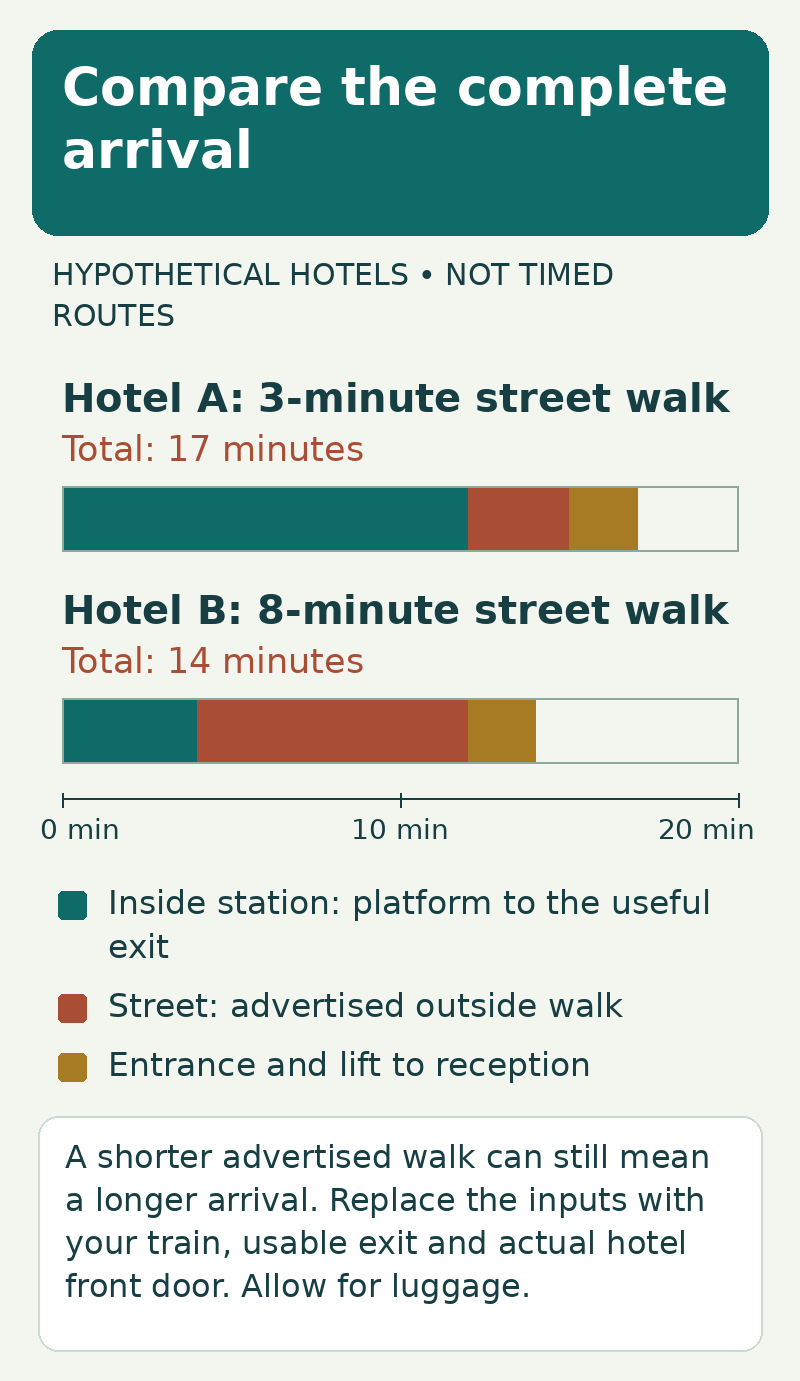
Hotel A wins a comparison of street-walk advertisements and loses this particular whole-arrival model. The point is not that an eight-minute hotel is always better. It is that station circulation and the actual front door can outweigh the small difference printed on a booking page.
For a wheelchair user, family with a pushchair or traveller with several cases, replace the shortest route with a usable step-free route. Add a realistic navigation allowance for the first arrival. Later in the stay, familiarity may change the balance; do not pretend that every daily journey will take the same time as the first one.
Check airport connections, then compare the room offers
The Narita Express normally serves Shinjuku, but your train and date must support the through journey. JR’s tunnel-works notice includes altered services around 7 November 2026, with affected trains on the preceding evening and following morning as well. Check the notice for the specific service rather than assuming a hotel’s generic airport instructions apply unchanged. [9][10]
The Skyliner instead serves Nippori and Keisei Ueno, so using it for Shinjuku involves an onward journey. For Haneda, check Keikyu’s actual route and transfers. [11][12] A hotel-served airport bus can also be worth comparing when the route and timetable fit, but do not assume every Shinjuku hotel has the same stop or departures.
Once the arrival works, compare room area, beds, maximum occupancy, smoking status, bathroom, cancellation deadline, taxes and any breakfast or laundry requirements. Consider the direct hotel offer too. An eight-minute approach may be an acceptable trade for a much better-suited family room; it is not a reason to compromise an essential accessibility requirement.
Questions that prevent the common booking mistakes
Is the south side always better for a first visit?
It is a useful initial shortlist for a JR-oriented trip, not an absolute rule. A hotel near Tochomae or Shinjuku-sanchome may fit your actual lines better. Start with the journey you will make, not a rule about the entire district.
Is Kabukicho automatically unsuitable for families?
Avoid treating a whole district as a yes/no category. Consider the surrounding evening setting, the exact entrance and the room layout. Families seeking a calmer approach may prefer another micro-area, while others may value nearby dining; choose with those trade-offs visible.
Will a station exit number guarantee a lift?
No. Check the operator’s facilities and the full route. An exit can involve stairs, an escalator that runs only one way, restricted opening hours or a diversion. The useful accessible route may be longer than the shortest one shown by a booking platform.
What should be saved before arriving?
The complete hotel name and address, the operator and station, the relevant exit or lift route, the hotel’s entrance directions, reservation details and a contact method. Save these offline rather than depending on mobile reception in a busy station.
Your next decision
Choose the Shinjuku micro-area that suits your trip, then make the station, exit and actual hotel door agree. A south-side JR approach, west-side tower hotel, Kabukicho address and Sanchome subway base offer different kinds of convenience. The right choice is the one you can reach comfortably and use repeatedly—not simply the shortest advertised walk.
How this guide was prepared
Station and hotel access distinctions are based on operator, tourism and property information. The platform-to-reception example is hypothetical arithmetic, not a site inspection or measured hotel comparison. No room availability, noise performance or personal hotel stay is claimed. Check current routes and room terms before booking.
Sources
Information reviewed on 18 October 2026. Check current operating notices, prices and booking conditions for your travel dates. Some local primary sources are in Japanese.
- GO TOKYO — Shinjuku area overview
- Tokyo Tourist Information — Sunroute Plaza Shinjuku station and exit details
- JR Kyushu Hotel Blossom Shinjuku — official station-to-hotel route
- Keio Plaza Hotel — West Exit and Tochomae access, including lift option
- Hotel Gracery Shinjuku — station, entrance and reception directions
- Tokyu Stay Shinjuku — official current hotel and access information
- Tokyo Metro — Shinjuku-sanchome station information and facilities
- JR East — Shinjuku station guide-map page
- JR East — Narita Express normal route information
- JR East — tunnel works and date-specific Narita Express changes
- Keisei — Skyliner route and connection information
- Keikyu — Haneda access guide
Illustrations in this article were created for Taylor’s Trailblazing Travels. Third-party photographs, where used, are credited beside the image or in the source list.