Where to Stay in Hakone: Best Onsen Areas and Ryokan Bases
Choose the area, the actual bath and the arrival you can make before committing to a ryokan dinner.
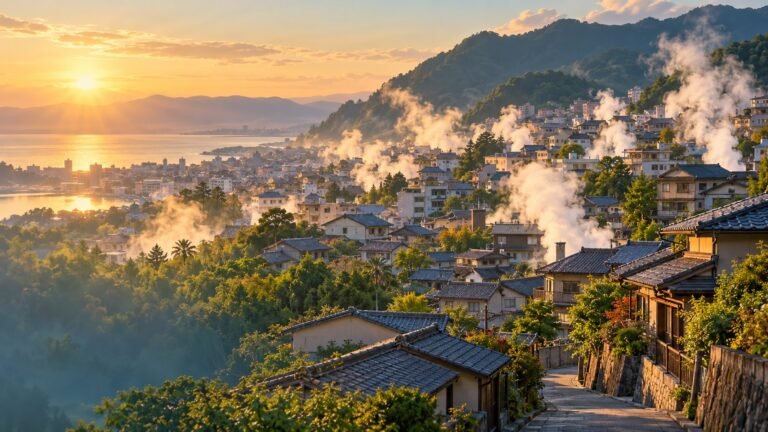
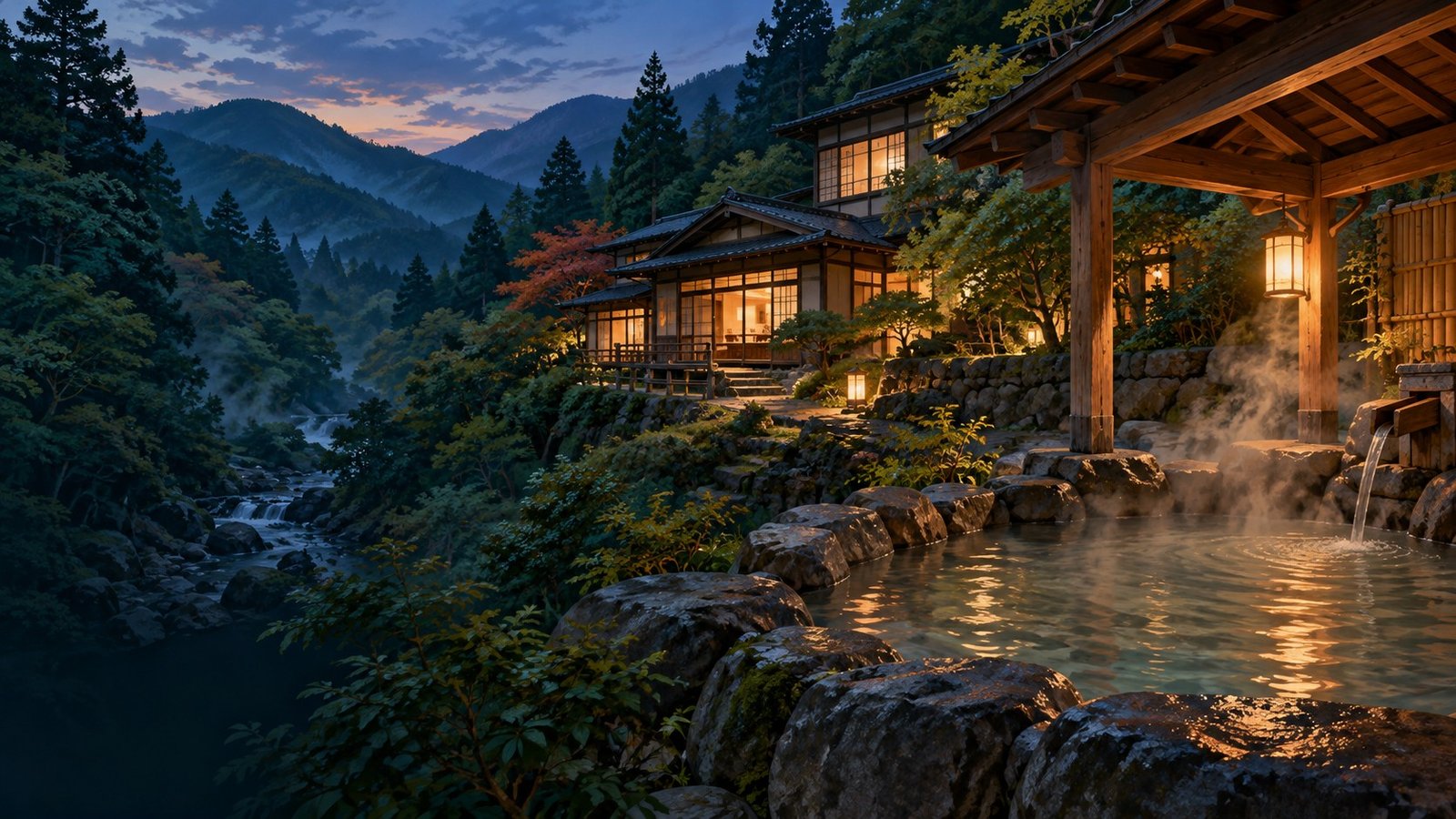
Original AI illustration inspired by Hakone; it does not depict a named ryokan or document a personal stay.
Deciding where to stay in Hakone means choosing how much of the trip belongs to the inn. An early dinner, a private bath and time to use both can matter more than being beside the next sightseeing stop. Hakone is spread across several areas linked by trains, buses and other transport; a booking labelled “Hakone” does not tell you how you will reach its front door.[1][2]
This research-led shortlist compares seven properties across five areas. Selection favours useful differences in access, sleeping arrangements, meals and bathing privacy. It is not a ranking based on personal stays, and date-specific room prices and availability have not been checked.
Some links in this guide are affiliate links. Taylor’s Trailblazing Travels may earn a commission if you book or buy through them, at no extra cost to you.
Choose the area
Arrival + tomorrow’s route
Start with the journey to the door, then the morning you want.
Choose the bath
Room, slot or communal
Private use can mean three quite different booking arrangements.
Compare the price
One complete night
Include dinner, breakfast, bath charges and local travel.
Where to stay in Hakone: choose among five onsen areas
Swipe across the table to compare →
| Base | Start here if… | Trade-off to accept |
|---|---|---|
| Hakone-Yumoto / Tonosawa | You have one night and want to organise the stay around arrival and dinner. | Yumoto is the rail gateway; Tonosawa continues beyond it. Do not treat both as the same station walk. |
| Miyanoshita / Kowakudani | A specific heritage hotel, room or private onsen matters more than a central base. | The mountain railway serves the area, but the hotel may be nearer a bus stop or use a shuttle. |
| Gora | You want mountain-rail and cable-car connections alongside the hotel stay. | A Gora address is not proof of an easy final walk or a step-free building. |
| Sengokuhara | You are happy to plan bus or road access and independent meals around the accommodation. | Treat the evening meal and next morning’s departure as part of the booking decision. |
| Lake Ashi | You want time by the lake and are willing to choose a particular lakeside base. | Togendai and Moto-Hakone/Hakone-machi are different arrival points; specify your port or stop. |
The last column matters as much as the first. A room that fits your bathing requirements can justify an extra transfer; a dinner you cannot reach on time cannot. For Tonosawa, Ichinoyu Honkan’s own directions illustrate the distinction: around five minutes by bus from Hakone-Yumoto to Kami-Tonosawa, followed by a one-minute walk.[9]
Swipe sideways to read the full planning graphic.
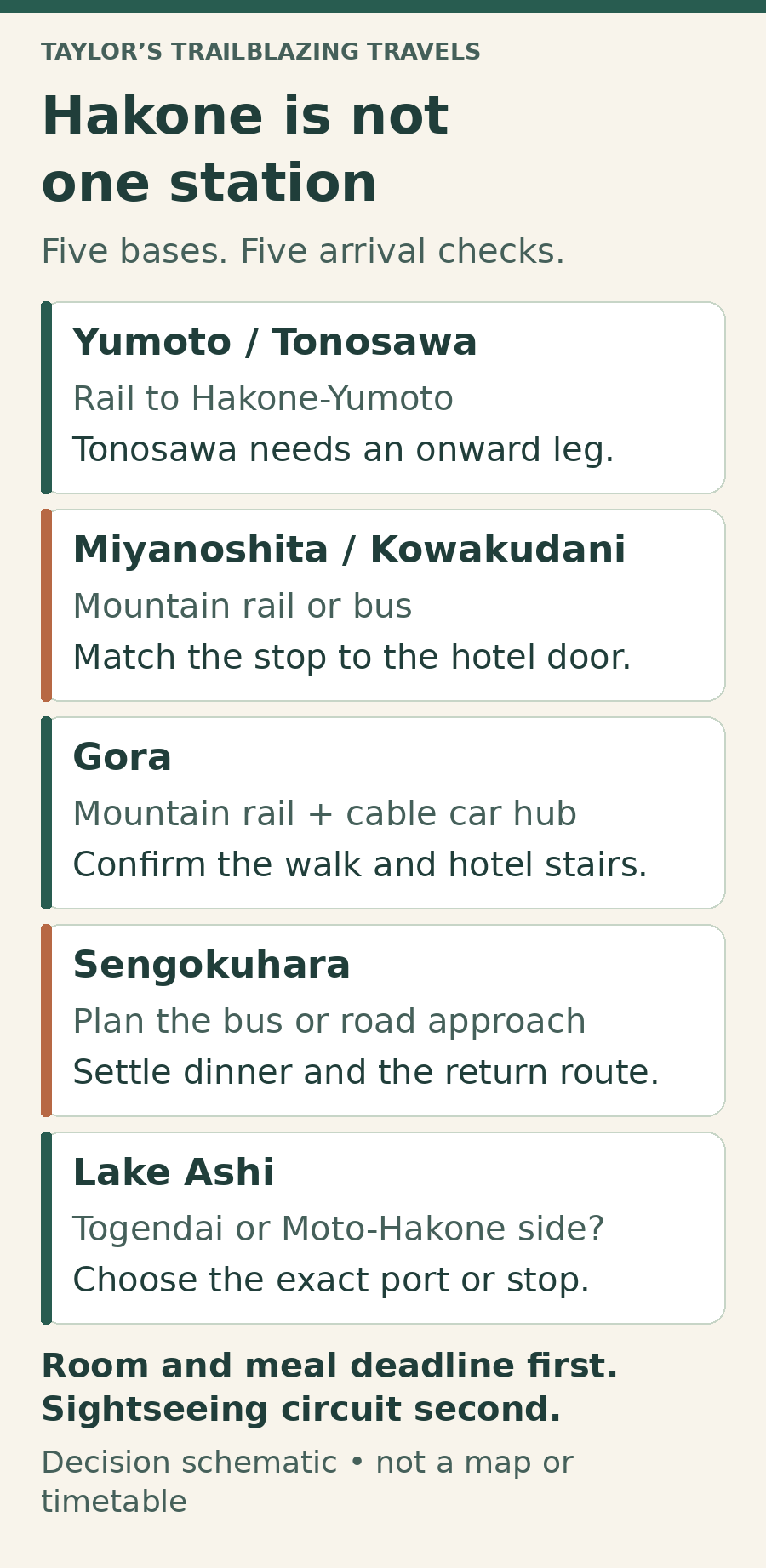
Use this selector as a shortlist, then check the property-level details below. It deliberately gives no “quietest area” score: the exact room, road, season and other guests would make that promise unreliable.
A two-gate method for choosing the right onsen stay
This is an original decision method for a one- or two-night visit. It uses two pass-or-fail checks before comparing areas or prices; a higher score elsewhere cannot compensate for failing either one.
Gate one: can the arrival protect the meal you bought?
Write down the property’s final meal-plan arrival time. Work backwards through the last bus, shuttle or walk and add a delay margin you are comfortable with. Count reaching the reception desk, not reaching Hakone-Yumoto. Yoshiike publishes a 17:00 meal-plan check-in deadline, whereas Ichinoyu Honkan asks dinner guests to arrive by 18:00; the two are not interchangeable.[4][7]
If the journey cannot support that arrival, choose a different plan, an earlier departure or another property. Treat an overnight flight followed by a fixed ryokan dinner as a commitment requiring extra margin, rather than assuming the hotel can serve the same meal whenever you arrive.
Gate two: will everybody be able to sleep, wash and bathe comfortably?
Separate a private bathroom from a private onsen. A shower and toilet do not establish that a room contains a hot-spring bath. A reservable or first-come private bath elsewhere in the hotel also gives a different amount of control from a bath inside your room. The Yutowa examples below show all three distinctions within one property.[17][18][19][20]
- For a couple wanting repeated private soaks, require the exact room category to include its own hot-spring bath.
- For a family happy with one shared private session, check the time limit, fee, capacity and how allocation works.
- For anyone who cannot use communal facilities, confirm the toilet and washing arrangement as well as the bath.
- For anyone who struggles with stairs or floor sleeping, obtain the actual bed layout and route between reception, room, dining and bathing facilities.
For conventional shared onsen, JNTO describes washing before entry, bathing without swimwear and keeping towels out of the water. Tattoo rules differ by property, so ask about the facilities you will actually use.[3]
Only after both gates pass should you compare the area, room total and sightseeing route. If you are still assembling the wider journey, the first-time Japan planning guide provides the broader framework.
Yumoto, Tonosawa and Miyanoshita: three different first stays
Yoshiike Ryokan, Hakone-Yumoto: a traditional room near the rail gateway
Yoshiike lists a seven-minute walk from Hakone-Yumoto Station, Japanese-style futon rooms, and communal indoor and outdoor hot-spring baths. Its published choices include dinner-and-breakfast plans and accommodation without meals. Meals are served in the dining room.[4]
This is a useful starting point if the station approach and a traditional sleeping arrangement suit you. The practical constraint is the meal: the English information says it cannot accommodate vegetarian or allergy-related alterations. Room-only arrivals are accepted later, up to the published 22:00 deadline, but that does not extend a dinner plan’s arrival window.[4]
Check Yoshiike Ryokan room plans on Booking.com. Read the chosen plan’s meal and cancellation terms before paying.
Tonosawa Ichinoyu Honkan: book the room category, not just the inn
The Japanese room with open-air bath has its own hot-spring bath and toilet, with futons laid out by guests. Its washing area has no shower. In contrast, the Japanese-style Twin has two raised tatami beds and a washbasin, but no private bath or toilet.[5][6]
The building has no lift and dining is on the fourth floor. There is also a free private marble bath: afternoon and evening use is booked at reception on the day, rather than reserved before arrival. These details make Honkan an option for travellers who actively want this style of inn and can manage the stairs.[7][8]
A current practical rule also deserves attention: Honkan prohibits using or charging guests’ own power banks inside; reception has loan units.[10]
Compare Ichinoyu Honkan room categories on Agoda. Match “Honkan” and the precise bathroom description; the Ichinoyu name covers other properties too.
The Fujiya Hotel, Miyanoshita: beds and a hot-spring bath in a hotel setting
For a specific bed-based alternative, the Comfy Lodge and Restful Cottage Deluxe Twin is listed at 41–49 m², with two 120 cm-wide beds; a third guest uses an 85 cm-wide extra bed. The Western building has no lift, so this particular category is not a shortcut to step-free accommodation.[11]
Fujiya says every guest room receives natural hot-spring water. That does not make every bath open-air: its FAQ identifies the Forest Wing Premier Suite as the category with a semi-open-air bath. It also explicitly says Mount Fuji cannot be seen from the rooms or hotel grounds.[12]
The hotel lists a seven-minute walk from Miyanoshita Station or two minutes from Hotel-mae bus stop. Choose it for the named room and hotel experience, then select the meal arrangement that suits you.[13]
Check Fujiya Hotel room categories on Booking.com. Check the building as carefully as the room size.
Kowakudani and Gora: private baths or flexible room types
Hakone Kowakien Ten-yu: a private open-air onsen with the room
Ten-yu’s Superior Room includes a private open-air hot-spring bath. The published 45 m² figure includes the balcony; the interior is 35 m². There are two 120 cm-wide beds, while extra guests use the additional sleeping arrangement specified for their layout, rather than four equivalent beds.[14]
This is a strong shortlist candidate when private soaking is the main reason for paying for a ryokan stay. Compare the dinner plan carefully: Ten-yu advertises both buffet dining and kaiseki, including a separate dining venue, so “dinner included” does not identify one fixed experience.[15]
Although the hotel belongs in the Kowakudani/Ninotaira part of the decision, its free station shuttle uses Gora. Use the hotel’s current shuttle timetable or the stated bus approach instead of assuming Kowakudani Station is the best final leg.[16]
Compare Ten-yu room and dinner plans on Booking.com. Compare indoor space, extra beds and dinner style together.
Hakone Yutowa, Gora: hotel rooms and condominiums solve different needs
Yutowa’s Standard Twin is approximately 30 m², with two 120 cm-wide beds, a sofa bed for a third person, a shower and a private toilet. Condominium A is about 48 m² and adds its own hot-spring view bath and a kitchenette with cooking equipment. It sleeps up to four using two beds and additional sofa-bed sleeping.[17][18]
The less expensive-looking category may change the practical offer: Yutowa’s Semi Double has no bath or shower in the room. Shared private baths elsewhere in the property are free, limited to 30 minutes and used without reservations, so an empty slot is different from guaranteed exclusive access throughout the evening.[19][20]
The hotel lists a five-minute walk from Gora Station and no station shuttle. Its FAQ warns that stairs are required between parts of the property and to the communal bathing areas. A convenient railway location therefore does not establish a step-free stay.[19]
Choose a Standard Twin when beds and communal or session-based bathing are acceptable; compare a condominium when your own bath and simple cooking would meaningfully change the visit. Confirm whether meals are included in the selected offer.
Compare Hakone Yutowa hotel and condominium options on Agoda. Keep hotel-room and condominium inclusions separate when comparing totals.
Sengokuhara and Lake Ashi: let the evening shape the base
Fuji-Hakone Guest House, Sengokuhara: a simpler stay with private bathing sessions
Fuji-Hakone Guest House offers tatami rooms with futons and shared bathrooms and toilets. It currently serves neither dinner nor breakfast. Private use of the indoor hot spring is included; its general information lists a ¥500 per-person charge for the outdoor bath.[21]
That differs from an exclusive plan on the guesthouse’s own website, which includes the outdoor bath. Compare that direct offer with the precise inclusions elsewhere. The published access is a one-minute walk from Senkyoro-mae bus stop.[22][23]
Shortlist it when shared facilities and arranging food independently suit your group. It is a poor match if a private en-suite bathroom or an included ryokan dinner is essential. Before booking, make a real evening food plan and check the bus journey you intend to use the following day.
Check Fuji-Hakone Guest House on Booking.com. Check the property’s direct plan too if the outdoor bath is a deciding feature.
Odakyu Hotel de Yama, Lake Ashi: choose the view and bath as separate upgrades
Hotel de Yama distinguishes standard rooms, named Mount Fuji View categories and a Premium Hot Spring Type with its own natural hot-spring view bath. Do not translate a lake-facing hotel description into either a guaranteed Fuji view or a private onsen in every room.[24]
Its complimentary shuttle runs from the Moto-Hakone sightseeing-cruise dock, taking about five minutes. The published operating window is 09:10–17:10. A late arrival therefore needs an agreed alternative, even when the daytime connection looks straightforward.[25]
This is the shortlist choice when a lakeside stay is itself a priority. Commit to the Moto-Hakone side in your arrival planning; “Lake Ashi” alone is too broad an instruction for a drop-off or a day’s final connection.
Compare Hotel de Yama view and bath categories on Booking.com. Select the named view and bath category you actually want.
Plan the arrival that gets you to the bath before dinner
The official transport sequence is useful orientation: the mountain train links Hakone-Yumoto and Gora; the cable car continues from Gora to Sounzan; the ropeway runs towards Togendai via Owakudani; sightseeing boats connect points on Lake Ashi. This is a network for choosing routes, not a requirement to carry luggage around the whole circuit before checking in.[2]
Rail tickets and passes: compare the journeys you will use
The Hakone Freepass covers designated local services for two or three days. A Romancecar journey requires its separate limited-express charge, and Izu-Hakone buses are outside the pass. Price your intended rides before assuming the pass pays for itself on an overnight stay.[26]
Compare Tokyo–Hakone listings on 12Go. The route page mixes different transport products and passes, so check the actual departure station, drop-off, ticket inclusions and any separate express reservation. Compare the result with the operator’s own booking information.[29]
Luggage forwarding: useful only if the drop-off fits
Hakone’s luggage service accepts station-to-participating-hotel bags at Hakone-Yumoto from 08:30 until 12:00, for delivery after 15:00. The regular one-way charge is ¥1,500 per piece within its 140 cm combined-dimension and 15 kg limits. Confirm that your property participates and that your arrival meets the deadline; an afternoon station arrival does not fit this published service.[28]
For the return direction, the published arrangement is hotel handover by 10:00 and station collection from 13:30 to 18:30. That will not suit an earlier onward train. Carry essentials you need before the bag arrives and confirm the handover with the property.[28]
When a private transfer solves the stay decision
A car becomes worth comparing when your group, bags or exact hotel location make several changes impractical. Compare a Tokyo–Hakone private transfer on GetYourGuide, or Compare a Tokyo–Hakone/Fuji private transfer on Viator. Both services advertise one-way transfers to or from Hakone/Fuji. Select the correct travel direction, then confirm your exact hotel drop-off, car-seat and luggage requirements with the operator before booking.[30][31]
Request the complete hotel address, passenger and luggage capacity, child seats if needed, waiting allowance and any charge outside the stated Tokyo collection area. Allow for road delays when agreeing the pickup: a private vehicle does not extend a ryokan’s dinner service. Check whether the quoted vehicle and assistance suit any mobility requirement.
Connection details on your phone
Mobile data can help with the final bus stop, hotel contact details and revised operating notices. Browse Airalo and select a Japan eSIM if that suits your phone and existing roaming allowance. Airalo offers Japan plans and requires an eSIM-compatible, network-unlocked device; check the selected plan’s allowances and save the hotel address and arrival instructions offline as well.[32][33]
An original comparison: what does the whole onsen night cost?
Compare complete offers after both decision gates pass. A room-only price can look attractive before the meals, travel and bath access you actually want are added. Half board is not automatically the better purchase either; your alternative evening determines its value.
Swipe across the table to compare →
| Item | A: room only | B: dinner + breakfast |
|---|---|---|
| Accommodation | ¥32,000 | ¥50,000 |
| Dinner for two | ¥12,000 | Included |
| Breakfast for two | ¥3,600 | Included |
| Extra local travel for meals | ¥2,400 | ¥0 |
| One private-bath session | ¥4,400 | In-room onsen included |
| Bathing tax: two adults | ¥300 | ¥300 |
| Complete one-night total | ¥54,700 | ¥50,300 |
Offer A starts ¥18,000 lower. Its chosen meals, extra local travel and one bath session add ¥22,400, so Offer B ends ¥4,400 lower after the same ¥300 bathing tax. The break-even premium for B’s room-and-meal package is therefore ¥22,400 under these assumptions: above that premium, A becomes cheaper.
Swipe sideways to read the full planning graphic.
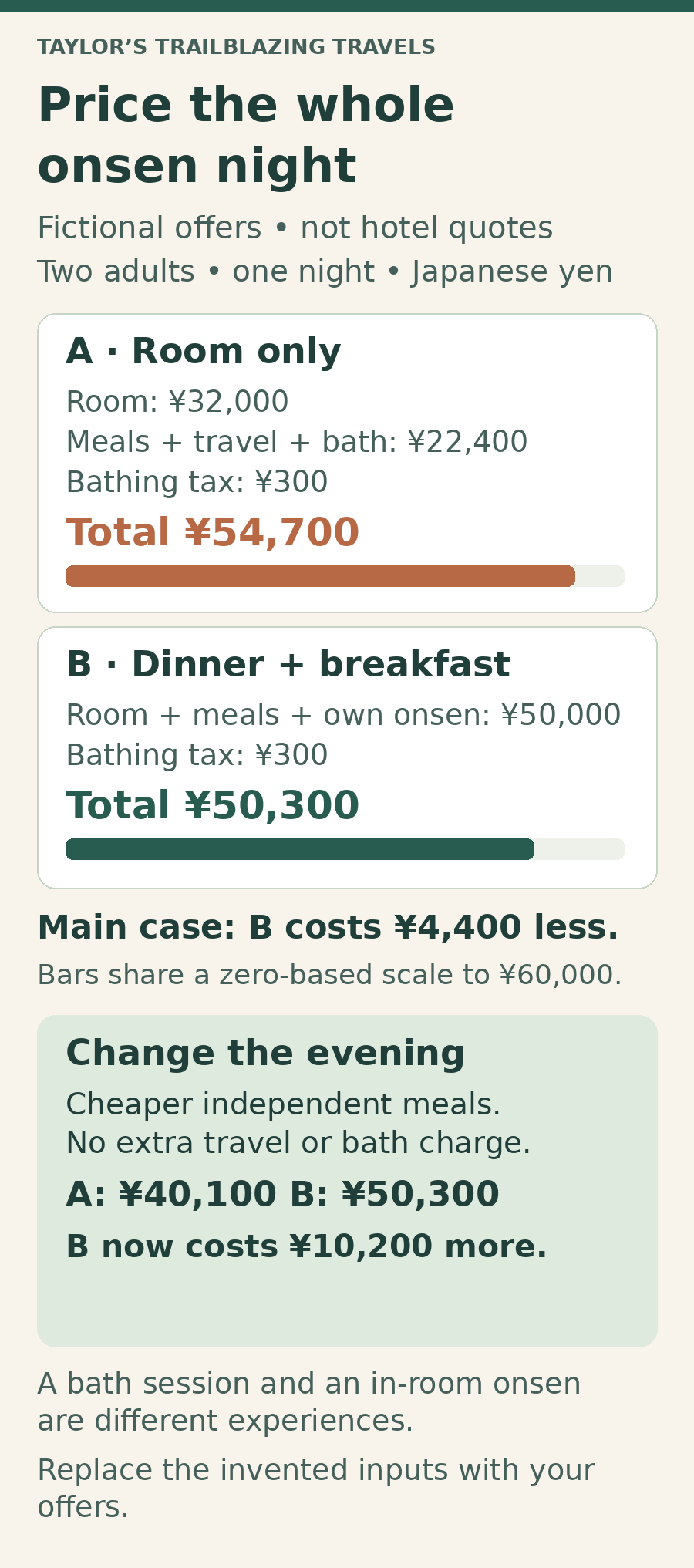
Change the evening and the answer changes
Suppose you instead choose ¥3,000 dinners and ¥900 breakfasts per adult, reach both without extra paid transport, and use a free private bath. Offer A becomes ¥32,000 + ¥6,000 + ¥1,800 + ¥300 = ¥40,100. Offer B now costs ¥10,200 more. That may still be worthwhile for the dining and in-room bathing experience, but it is an upgrade you are consciously buying.
A single private-bath session is not equivalent to repeated access to an in-room onsen. Decide whether that difference matters before accepting the arithmetic as the whole answer. Similarly, a room maximum of four does not tell you whether four adults get beds they want.
Hakone Town’s published overnight bathing tax is ¥150 per adult per night. Check whether the displayed offer includes it or asks for payment at the property, so you do not add it twice.[34]
For the wider holiday budget, use the Japan trip-cost guide for UK travellers, then replace this example’s inputs with the exact totals and currency shown at checkout.
Five details to settle before booking
- Save the full property name and room category. Record the building, bed sizes, extra sleeping arrangements and whether the toilet, shower and hot-spring bath are private.
- Read the actual meal plan. Confirm the arrival deadline, dinner style, dietary suitability and what happens if you are late.
- Write the last leg from a named station, bus stop or port to reception. Check the shuttle window and the route with your luggage and mobility needs.
- Price the full party for the full stay. Include meals, bath-session charges, taxes, children’s arrangements and any transport you would otherwise avoid.
- Keep the cancellation terms and any essential written confirmation with the booking. Recheck transport notices shortly before travel.
If a private bath is the reason for choosing Hakone, treat that feature as a booking condition. If the area is the priority, accept only rooms and arrival plans that let you enjoy it without sacrificing the part of the stay you came for.
Useful questions
Is one night in Hakone enough for a ryokan stay?
One night can work well if you arrive with time to settle in, bathe and have dinner. As an editorial planning choice, allow two nights when you want substantial sightseeing as well as unhurried hotel time, or when the first day starts with a long journey. Check what meals a second night includes and whether the menu changes.
Should you split two nights between different Hakone areas?
Usually there is little reason to move for such a short stay unless two particular properties are the purpose of the visit. Packing, checking out and waiting for another room reduces the time available for baths or sightseeing. A single base with a planned day route is the more straightforward editorial starting point.
Can you choose any Hakone hotel for a Mount Fuji view?
No. Hotel de Yama sells specifically named Mount Fuji View categories, while Fujiya Hotel explicitly says the mountain is not visible from its premises or rooms. Choose the documented room view and treat weather-dependent visibility as a separate matter; a Hakone address alone proves neither.[12][24]
Can travellers with tattoos use an onsen in Hakone?
Policies vary. Hakone Yutowa’s FAQ prohibits tattooed guests from its communal baths but permits use of its private baths or the hot-spring bath in a condominium. Obtain confirmation for your chosen property and facility; do not infer communal-bath permission from the availability of a private alternative.[19]
Is Gora automatically the best base for a Hakone Freepass?
Gora connects the mountain railway and cable car, which makes it useful for some routes. The pass also covers designated services elsewhere, so owning it does not determine your hotel area. Choose the base around your actual arrival, room requirements and intended rides, remembering the separate Romancecar supplement.[2][26]
Choose a Hakone stay you can enjoy at its own pace
Start with Hakone-Yumoto for a simpler first arrival, Gora for a mountain-transport base, or a specific property elsewhere when its room, bath or lakeside setting is the reason for going. Then check the dinner deadline and the bathroom description before comparing the price. In Hakone, the best base is the one that leaves you enough time to enjoy the stay you have booked.
Sources and checks
Research-led accommodation guidance with original planning comparisons. Linked operator and tourism sources provide the starting evidence; confirm current room categories, access and booking terms directly for your dates.
- Hakone Navi: destination areas
- Hakone Navi: getting around Hakone
- Japan National Tourism Organization: enjoying an onsen
- Yoshiike Ryokan: official English accommodation and meal information
- Ichinoyu Honkan: Japanese room with open-air bath
- Ichinoyu Honkan: Japanese-style twin room
- Ichinoyu Honkan: facilities and dining
- Ichinoyu Honkan: communal and private baths
- Ichinoyu Honkan: access
- Ichinoyu Honkan: portable power-bank policy
- Fujiya Hotel: Comfy Lodge and Restful Cottage Deluxe Twin
- Fujiya Hotel: accommodation questions
- Fujiya Hotel: directions
- Hakone Kowakien Ten-yu: Superior Room
- Hakone Kowakien Ten-yu: dining choices
- Hakone Kowakien Ten-yu: access and shuttle
- Hakone Yutowa: Standard Twin room
- Hakone Yutowa: Condominium A
- Hakone Yutowa: frequently asked questions
- Hakone Yutowa: private baths
- Fuji-Hakone Guest House: rooms, meals and shared facilities
- Fuji-Hakone Guest House: onsen and direct-booking plan
- Fuji-Hakone Guest House: access
- Odakyu Hotel de Yama: guest-room categories
- Odakyu Hotel de Yama: access and Moto-Hakone shuttle
- Hakone Navi: Hakone Freepass coverage and Romancecar supplement
- Hakone Ropeway: December 2026 to February 2027 inspection suspension notice
- Hakone Navi: luggage transport service
- 12Go: Tokyo to Hakone transport listings
- GetYourGuide: Tokyo private one-way transfer to or from Hakone or Mount Fuji
- Viator: private transfer between central Tokyo and Hakone/Fuji, product 419980P5
- Airalo: Japan eSIM plans
- Airalo: eSIM compatibility and unlocked-device requirement
- Hakone Town: bathing tax
Illustrations in this article were created for Taylor’s Trailblazing Travels. Third-party photographs, where used, are credited beside the image or in the source list.