Miyajima Travel Guide: What to See and How Long to Stay
Choose a half-day, a mountain day or an overnight stay, then arrange the island around tides, opening times and the journey back.
- Core visit · 4–5 hours on island
- With Mount Misen · 7–8 hours
- Slower option · One night
AI-generated editorial illustration inspired by Itsukushima Shrine and Miyajima; architectural details and the viewpoint are illustrative.
Miyajima rewards a little planning before you board the ferry. The island, also known as Itsukushima, brings shrine buildings, tidal water and wooded mountains into one landscape. UNESCO’s description treats that relationship as central to the place’s significance.[1]
The practical question is how much of it you want to experience. A waterfront and temple visit, a day including Mount Misen and an overnight stay require different amounts of time. This Miyajima travel guide helps you choose, then arrange the day around the tide, the ropeway and the journey back.
This guide contains affiliate links. If you book or buy through them, Taylor’s Trailblazing may earn a commission at no extra cost to you.
Shrine and town
Choose a four-to-five-hour island visit when you want the waterfront, one temple, food and room to wander.
Mountain priority
Give Miyajima a full day. The ropeway leaves a further stepped walk to the summit.
Evening and dawn
Choose an island overnight stay when those hours matter more than keeping the same mainland hotel.
Specific torii view
Check your date’s tide heights and opening hours before deciding what to do first.
How long do you need on Miyajima?
Count the time between stepping off the arrival ferry and joining the return queue. That is your island time. A four-hour excursion starting at a Hiroshima hotel has considerably less sightseeing time than four hours starting at Miyajima’s ferry terminal.
| Island time | What it suits | Main compromise |
|---|---|---|
| 2–3 hours | A deliberately short waterfront and shrine visit, with a snack | Little flexibility for queues, temples or a second tide view |
| 4–5 hours | Shrine, waterfront, Daishoin or another cultural stop, and lunch | Leave Mount Misen for a longer visit |
| 7–8 hours | The core sights plus a mountain block, if conditions and operating times allow | You still need to prioritise and protect the return time |
| One night | A less hurried visit, an island evening and an early start the next day | Another hotel change and a dinner plan to organise |
Four to five hours is a sensible first-visit target if you do not want to hike. The island should not feel incomplete because you have omitted the summit. Choose the longer day when mountain walking is something you want to do, rather than something added merely because a ropeway exists.
An overnight stay is a different decision. Its value is control over the early and late hours, time to return to the waterfront and less pressure to fit lunch, a temple and the mountain between two mainland journeys. It is most useful when those extra hours are part of your intended experience.
The island sights worth building a visit around
Itsukushima Shrine and the waterfront
The shrine’s over-water setting is the centre of most first visits. Its architecture preserves traditions associated with the late twelfth and early thirteenth centuries, with the sea in front and Mount Misen behind. Walk through it as an active religious place as well as an architectural sight, and allow room for worshippers.[1]
Standard adult shrine admission is ¥300. At the October check, ordinary hours were 06:30–17:30 for 15 October–30 November; summer and winter closing times differ. Comfortable shoes help on the wooden corridors, where the shrine warns of gaps between floorboards. A waterfront view of the torii is a different experience from entering the shrine buildings.[2]
Daishoin
Daishoin is a Shingon Buddhist temple with a long relationship to Itsukushima Shrine and the imperial family. It gives a short visit another religious and architectural perspective. Allow around an hour in the core-day plan, extending that if you want to look closely rather than move through the grounds quickly.[3]
Senjokaku and the Five-Storey Pagoda
Senjokaku, also called Hokoku Shrine, was commissioned by Toyotomi Hideyoshi in 1587 and remained unfinished. Its large wooden hall makes a useful alternative or extra cultural stop near the shrine district. The neighbouring Five-Storey Pagoda dates from 1407; plan to appreciate its exterior rather than assume an interior visit is available.[4]
Senjokaku’s published hours are 08:30–16:30 and standard adult entry is ¥100. It is a compact addition, but that closing time matters if you have spent the afternoon on the mountain.[2]
Omotesando and Machiya Street
Omotesando concentrates food and souvenir browsing, while Machiya Street offers a different walk past traditional buildings. Use the streets as part of the route between cultural stops, with time to choose a meal, instead of reducing the island to a single waterfront photograph.[18]
Plan for tide height, not simply “high” or “low” tide
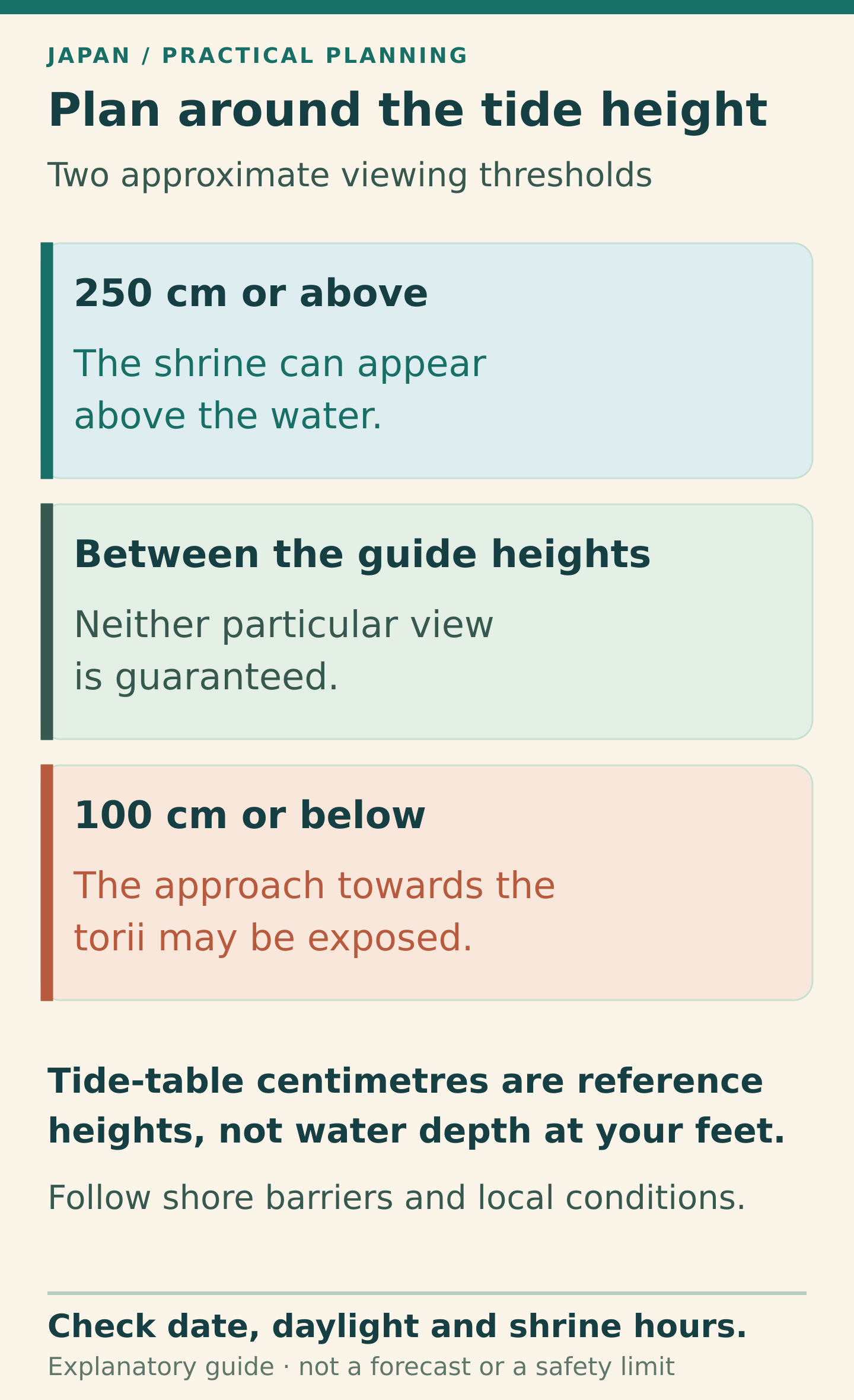
The Miyajima Tourist Association gives two useful approximate thresholds: at 100cm or below, the approach towards the torii may be exposed; at 250cm or above, the shrine has its characteristic appearance above the water. These are tide-table heights, not the water depth at your feet. A day’s lowest tide does not necessarily fall below the first threshold.[5]
Open the association’s tide explanation and linked date selector. Enter your travel date and compare the relevant height windows with daylight, shrine opening and your ferry plan. Some dates do not produce an exposed torii approach, and a useful water-covered view may fall outside your visit.[5]
- Decide which view matters most to you, or whether either is enough.
- Identify a suitable daylight window on your date.
- Place the shrine and waterfront around that window.
- Use the remaining time for a temple, food and, on a longer day, the mountain.
This order keeps the plan flexible: lunch can move more easily than the tide. A morning arrival is not automatically the correct answer, and an overnight booking should not be justified solely by an unchecked promise of seeing both states.
Follow local barriers and conditions on the shore. An exposed approach is an opportunity to observe the setting, not permission to wade towards the gate or extend a walk as the water returns.
Mount Misen: allow for the walk beyond the ropeway
The ropeway reaches Shishiiwa Station, not Mount Misen’s summit. The operator’s standard summit circuit takes about an hour on foot from the upper station and back, with steep slopes and stone steps. That remaining walk is the detail most likely to upset an overfilled half-day plan.[6]
The operator estimates about an hour for the return ropeway journey from Momijidani Station, before the summit walk. Allow an editorial block of roughly two to three hours for the mountain outing, adding time to reach the lower station, for queues and for your own walking pace. A full walk from the pier to the summit is described by Hiroshima’s tourist authority as roughly two hours uphill; a descent and rests still need to be added.[7][25]
The mountain has an earlier deadline than the ferry
Published ordinary ropeway hours are 09:00–16:00, with the final return departure at 16:30. The adult return fare is ¥2,000. Weather and maintenance can suspend the service, and reservations are required on designated busy dates. Check the ropeway’s current operating notice before setting off.[7][8]
The ropeway operator says wheelchairs and pushchairs cannot be taken aboard and that there are no lifts. Do not treat the cable car as a step-free route to the mountain. If the stepped paths or remaining time do not suit your group, give the town and temples a fuller visit instead.[8]
Carry water, wear shoes suitable for uneven paths and consider weather, fitness and sunset when deciding whether to continue. If the ropeway stops, hiking down is not an automatic substitute for everyone. Make the mountain decision early enough to retain a comfortable alternative.[6]
A 2026 change to older mountain itineraries
Reikado Hall and its reception building were destroyed by fire on 20 May 2026. Daishoin’s subsequent notices concern clearance and reconstruction. General entry restrictions were lifted the following day, but that is not a statement that the hall has been rebuilt. Consult the temple’s latest notice and local signs; older descriptions of entering the intact hall are out of date.[9][10]
Getting to Miyajima, and paying the right ferry fare
The conventional approach from Hiroshima Station is a JR Sanyo Line train to Miyajimaguchi, approximately 30 minutes, followed by a walk to the ferry terminal and a roughly ten-minute crossing. Miyajimaguchi is on the mainland; Miyajima is the island. Keeping those names distinct prevents an expensive hotel or meeting-point mistake.[11][24]
For planning from a central Hiroshima hotel, reserve approximately 70–100 minutes to reach the island, depending on your location and connections. That is an editorial allowance including local travel, walking and waiting, not a quoted train-and-ferry journey time. Check the actual route before fixing an early appointment.
JR Miyajima Ferry’s current Japanese fare page shows an ordinary adult one-way fare of ¥200. The island also charges a ¥100 visitor tax on a standard visit, collected with the inbound boat arrangements. If your rail pass covers the JR ferry, the visitor tax is still a separate obligation unless your particular ticket explicitly includes it.[12][13]
The direct Peace Memorial Park boat
Aqua Net’s World Heritage Sea Route connects the park’s riverside pier with Miyajima in about 45 minutes. At the check date it listed ¥2,400 one way or ¥4,400 return for an adult, with the visitor tax additional. The operator warns that tide conditions can alter or cancel sailings. Choose it for the convenient city departure, and check the dated service and reservation arrangements before relying on it.[14]
For either approach, note the last useful ferry for your plan and the onward mainland connection. A late ferry’s existence does not mean that restaurants, temple interiors or the ropeway will remain open. JR’s published timetable is the place to check the short crossing for your date.[15]
If Miyajima follows an Osaka stay, first organise the intercity leg. Compare Osaka-to-Hiroshima transport on 12Go alongside the rail operator’s own offer, checking departure station, final fees and ticket conditions. This is a mainland route comparison; arrange the Miyajimaguchi approach and local ferry separately.[22]
Stay on the island, by the mainland ferry or in Hiroshima?
Book an island night for the hours it gives you. If you mainly want daytime sightseeing and would leave early the next morning, keeping a Hiroshima room may be simpler. If an evening waterfront walk, a ryokan dinner and an early shrine visit are the point, staying on Miyajima can justify the move.
| Base | What it gives you | What it requires |
|---|---|---|
| Miyajima island | Early and late island time without a mainland commute | A confirmed dinner plan, luggage arrangements and the correct island address |
| Miyajimaguchi mainland | A base organised around the short ferry crossing | A boat journey for every island visit; it is not an island overnight experience |
| Hiroshima city | One room for city sightseeing and regional travel | The longer approach at the start and end of the day |
Search Miyajima-area accommodation on Booking.com to compare the wider choice. The destination results can include the mainland, so use the map and property address to establish which side of the water you are booking. A Miyajima label alone is not enough.[26]
Iwaso is one named option to investigate for a ryokan stay in the Momijidani area behind the shrine. Its official site describes the valley setting. Compare Iwaso room options on Agoda with Iwaso room options on Booking.com, checking the same dates and whether the room, meals and cancellation terms are equivalent. This is a researched example, not a personal stay recommendation.[16]
For an overnight booking, ask when you must arrive for dinner, whether the selected plan includes meals and whether dietary requests can be met. Confirm luggage storage before check-in or after check-out rather than assuming it, particularly if the mountain is part of either day. A small overnight bag may be easier if your wider luggage can remain with a mainland hotel by agreement.
What the island essentials cost
A useful budget starts with the services you will actually buy. The following is a standard-adult example using the JR ferry from Miyajimaguchi. It excludes the cost of reaching Miyajimaguchi.
| Plan | Calculation | Subtotal |
|---|---|---|
| Ferry, visitor tax and shrine | ¥200 outbound + ¥200 return + ¥100 tax + ¥300 shrine | ¥800 |
| The above, plus return ropeway | ¥800 + ¥2,000 | ¥2,800 |
| The above, plus Senjokaku | ¥2,800 + ¥100 | ¥2,900 |
The individual prices come from the ferry, city tax, shrine and ropeway sources; the totals are our arithmetic. They exclude lunch, drinks, accommodation, a guide and any other admission. A pass may change the ferry amount, but do not silently remove the visitor tax. Choosing the direct city boat changes the calculation substantially.[12][13][2][7]
For an overnight stay, compare the whole arrangement. A room-only price and a room with dinner and breakfast are different products; so are different bed layouts and bathroom arrangements. Enter your party size and dates before treating any displayed starting price as relevant.
An island overnight also falls within Hiroshima Prefecture’s accommodation-tax rules, effective from 1 April 2026: ¥200 per person per night at a room-only charge of ¥6,000 or more, and no tax below that threshold. The assessment includes service charges but excludes meals and consumption tax. Ask the property how it is collected. It is separate from the ¥100 Miyajima visitor tax used in the day-visit calculation.[28]
A flexible core visit, and how to add the mountain
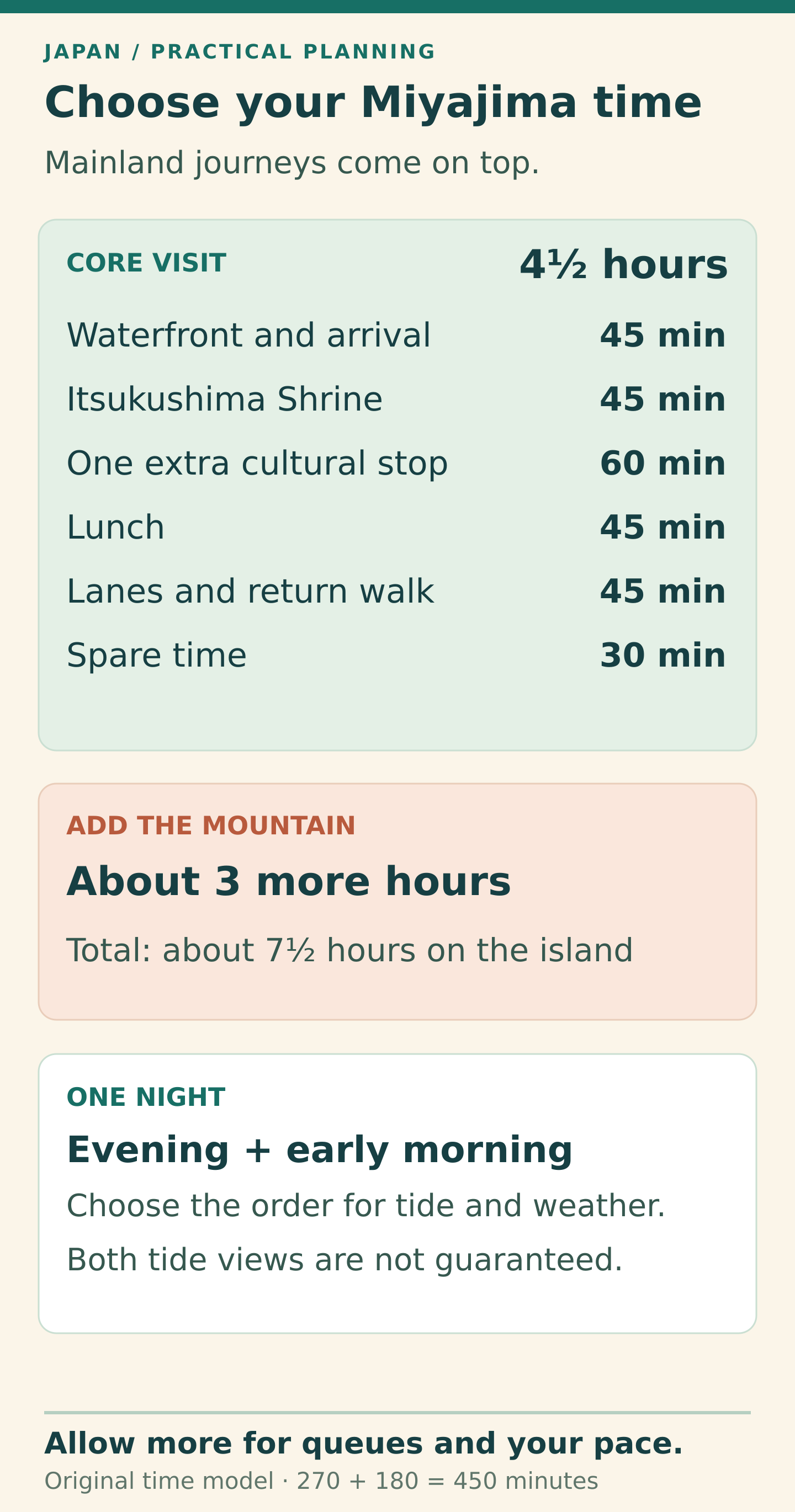
The following four-and-a-half-hour model is our suggested allocation, starting at Miyajima’s ferry terminal. It is deliberately expressed in blocks so you can move the waterfront visit to the right tide window.
| Block | Allowance | What to do with it |
|---|---|---|
| Arrival and waterfront | 45 minutes | Orientate yourself and walk towards the shrine district |
| Itsukushima Shrine | 45 minutes | Visit the corridors and allow time to look, subject to queues |
| Daishoin or another cultural stop | 60 minutes | Choose one substantial extra visit rather than several rushed ones |
| Lunch | 45 minutes | Sit down, or combine a lighter meal with browsing |
| Lanes and return towards the ferry | 45 minutes | Browse Omotesando or Machiya Street and make the return walk |
| Unallocated margin | 30 minutes | Use for a queue, rest or extra time at your favourite stop |
To include Mount Misen, add a mountain block of roughly three hours rather than removing lunch and every margin. That produces about seven-and-a-half hours on the island. Place the mountain early enough for the ropeway’s return deadline, then arrange the shrine and shore around the tide and their own opening times.
For one night, divide the same priorities across two days. An afternoon arrival can suit town and temple visits followed by an island evening; the next morning can hold the shrine or mountain. Reverse that order when the tide or weather makes another sequence more sensible. Recheck the following day’s operating notices rather than assuming yesterday’s conditions continue.
If queues consume the spare time, reduce the number of stops. If the mountain becomes impractical, make the core visit more leisurely. An itinerary remains useful when it tells you what to omit as well as what to do.
Food, deer and practical limits
Miyajima’s tourist association highlights oysters and anagomeshi, grilled conger eel served over rice. Momiji manju, maple-leaf-shaped cakes with different fillings, make an easy small purchase along the shopping streets. Choose food that suits your appetite and dietary needs rather than treating every speciality as a required stop.[17][27]
For an overnight stay, confirm dinner with your accommodation or a specific restaurant. Individual trading hours vary; a daytime shopping street is not evidence of an evening meal being available. A late mainland dinner also means checking the island-bound return ferry if your bed is on Miyajima.[18][15]
Do not feed the deer. The local tourist association explains the harm caused by inappropriate food and by paper or plastic being swallowed. Keep food, tickets and bags secure, take litter away and leave the animals space. Their presence does not guarantee an approachable or predictable animal encounter.[19]
For mobility planning, separate the waterfront visit from the mountain and stepped religious sites. Ask the relevant attraction or accommodation about your exact route and equipment needs. A general “accessible” label on a tour listing does not establish that every part of its optional itinerary will suit you.
In wet or windy weather, reassess the mountain before leaving the town. Save the tide information and return timetable offline. If you want mobile data, compare Airalo eSIM options and select Japan, checking device compatibility, network unlocking and the plan’s activation rules. Do not assume a mobile-data purchase guarantees reception on every mountain path.[23]
Choose a guided visit by meeting point and scope
A guide is useful if you want religious and historical context or help navigating the mainland approach. Compare the amount of island time, the starting point and the inclusions before comparing the headline duration.
Compare the Miyajima half-day small-group tour from Hiroshima Station on GetYourGuide for a structured group option. The checked M2N Tours listing lasts about four hours, including the approach, and covers the shrine district, Daishoin and shopping streets. It does not list Mount Misen. Confirm where the tour finishes and whether transport and entry charges are included in your selected option.[20]
Compare the customised private Miyajima half-day tour on Viator if a private walking arrangement better suits your interests. The researched Japan Guide Agency listing offers a licensed guide and uses public transport rather than a private vehicle, with transport and admission costs additional. Agree the meeting point and priorities; a four-hour private tour does not automatically create enough time for the summit.[21]
For either option, explain any mobility requirements before booking and read the exact cancellation conditions. If the guide finishes on the island, decide whether you want to stay independently afterwards and arrange your own return accordingly.
Your Miyajima questions answered
Does a Japan Rail Pass cover everything on Miyajima?
No. Even when your particular pass covers the JR ferry, the visitor tax remains separately payable unless it is explicitly included in the ticket you hold. Shrine admission, the ropeway and private boat services have their own charges and conditions. Check the precise pass rather than assuming all local transport is included.[13][2][7]
Will staying overnight guarantee both high- and low-water torii views?
No. More time gives you more opportunities, but the relevant tide heights may not occur during convenient daylight hours, and some days do not expose the approach. Check both dates before booking for a particular view.[5]
Can I visit Miyajima without going up Mount Misen?
Yes. The shrine, waterfront, Daishoin or Senjokaku, and time for lunch and the lanes form a complete visit. Four to five hours on the island is a useful planning target for that combination, with more time if you prefer a slower pace.
Is Miyajimaguchi the same place as Miyajima?
No. Miyajimaguchi is the mainland station and ferry area. Miyajima is the island reached by boat. Check hotel and tour addresses on the map, particularly if you want an island night or are meeting a guide close to the ferry.[24]
Choose the plan that fits your trip
Choose the visit length first. Four to five hours on the island suits a shrine, temple and food visit; a mountain day needs substantially more room. One night makes sense when you want to use the island’s early and late hours.
Then check the tide heights, the shrine and ropeway hours, your meal plan and the journey back. That sequence gives you a day shaped around Miyajima’s actual conditions, with enough flexibility to enjoy the places you chose to come for.
How this guide was researched
This guide combines official shrine, temple, tourist-association and transport information with relevant accommodation and activity listings. The duration comparisons and spending subtotals are original planning models, not personal-visit claims or live quotes. Japanese operator information was preferred where an English fare page was out of date. Dynamic facts were checked on 17 October 2026; recheck the linked notices for your visit.
Sources and checks
Official, operator and relevant booking information checked on 17 October 2026. Opening arrangements, fares and availability can change; recheck the linked source for your travel dates.
- UNESCO — Itsukushima Shinto Shrine
- Itsukushima Shrine — official opening hours and admission
- Miyajima Tourist Association — Daishoin Temple
- Miyajima Tourist Association — Senjokaku and other shrines
- Miyajima Tourist Association — understanding low and high tide
- Miyajima Ropeway — walking map
- Miyajima Ropeway — hours, fares and facilities
- Miyajima Ropeway — live operation and reservation information
- Daishoin — official news and Reikado reconstruction notices
- Miyajima Tourist Association — English operating notices
- Japan National Tourism Organization — Miyajima access
- JR Miyajima Ferry — current Japanese fare page
- Hatsukaichi City — Miyajima visitor tax
- Aqua Net Hiroshima — World Heritage Sea Route
- JR Miyajima Ferry — timetable
- Iwaso — official ryokan and valley information
- Miyajima Tourist Association — local food
- Miyajima Tourist Association — Omotesando and Machiya Street
- Miyajima Tourist Association — deer and wildlife guidance
- GetYourGuide — Miyajima half-day small-group tour
- Viator — private Miyajima half-day tour with licensed guide
- 12Go — Osaka to Hiroshima route comparison
- Airalo — device compatibility
- Miyajima Tourist Association — access
- Hiroshima Tourism Association — Mount Misen observatory
- Booking.com — Miyajima-area accommodation search
- Miyajima official visitor information — culinary heritage
- Hiroshima Prefecture — accommodation tax rules
Illustrations in this article were created for Taylor’s Trailblazing Travels. Third-party photographs, where used, are credited beside the image or in the source list.