Sanur Travel Guide: Calm Beaches, Walks and Island Connections
A slower shoreline stay works best when the beach holiday and the boat journey are planned separately.
Original editorial interpretation of Sanur, not a photograph or a guarantee of sea conditions.
Sanur offers a different sort of south-Bali stay: a shoreline associated with sunrise, comparatively sheltered water and an easier walking rhythm than the island’s dramatic surf coasts. Yet its usefulness as a departure point for nearby islands can obscure its value as somewhere to stay. [1]
This Sanur travel guide separates those two jobs. A holiday base should make ordinary mornings and evenings enjoyable. A transit night should make the correct boat check-in straightforward. Trying to optimise both without looking at the exact hotel and departure point can leave you staying beside the wrong part of the coast.
Some links in this guide are affiliate links. Taylor’s Trailblazing Travels may earn a commission when you book or buy through them, at no extra cost to you.
Choose the daily walk
A useful beachfront location matters more than harbour proximity.
Check the operator office
The meeting point may not be the terminal entrance.
Plan around conditions
Calmer-looking water is not an all-day swimming promise.
Count the whole journey
Check-in and onward travel sit outside the crossing time.
Start this Sanur travel guide with one decision: stay or connect?
For a coastal holiday, prioritise a pleasant route from the room to the shore, several meal options and a pool you would enjoy when the sea is not appealing. For a transit stop, prioritise a reliable transfer to the actual operator office and an easy late arrival at the hotel. A beach view is secondary if you will leave before breakfast.
Sanur’s flatter seafront makes it an attractive shortlist for families and people who prefer strolling to cliff steps. That is a broad comparison, not an accessibility certification: room approaches, kerbs, uneven paving and the hotel’s own entrance still need checking. The tourism board’s description of calm water should also be read as a general character, not a daily safety judgement. [1]
| Your priority | What to book around | What not to assume |
|---|---|---|
| Four relaxed nights | Beachfront access, dining and pool quality | A northern harbour-area room is automatically best |
| One night before an early boat | Operator meeting point and confirmed transfer | Every ferry checks in at the same desk |
| Travelling with children | Shade, short outings and suitable room layout | The sea is suitable at every tide |
| Limited walking range | Verified routes inside and outside the property | A “central” pin guarantees step-free access |
Sanur is a weaker fit for a holiday built around big surf or late-night venue hopping. It can still provide a useful final coastal pause after an active inland route. Decide what you would enjoy doing on an ordinary day with no excursion booked; that is a better test than the number of day trips on sale.
Choose a part of the shoreline you will actually use
Think of Sanur in broad north-to-south pockets rather than searching for a single perfect central point. The northern harbour side is relevant to transfers; Sindhu and the central beach stretches are useful for combining walks and meals; southern Semawang and Mertasari suit a different part of the coastal strip. These are orientation aids, not measured walking zones. [1][2]

Check both entrances of a beachfront property. Its road entrance may be convenient for taxis while its beach gate makes breakfast walks easy. Conversely, a room advertised as near the beach may require a detour around private grounds. Ask the hotel to show the route rather than accepting a distance alone.
A good first-morning experiment is a short out-and-back walk, not a commitment to cover the whole promenade. Start early enough to avoid the strongest heat, identify places to stop and turn around before the return becomes a chore. Shared paths need attention to bicycles and other users; keep children close and do not block the route for photographs.
For a traveller with reduced stamina, choose a modest daily radius around a confirmed beach access point and dining cluster. Paying slightly more for that location can remove repeated taxi journeys. A hotel at the far end of the shoreline may still be excellent, but it should be chosen for its own surroundings rather than a promise that everything is nearby.
Build an easy day around the beach, not an attraction checklist
Morning: shoreline time
Sanur’s sunrise-facing setting rewards an early walk when the weather cooperates. Make breakfast the next stop rather than immediately departing for the other side of Bali. Choose a manageable section of shoreline and ask your accommodation about conditions before swimming. [1]
At low water, some stretches can be shallow or less appealing for a swim. Keep a pool, shaded reading time or a longer meal as alternatives. Do not walk across living reef or seagrass merely to find deeper water, and keep clear of channels used by boats. A suitable swimming area must be assessed locally on the day.
Afternoon: leave a deliberate gap
One of Sanur’s strengths is that a holiday day does not need a driver, a ticket and a timetable. Use the warmest part of the afternoon for the room or pool. A short later walk can feel more rewarding than scheduling an all-island excursion and returning exhausted.
Evening: try a different dining setting
Denpasar’s tourism office identifies Sindhu Market as a Sanur food and snack stop. It is a useful contrast to hotel restaurants, with dishes selected from individual stalls rather than a single restaurant menu. Ask what is being cooked, check dietary needs directly and carry small cash. Stall availability and hours can vary. [2]
For an uncomplicated resort example, Hyatt Regency Bali describes a beachfront property on Jalan Danau Tamblingan with gardens and pools. It illustrates the kind of stay to compare, not a claim that a particular room or rate is right for everyone. [3]
Island boats: distinguish the crossing from the complete journey
Sanur is a departure point for both Nusa Lembongan and Nusa Penida, but tickets differ in operator, meeting point, arrival location and land transfers. Compare those details before choosing by the shortest advertised sailing time. 12Go provides separate comparison pages for the two destinations. [6][7]
Setia’s published Lembongan information gives a useful example: it advertises an approximately 30-minute crossing and asks passengers to check in at its Sanur office 45 minutes before departure, followed by transport to the harbour. Its listed Lembongan arrival area is Jungutbatu. These are operator-specific details checked on 1 November 2026, not instructions for every boat. [4]
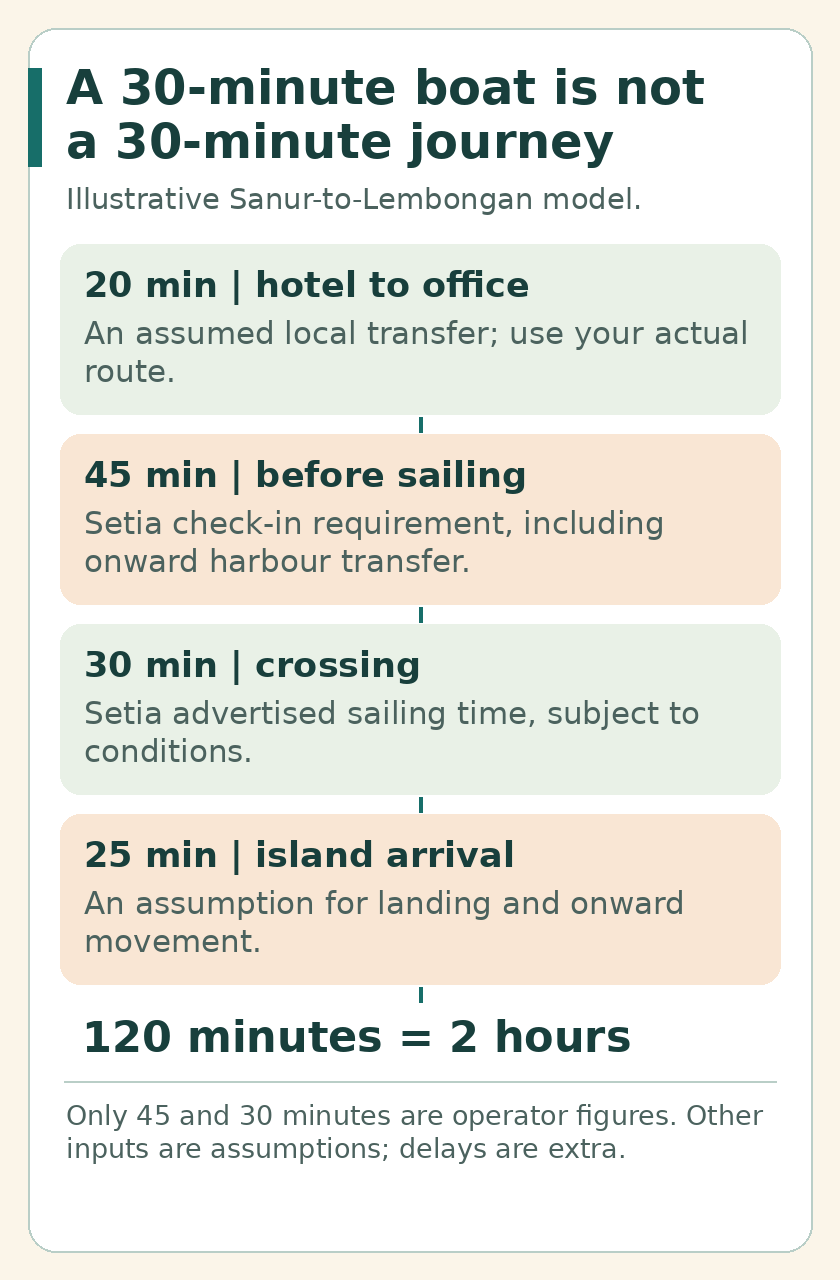
The diagram adds an illustrative 20-minute hotel-to-office transfer and 25 minutes for arrival formalities or onward movement. Thus 20 + 45 + 30 + 25 = 120 minutes, or two hours, before disruption. Only the 45-minute check-in requirement and 30-minute advertised sailing come from Setia; the other inputs are planning assumptions.
Setia’s boarding page also describes a QR-ticket option for going directly to Sanur Harbour. Follow the instructions confirmed for your ticket; the calculation above models the office-check-in route. Its standard Jungutbatu arrival is a beach landing via a shuttle boat, rather than a public jetty, and conditions can change the arrival area. [5]
Read the operator’s own boarding instructions as well as the reseller summary. Assistance, steps, boat changes and landing arrangements matter for children, heavy luggage and limited mobility. Obtain written confirmation of any essential help; a modern departure terminal does not establish that every stage is step-free. [5]
Check BMKG marine information and the operator’s current decision before departure. Keep a sea-trip buffer before an important flight rather than treating a same-day island return as a protected connection. [11]
Two nights, four nights or an island split?
Two nights: a genuine pause
With an afternoon arrival and morning departure, two nights provide one full day. Spend it locally: a shoreline walk, a meal away from the hotel and time at the pool. Adding a long excursion would remove most of what makes this short stay restful.
Four nights: a base with a spare day
Four nights can accommodate two relaxed local days and one weather-dependent outing without requiring an activity every morning. Make the first full day local so you understand the hotel’s surroundings before organising more. Keep the third day movable if a boat trip depends on sea conditions.
Sanur plus an island stay
Consider an overnight island visit when the destination itself matters more than ticking off a viewpoint. A day trip requires the outward journey, island transport and the return check-in within one window. Staying over changes the pace, but also adds packing and another hotel check-in. It is not automatically better for a very short holiday.
For families, compare a simple Sanur stay with one island transfer against a route that changes bases every two nights. The Itinerary Pace Checker can help you see how much time your own transfer estimates remove from a day. Enter the whole hotel-to-hotel journey, not just the boat duration.
A final night on Bali after an island stay is a planning buffer rather than a guarantee. Choose it according to flight timing and your tolerance for disruption; do not sell yourself a tight connection merely because the route looks short on a map.
Airport arrival and onward journeys without overcomplicating the stay
For an airport arrival, send the driver the hotel’s full name, address and flight details. Ask where to meet, what waiting time is included and whether a child seat or larger vehicle needs advance arrangement. A hotel’s location on a map does not predict the door-to-door journey; ask for a current estimate for its actual entrance.
For planning rather than a traffic promise, allow roughly 45-90 minutes on the road to your Sanur accommodation after meeting the driver, adjusting with current local advice. Time spent entering Indonesia and collecting luggage comes before that. Keep the first evening’s meal flexible.
Shared shuttles can be worth comparing for an onward inland trip. Perama lists Sanur among its Bali network stops and publishes meeting-point-based services, so check whether the ticket begins at an office rather than your hotel. [12] Add the first and last short transfers before comparing it with a private car.
Inside Sanur, combine walking with occasional hotel-arranged taxis when useful. You do not need to hire a vehicle for the entire stay simply to make one outing. For an excursion, agree the route and return time rather than asking only for a daily car price.
Save the ferry office and hotel details offline. A compatible unlocked phone can use an Indonesia eSIM as one connectivity option; Airalo’s country page lists current packages, which should be checked for data allowance and activation conditions. [13] Compare Indonesia options through Airalo Coverage is still a separate issue from having a data plan.
Choose the room and budget for the holiday you will take
Compare the same room occupancy and cancellation terms across services. Breakfast, an extra bed, taxes and airport transfers can change the apparent value. For children, confirm the bedding arrangement instead of assuming a double room includes a separate usable bed.
Booking.com and Agoda both provide Sanur accommodation searches. Their maps are useful for checking whether a result matches the stretch of shore you want; neither a destination label nor a low starting price confirms availability for your dates. [8][9]
An adjustable four-night couple’s envelope
| Component | Assumption | Amount |
|---|---|---|
| One room | 4 nights × Rp800,000 | Rp3,200,000 |
| Meals and drinks for two | 4 day-equivalents × Rp450,000 | Rp1,800,000 |
| Local and airport transport pot | Replace with your quotes | Rp700,000 |
| Flexible contingency | Unplanned local spending | Rp600,000 |
| Total, excluding excursions | For two people sharing | Rp6,300,000 |
This model excludes flights, insurance, visas or levies, island boats, paid activities and shopping. Its value is the structure, not a promise that these amounts buy a particular standard. Add your chosen boat or excursion separately, and replace every assumption with quotations before committing.
The Hotel Comparison Calculator compares your entered room rates and extras. Use one currency consistently; the tool does not fetch prices or convert currencies. A hotel you can enjoy without daily excursions may justify a higher room rate than one treated only as somewhere to sleep.
Keep beach and ferry decisions flexible
For more outdoor time, the broadly drier April-October period is a useful starting point. November-March is generally wetter, so favour a hotel you would enjoy during interrupted beach days. Neither season guarantees a calm crossing. [14]
A sheltered-looking beach and an open-sea boat journey are different environments. Conditions on the shore do not certify the crossing. Use the operator’s advice and current marine warnings, and do not pressure a captain to sail to protect a prepaid onward plan. [11]
For swimming, identify a locally recommended area, watch children closely and stay away from working boat lanes. After heavy rain or when water quality looks poor, choose the pool or a land-based activity instead. The general description of Sanur as calm should never replace an assessment of the water in front of you.
Accessibility also deserves separate checks for the hotel and excursion. Request details for the room route, beach gate, bathroom, vehicle and boat. A traveller comfortable with the promenade may still find boarding or an island landing unsuitable. It is reasonable to choose a pleasant Sanur holiday and leave the sea crossing out.
Before travel, review FCDO’s current entry requirements and the arrangements relevant to your passport. A destination guide is not a substitute for checking documents, insurance and any applicable visitor charges. [10]
Sanur questions that change the booking decision
Is Sanur only useful for one night before a ferry?
No. Book it as a holiday base when walking, slow meals and a pool-and-beach rhythm are the point. A transit-only stay is a different product choice, centred on your actual operator check-in location.
Should you stay beside the harbour?
Not automatically. For one very early departure it may simplify the morning. For four holiday nights, the daily walking environment can matter more than saving a short transfer once. Compare the actual address and access rather than choosing by the word “harbour”.
Can you leave your main luggage at a Sanur hotel?
Ask the property directly, particularly when you will not return for another paid night. Confirm storage dates, security, size limits and any charge. Do not assume a room booking creates an unlimited luggage-storage service.
Is a Penida day trip the same as a Lembongan day trip?
No. They have different landing points and onward plans. Decide which island experiences you actually want and price the full transport. A ticket to an island is not an itinerary around it.
What is the most common planning error?
Using the crossing duration as the day’s travel budget. Hotel transfers, check-in, boarding, arrival and island transport all consume time. The second common error is booking so many outings that there is no day left to enjoy Sanur itself.
Choose Sanur for the days between the excursions
Sanur is a strong option when a successful holiday includes ordinary pleasures: a manageable morning walk, a familiar cafe and time to decide what to do next. Start with three or four nights for that kind of stay, or keep a clearly defined transit night when an island connection is the only reason to stop.
Its main trade-off is that a calmer coastal rhythm may feel too quiet for a surf-and-nightlife trip. Its main planning advantage is the opportunity to make fewer arrangements, not the opportunity to cram in more day trips.
Use the Indonesia travel hub to organise the wider route. Book the hotel location for the daily experience, then treat any ferry as a separate journey with its own check-in, landing and contingency plan.
Sources and planning assumptions
Sources consulted for this editorial review on 1 November 2026. Official information and provider descriptions support the factual points; the base selectors, sample plans and clearly labelled calculations are original planning judgements. They are not personal trip reports, live quotations or safety clearances. Recheck operator terms, access, weather and travel requirements before booking or departure.
- Indonesia Travel – Sanur Beach
- Denpasar Tourism – Sindhu Night Market
- Hyatt Regency Bali – location and resort information
- Setia Fast Ferry – timetable and check-in
- Setia Fast Ferry – boarding information
- 12Go – Sanur to Nusa Lembongan
- 12Go – Sanur to Nusa Penida
- Booking.com – Sanur accommodation search
- Agoda – Sanur accommodation map
- FCDO – Indonesia entry requirements
- BMKG – Marine weather information
- Perama Tour – Bali shuttle network and meeting points
- Airalo – Indonesia eSIM information
- Indonesia Travel – broad climate and seasonal patterns
Illustrations in this article were created for Taylor’s Trailblazing Travels. Third-party photographs, where used, are credited beside the image or in the source list.