Balinese Temples for First-Time Visitors: Which to Prioritise
Choose a meaningful first shortlist, understand the visitor boundaries and leave room to appreciate each setting.
Original editorial illustration inspired by Balinese lake-temple scenery; not a record of an actual visit.
Balinese temples deserve more than a rushed stop between photographs. A good first visit starts with your interests and where you are staying, then adds enough explanation to make the place meaningful. Choose a few contrasting settings instead of trying to complete a list.
Some links in this guide are affiliate links. Taylor’s Trailblazing Travels may earn a commission when you book or buy through them, at no extra cost to you.
Choose a contrast
A water temple and a coastal visit offer different contexts.
Protect one sunset plan
Do not make distant temples compete for the same evening.
Check separate tickets
A performance may not include temple entry or transport.
Observe respectfully
Participation in a ritual is not required for a worthwhile visit.
Balinese temples: prioritise a different experience, not another stop
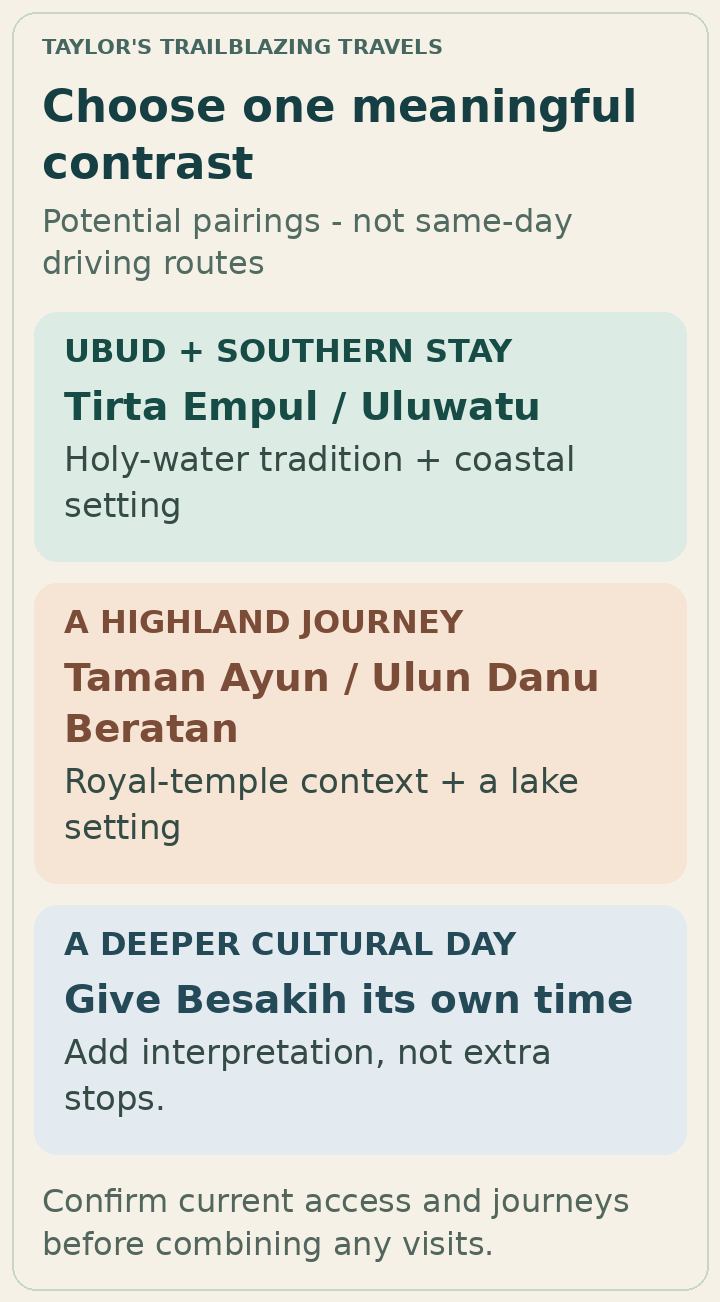
For a first visit, choose two or three temples with genuinely different settings and purposes rather than attempting every famous name. An Ubud-based trip can prioritise Tirta Empul; a southern stay can favour Uluwatu; a highland journey can include Ulun Danu Beratan. Besakih deserves a more deliberate cultural outing, while Tanah Lot suits travellers drawn to a sea-temple landscape. Taman Ayun offers another option when a royal-temple setting fits the route. [1][2][3][4][5][6]
The table is an editorial selection framework, not a ranking of religious importance. A convenient visit is not a less valuable one, and a visitor ticket does not grant access to every sacred enclosure.
| Temple | Prioritise it for | Most coherent trip context | Important limitation |
|---|---|---|---|
| Tirta Empul | Understanding a living holy-water tradition | Time based around Ubud and Tampaksiring | Purification is a ritual, not a compulsory tourist activity |
| Uluwatu | A coastal setting and an optional Kecak performance | A south-Bali stay | Temple access, show ticket and transport need separate checking |
| Ulun Danu Beratan | Lake-and-highland scenery | A Bedugul or northbound journey | Do not confuse it with Ulun Danu Batur |
| Besakih | A more substantial introduction to a major temple complex | A dedicated eastern-Bali outing | Sacred boundaries and the visit’s physical demands matter |
| Tanah Lot | The relationship between shrine, rock and sea | A western coastal outing | Tides and viewing access do not mean entry to the shrine |
| Taman Ayun | A royal-temple and landscaped setting | A Mengwi-area route | Visitor circulation does not include every sacred space |
The geographical and cultural descriptions come from the tourism sources; the route choices are planning judgements. [1][2][3][4][5][6]
Tirta Empul, Uluwatu and Ulun Danu Beratan
Tirta Empul: meaningful without entering the water
Tirta Empul remains an active place of worship associated with holy springs and purification. The national tourism guide describes its sacred water tradition and visitor participation, but participation should follow the temple’s present instructions. Observing respectfully is a complete visit in its own right. [2]
Choose it because you are curious about that tradition, not because every itinerary includes a photograph beneath a water spout. Before joining a ritual, ask an authorised guide what it means, where visitors may go, what clothing is needed and whether there are restrictions relevant to you. Do not improvise a ritual from another visitor’s movements.
For someone who wants cultural explanation rather than a checklist, this can justify spending longer at one temple and dropping an unrelated attraction. Tell the guide that understanding the site matters more than filling the hour with photographs.
Uluwatu: separate the temple visit from the show
Uluwatu is a cliff-top temple in southern Bali. The optional Kecak performance is a distinct event, not simply the temple’s general admission. [1][7] Decide whether you want the landscape, the performance or both before comparing tickets.
A performance-led visit needs an agreed arrival margin, the correct show slot and a return arrangement. Allow a sensible arrival margin specified on the ticket you actually select. Confirm whether it includes temple entry, the show itself, guiding and the journey home: a similarly named booking option may have different inclusions. [7]
Travellers arranging their own transport can check this Uluwatu Kecak show ticket. It is a performance-booking option, not evidence that a driver, guide or all site fees are included. Allow the evening to revolve around the booking rather than promising another sunset stop afterwards.
Ulun Danu Beratan: include it when the highlands make sense
Ulun Danu Beratan stands by Lake Beratan in the Bedugul highlands and is associated with the goddess Danu and water. Its lake setting is the reason to choose it in this comparison. [3]
The planning advantage is strongest when you are already heading into the highlands. A long out-and-back drive solely to reproduce a photograph is less compelling for a short southern holiday. Give yourself time to enjoy the setting without treating clear skies, perfect reflections or empty grounds as part of the ticket.
Check the complete name when booking: Ulun Danu Beratan and Ulun Danu Batur are different places. Sending a driver a saved image without the correct destination is an avoidable source of confusion.
Besakih, Tanah Lot and Taman Ayun
Besakih: prioritise interpretation and enough time
Besakih is a major temple complex on Mount Agung’s slopes, commonly described as Bali’s Mother Temple. Its scale and continuing religious role make it a different proposition from a brief scenic photo stop. [4]
Choose a visit that includes proper explanation and a realistic walking arrangement. Ask which public areas the guide intends to cover, how much climbing is involved, where the vehicle stops and what the current ticket includes. Someone who needs a gentler route should request precise details before committing, rather than discovering the steps at the entrance.
It is a strong priority for a traveller particularly interested in Balinese Hindu traditions. For someone with only one free afternoon on the south coast, a closer temple with enough time to understand it is likely to be a better editorial recommendation.
Tanah Lot: enjoy the seascape without assuming shrine access
Tanah Lot’s distinguishing feature is its shrine on a coastal rock formation. The tide changes the relationship between the rock and the surrounding water, which helps explain why the site attracts landscape photographers. [5]
Treat the outing as a visit to the authorised viewing areas, not a promise to enter the shrine itself. Follow barriers and staff directions rather than attempting a crossing because another person appears to be doing it. An appealing sunset is a possibility, not a contractual feature of a temple tour.
Tanah Lot and Uluwatu can both appeal to the same traveller, but they should not automatically compete for the same evening. Choose one sunset focus. The second coastal temple needs a separate reason to earn its travel time.
Taman Ayun: a calmer kind of cultural comparison
The tourism ministry describes Taman Ayun as a royal temple in Mengwi with gardens and surrounding water features. [6] It provides a different architectural setting from a sea cliff or a holy-water ritual.
Use it as a possible contrast when the route already goes through the area, not as a compulsory seventh stop. Ask for time to understand the layout and what can be viewed from the visitor route. “Temple tour” should describe an opportunity to learn, not permission to wander through gates because they happen to be open.
Build a shortlist using the route-fit test
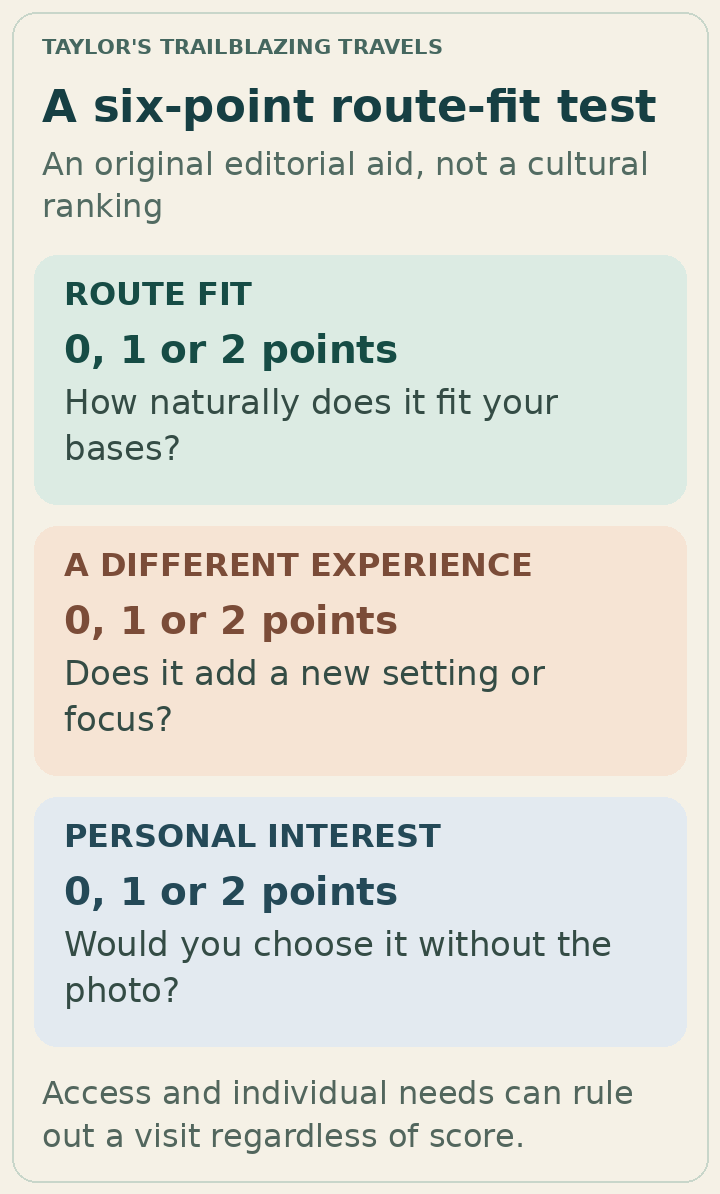
This original method helps a first-time visitor choose without pretending to measure which temple is objectively best. Give each candidate zero, one or two points for each of three questions: does it fit the route, does it offer a setting different from the other choices, and does it match your actual interest? The maximum is six.
A score is only a planning aid. Access, religious observance and individual mobility are separate conditions that can rule out a visit regardless of its score.
| Example for a traveller staying in Ubud and the south | Route fit | Adds a different experience | Matches stated interest | Total |
|---|---|---|---|---|
| Tirta Empul: interested in living traditions | 2 | 2 | 2 | 6 |
| Uluwatu: wants a coastal evening and performance | 2 | 2 | 2 | 6 |
| Tanah Lot: another coastal view, no specific priority | 1 | 1 | 1 | 3 |
| Besakih: strong cultural interest, extra journey acceptable | 1 | 2 | 2 | 5 |
These scores are invented for the stated traveller, not findings about every itinerary. Someone staying in the western coastal area might give Tanah Lot a stronger route-fit score; someone spending nights in the highlands should consider Ulun Danu Beratan differently.
The useful result is not the number. It is seeing why an extra temple is on the list. If it adds only another version of an experience you already have, replace it with an unhurried meal or more time at the first site.
Three workable ways to organise the visits
For an Ubud-and-south holiday, put Tirta Empul on an Ubud-based day and Uluwatu on a southern day. Add Besakih only when its cultural depth matters enough to justify a dedicated outing.
For a northbound journey, consider Taman Ayun and Ulun Danu Beratan as potential stops, but obtain current driving and access estimates before combining them with a hotel move. The presence of both names on a map is not proof of a comfortable transfer day.
For a short western-coast stay, prioritise Tanah Lot rather than chasing a distant temple simply because it appears higher on a list. The site’s Trip Itinerary Planner can help organise your overnight bases, but it does not verify temple access or travel times.
Dress, sacred boundaries and respectful observation
Bali’s published tourist code requires respectful dress and conduct, licensed guiding at attractions, and restrictions on entering the middle and inner sanctums. Its worship exception has conditions concerning appropriate religious clothing and menstruation. Follow the temple’s current instructions; a tourist admission ticket is not permission to disregard these boundaries. [8]
Cover shoulders and knees, and wear the sarong and sash requested by the site. Do not assume that your own scarf satisfies every requirement or that a rental is always included. The national tourism guidance also asks visitors not to disrupt rituals or step on offerings. [1]
Ask before photographing people closely. During worship, keep to the permitted visitor area, lower your voice and give the ceremony physical space. Never climb sacred structures to improve an angle. When a guide explains that a section is unavailable, accepting that limit is part of a respectful visit, not a failure to receive the full attraction.
For a private question about eligibility to enter or participate, ask staff discreetly before joining a queue. A guide should be willing to explain restrictions without pressuring anyone into a ritual.
Tickets, guiding and how to compare a quote
Make a small checklist for each proposed visit: site admission, licensed guide, transport, parking, clothing hire if required, and any separate performance or activity. Ask whether the total is per person or per vehicle and which items remain payable locally.
The Uluwatu example shows why this matters. A show reservation and a temple visit can sit beside each other in an itinerary while still requiring separate payments. A performance ticket may not include the temple entrance fee, and neither payment establishes admission to restricted sacred areas. Confirm the site’s current tariff and your exact booking inclusions rather than using an old provider quote. [7]
Do not multiply an unverified price list across six temples and call it a trip budget. Obtain current amounts for the sites you have actually chosen. For a group, agree whether people who skip the performance are paying for transport only or sharing a wider package.
Accommodation can also reduce the pressure to cover everything in one day. For a genuine Ubud-based cultural stay, compare Ubud accommodation on Booking.com with Agoda’s Ubud-area map. Check actual property locations and cancellation terms rather than assuming an Ubud label means a central address.
Mobility, families and avoiding temple fatigue
A temple can be rewarding without every member of the group following the longest visitor route. Before booking, explain limits on steps, walking distance, standing and heat. Ask about the entire path from vehicle to viewpoint and back, not simply whether cars can reach the entrance.
For children, one clear story and a manageable visit often gives a better experience than several unfamiliar sites with no explanation. Build in a toilet and meal plan. For a performance, check the seating arrangement, duration and ability to leave when needed instead of assuming that a child ticket settles suitability.
The most common planning errors are fitting two distant sunset attractions into one evening, confusing Beratan with Batur, treating purification as a photo prop, and assuming a driver automatically provides qualified cultural interpretation. Avoiding those errors is more useful than collecting another temple name.
First-visit questions
Can non-Hindus visit Balinese temples?
Visitor access is available at many sites, but public grounds and sacred enclosures are not the same thing. Respect the boundaries and conditions explained at the entrance; attendance at a ritual is not a way around them. [1][8]
Do I have to take part in purification at Tirta Empul?
No itinerary needs to make participation compulsory. Choose observation and explanation when that suits your interest. A respectful cultural visit does not depend on entering the water.
Is a sarong enough if I am wearing beach clothes?
Plan modest clothing before you leave, rather than using a sarong as a substitute for covering the rest of the body appropriately. Confirm the specific site’s requirements and any separate clothing needed for a ritual. [1]
Is it better to visit more temples with a private driver?
A private vehicle can give control over the schedule, but it cannot remove distance, queues, ceremonies or walking demands. Use the flexibility to spend time well, not simply to increase the stop count.
Can I rely on published opening times during a ceremony?
Check directly for your date. Religious use takes priority over a sightseeing plan. Keep a second option that does not require intruding on worship or crossing a closed boundary.
A considered first shortlist
Start with the temple that fits your base and strongest interest, then add a contrasting one. Tirta Empul plus Uluwatu is a logical shortlist for an Ubud-and-south itinerary; Ulun Danu Beratan fits a highland journey; Besakih rewards a more purposeful cultural day. Tanah Lot and Taman Ayun should earn their place through route fit and interest, not obligation.
Leave with an understanding of what you were permitted to see and why it matters. That is a more satisfying first introduction than a crowded schedule of gates, queues and hurried photographs.
Sources and fact-checking notes
This shortlist is research-led, not based on claimed personal temple visits. Route-fit scores are illustrative editorial judgements for the stated traveller, not a ranking of religious importance. Site instructions and ceremonial access take precedence over a sightseeing itinerary. The quoted Uluwatu fee is a dated provider statement and must be rechecked.
Last editorial review: 2 November 2026. Recheck prices, rules, access and booking conditions before travel.
- Indonesia Travel: temple settings and visitor etiquette.
- Indonesia Travel: Tirta Empul holy springs.
- Indonesia Travel: Ulun Danu Beratan.
- Indonesia Travel: Besakih Temple.
- Indonesia Travel: Tanah Lot.
- Indonesia Travel: Taman Ayun.
- GetYourGuide: Uluwatu Kecak show ticket and additional admission.
- Bali Governor: Circular 07 of 2025, tourist code.
Illustrations in this article were created for Taylor’s Trailblazing Travels. Third-party photographs, where used, are credited beside the image or in the source list.