
Sidemen Travel Guide: Rice Valleys, Walks and Quiet Retreats
Choose a valley base that makes walking, village visits and unhurried afternoons easy.
An original Sidemen-inspired illustration, not a photograph of a particular hotel or walking route.
Some links in this guide are affiliate links. Taylor’s Trailblazing Travels may earn a commission if you book or buy through them, at no extra cost to you.
A good Sidemen stay begins with a smaller plan. This Sidemen travel guide is for travellers who would rather understand a rice valley, spend time with a craftsperson and enjoy the place they are sleeping than collect another long list of stops.
Sidemen is in Karangasem, east of Ubud. Indonesia’s tourism board highlights its village paths, rice fields and overnight stays with views of the agricultural landscape. [1] That makes it an appealing inland counterweight to a beach holiday, but a countryside address does not automatically mean convenient walking or silence.
Two nights gives one full day between arrival and departure.
Check the actual lane, room access and dinner options.
A guided field walk can explain farming as well as scenery.
Quiet surroundings may mean more arranged transport.
Sidemen travel guide: decide what you want to slow down
The strongest reason to add Sidemen is not that it promises an untouched version of Bali. It is that a small programme can be satisfying here. A walk, a meal, a conversation about weaving and time at your accommodation can make a coherent day. That is a planning choice, not a claim that the valley has no tourism.
It suits couples who want a countryside pause, walkers happy with an adaptable route and travellers curious about working landscapes. It is less convincing for a group wanting independent evening entertainment, extensive shopping or a different attraction every hour. A pool and a view may matter more than proximity to a famous landmark.
Decide whether your priority is walking from the door or staying somewhere you rarely leave. These can lead to different bookings. For the first, ask for a usable route to meals and the walk meeting point. For the second, check the restaurant, room comfort and cancellation terms with the same care you would give the scenery.
Two nights or three: count complete days
For this planning model, arrival is in the afternoon and departure is the following morning after the final night. One night therefore supplies no complete day; two nights supply one; three nights supply two. Arrival and departure can still contain enjoyable hours, but they should not be counted as full sightseeing days.
| Stay | What it gives you | Best use |
|---|---|---|
| One night | An arrival afternoon and departure morning | A deliberate overnight stop when the transfer route already makes sense. |
| Two nights | One full day | A field walk and one other experience without changing hotels again immediately. |
| Three nights | Two full days | A flexible walking morning plus a craft or cooking day, with room for weather changes. |

Three nights is the more forgiving choice for anyone paying for a special retreat. Two nights is adequate when the valley is one part of a larger trip and you can keep the programme focused. Four nights can work for people who actively enjoy staying put; it is not necessary simply to complete this guide.
Add Sidemen to the Trip Itinerary Planner using actual overnight dates. Enter your own transfer allowance and keep a beach stay or another inland base separate. The planner organises the route; it does not confirm roads, transport or booking availability.
Choose the access, not just the balcony photograph
Start with accommodation around Tabola and the wider Sidemen valley, then inspect the exact property position. The local accommodation market includes smaller guesthouses and villa-style retreats; named properties are useful reference points, not proof that nearby lanes have the same access. Wapa di Ume describes a programme of local experiences, while Samanvaya presents itself as a retreat with a guest-age restriction. [2][8]
Ask for four answers before paying
First, can your driver reach reception, or is there a final walk with luggage? Second, how many steps separate reception, the room, restaurant and pool? Third, where will you eat when you do not want another car journey? Fourth, what can you reasonably walk to without using a narrow or unlit road? Ask about the route itself rather than accepting a straight-line distance.
For a family, confirm the minimum guest age for the exact property and room. Samanvaya’s own website stated 14 and over when checked on 1 November 2026; that is its policy, not a rule for Sidemen. [8] For limited mobility, request photographs or a short video of the full arrival-to-room route and bathroom layout. A room described as ground-floor may still require access steps.
Sound is another practical detail. Ask about building works, roadside rooms, ceremonies and animal noise without expecting a rural community to behave like a sealed resort. Choose a room for the sleeping conditions you need; do not assume that a countryside view answers that question.
For two serious options, use the Hotel Comparison Calculator with your own quotes. Add the transfers and meals that differ, rather than comparing only the room rate.
Make the field walk your main event
A field walk is more rewarding when it explains what you are looking at. Local operators offer rice-field walks, and some combine them with a meal or cooking activity. [3][4][5] Ask who leads the walk, whether it starts near your accommodation and how the route changes after rain. A route tailored to your walking ability is more useful than a long advertised distance.
Request a plain description of the surface: village lanes, narrow field edges, steps, mud, shade and any water crossing. Agree the maximum walking time, planned rests and a turnaround option. A guide can help navigate agreed paths, but hiring one does not make every crossing or slippery edge appropriate for every walker.
Wear footwear with grip that you already know fits. Carry water, sun protection and a small rain layer, and keep both hands available on uneven sections. Do not walk onto planted areas to improve a photograph. The tourism board explicitly asks visitors to stay on paths and respect working fields. [1]
Choose the experience, not the headline duration
A two-hour outing can be ample when you stop to discuss irrigation and cultivation. A longer walk may suit someone who wants sustained exercise, but it consumes more of the cooler part of the day. Ask whether a quoted duration includes transport, lunch or a workshop before comparing two offers.
Weaving, cooking and a quiet afternoon
Sidemen’s appeal is not limited to the fields. Wapa di Ume’s published local guide describes traditional weaving and cultural activities, and Sidemen Tour Guide offers a combined trekking and cooking experience. [2][3] These are examples of available approaches, not a promise that every workshop accepts walk-in visitors.
A weaving visit with a purpose
Arrange the visit through a host who can explain when someone will actually be working. Ask how the pattern is planned, what fibres are being used and how long a piece takes. Permission matters before photographing people or their work. When buying, ask where the piece was made and how it should be cared for, rather than relying on a general souvenir label.
A cooking session rather than another car tour
Choose a class for the dishes and teaching format you want. Confirm whether you cook yourself or watch a demonstration, whether ingredients can accommodate dietary needs and whether the price includes your meal and transfers. A shared lunch can replace a separate restaurant stop, which is useful when you are trying to keep the day simple.
Leave the afternoon genuinely open. A book, an agreed short village walk or a treatment you have chosen can be enough. Avoid filling the gap with a distant waterfall merely because a driver offers it. A quiet retreat loses much of its value when every usable hour is spent leaving it.
Getting there without depending on a scooter
A pre-arranged car is the simplest fit for this guide, especially with luggage or a late arrival. Compare a direct quote from your accommodation with a route-search service. 12Go has specific pages for Ubud to Sidemen Transfer and Ngurah Rai Airport to Sidemen Transfer; the listed stop name is not proof that your individual hotel is included. [6][7]
Ask the provider to confirm the full destination address, pickup instructions, luggage allowance, waiting time and total price. For an airport pickup, explain that the landing time is not the time you will be standing outside. For a shared service, identify the boarding point and any final taxi before deciding it is cheaper.
Within the valley, pre-book transport for an activity that is not genuinely walkable from your room. Save the driver’s contact and meeting point before setting off. A room advertised as close to an attraction may still be on the wrong side of a steep lane or stream.
Do not learn to ride a scooter as a way to make a remote booking work. FCDO warns about road conditions and motorbike accidents and advises checking the correct licence and insurance. [9] A driver and fewer outings are a reasonable alternative, not a less authentic holiday.
For messaging a host or driver, check your existing roaming allowance first. Airalo offers Indonesia data plans, but you must check device compatibility and the plan conditions; rural reception is not guaranteed. [10] Browse Airalo and select Indonesia when comparing connectivity options. Download the address and essential information for offline use as well.
The cheaper room can produce the dearer stay
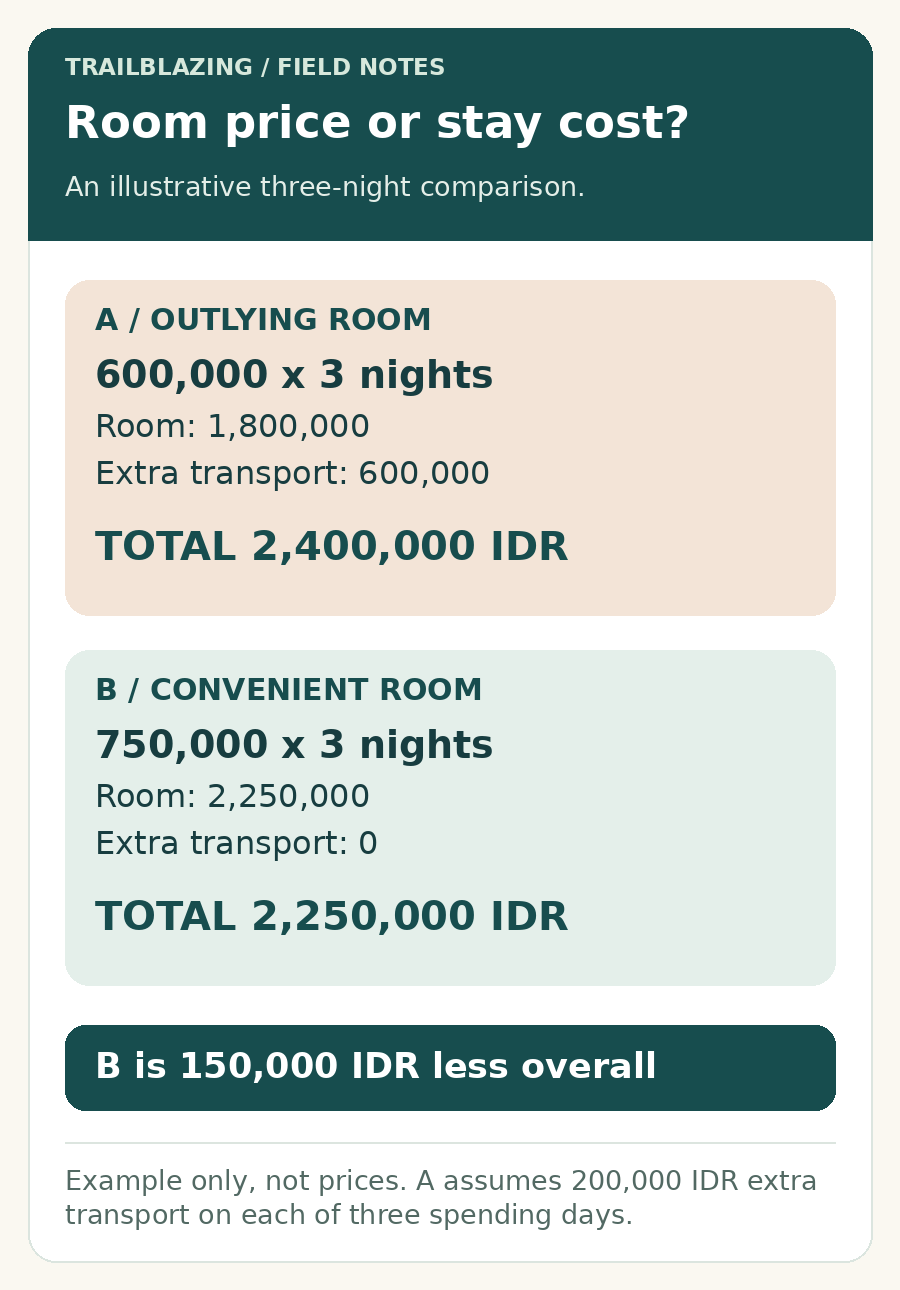
Here is an illustrative three-night comparison for two adults sharing one room. It is an original calculation, not a current hotel quotation. Both options assume the same meals and activities; only the room and extra transport differ. All figures are Indonesian rupiah, with assumptions set on 1 November 2026.
| Cost | A: outlying room | B: convenient room |
|---|---|---|
| Room rate per night | 600,000 | 750,000 |
| Three nights | 1,800,000 | 2,250,000 |
| Additional local transport | 200,000 x 3 spending days = 600,000 | 0 in this example |
| Compared total | 2,400,000 | 2,250,000 |
Option B costs 450,000 more for the room but saves 600,000 in the assumed transport, leaving it 150,000 cheaper overall. This result changes if you stay at the resort all day, share rides, find different quotes or need transport from both properties. Zero is an assumption to verify, not a claim that a central address removes every journey.
Build the rest of the budget separately: arrival and onward transfers, meals not included in the room, a guide or class, drinks, tips you choose to give and a contingency. Keep per-room, per-car and per-person charges in different rows. The Travel Budget Calculator uses GBP inputs, so convert your own quotes consistently before entering them; it does not perform currency conversion.
Take a small cash reserve for local spending and ask each host about payment methods. Paying more for a view can be a valid choice. The point of the comparison is to make that choice consciously, not to pretend the cheapest mathematical total must be everyone’s best holiday.
A three-night plan with room to change
| Day | Main plan | Leave flexible |
|---|---|---|
| Arrival | Check the room, confirm the walk and arrange dinner | A short familiarisation walk only if the route and daylight suit. |
| First full day | A morning field walk, followed by a meal and rest | One small local visit; omit it when the walk runs longer. |
| Second full day | A pre-arranged weaving or cooking experience | Pool, reading or a short repeat walk on a confirmed route. |
| Departure | Breakfast and the agreed onward transfer | No ambitious detour before a flight or ferry. |
For two nights, keep the field walk and choose either weaving or cooking on the same full day only when their times fit. For one night, do not pay for a retreat expecting two complete days. Consider arriving early enough to use the accommodation rather than adding a stop to an already long travel day.
Season, weather and sensible alternatives
Plan around the conditions you actually encounter. Rain can change surfaces and access, while cloud may hide a mountain view. FCDO notes flooding and volcanic hazards in Indonesia and advises following local warnings. [9] This guide does not certify a particular walking route or volcano access as safe.
If the paths are unsuitable, switch to the indoor visit you have arranged, extend lunch or enjoy your accommodation. Do not replace one wet walk with a more remote waterfall merely to keep an itinerary busy. That is also why a third night can be useful: it offers another morning without forcing you to change hotels.
Questions to settle before choosing Sidemen
Is Sidemen a substitute for Ubud?
It can replace part of an inland stay when your priority is a rural pause. It is a weaker substitute when art museums, a wide choice of organised classes or frequent independent dining are the central reasons for visiting. Choose according to the days you want, not a claim that one place is the more authentic Bali.
Can I enjoy the valley without doing a long walk?
Yes, by choosing a property with a view you value and arranging short, suitable visits. Confirm vehicle access and steps carefully. A viewpoint or seated craft demonstration may fit better than a narrow field path; neither should be described as universally step-free.
Should I arrange a guide before arrival?
Reserve ahead when you have one available morning, specific access requirements or a preferred guide. Otherwise, ask your accommodation about suitable local options on arrival. In either case, agree the route, inclusions and weather alternative before paying.
Is a day trip worthwhile?
A focused walk or workshop can justify a day trip when the total journey fits your starting point. It will not provide the same quiet evenings and flexible mornings as an overnight stay. Compare the whole door-to-door day, not just the time stated for the activity.
What is the simplest booking order?
Choose the right base, secure arrival transport and confirm one main experience. Add the rest only when it improves the stay. Begin with the Indonesia travel hub when placing Sidemen within a wider route.
Sources & editorial approach
Independent editorial review: 2 November 2026. The selection, suggested plans and labelled calculations are research-led editorial judgements, not reports of personal visits, measured journeys or live offers. Confirm changeable fees, access, schedules and booking conditions before travelling.
- Indonesia Ministry of Tourism: Sidemen and responsible rice-field visits.
- Wapa di Ume Sidemen: local activities, weaving and village experiences.
- Sidemen Tour Guide: locally offered walks and cooking sessions.
- GetYourGuide: Sidemen rice-field trek and local lunch listing.
- Viator: Sidemen Trekking, A Walk from a Different Perspective.
- 12Go: Ubud to Sidemen Transfer options.
- 12Go: Ngurah Rai Airport to Sidemen Transfer options.
- Samanvaya: location, accommodation and stated guest-age policy.
- FCDO: Indonesia transport safety and natural hazards.
- Airalo: Indonesia plans and device-compatibility information.
Illustrations in this article were created for Taylor’s Trailblazing Travels. Third-party photographs, where used, are credited beside the image or in the source list.