
Best Things to Do in Ubud Beyond the Main Tourist Streets
Art, working studios and village outings that reward time rather than a hurried circuit.
An original Ubud-inspired cultural courtyard illustration, not a documentary image of any venue reviewed below.
Some links in this guide are affiliate links. Taylor’s Trailblazing Travels may earn a commission if you book or buy through them, at no extra cost to you.
The best things to do in Ubud do not have to compete for space on the same crowded sightseeing loop. Move beyond the central shopping streets and there are art collections to spend time with, studios where a process matters more than a purchase, and village outings that work better as a half-day than a brief photo stop.
This is an experience-selection guide, not a general guide to every Ubud attraction. The seven choices below were selected for a clear cultural or landscape interest, identifiable visitor arrangements and the ability to build a manageable day around them. They are not ranked by popularity or presented as undiscovered places.
Choose one museum in depth before adding another.
Book a genuine hands-on session, not a compulsory shopping stop.
Keep the route short enough to turn back comfortably.
One timed activity plus one flexible stop is a useful limit.
The best things to do in Ubud for your interests
Begin with what you want to do, not the number of locations you can add. A museum lets you look and interpret; a workshop asks you to participate; a walk changes the setting and pace. Combining one of each can work across several days, but forcing all three into a single excursion often diminishes the experience you care about most.
| Experience | Best fit | Time to protect | Important distinction |
|---|---|---|---|
| Neka Art Museum | A focused introduction to Balinese and Indonesian art | About 1.5-2 hours | Museum visit, not a shopping-gallery stop. |
| ARMA | Art with gardens and a possible cultural session | About 1.5-2 hours; longer for a class | Workshop time is additional. |
| Threads of Life, Petulu | Hands-on natural-dye and batik interest | Class 09:30-13:00; allow for a separate meeting and return transfer | The studio is at Petulu; the meeting point is elsewhere. |
| Mas woodcarving | Learning a craft with a local instructor | Protect 2-3 hours plus travel | Confirm a lesson rather than a showroom visit. |
| Farm cooking class | Food, ingredients and practical participation | Published option 5.5-8 hours | This can occupy most of a day. |
| Goa Gajah, Bedulu | A cultural site outside the central streets | About 1-1.5 hours | Respect worship and check access requirements. |
| Campuhan Ridge Walk | An adjustable outdoor break | About 45-90 minutes for a short outing | Popular rather than secret; no all-weather promise. |
Venue details and the two quoted operator durations are supported by the sources in the relevant sections below. The suggested time blocks are deliberately broad, excluding travel unless stated. A family, photographer or traveller who needs frequent rests may reasonably allow more.
North-west: an art collection and a short landscape outing
Neka Art Museum: look closely rather than count galleries
Neka is on Jalan Raya Sanggingan. Its own visitor information lists daily opening from 09:00 to 17:00, last entry 30 minutes before closing and closure on Nyepi. The main website lists an adult ticket at IDR 150,000; its visit page says tickets are purchased in person. Checked 1 November 2026. [1][2]
Give yourself a question to follow through the collection: how a story is told, how landscape is represented or how artists use detail. Choose a few works to examine rather than trying to remember every name. This turns a museum visit into an interest-led activity instead of another entrance ticket.
It suits travellers who enjoy context and a slower indoor component. It is less likely to satisfy someone hoping for a hands-on lesson unless a separate session has been arranged. Check access to the particular galleries you want to see when steps or walking distances matter; an indoor venue is not automatically step-free.
Campuhan: a short walk, not a claim to remote countryside
Campuhan Ridge Walk is an established Ubud outing, not a hidden trail. [10] Make it an optional out-and-back walk whose length you control. Check the entry route locally, go when heat and weather are manageable and turn around before the return becomes tiring.
Do not assume the walk connects conveniently to every Sanggingan venue on foot. Plan the museum and walk as a north-western grouping, then confirm the actual connecting road or transfer. A short car movement can be more sensible than an unpleasant roadside walk made only to preserve a “walking day” label.
South and south-east: art, carving and Bedulu
ARMA: give the cultural programme its own time
ARMA combines an art collection with a broader programme of visual and performing arts. Its published activities include cultural workshops, and the resort information lists sessions such as Balinese painting and offering-making. [3][4] Confirm which session operates on your date and whether advance booking, materials and admission are included.
A museum-only visit and a workshop visit have different rhythms. For the first, protect a block for looking and resting in between. For the second, arrive ready to participate rather than scheduling a driver to leave before the class has finished. Ask what you will make and what happens if a session cannot run.
Mas: ask for a lesson with a maker
Mas is associated with woodcarving, and Indonesia’s tourism village directory lists a carving-class offer there. Taman Harum also advertises lessons with tools and materials supplied. [6][7] Contact the actual host about availability, the location and whether non-resident visitors can join.
Choose a lesson by its teaching arrangement. Ask about group size, the type of project, the time available and how beginners or children are supervised. A shorter session focused on one technique may be more satisfying than an ambitious project finished mostly by someone else.
Watching a demonstration can also be worthwhile when making is not practical. Agree that distinction before arrival and do not feel obliged to buy because a driver has brought you to a gallery. When purchasing woodwork, ask what wood was used and whether there are any relevant export or home-country import requirements for that item.
Goa Gajah: a site visit, not a photo queue to hurry through
Bali’s tourism office places Goa Gajah, often translated as Elephant Cave, in Bedulu. It describes the carved cave entrance and religious features of the site. [9] Give the setting some attention rather than treating the entrance carving as the whole visit.
Check dress, open areas and any visitor restrictions on arrival, and respect worshippers. Ask about the full route before descending if stairs or uneven surfaces are difficult. A combined south-eastern outing can include Mas or Goa Gajah; it does not need to include both simply because they appear in this section.
North of town: choose a process you want to learn
Threads of Life: natural dye at the Petulu studio
The natural-dye batik class takes place at Threads of Life’s studio at Umajati Retreat in Petulu, not at a central shopping address. Sessions run Monday-Friday, 09:30-13:00, with booking by 20:00 the previous day. The published meeting arrangement starts at Pura Dalem Puri Peliatan around 09:00-09:15, with a return from the Petulu studio around 13:15-13:30; confirm pickup details when booking. The page lists IDR 950,000 and says the class is not appropriate for children under ten. Checked 1 November 2026. [5]
The interest here is the process: how wax, cloth and dye interact, rather than how quickly you can buy a finished souvenir. Wear clothes you can work in, ask what you will take away and confirm shuttle or meeting-point arrangements. A fixed 09:30 start should determine the morning plan, not compete with another attraction booked beforehand.
Although the studio session lasts three and a half hours, the stated meeting and return arrangement can take roughly four and a half hours in total, before travel to the meeting point. A late lunch and a flexible afternoon are reasonable. Avoid adding a second distant timed class. A specialised workshop is often the most expensive item in an otherwise modest day; that can be good value when the subject is the reason for the outing.
Farm-based cooking: treat it as the day’s anchor
Bali Farm Cooking School’s GetYourGuide listing describes farm ingredients, cooking and a meal, with regular and vegetarian options. The listed duration is 5.5-8 hours, and the market visit depends on the selected programme. [8] Check the exact option and meeting point rather than assuming that every departure has identical inclusions.
Tell the provider about allergies or dietary restrictions before paying, and ask whether suitable substitutions and cross-contact precautions can actually be provided. Confirm how much is hands-on, how many people share a workstation and whether your transport is from a meeting point or your accommodation.
Direct booking can be the clearest route for a specialist studio such as Threads of Life. A marketplace can help compare other operators, but the words “Ubud class” may cover venues beyond town. Protect the teaching time first, then budget the journey around it.
Group the outings without pretending this is a walking map
Use the four groups below as a first filter, then check the actual route from your accommodation. They are broad geographic planning groups, not a promise that neighbouring names are safely walkable or that every venue can be combined in one day.
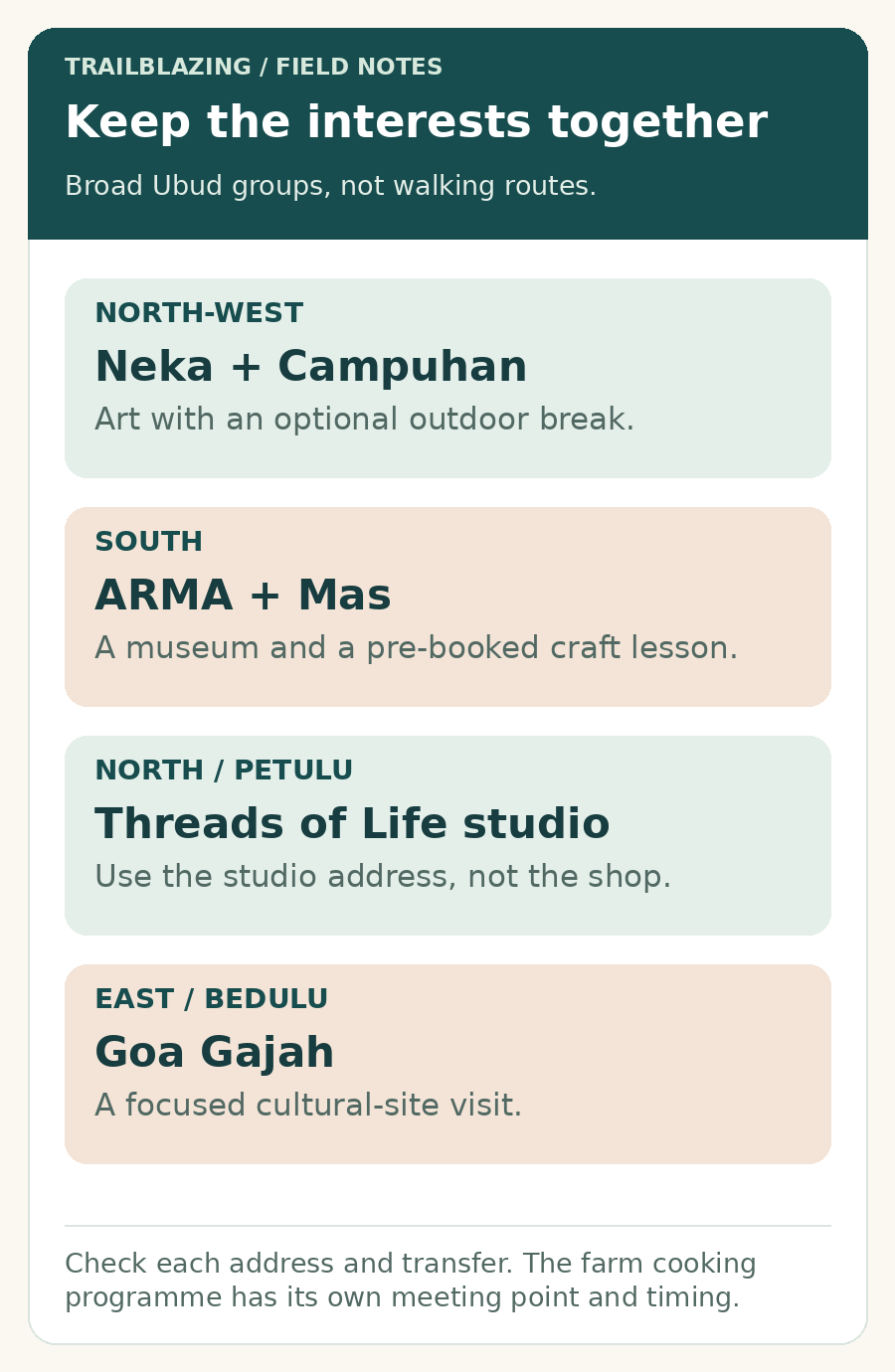
| Priority | Anchor | Optional addition | Avoid |
|---|---|---|---|
| Art and an outdoor break | Neka | A short Campuhan visit when conditions suit | A rigid early walk that risks a timed appointment. |
| Making and art | A Mas carving lesson | ARMA before or after the agreed lesson | Adding every southern temple and gallery. |
| Textiles | Threads of Life at Petulu | Lunch and an unbooked afternoon | A distant second workshop with a fixed start. |
| Food | Farm cooking programme | A relaxed evening near your accommodation | Assuming a 5.5-8-hour activity leaves a free sightseeing day. |
| A shorter cultural outing | Goa Gajah | One nearby, pre-agreed stop | Treating an unfamiliar walking shortcut as part of the plan. |
For three Ubud days, pick one making or cooking day, one art-led day and one lighter day. That provides different experiences without repeating the same formula. A traveller more interested in painting than craft should simply spend longer at the collections; variety is not a requirement.
For one available day, choose the subject that interests you most. This guide deliberately does not insist that rice terraces, waterfalls and every central landmark must be added. A focused visit can leave a stronger impression than a long sequence of short exits from a car.
A 5-hour-30-minute arts day: see where the time goes
This original model pairs an ARMA museum visit with a pre-arranged carving lesson in Mas. The numbers are planning assumptions, not venue guarantees or measured driving times. Confirm the lesson duration and replace the transfer allowance for your actual accommodation and traffic conditions.
| Component | Minutes | How to use the allowance |
|---|---|---|
| Museum visit | 90 | Choose a few themes rather than rushing every room. |
| Carving lesson | 120 | Replace with the actual booked session duration. |
| Lunch | 45 | Choose somewhere that fits the route. |
| All transfers | 45 | Assumption; increase when your base or road conditions require it. |
| Flexible buffer | 30 | For late starts, rest or a slower finish. |
| Total | 330 = 5 h 30 min | Still excludes any further attraction. |
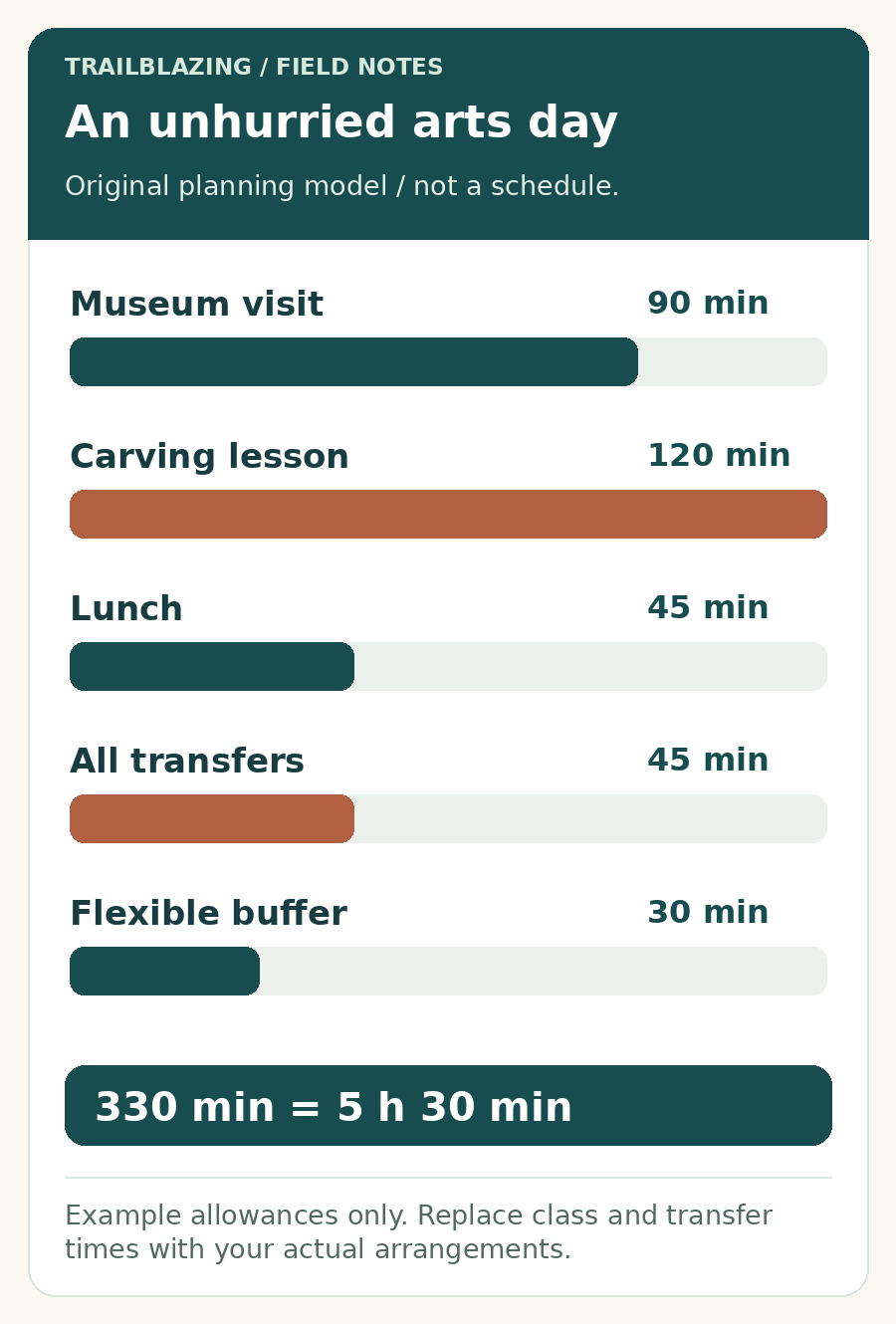
An eight-hour window would leave two and a half hours beyond this model, but that is not automatically an invitation to add another paid stop. Transfers may take longer, the lesson may run for three hours, or your group may need more rests. Spend the remaining time only after the essential parts fit.
The useful measure is participation time versus movement time. If an added attraction brings 45 minutes of driving for a 15-minute visit, decide whether it improves your day. There is no universal ratio, but making that trade-off visible is more useful than choosing the longest tour description.
For a multi-day stay, use the Itinerary Pace Checker to review the daily hours and transfers you enter. It is an organiser and pressure check, not a live traffic or opening-hours service.
Transport, prices and the bookings worth making
Reserve the scarce part first
A small workshop, a specific teacher or a class with a fixed start is the booking to secure before arranging the surrounding day. Museum visits can often be more flexible, but check their own visitor instructions and closure dates. Neka’s current guidance specifically describes in-person ticket purchase. [2]
For paid sessions, compare the complete cost: teaching, materials, any item you take home, meals, admission and pickup. Avoid treating a low headline price as comparable when it buys a demonstration rather than a participatory lesson. Keep dated quotes rather than budgeting from a social-media caption.
Choose accommodation that supports your interests
Several nights are useful when you want more than one workshop without back-to-back travel days. Choose a base for the activities and independent meals you expect to use, not simply a listing with “Ubud” in the title. A secluded room is less helpful when every class starts across town.
A useful transport question is whether to retain one driver for the whole day or arrange separate transfers. The first offers continuity but may cost more during a long class; the second requires a dependable pickup plan. Confirm the actual workshop finish and allow time to clean up, collect your work and say goodbye.
Simple preparation that makes the day easier
Bring footwear you have already worn comfortably, a small water supply and a rain layer appropriate to the day. Prioritise fit and grip over a new brand. For mostly paved museum and village visits, UK readers comparing ordinary walking footwear can browse the Skechers UK Outlet; a general footwear shop is not evidence that every model suits muddy paths or hikes.
For driver messages and map access, check your existing data plan before buying another. Open Airalo and compare Indonesia options only after checking handset compatibility and activation conditions. Indonesia plans are offered, but local reception is not assured. [13] Save the venue address and meeting instructions offline too.
Common mistakes, useful questions and a final choice
What does “beyond the main tourist streets” really mean?
It means looking beyond the central shopping and landmark circuit to choose a deeper activity. It does not mean every venue is secret, empty or non-commercial. Neka, ARMA and Campuhan are established places; the difference is how you plan and use your time.
Can children join all the workshops?
No. Age policies and tools differ. Threads of Life states that its natural-dye batik class is unsuitable for under-tens. [5] For carving or cooking, ask about supervision, equipment and whether an adult must participate. An activity available to families elsewhere may have a different rule.
Which option is best on a wet day?
An art museum or confirmed sheltered workshop is a useful first choice. Check the full route between rooms, toilets and transport, because a cultural complex may still include outdoor walking. Avoid replacing a slippery ridge walk with an equally wet, more remote path.
Do I need a guide for everything?
No. A teacher adds most value when you are learning a craft, and a guide can add context where you want interpretation. An independent museum visit or short walk can be appropriate when the route and arrangements are clear. Pay for the help that changes the experience rather than adding a guide automatically.
Should Tegallalang be added to every Ubud day?
No. A dedicated rice-terrace visit has its own travel, walking and rest requirements. Add it on a separate, suitable outing rather than turning a specialist workshop day into another broad sightseeing circuit.
The avoidable mistakes are booking a shop visit as though it were a class, mixing up a studio and retail address, assuming a short map distance means a comfortable walk, and scheduling a late workshop after an uncertain cross-town drive. Confirm the exact experience first and let the route follow.
Use the Indonesia travel hub for wider planning and the Travel Guide Finder to locate relevant published guides as the collection develops.
Sources & editorial approach
Independent editorial review: 2 November 2026. The selection, suggested plans and labelled calculations are research-led editorial judgements, not reports of personal visits, measured journeys or live offers. Confirm changeable fees, access, schedules and booking conditions before travelling.
- Neka Art Museum: collection, Sanggingan address and ticket prices.
- Neka Art Museum: visit arrangements, hours and Nyepi closure.
- ARMA: art collection and cultural role.
- ARMA: published cultural workshops.
- Threads of Life Dye Studio: Petulu natural-dye batik class.
- Taman Harum Cottages: woodcarving and cultural activities.
- Indonesia Ministry of Tourism village directory: Mas woodcarving.
- GetYourGuide / Bali Farm Cooking School: organic-farm cooking programme.
- Bali Provincial Tourism Office: Goa Gajah at Bedulu.
- GetYourGuide: Campuhan Ridge Walk orientation and outings.
- GetYourGuide: Ubud workshops and classes comparison.
- Viator: Ubud experience and excursion listings.
- Airalo: Indonesia data plans and compatibility links.
Illustrations in this article were created for Taylor’s Trailblazing Travels. Third-party photographs, where used, are credited beside the image or in the source list.