
Amed Travel Guide: East Bali Snorkelling, Diving and Villages
Choose your bay and your time in the water before deciding where to sleep along this stretched-out coast.
Original editorial illustration inspired by the Amed coast, not a documentary view or a promise of conditions.
Amed is better understood as a line of coastal communities and bays than a single resort centre. Its appeal is the combination of village life, a slower shoreline rhythm and access to snorkelling and diving, but those experiences are spread out. Choosing the wrong hotel for your favourite bay can turn a simple water-focused break into a series of transfers. [1]
This Amed travel guide makes the practical sequence explicit: choose the kind of time in the water you want, pick a suitable base, then place the stay within your wider Bali route. It also treats a journey into the highlands after scuba diving as a real planning question rather than an automatic next stop.
Some links in this guide are affiliate links. Taylor’s Trailblazing Travels may earn a commission when you book or buy through them, at no extra cost to you.
Amed is a coastal area
The hotel name alone does not tell you which bay you will use.
Match the activity to you
Shore snorkelling, a boat trip and scuba have different needs.
Keep a spare water morning
Do not make one brief window carry the entire trip.
Check altitude after scuba
A road into the highlands also needs post-dive planning.
Amed travel guide: choose the bay before the room
Begin with your daily route to the water, not the longest list of hotel facilities. Amed village, Jemeluk and Lipah serve different parts of the coastline; accommodation descriptions can use the wider Amed name for all of them. Diving operators distinguish the local bays and sites rather than treating the shore as one interchangeable reef. [1][2]
| Area to investigate | Useful starting point for | Check before booking |
|---|---|---|
| Amed village / western approach | A practical arrival base and a choice of local services | The trip to the bay or dive centre you intend to use |
| Jemeluk | A stay focused on the bay and nearby water activities | Shore entry, room-to-water route and roadside noise |
| Bunutan / Lipah | A quieter-feeling stay around a chosen beach or property | Steps, restaurant access and the distance between coves |
| Farther eastern properties | Seclusion and time largely on site | Everyday transport, pickup coverage and dining options |

For a couple with one diver and one non-diver, the best base is often the one where the non-diver has an enjoyable morning without organising a taxi. Ask whether the dive centre collects from your address, while checking the pool, nearby meals and beach route for the person staying behind.
For limited mobility, a room above the bay may deliver a lovely view but a difficult daily climb. Request photographs or a description of the actual steps and gradients. “Beachfront” also does not mean a smooth sandy entry into the water.
Choose between shore snorkelling, a boat outing and scuba
Shore snorkelling: simplest is not the same as risk-free
Jemeluk and Lipah feature among the local sites described by Amed dive operators. Ask where to enter and exit that day, what currents or boat movements to expect, and whether your swimming confidence matches the conditions. Do not use a pleasant-looking bay as a substitute for that conversation. [2]
A guided first session can be more useful than hiring equipment and guessing the route. Check mask fit before entering, use appropriate flotation when advised, stay with your companion and avoid standing on coral. An unfamiliar mask is a reason to practise calmly first, not to head immediately towards a distant feature.
A jukung outing: clarify who is supervising in the water
Local operators offer trips in traditional outrigger boats between snorkelling locations. Amed Sailing describes a route with equipment and a guide, but inclusions must be confirmed for the exact trip you buy. A captain steering the boat and an in-water guide are different roles. Wildlife sightings and the number of usable stops are not guarantees. [3]
Compare the meeting beach, flotation, supervision, boat boarding and cancellation terms. A shorter suitable outing is preferable to a long list of stops that ignores your confidence. The linked Captain Komang listing excludes children under ten, non-swimmers and people with mobility impairments, so it is not a default choice for every family. [11]
Compare an Amed boat-snorkelling optionScuba: choose the operator and level, not just the price
Discuss certification, recent experience, health screening and the conditions with a qualified dive operator. Ask what the quote includes, how groups are matched and what happens if the planned site is unsuitable. A trial session, a qualification course and a certified diver’s trip are different products. [4][5]
Tulamben’s USAT Liberty wreck belongs to a separate nearby diving area, not the same site as the Japanese wreck associated with the Amed coast. Tell the operator which experience you mean rather than booking simply “the wreck”. [12]
Leave some time for the villages and the view
Amed does not need to be filled entirely with water activities. A walk near your accommodation, a meal overlooking the coast and watching working boats from a respectful distance can provide the unhurried part of the stay. Ask before photographing people closely, keep access clear and do not move fishing equipment to improve a picture.
For a non-diver, an enjoyable day might be breakfast by the bay, a short locally advised swim or snorkel, a long lunch and the pool. That is a complete holiday day, not a gap requiring a long inland tour. A property with comfortable shaded space matters more when you expect to spend several afternoons there.
Village-based activities should be arranged through people who actually offer them. Ask whether a workshop or demonstration is operating and what the visit involves; do not assume every working household welcomes visitors. Similarly, a road with coastal views is still a road, not automatically a pleasant walking trail.
Do not combine every east-Bali stop into one day
When adding a temple, garden or inland viewpoint, ask the driver for the whole door-to-door route, including access and waiting. It may be more sensible as a separate transfer-day stop than as a return excursion from a distant eastern hotel. After scuba, however, any route gaining altitude must first be discussed with your dive professional. [5]
The practical test is whether the outing serves your interests. Travellers who have already spent several days exploring inland Bali may gain more from keeping Amed deliberately coastal.
How many nights, and what comes after the last dive?
Three nights normally provide two full days when arrival is in the afternoon and departure in the morning. That is a useful starting point for a first visit: one planned water outing and one flexible day. Four nights are more forgiving when you want repeated diving, a course or an alternative window after unsuitable conditions.
For a course, confirm the operator’s actual timetable, preparation and assessment requirements before allocating nights. Do not compress training to make an already-booked transfer work. A holiday plan should fit the activity safely, not pressure the instructor to fit the activity into an artificial deadline.
A highland drive is not just an ordinary road transfer after scuba
Divers Alert Network warns that flying or travelling by road to higher elevation after diving can increase decompression risk. This matters when the next stop is inland, such as Munduk or a highland excursion, even when no flight is involved. [5]
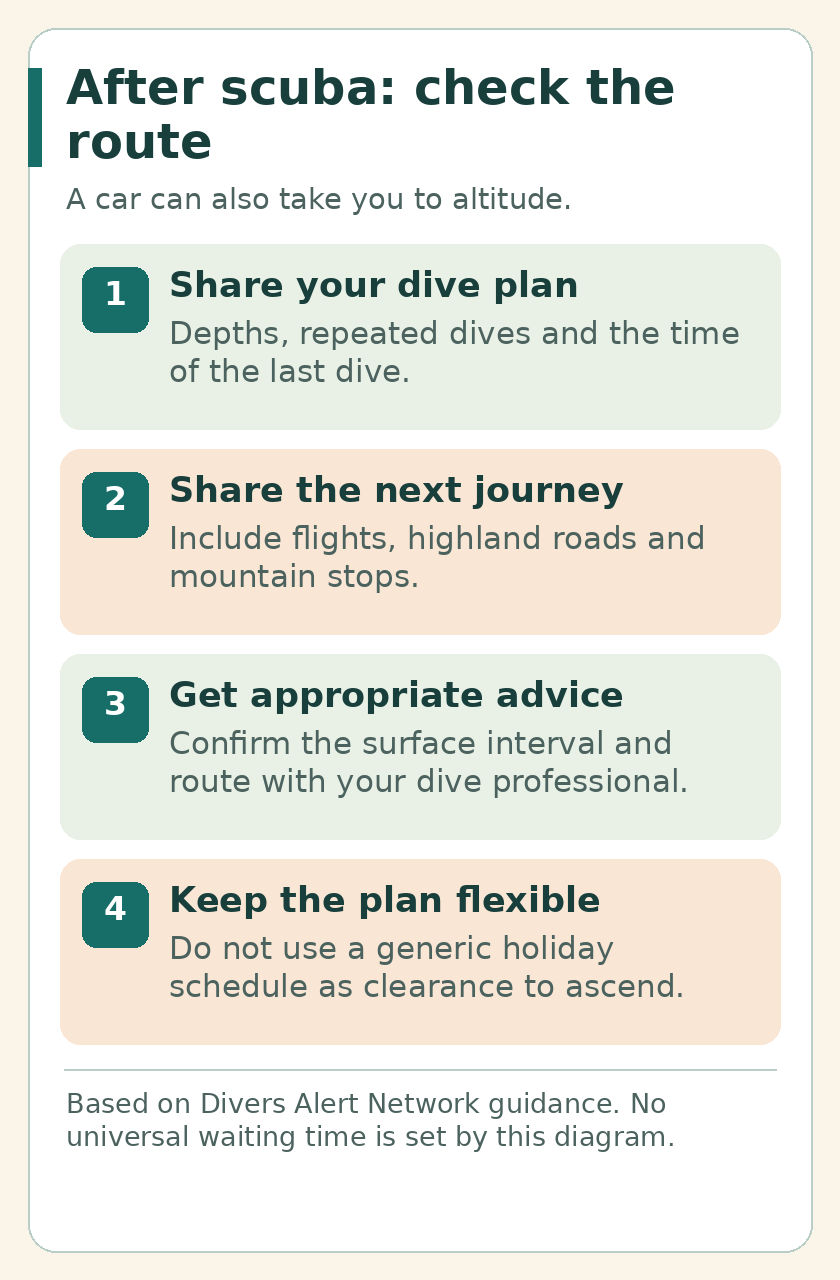
Give the dive professional the actual dive schedule and intended route, including any mountain pass or viewpoint. Follow the appropriate surface interval and medical advice for your situation; a generic holiday diagram cannot clear you for ascent. Do not substitute a standard no-fly countdown for a discussion of the road route.
One option to investigate is doing the highland portion before the scuba portion, then arranging a suitable coastal interval before onward travel. That is an itinerary idea, not a medical clearance. The Itinerary Pace Checker can help allocate nights, but it does not assess dive safety or route altitude.
Getting to Amed and travelling locally
Amed is a more substantial move from the airport or the southern resorts than a short cross-town taxi trip. Keep the arrival day mainly for transport. As an editorial allowance, set aside roughly three to five hours for a private airport-to-Amed road journey after leaving the terminal, then seek a current estimate for your exact hotel and departure time. This is not a guaranteed transfer duration.
12Go lists airport-to-Amed car transfers. Compare the final destination area, luggage capacity, flight waiting and price inclusions with a quote from your accommodation. An eastern coastal address may not be covered by every offer carrying the broad Amed label. [6]
Perama also lists Amed in its shared-shuttle network and publishes Amed Cafe Hotel as a meeting point. Check the current departure and where you will be dropped, then arrange the final journey to your own property. A shared shuttle and a door-to-door car should not be compared on fare alone. [7]
For local trips, ask the hotel or dive centre about pickup arrangements before assuming you can hail a car at any time. Group errands, meals and beach visits when they require transport. Walking between nearby stops may work, but assess the road, lighting and your own comfort rather than following a map’s shortest line.
Arrange the departure too. Travellers heading to the Gilis should confirm the current departure harbour and the complete land-and-sea ticket; do not infer a direct Amed sailing from an old itinerary. A road-and-boat combination is a different journey from leaving by boat beside the hotel.
Where to stay and how water activities change the budget
Make the hotel shortlist after identifying your preferred bay and operator. Compare the actual room level, air conditioning, hot water, breakfast, pool, noise and steps. Ask whether a sea-view balcony faces an open view or whether your room category differs from the photographs leading the listing.
Both Booking.com and Agoda provide Amed searches. Use their maps critically: a result can be described as Amed while sitting a substantial distance from the bay you have chosen. No specific availability or room rate has been checked for your travel dates. [8][9]
Price the water plan separately from the room
For two divers taking two paid dive days each, the activity bill is four times the per-diver daily quote. If a hypothetical two-dive-day package costs Rp1,200,000 per person, that is Rp4,800,000 for the pair across two days. This is an invented arithmetic example prepared on 1 November 2026, not an advertised Amed price.
That calculation shows why comparing only room rates can miss the largest decision. Ask whether equipment, boat transport, site fees, lunch and a computer are included. A course quote needs a different comparison, including training materials and certification where relevant; do not compare it directly with a recreational dive-day price.
Non-divers should separate equipment hire, an in-water guide and a boat excursion. Buying the most expensive version does not automatically make it the most suitable. A locally guided shore session can solve a different need from a multi-stop boat trip.
Use the Hotel Comparison Calculator for accommodation totals and keep activity quotations alongside it. Add arrival and departure transport, meals, insurance and a contingency before deciding what the complete Amed stop costs.
A three-night snorkelling-focused stay
This original plan is for confident swimmers interested in suitable guided snorkelling, village time and a slower break. It is not a scuba-course schedule and does not authorise any water activity. Choose the actual sites with a local professional after checking conditions.
Arrival afternoon
Reach the hotel, inspect the beach route and meet or contact the operator for the next morning. Agree equipment, supervision and the meeting point. Keep the evening local rather than adding a sunset drive that turns a long transfer into another rushed day.
First full day
Use the best suitable window for one water outing. Leave the later part of the day open for a meal, rest and a short village walk. An outing cancelled for conditions should move to the following day where possible, not be forced into a less suitable window because everything else has been prepaid.
Second full day
Choose another bay or repeat a place you enjoyed, subject to advice. Alternatively, keep the day dry and enjoy the coast from land. Trying to reach every named snorkelling site adds transfers without necessarily adding enjoyment.
Departure
Leave enough time for the full onward journey and do not add a last-minute water session before a tightly booked connection. For scuba divers using this general rhythm, replace it with the operator’s schedule and agreed post-dive travel plan.
Amed works especially well as a contrast to a busier first part of Bali. It is less effective as a single hurried overnight where the return drive consumes most of the usable stay.
Conditions, reef care and practical preparation
April-October is broadly the drier period, while November-March is generally wetter. For a water-focused holiday, use that as a seasonal starting point, then let local visibility and sea conditions decide the actual outing. [13]
Choose water activities by the conditions on the day, not a promised wildlife photograph. Ask about currents, visibility, safe entry and exit, boat traffic and the plan if conditions change. FCDO advises care when choosing diving and water-sports providers in Indonesia. [4]
Stay off coral, avoid touching or chasing marine animals and give guides room to change the route. A named “Turtle Point” is a location label, not a sighting guarantee. Keep fins controlled in shallow water and use an entry area agreed with the guide rather than walking over reef to save a few metres.
Bring sun protection, a towel, a change of clothes and only the valuables you need. Carry some cash for small purchases, but do not keep all money and documents in a beach bag while everyone is in the water. Ask how belongings are handled during the trip.
For communication, save contacts and maps offline. Airalo offers Indonesia eSIM packages for supported devices; check compatibility, activation and the listed network before purchase, and do not treat the package as a guarantee of coverage in every coastal hollow. [10] Browse Airalo for an Indonesia data option
Keep practical footwear for the shore and village routes, but ask the guide what is appropriate in the water. Equipment should help you avoid injury and reef damage; it is not a reason to walk on coral. Travel insurance should cover the exact activities, depths and qualifications involved.
Questions to settle before booking Amed
Is Amed worthwhile without diving?
Yes, when snorkelling, a quieter coastal stay and unhurried days are attractive. Choose a hotel that works for time out of the water. It is a less compelling choice when you want a short transfer, extensive nightlife and a long sandy promenade.
Do you need a boat to snorkel?
Not for every local outing. Operators describe shore-access sites as well as boat trips. [2] Let conditions, your confidence and the desired site decide; do not assume shore access means supervision is unnecessary.
Can a non-swimmer join a snorkelling trip?
Discuss this explicitly with a qualified provider before booking. Do not rely on a generic “beginner-friendly” label or a flotation aid as permission to enter open water. A land-based visit or an appropriately supervised alternative may be the better choice.
Is Tulamben the same place as Amed?
No. Treat it as a separate dive-area outing with its own transfer and site arrangements. Make sure the operator and accommodation names match the place you intend to visit, especially when the USAT Liberty is the main reason for the trip. [12]
Can you drive straight to Munduk after a morning dive?
Do not make that plan without discussing the dive profile, interval and route altitude with the dive professional. Road travel can involve the same relevant reduction in atmospheric pressure as other ascents. [5]
Amed is strongest when you stop trying to rush it
For a first visit, choose a specific bay, allow three or four nights and organise the main water activity with a provider who matches it to your ability and conditions. Preserve a flexible morning rather than relying on one short window between long drives.
The benefits are the water-focused days and a slower coastal setting. The costs are longer transfers, dispersed services and the need to check shore access carefully. Those trade-offs favour travellers who want to stay put, not those looking for a quick detour from southern Bali.
Use the Indonesia planning hub to connect the stop to the wider route. For divers, the most important onward decision is not simply where to go next, but when and by which altitude profile it is appropriate to travel.
Sources and planning assumptions
Sources consulted for this editorial review on 1 November 2026. Official information and provider descriptions support the factual points; the base selectors, sample plans and clearly labelled calculations are original planning judgements. They are not personal trip reports, live quotations or safety clearances. Recheck operator terms, access, weather and travel requirements before booking or departure.
- Indonesia Travel – Amed and east-Bali activities
- Amed Jepun Divers – Amed dive sites
- Amed Sailing – snorkelling route and inclusions
- FCDO – Indonesia safety, diving and water sports
- Divers Alert Network – snorkelling, scuba and post-dive altitude
- 12Go – Denpasar Airport to Amed
- Perama Tour – shuttle network and Amed meeting point
- Booking.com – Amed accommodation search
- Agoda – Amed accommodation map
- Airalo – Indonesia eSIM information
- GetYourGuide – Captain Komang snorkelling listing
- Indonesia Travel – Tirta Gangga and nearby Amed and Tulamben
- Indonesia Travel – broad climate and seasonal patterns
Illustrations in this article were created for Taylor’s Trailblazing Travels. Third-party photographs, where used, are credited beside the image or in the source list.