
Bali Travel Guide: Regions, Beaches and Cultural Highlights
Choose the right coast, leave room for culture and build a holiday with fewer hours on the road.
An original illustrative scene inspired by Bali; not a record of a particular temple, viewpoint or visit.
A Bali travel guide is most useful before the hotel search begins. The first decision is not which resort has the prettiest pool: it is whether your days should revolve around cultural visits, a surf coast, easy dining or time beside the sea. Those preferences point towards different bases, and combining all of them through daily drives can make an apparently restful holiday surprisingly busy.
Bali lies between Java and Lombok, with an interior of uplands and agricultural landscapes as well as its coastal resorts. Its Hindu temples and ceremonies are part of everyday community life, not just visitor attractions. [1] This guide uses that geography to help you choose a manageable trip, rather than treating the island as one interchangeable beach destination.
One inland stay and one genuinely different coastal stay.
Restaurants, surf, culture or resort time: pick the priority.
Keep arrival and hotel-change afternoons lightly planned.
A beautiful beach is not automatically a swimming beach.
Bali travel guide: choose regions before hotels
Use the table as a holiday-style selector, not a ranking. The question is which ordinary day you would enjoy repeating. A traveller who wants three surf mornings has a different requirement from someone hoping to walk to dinner and occasionally visit a temple.
| Base or area | Choose it for | Accept the trade-off |
|---|---|---|
| Ubud | Museums, arts, rice-field outings and an inland cultural stay. | No beach; outlying accommodation can mean more car journeys. |
| Seminyak | Restaurant choice, shopping and west-coast sunsets. | Traffic and urban development; beach proximity does not mean quiet. |
| Canggu coast | A repeated surf, cafe and sunset routine. | Several separate neighbourhoods rather than one easy walking centre. |
| Sanur | A coastal base with a more stay-local holiday rhythm. | Choose the actual beach access and hotel setting, not just the area name. |
| Nusa Dua | Resort facilities and a holiday organised around the hotel. | Less reason to choose it when independent village exploring is the priority. |
| Amed | A more marine-focused stay with snorkelling or diving interests. | A different part of the island; treat it as a stay, not a casual southern detour. |
| Uluwatu / Bukit Peninsula | A cliff-coast setting and a visit to Uluwatu Temple. | Check stairs, beach access and distances between your chosen venues. |
| Jimbaran | A bay-side stay and an evening organised around a beach meal. | The exact hotel access and dining location still matter. |
| Munduk | Inland landscapes, agricultural scenery and waterfall outings. | A distinct inland leg, not an extra stop added casually to a southern beach day. |
The official tourism sources describe Ubud’s inland cultural setting, Seminyak’s west-coast dining district, Canggu’s surf coast, Sanur’s coastal tourism and Nusa Dua’s resort enclave. Amed adds a distinct east-Bali marine option. [2] [3] [4] [5] [6] [7] Uluwatu adds a cliffside cultural setting, Jimbaran a bay-side alternative, and Munduk an inland landscape-and-waterfall option. [8] [9] [10]
There is no requirement to collect every famous district. Seminyak and Canggu can serve overlapping purposes on a short holiday, so changing hotels between them needs a reason: several booked surf lessons, a specific event or a much better accommodation fit. Otherwise, moving from the coast to Ubud gives a more meaningful contrast.

How many nights, and how many hotel changes?
Count nights on the island, rather than the headline length of an international holiday. A late landing and an early departure do not create two sightseeing days. Similarly, checking out, moving bags, travelling and checking in can interrupt more of the day than the driving time alone.
| Time available | An uncomplicated structure | What to leave out |
|---|---|---|
| 7 nights | 3 Ubud + 4 in one coastal base | A second coastal hotel and an offshore-island rush. |
| 10 nights | 4 Ubud + 6 on the coast, or 4 + 3 + 3 if a third region is essential | A new hotel every other night. |
| 14 nights | 4 Ubud + 4 Amed + 6 in a southern coastal base, or simply 5 + 9 in two bases | Trying to make this one route fit every interest. |
Choose the order around flight times and the reason for each stay. An exhausted late arrival may justify beginning closer to the airport instead of immediately continuing inland. On departure, use a driver-confirmed estimate for your exact address and retain a separate airport check-in allowance. A southern final base can simplify the plan, but does not remove traffic risk.
A useful test for adding another stop
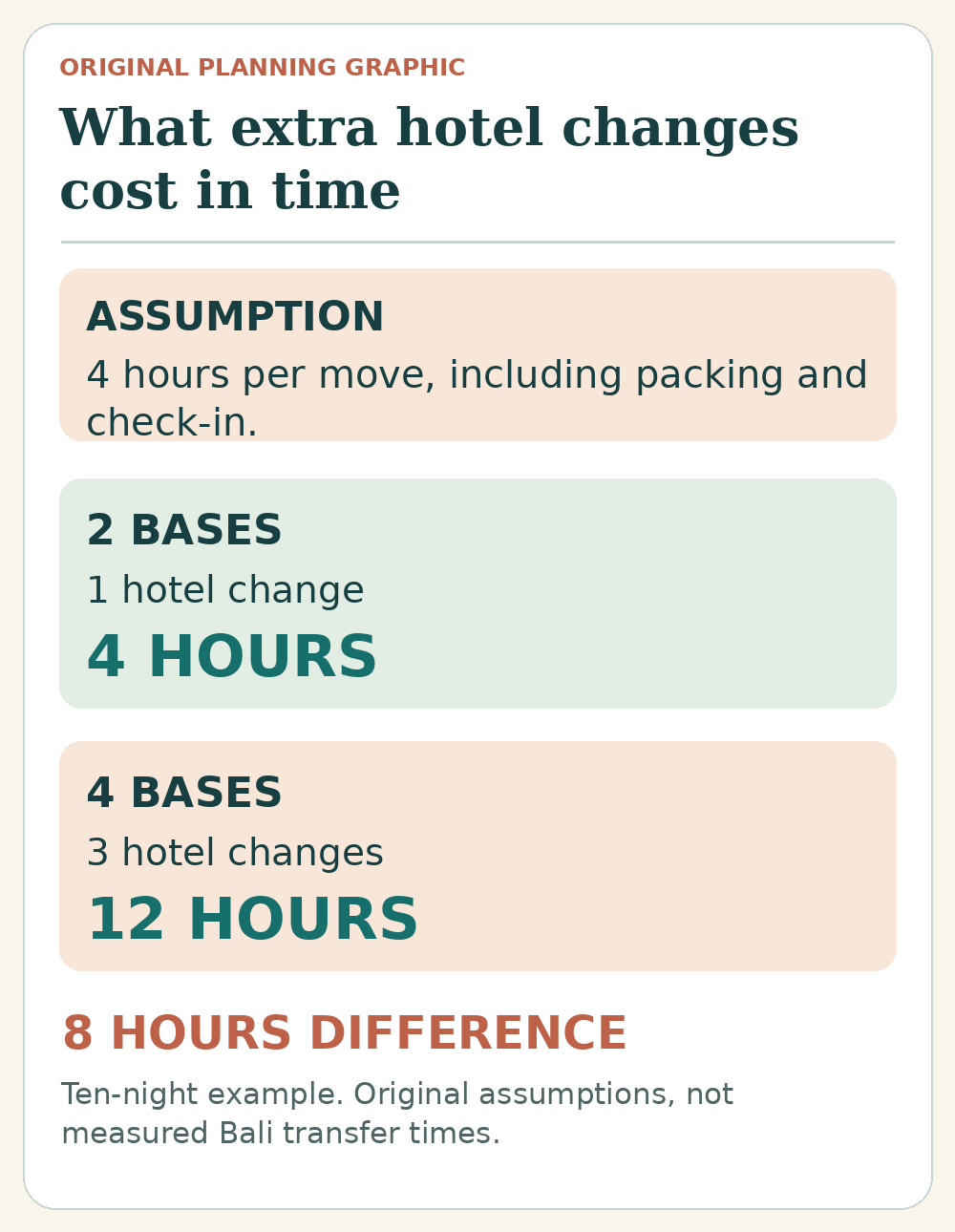
Imagine a ten-night holiday and allow four hours per hotel change for packing, checkout, travel and settling in. Two bases create one change, using four hours; four bases create three changes, using twelve. The extra eight hours are the equivalent of one generous exploring day. These are deliberately transparent assumptions, not measured Bali transfer times.
Add the third base when it buys a genuinely different experience worth that interruption. Do not add it just because a map makes the next place look close. Enter your own stop lengths and researched journey estimates in the Itinerary Pace Checker; its flags are planning prompts, not transport verification.
Choose a beach experience, not just a beach name
There are at least three different beach holidays hidden inside the word Bali: learning or practising surfing, spending most days around a resort pool with occasional beach time, and choosing a coastal neighbourhood for sunset walks and dinner. A hotel can be excellent for one and inconvenient for another.
For Seminyak and Canggu, put sunsets, sand and nearby venues ahead of any assumption about gentle water. Official travel advice warns that many south-coast Bali beaches are unsuitable for swimming. Follow local lifeguard instructions and warning signs; do not enter because other people have done so. [11]
For a family prioritising swimming, ask prospective hotels about the pool, lifeguard arrangements, access to the sand and typical tidal constraints. Sanur and Nusa Dua are worth comparing, but neither area name guarantees safe water on a particular day. A pool-centred plan can remain enjoyable when sea conditions rule out swimming.
For Amed, choose the marine activity first and then the accommodation. Ask an operator about the actual entry point, equipment, supervision and suitability for your experience. A coastline associated with snorkelling is not permission to enter unfamiliar water alone. A rest day, rather than an extra excursion, is often the better use of a longer stay.
Make cultural time more than a photograph stop
A useful cultural day has space to understand one place. In Ubud, that might mean an art museum followed by a village craft visit; elsewhere it might mean a temple visit with a knowledgeable local guide and a meal nearby. Avoid itineraries that reduce every stop to a brief queue for a picture.
The UNESCO-listed cultural landscape concerns specific rice terraces, water temples and the cooperative subak irrigation system. It is not a blanket designation for every rice field on Bali. [12] Asking how water is shared, who maintains a path and whether visitors may enter a field gives a rice-landscape visit more substance than choosing the best swing backdrop.
Treat temple access as conditional on local practice. Ask about dress and restricted areas, follow the staff’s instructions and step aside for worshippers. Seek permission before close photographs of people or ceremonies. A ticket does not turn a sacred space into unrestricted scenery.
Give one museum, craft demonstration or guided cultural outing a protected slot rather than squeezing it between long drives. A small-group experience can be useful when it explains context; a private car can suit travellers who need control over pace. In either case, inspect the actual stops, pickup area, entrance-fee inclusions and whether shopping stops can be declined.
The booking selection includes varied Ubud experiences, so filter for the kind of day you want rather than assuming every high-rated result answers the same need. [13]
Seasons, rain and the shape of the day
Indonesia’s tourism guidance places Bali’s broadly drier season around April to October and wetter season around November to March. Those boundaries are approximate, not a forecast for a booked week. [14] A month label is less useful than a plan that still works when an outdoor afternoon is lost.
Put the activity that matters most in the first suitable weather window. Keep a museum, a long lunch or a hotel afternoon as a genuine alternative, rather than another non-refundable booking. If a trip depends on boats, climbing or exposed viewpoints, check the relevant local conditions close to departure instead of treating seasonal averages as clearance.
During heavy rain, shorten the programme rather than compensating with tighter driving connections. Flooding, landslides and volcanic disruption are recognised travel risks; check official warnings and airline updates when they affect the intended route. [15]
A practical packing choice is a small rain layer, sun protection and footwear suitable for the actual paths you intend to use. You do not need a new specialist kit for every temple or cafe visit. For uneven trails, ask about the terrain before deciding whether your everyday shoes are appropriate.
Arrival formalities and getting to your first base
For a full British citizen passport, the FCDO currently states at least six months’ validity on arrival and two blank pages. Eligible tourism visitors can obtain a 30-day visa on arrival; the listed fee is IDR 500,000, with onward or return travel evidence required. Recheck your own nationality and trip purpose before departure. Checked 1 November 2026. [16]
The All Indonesia arrival declaration is separate from the visa. The official system accepts submissions within three days before arrival; the declaration is free. Use the government service rather than a paid imitation. [17] Bali’s visitor levy is also separate: the stated standard amount is IDR 150,000 per foreign tourist, with applicable exemptions to be checked through Love Bali. Keep the payment receipt. Checked 1 November 2026. [18]
Book the transfer to the address, not the district
Send the driver the hotel’s map pin, the villa entrance instructions if relevant, flight details, passenger count and luggage. Ask whether the price is per vehicle and includes airport parking, waiting time and any late-arrival charge. Child seats or mobility needs require explicit confirmation, not a note added after payment.
12Go has an airport-to-Ubud comparison page, but the individual product controls pickup, vehicle size and destination coverage. [19] Compare it with the accommodation’s own transfer quote. For a first late arrival, a clear meeting process may be worth more than a small price difference.
Do not treat scooter rental as a required part of visiting Bali. The FCDO advises checking the correct licence and insurance and highlights serious motorbike accidents. A car with a driver can be the more appropriate choice. [15]
Budget for the whole holiday, not a headline room rate
Build the budget in Indonesian rupiah first. Accommodation is per room or villa, many meals and entries are per person, and private transport may be per vehicle. Mixing those units is a common reason a supposedly low daily figure becomes unrealistic.
| Cost component | Explicit assumption | Illustrative total |
|---|---|---|
| Rooms | 10 nights × IDR 1,000,000 | IDR 10,000,000 |
| Food and non-alcoholic drinks | 10 budget-days × 2 people × IDR 300,000 | IDR 6,000,000 |
| Local transport and transfers | A chosen whole-trip allowance | IDR 2,500,000 |
| Activities | A chosen allowance for two people | IDR 2,000,000 |
| VOA and Bali levy | 2 × (IDR 500,000 + IDR 150,000), where applicable | IDR 1,300,000 |
| Subtotal | Excluding international flights and insurance | IDR 21,800,000 |
| 10% contingency | 10% of the subtotal | IDR 2,180,000 |
| Total with contingency | Replace assumptions with real quotes | IDR 23,980,000 |
This is arithmetic, not a survey of available prices or a claim that every traveller needs this amount. Ten nights can span eleven calendar dates; add food or transport on arrival and departure where the ten budget-days do not cover them. The entry-fee inputs above are the dated official figures; the other amounts are deliberately chosen planning assumptions. [16] [18]
A room-price change of IDR 300,000 per night changes the ten-night total by IDR 3,000,000 before contingency. That is why choosing the right accommodation category matters more than optimising every small snack purchase. Include tax, service charges, breakfast, cancellation rules and access costs in the comparison.
For two actual quotes, the Hotel Comparison Calculator lets you enter the costs yourself. It does not retrieve live rates or convert currencies; use one currency for all options.
What to arrange before departure
Secure the first night’s accommodation and a workable arrival plan before polishing the sightseeing list. Next, reserve the experiences that genuinely depend on a small group, a particular instructor or a limited session. Leave ordinary meals and weather-sensitive afternoons flexible unless a specific venue is central to the trip.
For accommodation, ask about current nearby building work, late check-in, vehicle access and the actual room or villa layout. For tours, compare walking demands, stairs, bathroom opportunities, group size and cancellation cutoffs. Accessibility is a property-and-route question, not an island-wide label.
Mobile data can help with driver messages and map pins. Airalo lists Indonesia plans, but your phone must support the chosen eSIM and be unlocked; review coverage, data allowance and activation conditions rather than assuming every plan behaves alike. [20]
Once the stays make sense, use the Trip Itinerary Planner to organise your own stops and nights. A saved plan is useful for communication; it does not confirm transport, entry eligibility or reservations.
The choices most likely to make a Bali trip harder
Booking a remote villa and then planning every meal elsewhere creates repeated transport decisions. Choosing two similar coastal bases without a specific reason spends time moving without necessarily adding variety. Booking a boat trip immediately before an international flight creates a dependency that a land-based final night could avoid.
Another mistake is reading a brief online driving estimate as a door-to-door commitment. Add the non-driving parts, check the day with your driver and preserve a fallback. Equally, do not pay for an all-island itinerary simply to avoid making choices: a smaller route can be a more complete holiday.
Questions that change the booking decision
Is a week enough for Bali?
Seven nights can work well for two bases or a single relaxed stay. It is not enough to see every region without turning much of the holiday into a transport exercise. Choose the experiences you would be disappointed to miss and let those determine the route.
Should I stay in Ubud or on the beach first?
Use your flight arrival, energy level and departure plan. Neither order is inherently better. A very late arrival favours a simple first transfer, while a final coastal stay can be convenient when it genuinely shortens the journey to the airport.
Can I enjoy Bali without riding a scooter?
Yes. Choose a base with nearby daily needs, use cars for longer outings and keep each sightseeing day geographically coherent. Budgeting for a driver on a few useful days is preferable to building a holiday around transport you are not qualified or comfortable to use.
Does this plan include Nusa Penida?
No. It is a mainland-first structure. Add an offshore island only after checking the boat arrangements, the time spent getting to and from the port and a suitable weather margin. It should replace another element, not simply fill the final empty afternoon.
Do hotel prices include the Bali levy and visa?
Do not assume so. Treat entry-related charges separately unless your booking explicitly states an included service. A room tax or service charge is not the same item as a visa or provincial visitor levy.
A sensible first Bali holiday
Begin with three or four nights in Ubud and one coastal stay chosen around your ordinary day: dining in Seminyak, a surf routine in Canggu, or a hotel-and-beach rhythm in Sanur or Nusa Dua. Longer trips can add a contrasting region, but extra nights are also an opportunity to stop moving.
The best next step is to shortlist two realistic accommodation options in each chosen base, check their full costs and transfer arrangements, and leave at least one flexible half-day. Explore the Indonesia planning hub when you are ready to place Bali within a wider trip.
Sources & editorial approach
The source list identifies tourism, government and operator references used for this research-led guide; specific opening times, prices and booking conditions can change. The area choices, sample days and explicitly labelled calculations are original planning judgements, not measured journeys, personally tested visits or live offers. Recheck changeable rules and booking terms for your dates.
- Indonesia Ministry of Tourism: Bali geography and cultural context.
- Indonesia Ministry of Tourism: Ubud orientation and cultural attractions.
- Indonesia Ministry of Tourism: Seminyak geography and traffic.
- Indonesia Ministry of Tourism: Canggu beach and surf setting.
- Indonesia Ministry of Tourism: Sanur.
- Indonesia Ministry of Tourism: Nusa Dua.
- Indonesia Ministry of Tourism: Amed coastal activities.
- Indonesia Ministry of Tourism: Uluwatu cliffside temple.
- Indonesia Ministry of Tourism: Jimbaran Bay.
- Indonesian tourism village directory: Munduk landscape and activities.
- Irish Department of Foreign Affairs: Indonesia, including swimming risks.
- UNESCO: Cultural Landscape of Bali Province and the subak system.
- GetYourGuide: Ubud activities and booking options.
- Indonesia Ministry of Tourism: weather, climate and seasons.
- FCDO: Indonesia safety, transport and natural hazards.
- FCDO: Indonesia entry requirements (British citizen passports).
- Indonesia Ministry of Tourism: All Indonesia arrival declaration.
- Indonesia Ministry of Tourism: Bali visitor levy.
- 12Go: Denpasar Airport to Ubud route search.
- Airalo: Indonesia eSIM plans and device-check links.
Illustrations in this article were created for Taylor’s Trailblazing Travels. Third-party photographs, where used, are credited beside the image or in the source list.