Canggu Travel Guide: Beaches, Cafés and Neighbourhoods
Find the right everyday patch of the coast instead of spending each day trying to cross all of Canggu.
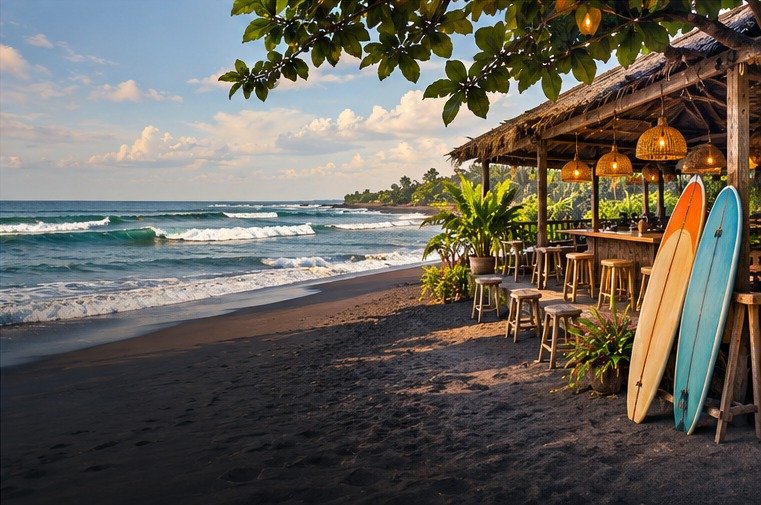
An original surf-coast illustration inspired by Canggu; the cafe is not presented as a real or bookable venue.
A useful Canggu travel guide begins with the scale of the place. The holiday label covers several different coastal and inland pockets, and a room described as Canggu may not be convenient for the beach, cafe or surf school you plan to use. Choosing your everyday patch matters more than making a list of every popular venue.
Canggu’s coastal identity includes dark sand, surf and sunsets. [1] For a visitor, the central question is whether that daily rhythm appeals enough to stay local. It is a weaker base when most of the holiday consists of distant sightseeing or when quiet sea swimming is the non-negotiable priority.
Keep the hotel, regular cafe and main activity close in practice.
Neighbourhood reputation cannot describe the room next door.
Ability, conditions and supervision matter more than a beach label.
Do not cross between every famous cafe and beach each day.
Canggu travel guide: choose your everyday neighbourhood
Use the following as a visitor’s decision framework, not a set of exact administrative boundaries. The right choice depends on what you want to do repeatedly, and every option still needs a specific room-and-access check.
| Area to inspect | Good reason to choose it | Trade-off to check |
|---|---|---|
| Batu Bolong and nearby lanes | A stay organised around a local cafe, surf meeting point and social evenings. | Traffic, venue noise and whether your actual walking routes are comfortable. |
| Berawa | A particular beach venue, restaurant or activity you expect to use often. | The distance between those places and the sleeping conditions at your hotel. |
| Echo Beach / Pererenan side | A preferred beach-facing or cafe-centred pocket on the western side of the visitor area. | Do not assume quieter, undeveloped or easily connected simply from the name. |
| Inland accommodation marketed as Canggu | A villa or hotel worth spending substantial time in. | Extra driving, access after rain and the cost of repeatedly reaching the coast. |
First-party addresses give useful anchors: Revolver Canggu lists Jalan Nelayan; Milk & Madu distinguishes Berawa from Beach Road; BAKED. lists Pererenan among its locations; FINNS publishes a separate age rule that can determine whether it suits your group. [2] [3] [4] [5] These venues help orient a shortlist, but their presence does not establish that every hotel in the wider area is convenient.
A sensible initial shortlist has two properties in the same everyday area, rather than five properties scattered across the wider coast. Compare them with the same daily plan so that the trade-off is visible.
The three-pin test: hotel, daily food and main activity
Pin the accommodation entrance, the place you expect to eat or get coffee most often, and the surf school meeting point or beach access that matters to you. Then inspect the real route between them. Straight-line proximity is not enough.
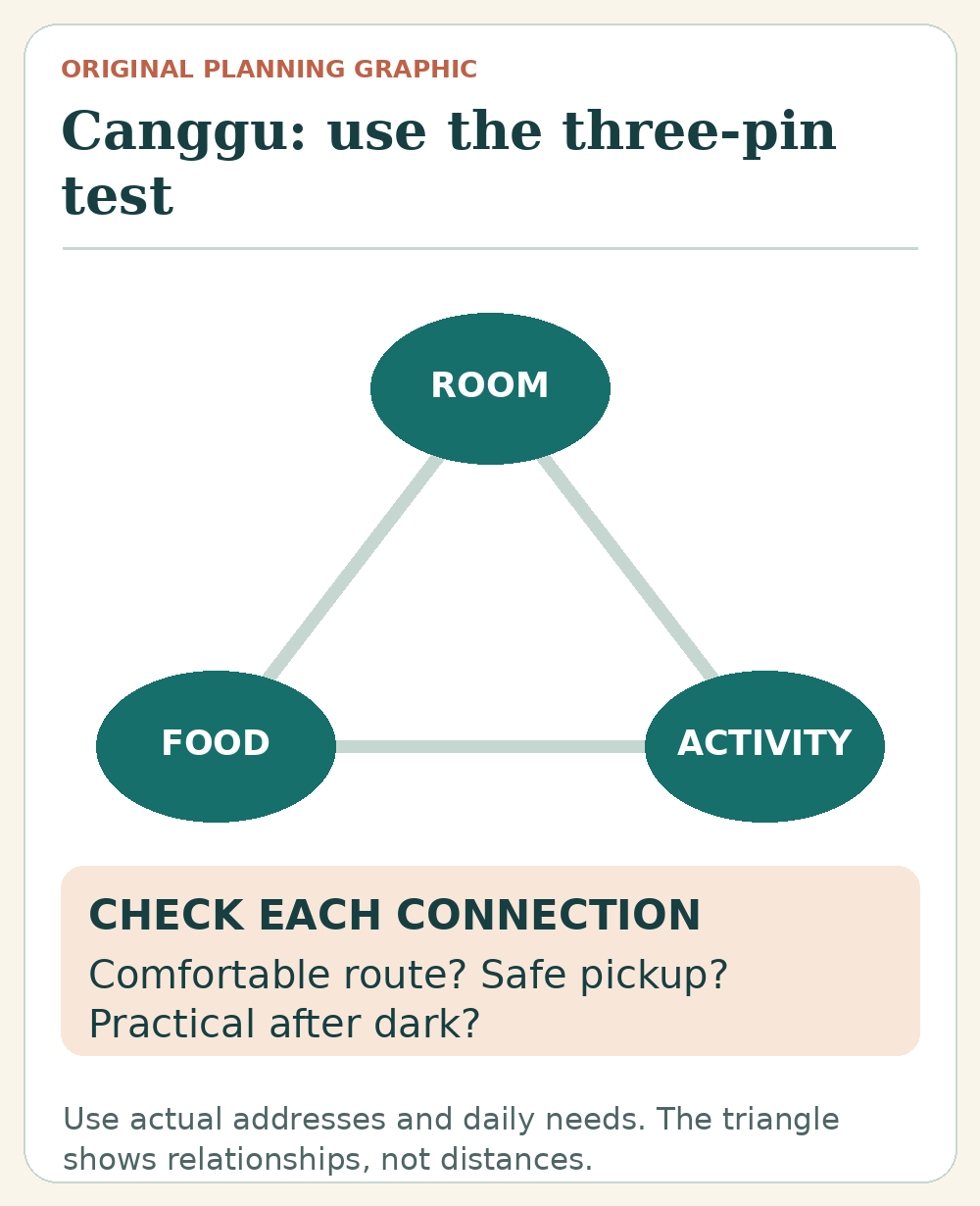
For each connection, ask whether you would comfortably make it twice a day in heat, rain or after dark. Look for awkward road sections, steps, unlit lanes and unclear vehicle access. Ask the accommodation how guests normally make that specific journey instead of asking only whether the property is central.
Give the longest repeated journey the most weight
Suppose one hotel saves 20 minutes each way on the daily journey to your main activity. Over four days, the difference is 20 × 2 × 4 = 160 minutes. That is two hours and forty minutes returned to the holiday. This is an illustrative calculation, not a claim about any particular Canggu route.
If the nearer room costs IDR 150,000 more per night for four nights, its room premium is IDR 600,000. Compare that premium with the actual extra transport costs and your own value for those 160 minutes. The method does not say to buy the expensive room; it makes the real trade-off visible.
For a villa-focused holiday, use a different anchor: a reliable meal option, the place a car can collect you and the accommodation’s own facilities. There is no reason to pay for coastal convenience you will barely use.
Beaches and surfing: match the session to the person
Canggu’s reputation for surf does not make every beach or every day’s conditions suitable for every visitor. Choose a lesson by the instructor’s assessment of your experience, swimming ability and the conditions, not by a promise that a named beach is always beginner-friendly.
Ask how many students share an instructor, whether the meeting point changes with conditions, what equipment is included and what happens when the session is unsuitable. A good booking decision should leave room for postponement or an alternative plan rather than treating a paid slot as an obligation to enter the water.
Before paying, also check the insurance cover you need for the activity. A board rental is not instruction, and watching a few people near shore is not a reliable guide to currents or the bottom.
The destination search is a starting point for comparison, not an endorsement of every listed operator. [6]
For non-surfers
Choose coastal walks, a shaded meal or a sunset stop without making swimming compulsory. Official travel advice cautions that many south-coast Bali beaches are unsuitable for swimming. [7] A hotel pool is a useful alternative, especially when safe water time is central to the holiday.
Do not cross an unfamiliar river mouth or walk onto exposed rocks simply to continue along the sand. Use a known public access route and turn back when conditions make the shoreline unsuitable. A beach outing should have an easy alternative, not a required destination reached at any cost.
Cafes: build a local routine rather than a cross-coast checklist
The practical way to enjoy Canggu’s cafes is to select one dependable local option and perhaps one deliberate outing elsewhere. Travelling between several photogenic interiors in a day can consume the time you hoped to spend relaxing.
| Cafe | Location clue | How to use it in your plan |
|---|---|---|
| Revolver Canggu | The official venue page gives Jalan Nelayan No. 5. | A possible anchor when inspecting the Nelayan/Batu Bolong-side area. |
| Milk & Madu | Its own contact page separates Berawa and Beach Road. | Select the actual branch before judging distance from your room. |
| BAKED. | Its outlet list includes Pererenan. | A possible local option when staying on the Pererenan side; confirm the exact branch. |
Locations checked 2 November 2026 through the businesses’ own pages; opening hours, outlet locations and booking policies can change. No personal tasting, value ranking or guarantee of a table is implied. [2] [3] [4]
Choose the venue for the occasion. A slow breakfast, a quick coffee after a lesson and a work call need different seating and noise conditions. Confirm laptop policies rather than assuming that every cafe functions as a coworking space, and buy appropriately when using a table.
Check the current menu and tax or service treatment before comparing costs. Where an allergy or strict dietary requirement matters, contact the branch directly rather than relying on an old menu photograph. A brand with several locations may have different layouts or facilities in each.
For something more specifically local, ask your host about nearby food options and what the dishes contain. You do not need to turn every meal into a named recommendation to have a varied trip.
Beach clubs, nightlife and the room you sleep in
Decide whether a large beach venue is a main reason for visiting or an occasional outing. That choice affects where you stay. Close access may be valuable for an event; it can be a disadvantage when early sleep is essential.
FINNS publishes an ages-16-and-over entry rule for its beach club. Its published terms require an original physical ID and exclude children under 16; digital copies are not accepted. Terms checked 2 November 2026. [5] Families should not build a day around entry assumptions, and all visitors should check the current seating, spending and special-event terms directly.
A free-entry headline, where offered, does not establish that every seat, pool area or event is included. Confirm the arrangement you actually intend to use, especially when booking for a group. There is no need to buy a daybed when the real aim is a brief sunset visit elsewhere on the coast.
Ask accommodation providers a precise question
Instead of asking whether the hotel is quiet, ask whether there is currently construction beside the room, music audible at your intended bedtime or a venue whose event schedule affects the property. Ask which room position is least exposed and request the answer in writing.
For children, early surf mornings or anyone sensitive to noise, prioritise sleep over a vague neighbourhood reputation. Pererenan, Berawa or Batu Bolong cannot promise a particular room’s surroundings. A well-sited room in a busy area can suit you better than an isolated listing with an unverified next-door development.
Getting there without assuming you need a scooter
Arrange the first transfer to the exact hotel or villa entrance, especially for an evening arrival. Confirm the flight number, luggage, pickup procedure and waiting allowance. 12Go has a Denpasar Airport-to-Canggu route search, but the individual provider’s terms determine the actual drop-off and vehicle. [8]
A no-scooter stay is possible when you design it around a small daily area and use cars for the journeys that need them. Ask about pickup access before booking an inland villa. The cheapest-looking accommodation can create a transport dependence that a better-located room avoids.
For motorbike use, the FCDO advises checking licence and insurance requirements and highlights serious road accidents. [9] Do not take the availability of a rental as proof that you are legally or practically prepared to ride.
For a driver or ride booking, use a clear pin and wait somewhere safe and identifiable. Allow time to leave a busy event or venue rather than attaching another fixed booking immediately afterward. On departure day, obtain a current journey estimate and preserve the airline’s separate check-in window.
Mobile data can help with messages and pickup coordination. Airalo offers Indonesia plans, but check the phone, coverage, data allowance and activation policy. [10] Browse Airalo and choose an Indonesia plan only after comparing it with your existing roaming; keep the entrance instructions offline.
A four-night Canggu plan that stays local
Use the first day to learn the area rather than trying to prove the hotel choice by immediately leaving it. For a four-night stay, protect the three full middle days for the routine you came for.
| Day | One useful anchor | What stays optional |
|---|---|---|
| Arrival | Check in, confirm the local route and eat nearby. | A short sunset visit only if arrival timing allows. |
| Full day 1 | A suitable surf lesson or a local beach-and-cafe morning. | A second activity; leave space to recover and understand the neighbourhood. |
| Full day 2 | Repeat the activity you enjoyed or take one booked workshop/outward excursion. | Moving between several distant venues for the sake of variety. |
| Full day 3 | A flexible local day and a chosen sunset or dinner. | A paid beach venue; it is not compulsory to the Canggu experience. |
| Departure | Pack and complete the confirmed airport or onward transfer. | Anything that depends on an uncertain return time. |
For a surf-focused stay, your school may recommend a different session order. For a non-surfing stay, replace lessons with time around the accommodation, a walk and the cafe or food experiences you actually enjoy. Do not pretend that the same schedule suits both travellers equally well.
Three nights can work for an introduction; five or more become worthwhile when you want a repeated local routine. If the wish list is mainly Ubud temples and distant rice landscapes, changing base may be more sensible than making Canggu the departure point for every day.
Build a budget that reflects the way you will spend time
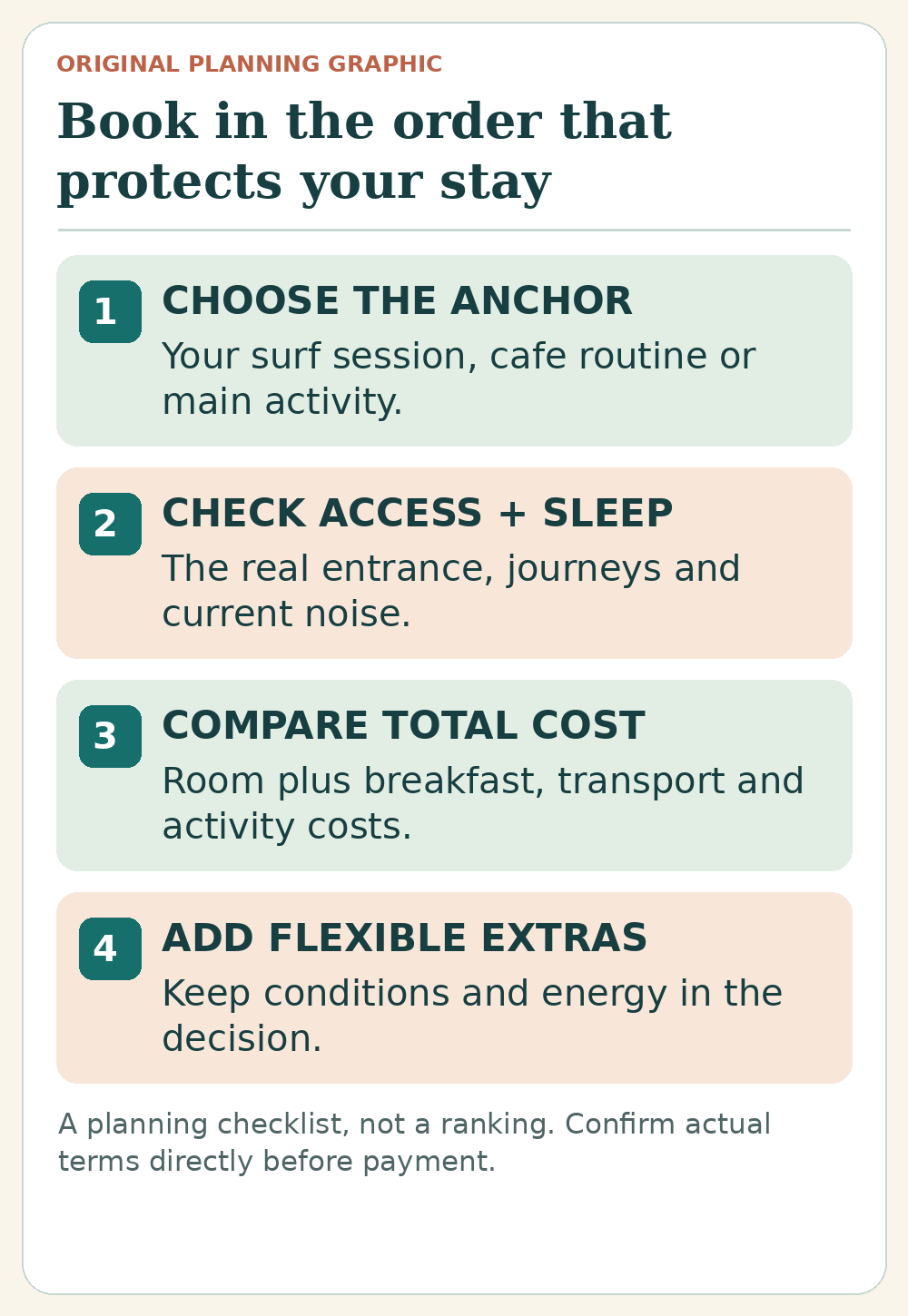
Choose the expensive decisions first: accommodation, repeated transport and the main activity. A surf lesson programme, a venue-centred social trip and a slow villa stay can have very different spending patterns despite using the same area name.
For a four-night trip, separate the room total from the number of food and activity days. Add airport or onward transfers as whole-journey items, and price a lesson by the number of sessions rather than vaguely allocating a daily attractions figure.
Compare two lodging options using your three-pin plan. A lower room rate is a real saving only after adding any extra journeys. The Hotel Comparison Calculator accepts your own room rates and additional costs; it is not a source of live Canggu prices.
Leave optional spending genuinely optional. You can enjoy the coast without purchasing a paid venue experience every day. Conversely, when a particular event is the main reason for travelling, put its full admission, seating and transport cost into the budget before committing to the room.
Weather, longer stays and the mistakes to avoid
Bali is broadly wetter from November to March and drier from April to October. [11] These are general seasonal tendencies, not a surf forecast or a guarantee of daily sunshine. For a trip centred on water activities, use the operator’s current assessment rather than choosing solely by calendar month.
A longer stay needs an additional level of checking: room-level internet performance, a suitable workspace, laundry arrangements, noise at working hours and the actual costs of your routine. A cafe photograph does not establish a dependable working environment.
Also check the immigration permission for what you intend to do. The FCDO notes that the usual visitor visa is not suitable for all work, including some influencer or commercial content activity. [12] Do not assume that the presence of laptop users means every remote-working arrangement is permitted.
Three common mistakes are booking an inland room without costing the daily trips, choosing a district on the assumption that it is always quiet, and buying a surf session without discussing ability or conditions. All three can be prevented with specific questions before payment.
Canggu questions that affect the stay
Which neighbourhood is best without a scooter?
Choose the property whose real routes to your regular food and main activity work for you. Batu Bolong, Berawa and Pererenan all need an exact pin check; no neighbourhood label eliminates the need to inspect access.
Is Canggu suitable for someone who does not surf?
Yes, when cafes, food, sunset time and the accommodation itself are the attraction. It is less compelling when you do not enjoy that routine and are primarily seeking easy sea swimming or sightseeing far from the coast.
Is Pererenan automatically quieter?
No. Check the immediate surroundings, construction and room position. Area reputations can lag behind development and cannot describe the sound beside a particular property.
Should families avoid Canggu?
Not necessarily, but choose deliberately around the pool, bedroom arrangement, safe access and child-appropriate activities. Confirm venue age policies; an adults-only beach club is not a family fallback.
Should I split a short stay between Canggu and Seminyak?
Usually only for a concrete reason, such as several sessions or an event in the second area. Otherwise, a single well-chosen coastal base avoids packing and check-in time without sacrificing the main experience.
How many activities should I book ahead?
Reserve the main lesson, workshop or event that matters, with clear change terms. Leave enough space for conditions and personal energy to influence the rest of the stay.
Make Canggu smaller, and the holiday easier
Choose the daily anchor first, then a room with usable access and credible sleep conditions. Add one familiar cafe, a realistic beach or surf plan and enough flexibility to repeat what you enjoy.
A successful Canggu stay does not need to cover every neighbourhood. It needs a small part of the coast that fits your own routine. Use the Indonesia travel hub for the wider trip and the Itinerary Pace Checker when deciding whether another hotel move actually earns its place.
Sources & editorial approach
The source list identifies tourism, government and operator references used for this research-led guide; specific opening times, prices and booking conditions can change. The area choices, sample days and explicitly labelled calculations are original planning judgements, not measured journeys, personally tested visits or live offers. Recheck changeable rules and booking terms for your dates.
- Indonesia Ministry of Tourism: Canggu beach and surf setting.
- Revolver: Canggu cafe on Jalan Nelayan.
- Milk & Madu: Berawa and Beach Road locations.
- BAKED.: outlet locations including Pererenan.
- FINNS Beach Club – official ages 16+ and physical-ID entry terms.
- GetYourGuide: Canggu activities and surf-related options.
- Irish Department of Foreign Affairs: Indonesia, including swimming risks.
- 12Go: Denpasar Airport to Canggu route search.
- FCDO: Indonesia safety, transport and natural hazards.
- Airalo: Indonesia eSIM plans and device-check links.
- Indonesia Ministry of Tourism: weather, climate and seasons.
- FCDO: Indonesia entry requirements (British citizen passports).
Illustrations in this article were created for Taylor’s Trailblazing Travels. Third-party photographs, where used, are credited beside the image or in the source list.