Diving Around Nusa Penida: Manta Encounters and Operator Choices
Choose the right operator and a suitable dive before choosing the wildlife photograph.
Original manta-habitat illustration; not a photograph, a specific dive-site map or evidence of a sighting.
Diving around Nusa Penida can be a main reason for travelling to Bali. Yet “manta trip” is not a useful description of the service on its own. It might mean a snorkelling excursion, a first scuba experience or a boat carrying certified divers with very different levels of experience.
This guide is principally for certified recreational divers choosing an operator. It compares published requirements and practical booking arrangements, not underwater techniques or independently audited safety records. New or returning divers should discuss an appropriate training or refresher plan before treating Penida as a sightseeing booking.
This article contains affiliate links. Taylor’s Trailblazing Travels may earn a commission from qualifying bookings or purchases, at no extra cost to you.
Tell the operator your certification, logbook history and last dive.
A training ratio is not necessarily the certified-diver ratio.
No operator can promise a wild animal will appear.
No-fly time and ferry contingency solve different problems.
Is diving around Nusa Penida the right booking?
PADI describes Penida as a destination for manta encounters, with a range of reef and drift sites. That is a reason to research the trip, not evidence that every site suits every qualification. Conditions and diver capability must determine the actual plan. [1]
Send the operator your certification level, total dives, date of the last dive, experience in moving water, and anything that affects comfort or equipment fit. An honest answer gives the operator a chance to suggest a refresher, private guide, different site or different destination. A willingness to pay for a more expensive package cannot replace suitability.
As one concrete example, Bali Scuba publishes Open Water certification, at least 25 logged dives and diving within the previous six months for its standard Penida trip, with a private-guide option for people below those criteria. These are that operator’s terms, not universal Indonesian rules or a promise that everyone with 25 dives can safely join. [3]
A Discover Scuba experience is a different activity from a certified-diver trip. Ask a qualified instructor about suitability, training, medical screening and the actual site before booking. Do not buy a certified-diver product because its photographs are more appealing.
The FCDO advises checking operator credentials, insurance, emergency oxygen and arrangements for transfer to a hyperbaric chamber. Treat vague answers to those questions as a reason to investigate further or choose another operator. [2]
Screen the operator before comparing prices
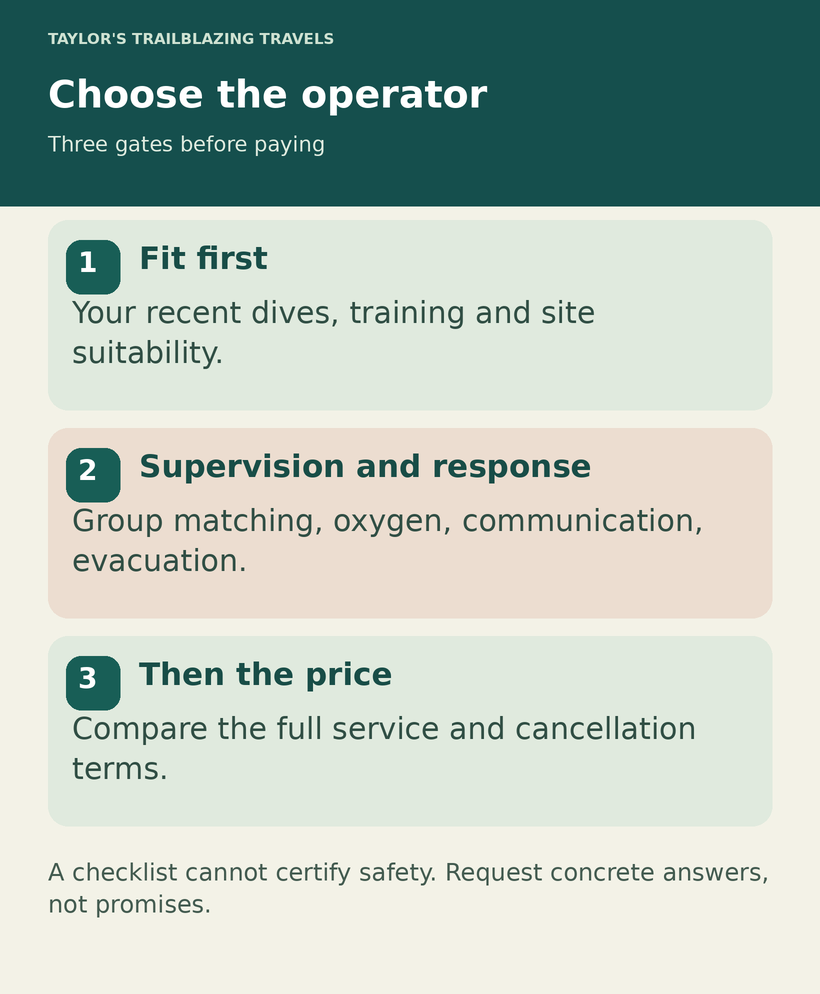
The framework below uses gates rather than a numerical safety score. Excellent equipment photographs cannot compensate for an unsuitable dive plan, and a low price cannot compensate for an unclear emergency response. The questions are a way to obtain information, not an independent inspection.
| Gate | Evidence to request | Reason to pause |
|---|---|---|
| 1. Diver and site fit | Written acceptance based on your experience; refresher needs; who chooses the site on the day | A fixed challenging itinerary promised before anyone asks about you |
| 2. Supervision and emergency response | Guide qualification and group size; oxygen; communication; missing-diver and evacuation arrangements | Only a review score or a generic “fully safe” answer |
| 3. Booking transparency | Equipment inclusions, meeting point, total cost and weather/cancellation terms | Unclear extras or a guaranteed animal encounter |
Ask specifically who leads your group, not just who owns the business. Confirm whether people with markedly different experience will dive together, and how the operator handles a diver who wants to stop. Credentials and agency listings are useful checks, but neither establishes the condition of the particular boat and equipment on your departure. [2]
Raise any medical or medication questions with an appropriately qualified clinician and follow the operator’s screening process; do not seek a clearance from a travel article. Check that your insurance covers the intended activity, certification limits and any required evacuation rather than assuming ordinary holiday cover includes everything. [2]
Four operator enquiries with different strengths
These examples were selected for transparent published information and different departure or service arrangements. They are not a ranking of the safest operators. No boat inspection, booking transaction or personal dive was carried out. Reconfirm terms for your dates; provider information was reviewed on 1 November 2026.
| Operator / starting point | Useful published detail | What to ask next |
|---|---|---|
| Bali Scuba / mainland Bali | Standard Penida trip has explicit logged-dive and recency criteria. [3] | Would a private guide actually make my proposed itinerary suitable? |
| Two Fish Divers Penida / Penida | Its PADI profile states a maximum 2:1 instructor ratio for Discover Scuba and Open Water training. [4] | What is the ratio and site plan for my specific certified-diver booking? |
| Project Laut / Penida | Advertises certified fun-diving groups of up to four and condition-dependent site choice. [5] | How will the group be matched by experience, and is a refresher needed? |
| Blue Corner Dive / Lembongan or Penida | Advertises a maximum four divers per guide for certified fun diving. [6] | Which island base and meeting point does the chosen product use? |
The Two Fish figure is deliberately not presented as a fun-diving guarantee: a ratio for students in training cannot be silently transferred to every other product. Similarly, a four-person group may be attractive, but the number alone does not settle compatibility, supervision or emergency provision.
Read the operators’ own pages before contacting them: Bali Scuba, Two Fish’s PADI profile, Project Laut and Blue Corner. Ask for the same answers from each so that the comparison is meaningful.
Environmental policies deserve a separate question. Green Fins distinguishes its assessed Certified Members from online Digital Members; an environmental membership is not proof of medical readiness or a substitute for the safety checks above. [10]
Let the manta determine the encounter
Manta sightings are possible around Penida through the year, but wildlife presence and access to a particular site remain uncertain. Bali Scuba explicitly says its planned Manta Point visit depends on sea conditions. A substituted reef dive is not automatically evidence that an operator has failed to deliver responsibly. [1][3]
Manta Trust’s guidance asks visitors to keep at least three metres away, avoid chasing or touching, and leave the animal’s route unobstructed. Divers should remain around the edge of a cleaning station rather than occupy its central space. Follow local instructions that are more restrictive and maintain clearance from coral. [7]
A useful pre-booking question is: “What happens when other groups crowd the animals?” The answer should explain how your group avoids adding to the pressure, rather than promise that a guide will get you the closest photograph. Keep the encounter subordinate to the dive plan and your own ability to remain controlled.
Do not confuse the package names
Ask for the actual proposed sites and activity. Manta Point, Manta Bay and a generic “manta snorkelling” product are not interchangeable promises. A passenger ferry ticket is not a dive boat booking either. The written confirmation should identify scuba versus snorkelling, who operates it, the departure base and whether the site may change.
There is little value in chasing a second famous species simply to justify a longer or more demanding dive. Explain your interests, but allow the qualified team to recommend an appropriate alternative. No wildlife checklist overrides certification limits or the decision to end a dive.
Mainland day trip or an island dive stay?
For one dedicated dive day, a mainland-based operator may avoid a hotel move. For several days, an island stay can make repeated meetings simpler and create more flexibility. The trade-off is that an island stay introduces a passenger-boat journey and another connection before the international flight.
| Base arrangement | Works especially well when | Main booking question |
|---|---|---|
| Remain in south Bali | You want one operator-organised dive day without repacking | Does the price include your actual hotel pickup area? |
| Stay on Nusa Penida | Several dive days are the trip’s main purpose | How far is the room from the chosen dive centre and departure point? |
| Stay on Nusa Lembongan | Your preferred operator departs there and you want that island stay | Is the confirmed product actually based on Lembongan rather than Penida? |
For Penida accommodation, compare Booking.com’s island listings and Agoda’s Penida map, then obtain the operator’s meeting pin. These are island searches, not a claim that every listed hotel is close to your dive boat.
For a separately arranged island transfer, compare Sanur-to-Nusa Penida passenger boats on 12Go. Check the named ports, baggage, check-in requirements and cancellation terms. Do not use a ferry timetable as confirmation that you can arrive and immediately join a separately booked morning dive. [9]
A land-based contact plan is useful: save the hotel, boat and dive-centre details offline, and arrange how changes will reach you. Travellers needing mobile data can compare Airalo and check its Indonesia plans, after checking device compatibility, network information and activation terms. A data plan may help with messages on land, but it must never be treated as dependable communication at sea. [11]
Calculate the complete dive-day price
A lower headline price may exclude equipment, computer hire, hotel transport, marine charges or a private guide. Request a total for the same number of dives, same equipment needs and comparable cancellation terms. Separate optional upgrades from changes necessary for your suitability.
| Component | Advertised amount | Calculation |
|---|---|---|
| Three-dive Penida trip | IDR 3,100,000 | Base price |
| Full equipment rental | IDR 400,000 | Base plus rental = IDR 3,500,000 |
| Private guide where agreed | IDR 800,000 extra | Base, rental and guide = IDR 4,300,000 |
The provider lists hotel transfers from specified areas, lunch, tanks, weights and a guide within the base package. The arithmetic above is an example of comparing inclusions, not a personal quote, a universal Penida price or a guarantee of acceptance. No GBP conversion is shown because the eventual exchange rate and payment costs are not fixed. [3]
Ask whether the selected insurance, taxes or other local charges are additional, and what happens when the boat cannot reach the intended site. A no-manta day, a weather cancellation and a customer cancellation can have different terms. Record the final quote before comparing it with a shorter two-dive trip.
The Travel Budget Calculator can hold your own dive, transport and accommodation allowances. Replace any starter figures with actual quotations; it does not fetch dive availability or confirm cover.
Separate no-fly time from boat-transfer contingency
DAN recommends minimum pre-flight surface intervals of 12 hours after a single no-decompression dive and 18 hours after multiple dives in a day or diving over several days, for divers without symptoms. Longer intervals are more conservative; these are not guarantees of avoiding decompression sickness. Dives requiring decompression stops need substantially longer and individual advice. [8]
A simple planning example: after a multi-dive day ending on Tuesday at 13:00, 18 hours ends on Wednesday at 07:00. A 24-hour planning allowance ends at 13:00. Choosing a later departure still does not replace the actual dive-computer restrictions, professional advice or a longer interval your circumstances require. [8]
Now add a separate transport question: will you already be back on Bali before the long-haul departure day? Reserving a non-diving mainland night can help with boat disruption as well as giving a slower finish. An elapsed surface interval does not make a cancelled ferry arrive, and an early ferry does not shorten the interval.
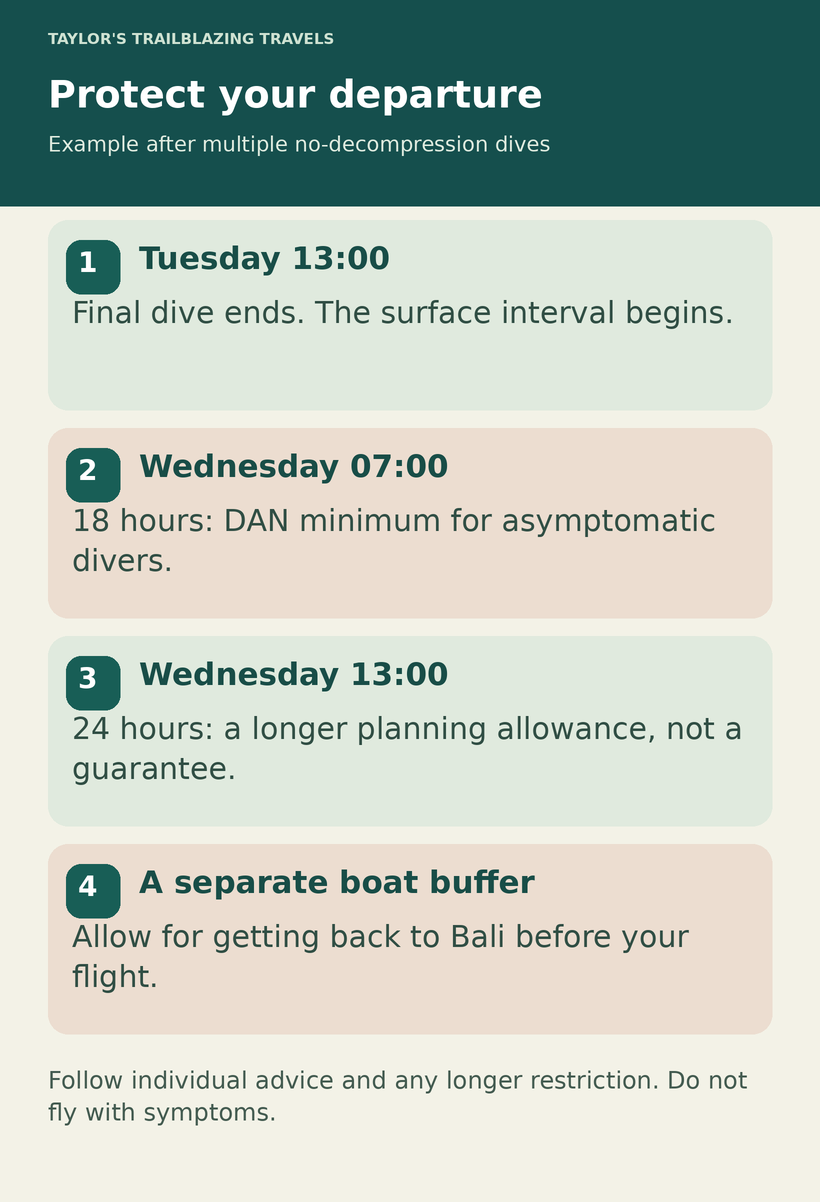
Schedule the last dive first when working backwards from flights. Do not add a high-altitude excursion to a surface interval without obtaining appropriate diving-medical advice. Symptoms after diving require urgent medical assessment, not an attempt to wait out a countdown. [8]
Final booking decisions and common mistakes
Will a private guide guarantee access to Manta Point?
No. A private guide may improve the match between supervision and your needs, but cannot remove unsafe conditions, guarantee wildlife or make an unsuitable dive appropriate. Ask what alternative would be proposed instead. [3]
Is a small group enough to choose an operator?
It is one useful factor. Compare actual group matching, equipment, communication, emergency planning and the freedom to decline a dive. A ratio without context should not become a safety ranking.
Should snorkellers and divers book the same package?
Only after the provider confirms that both activities are deliberately supported with suitable staff and sites. Do not assume non-diving companions will be supervised merely because there is room on the boat.
What should be confirmed in writing?
Your accepted experience level, exact product, meeting point, equipment requirements, group ratio, full price and change/cancellation rules. Keep those details with the insurance documents and leave room in the itinerary for a sensible decision not to dive.
For a single day, compare a suitable mainland operator with the cost of moving islands. For several dive days, favour a convenient island base and protect the return. In both cases, buy a well-matched diving service, not a wildlife promise.
Sources and editorial method
Sources consulted on 1 November 2026. Provider statements describe their advertised services, not an independent inspection. Comparisons, checklists and worked examples are original editorial analysis; illustrative inputs are labelled where used.
- PADI: diving in Nusa Penida
- FCDO: Indonesia scuba-diving and transport safety advice
- Bali Scuba: Nusa Penida requirements, itinerary and advertised prices
- PADI operator profile: Two Fish Divers Penida
- Project Laut: certified fun diving and group size
- Blue Corner Dive: certified fun diving
- Manta Trust: Swim with Mantas interaction guidance
- Divers Alert Network: flying after diving
- 12Go: Sanur to Nusa Penida passenger routes
- Green Fins: environmental membership categories
- Airalo: Indonesia eSIM plans
Illustrations in this article were created for Taylor’s Trailblazing Travels. Third-party photographs, where used, are credited beside the image or in the source list.