Nishiki Market Visit Guide: Food Stalls and Responsible Visiting
Choose a few food stops, leave room for everyday shoppers, and enjoy the market without turning it into a moving picnic.
- Shop-by-shop hours
- Eat where permitted
- A flexible tasting plan
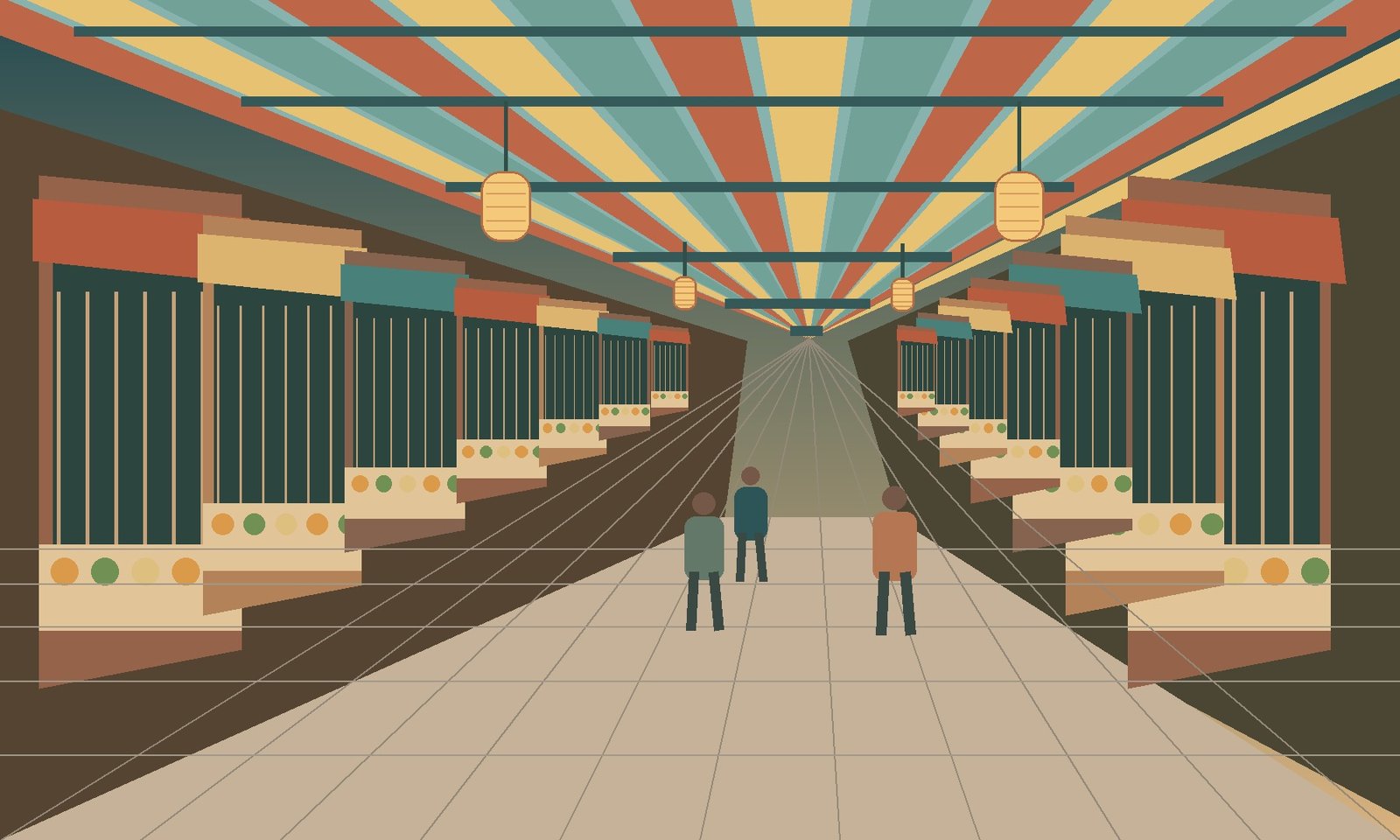
Original stylised market illustration, not a photograph of particular Nishiki shops or current conditions.
Nishiki is easier to enjoy when you arrive with an appetite and a little restraint. You do not need to taste everything, chase a viral stall or photograph every counter. A few contrasting stops can teach you more than a long queue for the same snack everyone else is holding.
The market is a collection of independent shops on a public shopping street, not one attraction with a single opening time. [1] This guide helps you choose food and non-food stops, protect a realistic budget, and make the visit work for the people who shop and trade there every day.
This article contains affiliate links. If you book or buy through them, Taylor’s Trailblazing Travels may earn a commission at no extra cost to you.
Best approach
Pick a savoury stop, a tofu stop and a sweet option; keep the rest flexible.
Timing
Mid-morning is a useful planning choice, not a guarantee every shop is open.
Budget method
Set a spending envelope before ordering; displayed prices decide what fits.
Essential courtesy
Stop to eat where the seller permits; keep the moving lane clear.
Start with the shops, not a single market opening time
Nishiki has no shared closing day. Its association notes that many shops close on Wednesdays and many close from 1–3 January, while individual schedules differ. Payment methods also vary by shop. [1] Choose two or three places you would be disappointed to miss and check those first.
A start around 10:00 or 10:30 is an editorial compromise: it avoids building the visit around very early retail opening, while leaving lunch and the afternoon flexible. It is not a promise about crowd levels or a universal market opening time. The shop examples below show why checking matters.
For access, use the association’s map and directions, which identify connections from Shijo, Karasuma and Kyoto-kawaramachi. [3] Pick an entrance according to your next stop and the shops on your shortlist. Wandering the full street and then retracing it for every purchase usually adds more congestion than value.
For more food-focused ideas, see our Japan food and culture guides. Our Japan travel etiquette guide also explains useful visitor customs beyond Nishiki Market.
Three food shops to help you choose
These are examples from the market association’s own directory, chosen for contrasting products rather than a ranking or a claim of personal tasting. Stock, menus and prices must be checked at the counter. A shop’s presence here does not mean every item is suitable for every diet.
| Shop | What to look for | Decision before buying |
|---|---|---|
| Tanaka Keiran | Kyoto-style rolled egg and egg dishes [4] | Ask which portions are for immediate eating and where to eat them |
| Konnamonja | Tofu, yuba and soy-milk sweets, including doughnuts [5] | Choose either a savoury tofu product or a sweet snack to avoid repeating the same taste |
| Uchida Tsukemono | Kyoto pickled vegetables [6] | Decide whether this is a tasting opportunity offered by staff or a purchase to take away |
Tanaka Keiran: make egg the savoury stop
The directory identifies Tanaka Keiran as a specialist in egg dishes, including dashimaki. [4] It can give your visit a clear savoury focus without ordering several similar snacks. Ask what is ready to eat now and what is intended for later; not every attractive display item is a walk-up snack.
Konnamonja: tofu does not have to mean only one texture
The shop directory describes tofu, fried tofu, yuba and soy-milk sweets. It lists 10:00–18:00 with irregular holidays. [5] Choose the item that adds a new texture or flavour to your plan. Do not assume that a soy-based dessert is free of other allergens, or that a tofu dish has no animal-derived seasoning; ask about the actual item.
Uchida: a chance to think beyond ready-to-eat snacks
Uchida’s directory entry focuses on Kyoto pickles. [6] This is a useful contrast to fried or sweet foods, but sampling is not an entitlement. Accept only what staff offer. For a take-away purchase, ask about storage, shelf life and packaging; a product that needs refrigeration may be a poor choice at the start of a long sightseeing day.
There is no need to complete a food checklist. If the first two purchases are generous, skip the next savoury item and leave room for tea or something sweet. Buying less and enjoying it properly is a better result than carrying half-eaten food through a crowded arcade.
Build a tasting budget that can survive the real prices
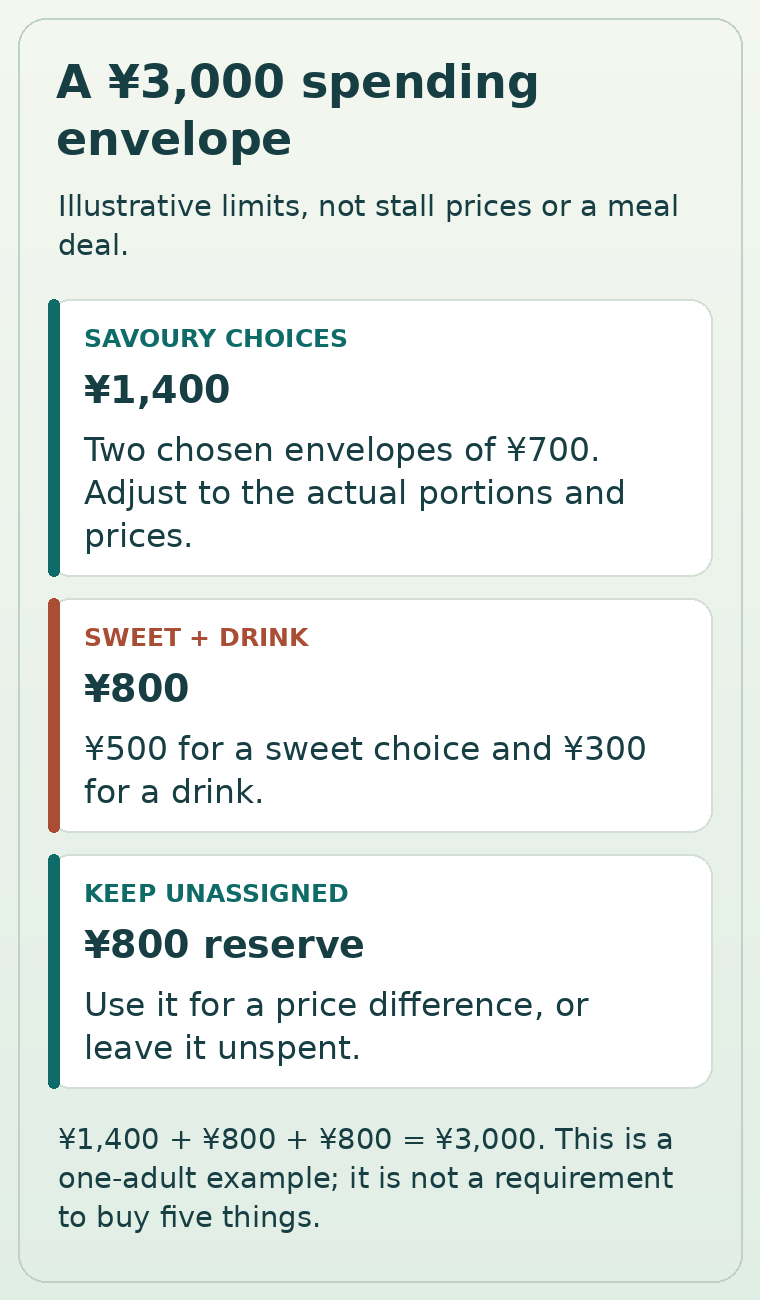
Use spending limits as a decision tool, not as invented market prices. Here is an illustrative ¥3,000 envelope for one adult. It is not a quoted meal deal or a promise that each category can be filled at that amount.
| Envelope | Illustrative limit | How to use it |
|---|---|---|
| First savoury choice | ¥700 | Buy only if the actual portion and price suit you |
| Second contrasting choice | ¥700 | Skip or share a suitable portion if already full |
| Sweet choice | ¥500 | Leave room rather than buying it first |
| Drink | ¥300 | Check the real price; adjust another envelope if necessary |
| Unspent reserve | ¥800 | Keep for a price difference or a purchase you genuinely value |
| Total ceiling | ¥3,000 | ¥700 + ¥700 + ¥500 + ¥300 + ¥800 |
The reserve is deliberately large. If one item costs more than its envelope, the plan still works by using part of the reserve or dropping another purchase. Spending all the money is not the objective. For two people, decide whether your ceiling is per person or shared before ordering; portions, appetites and dietary needs differ.
Carry a modest amount of yen as well as your usual payment method, but ask at each counter rather than assuming either cash-only or universal card acceptance. The association directs payment questions to the individual shop. [1] Confirm the displayed price and what the serving includes before paying.
Visit responsibly: finish one purchase before starting the next
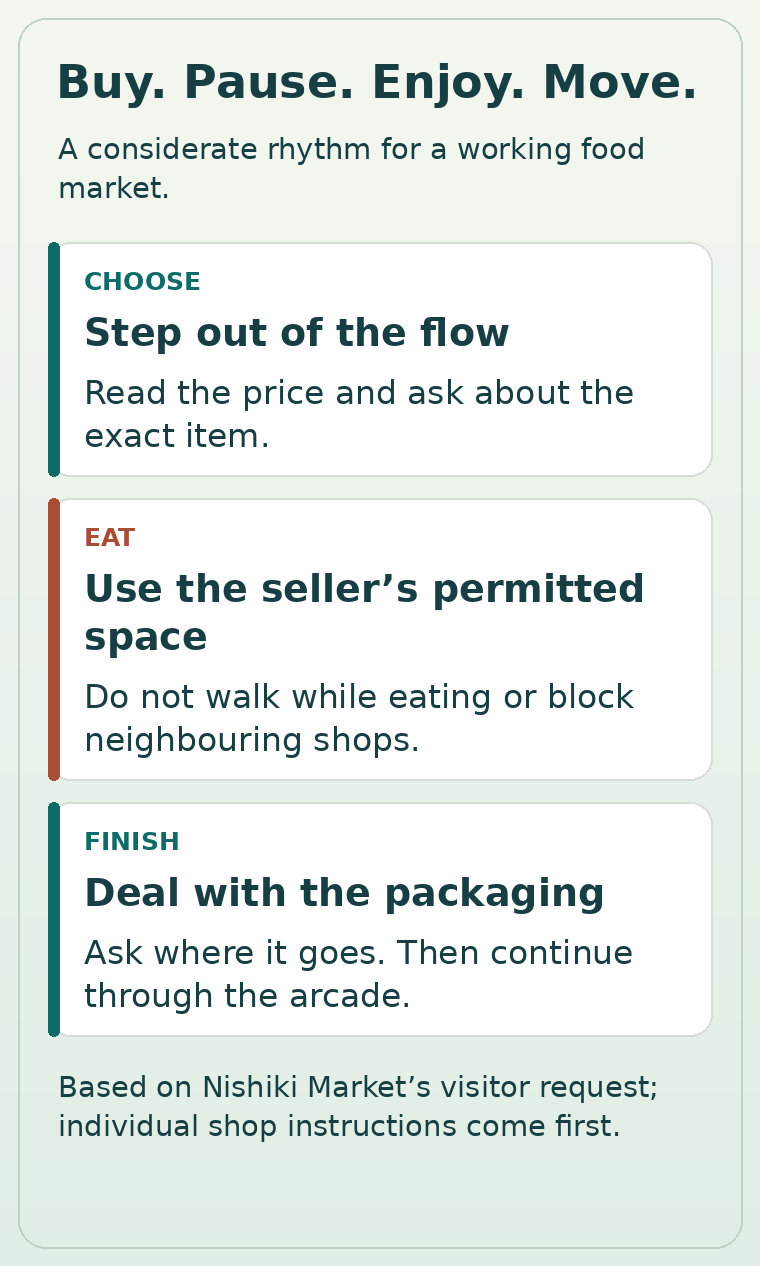
The association’s instruction is specific: refrain from walking while eating, and enjoy purchases in front of the shop where you bought them or inside it. [2] Follow the seller’s directions about exactly where to stand; do not interpret “in front” as permission to block the neighbouring shop or the centre of the street.
- Step out of the moving lane to read a menu, queue or organise payment.
- Ask before photographing staff, customers or a close-up of a counter. Respect any no-photography sign.
- Ask the seller where packaging should go; do not leave it on another counter or force it into an unrelated bin.
- Keep backpacks close and leave large luggage at your accommodation or an appropriate storage facility.
- Do not occupy a seat or eating area belonging to a shop from which you have bought nothing unless staff explicitly permit it.
For families, choose a stopping place before handing out food. With a group, let one or two people approach the counter while the others wait without forming a wall across the arcade. A guide is not an exemption from these courtesies.
A 90-minute visit without repeated backtracking
Here is a simple allocation, not a claim about the time a shop will take to serve you: ten minutes to orient yourself, four fifteen-minute shop stops, and twenty minutes of flexibility. The sum is 90 minutes. A stop may be browsing or buying ingredients rather than eating.
| Part | Purpose | When to shorten it |
|---|---|---|
| First 10 minutes | Read the map and confirm the priority shops are open | You already know your entrance and shortlist |
| Four 15-minute stops | Choose, queue, buy and finish one purchase at a time | A queue uses up the budget for a lower-priority stop |
| 20 minutes of flexibility | Slow movement, payment, a toilet detour or a pause | Do not spend this before seeing actual conditions |
If a queue takes 25 minutes rather than 15, it uses ten minutes of your reserve. When two stops do that, the buffer is gone. Drop the fourth stop or lengthen the visit instead of making up the time by eating while walking.
Finish towards the side of the market that suits your onward route. Nearby shopping streets or a riverside break can be a better contrast than another queue-heavy food destination. Keep a real seated lunch option separate if anyone is still hungry; the tasting budget is not a nutritional or meal-completeness claim.
Would a food tour add enough value?
A guide is most useful when you want explanations of ingredients, help choosing among unfamiliar products and a coordinated small-group visit. Independent visiting suits readers who prefer to choose their own portions, skip queues and keep spending flexible.
Compare the actual tasting inclusions, language, meeting point, group size and duration. Ask about dietary requirements before booking rather than treating a booking-platform filter as confirmation. A tour including seven tastings is not necessarily better value for a light eater than a shorter visit with fewer purchases.
Do not buy a tour merely to gain access to the shopping street. The benefit you are evaluating is the guiding and included experience. Likewise, a guide cannot promise that the arcade will be quiet or that a particular independent shop will be open.
Dietary, accessibility and practical questions
Can a vegetarian, vegan or allergic traveller eat here confidently?
Ask about the exact dish, its stock, seasoning and preparation rather than relying on its appearance or a translated product name. Make your requirement clear in writing. If staff cannot confirm something essential to your safety, choose another item or a separately arranged meal. A food tour should confirm what it can accommodate before you pay.
Is the arcade suitable for wheelchairs and pushchairs?
The association says visitors may use the public street, but warns that it is not fully accessible for every mobility aid and can become very crowded. [1] That is different from a guarantee that every shop entrance, counter or eating area is accessible. Keep the route short and be willing to leave when movement becomes uncomfortable.
Where are the toilets?
The association lists a toilet at its office, with stated hours of 10:00–17:00 and a 1–4 January closure. [1] Check its map and current notices rather than assuming every shop has a customer toilet. Build a detour into the visit when a toilet stop is important.
Is there value beyond food?
Yes: browsing the official shop directory can reveal cookware, ingredients and other specialist purchases as well as ready-to-eat food. [2] Decide whether you are buying something useful at home or simply filling a bag. For anything difficult to transport, check packing and your airline’s baggage rules before buying.
Leave with a few good choices, not a trail of packaging
A good Nishiki visit is selective. Choose contrasting products, pay attention to each shop’s instructions, and make stopping part of the pleasure. When the street becomes too crowded or your appetite is satisfied, move on; you do not owe the market a complete tasting circuit.
Sources and further checking
Source pages checked on 18 October 2026. Recheck date-sensitive visitor arrangements and booking terms before committing.
- Nishiki Market association — hours, holidays, payments, access needs and toilets
- Nishiki Market association — market directory and visitor request
- Nishiki Market association — access
- Nishiki Market shop directory — Tanaka Keiran
- Nishiki Market shop directory — Konnamonja
- Nishiki Market shop directory — Uchida
- GetYourGuide — Nishiki Market food tour
Illustrations in this article were created for Taylor’s Trailblazing Travels. Third-party photographs, where used, are credited beside the image or in the source list.