Japan · Tokyo on foot
Tokyo Neighbourhood Walks: Self-Guided Routes Beyond the Main Sights
Three different half-days, from Yanaka’s shopping lanes to Fukagawa’s garden and Koenji’s arcades.
Tokyo neighbourhood walks work best when they leave room for something unplanned: a shop window, a seated coffee or a shrine visit that takes longer than expected. These three routes each connect a manageable set of named landmarks, with a station at either end and a practical place to finish early.
Choose Yanaka and Nezu for a compact shopping-street and shrine combination; Fukagawa for a garden, local history and temple approaches; or Koenji and Asagaya for browsing. They are original suggested itineraries assembled from official tourism maps and venue information. Distances and timings are planning estimates, not recorded tracks or accounts of a personally walked route.
Taylor’s Trailblazing Travels may earn a commission when you book or buy through an affiliate link in this guide, at no extra cost to you. This helps fund the research and upkeep of the site.
Pick the kind of afternoon
Yanaka for a compact introduction, Fukagawa for garden and history, Koenji–Asagaya for browsing.
Plan for stopping
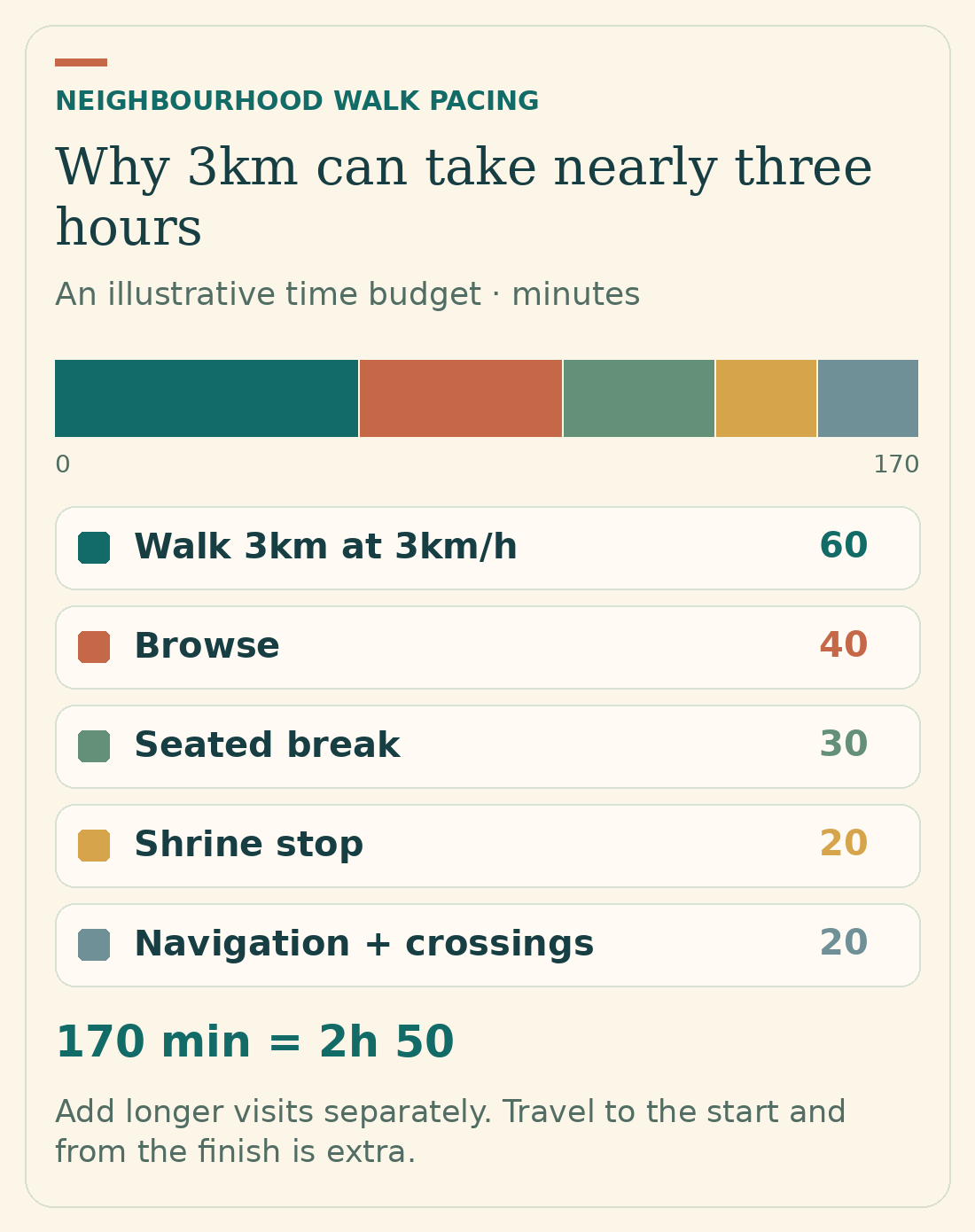
A 3km route is about an hour of walking at the planning pace used here; food, shops and visits turn it into a half-day.
Keep the short finish
Sendagi, Kiyosumi-Shirakawa and Shin-Koenji give each route a useful point to stop before completing the full walk.
Check access separately
An easy-looking map does not establish a step-free route. Station lifts, garden paths and shrine approaches need their own checks.
Which Tokyo neighbourhood walk should you choose?
Swipe or scroll sideways to read every column.
| Walk | Best fit | Distance / time | Short finish |
|---|---|---|---|
| Nippori → Nezu | Shopping lanes and a shrine; the most compact choice | 2–3km · 2½–3½ hours | Sendagi, after Yanaka Ginza |
| Kiyosumi-Shirakawa → Monzen-Nakacho | Garden, indoor history and temple approaches | 3–4km · 4–5 hours with both paid stops | Return to Kiyosumi-Shirakawa after the garden or museum |
| Koenji → Asagaya | Independent shops, cafés and arcades | 3–4km · 2½–4 hours | Shin-Koenji, after LOOK Street |
The choices above are editorial judgements. The routes connect landmarks shown in the official Yanaka and Fukagawa guides and Suginami’s area map; our order, breaks and time allowances are our own.[1][4][9]
Save the named stops in your map app before setting off. Treat the directions below as a landmark sequence: follow current pedestrian routing between the named roads and entrances, and obey any temporary closures. There is no need to search for an unmarked shortcut.
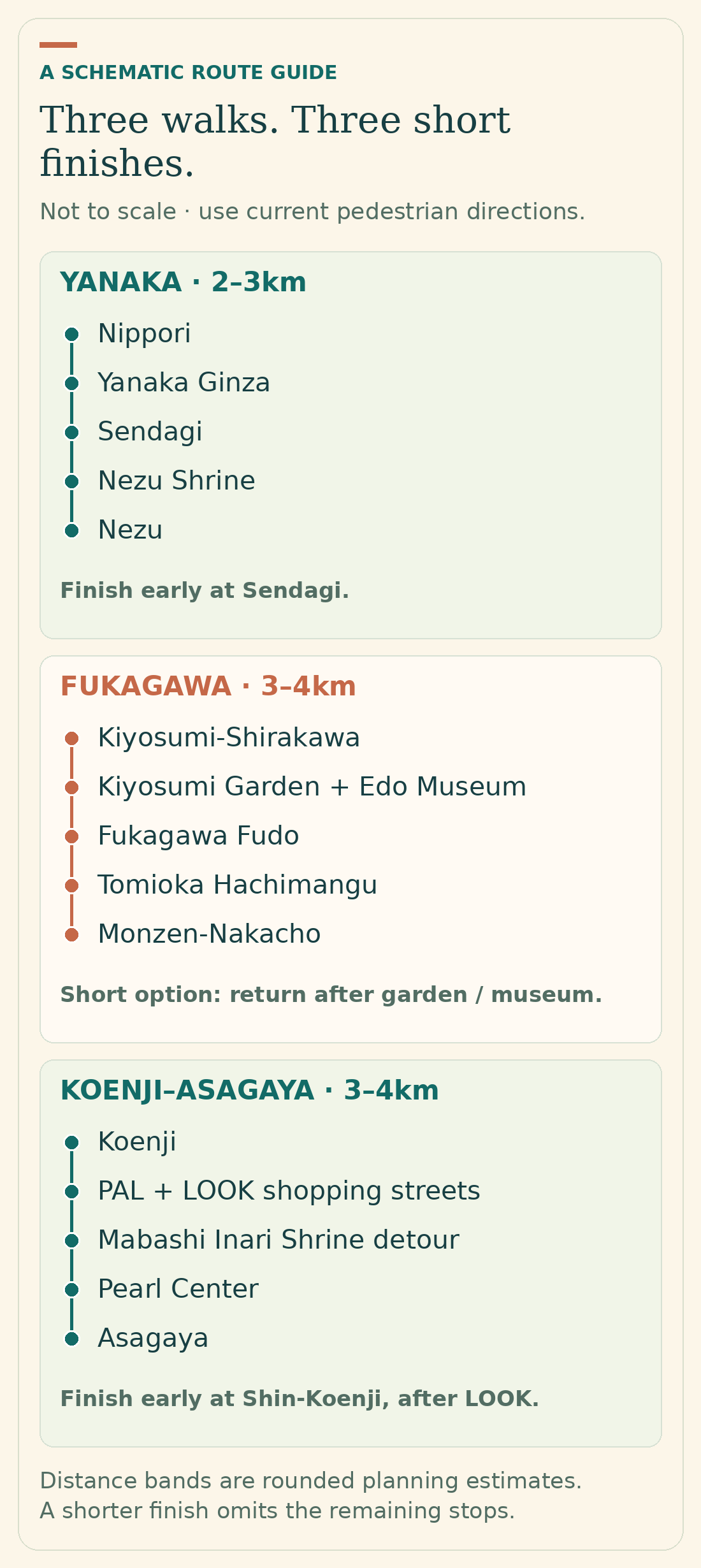
Walk 1: Nippori to Nezu, through Yanaka’s shopping streets
Start: Nippori. Finish: Nezu. Allow: 2½–3½ hours, with roughly 40–60 minutes of moving time. This is the best fit if you want a short route with a clear change from busy shopping to shrine grounds.
Follow these landmarks
- Nippori → Yuyake Dandan. Use the station’s northwest side, following signs towards Yanaka. GO TOKYO’s route starts at the North West Exit and follows the road beside the cemetery towards Yanaka Ginza. Stay on that public approach to the top of the Yuyake Dandan staircase; a cemetery detour is optional and outside this route’s estimate.[1]
- Yuyake Dandan → Yanaka Ginza → Yomise-dori. Descend to Yanaka Ginza and browse along the shopping street to its western end. At Yomise-dori, turn south. Pause for food at the shop’s designated eating space rather than occupying the narrow through-route.[1][2]
- Sendagi → Nezu Shrine. Make Sendagi Station your next navigation pin, then use Shinobazu-dori southwards as the clear connecting road. Leave it for the signposted Nezu Shrine approach on the west side. Pin the actual shrine, at 1-28-9 Nezu, rather than a restaurant or shop carrying the neighbourhood name.[2][3]
- Nezu Shrine → Nezu Station. Allow a quiet stop in the grounds, subject to opening and event arrangements, then return towards Shinobazu-dori and follow station signs south to Nezu on the Chiyoda Line. The shrine lists both Nezu and Sendagi as nearby stations.[3][19]
Where to stop, and when to shorten it
Give shopping and a seated break about an hour between them, then keep 20–30 minutes for the shrine. Those are suggested allowances: an appealing shop or a queue can easily change them. A late-morning start is a useful planning choice for a shopping-led walk; check opening times if one particular business matters to you.
Short version: finish at Sendagi after Yanaka Ginza and Yomise-dori, leaving the shrine for another day. For a route that avoids the Yuyake Dandan stairs, start from Sendagi, approach the shopping street from its western end and view the steps from below. This adjustment does not certify the whole outing as step-free.
Yanaka has gradients, steps and narrow streets used by vehicles. The metropolitan accessibility guide documents specific alternatives, which should be checked against your own needs. Nezu’s azalea season brings extra activity; check the shrine’s current visiting arrangements before relying on a quiet visit.[2][19]
Walk 2: Kiyosumi-Shirakawa to Monzen-Nakacho, through Fukagawa
Start: Kiyosumi-Shirakawa. Finish: Monzen-Nakacho. Allow: 4–5 hours with Kiyosumi Garden and Fukagawa Edo Museum. This is the most structured half-day, and the easiest one to rebuild around an indoor stop if light rain interrupts it.
Follow these landmarks
- Station → Kiyosumi Garden. Follow signs towards the garden from the station’s A3 area. The garden is close to the station; use its visitor entrance, rather than treating a neighbouring park entrance as garden admission.[4][5]
- Garden → Fukagawa Edo Museum. Return towards Kiyosumi-dori and take the signed museum street east. The museum’s own access page gives its address as 1-3-28 Shirakawa and directs visitors from A3. Inside, a reconstructed Edo-period neighbourhood provides the historical context for this part of Tokyo.[6][20]
- Museum → Kiyosumi-dori → Eitai-dori. Return west to Kiyosumi-dori, then follow its pavement south towards Monzen-Nakacho. At Eitai-dori, turn east. This named-road connection keeps navigation straightforward; allow for ordinary traffic lights and an exposed urban stretch between the sightseeing stops.
- Eitai-dori → Fukagawa Fudo → Tomioka Hachimangu. Look for Ninjo Fukagawa Goriyaku-dori, the short shopping approach leading north from Eitai-dori towards Fukagawa Fudo. After visiting, return to Eitai-dori and continue east to Tomioka Hachimangu’s main approach. The shrine’s grounds include monuments connected with sumo.[4][8]
- Tomioka Hachimangu → Monzen-Nakacho. Return to Eitai-dori and follow the station signs west. Monzen-Nakacho serves the Tozai and Oedo lines, so check which line you need before choosing an entrance.[8]
Leave time for the garden, museum and a break
Allow around 45 minutes in the garden, an hour in the museum, 30–45 minutes for lunch or coffee and time for both religious sites. One generous planning example is 70 minutes walking + 45 in the garden + 60 in the museum + 40 for lunch + 40 for the temple and shrine + 20 for navigation and delays: 275 minutes, or 4 hours 35 minutes. Starting around 10:00 leaves useful margin before the paid attractions’ last admissions. These are suggested allowances, not measured visit or journey times.
Swipe or scroll sideways to read every column.
| Stop | Adult admission | Timing constraint |
|---|---|---|
| Kiyosumi Garden | ¥150 | 09:00–17:00; last admission 16:30. Closed 29 December–1 January.[5] |
| Fukagawa Edo Museum | ¥400 | 09:30–17:00; last admission 16:30. Normally closed on the second and fourth Mondays, except public holidays; other closures also apply.[6][7] |
| Both paid stops | ¥550 total | Food, transport and any special events are additional. |
Short version: finish back at Kiyosumi-Shirakawa after the garden and museum. If you still want the temple approaches but not the connecting walk, the Oedo Line links Kiyosumi-Shirakawa and Monzen-Nakacho in one stop. Allow separately for station access and waiting.[4]
For mobility planning, consult the official accessibility route, which uses that train connection. Our continuous walk is a different itinerary. The guide identifies a suitable garden path and museum lift assistance, but also slopes within Tomioka Hachimangu; a generally level neighbourhood is not a guarantee that every attraction entrance suits you.[4]
Walk 3: Koenji to Asagaya, from vintage shops to a covered arcade
Start: Koenji. Finish: Asagaya. Allow: 2½–4 hours for 3–4km with browsing. Choose this route for shop windows and cafés, with a shrine detour between two shopping districts. The joining roads are part of everyday Tokyo; do not expect an uninterrupted heritage lane.
Follow these landmarks
- Koenji south side → PAL. From the station’s south side, enter PAL Shopping Street and walk south under its roof. Use the street name as your marker: the attraction is the mix of independent businesses, so there is no essential individual shop to tick off.[10]
- PAL → LOOK Street → Shin-Koenji. Continue south along LOOK Street towards Ome-kaido. LOOK continues the shopping route, with second-hand clothing shops and cafés, but it is not covered. Shin-Koenji Station, near its southern end, is your useful early finish.[9][11]
- Ome-kaido → Mabashi Inari Shrine. Turn west along Ome-kaido towards Minami-Asagaya. Before reaching that station, take a northward detour to Mabashi Inari Shrine, using the public approach identified by your map at 2-4-4 Asagaya-minami. Its carved dragon torii is a specific feature to look for. Return to Ome-kaido after the visit, making this a simple out-and-back detour.[9][12]
- Minami-Asagaya → Pearl Center → Asagaya. Continue west towards Minami-Asagaya, then join the southern end of Asagaya Pearl Center on the north side of Ome-kaido. Follow the arcade north to JR Asagaya Station’s south side. The covered shopping street extends for roughly 700 metres, giving this walk an unhurried final browsing stretch.[9][13]
Start around lunchtime if browsing is your priority, and check any must-visit business individually. Plan one seated stop in Koenji or Asagaya rather than trying to squeeze both districts into a brisk march. The longer time estimate assumes substantial shopping; anyone mostly window-shopping can shorten it.
Short version: Koenji → PAL → LOOK → Shin-Koenji. Skip the westward connection and shrine detour when tired. If you want only the Asagaya arcade, start at Minami-Asagaya and follow Pearl Center north to JR Asagaya instead.[9][13]
PAL and Pearl Center provide covered stretches, but LOOK, the joining roads and the shrine detour are outside. In sustained rain, choose one arcade and a café rather than treating the entire route as sheltered. Local festivals can also change the feel and crowd level of the shopping streets.[10][11][13]
When a guided Yanaka walk is worth considering
The self-guided routes need no tour reservation. A guide can still be useful if interpretation or organised food tastings are the main reason you want to visit Yanaka. Choose one of these as the core activity for that half-day; check its actual start and finish rather than adding the full free route afterwards.
Swipe or scroll sideways to read every column.
| Your priority | Listed format | What to check |
|---|---|---|
| Historical context | The Old Quarter of Tokyo – Yanaka Walking Tour: approximately three hours, with an English-speaking guide.[17] | The listing starts at Nippori and finishes at Yanaka Ginza, a different finish from our walk. It is listed as not wheelchair accessible. |
| Food and conversation | Old Town Tokyo Food Tour: approximately 3½ hours, including tastings, lunch and a tea-related experience.[18] | Confirm dietary requirements, current inclusions and the minimum booking size. Do not assume every substitution can be accommodated. |
For a history-led visit, Compare the Yanaka history walk on Viator. For a food-led half-day, See the Old Town Tokyo Food Tour on GetYourGuide. Choose the activity that solves your own planning need; neither is required to follow the routes in this guide.
Keep everyday streets comfortable for the people who use them
Stay on public streets and open visitor routes. A photogenic doorway, residential courtyard or temple side gate is not an invitation to enter. Ask before photographing people, respect signs about photography and leave entrances clear while checking a map. Follow a shop’s directions about where to eat and dispose of rubbish responsibly.[14]
At shrines and temples, give worshippers space and keep your voice low. Treat a closed gate or a ceremony as a reason to change the plan. A satisfying neighbourhood walk depends more on noticing a few places carefully than completing every suggested stop.
Questions before you go
Which walk is best for a first visit to Tokyo?
Nippori to Nezu is the most compact starting choice in this guide. It combines shopping and a shrine, and you can finish at Sendagi if your group wants a shorter outing. Choose Fukagawa instead if an indoor history stop is more appealing than browsing.
Are these Tokyo walks free?
There is no charge or reservation to follow the suggested public-street routes. Food, transport, purchases and paid attractions are separate. Kiyosumi Garden and Fukagawa Edo Museum currently total ¥550 for one ordinary adult admission to each; seasonal or special events may have different arrangements.[5][7]
Can I do all three walks in one day?
That would defeat the relaxed timings used here. Choose one as a half-day and leave space for the rest of your plans. The route times exclude travel between neighbourhoods and your journey from accommodation.
Which route works best in rain?
Fukagawa has a useful indoor museum, provided it is open on your date. PAL and Pearl Center offer covered shopping, but the complete Koenji–Asagaya route has exposed sections. For prolonged rain, choose one indoor activity or one arcade instead of a full connecting walk.[6][10][11][13]
Are the routes suitable for wheelchairs or pushchairs?
They have not been audited as continuous step-free routes. The Yanaka itinerary includes the Yuyake Dandan stairs; starting at Sendagi avoids that particular staircase. Check station lifts, gradients and each attraction’s access information using the metropolitan accessibility guides before choosing a route.[1][2][4]
Do I need to book anything in advance?
You do not need a tour booking for the self-guided routes. Check attraction calendars and any restaurant or guided activity you particularly want. The important preparation is choosing a sensible start time, saving the landmarks and knowing where you will finish early if needed.
Make your choice
Start with Nippori to Nezu if you want a compact first walk. Give Fukagawa a full half-day when the garden and Edo history are the attraction, and choose Koenji to Asagaya when browsing matters more than sightseeing appointments. Save the short finish before setting off, leave time to sit down and let one neighbourhood be enough for the afternoon.
Sources
Official visitor information and the identified booking listings were consulted for this guide. Prices and dated operating information were checked on 17 October 2026; recheck the relevant venue and your selected ticket before travelling.
- GO TOKYO — Explore Yanaka & Nezu
- Tokyo Metropolitan Government — Yanaka accessibility route
- Nezu Shrine — official access information
- Tokyo Metropolitan Government — Fukagawa accessibility route
- Tokyo Metropolitan Park Association — Kiyosumi Garden visitor information
- Koto City Cultural Community Foundation — Fukagawa Edo Museum overview and hours
- Koto City Cultural Community Foundation — Fukagawa Edo Museum admission
- GO TOKYO — Fukagawa area guide
- Suginami Industrial Promotion Center — official Koenji and Asagaya area map, January 2025 edition
- Experience Suginami — Koenji PAL Shopping Street
- Experience Suginami — Koenji LOOK Shopping Street
- Mabashi Inari Shrine — official website and address
- GO TOKYO — Asagaya Pearl Center Shopping Street
- Japan Tourism Agency — Travel Etiquette for the Future
- Airalo — Japan eSIM plans
- Airalo Partners — eSIM device compatibility requirements
- Viator — The Old Quarter of Tokyo, Yanaka Walking Tour
- GetYourGuide — Old Town Tokyo Food Tour
- GO TOKYO — Yanaka and Nezu area guide
- Koto City Cultural Community Foundation — Fukagawa Edo Museum access
Illustrations in this article were created for Taylor’s Trailblazing Travels. Third-party photographs, where used, are credited beside the image or in the source list.