Kyoto · District guide
Arashiyama Guide: Bamboo Grove, River and Quiet-Side Walks
Choose a satisfying half-day, a northern descent or a gorge outing — with enough room to stop.
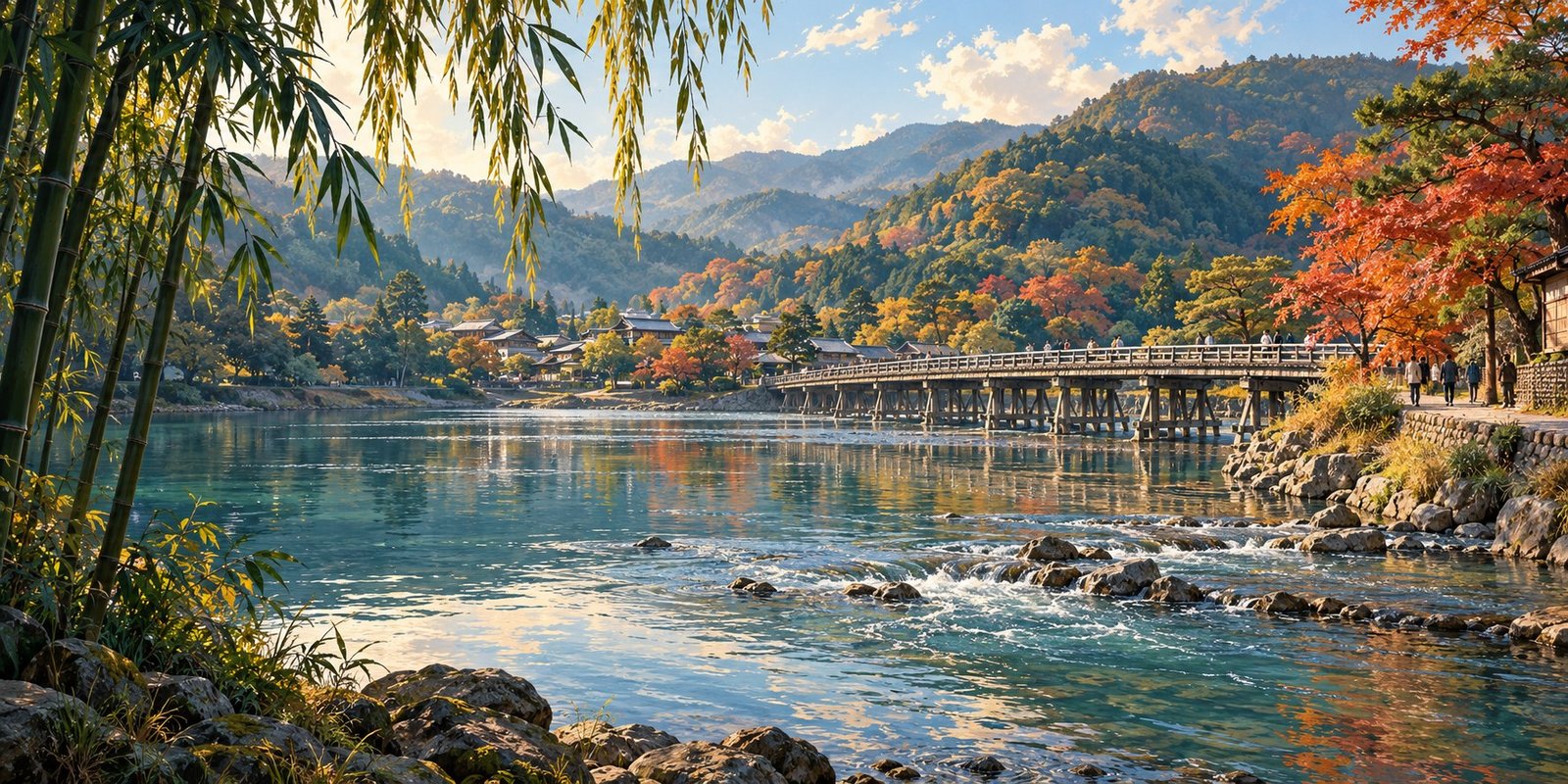
Arashiyama makes more sense as a small district to explore than as a photograph to collect. The bamboo path and Togetsukyo Bridge are its famous anchors; northern Saga adds temple gardens and a preserved street, while the railway and boat trips take you into a separate gorge itinerary.[1]
This Arashiyama guide helps you choose between those experiences. Start with the core half-day if it is your first visit. Give northern Saga more time if walking and smaller temple stops appeal, and make the train or boat a deliberate change of plan. The quieter-side suggestions offer different surroundings; none guarantees an empty path.
Taylor’s Trailblazing Travels may earn a commission when you book or buy through an affiliate link in this guide, at no extra cost to you. This helps fund the research and upkeep of the site.
Choose your day before your tickets
The core walk, northern Saga and the gorge reward different interests. Pick one main plan, then add only what your remaining time permits.
Use the right Arashiyama station
JR Saga-Arashiyama, Randen Arashiyama and Hankyu Arashiyama sit in different places. Choose the line that suits your Kyoto starting point.[2]
Start the northern walk at the top
Reach Otagi by bus or taxi, then walk downhill. Check its closing days before committing: the temple currently closes on Wednesdays and Saturdays.[7]
Choose the Arashiyama day that fits
Swipe or scroll sideways to read every column.
| Plan | Allow locally | Choose it for | Leave out |
|---|---|---|---|
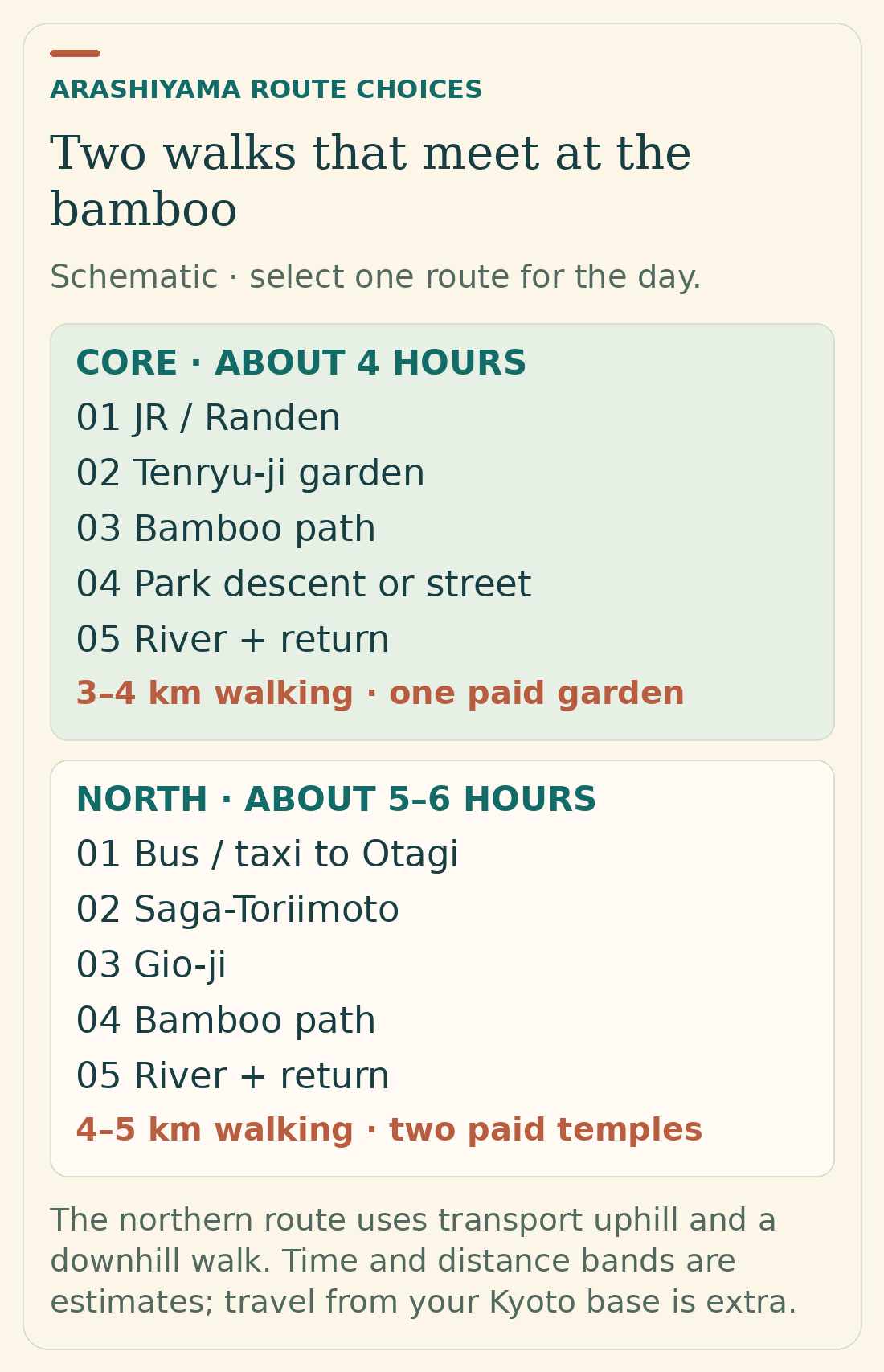
| Core garden, bamboo and river | About 4 hours; 3–4 km walking | A first visit with one substantial garden and a proper break | Northern temples and gorge transport |
| Northern Saga descent | About 5–6 hours; 4–5 km walking, plus an initial bus or taxi | Otagi, a preserved street, Gio-ji, bamboo and river | Tenryu-ji interiors and train/boat connections |
| Scenic train and Hozugawa boat | Allow 4–5 hours from Torokko Saga to the Arashiyama riverside | Valley scenery and a longer seated river journey | The northern walk; add lunch and gardens separately |
These are editorial estimates, not timed walks. Distance bands follow the named connections on official area maps and include modest wandering inside the selected stops. The walking plans assume an easy moving pace of around 3 km/h, time for admissions and photographs, and a 45–60-minute food break. Queues, mobility needs and prolonged garden visits can increase the total. Travel to and from Arashiyama is additional.[3][6]
If you only have two hours, use the public bamboo path and the river, with a quick return to your station. Drop a paid visit before turning lunch and transport into a race.
Arrive at the station that suits your start
From Kyoto Station: use the JR Sagano Line to Saga-Arashiyama. Both local and rapid services stop here. Kyoto’s official guidance favours rail over the slower, often crowded bus approach; allow time to reach the Sagano platforms inside Kyoto Station. The advertised rapid ride can be about 11 minutes, but that does not include waiting, the station walk or reaching the sights.
From the Kawaramachi area: Hankyu via Katsura brings you to Hankyu Arashiyama, south of the river. Start with the bridge, then continue to Tenryu-ji and bamboo. Randen Arashiyama is the tram stop on the main shopping street, convenient if you are already travelling on that network.[2]
The three names are not interchangeable. JR Saga-Arashiyama is north-east of the core; Randen is beside the main street; Hankyu is across the river. Tenryu-ji lists roughly 13 minutes on foot from JR, five from Randen and 15 from Hankyu. Use the full station name when checking your return journey.[3][4]
The JR Sagano Line is ordinary transport. The Sagano Romantic Train, whose stations use “Torokko” in their names, is a separately ticketed sightseeing ride. A Randen ticket is another system again.[10][11]
The core half-day: garden, bamboo and river
Suggested order: JR Saga-Arashiyama or Randen Arashiyama → Tenryu-ji garden → bamboo path → Kameyama Park → riverside → Togetsukyo Bridge → your return station. Reverse the first river segment if arriving on Hankyu. Aim to be near the garden at opening if it is your priority; visit the bamboo first if you arrive earlier.
Give Tenryu-ji the first substantial stop
From JR, follow pedestrian directions west towards the main street, Nagatsuji-dori, then find Tenryu-ji’s main approach. From Randen, the temple is directly across the main road. Budget 45–60 minutes for the garden as an editorial allowance. Choose the garden ticket for this route; add the buildings only if you want their interiors and have time. Separate admissions should not be mistaken for one all-inclusive temple ticket.[2][4][6]
After the pond garden, continue through the garden towards the north gate, which leads onto the bamboo path. Randen’s official walking course confirms this connection. It is a useful through-route during admission hours; outside them, use the public approach to the grove near Nonomiya Shrine.[6][26]
Walk the grove, then choose your descent
Head west through the bamboo towards the Okochi Sanso entrance. Treat that entrance as a landmark unless you have deliberately allowed another garden visit. Continue towards Kameyama Park and use its signed public paths to descend to the river. There are branching paths and changes of level: the higher viewpoint is an optional diversion, not a necessary part of reaching the water.[6]
Allow around 45–60 minutes for bamboo photographs and the park-to-river connection. If slopes or wet steps are unappealing, retrace the bamboo path east towards Nonomiya and the main street, then head south to the bridge. This trades the park for a clearer street route; it is not a certification of step-free access.
Let the river be a stop
From the north-bank path, follow the riverside east towards Togetsukyo. Pause away from the bridge approaches, then cross if you want the south-bank perspective or are returning on Hankyu. The official area map shows the island park and the separate Hankyu approach. Finish with a seated meal or drink and enough time to reach your actual station.[3]
Shorten it: finish after the bamboo by returning through Nonomiya to the main street and Randen or JR. Alternatively, skip the park descent and take the street to Togetsukyo. This is a better adjustment than squeezing every garden into the final admission hour.
Northern Saga: start high and walk back down
Choose this longer route for small temple stops and the preserved Saga-Toriimoto street. The sequence is Otagi Nenbutsu-ji → Saga-Toriimoto → Gio-ji → the Nison-in and Rakushisha area → bamboo → river. It replaces the core garden visit. Kyoto’s official northern-temple itinerary gives an entire day to six temples; this version deliberately selects two paid stops.[3][8]
Reach Otagi first
Otagi itself recommends arriving by taxi or bus and walking downhill. From JR Saga-Arashiyama, its guidance gives an approximately ¥1,500 taxi fare, subject to traffic and the meter. For the bus, walk to Nonomiya on the main street and take Kyoto Bus 94 towards Kiyotaki, leaving at Otagi Dera Mae. The temple quotes ¥230 and about 25 minutes from Arashiyama; waiting and reaching the stop are additional. Check the current departure before choosing the bus.[7]
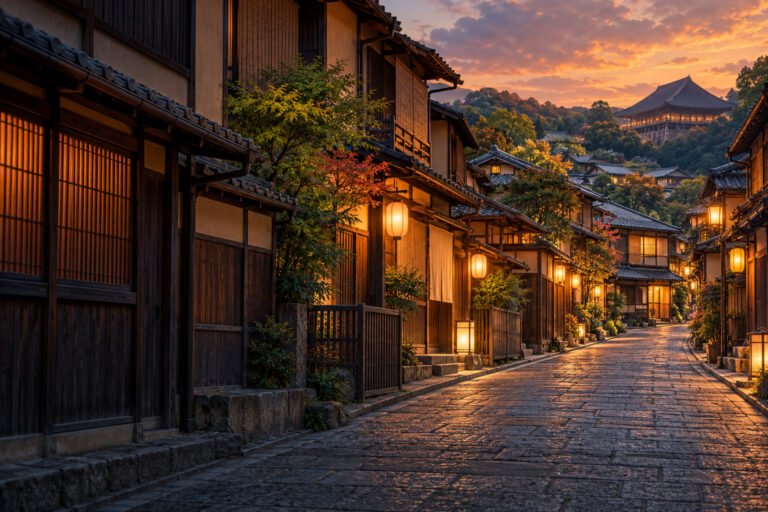
Allow roughly 45–60 minutes at Otagi as a planning choice. Its expressive stone rakan figures give you something specific to look at beyond a building façade. Leave by the public road and follow the downhill route into Saga-Toriimoto. The large red torii near the traditional teahouses is a useful landmark; continue through the preserved street towards Adashino Nenbutsu-ji. Otagi and Adashino are different temples.[1][8]
Make Gio-ji the selected garden stop
From the Adashino area, follow signs and current pedestrian directions towards Gio-ji. Kyoto’s route places these temples about 12 minutes apart on foot. Gio-ji’s moss garden and modest thatched building offer a different scale from Tenryu-ji; allow 30–45 minutes. Its ticket is separate from Otagi’s.[8][9]
Continue towards Nison-in and the Rakushisha area, using those named landmarks to reach the bamboo side of the district. You need not enter either site for this route. At the grove, decide whether energy and daylight suit the park descent to the river or the street return described above. Keep a map available at junctions instead of assuming every narrow lane leads south.[3]
Shorter northern choice: if Otagi is closed, avoid the trip uphill. Start from JR and make Gio-ji your northern turning point, then return through the bamboo towards the river. Allow around four to five hours with a meal, depending on your approach and garden time. If already tired at Gio-ji, omit the river and follow pedestrian directions back to JR.
Quieter surroundings are a possibility, not a promise. These are visited temples and a lived-in district. Remain on public roads and open visitor paths, leave doorways clear, and do not enter a garden or residential driveway simply because it looks photogenic.[18]
When a guide helps: MK’s Otagi-and-bamboo tour adds an English-speaking guide and a one-way car journey from Kyoto Station before the walk downhill. Compare the exact listing on GetYourGuide or Viator if interpretation and arranging the uphill journey matter to you. It is an approximately three-hour guided alternative, ending in Arashiyama; your return journey and any later Gio-ji or river visit are separate. There is substantial walking, and GetYourGuide notes that small parties can sometimes be combined. Check the date, admission inclusions, group arrangement and cancellation terms before paying.[20][21]
Fees and opening hours that change the plan
Swipe or scroll sideways to read every column.
| Stop | Admission | Regular visiting hours |
|---|---|---|
| Tenryu-ji garden | ¥500; buildings add ¥300 | 08:30–17:00; garden last entry 16:50 |
| Otagi Nenbutsu-ji | ¥1,000 | 09:00–16:00; closed Wednesdays and Saturdays |
| Gio-ji | ¥500 | 09:00–17:00; last entry 16:30 |
The core plan’s garden admission totals ¥500 per adult; the two selected northern temples total ¥1,500. Food, local transport and any extra attractions are additional. Public bamboo walking and the river viewpoints do not require a tour purchase.
Autumn 2026: Tenryu-ji announces a 07:30 garden opening on 14–30 November at the garden reception; the north gate still opens at 08:30. Its Japanese notice also lists partial building closures on 29–30 October and separate Cloud Dragon Hall restrictions on 28–30 October. These are hall-specific notices, so check the exact area you want rather than assuming the whole garden closes.[5]
Choose the train, the boat or a riverside walk
The Sagano Romantic Train is a roughly 25-minute sightseeing journey through the Hozu valley. The standard one-way adult fare checked for 18 October 2026 is ¥880. Buy the correct direction and departure through the operator’s ticket page and check its operating calendar. Limited same-day sales exist, but they do not guarantee a seat.[10][11]
For a train-only outing, one practical return is to walk about ten minutes from Torokko Kameoka to JR Umahori and use ordinary JR rail back towards Kyoto or Saga-Arashiyama. Check the next train before leaving. Torokko Kameoka is not JR Kameoka, the station used for the straightforward boat-pier approach.[12][15]
The Hozugawa boat travels downstream from Kameoka to Arashiyama and takes about two hours, depending on water conditions.[27] The adult fare is ¥6,000. It suits readers who want the river journey itself and can commit to its duration. If the boat is the priority, reach JR Kameoka directly; the operator gives an approximately eight-minute walk from the north exit to the boarding point.[14][15]
Combining them requires a transfer. After the sightseeing train, Torokko Kameoka has an onward bus connection to the boat boarding point. The operator’s current guidance gives about ten minutes on the bus, with the bus fare additional. Allow for leaving the station, waiting and boat check-in; the boats are not beside the train platform. Match the actual train, bus and boat departures before buying separate tickets.[16]
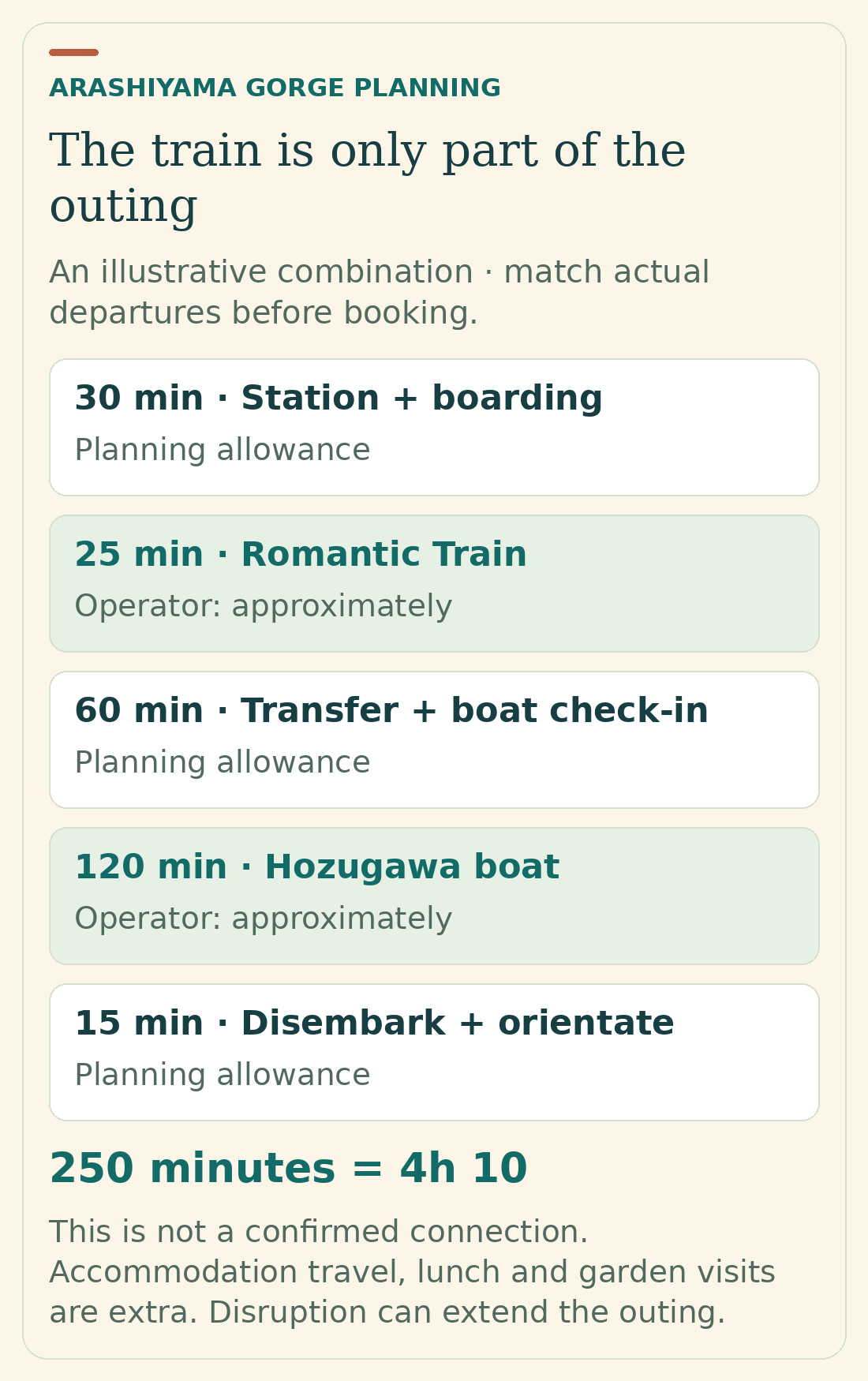
Our illustrative combined-outing budget is 30 minutes for station arrival and boarding, 25 on the train, 60 for the transfer and boat check-in, 120 on the river, and 15 to disembark and orientate: 250 minutes, or four hours ten minutes. This is an allowance model, not a verified connection. Add transport from your accommodation, lunch and any bamboo or garden visit.
Rain alone does not automatically stop the boats, but storms and high water can. Check the operator’s live notice that morning and use the independent core walk as your alternative if conditions suit walking. Do not make the final boat the only way to recover a tightly packed day.[14]
If you simply want river scenery and the freedom to pause or turn back, the local river walk already provides that. The train and boat are worthwhile choices for particular interests; neither is required to complete an Arashiyama visit.
Should you stay overnight in Arashiyama?
Stay locally if an unhurried evening and an early return to the river are the point of the trip. For a single half-day among several Kyoto districts, keeping your existing base avoids a hotel move and luggage handling. This is a pacing decision, not a requirement for seeing the bamboo.
For a local stay, compare the actual location against your arrival line: around JR Saga-Arashiyama for JR access, the central river area for the bridge, or the south side for Hankyu. A broad Arashiyama label does not establish a short walk to every attraction.[2]
Use the Arashiyama accommodation pages on Agoda and Booking.com to compare the same dates, room type and cancellation conditions. Check whether meals and taxes are included and confirm the walking route from the appropriate station. These are district search pages, not a recommendation of every property listed.[22][23]
For the wider spending plan, use the Japan trip cost guide before choosing an overnight stay or a paid river outing.
Questions before you go
Is the bamboo grove enough for an Arashiyama half-day?
The grove itself is a short walk. Pair it with one garden and the river for a more rounded half-day; the roughly four-hour core plan includes visits and a food break, not four hours inside bamboo. If time is tight, use the bamboo and river route and leave out the paid garden.[26]
Can I visit Tenryu-ji before the bamboo grove?
Yes. During admission hours, the garden’s north gate connects to the bamboo path. The usual garden opening is 08:30. If you arrive earlier, use the public bamboo approach first, and check any dated early-opening notice before relying on a different temple schedule.[4][5][6]
Is Otagi the same temple as Adashino Nenbutsu-ji?
No. They are separate stops in northern Saga. This guide selects Otagi and Gio-ji for paid visits and uses the Adashino area as a navigation landmark. Confirm “Otagi Nenbutsu-ji” when arranging your uphill journey.[8]
Can I take the Hozugawa boat without the Romantic Train?
Yes. Use JR Kameoka and walk from its north exit to the boarding point. The boat operator specifically provides this access route. Check boat availability and operating conditions independently of sightseeing-train tickets.[15]
What should I cut if I arrive after lunch?
Choose the core bamboo-and-river walk with one paid stop only if its last admission leaves enough visiting time. Avoid travelling to Otagi simply to reach it near closing. Starting late is a good reason to shorten the plan, particularly when daylight or the weather limits the park paths.
Make your choice
For a first visit, choose Tenryu-ji’s garden, the bamboo and the river, and give them about four local hours. For a more walk-focused day, take transport to Otagi and descend through northern Saga, selecting Gio-ji as the second paid stop. Choose a gorge journey when the ride is the experience you most want. Making that choice before setting out gives the district room to be enjoyed at walking pace.
Sources
Official visitor information and the identified booking listings were consulted for this guide. Prices and dated operating information were checked on 18 October 2026; recheck the relevant venue and your selected ticket before travelling.
- Kyoto City Tourism Association: Saga and Arashiyama area
- Kyoto City Tourism Association: comfortable access to Saga and Arashiyama
- Kyoto City official Saga and Arashiyama area map (PDF)
- Tenryu-ji: admission and access
- Tenryu-ji: current visiting hours and 2026 notices (Japanese)
- Randen: detailed area guide and walking courses, particularly C-1 (PDF)
- Otagi Nenbutsu-ji: official access, admission and closing days
- Kyoto City Tourism Association: six Saga and Arashiyama temples
- Gio-ji: official English visitor information
- Sagano Scenic Railway: about the Romantic Train
- Sagano Scenic Railway: fares, ticket purchase and calendar links
- Sagano Scenic Railway: Torokko Kameoka station and JR Umahori connection
- Sagano Scenic Railway: accessibility and station steps
- Hozugawa boat operator: fares, journey duration and operating restrictions
- Hozugawa boat operator: access from JR Kameoka
- Hozugawa boat operator: transfer from Torokko Kameoka
- Hozugawa boat operator: information for visitors with mobility needs
- Kyoto City Tourism Association: Arashiyama visitor etiquette and Kameyama Park
- Kyoto City: Arashiyama congestion forecast and live cameras
- GetYourGuide: MK Travel Otagi and Arashiyama walking tour listing
- Viator: Kyoto MK Otagi and Arashiyama tour listing
- Agoda: Arashiyama accommodation area page
- Booking.com: Arashiyama accommodation district page
- Airalo: device compatibility and carrier restrictions
- Airalo: Japan eSIM packages and activation guidance
- Japan National Tourism Organization: Arashiyama Bamboo Grove
- Hozugawa boat operator: Kameoka-to-Arashiyama course overview
Illustrations in this article were created for Taylor’s Trailblazing Travels. Third-party photographs, where used, are credited beside the image or in the source list.