Japan Travel Etiquette: Practical Rules for Visitors
How to read the setting, follow local instructions and handle unfamiliar customs with confidence.
- Everyday visitor situations
- Customs and local rules
- Practical next steps
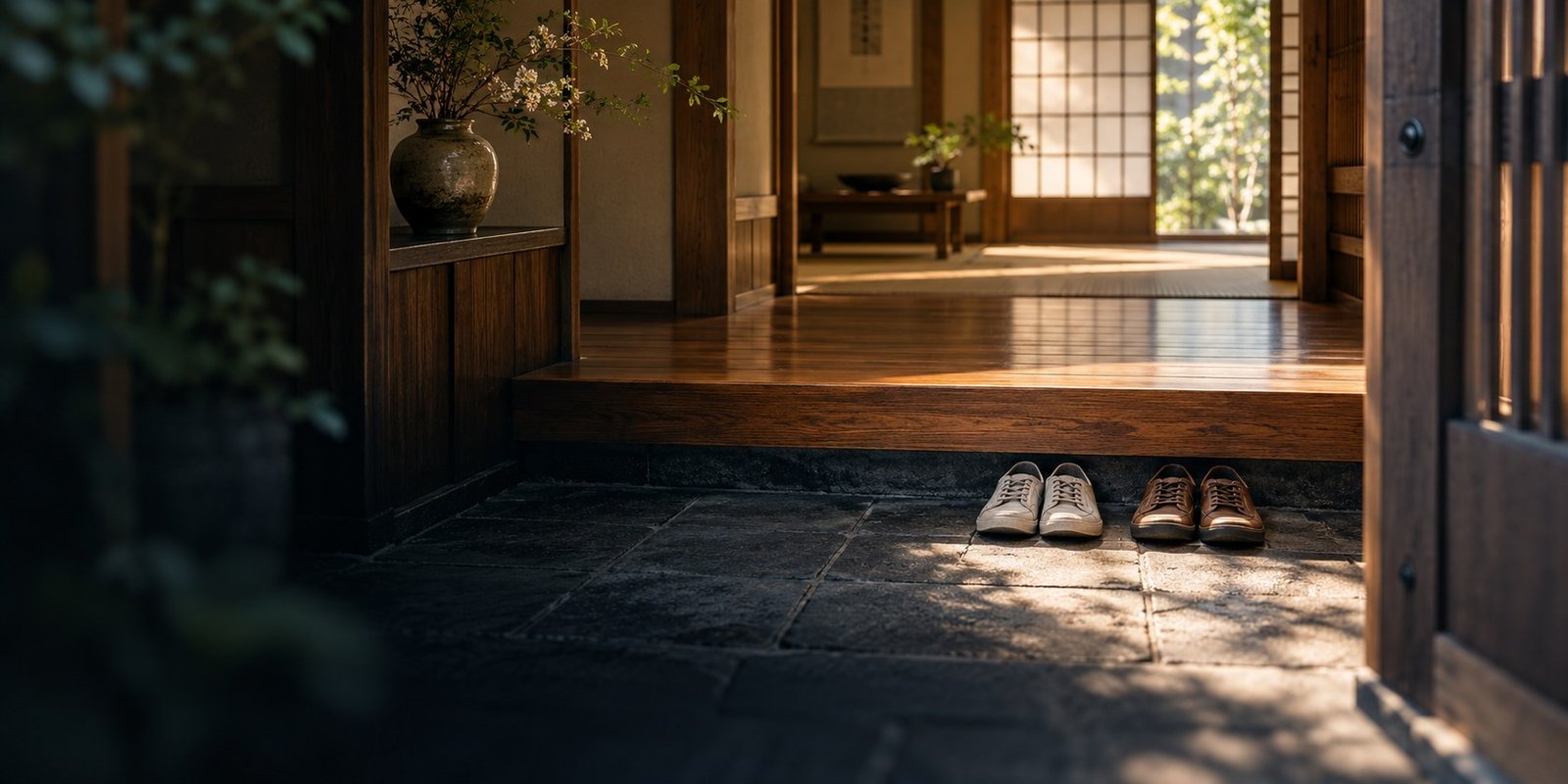
AI-generated editorial illustration of an imagined Japanese entrance hall; it is not a photograph of a particular home or business.
The most useful Japan travel etiquette is knowing which instruction applies where you are. Eating a boxed lunch on the Shinkansen and opening a meal on a commuter train are different situations; JNTO’s guidance makes that distinction explicitly. [1]
You do not need to memorise a performance of politeness before your holiday. You need a few reliable habits, an eye for local instructions and a way to ask when something is unclear. This guide uses a practical sequence: posted rule, then observation, then a question. It also separates everyday customs from venue conditions and restrictions that carry legal consequences.
Read the instruction
A current sign or staff direction takes priority over copying the crowd.
Protect shared space
Consider who needs the doorway, seat, pavement or quiet around you.
Check two permissions
For a photograph, consider both the place’s rules and the person’s consent.
Ask the exact bath
A town’s tattoo policy may differ from the policy inside your accommodation. [2]
Start with the rule for the place you are in
“Etiquette” covers several kinds of instruction. Understanding the difference helps you decide whether to adapt to a custom, check a condition of entry or look up a local restriction.
| Type | Example | Your next step |
|---|---|---|
| Social custom | Extra tipping is generally not expected in everyday hospitality. [3] | Use the usual local approach; do not assume every unfamiliar habit is compulsory. |
| Venue rule | Meiji Jingu prohibits photographs and video at its main sanctuary. [4] | Follow the restriction in that area, even if photography is allowed elsewhere. |
| Local legal restriction | Kyoto has designated areas where street smoking incurs a penalty. [5] | Check the council’s current map and use a designated smoking place. |
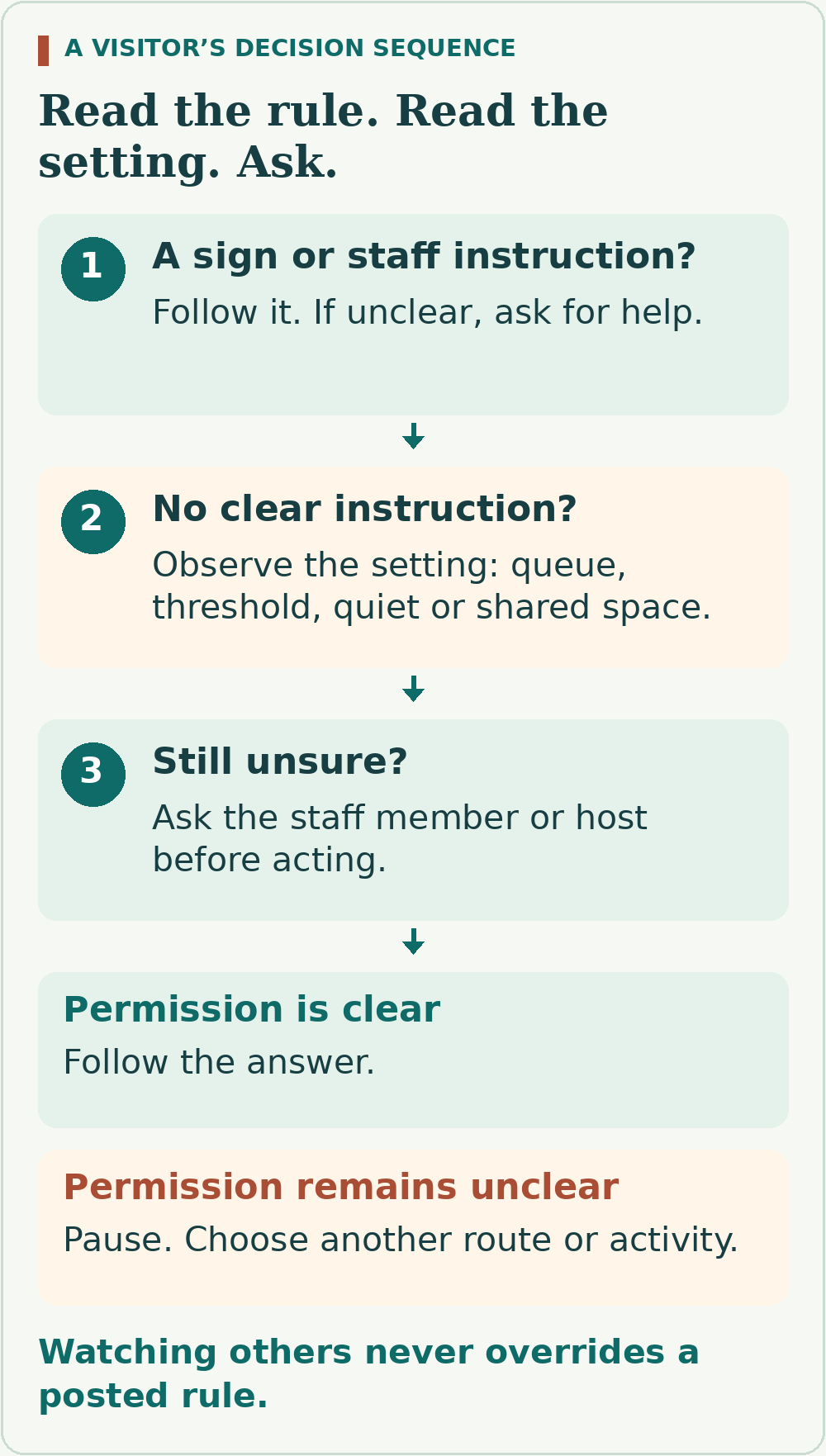
Use this sequence at an unfamiliar entrance, platform, dining room or visitor site:
- Read the posted rule. Look for pictograms, barriers and staff directions as well as written notices.
- Observe the setting. Where is the queue? Which side of the threshold holds outdoor shoes? Are people quietly praying?
- Ask if the answer is still unclear. A staff member or host can explain their own arrangements more reliably than another visitor.
If you still cannot establish permission to enter, take a photograph or use a facility, pause that action. Choose an accessible public route or another activity while you find the answer. Observation helps interpret a setting; it never overrides a sign.
Make room on trains and in stations
At the platform, join the indicated queue and leave the doorway clear for people getting off. Once aboard, move far enough inside for others to follow. If you are standing at a door, be ready to step aside or briefly onto the platform at a stop. Keep your bag close or use the luggage rack rather than taking someone else’s space. Tokyo Metro highlights keeping doors clear and managing bags in its passenger guidance. [6][9]
Put your phone on silent and avoid calls in the carriage. Keep conversations and headphone sound low. Offer priority seats to people who need them; a need is not always visible. Tokyo Metro also asks passengers to switch phones off near priority seats when the carriage is crowded. Follow the notice on the service you are using. [7][8]
On escalators, follow the safety instruction rather than trying to memorise a city’s supposed “correct side”. Tokyo Metro asks people to hold the handrail, stand still and use both sides. Keep wheeled luggage under control and leave aisles and doors clear. [8]
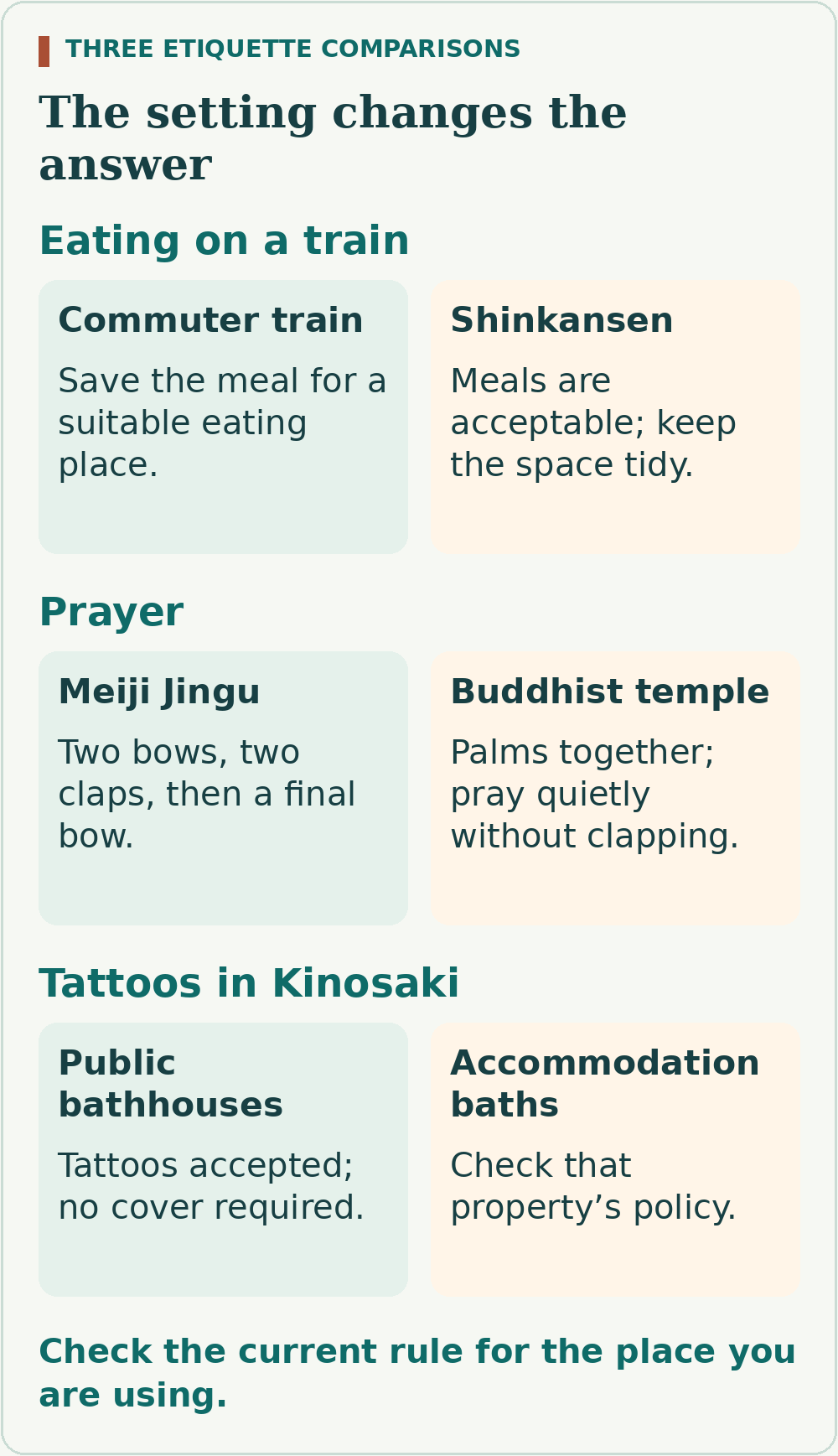
Meals depend on the train. JNTO describes eating on the Shinkansen as acceptable and eating on commuter trains as poor manners. For an ordinary urban journey, save your meal for a suitable eating place. On a longer service where meals are appropriate, contain your food and packaging and avoid spills into neighbouring space. [1]
Notice the boundary between shoes, slippers and socks
At accommodation and other entrances where shoes come off, use the shoe storage or place your pair neatly out of the way. Change into indoor slippers if they are provided. Remove those slippers before stepping onto tatami matting. If there is a separate pair for the toilet, use it there and change back when you leave. [9]
The useful clue is the boundary: a rack, a change in floor level, a sign or a host showing you where to stop. Do not remove your shoes in every building automatically. Pause at an unclear threshold and ask before crossing it.
If you accidentally leave a toilet wearing its slippers, return and swap them. If an injury or access need makes a footwear arrangement difficult, explain that to staff and ask what they can offer; do not struggle at a busy doorway or assume an exception is available.
Follow the setting when eating and paying
At the table
Two chopstick habits are especially useful to remember: do not leave chopsticks standing upright in rice, and do not pass food directly from one person’s chopsticks to another’s. Put the food on a plate instead, using serving utensils when supplied. Avoid pointing at people with chopsticks or using them to pull a dish towards you. [10]
When ordering or paying, follow the restaurant’s instructions rather than assuming a familiar system. If you are unsure whether to sit down, order at a counter or take the bill to a till, ask.
At a food stall
Buying something to take away does not tell you where to eat it. Ask the seller or use the indicated eating area. Nishiki Market in Kyoto specifically asks visitors not to walk through the market while eating; it directs customers to eat in front of or inside the shop where they bought the food. Apply that instruction there, rather than turning it into a claim that eating while walking is illegal throughout Japan. [11]
When paying the bill
Extra tipping is not generally expected in restaurants, cafés, bars, taxis or hotels. Pay the stated bill and thank the staff. JNTO notes that some private guides and interpreters accustomed to overseas visitors may accept tips, although these are not expected. If your provider gives specific guidance, check it. There is no need to describe tipping as inherently insulting or to insist that a staff member accept money they have declined. [3]
Treat shrines and temples as places of worship
A Shinto shrine and a Buddhist temple do not use an identical prayer routine. Identify the place through its own visitor information, and follow the instructions at the worship area. At a Buddhist temple, the usual approach is to bring your palms together for a quiet prayer without clapping. [12]
For a specific shrine example, Meiji Jingu’s sequence is two bows, two claps and a final bow; its guidance says you may make a coin offering. Use the ritual given by the shrine you are visiting instead of treating this example as a rule for every religious site. [13]
If a purification basin is in use, follow the displayed procedure and never put your mouth directly on a shared ladle. Inside buildings, observe any footwear and photography restrictions. JNTO’s shrine and temple guidance covers these distinctions. [12]
You can make space for worshippers without performing a ritual yourself. Keep conversations subdued, stand clear of the approach while deciding what to do and avoid turning someone else’s prayer into your photograph. Meiji Jingu’s main sanctuary is a concrete example of an area where photographs and video are prohibited. [4]
Check the bath’s admission rules before you arrive
Most communal onsen bathing is without swimwear, but check the particular facility’s clothing and admission arrangements. If you would prefer privacy, investigate a private bath before booking and ask about its conditions. Do not assume that bringing a swimsuit solves a concern about communal bathing. [14]
Once admitted, follow the bathhouse’s sequence:
- Leave your belongings, including your phone and camera, in the designated storage.
- Wash and rinse at the washing area before entering the shared water. Use the shower carefully so you do not splash other bathers.
- Keep your towel and hair out of the bathwater; tie up longer hair.
- Soak quietly, without swimming or splashing.
- Dry yourself before returning to the changing area so you do not leave a wet floor.
Kinosaki’s bathing guide explains the washing, towel and drying steps, while JNTO also emphasises quiet bathing and keeping cameras and phones out of the bath area. An apparently empty bath is still a place where someone may enter expecting privacy. [15][14]
Tattoos: ask about the actual facility
Tattoo policies vary. Kinosaki’s public bathhouses welcome tattooed visitors without requiring a cover, but the town’s official visitor guidance warns that baths inside accommodation may have different policies. Acceptance at the public baths therefore does not answer the question for your ryokan or hotel. [2]
Before paying, ask whether your tattoos are accepted and whether any size, covering or private-use conditions apply. Some facilities accept covers, but that is a condition to verify, not a workaround to assume. JNTO’s onsen guidance describes different approaches, including private-bath options. [14]
Protect privacy, access and the everyday street
Before taking a photograph, make two checks: does the place allow it, and has the person agreed to be your subject? A ticket or an open gate does not automatically settle either question. JNTO advises asking permission before photographing people and respecting private property. [1]
In Gion, the message from Southern Gionmachi asks visitors not to stop, touch, follow or photograph geiko (Kyoto geisha) and maiko (apprentice geisha) without permission. It also asks people to stay off private property and keep roads and pavements clear. Read the signs on the particular lane: this guidance should not be turned into a claim that every street in Gion is closed to visitors. [16]
For a practical test, ask whether your group would prevent someone getting home, opening a shop or walking to work. Move aside to consult a map, wait for a picture or meet a guide. Keep voices low around homes, particularly early and late, and leave closed gates, garden boundaries and roped-off areas alone. Kyoto’s responsible travel guidance emphasises quiet residential streets and respect for private property. [17]
Rubbish and smoking
Carry a small bag for your rubbish and use a bin only for the waste it is intended to take. Read the separation labels; a bottle bin is not a general litter bin. Kyoto suggests using a shop’s disposal facilities for takeaway waste where provided and carrying your waste with you when a suitable bin is unavailable. [17]
If you smoke, check the local restrictions and use a designated smoking place. Kyoto City asks people to avoid smoking in outdoor public places across the city and applies penalties in designated street-smoking enforcement areas. The council’s current map is the useful reference for those boundaries. This is an example of a local restriction with consequences beyond social disapproval. [5]
If you are unsure, ask a small, specific question
Make the question easy to answer: “Shoes off here?”, “May I take a photograph here?” or “Where should I eat this?” Point to the relevant object or area without crossing the boundary. If a translation app helps, show a short written question rather than playing audio in a quiet space.
JNTO gives two useful phrases: “Sumimasen” can mean “excuse me” or “sorry”, while “arigato gozaimasu” expresses thanks. [9] A brief apology followed by the correction is a practical response when you get something wrong.
| What happens | Useful response |
|---|---|
| Staff signal that photographs are not allowed | Lower the camera, acknowledge the instruction and ask only if you need to clarify where the restriction ends. |
| You enter the wrong queue or doorway | Step safely out of the way, apologise briefly and join the correct route. |
| A bath’s policy does not meet your needs | Ask about an available alternative before undressing or paying. If none works, choose another facility. |
| Other visitors ignore a notice | Continue to follow it. Ask staff about uncertainty rather than confronting strangers. |
The correction matters more than extending the interruption. Once you have understood the instruction and acted on it, let staff, residents or fellow passengers continue with their day.
Make the decision that fits your trip
Before a day out, check any rules that could change your plans: your bath’s admission conditions, restrictions at a religious site and access notices for a place you want to photograph. At each location, keep the sequence simple: follow the posted rule, observe the setting and ask when the answer is unclear. Leave enough time and space to act on the answer.
For the wider trip decisions around these everyday situations, use the Japan travel guide for first-time visitors.
How this guide was researched
Researched on 17 October 2026 using JNTO, transport operators, religious sites and official local visitor guidance. The decision sequence and response examples are editorial tools. Named venue policies and local restrictions are described within their stated scope; check the current notice or operator before your visit.
Sources
Official guidance and operator information reviewed on 17 October 2026. Recheck time-sensitive details for your own travel dates.
- JNTO — Traveling mindfully
- Visit Kinosaki — Tattoos in Kinosaki Onsen
- JNTO — Tipping in Japan
- Meiji Jingu — Shrine etiquette and visitor rules
- Kyoto City — Preventing street smoking and designated enforcement areas (Japanese)
- Tokyo Metro — Consideration for other passengers
- Tokyo Metro — Things to consider when riding the subway
- Tokyo Metro — Passenger safety and consideration (Japanese)
- JNTO — Understanding and mastering Japanese manners and etiquette
- JNTO — Japanese food etiquette guide
- Nishiki Market Shopping Street — Our requests to visitors
- JNTO — Shrine and temple traditions
- Meiji Jingu — How to pay respect
- JNTO — How to best enjoy onsen
- Visit Kinosaki — Taking a Japanese bath
- Kyoto City Tourism Association — A message from Southern Gionmachi
- Kyoto City Tourism Association — Responsible travel
Illustrations in this article were created for Taylor’s Trailblazing Travels. Third-party photographs, where used, are credited beside the image or in the source list.