Itsukushima Shrine and Miyajima Tides: How to Plan Your Visit
Choose the view you want, find its dated tide window, and fit shrine opening and the return journey around it.
- Shrine adult admission ¥300
- Use the official dated tide tool
- Keep a return margin
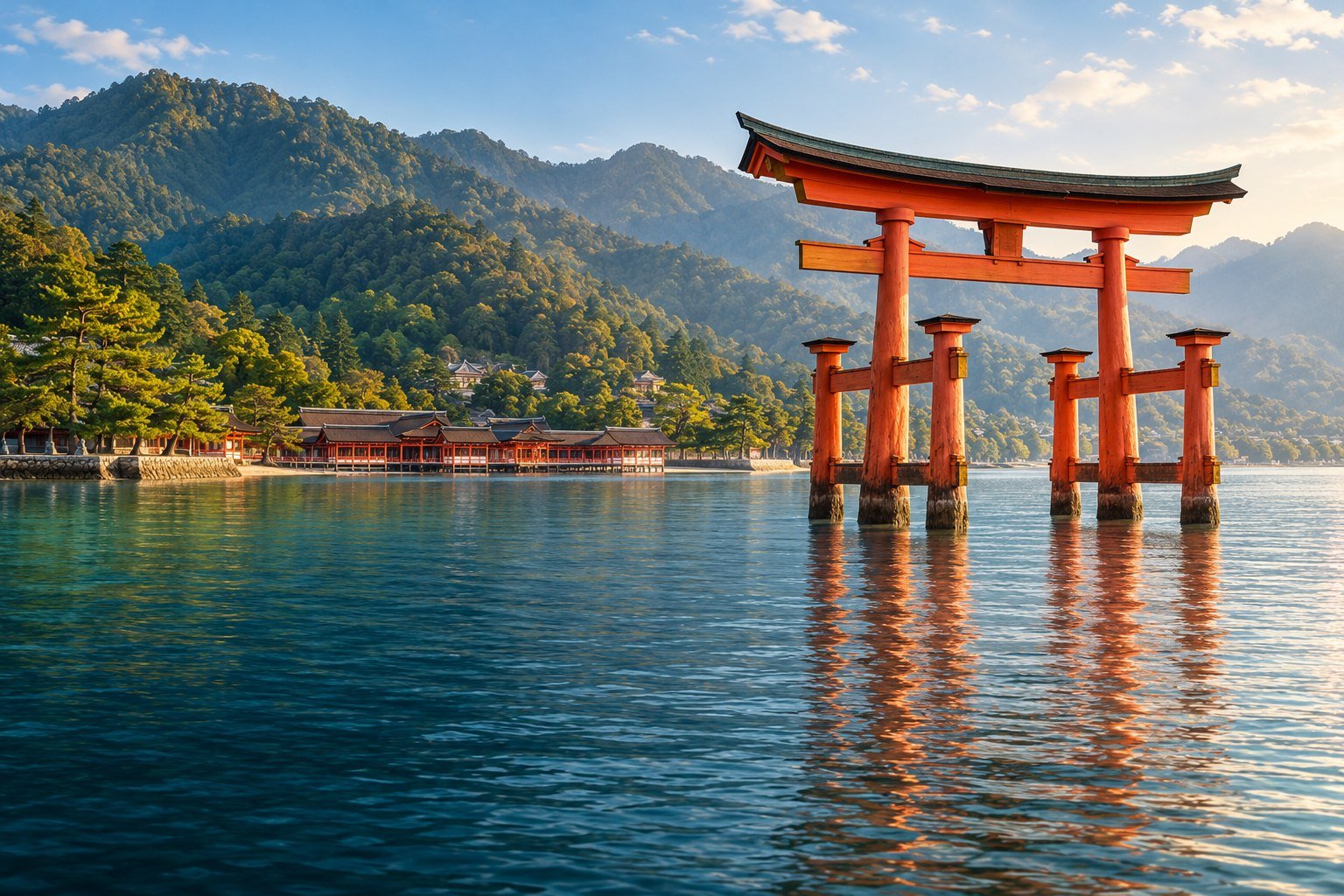
AI-generated original editorial illustration of the shrine’s coastal setting; it does not document tide or construction conditions on a particular day.
Itsukushima Shrine’s relationship with the sea is part of its meaning. The shrine, its offshore torii and the wooded island form a sacred landscape recognised by UNESCO. Its buildings preserve an architectural tradition shaped in the late twelfth century, with rebuilding and conservation across subsequent centuries. Understanding that setting adds something that a perfectly timed photograph alone cannot provide. [1]
For the practical visit, decide which experience matters most: the shrine appearing to stand in water, a possible walk towards the Great Torii, or time inside the shrine regardless of the tide. Then check the exact date. The useful plan is the overlap between the tide you want, the shrine’s opening hours and the time you can actually remain on the island.
Taylor’s Trailblazing Travels may earn a commission when you book or buy through links in this guide, at no extra cost to you. This helps support the site’s research and upkeep.
Choose one priority first
If time is short, decide whether the sea-level view or a possible torii walk matters more. Both need a suitable date and enough time.
Read the height and window
Use the official dated lookup, including any “no walk” result. The clock time of low tide alone cannot decide your visit.
Protect shrine entry
An attractive evening tide can fall after the shrine closes. Reserve enough time for the corridors within the published hours.
Work back from the pier
Choose the return route, then subtract walking and a boarding margin. Treat a final sailing as a limit, not your preferred plan.
Use tide height to choose the experience
The Tourist Association gives two practical height thresholds for planning. The middle band can still make an interesting shrine visit; it simply does not assure either of the two familiar sea-level effects. The numbers below describe the published tide reference, not the depth of water beneath your feet. [2][4]
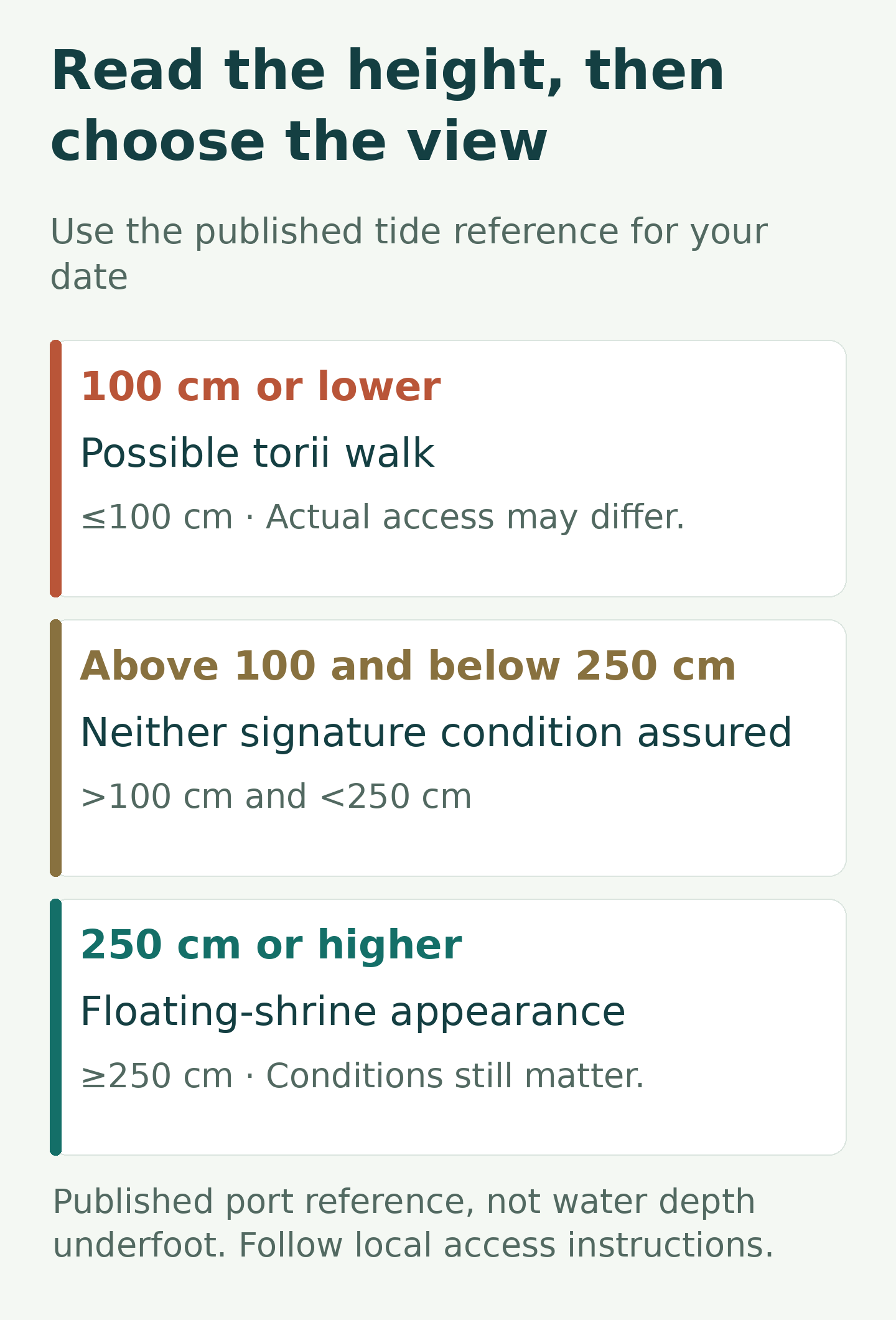
The association’s monthly tables use Hiroshima Port as their reference and say that Itsukushima Port’s tide changes occur slightly earlier. Do not invent a fixed minute adjustment. Follow the association’s dated visiting windows, then local signs, staff advice and the conditions you can see. [4]
The Japan Meteorological Agency explains that its tables predict astronomical tides from observed patterns; weather and other factors can make the actual sea level differ. Its published times use Japan Standard Time. These are planning data, not permission to cross water or enter an area that has been closed. [5]
Choose the shrine-with-water view if your main interest is the relationship between buildings and sea. Choose a torii-walk window if approaching the gate from the exposed foreshore is the priority. For both, first find a date with suitable windows, then check whether the gap between them fits your day. Staying longer cannot create a tide condition that never occurs on that date.
Look up the exact date before booking the day
- Open the official English tide tool and set your intended year, month and day. Check the date shown in the result, especially if the page initially displays the current day.
- Read the indicated torii-walking and floating-shrine windows. A result with no walking window is meaningful; do not replace it with the nearest low-tide time.
- Compare the useful daylight window with shrine opening and the time you can reach the waterfront.
- Choose your return route and reserve time to get back to its pier. Put that cutoff in your plan alongside the tide window.
- Save the dated result for reference, then recheck operator and local notices close to travel. A saved tide prediction cannot show a new service cancellation. [3]
If your dates are flexible, use the association’s monthly tide tables to identify candidate days, selecting the correct month and year, then return to the daily tool. Avoid building a plan around a screenshot whose date or reference location you cannot establish. [4]
The most useful note on your phone contains four entries: your desired condition, its dated window, shrine closing time and your waterfront departure cutoff. This is easier to act on than a long list of high and low tides with no connection to the rest of your journey.
Turn a tide window into time you can actually use
Here is a worked example using the official result for 18 October 2026, checked on that date. The daytime floating-shrine window was 12:45–17:15. There was no torii-walk window; the lowest listed tide was 109 cm. The example illustrates a method and should not be reused as a prediction for another date. [3]
Now add a hypothetical traveller who arrives on the island by noon and needs to be back at the pier by 16:00. Allow thirty minutes from leaving the waterfront to that deadline, combining walking and a personal buffer. The waterfront cutoff is therefore 15:30. The shrine’s regular hours on the example date were 06:30–17:30. [6]
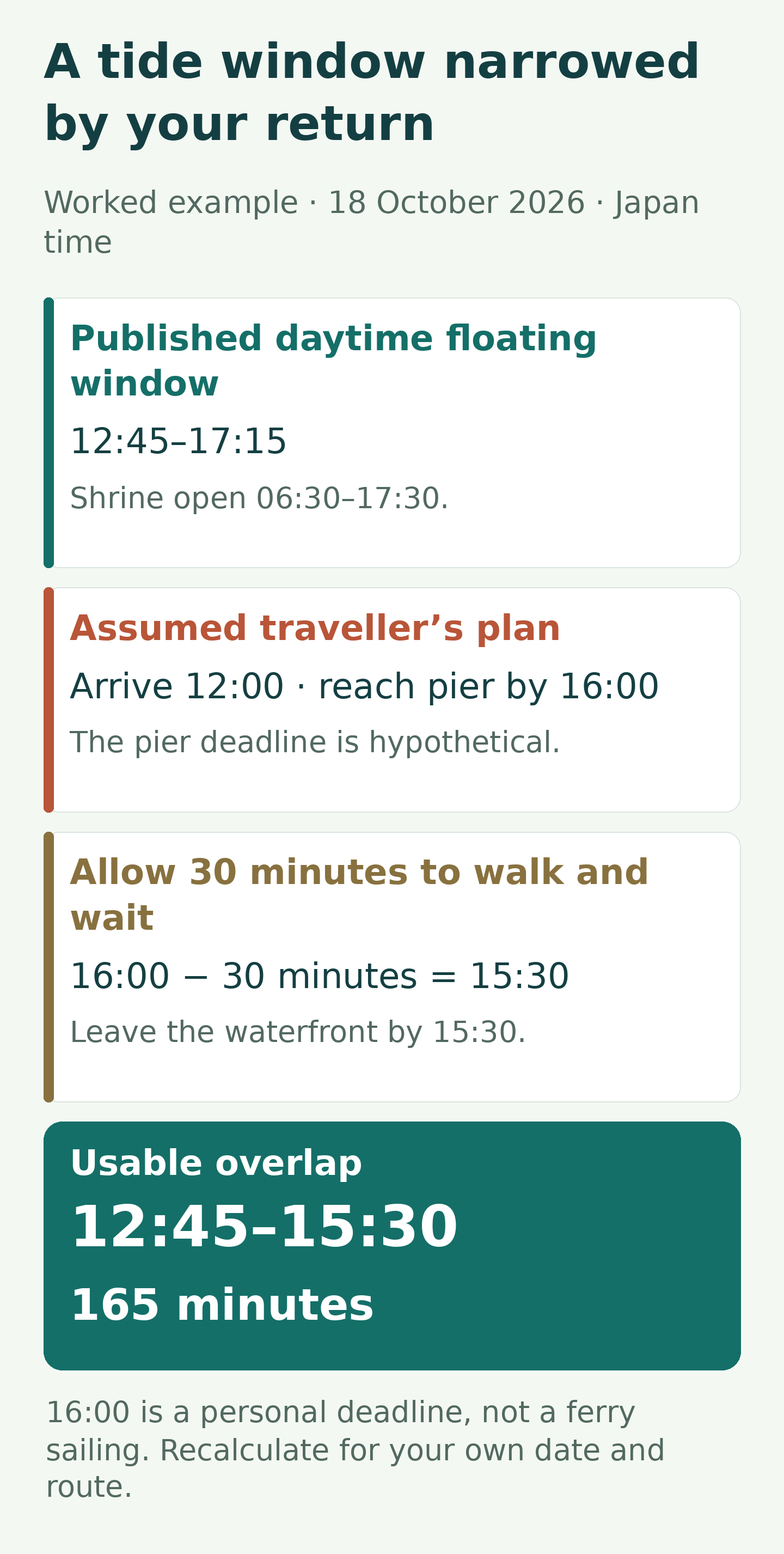
The overlap is 12:45–15:30: 165 minutes, or two hours and forty-five minutes. That is shorter than the four-and-a-half-hour published daytime tide window because the traveller’s own return constraint ends it first. The 16:00 deadline is an invented planning input, not a ferry departure or last-boat time.
Move the same pier deadline one hour earlier and the usable window falls to 105 minutes. If it disappears entirely, change the return constraint, select a different date or accept a different tide experience. Do not move a real transport departure on paper to make the itinerary fit.
How much time should you set aside?
For a shrine-and-waterfront visit focused on one tide condition, a three-to-four-hour island stay is a reasonable starting allowance. Within it, allow roughly 30–45 minutes for the shrine itself, time for walking and a meal or pause, and a return buffer. Those are editorial allowances, not official minimums. Queues, ceremonies, access needs and photography can extend them.
Seeing both tide states may require a substantially longer stay or an overnight, depending on the date. Calculate the gap between the actual windows before adding unrelated activities. A full island itinerary should be built around that result, rather than assumed to fit inside it.
Keep the shrine visit inside its own opening hours
| Dates | Hours |
|---|---|
| 1 January | 00:00–18:30 |
| 2–3 January | 06:30–18:30 |
| 4 January–end February | 06:30–17:30 |
| 1 March–14 October | 06:30–18:00 |
| 15 October–30 November | 06:30–17:30 |
| December | 06:30–17:00 |
Swipe or scroll sideways to read the full table.
The shrine normally opens year-round. Admission is ¥300 for adults, ¥200 for high-school students and ¥100 for primary- and junior-high-school pupils. The Treasure Hall is separate, open 08:00–17:00; combined tickets cost ¥500, ¥300 and ¥150 respectively and are sold only at the shrine entrance. All were checked on 18 October 2026. [6]
Choose whether you want the Treasure Hall before paying. Then follow the shrine’s entrance-to-exit route through its corridors and principal spaces, respecting barriers around areas that are not part of the visitor path. The official route page is useful for orientation. Wear stable, comfortable shoes: the corridor boards have gaps that can catch narrow heels. [7]
To see water surrounding the shrine from within the corridors, place the admission visit within both the tide window and opening hours. If you later return to the waterfront for a different view, do not assume your earlier shrine ticket includes re-entry; ask staff before leaving if a second interior visit matters.
Current works and the view to expect
The shrine’s East Corridor reinforcement programme runs through December 2026. Its official construction notice says the corridor remains passable during the works. Treat it as a possible change to the surroundings and route experience, rather than an announced closure of the whole shrine. [8]
The nearby five-storey pagoda has a longer repair programme: its official outline gives February 2025–October 2027, with scaffolding removal planned for December 2026. These are different milestones. Check the current notice if the pagoda view matters to your photographs; a planned removal date does not guarantee that work has finished. [9]
Choose the ferry route before fixing the return deadline
For the ordinary mainland crossing, travel from Hiroshima Station on the JR San-yo Main Line towards Iwakuni and get off at Miyajimaguchi. The ferry operator gives about twenty-eight minutes for that train journey; walking to the terminal, waiting and crossing are additional. Follow the terminal signs for the operator you have chosen. [28]
| Route | One way / return | Planning implication |
|---|---|---|
| JR ferry, Miyajimaguchi–Miyajima | ¥200 / ¥400 | Short mainland crossing; check JR’s calendar. [10][11] |
| Matsudai ferry, Miyajimaguchi–Miyajima | ¥200 / ¥400 | Use Matsudai’s own ticket and timetable. [12] |
| Aqua Net, Peace Park–Miyajima | ¥2,400 / ¥4,400 | Direct river-and-sea route; operation depends on the date and tide. [14] |
Swipe or scroll sideways to read the full table.
The Miyajima Visitor Tax is normally ¥100 per person each time they enter the island; preschool children are exempt. It is separate from the ferry fare and is generally collected with the ticket or transit-card payment. A qualifying transport pass may still require a tax payment at the window. Check what your particular product includes. [13]
The basic adult shrine-day calculation from Miyajimaguchi is ¥400 return ferry + ¥100 tax + ¥300 shrine admission = ¥800. Choosing the combined shrine-and-Treasure-Hall ticket makes it ¥1,000. This excludes the train to Miyajimaguchi, food and accommodation; the tax is counted once for one island entry, not once in each direction. [6][10][13]
The last return belongs to a specific operator
JR’s regular crossing takes about ten minutes. Its current regular timetable lists the final departure from Miyajima at 22:14; 22:42 is the opposite direction from Miyajimaguchi. Check the operator’s date-specific calendar and current service notices rather than assuming the regular table applies. Allow for your onward mainland train or other connection as well. [11]
Aqua Net’s direct route from the Peace Park is about forty-five minutes, with services that can be cancelled or rerouted because of high or low tide. Check the selected day on its official timetable before choosing the return. A late JR departure does not extend a direct boat ticket’s operating hours. If a connection is important, select an earlier service with a practical alternative. [14]
If you are considering a pass, compare the Hiroshima–Miyajima transport and pass listings on 12Go. At the check date, the route page included Hiroden and Setouchi Sea Line day-pass products. Read the actual operators, validity and redemption instructions before buying; these listings should not be mistaken for a reserved single JR ferry departure. Compare the included journeys with the simple fares above. [25]
Plan the shoreline approach and accessible route
For a permitted low-tide approach, the Tourist Association identifies steps at Mikasanohama on the shrine entrance side and Nishimatsubara on the exit side. There is no descent to the tidal flat from inside the shrine corridors. The ground can be wet and muddy; use footwear you can clean, and return by a clearly accessible route while the conditions remain suitable. [2]
A tide-height number is not a reason to wade. If the approach is covered, cordoned off or looks unsafe, stay on the established waterfront. Keep children close and allow time to get back before conditions change.
My recommendation for a close view is to leave the torii’s structure untouched: do not climb it, attach anything or press coins into gaps. For monetary offerings, the Tourist Association’s worship guidance directs visitors to the offering box. [17]
JR describes an accessible route from Miyajimaguchi Station using slopes and underpass lifts. Staff assist with ferry boarding, and the ferry’s first floor has wheelchair spaces. Use that route’s instructions rather than assuming every entrance or gangway is equivalent. [15]
The Tourist Association describes Itsukushima Shrine as accessible, while only parts of the wider island are barrier-free. Its tourist information office lends a limited number of wheelchairs free from 09:00–17:30, without advance reservations. Contact the relevant operator or shrine about a specific mobility need before travelling, particularly during works. [16]
The step-free shrine visit and the stair access to a tidal flat are separate decisions. A visitor who cannot use the foreshore can still plan around the waterfront and the shrine’s permitted route. Increase the walking and resting allowance in the time model, and confirm where a borrowed wheelchair must be returned before choosing a late departure.
Treat the shrine as a place of worship
The Great Torii marks a boundary between sacred space and the everyday world. Give worshippers and ceremonies priority, keep voices considerate, and follow current signs and staff directions. If you choose to pray, the local association explains the offering-box, two-bows, two-claps and final-bow custom. Observing quietly is also a respectful way to visit. [17]
For photographs, the association identifies viewpoints at Mikasanohama and within permitted shrine areas, including the East Corridor. Take the photograph without blocking circulation, and look for any local restriction before using equipment or photographing a ceremony. Ask before making identifiable people the subject of your picture. [18]
Drone photography has separate restrictions: Hatsukaichi City’s guidance prohibits it within the shrine grounds and over the Great Torii. Ordinary photo opportunities do not imply permission for a drone. [19]
Miyajima’s deer are wild and must not be fed. Keep food and paper belongings secure, avoid encouraging animals towards someone else for a photograph, and carry your rubbish to a suitable disposal point. These small decisions help the waterfront work for visitors, residents and wildlife. [20]
Decide whether a guide or island overnight helps
A guide is most useful when you want religious or architectural context, help with transfers or a route adapted to your group. Ask a provider to confirm the tide window it can realistically accommodate. A fixed-duration product can include substantial travel time, so compare the time on the island as well as the headline length.
Check this private Miyajima tour from Hiroshima on GetYourGuide if you want an arranged day with a Hiroshima Port ferry journey. The current listing is six hours including travel and includes the return ferry. Attraction tickets and other transport are excluded; ask whether the visitor tax is included and how the tide, meeting point and return sailing affect the proposed shrine time. [21]
Compare Viator’s half-day private Miyajima tour with a licensed guide if a customised walking visit is a better fit. The current listing is approximately four hours and excludes ferry fares, other transport, admission and visitor tax. Confirm where the tour starts, how much of the duration is spent reaching the island, and whether your preferred tide window is achievable. [22]
Choose an overnight on the island when it meaningfully expands your access to an early or late window, or removes the need to connect two tide states to a mainland return. Search accommodation near Itsukushima Shrine on Booking.com and compare accommodation near the Great Torii on Agoda, then check each property’s actual map location. Nearby results can include the mainland: a hotel with Miyajima in its name does not automatically keep you on the island after the ferries. [23][24]
The association lists the usual evening illumination from thirty minutes after sunset until 23:00, with occasional ritual or event exceptions. This does not extend shrine admission. A light-off time later than a ferry departure is not a reason to plan a return at that hour. For an island stay, confirm check-in, meal and any luggage arrangements directly with the accommodation before building the evening around it. [16]
Check the date, conditions and connection before leaving
Recheck the official tide result, shrine information and the operator’s current service notice close to departure. Keep your preferred window and return cutoff together. Carry your ticket details, an offline map, practical footwear and whatever your group needs for sun, rain and a comfortable wait.
If you need mobile data to follow service changes or contact a guide, compare it with your existing roaming. You can check Airalo for a Japan eSIM through its general store, selecting the Japan plan and allowance you need. Confirm eSIM support and that your device is not carrier-locked. Save essential tide and ticket information offline even if you buy data. [26][27]
When the day’s conditions change, revise the plan in this order: safe access, an achievable return, shrine admission, then the preferred tide view. That order protects the visit’s practical foundations while leaving room to appreciate the place in the conditions available.
Choose the date and tide you can realistically enjoy
For a short first visit, select one tide experience and make time for the shrine itself. If both sea-level conditions matter, calculate the gap between their dated windows before booking transport or an overnight. A realistic return cutoff and a little flexibility will serve you better than a schedule that depends on every connection and photograph happening at its exact predicted moment.
Sources and research
Sources checked on 18 October 2026. Recheck opening times, prices, access arrangements and booking conditions for your travel date.
- UNESCO: Itsukushima Shinto Shrine
- Miyajima Tourist Association: tide-height guide, updated 10 September 2026
- Miyajima Tourist Association: official daily tide lookup, consulted for 18 October 2026
- Miyajima Tourist Association: October 2026 monthly tide table and Hiroshima Port reference
- Japan Meteorological Agency: tide-table explanation, datum, predictions and Japan Standard Time
- Itsukushima Shrine: official opening hours and admission charges
- Itsukushima Shrine: route and visitor guidance
- Itsukushima Shrine: East Corridor reinforcement notice, April 2024–December 2026
- Itsukushima Shrine: five-storey pagoda repair outline and scaffolding schedule
- JR West Miyajima Ferry: fares, with current fare graphic visually checked
- JR West Miyajima Ferry: regular timetable and date-specific operating calendar
- Miyajima Matsudai Kisen: passenger fares
- Hatsukaichi City: Miyajima Visitor Tax
- Aqua Net: World Heritage Sea Route, fares, reservations and tide-related operation changes
- JR West Miyajima Ferry: accessible route and boarding assistance
- Miyajima Tourist Association: accessibility, wheelchair loans and evening illumination FAQ
- Miyajima Tourist Association: Shinto, torii and worship customs
- Miyajima Tourist Association: suggested souvenir-photography viewpoints
- Hatsukaichi City: drone restrictions around Miyajima and Itsukushima Shrine
- Ministry of the Environment: Miyajima wildlife guide and no-feeding advice
- GetYourGuide: private Miyajima tour from Hiroshima with Hiroshima Port ferry
- Viator: Miyajima half-day private customised tour with licensed guide
- Booking.com: accommodation near Itsukushima Shrine, including island and mainland results
- Agoda: accommodation near the Great Torii
- 12Go: Hiroshima to Miyajima route and pass comparison
- Airalo: device compatibility requirements
- Airalo: Japan eSIM plans
- JR West Miyajima Ferry: access from Hiroshima Station and the mainland terminal
How this guide was researched
This research-led guide uses the shrine, Miyajima Tourist Association, Japan Meteorological Agency, local authority and ferry operators for practical facts, checked on 18 October 2026. The 165-minute worked example combines an actual published tide window with an invented traveller deadline and an editorial thirty-minute return allowance. Apply the method using fresh tide data and your own transport constraints.
Illustrations in this article were created for Taylor’s Trailblazing Travels. Third-party photographs, where used, are credited beside the image or in the source list.