Hiroshima Travel Guide: History, Neighbourhoods and Nearby Islands
Give the city’s history proper time, choose a useful base and decide which island deserves a day of your trip.
- Suggested stay · 2–3 nights
- First priority · One unhurried city day
- Island choice · Miyajima first
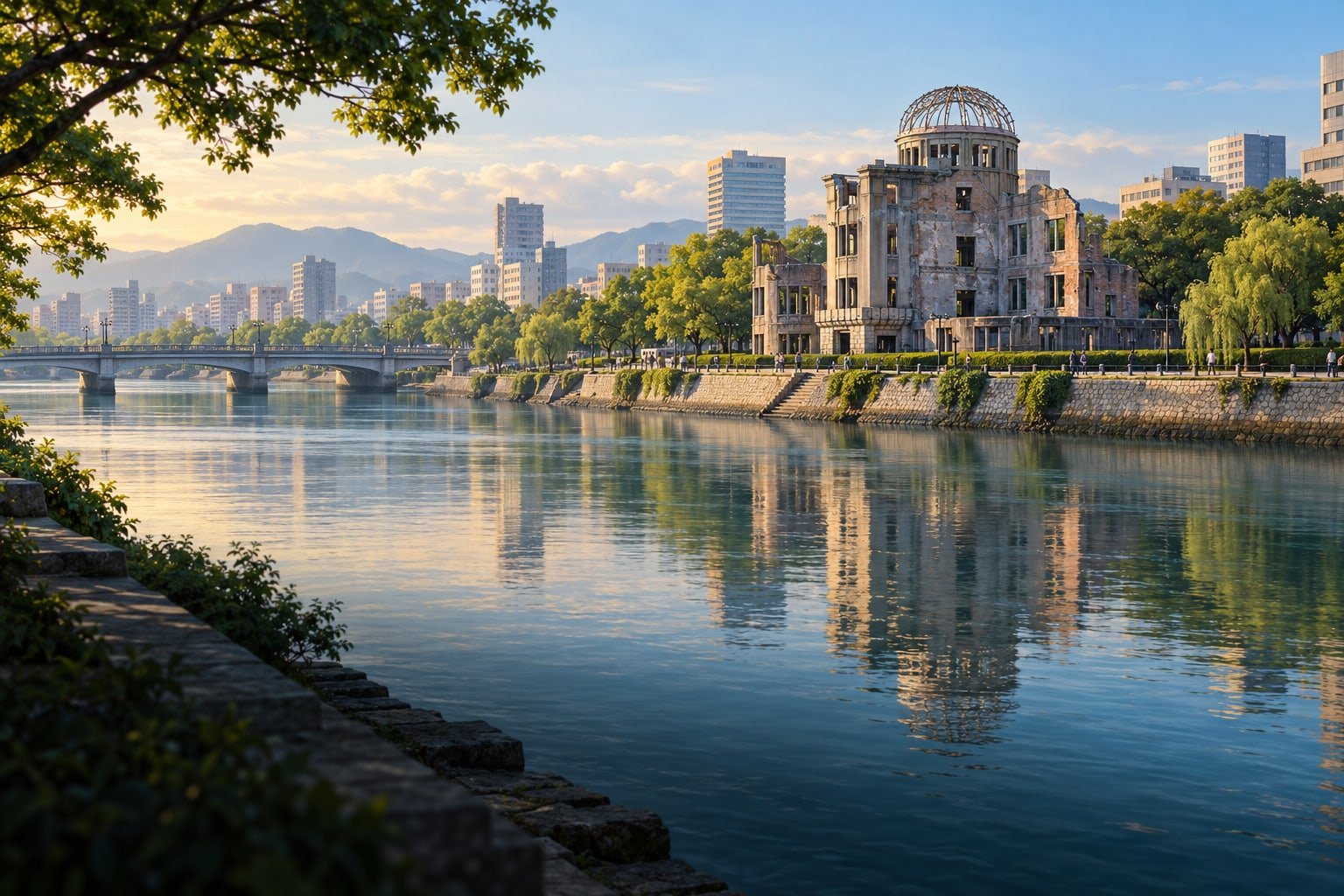
AI-generated editorial illustration inspired by contemporary Hiroshima and the Atomic Bomb Dome; not a documentary photograph.
Hiroshima deserves a day in which the next departure is not constantly on your mind. The Atomic Bomb Dome preserves a surviving ruin from the bombing of 6 August 1945; the surrounding city is also somewhere to eat dinner, follow a river, browse a shopping street and stay for several nights.[1]
This Hiroshima travel guide starts with that balance. It gives the peace sites a considered place in your visit, explains which neighbourhoods suit different stays and treats the nearby islands as choices requiring time of their own. The most useful first decision is how many complete sightseeing days you actually have.
This guide contains affiliate links. If you book or buy through them, Taylor’s Trailblazing may earn a commission at no extra cost to you.
One full day
Centre the visit on the museum, memorial park and a city meal. Add a garden only if time and energy allow.
Two usable days
Pair a full Hiroshima day with Miyajima. Count arrival and departure hours before settling on two nights.
Rail convenience
Choose the station district when luggage, an early train or several onward journeys shape the stay.
Another island
Give Etajima or Ninoshima its own plan, including the correct port, a realistic activity and a return sailing.
How long to stay in Hiroshima
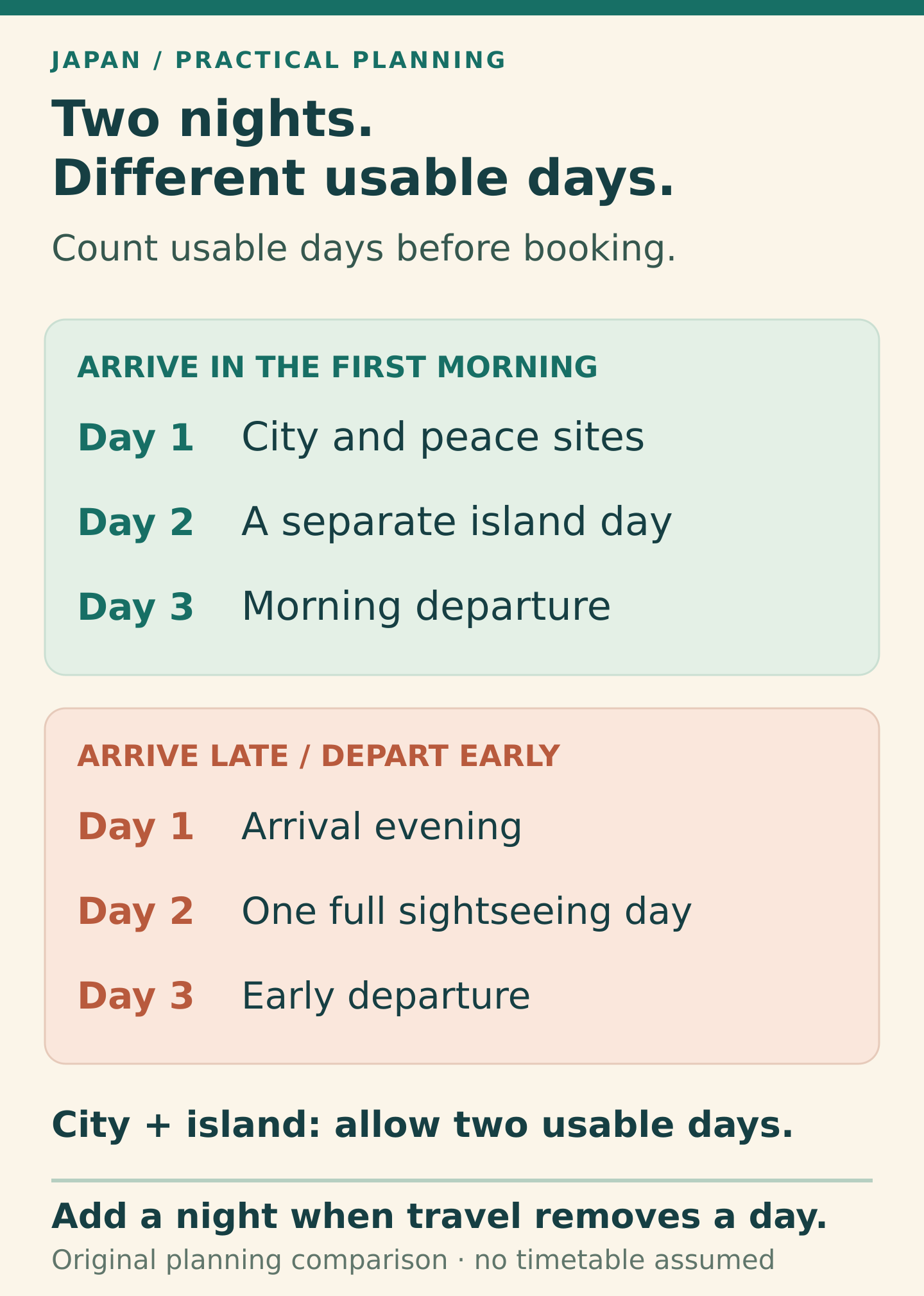
Choose the length of your stay by usable time, not the number of dates on the booking. Arriving at 18:00 and leaving at 09:00 two days later gives you one complete day. It does not give you two.
| Time available | A satisfying plan | What to leave for another visit |
|---|---|---|
| One full day | Peace Memorial Museum, the park and Dome, lunch and a central-city evening | A substantial island excursion |
| Two full days | One city day and one Miyajima day | A second island unless you extend |
| Three full days | City and Miyajima, plus a slower city day or a separately planned island | No need to add distance merely to fill time |
For a two-night stay, a workable pattern is to arrive during the first morning, visit the city that day, spend the second day on Miyajima and leave on the third morning. If you arrive late, add a third night or leave late enough on the final day to use it meaningfully.
A fast combined city-and-island excursion can suit someone with a fixed stopover. The trade-off is how little time remains for museum interpretation, meals, changes in weather and simply deciding to stay longer somewhere. If Hiroshima’s history is a principal reason for your trip, protect that time first.
Choose a neighbourhood for the way you travel
The main choice is between station convenience and the central shopping and memorial districts. Hiroshima Station is your intercity arrival point; Hondori and Otemachi place you closer to the peace sites; Hatchobori is a shopping and dining focus. The official city map and tram network help you check the actual address rather than relying on a broad “central Hiroshima” label.[9][10][13]
| Area | Choose it for | The practical compromise |
|---|---|---|
| Hiroshima Station | Early trains, a short stay, simple luggage handling and rail day trips | Allow a separate journey to the memorial district |
| Hondori / Otemachi | A city visit organised around the park, rivers and central streets | Check the connection back to the station for departure day |
| Hatchobori | Department stores, restaurants and an easy choice of evening plans | Read recent room-noise comments if a nearby nightlife street matters to you |
| Shukkeien / Hakushima side | A base chosen around the garden and the north-eastern city centre | Map the hotel’s own walk to transport; this is not one compact station frontage |
Compare the same dates using Agoda’s Hiroshima city accommodation search and Booking.com’s Hiroshima city accommodation search. Both are city-wide searches. Use the map to select your neighbourhood, then compare room size, bed arrangement, cancellation conditions and the total for your party.
For a short stay, a slightly higher room total can be worth considering if it removes awkward luggage transfers. Conversely, being beside the station adds little if you are spending most of the trip around the park and central restaurants. Choose for the movements you will actually make.
Give the peace sites time and context
The Dome is the damaged former Hiroshima Prefectural Industrial Promotion Hall, preserved at its original site. It became a UNESCO World Heritage property in 1996. View it as a place of remembrance and historical evidence; keep photographs considerate of other visitors and anyone paying respects.[1]
Peace Memorial Park occupies the former Nakajima district, once a lived-in commercial neighbourhood. That fact changes a walk through its open spaces: this was part of a working city before it became a memorial landscape. Use the official park map to locate the museum, Cenotaph, Children’s Peace Monument and Dome, rather than treating the grounds as a single photo stop.[5]
Museum and Memorial Hall: two different visits
The Hiroshima Peace Memorial Museum presents victims’ possessions, photographs and the history of the bombing and its consequences. An editorial allowance of about two hours is a starting point, not a maximum; leave room to pause or finish earlier if the material becomes difficult.[2]
The separate Hiroshima National Peace Memorial Hall for the Atomic Bomb Victims centres on people’s words, memoirs and testimony. Admission is free. It can add a more personal layer to the visit, particularly if you want to spend time with individual accounts rather than move directly to another attraction.[4]
Book the museum before arranging the rest of the day
At the October 2026 check, September–November opening was 07:30–19:00, with last admission at 18:30. Entry during 07:30–08:30 and 17:30–18:30 required the appropriate advance web ticket. Standard adult admission was ¥200; an audio guide cost a further ¥400. Follow the booking link from the official city museum information page and check your season’s arrangements.[2]
Advance booking is also useful outside those special slots. The museum’s visitor guidance identifies the middle of the day as a busy period and notes annual closure arrangements; check the dated calendar, particularly around the end of December and exhibition maintenance in February.[3]
Allow roughly three to four hours for the museum, a considered park walk and some time at the Memorial Hall. This is a planning allowance, not an official tour duration. Follow it with lunch, a river walk or free time rather than a tightly timed succession of appointments.
Shukkeien, the castle grounds and the present-day city
Shukkeien gives you another period of Hiroshima’s history to consider. Created in 1620, the garden arranges ponds, bridges, islands and planted scenes within a compact landscape. It was damaged by the atomic bombing and subsequently restored. A leisurely 45–60 minutes is a useful initial allowance if you enjoy looking closely rather than covering every path.[8]
The garden’s current standard adult admission is ¥350. Ordinary closing time is 18:00 from 16 March to 15 September and 17:00 from 16 September to 15 March, with last admission half an hour earlier. Its published year-end closure is 29–31 December.[7]
Hiroshima Castle: plan for the grounds
The reconstructed castle keep closed to visitors on 22 March 2026. The official notice says the keep’s exterior remains, while the reconstructed Ninomaru buildings, Sannomaru facilities and other services continue. Do not plan an interior tower visit from an older itinerary; check the castle’s current notice for the facilities you want to see.[6]
The garden and castle area make a useful separate half-day or arrival-day grouping. They give a city stay a different rhythm from the peace sites. There is no need to place every historical stop on the same day, especially if the museum is the most demanding part of your visit.
Leave an evening for ordinary city life, too. Browsing shops, choosing a counter for dinner and walking back through the centre helps a stay feel less like a succession of prescribed sights. You do not need a ticketed attraction for every spare hour.
Where to spend an evening, and what to eat
Hiroshima-style okonomiyaki is a useful first food choice. Its components are built in layers: a thin batter base, vegetables including cabbage, pork and noodles, with egg and sauce in the finished dish. Recipes and options differ, so ask about the actual filling rather than assuming that removing visible meat makes an order vegetarian.[12]
Okonomi-mura groups several okonomiyaki counters in the central Shintenchi area. It is a practical place to compare menus and choose an available seat. A long queue is not an obligation: decide whether watching a particular counter matters more to you than an unhurried meal.[11]
Hondori is a useful covered shopping route through the centre. Hatchobori and neighbouring Nagarekawa broaden the evening restaurant choice; Ekinishi, west of Hiroshima Station, can suit a station-based dinner. These are different areas, so choose the one that fits the end of your day instead of crossing the city for a vaguely described “local district”.[9][10]
If you have dietary requirements, make them part of the restaurant search before you are hungry. Ask about sauces, stock, pork, seafood and shared cooking surfaces as relevant to your needs. On the museum day, give lunch some space in the schedule; booking an expensive or tightly timed experience immediately afterwards leaves little flexibility.
Arriving in Hiroshima and moving around
For an intercity journey from Osaka, check the departure station, train type and reservation conditions before comparing prices. 12Go’s Osaka-to-Hiroshima route comparison is a relevant additional search option. Compare its final total, ticket collection or delivery method and changes policy with the rail operator’s own offer; a route listing is not evidence that every departure or pass is available there.[15]
Hiroshima Airport is a separate transfer from the city. The airport’s official bus information gives approximately 45–50 minutes to Hiroshima Station’s Shinkansen gate and approximately 55 minutes to Hiroshima Bus Centre, with a ¥1,500 adult one-way fare for either route at the check date. Road conditions affect those estimates; choose the terminal that fits your hotel.[14]
For urban sightseeing, combine walking with the tram when it saves a meaningful distance. Hiroshima Electric Railway lists a ¥240 adult flat fare, including examples between Hiroshima Station and the Dome and between the Dome and Miyajimaguchi. Check the current route and payment guidance rather than boarding by destination name alone.[13]
A transport pass only helps when its actual coverage matches the services you will use. Write down the journeys first, add the ordinary fares, then compare the pass. In particular, a private boat from Peace Memorial Park is a different service from the short ferry at Miyajimaguchi.
For mobile maps and last-minute operating notices, compare an eSIM through Airalo and select Japan. Check that your phone supports eSIM and is network-unlocked, then review the selected plan’s data allowance, activation rule and coverage. Save essential tickets and return-journey details offline as well.[23]
Choose a nearby island by the day you want
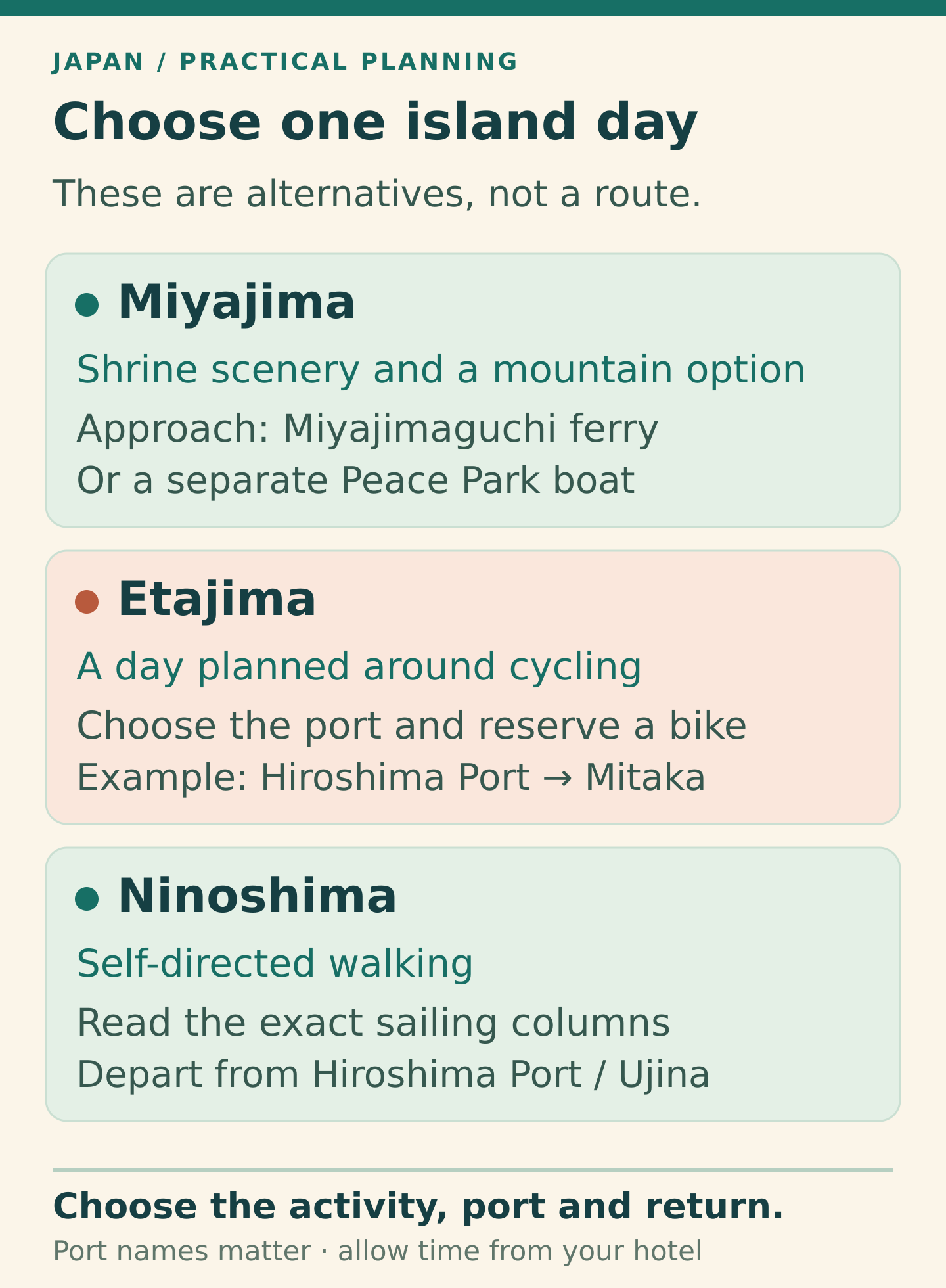
Miyajima is the strongest first choice if you want the region’s famous shrine landscape. Etajima makes more sense for a separately planned cycling day. Ninoshima can suit a simpler, self-directed island outing. They are alternatives, not a three-island route to squeeze around the museum.
| Island | Why choose it? | Access to plan | What needs deciding first? |
|---|---|---|---|
| Miyajima | Shrine scenery, historic lanes and the option of a mountain outing | About 30 minutes by JR train from Hiroshima Station to Miyajimaguchi, then a short ferry crossing | Whether the day is for the waterfront and temples, or also Mount Misen |
| Etajima | A day organised around cycling and the Seto Inland Sea | For example, Hiroshima Port to Mitaka is roughly 40 minutes by ferry | Your arrival port, bike collection and return location, route length and last useful sailing |
| Ninoshima | A smaller-scale outing for visitors happy to make their own walking plan | Direct Hiroshima Port–Ninoshima services take about 20 minutes; some routings are longer | The exact boat, a suitable walk and what food or water to bring |
The Miyajima rail approach and crossing are documented by the national and local tourist organisations. Give the island a separate day if you also want Mount Misen; the mountain is not simply the endpoint of a quick cable-car ride.[16][24]
There is also a direct Peace Memorial Park–Miyajima boat taking about 45 minutes. Its central departure point can be useful, but it costs more than the conventional approach and sailings can change or be cancelled because of tides. Consult the operator before making a same-day city-and-island schedule depend on it.[17]
Etajima’s tourist organisation describes a multi-location bicycle-rental scheme, including some returns at a different port. Availability and hours depend on the location, so arrange the bike and ferry as one plan. The Mitaka crossing is one specific route, not a promise that every Etajima port is 40 minutes from Hiroshima.[18][19]
On Ninoshima, Aki-kofuji is a specific hiking option: the island’s 278-metre summit has routes with views towards Hiroshima. Choose a suitable route and check conditions before committing; the short crossing does not remove the need to plan the walk.[25]
Ninoshima’s operator distinguishes direct sailings from services that call at Gakuen. Read the columns for your actual departure and return. Hiroshima Port in Ujina, used for these island routes, is not the Peace Memorial Park pier.[20]
Build a realistic city day and a useful cost subtotal
A straightforward city day starts with your reserved museum slot, continues through the memorial grounds and leaves the afternoon adjustable. After lunch, choose the garden if you want another sight, or keep the time free. Finish around Hondori or Hatchobori; station-based visitors can also leave dinner until the journey back.
Here is a deliberately narrow spending calculation for one adult. It helps compare a pay-as-you-go city day with a pass or tour, without presenting an invented all-in daily budget.
| Component | Amount | Assumption |
|---|---|---|
| Peace Memorial Museum | ¥200 | Standard adult admission |
| Shukkeien | ¥350 | Standard adult admission |
| Two tram journeys | ¥480 | Two ordinary adult fares of ¥240 |
| Calculated subtotal | ¥1,030 | Admissions and the two specified rides only |
The fare inputs come from the museum, garden and tram information; the ¥1,030 total is our calculation. It excludes accommodation, meals, intercity travel, island boats, shopping and any guide. An optional museum audio guide adds ¥400. Your walking choices may remove a tram ride, while a different hotel location may add one.[2][7][13]
For the larger trip budget, obtain hotel totals for your exact dates and price the intercity leg separately. That is more dependable than converting a generic yen-per-day allowance into pounds and treating it as a quote.
For hotel stays, add Hiroshima Prefecture’s accommodation tax, introduced on 1 April 2026. It is ¥200 per person per night when the tax-exclusive room-only charge is ¥6,000 or more; lower charges are exempt. The threshold includes the room’s service charge but excludes meals and consumption tax. Check how the property collects it. This overnight tax is separate from Miyajima’s visitor tax.[26]
When a guide earns a place in the plan
Independent visits work well when you want control over the time spent in each exhibition. A guide can be useful when you value a structured explanation of places that are easy to walk past without understanding. Choose by the route and the length of the commitment.
Compare the three-hour Hiroshima peace walking tour on Viator if a shorter, focused historical walk suits you. The researched listing names BE Hiroshima as operator and includes peace sites and surviving buildings. Its listed route should not be read as a promise of Peace Memorial Museum admission; make a separate museum plan unless the option you select explicitly includes it.[22]
Compare the full-day Hiroshima city tour on GetYourGuide if you prefer a broader organised day. The checked listing is about 8½ hours and combines places including Mitaki-dera, Shukkeien, castle grounds and the peace district. That is a different level of commitment from a memorial walk. Read the chosen date’s meeting point, physical requirements and admission inclusions before booking.[21]
Whichever model you choose, leave enough space to visit the museum at your own pace. A guide’s finish time does not have to become the finish time for your engagement with Hiroshima’s history.
Your Hiroshima questions answered
Can I visit Hiroshima as a day trip?
Yes, provided the journey leaves you a useful block in the city. Prioritise the museum, park and Dome, then add a meal or another short city stop. If you also want a substantial Miyajima visit, an overnight stay gives you more control over the time available. Check actual train times before buying timed admission.
Can I still go inside Hiroshima Castle?
The reconstructed keep closed on 22 March 2026. The official announcement identifies other continuing facilities, including the Ninomaru buildings and Sannomaru area. Check those separately; an older description of the tower’s interior is no longer a reliable plan.[6]
How should I plan the peace sites with limited mobility?
The museum lists lifts, accessible toilets and wheelchairs available for use. The National Peace Memorial Hall also has lifts and permits wheelchairs and mobility carts. Check the route from your hotel and the particular entrance or assistance you need; these facility provisions do not establish that every city walk is suitable for every visitor.[2][4]
Is Miyajima the only worthwhile island from Hiroshima?
It is the most straightforward first choice for a shrine-and-scenery day. Etajima is worth considering when cycling is the purpose of the outing, while Ninoshima can suit a self-directed visit with the ferry timetable in hand. Choose another island because its activities suit you, and reserve a separate day or substantial time block for it.[18][20]
Choose the plan that fits your trip
Give Hiroshima one full city day before adding distance. Choose a neighbourhood that simplifies the start and end of that day, arrange the museum entry, and keep the time immediately afterwards flexible.
With a second usable day, Miyajima is the natural next choice for most first visits. With more time, decide whether you want another island or a slower city stay. Two nights work when the travel hours work; three nights give more room when they do not.
How this guide was researched
This guide was researched from city, tourism, attraction and transport-operator information, with booking listings checked where a specific comparison is useful. The stay recommendations, time allowances and ¥1,030 subtotal are editorial planning models, not a record of a personal visit or a quoted package. Dynamic information was checked on 17 October 2026; follow the linked operator for your travel date.
Sources and checks
Official, operator and relevant booking information checked on 17 October 2026. Opening arrangements, fares and availability can change; recheck the linked source for your travel dates.
- UNESCO — Hiroshima Peace Memorial (Genbaku Dome)
- City of Hiroshima — Peace Memorial Museum visitor information
- Hiroshima Peace Memorial Museum — advance web-ticket guidance
- Hiroshima National Peace Memorial Hall — official FAQ
- Hiroshima Peace Culture Foundation — Peace Memorial Park map and history
- Hiroshima Castle — keep closure announcement, 23 March 2026
- Shukkeien — official visitor information
- Hiroshima Tourism Association — Shukkeien
- Hiroshima official English visitor guide and city map
- Hiroshima Tourism Association — Hatchobori at night
- Hiroshima Tourism Association — Okonomi-mura
- Otafuku Foods — Hiroshima okonomiyaki preparation
- Hiroshima Electric Railway — fares
- Hiroshima Airport — access timetable and fares
- 12Go — Osaka to Hiroshima route comparison
- Japan National Tourism Organization — Miyajima access
- Aqua Net Hiroshima — World Heritage Sea Route
- Hiroshima Tourism Association — Etajima bicycle rental
- Setonaikaikisen — Hiroshima–Mitaka ferry
- Ninoshima Kisen — official timetable and fares
- GetYourGuide — Hiroshima city tour listing
- Viator — Hiroshima three-hour peace walking tour listing
- Airalo — device compatibility
- Miyajima Tourist Association — access
- Hiroshima Tourism Association — Aki-kofuji on Ninoshima
- Hiroshima Prefecture — accommodation tax rules
Illustrations in this article were created for Taylor’s Trailblazing Travels. Third-party photographs, where used, are credited beside the image or in the source list.