Japan Public Holidays and School Breaks: How to Avoid Travel Bottlenecks
Separate the national calendar, local school breaks and real capacity limits before choosing your travel days.
- Confirmed 2027 holidays
- Local school examples
- Golden Week date check
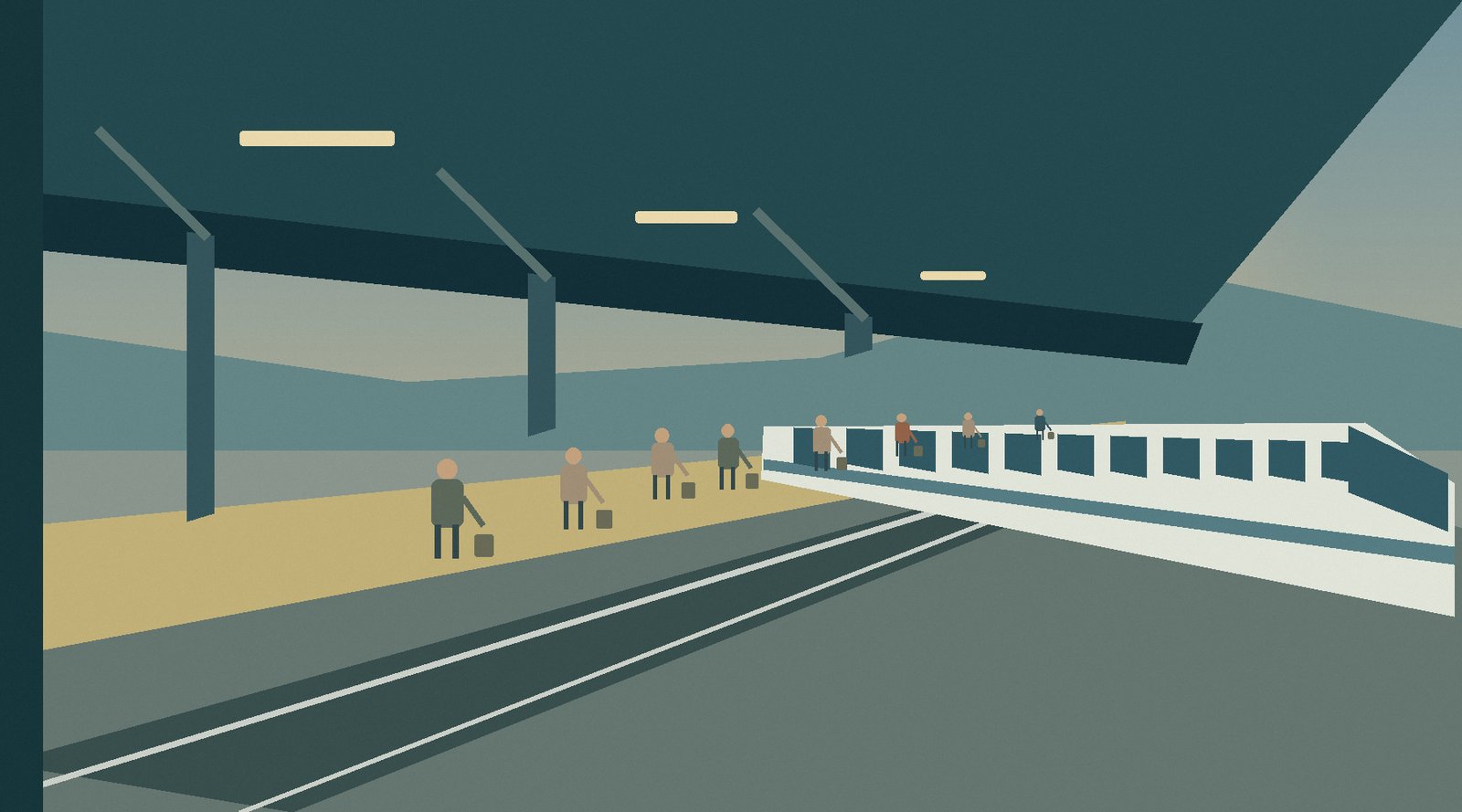
Original editorial illustration of an imagined busy Japanese station; it is not a photograph, a crowd forecast or a depiction of a named station.
A Japan holiday calendar is only the first layer of the planning problem. The dates can be correct while the itinerary still puts a hotel change, popular excursion and essential train journey on the same busy day. Conversely, a trip overlapping a holiday is not automatically a bad idea if the main reservations are workable and the daily plan has room to adapt.
This guide uses national dates for 2027, with the remaining national holidays in 2026 noted separately. School-calendar examples are labelled by place and academic year. None of these calendars is presented as a forecast of fares, available rooms or crowd levels on an individual train.
National dates
Use the calendar for the exact travel year.
School breaks
Local and school-specific dates are a separate layer.
Limited capacity
Check the hotel, train or attraction that can constrain your trip.
Fixed dates
Reduce unnecessary moves and keep workable alternatives.
Use three layers of information
Read the national holiday list as confirmed calendar information. Then investigate local school breaks and traditional holiday periods. Finally, check the real-world constraint: the train with the seating you need, the room that fits your party, the timed ticket or the only convenient transfer.
| Layer | What it establishes | What it does not establish |
|---|---|---|
| National holidays | Which dates are statutory holidays. | That every business closes or every road is congested. |
| Local school calendar | Breaks for the named authority and school group. | A single nationwide school-holiday timetable. |
| Operator and venue information | Published schedules, reservation rules, closures and available products. | A guarantee that the rest of the route will be easy. |
This prevents two common errors: avoiding an entire month because one festival is busy, or assuming a normal weekday must be quiet because it is not marked red on a calendar. Both decisions skip the actual itinerary.
A long weekend may affect the journey out and the return differently. Treat that as a reason to inspect both directions, not as permission to invent a national “quiet direction” rule. Use the operator’s current information and compare practical alternatives for the specific route.
Check the confirmed national dates for 2027
The following list follows the Cabinet Office calendar. Weekdays have been added by calendar calculation. The 22 March substitute holiday is included.[2]
| Date | Day | Holiday |
|---|---|---|
| 1 January | Friday | New Year’s Day |
| 11 January | Monday | Coming-of-Age Day |
| 11 February | Thursday | National Foundation Day |
| 23 February | Tuesday | Emperor’s Birthday |
| 21 March | Sunday | Vernal Equinox Day |
| 22 March | Monday | Substitute holiday |
| 29 April | Thursday | Shōwa Day |
| 3 May | Monday | Constitution Memorial Day |
| 4 May | Tuesday | Greenery Day |
| 5 May | Wednesday | Children’s Day |
| 19 July | Monday | Marine Day |
| 11 August | Wednesday | Mountain Day |
| 20 September | Monday | Respect for the Aged Day |
| 23 September | Thursday | Autumnal Equinox Day |
| 11 October | Monday | Sports Day |
| 3 November | Wednesday | Culture Day |
| 23 November | Tuesday | Labour Thanksgiving Day |
For travel later in 2026, the remaining national holidays after this guide’s 17 October review are Tuesday 3 November and Monday 23 November. The year-end travel period is a separate consideration; it is not a block of additional December national holidays.[2]
Read Golden Week 2027 one day at a time
The calendar creates a mixture of a Thursday holiday, an ordinary Friday, a weekend and three following holidays. Some travellers may take leave around that pattern, but a possible extended break is not the same thing as a statutory seven-day holiday. The practical concern is whether your particular bookings remain workable.
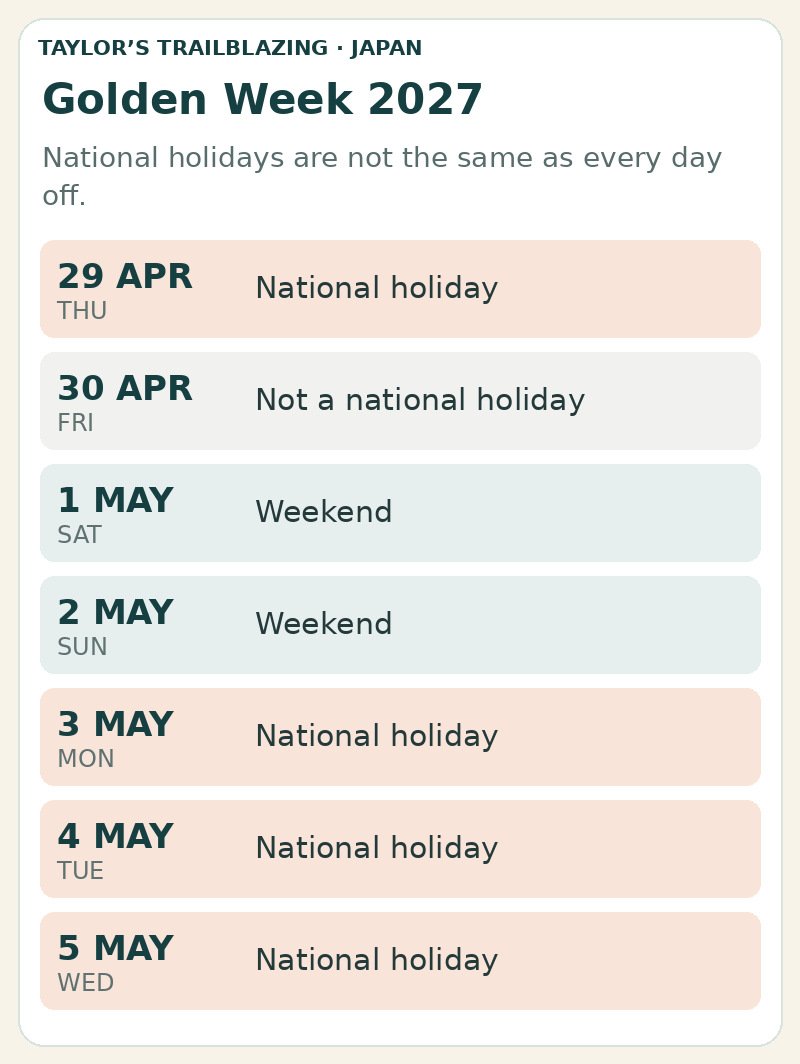
Before choosing a hotel-change date, compare the available journeys around the whole window. Moving a train ride to the Friday is not automatically a solution: it may still coincide with travel around the holiday period. Equally, a date just after Golden Week is not guaranteed to be cheap or quiet.
The simplest adjustment can be to stay in one base through the holiday cluster, take suitable local outings and make the longer intercity move outside it. That reduces the number of reservations which must all work on a difficult day. It does not remove queues from famous attractions.
For a special room, evening event or family visit that cannot move, reverse the process: keep the commitment, then place the surrounding transport and less important sightseeing where there is more flexibility.
Treat New Year and Obon differently from the national list
JNTO identifies late December–early January and mid-August Obon as major holiday travel periods alongside Golden Week. New Year can also bring multi-day business closures. Obon is not itself one of the named national holidays in the Cabinet Office list.[1][2]
For New Year, investigate opening and service arrangements rather than assuming the problem is only a crowded train. Check the actual restaurant, attraction, luggage service and hotel arrival instructions you intend to use. A venue’s normal weekday hours may not settle a holiday visit.
For Obon, investigate the region and the transport you need around mid-August. Avoid applying a single local observance or guessed nationwide peak day to the whole country. A family holiday period, a festival and a national holiday such as Mountain Day can overlap without having identical dates.
Local events can create a bottleneck outside the national list too. Hakone Navi, for example, flags the Hakone Ekiden on 2–3 January and associated traffic restrictions, as well as Golden Week, Obon and autumn foliage pressure. That is a useful reminder to check local event and access notices for the place actually on your route.[7]
Use local school dates—not an invented national calendar
School breaks need a separate source check. The official Kyoto and Fukui calendars below apply to their named municipal school groups in the 2026/27 academic year, not to every school in Japan. Their differences show why one national set of exact school-holiday dates would be misleading.[3][4]
| School group | Winter break 2026/27 | End-of-year break, March 2027 |
|---|---|---|
| Kyoto municipal primary schools | 25 December 2026–5 January 2027 | 25–31 March 2027 |
| Kyoto municipal kindergartens | 24 December 2026–6 January 2027 | 25–31 March 2027 |
| Fukui municipal elementary/junior-high schools | 24 December 2026–7 January 2027 | 25–31 March 2027 |
These sources do not establish the following April’s full start-of-year break or nationwide summer dates for 2027. Check the newly published 2027/28 calendar and the relevant local authority or school before treating those dates as fixed. Private schools and other education groups may follow different calendars.
Broad late-March/early-April, summer and year-end travel checks can help you decide where to investigate, but they are not exact school calendars. For a theme park or family-focused destination, inspect its dated ticket calendar and local context rather than translating “school holiday” directly into a predicted queue length.
Keep your own UK school dates separate as well. Your possible departure dates determine the options you can compare; the Japanese calendars help assess what those options overlap with. Neither overrides the other.
When the dates cannot move, change the structure
Start with the scarce booking or unavoidable journey. Secure a suitable option when it is offered, then arrange less important plans around it. Consider fewer hotel changes, a longer stay in one base and flexible activities rather than trying to move accommodation every few nights.
Here is an original comparison for a hypothetical ten-night trip from 30 April to 10 May 2027. Both versions use Tokyo and Kyoto, but they allocate the nights differently. This is a trade-off illustration, not a recommendation that six Tokyo nights or four Kyoto nights is right for everyone.
| Arrangement | Tokyo nights | Kyoto nights | Tokyo → Kyoto move |
|---|---|---|---|
| Earlier move | 30 April–3 May: 3 nights | 3–10 May: 7 nights | 3 May, a national holiday |
| Later move | 30 April–6 May: 6 nights | 6–10 May: 4 nights | 6 May, not a national holiday |
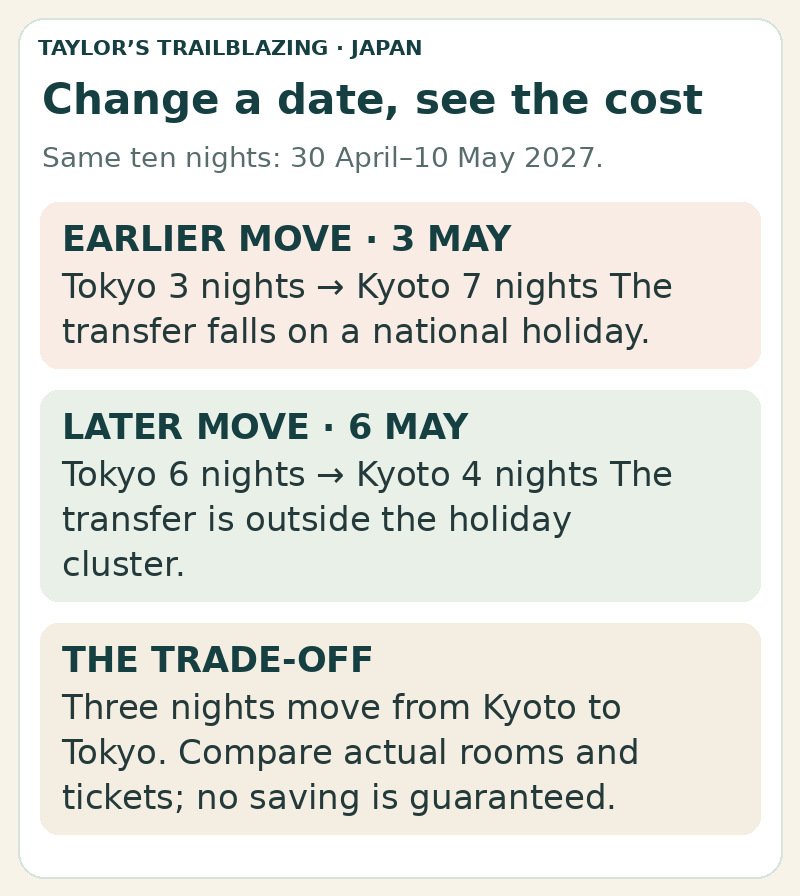
The later move removes the long-distance journey from 3 May, but it gives three nights to Tokyo that the earlier plan spends in Kyoto. That is the price of the change in experience terms. Compare the actual tickets and rooms before adopting it; the calendar alone cannot establish a saving or guarantee space.
Another response is to keep the original allocation and reserve a workable train, with margin around the journey. Moving the date is an option, not a moral requirement. Avoid replacing a clear plan with a much worse one just to escape a red calendar square.
Check the train rules, not just the holiday names
JR Central designates peak periods when Nozomi seating on the Tokaido/Sanyo corridor is entirely reserved. Its page identifies the applicable periods; this guide does not extend a published 2026 operating notice into unannounced 2027 dates. Check the exact notice for your journey before purchase.[5]
SmartEX offers eligible advance reservations, but not every product or special seat is available through the same early window. Check the seating and luggage needs of the whole party and the later confirmation details rather than assuming an early transaction settles every aspect of the trip.[6]
If the preferred journey is full, review later or earlier departures and different travel days before committing to a much less comfortable alternative. Assess the arrival time and the final transfer as well as whether a ticket can be bought. An overnight ride is not an equivalent replacement for every traveller.
Run a bottleneck check before paying
- Mark national holidays for the exact year and keep weekends visually separate.
- Add only the relevant, sourced local school breaks and event dates.
- Flag each long-distance journey and every hotel check-in or check-out.
- Identify the booking with the fewest acceptable alternatives: room, seat, ticket or transfer.
- Compare a realistic second plan and read the cancellation conditions before committing.
- Recheck operating notices nearer departure and leave usable margins around the hardest travel days.
The value of this worksheet is that it points to something you can change. “Japan is busy” does not tell you whether to reserve a seat, move a museum visit or stay another night. “Our only workable Kyoto room and our only acceptable train are both unconfirmed for the same holiday” identifies the actual decision.
Keep an ordinary alternative within the same base: an untimed walk, a different neighbourhood or a meal chosen from several options. A flexible substitute is more useful than a long list of distant alternatives which all require another scarce journey.
Useful questions before you decide
Is every day of Golden Week a public holiday?
No. The 2027 calendar has national holidays on 29 April and 3–5 May. The intervening days include an ordinary Friday and a weekend. Work leave and travel patterns can extend beyond the statutory dates.[2]
Are school holidays the same throughout Japan?
No single exact calendar should be assumed. The official local examples in this guide differ even within the same academic year and, in Kyoto, by school group. Use the relevant authority or school’s published dates.[3][4]
Does a public holiday mean attractions and restaurants are closed?
Not automatically. Check the named venue’s operating calendar. The New Year period particularly warrants a separate closure check rather than reliance on normal weekly hours.[1]
Should I cancel a trip because it overlaps a holiday?
Not on the calendar alone. First check whether suitable accommodation, essential journeys and must-do activities are available on acceptable terms. A workable trip with fewer moves can be better than an expensive change made without checking the actual constraints.
The practical decision
Use the calendar to locate the problem, then solve that problem at itinerary level. Confirm the scarce reservations, reduce unnecessary moves and keep the replaceable parts flexible. The aim is not to avoid every Japanese holiday; it is to avoid a trip that depends on several difficult bookings all working at once.
Research and planning notes
National dates were checked against the Cabinet Office on 17 October 2026; weekdays and the ten-night comparison were calculated separately. School examples refer specifically to the named 2026/27 local calendars. Future school dates, train peak-operation dates and traveller-specific inventory are not inferred from earlier years. The advice is planning analysis, not a crowd or price forecast.
Sources
Source links and selected high-impact claims independently reviewed on 18 October 2026. Booking rules, operating notices and availability can change; use the current source before making a purchase or fixing a journey.
- JNTO — business hours and holidays Major holiday travel periods and operating-hour guidance.
- Cabinet Office of Japan — national holidays in 2026 and 2027 Official date list and statutory substitute/intervening-holiday provisions; Japanese.
- Kyoto City Board of Education — 2026/27 terms and breaks Municipal school and kindergarten schedules; published 3 April 2026; Japanese.
- Fukui City — 2026/27 school-year events Municipal elementary/junior-high schedule; updated 3 April 2026; Japanese.
- JR Central — peak-period Nozomi seating Operator-designated peak dates and reservation guidance.
- SmartEX — reservation reception times Eligible advance reservations and exclusions.
- Hakone Navi — crowd forecast and event pressure points Local operator guidance, not a national crowd forecast.
- 12Go — Tokyo to Osaka route comparison Commercial comparison page; no date-specific availability or fare quoted.
Illustrations in this article were created for Taylor’s Trailblazing Travels. Third-party photographs, where used, are credited beside the image or in the source list.