
What to Book Ahead in Japan — and What Can Wait
Reserve the things you would struggle to replace. Keep breathing space around the rest.
- Reservation decision table
- Official ticket examples
- Flexibility without guesswork
Original editorial illustration of an imagined Japanese inn and garden; it is not a photograph or a recommendation of a particular property.
The useful question is not “How early should I book everything?” It is “What would happen if I left this particular thing unbooked?” Some Japan experiences require advance admission. Others deserve a reservation only because your date, group size or personal needs leave few acceptable alternatives. Plenty of ordinary sightseeing works better with room to change your mind.
Use this guide to sort the booking list before turning it into a calendar. The emphasis is on what belongs on that list, what does not, and which details turn a casual idea into something worth securing.
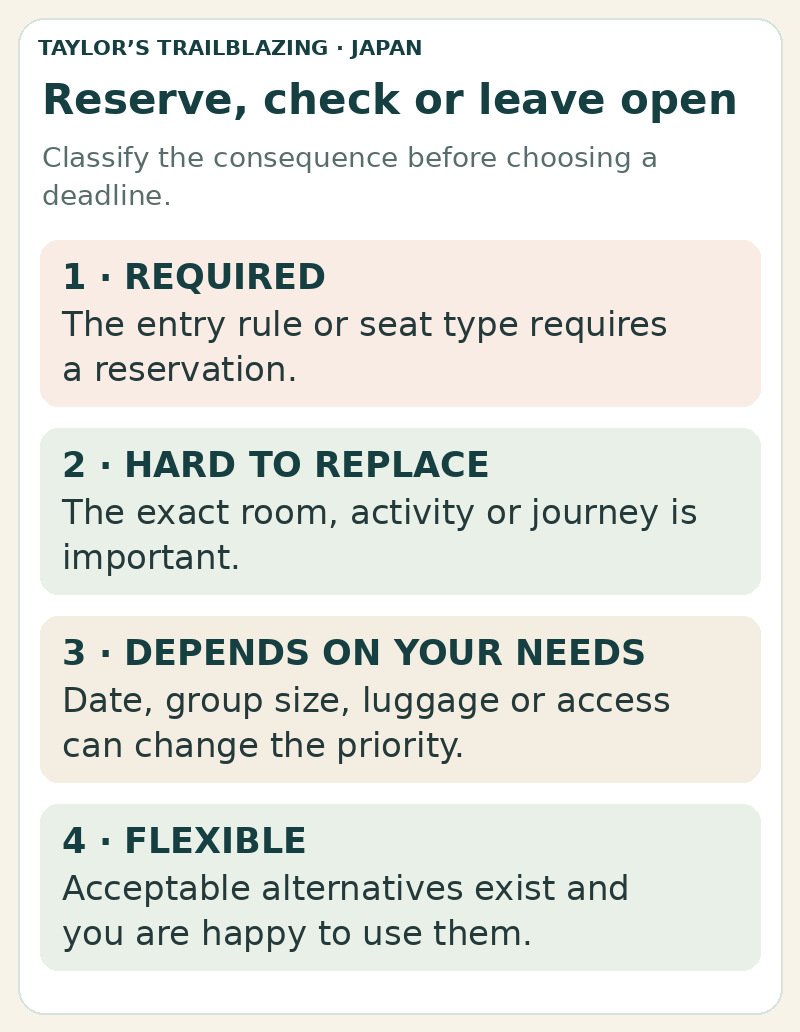
Required
No valid reservation means no entry: act through the official booking route.
Hard to replace
Secure the room, seat or experience that your plan genuinely depends on.
Conditional
Group size, luggage, access needs and busy dates can raise the priority.
Flexible
Leave space when the alternatives are genuinely acceptable.
Sort the bookings by consequence, not by hype
The following classification is an editorial decision framework. Supplier rules override the suggested category. Your own non-negotiable requirements can also move an item upwards: a flexible hotel search and a room that meets a very specific access need are different booking problems.
| Item | Usual decision | What changes the priority |
|---|---|---|
| Advance-only attraction | Book through the authorised release process. | The exact date, entry time and admission conditions. |
| First and last accommodation | Secure a suitable option once flights and route work. | Late arrival, early departure, room needs and rate conditions. |
| Special ryokan or private-bath stay | Book once the essential features are confirmed. | Specific room/bath, meal arrangements and arrival cut-off. |
| Important intercity journey | Reserve when the travel date and suitable product are available. | Peak dates, travelling together, luggage and a fixed onward commitment. |
| Small-group workshop or named restaurant | Reserve if this exact experience matters. | Language, dietary needs, party size and limited alternatives. |
| Ordinary urban transport | Often leave the actual ride flexible. | Special train, reserved seating, last services or accessibility needs. |
| Neighbourhood walk or flexible meal | Usually leave unbooked. | Private access, special event, a particular restaurant or group requirements. |
| Weather-dependent outing | Decide later when practical. | Limited transport, cancellation terms and how acceptable the alternatives are. |
A popular name alone does not establish urgency. Ask whether a comparable time, place or activity would still make you happy. Conversely, a modest workshop can be worth booking early when it is the one activity a family member most wants.
Recognise reservations that are genuinely required
Ghibli Museum in Mitaka is a clear example: admission is by advance reservation, and tickets are not sold at the museum. The official page directs overseas visitors to its recognised purchase methods. Its LAWSON online release is at 10:00 Japan time on the 10th of each month for the following month.[1]
That rule is for Ghibli Museum, not every Ghibli-branded attraction or tour. Check the exact venue and ticket. A tour mentioning a museum is not necessarily an admission ticket, and the existence of a booking page does not guarantee the date you need.
Tokyo Disney Resort currently releases dated park tickets at 14:00 Japan time for the same date two months later, with its stated exception for months lacking a corresponding date. Sales can stop when limits are reached; the official calendar is the purchase check, not a general crowd prediction.[2]
For other timed museums, observation decks, performances or special exhibitions, inspect the venue’s official page before deciding whether to reserve. Identify the exact building, event and ticket inclusions. Do not assume a broad attraction name covers every exhibition or viewing area.
Reserve the accommodation that makes the trip possible
The first night, final night and least replaceable special stay normally deserve attention before filling the evenings with activities. Confirm the airport and arrival time first. A room with a helpful location is not useful if the check-in arrangements do not fit your flight.
For a ryokan, investigate the room, meals, latest arrival, bathing arrangements and any personal requirements. A private bath may be in the room or a separate reservable facility. Before treating it as the reason for choosing a property, obtain the specific answer and understand any extra cost or time limit.
For a family or someone with access requirements, search the actual party size and sleeping arrangement. Do not use the price for two adults as a stand-in for a larger party. Similarly, a general “accessible” label should lead to specific questions rather than finish them.
Read the rate conditions, not just the headline label. Note when payment is taken and the point at which cancellation costs change. Keep only reservations you are genuinely considering and release discarded alternatives within the agreed terms. Flexibility is useful when you understand its deadline.
Reserve the journeys that are expensive to miss
A long-distance train between already-booked hotels is different from an ordinary urban ride taken when you feel ready. Prioritise the journey when your group needs seats together, a particular service is important, the next commitment is fixed, or the available alternatives would damage the trip.
Do not assume all Japanese rail reservations open exactly one month ahead. SmartEX allows eligible products to be reserved up to a year before travel, but not every seat or product is included. Train details can be finalised later, and special products and seating have separate conditions.[3]
Luggage can change the decision too. SmartEX has a separate process for seats with an oversized-baggage area. Check the required seat type for the luggage you will actually carry rather than assuming any reserved seat solves the problem.[4]
JR Central operates all Nozomi seats as reserved during its designated peak periods. Check the operator’s exact current dates; do not infer that every train in Japan follows the same rule or that an unreserved alternative guarantees a seat.[5]
For an arrival-day airport transfer, avoid putting a tight prepaid departure immediately after the scheduled landing unless the service’s terms genuinely accommodate the uncertainty. First inspect immigration, baggage, terminal access and what happens after a delay. A later flexible choice can be more useful than an early nominal saving.
Book the experience you want—not just an attractive description
A small workshop, guided visit or particular meal deserves a reservation when that exact activity is part of the reason for travelling. Check the duration, language, meeting point, actual operator, group size and what the price includes. Make sure transport time fits either side.
Do not prepay every evening in the name of being organised. Leave some meals open so that a late lunch, tired child, weather change or unexpectedly enjoyable neighbourhood does not turn dinner into an obligation.
For a specific restaurant, ask about the booking conditions, menu, dietary arrangements and cancellation policy. A booking service can be useful for a genuine language or reservation barrier, but it is not a reason to replace an ordinary, flexible meal with an expensive set menu.
What can usually stay flexible
Unstructured neighbourhood exploring, shopping and meals chosen from several acceptable places do not need every hour assigned in advance. Check the hours and any access rules of named venues, but leave the order adjustable when no reservation is required. Special exhibitions, private gardens and particular events are separate questions.
Keep some weather-dependent plans movable when the transport and accommodation allow it. The important distinction is whether you can replace the activity without losing something essential. A hilltop view and a museum on the same city stay may be swappable; a remote overnight trip with limited access is a much larger commitment.
Urban transport often works as a decision on the day, but check last services and special reservation products separately. JNTO advises checking the full route and last trains, especially when evening plans extend beyond ordinary sightseeing hours.[6]
Preparation is not the same as prepayment. Saving the hotel address, downloading useful material and checking an account login can remove uncertainty without committing every activity to a date.
Use a short booking test for uncertain items
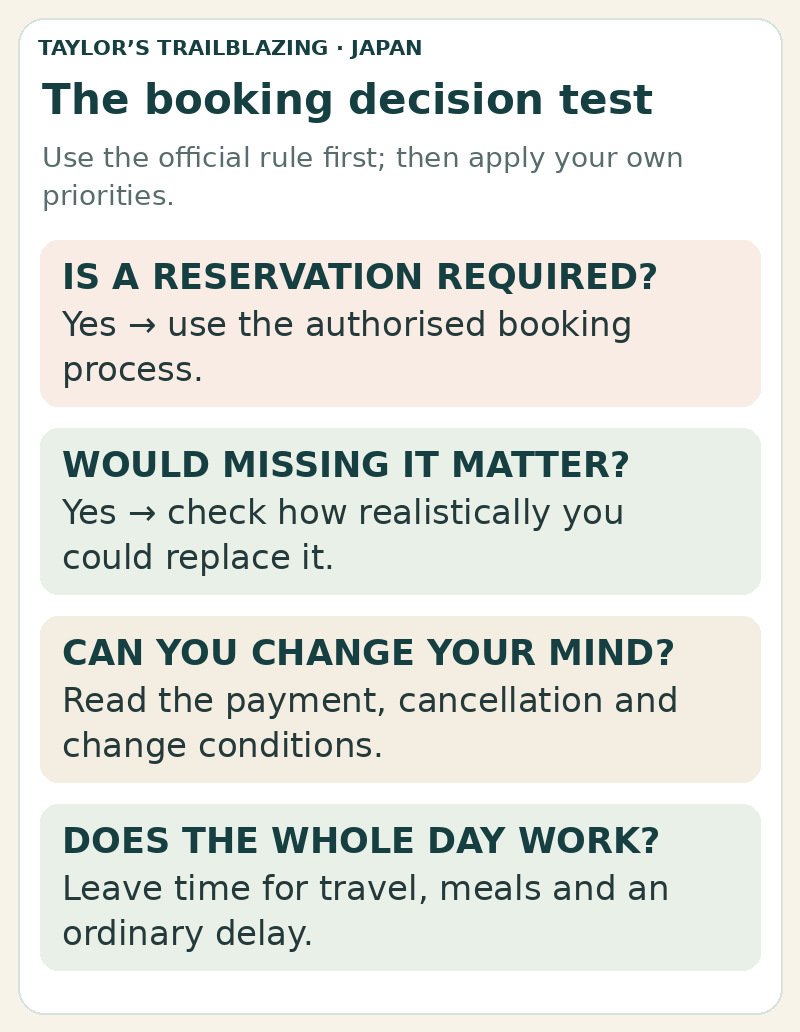
Start with the official rule: does the activity or seat type require a reservation? If yes, use its booking process. If not, ask whether an acceptable substitute is realistically available to you. Finally, compare the cost of changing your mind with the disappointment or disruption of missing out.
| Situation | Better starting decision | Reason |
|---|---|---|
| One must-do workshop on the only free afternoon | Reserve if the exact terms work. | A different day is not a real substitute. |
| Any pleasant neighbourhood walk over three city days | Keep flexible. | You have several interchangeable times and places. |
| A sunset view that would disappoint in poor visibility | Retain flexibility when tickets allow it. | Weather matters more than securing an arbitrary early purchase. |
| A train feeding an important onward commitment | Secure a suitable journey and a buffer. | The consequences extend beyond that one train ride. |
For a short Tokyo stay, that could mean leaving arrival evening open, fixing one wanted timed experience on a middle day and keeping another day for a weather-dependent outing. This is an organising example, not a claim that those experiences are available on your dates.
Apply the test to the whole day as well as the item. Three individually sensible reservations can become a poor plan when their locations and times leave no margin for travel, meals or rest.
Useful questions before you decide
Does “sold out” mean there will never be another chance?
Not necessarily, but do not build the trip around a speculative release. Tokyo Disney Resort explicitly notes that sold-out tickets may return without notice. Follow the official channel and keep an acceptable alternative.[2]
Should I book every Shinkansen trip before leaving the UK?
Prioritise the important and less flexible legs. Check the actual product, dates, luggage and seating requirements rather than using a single rule for all trains. Eligible SmartEX products and peak-period seating have specific conditions.[3][4][5]
Are third-party tickets always the same as buying directly?
No. Compare the named product, inclusions, confirmation process and cancellation rules. A guided tour or package can differ substantially from admission only, even when both mention the same attraction.
What should I leave unplanned on a busy trip?
Keep useful margins around arrival, hotel changes and at least some meals. The best unplanned time is time you can actually use, rather than a gap too short to travel anywhere or recover from a delay.
The practical decision
Reserve the things that determine whether the holiday works. Leave the replaceable parts flexible, with enough information to make a good decision later. A shorter list of well-understood reservations is more useful than a full calendar of commitments you cannot easily change.
Research and planning notes
The booking categories and decision examples are original editorial frameworks, not supplier guarantees or predictions of sell-outs. Named ticket and railway rules were checked on 17 October 2026. Recheck the official source and the exact product terms before purchase; no personal travel experience, ticket availability or commission attribution is claimed.
Sources
Source links and selected high-impact claims independently reviewed on 18 October 2026. Booking rules, operating notices and availability can change; use the current source before making a purchase or fixing a journey.
- Ghibli Museum, Mitaka — official tickets Advance-only entry and authorised overseas purchase methods.
- Tokyo Disney Resort — official park tickets Dated-ticket release rules and current ticket calendar.
- SmartEX — reservation reception times Eligible one-year reservations and exclusions.
- SmartEX — oversized-baggage seating Seat type and booking considerations.
- JR Central — peak-period Nozomi seating Check the exact published operating dates.
- JNTO — business hours and holiday travel Holiday demand, venue hours and transport checks.
- GetYourGuide — Tokyo activities Commercial marketplace for comparing named activities; no dates or prices quoted.
- 12Go — Tokyo to Osaka Commercial transport comparison, separate from official operator conditions.
- Airalo Help Centre — package expiry and activation The selected plan’s activation policy determines when validity starts.
Illustrations in this article were created for Taylor’s Trailblazing Travels. Third-party photographs, where used, are credited beside the image or in the source list.