Japan · Tokyo · Museums
Best Museums in Tokyo: Art, History and Rainy-Day Choices
Pick the collection you want to see, then build a comfortable day around its location, tickets and opening calendar.
The best museums in Tokyo answer different questions. Tokyo National Museum is the strongest starting point for historic Japanese art and objects; Edo-Tokyo Museum explains the city itself; the National Museum of Nature and Science gives families and natural-history enthusiasts a different kind of day.[2][3][7] Choose the subject first, then check the calendar and journey.
A wet day does not have to become a race between buildings. This guide compares the useful collection choices, separates advance-booking visits from flexible ones, and shows how two nearby museums can fit into a comfortable day. The recommendations are based on museum information reviewed on 17 October 2026, with suggested time allowances clearly distinguished from opening hours.
Taylor’s Trailblazing Travels may earn a commission when you book or buy through an affiliate link in this guide, at no extra cost to you. This helps fund the research and upkeep of the site.
Start with your interest
Japan’s art: Tokyo National Museum. Tokyo’s city story: Edo-Tokyo Museum.
Plan one main visit
Treat a second museum as optional, with lunch, movement and a rest built in.
Check the actual date
Weekly closures, installation periods and 2026 refurbishment work change the choices.
Separate ticket types
Collection entry, special exhibitions and guided tours have different inclusions.
Check these museum closures before choosing
Opening information checked on 17 October 2026. Several familiar recommendations need a date check before they can work as a rainy-day plan.
- Edo-Tokyo Museum has reopened: its renovated museum in Ryogoku welcomed visitors again on 31 March 2026. Older advice saying it is shut for a long renovation is out of date.[3]
- Miraikan is closed for refurbishment from 1 October 2026 to 22 April 2027. Choose the National Museum of Nature and Science in Ueno for a science-focused museum day during that closure.[19]
- Mori Art Museum is closed from 24 September to 30 October 2026; its next exhibition starts on 31 October. It cannot rescue an indoor day before then.[13]
- Nezu Museum is between exhibitions after 12 October, with its next show beginning on 24 October 2026. Its gallery, garden and café are not an everyday fallback between exhibitions.[11][12][30]
A collection museum can also close for maintenance or installation work. Check the actual date in its calendar, especially around Mondays, public holidays and the New Year; a search result displaying normal opening hours is not enough.
The best museums in Tokyo for different interests
The selections below balance what you will see, how much time it merits, ease of entry and the usefulness of its location. Use the best-fit descriptions to choose a subject and a manageable commitment. Time allowances are suggested gallery time, excluding your journey, ticket queues and meals.
Swipe or scroll sideways to read every column.
| Museum and best fit | Admission to plan around | Suggested time | Hours and booking effort |
|---|---|---|---|
| Tokyo National Museum, Ueno: historic Japanese art and archaeology | ¥1,000 collection | 2–3 hours | 09:30–17:00; Friday/Saturday to 20:00. Usually closed Monday. Online collection tickets useful.[1][2] |
| Edo-Tokyo Museum, Ryogoku: how the city and everyday life changed | ¥800 permanent exhibition | 2–3 hours | 09:30–17:30; Saturday to 19:30. Usually closed Monday. Online or on-site purchase.[4][5] |
| National Museum of Nature and Science, Ueno: dinosaurs, nature and science | ¥630 permanent exhibitions | 2–3 hours | 09:00–17:00. Usually closed Monday. Check temporary gallery closures.[6][7] |
| National Museum of Western Art, Ueno: European paintings and sculpture | ¥500 collection | 1–1½ hours | 09:30–17:30; Friday/Saturday to 20:00. Usually closed Monday.[8][9] |
| National Museum of Modern Art, Tokyo (MOMAT), Takebashi: Japanese modern art | ¥500 collection | 1½–2 hours | 10:00–17:00; Friday/Saturday to 20:00. Usually closed Monday; also closed 22 October 2026.[10] |
| Nezu Museum, Aoyama: a focused art exhibition and garden | Collection ¥1,400 online / ¥1,600 at door; special shows from ¥1,600 / ¥1,800 | 1½–2 hours with garden | 10:00–17:00. Usually closed Monday and between exhibitions. Timed online tickets; next show 24 October.[11][12] |
| Mori Art Museum, Roppongi: contemporary exhibition and an evening visit | Next show, standard online: ¥2,600 weekday / ¥2,800 weekend or holiday; at-door prices ¥200 higher. See advance offer below. | 1½–2 hours | From 31 October: generally 10:00–22:00; Tuesday to 17:00. Dated exceptions apply. Select exhibition and slot.[14] |
| Ghibli Museum, Mitaka: animation and Studio Ghibli | ¥1,000 base admission for ages 19+; check ticket-channel fees | 2–3 hours | 10:00–18:00 on its opening dates. Advance reservation essential; no door sales.[15][18] |
The easiest way to narrow this list is to finish the sentence “I want to understand…”. Choose Tokyo’s streets and domestic life for Edo-Tokyo; Japanese objects and artistic traditions for Tokyo National Museum; modern painters and changing artistic ideas for MOMAT; or nature and evolution for the science museum. Paying for a museum that answers your question matters more than ticking off the most famous name.
Japanese art or Tokyo history: choose the right starting point
Tokyo National Museum: the strongest starting point for objects and art
Tokyo National Museum brings together painting, calligraphy, sculpture, decorative arts and archaeology, with a searchable record distinguishing collection holdings from objects currently displayed.[2] Choose it if the temples, ceramics, costumes and historic places on the rest of your Japan itinerary would mean more with some visual context.
For a first visit, make the Japanese Gallery, Honkan, your main commitment. Give yourself permission to skip whole rooms and concentrate on three themes that interest you. Comparing one object closely with the next usually teaches more than walking past every case. An archaeological or Buddhist-art interest can justify another gallery, but a collection ticket need not become an obligation to cover the whole campus.
The trade-off is breadth. Someone who wants one continuous story about Tokyo’s development may find Edo-Tokyo easier to organise mentally. In heavy rain, staying in one main building also reduces the inconvenience of moving between galleries around the museum grounds.
If you would enjoy asking questions and having someone select objects for you, Check the private Tokyo National Museum tour on GetYourGuide. MACHI TOUR JAPAN advertises English-guided options of two or four hours, with admission included and special exhibitions excluded. One itinerary label names MOMAT even though the stated address and gallery details are for Tokyo National Museum in Ueno. Confirm the venue and chosen duration with the provider before paying.[25] Independent entry remains the sensible choice if you mainly want a short, inexpensive browse.
Edo-Tokyo Museum: the clearer choice for the city’s story
The permanent exhibition uses Edo and Tokyo zones, models and life-size reconstructions, including a reconstruction of part of Nihonbashi Bridge. These create a framework for thinking about houses, streets, social differences and the expanding city.[29] This is the stronger choice for a traveller who wants to understand the setting behind modern Tokyo rather than study individual artworks.
It can work well for a mixed-interest group: choose a shared question, such as “How did ordinary people live?”, and use that to select displays. The disadvantage is the temptation to read everything. A two-hour visit needs a narrower brief than a half-day visit.
Ryogoku also has a useful wet-weather approach: the museum lists approximately one minute on foot from Toei Oedo Line Ryogoku exits A3/A4, or three minutes from the JR station’s west exit. Those are published walking estimates, not a guarantee of a step-free route or a completely covered approach.[24]
Art museums: match the collection to your appetite
National Museum of Western Art: a manageable Ueno companion
The permanent galleries cover European painting from the late medieval period through the early twentieth century, alongside sculpture. The museum’s guide places it about a minute’s walk from JR Ueno’s Park Exit.[9] This combination makes it a useful second stop: a narrower visual brief and a convenient position when you are leaving the park.
Choose it if you enjoy close looking at paintings, or if one person in your group prefers familiar European artistic traditions. Give yourself three or four works to linger over. If your main aim is learning about Japan, put Tokyo National Museum or MOMAT first; the Western Art collection then becomes a deliberate contrast.
MOMAT: Japanese art after the traditional-art galleries
MOMAT gives a different lens on Japanese art. Its autumn 2026 collection display includes paintings by Kaburaki Kiyokata, Hishida Shunso and Higashiyama Kaii, while a related display considers Japanese artists in Paris. The collection programme runs from 29 September 2026 to 11 January 2027, with rotations during the period.[10]
It is a good fit when you want to consider how artists represent modern life, landscape or exchanges of ideas across countries. Make it a dedicated Takebashi outing. Adding it after two Ueno museums risks spending the afternoon changing trains while your attention for art is already fading.
Nezu Museum: let the exhibition lead, with the garden as a bonus
Nezu’s next exhibition, Bugaku Costumes: The Enduring Beauty of Textiles, runs from 24 October to 23 November 2026, with adult online admission of ¥1,600 and same-day admission ¥200 higher.[12] This illustrates the right way to choose Nezu: inspect the current exhibition theme before deciding the museum belongs on your itinerary.
The garden can make the visit especially appealing when the weather permits, but it should not carry the whole value calculation on a day of persistent rain. Ask whether the gallery exhibition alone would interest you enough to pay. If the answer is no, choose another art museum and save Nezu for a drier day.
From Omotesando, the museum lists an eight-minute walk from A5 or a ten-minute walk from B3, the lift exit. The latter is useful to know when planning with a wheelchair, pushchair or difficulty using stairs; it does not establish that every garden path will suit you.[11]
Mori Art Museum: choose the show, then use the late opening
Mori is an exhibition-led choice. Its next major show, Mariko Mori: All That Shines, opens on 31 October 2026 and runs to 28 March 2027. Most evenings during that run extend to 22:00, but Tuesdays normally finish at 17:00 and some dates differ.[14]
Booking before the exhibition opens can reduce the cost. The museum’s online advance offer lists adult tickets at ¥2,100 for weekdays or ¥2,300 for weekends and holidays, for purchases through 30 October 2026. Select the correct visit date and check the offer conditions.[31]
That can free the daylight hours for another part of your trip. It does not make an exhibition automatically interesting to every traveller: read the show description first. Check exactly what the ticket includes; Mori Art Museum, Tokyo City View and Mori Arts Center Gallery are separately named venues, so a booking for one should not be assumed to admit you to all three.[13]
A useful alternative: the National Art Center, Tokyo
This is an exhibition centre without a permanent collection. Entry to the building is free, while exhibition admission and ticket arrangements vary.[20][21] It is useful when a current show interests you, or when architecture is your reason for going; free building access alone should not be mistaken for a free museum collection.
Nogizaka Station Exit 6 provides direct access, making the station approach particularly useful in rain. Normal building hours are 10:00–18:00, with Tuesday closure and holiday exceptions.[20][22] Check the exhibition calendar before making it the main event.
For families: dinosaurs now, Ghibli with a reservation
National Museum of Nature and Science
The museum’s permanent galleries cover subjects including dinosaur evolution, biodiversity and science and technology, across the Japan and Global galleries.[7] It is the most straightforward choice here when children are motivated by creatures, specimens and big questions about the natural world.
Start with the subject your child already likes, then add one unfamiliar area. A “find everything” approach turns the building’s scale into a problem; a dinosaur-focused morning followed by lunch can be a complete visit. Adults with an interest in natural history need not treat it as a children-only option.
At the review date, part of Global Gallery 2F was temporarily closed, and the third basement floor had been closed for renovation since 8 September 2026. Check which galleries are available if a particular exhibit is the reason for your trip. General permanent admission is free for high-school pupils and younger, with separate rules for special exhibitions.[6]
Ghibli Museum: an animation visit worth planning around
Ghibli’s rooms explore the making of animation, and the museum includes its own short-film theatre, a rooftop garden and the Cat Bus play area for children aged 12 and under.[17] The film-making emphasis can interest adults as much as children; a family expecting unrestricted play throughout the building may want the science museum instead.
This is not a spontaneous response to a weather forecast. Entry requires a reservation and there are no museum ticket sales on arrival. The overseas Lawson release is advertised for 10:00 Japan Standard Time on the tenth of each month for the following month. Start from the museum’s official English ticket page and use its linked English Lawson channel.[15]
For visits from November 2026, the museum announced a new QR-based ticket system and a ¥110 per-ticket system fee in its 6 October Japanese notice. That notice links the Japanese Lawson route; overseas visitors should check the fee and ticket-display instructions in their own English booking channel rather than assume the domestic procedure is identical.[16]
Allow extra time for Mitaka. The museum’s published directions give approximately 20 minutes by JR Chuo Line from Shinjuku to Mitaka, followed by a 15-minute walk from the south exit; a community bus is another option.[18] Those components exclude reaching Shinjuku, waiting, finding the correct exit and museum entry. Keep at least half a day available rather than fitting Ghibli between two central-Tokyo appointments.
For travellers who want a packaged day, Compare the JTB Ghibli Museum bus tour on Viator. The museum itself lists Sunrise Tours JTB as an official overseas booking route, and this product is supplied by JTB Global Marketing & Travel.[15][26] This is an advertised 8½-hour bus day, usually including the Edo-Tokyo Open Air Architectural Museum; a temple may replace that stop when the museum is closed. Plan for outdoor time as well as galleries. The Viator option checked was non-refundable and not wheelchair accessible. Compare its full itinerary and terms with the operator’s own booking, which has a different cancellation schedule. Entry is subject to confirmation and availability.[26][27]
Build a rainy-day plan around attention, not a museum count
A useful museum day needs three budgets: money, time and attention. Admission is often the smallest of these. A second museum can be inexpensive, yet still cost an hour of useful concentration if getting there means another station, another queue and another round of decisions.
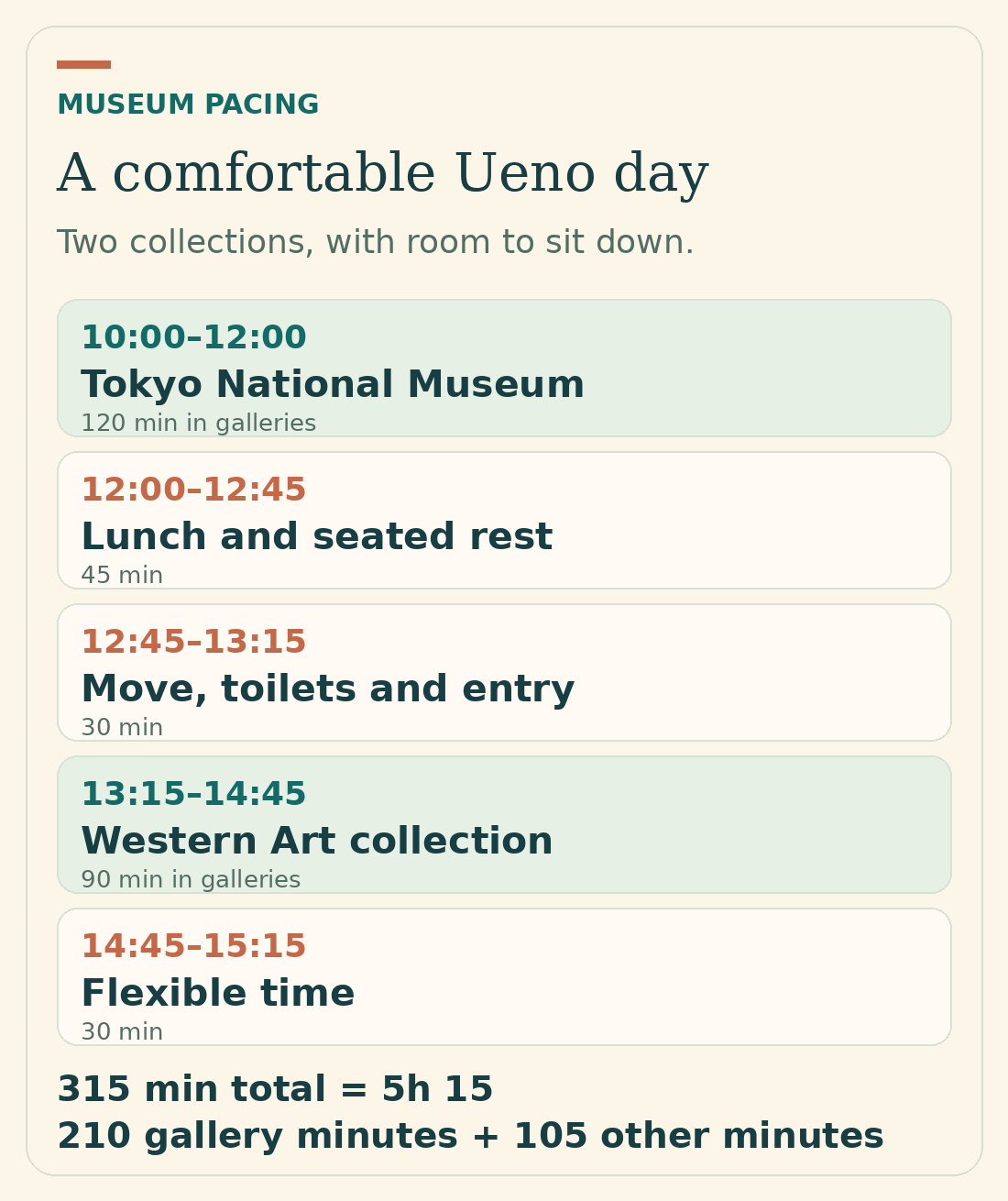
An adaptable Ueno day: art and history in 5 hours 15 minutes
Use Tokyo National Museum as the main visit, then add the National Museum of Western Art only if you still want more. Both are in the Ueno museum area; the timing below is an original pacing plan, not a guided-tour timetable or measured route.[1][9]
Swipe or scroll sideways to read every column.
| Time | Commitment | Why it belongs |
|---|---|---|
| 10:00–12:00 | Tokyo National Museum: 120 minutes | One main gallery and selected interests; arrive before 10:00 for admission. |
| 12:00–12:45 | Lunch and a seated rest: 45 minutes | Decide whether you actually want a second museum. |
| 12:45–13:15 | Moving, toilets and next entry: 30 minutes | A combined allowance, not a claim that the walk itself takes 30 minutes. |
| 13:15–14:45 | Western Art collection: 90 minutes | A different subject with a deliberately shorter visit. |
| 14:45–15:15 | Flexibility: 30 minutes | Use it for delays, another room or an earlier finish. |
The arithmetic is 120 + 45 + 30 + 90 + 30 = 315 minutes. It reserves 3½ hours for galleries and 1¾ hours for the things an attraction list usually forgets. If rain, mobility needs or queues use the flexibility first, shorten or remove the second museum rather than compress lunch and rest.
For a family with dinosaur enthusiasts, replace the first museum with the National Museum of Nature and Science. If the children are still engaged there at lunchtime, use the afternoon for more of the same collection and drop Western Art. The replacement is a choice, not a requirement to finish both.
When one museum is the better plan
- With around three hours available from leaving your hotel to returning, choose one venue after checking the door-to-door journey. The allowances above cannot simply be squeezed into that window.
- During heavy rain, compare the station approach as well as the indoor galleries. Ueno’s museums are separate buildings; the National Art Center’s direct Nogizaka access can be more convenient if its exhibition fits.[22]
- If you are curious about a specialist exhibition, spend the second ticket budget there. It is usually a better use of attention than adding an unrelated collection purely because it is nearby.
- If you only need an evening plan, check Friday/Saturday collection opening at Ueno or MOMAT, or Mori’s exhibition dates and evening calendar. Last admission is not the amount of time you need to enjoy the visit.[1][8][10][14]
Use Edo-Tokyo as a separate Ryogoku half-day if urban history is your main interest. A single large museum with a comfortable lunch is a stronger plan than automatically combining it with a cross-city art stop. Keep gardens and longer outdoor walks optional until you see the weather.
If this is part of a first visit, the Japan travel guide for first-time visitors helps put Tokyo’s museum days into the wider journey.
Tickets, realistic costs and when a museum pass helps
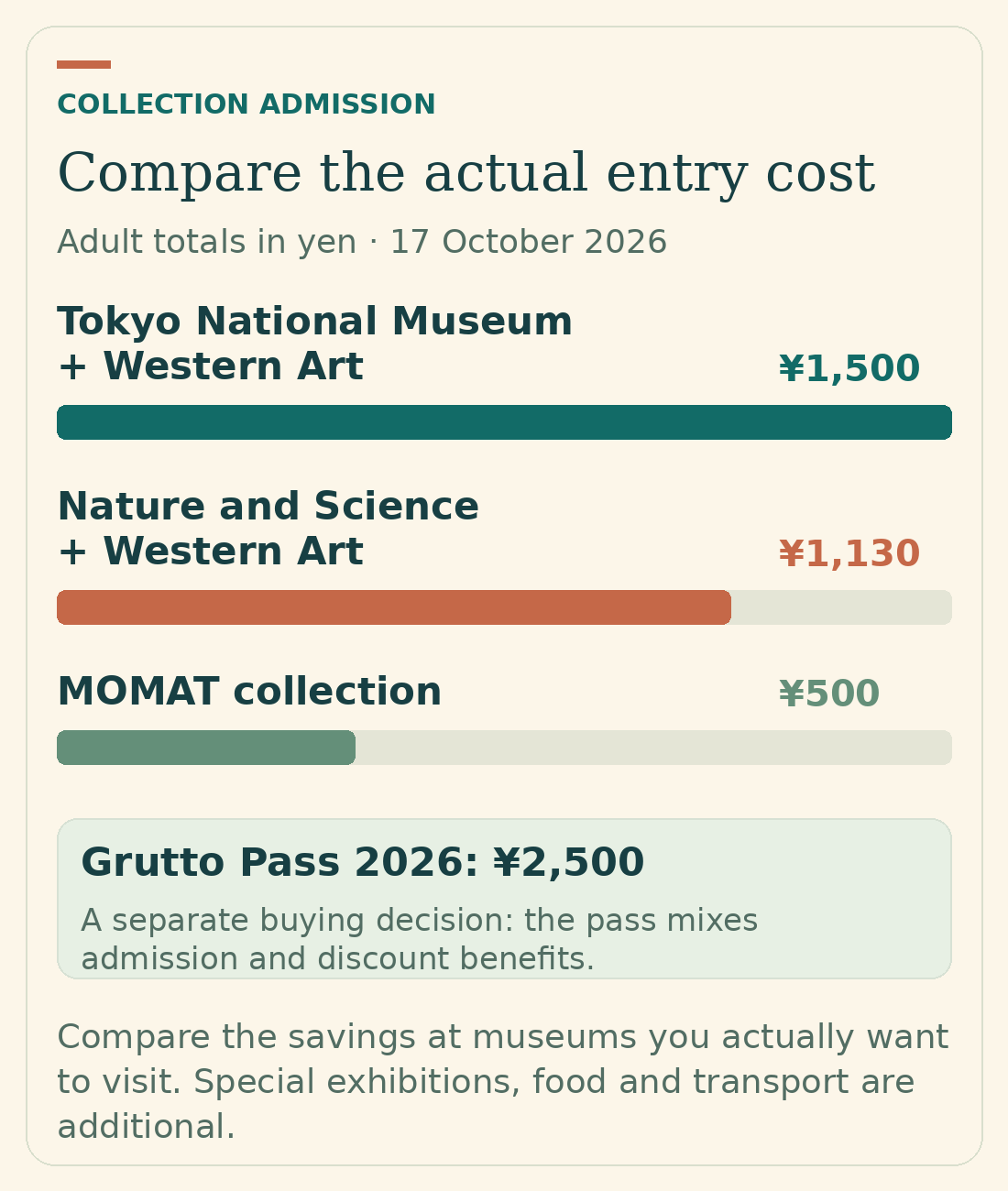
Start by distinguishing collection admission from the separately priced exhibition advertised on a banner. The cheapest ticket may not include that show. Conversely, a special-exhibition ticket may include the collection too: Tokyo National Museum explicitly includes its collection exhibitions with a special-exhibition ticket on the same day.[1] Check this before paying twice.
Swipe or scroll sideways to read every column.
| Plan | Calculation | Admission total |
|---|---|---|
| Tokyo National Museum + Western Art | ¥1,000 + ¥500 | ¥1,500 |
| Nature and Science + Western Art | ¥630 + ¥500 | ¥1,130 |
| MOMAT collection only | One collection ticket | ¥500 |
These totals use the museums’ published collection prices; they show why an inexpensive museum pair does not automatically justify a sightseeing pass.[1][6][8][10]
The Tokyo Museum Grutto Pass 2026 costs ¥2,500 and combines admission tickets with discount coupons. It lasts two months from first use, with a final expiry of 31 March 2027, and each designated facility can be used once.[28]
For either Ueno pair above, paying separately costs less than the pass price even before checking what it includes. For a longer museum-focused stay, list the institutions you actually intend to visit and add only the savings the pass gives at those institutions. A ¥200 discount contributes ¥200 towards breaking even, not the full ticket price. Buy when realistic savings exceed ¥2,500; do not fill extra days with unwanted museums to make the arithmetic work.
For guided experiences, compare admission, guide language, duration, private versus shared group, meeting point and cancellation terms. A ticket booking and a guided museum visit solve different problems. Pay for interpretation when you value it; use the official collection ticket when all you need is entry.
Practical checks for a comfortable visit
Access includes the approach, seating and sensory needs
Tokyo National Museum publishes lift and ramp information, wheelchair and walking-aid loans, accessible-toilet details and sensory maps covering seating, sound and light. Its accessibility page also identifies steep entrance ramps and small internal steps in some buildings.[23] Read the parts relevant to you instead of relying on a blanket “accessible” label.
For any museum, check the appropriate station lift, entrance, distance to seating and the particular exhibition’s layout. A companion discount and a step-free gallery do not answer every practical question. Contact the venue if you need to confirm acceptance of overseas disability documentation or a particular mobility aid.
Remove avoidable arrival-day problems
- Leave your suitcase with your accommodation or a suitable storage service before Tokyo National Museum. Its current notice prohibits suitcases and says that baggage inspection and metal-detector screening operate at the main gate.[1]
- Keep entry instructions and reservation details available on your phone, and check whether the ticket needs a live display rather than a screenshot. Allow battery for the return journey too.
- Wear shoes you can comfortably stand in and carry a light layer. The National Art Center specifically advises adjustable clothing because exhibition rooms can be cool.[20]
- Carry required age or student identification if claiming a reduced price. Read the rule for your museum rather than assuming that one institution’s age bands apply everywhere.
- Check the final entry time, then work backwards from how long you want inside. Arriving five minutes before admissions stop rarely makes a satisfying visit.
Finally, choose your subject before buying. Digital installations can be a good alternative for someone who wants immersive art, but they deserve their own decision about sensory experience and timed tickets. They do not replace the historic collections, science galleries or city-history explanations compared here.
Questions before you go
Which museum should I choose if I have only 90 minutes inside?
For paintings, the National Museum of Western Art is a practical focused choice near JR Ueno’s Park Exit. Choose the collection and a few works to examine closely, rather than adding a separate exhibition.[9] A short visit to Tokyo National Museum can also work if you commit to one gallery and accept that most of the campus will remain unseen.
Will the famous object shown on a museum website be on display?
Do not assume it. A collection catalogue shows what a museum holds, which can differ from what is currently exhibited. Tokyo National Museum’s collection search distinguishes current displays; check the object and exhibition dates if one work is the reason you are travelling.[2] Choose a second interest so a rotation does not undermine the whole visit.
Is Ghibli Museum worthwhile for children unfamiliar with the films?
It can be if they enjoy drawing, animation or imaginative buildings: the museum explains the making of films and includes an original short-film theatre.[17] Familiarity with a few films gives the characters more meaning, but the bigger question is whether your child enjoys looking and discovering. If they need a broader subject choice and you have no reservation, choose the science museum.
What if Monday is my only free museum day?
Check the National Art Center’s exhibition programme first: its normal closure is Tuesday, with holiday exceptions.[20] Mori can also work during an active exhibition, but not during its September–October 2026 installation closure.[13] A public-holiday Monday can change the usual rules elsewhere, often moving closure to the next day. Confirm your date at the chosen museum.
Make your choice
Choose Tokyo National Museum if this is your first chance to explore Japanese art, and Edo-Tokyo if you want the city’s development to make more sense. For families, follow the children’s interests: dinosaurs and science can make a complete day, while Ghibli needs its own reservation and time in Mitaka.
Keep one principal museum and one optional addition. That leaves enough space for attention, food and the weather—and makes the visit easier to adapt without losing what you most wanted to see.
Sources
Official visitor information and the identified booking listings were consulted for this guide. Prices and dated operating information were checked on 17 October 2026; recheck the relevant venue and your selected ticket before travelling.
- Tokyo National Museum: admission, opening hours and visitor notices
- Tokyo National Museum: the collection and current-display search
- GO TOKYO: Edo-Tokyo Museum reopening and visitor overview
- Edo-Tokyo Museum: admission and tickets
- Edo-Tokyo Museum: opening hours
- National Museum of Nature and Science: Ueno admission and closure notices
- National Museum of Nature and Science: permanent exhibitions
- National Museum of Western Art: visitor information
- National Museum of Western Art: English museum guide
- MOMAT Autumn Days 2026: collection admission, hours and calendar exceptions
- Nezu Museum: visitor information and admission
- Nezu Museum: Bugaku Costumes, 24 October–23 November 2026
- Mori Art Museum: current closure and exhibition schedule
- Mori Art Museum: Mariko Mori, All That Shines
- Ghibli Museum: official overseas ticket routes and admission
- Ghibli Museum: ticket-system change announced 6 October 2026 (Japanese)
- Ghibli Museum: exhibition rooms, animation and rooftop garden
- Ghibli Museum: hours and directions
- Miraikan: refurbishment closure and admission information
- National Art Center, Tokyo: visitor FAQs
- National Art Center, Tokyo: role and exhibition programme
- National Art Center, Tokyo: station access
- Tokyo National Museum: accessibility and sensory information
- Edo-Tokyo Museum: station approaches
- GetYourGuide: MACHI TOUR JAPAN private Tokyo National Museum tour
- Viator: JTB Ghibli Museum and film appreciation bus tour
- JTB Sunrise Tours: Ghibli Museum and film appreciation bus tour
- Tokyo Museum Grutto Pass 2026: price and conditions
- Edo-Tokyo Museum: permanent exhibition and reconstructed streets
- Nezu Museum: collection exhibition ending 12 October 2026
- Mori Art Museum: Mariko Mori advance-ticket offer and selling deadline
Illustrations in this article were created for Taylor’s Trailblazing Travels. Third-party photographs, where used, are credited beside the image or in the source list.