Seminyak or Canggu: Beaches, Dining and Accommodation Compared
Two neighbouring coastal choices, compared through the daily holiday you actually want.
Original coastal illustration, not a photograph or a location-accurate view.
Choosing Seminyak or Canggu is less about finding the fashionable answer and more about deciding what happens after you leave your room. Will most days revolve around dinner reservations and a beach walk, or a surf lesson, a favourite breakfast place and time in one neighbourhood?
The two names also hide substantial differences between individual streets and properties. This comparison treats the area as the starting point, then tests the actual hotel, daily journeys and beach expectations. It is a research-led planning guide, not a report of personal stays.
Some links in this guide are affiliate links. Taylor’s Trailblazing Travels may earn a commission if you book or buy through them, at no extra cost to you.
A dining-led short stay
Start with the restaurants and beach entrance you will actually use.
A surf-centred routine
Pick one pocket rather than travelling across the area all day.
Sea conditions matter
A surf beach and a hotel pool solve different holiday needs.
Count everyday transport
The cheaper room is not necessarily the cheaper holiday.
Seminyak or Canggu: compare the holiday, not the label
Seminyak is the more natural starting point for a trip organised around varied dining, browsing shops and a coastal hotel. Canggu earns its place when the surf-oriented coast is itself a reason to go. Those distinctions follow the destinations’ established tourism identities; the recommendations below are editorial judgements rather than measured quality scores. [1][2]
| Decision | Seminyak starting point | Canggu starting point |
|---|---|---|
| Main holiday priority | Meals, shopping and a beach-facing base | Surfing and a recurring neighbourhood routine |
| A short stay | Good candidate when daily stops sit close together | Works when the chosen pocket contains the activities |
| Ocean expectations | Sunset and beach time, not guaranteed calm swimming | Surf focus, not a sheltered swimming lagoon |
| Accommodation choice | Assess the exact room, entrance and nearby streets | Check whether the address matches the advertised neighbourhood |
| Evening plans | Choose a dining pocket; check noise at the room | Choose the venue or beach first; plan the journey home |
| Without a scooter | Favour a small walking area plus booked cars | Apply the same test more strictly; avoid scattered daily stops |
There is no defensible universal winner for couples, families or first-timers. A quiet, well-positioned Canggu hotel may serve a family better than a noisy Seminyak room. Equally, a traveller who likes surf culture but does not plan to surf need not choose Canggu if most desired meals and outings are elsewhere.
Start by writing three things you expect to do repeatedly. Give each a real location. An area that suits those repeated journeys usually matters more than an attraction visited once.
Choose a usable pocket inside the area
For Seminyak, distinguish the Double Six side, the Kayu Aya dining-and-shopping area and the Petitenget side rather than treating the whole coastal strip as one hotel zone. The tourism board describes an area extending from Double Six towards Petitenget and the neighbouring settlements; its boundaries are not a neat municipal box. [1]
For a Canggu search, inspect the map around Berawa, Batu Bolong and Echo Beach rather than accepting the area name as a distance guarantee. Listings around neighbouring places can appear in the same broad search. Check the precise entrance, not just the middle of a property plot. A wall, river, construction site or missing crossing can make an apparently close destination awkward.
For each shortlisted room, check two ordinary routes: the morning walk to your chosen beach entrance and the return from your preferred dinner area after dark. Note crossing points and the place a driver can actually stop. The deciding question is not how central the neighbourhood sounds but whether you would repeat those two journeys comfortably.
The daily-life triangle
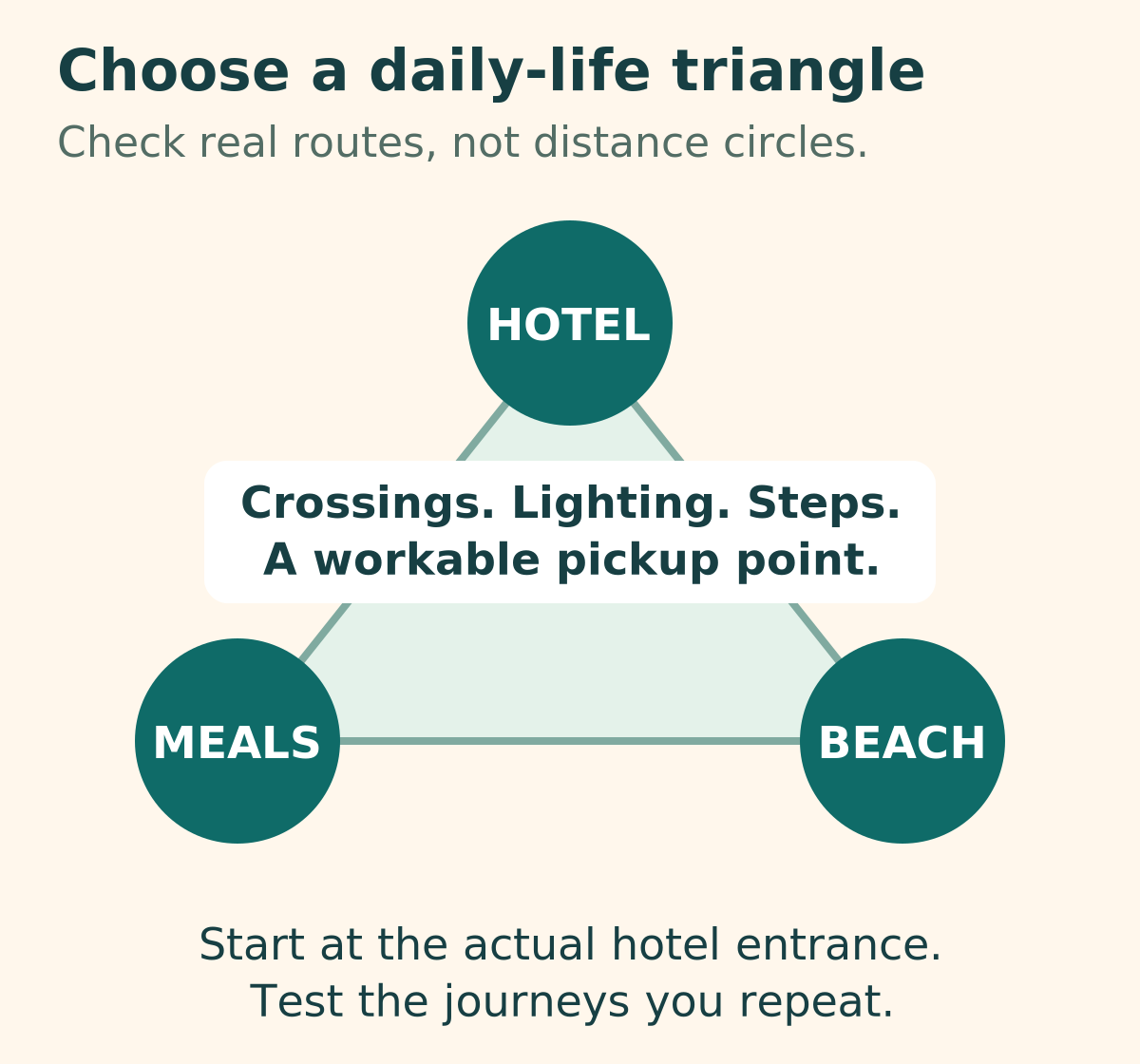
Put your hotel entrance, two realistic places to eat and your intended beach access point on a map. Then inspect the routes between them. Check crossings, pavement continuity, lighting, steps and where a car can collect you. This is an original practical screening method, not a claim that every street in one area is better than every street in the other.
Read this graphic
Schematic linking the hotel entrance, everyday meals and the beach access point, with actual walking routes to be checked.
Reject a convenient-looking hotel when the only attractive walk depends on a shortcut you cannot verify. Ask the property for a current description or short video of the route. For a pushchair or mobility aid, ask about kerbs and gradients as well as distance.
For remote work, add a separate fourth check: an actual workspace and connection that meet your needs. Neither a cafe scene nor a “fast Wi-Fi” amenity label proves a particular room is suitable for work calls.
Beaches: separate scenery, surfing and swimming
Canggu’s tourism identity is strongly tied to surfing and its darker sand. That makes it an appealing setting for people who enjoy watching waves or building a trip around lessons. It does not make every break appropriate for a beginner. [2]
Seminyak is a sensible candidate for a beach walk and a sunset-oriented holiday, but the distinction is not “swimming beach versus surf beach”. Bali can have dangerous currents, and local flags and advice take priority over a destination description. [3]
Choose a hotel pool as the dependable swimming component when travelling with children or when relaxed daily swimming matters. At the shore, assess the conditions on the day rather than assuming that the number of people in the water means it is suitable.
When a lesson changes the choice
A surf lesson can justify Canggu when the instructor, meeting point and lesson timing fit your stay. Ask where beginners will actually enter the water, how groups are organised and what happens when conditions are unsuitable. A lesson sold under “Canggu” is not evidence that every nearby beach is beginner-friendly.
For non-surfers, the result can be the opposite: a nicer pool, shorter dinner walk or calmer room may matter more than being steps from a famous break.
Dining and evenings: choose by frequency
Seminyak’s established dining-and-shopping focus makes it a useful default for travellers who want several different evenings without making each one a separate excursion. That is an area-level starting point, not a promise that every room is within an easy walk of good restaurants. [1]
Rather than collecting a long list of fashionable places, shortlist a breakfast option, a simple meal and one special dinner. Check whether each is a realistic journey from the proposed accommodation. A holiday with three cross-area restaurant trips every day can become transport-led even when the food itself is excellent.
Canggu makes more sense when you already have a neighbourhood or activity routine in mind. For example, a lesson, a nearby lunch and an unhurried afternoon may be a better fit than breakfast in one district, shopping in another and dinner back across traffic. The point is to reduce repeated movement, not to declare one area more authentic.
Noise is a room-level question
Ask whether the specific room faces a road, bar, event space, construction site or service area. A “quiet hotel” review from several months ago cannot settle what is happening beside the room you are booking. Check recent dated feedback and ask about planned works.
For a late evening, agree where you will meet the return car before entering a busy venue. Travellers who want early nights should make that a booking criterion, not rely on the area’s general reputation.
Accommodation: two examples, then the booking test
Hotel Indigo Bali Seminyak Beach and COMO Canggu illustrate why the address matters more than a destination label. They are examples for researching location and facilities, not a ranked shortlist or hotels personally inspected for this guide.
Hotel Indigo is an established Seminyak beach-area property. Use its official location details to investigate whether that part of Seminyak suits your daily plans; do not assume it places every restaurant in the wider area nearby. IHG also makes clear that cancellation depends on the rate booked. [4]
COMO Canggu identifies its location at Echo Beach and publishes an on-site surf offering. That is a more specific proposition than simply “stay in Canggu”: it is relevant when the coast and surfing are central to the holiday. Verify the room category and included services rather than assuming that all accommodation has the same view or facilities. [5]
Apply the same checks to smaller hotels, guesthouses and villas. Is breakfast included? Can a car reach the entrance with luggage? Is there a staffed arrival arrangement? Are taxes and service charges included in the final total? Can a villa provide the level of support your group expects?
Before paying for a non-refundable rate, ask the property the one question most likely to change your choice. For one traveller that is overnight noise; for another it is the exact walk to dinner or whether the pool can be supervised comfortably.
A five-night cost test that exposes false savings
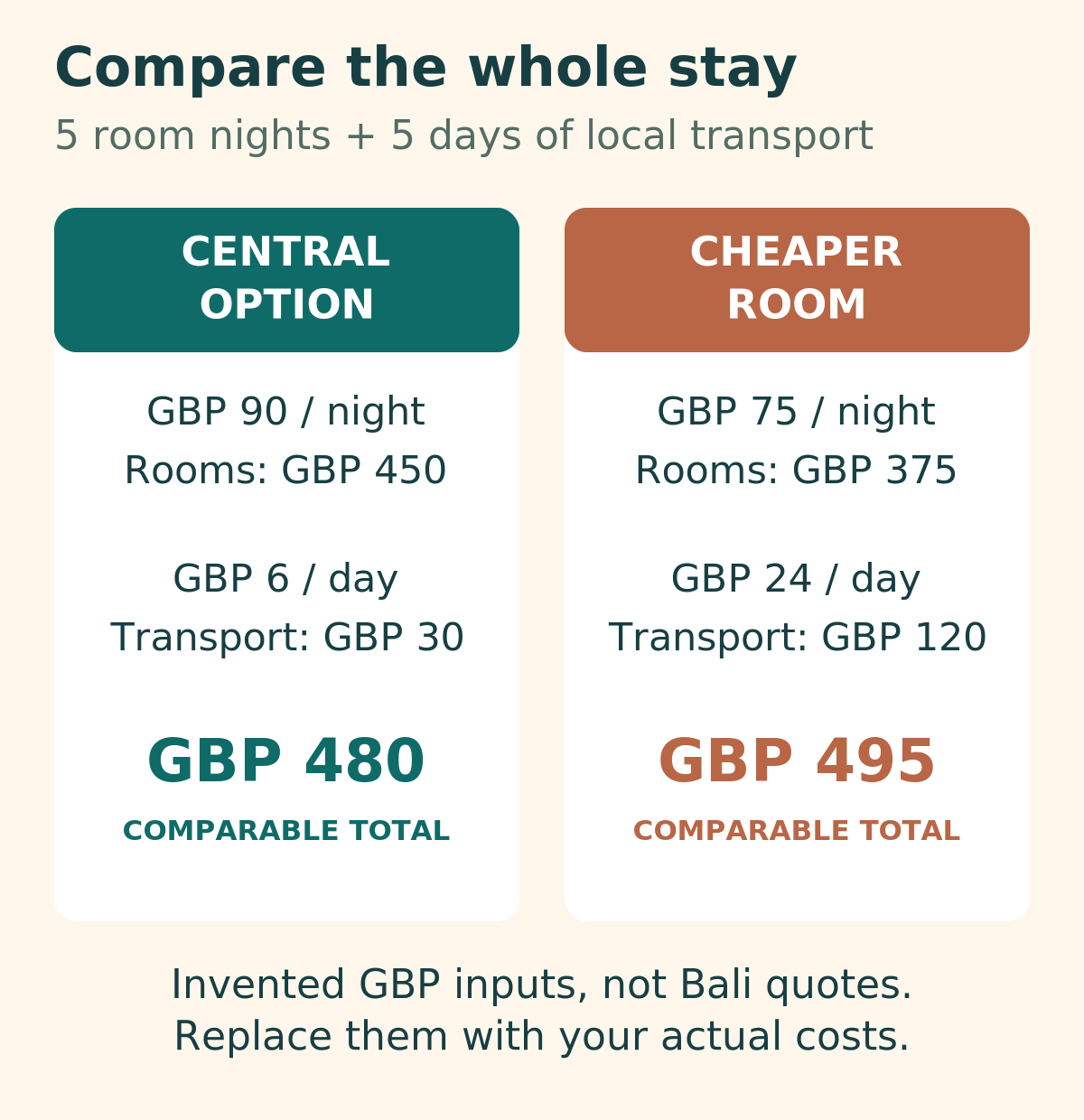
Comparing headline room rates alone can reward the less convenient hotel. Use the same five-night stay and add the everyday transport each location would require. The following numbers are deliberately invented GBP inputs for a calculation, not quoted Bali prices or claims that either area is cheaper.
| Illustrative input | Central option | Cheaper room |
|---|---|---|
| Room per night | £90 | £75 |
| Five room nights | £450 | £375 |
| Daily local transport | £6 | £24 |
| Five days of transport | £30 | £120 |
| Comparable subtotal | £480 | £495 |
The second room saves £15 per night but adds £18 per day in transport. Over this example stay it costs £15 more overall, before counting time spent waiting for cars. Neither set of inputs is attached to a particular real hotel.
Read this graphic
Illustrative five-night comparison: a GBP 90 room with GBP 6 daily transport totals GBP 480; a GBP 75 room with GBP 24 daily transport totals GBP 495.
With your own quotes, calculate the break-even point: the daily room saving must exceed the additional daily transport and any extra meal costs caused by the location. A cheaper property can still win, especially for travellers happy to remain on site; the arithmetic simply makes that choice explicit.
The hotel comparison calculator lets you compare user-entered stay costs. Keep every amount in the same currency; it does not supply live room prices or convert currencies. [7]
Getting around without making a scooter the solution
A scooter should not be the workaround for a poorly positioned hotel. Use booked cars or taxis when needed, and evaluate the location for the way you intend to travel. The FCDO advises checking licensing and insurance requirements before driving or riding; holiday enthusiasm is not a substitute for either. [3]
For airport arrival, obtain a door-to-door quote with the hotel name and exact address. Confirm the vehicle size, luggage capacity, waiting arrangements and what happens if your flight is delayed. Do not compare a terminal-to-area quote with a fully specified hotel transfer as though they were the same service.
Avoid building the arrival day around a precise transfer duration. Traffic, the final approach and flight formalities introduce variables that an old destination guide cannot resolve. A current driver estimate is more useful than a copied “minutes from the airport” claim.
For outings between Seminyak and Canggu, group stops rather than repeatedly crossing back and forth. A booked meal and a coastal stop in one outing are easier to manage than separate journeys for breakfast, shopping and sunset.
Keep the last night where it best supports your departure, not where an unfinished checklist happens to end. The extra hotel move is worthwhile only when its practical benefit outweighs packing and checking in again.
Four useful scenarios and the mistakes to avoid
Three nights, first visit, no scooter
Begin with a compact Seminyak pocket if the wish list is dinner, shopping and a pool. Then let the actual hotel map decide. Choose Canggu instead when its location makes the planned lesson or neighbourhood routine easier; do not choose it merely because it is fashionable.
A week built around learning to surf
Begin with the instructor and meeting point, then look for accommodation that supports that routine. Canggu is a logical candidate, but lesson suitability still depends on conditions and individual ability. Keep non-surf plans nearby so a cancelled session does not waste a whole day.
A family wanting daily swimming
Prioritise the pool, room layout, easy meals and manageable transport. Neither area wins simply by being coastal. A safe-feeling hotel routine is more useful than proximity to waves the children cannot use.
A couple seeking dinners and quiet nights
Shortlist dining locations, then investigate the room’s noise exposure. Being close enough to walk to an evening meal does not require sleeping above the busiest venue. A small increase in room cost may be worthwhile when it buys the combination you actually value.
For five nights or fewer, the default recommendation is one carefully chosen base. Splitting can make sense for a specific event or a genuinely different hotel experience, but not just to prove you have stayed in both areas.
Final questions before you choose
Can you enjoy Canggu without surfing?
Yes, when its particular restaurants, accommodation or social setting are what you want. However, check that those interests are genuinely concentrated near the hotel; the area name alone does not supply a convenient daily routine.
Which is cheaper?
There is no universal answer without comparable dates, room categories and transport needs. A lower nightly rate can be cancelled out by everyday journeys. Compare the total stay cost and cancellation conditions, not a single search-page price.
Should you stay in both?
Not automatically. For a short holiday, choose one and visit the other with a purposeful outing. A split stay is justified by different experiences, not the small distance between two map labels.
What is the best tie-breaker?
Ask which hotel makes an ordinary day easier: breakfast, the main activity, a place to rest and dinner. This catches practical problems that an attractive hero photograph will not reveal.
Continue with the Indonesia planning hub when this coastal stay needs to fit into a wider island itinerary.
Sources and research notes
Initial source review: 1 November 2026; editorial update: 2 November 2026. Recheck changing advice, terms and conditions before travel.
This Seminyak–Canggu comparison uses official destination descriptions and named hotel examples, then adds a daily-life walking-route screen and a five-night illustrative cost test. No property was personally inspected, and the example GBP inputs are not live rates or price predictions.
- Indonesia Travel – SeminyakCoastal orientation, dining and accommodation context; old quoted fares are not used.
- Indonesia Travel – Canggu BeachBlack-sand coastline and surf identity; historical journey-time claims are not used.
- FCDO – Indonesia safety and securitySwimming and road-travel precautions.
- IHG – Hotel Indigo Bali Seminyak BeachOfficial property identity, location and rate-specific cancellation advice.
- COMO Canggu – frequently asked questionsEcho Beach location and on-site surf offering.
- GetYourGuide – Canggu Surf LessonExample activity listing; not a guarantee of conditions or availability.
- Taylor's Trailblazing Travels – Hotel Comparison CalculatorUser-entered accommodation comparisons; no live prices or currency conversion.
Illustrations in this article were created for Taylor’s Trailblazing Travels. Third-party photographs, where used, are credited beside the image or in the source list.