
How Many Days Do You Need in Indonesia? Choosing a Realistic Trip Length
Count the days you can enjoy, not just the dates printed on the flight booking.
Original route-planning illustration; the island shapes and dotted line are not a geographical map.
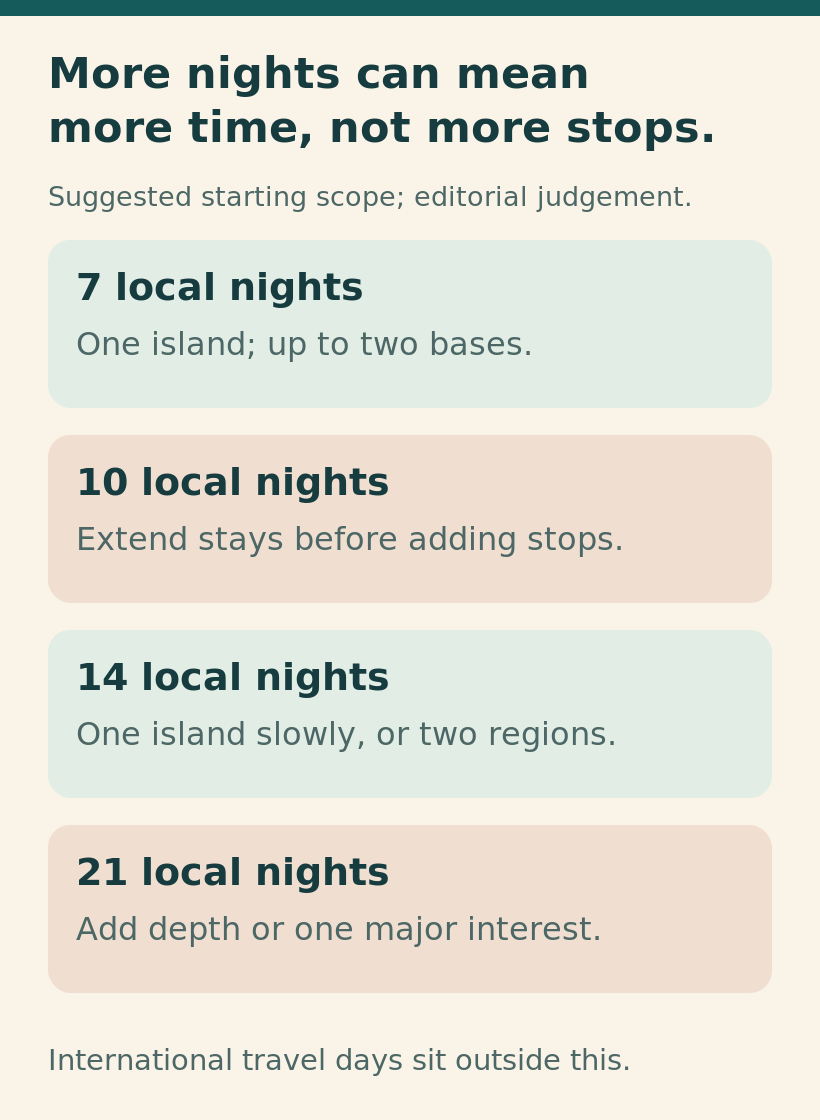
How many days do you need in Indonesia? Seven local nights can make a worthwhile single-island holiday; around 14 nights gives a focused two-region trip more breathing room; three weeks creates room for another major interest. None of those durations is enough to see the whole country, and none needs to be.
The better test is whether the available time supports the experience you want after arrival, departure and relocation are counted. This guide compares trip lengths rather than prescribing a sightseeing checklist. Its calculations are transparent planning judgements, not measured journey averages.
This article contains affiliate links. Taylor’s Trailblazing Travels may earn a commission from qualifying bookings or purchases, at no extra cost to you.
One island; one or two bases.
More breathing room, not automatically another island.
A focused two-region trip becomes practical.
Add depth or one major extra interest.
How many days do you need in Indonesia for your kind of trip?
| Available local nights | Good starting scope | Example allocation | Main limit |
|---|---|---|---|
| 7 | One island, up to two bases | Ubud 3 + Sanur 4 | Little room for a separate flight or boat detour |
| 10 | One island with more depth | Ubud 4 + Sanur 6 | More time does not require more hotel changes |
| 14 | One island slowly or two focused regions | Yogyakarta 4 + Ubud 5 + Sanur 5 | Every flight still consumes time |
| 21 | Two regions deeply or one distinct addition | Yogyakarta 4 + Ubud 5 + Labuan Bajo 4 + Sanur 8 | Not a complete tour of Indonesia |
| 28 | Longer stays and selective exploration | Build from interests, not a destination quota | Check the actual visa expiry and departure margin |
The examples prioritise coherent experiences: Yogyakarta for Javanese culture and nearby temple visits, Bali for a varied inland/coastal stay, and Labuan Bajo for Komodo access. Those destination roles are grounded in official tourism information; the night allocations are this guide’s judgement. [1][2][3]
Someone who wants quiet days by the sea can use all 14 nights in two nearby bases. Someone travelling principally for forest wildlife should design a focused route around that objective rather than copying the Bali examples. A duration recommendation is only useful after the main interest has been chosen.
Separate annual leave, local nights and full days
Write down three numbers before choosing a route: calendar dates away from home, nights spent in Indonesia, and full days between local arrival and departure. They describe different things. An overnight flight can consume a date without providing a hotel night at the destination.
For example, arriving in Indonesia on 10 June and leaving on 24 June gives 14 local nights, parts of 15 calendar dates, and 13 full intervening days. The outbound and homeward flight timetable determines how many dates that consumes in the UK. This is a date-counting example, not a flight schedule.
Late arrival and early departure reduce the practical value of the first and last dates. Put those dates into the plan as arrival and departure, not as full sightseeing days with airport transfers squeezed around them. When the flight times are still unknown, avoid spending the same theoretical afternoon twice.
Use the Trip Itinerary Planner to allocate local nights and label travel nights separately. Enter the actual flight dates yourself; the planner does not calculate time zones or validate the connection. [4]
Calculate usable days with a simple transfer model
Start with local nights minus one. That gives the full calendar days strictly between arrival and departure. Then deduct a planning allowance for relocations happening on those days: half a day for a local road move, one day for a domestic-flight move, and one day for an island-boat move.
The model is deliberately cautious and easy to edit. It does not claim that every flight or boat consumes a full day. It recognises that packing, checkout, terminal procedures and the final transfer can prevent a day from feeling like a normal sightseeing day. Replace an allowance when you have better evidence for your actual journey.
| Route structure | Move allowances | Calculation | Usable full-day equivalent |
|---|---|---|---|
| Two Bali bases | One road-move day | 13 – 0.5 | 12.5 days |
| Java plus two Bali bases | One flight day + one road day | 13 – 1 – 0.5 | 11.5 days |
| Four bases including a boat stay | One flight day + one road day + one boat day | 13 – 1 – 0.5 – 1 | 10.5 days |
| Five bases with more flights | Two flight days + two road days | 13 – 2 – 1 | 10 days |
The four-base example describes a one-way sequence ending at a usable departure gateway. A route that must return by boat needs that extra move counted too. This distinction is why a route sketch must show the return connection, not only the attractive outbound journey.
The difference between 12.5 and 10 days is 2.5 full-day equivalents, despite identical hotel-night totals. Whether that trade is worthwhile depends on what the extra destinations add. The formula does not count an enjoyable train journey as worthless; it simply separates travel from uncommitted time at a base.

The Itinerary Pace Checker accepts your stops, nights and estimated door-to-door journey times. Use it to inspect the difficult days, then verify the real transport details separately. [5]
Seven to ten nights: make one island feel like a holiday
With seven nights, resist treating Indonesia as a checklist. A three-night inland stay followed by four coastal nights gives two contrasting bases while keeping the logistics understandable. The first changeover day still costs time, so avoid placing a major prepaid activity across it.
For ten nights, extending those stays may be better than adding a third island. Four inland nights allow three full days between arrival and checkout; six coastal nights leave room for both excursions and days without a plan. That is depth, not wasted capacity.
Bali’s official tourism overview describes its temples, arts, rice-field landscapes and coastal resort areas. The point of a two-base arrangement is to group the experiences you actually want, not to visit every named area. [2]
Compare Bali stays by area on Agoda and alternative Bali accommodation on Booking.com once you know how many nights each base earns. These are general island searches; filter to the chosen area and inspect the real map location. [6][7]
A short trip can still be worthwhile from the UK when the flights, budget and recovery time work for you. There is no universal threshold that makes a long-haul journey worthwhile. The mistake is booking a seven-night trip and planning it as though it contains two weeks of ground time.
Fourteen nights: add contrast rather than a destination collection
Two weeks of local nights offers a useful balance between a focused route and variety. In the Java-and-Bali example, four nights in Yogyakarta leave three full intervening days before relocation; five inland Bali nights and five coastal nights then prevent the rest from becoming a series of checkouts.
Yogyakarta’s cultural sights and access to Borobudur and Prambanan justify treating it as a proper stay rather than an airport detour. [1] Compare Yogyakarta cultural experiences only after protecting enough time for the visit. Check whether admission, pickup and the desired access are included; a convenient-looking package may still be a long day. [8]
Choose between adding Java and adding another beach island. A traveller chiefly interested in temples and food gets a different benefit from Java than someone seeking quieter coastal time in Lombok. Lombok has its own beach and mountain geography, but getting there creates another travel decision. [9]
For a Lembongan stay, inspect Sanur-to-Nusa-Lembongan services and budget the complete relocation, including the return if you fly home from Bali. The route listings are a starting point for checking the correct service, not proof of a protected connection. [10]
Do not add a boat stay simply to say the trip includes more islands. It should deliver something you cannot reasonably get from the existing coastal base, and you should be comfortable spending the additional time on the move.
Twenty-one nights: one extra region, or simply a better pace
Three weeks creates choices rather than an obligation to travel further. The example allocation adds four nights around Labuan Bajo, while keeping eight final nights in Sanur. That generous finish allows relaxation and helps avoid a last-day rush back from a boat-based region.
Official tourism guidance identifies Labuan Bajo as the access point for Komodo trips and describes both land-based excursions and liveaboards. Those are not equivalent products: one returns you to a hotel; the other uses nights aboard. Decide which you are counting before comparing the itinerary. [3]
A four-night block is a starting allowance, not a guarantee of any particular wildlife encounter or sailing. Check the actual boat schedule, national-park arrangements, sea conditions and cancellation policy. Give essential excursions more than one possible day when the operator’s arrangements allow it.
An equally valid three-week holiday uses two main regions more slowly. Longer stays can accommodate laundry, rest and activities chosen after arrival. They also make the accommodation itself part of the holiday rather than a place to store bags.
At four weeks and beyond, check the visa position before refining the route. B1 permission is initially up to 30 days, and an extension has a process to complete. A 28-night stay normally spans 29 local calendar dates, leaving little margin within an ordinary 30-day permission. Check the actual expiry, not a rough month calculation. [11][12]
Protect the days whose failure would cost the most
Not every free day serves the same purpose. A recovery day is for you; a weather-flexibility day gives an excursion another chance; a connection buffer sits before an important departure. Do not label one day as all three and then fill it with an inflexible tour.
For an independently booked boat trip before an international flight, return to the departure island at least the previous day as a starting precaution. Use more margin when the next available service is uncertain or a missed flight would be difficult to replace. This is risk-reducing judgement, not a promise that one night is sufficient.
FCDO identifies ferry safety concerns and natural-hazard risks in Indonesia. Use current operator and authority information rather than treating a dry-season booking as proof that a service will run. [13] The tourism ministry’s general climate guide also notes regional differences; apply it to the actual route, not every island indiscriminately. [14]
One way to protect the trip without increasing its total length is to move the ambitious excursion earlier. Leave the final base near the required gateway, and choose activities there that can be changed or dropped without causing another transport problem.
For travellers who need more rest, step-free arrangements or predictable facilities, fewer bases may be worth more than extra destinations. Ask about the exact access conditions and transfer assistance before allocating a short stay that depends on everything being easy.
Use a three-question test before adding another stop
First, identify what the proposed stop adds that the existing route does not. Second, calculate its complete transfer burden, including the return or onward connection. Third, say which existing nights you are willing to remove. When one of those answers is vague, leave the stop off this trip.
A two-night stay has only one full intervening day before travel allowances are considered. That can be sensible for a specific objective, but it is not automatically two days of experiences. Compare a two-night addition with simply giving those nights to a place already on the route.
Write a priority order for the whole trip. Protect the top one or two interests, keep the least replaceable day away from the tightest connection, and cut the lowest-priority move first when the plan becomes crowded.
Is 10 days enough for Bali and Java?
It can be made to work as a very focused trip, but it offers less slack than the 14-night example. Count the actual local nights, the domestic flight day and your arrival times before deciding that the second region adds more than it removes.
Does a day tour avoid the cost of moving hotels?
It avoids packing and checking out, but a long return journey can still consume most of the day. Compare door-to-door time, not only whether the same room is used that night.
Should a 21-night trip always include three islands?
No. Two well-chosen regions with longer stays can be a stronger holiday. The number of islands is not a measure of value, and a boat-dependent addition may be less suitable for your preferences than extra time at an existing base.
How much extra time should families allow?
There is no reliable universal percentage. Add the time your family actually needs for meals, rest, boarding and room changes, then remove any transfer day that still looks fragile. Start with fewer bases rather than assuming children will adapt to a compressed adult route.
Sources & Editorial Method
Research-led guidance drawing on the named official, destination and transport sources. Recheck time-sensitive requirements and operator details directly. Routes, allowances and decision models are editorial analysis, not first-hand reports or live booking quotations. Government requirements and operator arrangements can change.
- Indonesia Ministry of Tourism – Yogyakarta cultural overview
- Indonesia Ministry of Tourism – Bali destination guide
- Indonesia Ministry of Tourism – first-time Komodo planning
- Taylor's Trailblazing Travels – Trip Itinerary Planner
- Taylor's Trailblazing Travels – Itinerary Pace Checker
- Agoda – Bali accommodation and area search
- Booking.com – Bali accommodation search
- GetYourGuide – Yogyakarta experiences and ticket inclusions
- Indonesia Ministry of Tourism – Lombok trip planning
- 12Go – Sanur to Nusa Lembongan route listings
- Central Jakarta Immigration – B1 visitor visa rules and fees
- UK FCDO – visa length, extension and overstay conditions
- UK FCDO – Indonesia safety and security
- Indonesia Ministry of Tourism – weather, climate and seasons
Illustrations in this article were created for Taylor’s Trailblazing Travels. Third-party photographs, where used, are credited beside the image or in the source list.