Bali and the Gili Islands Itinerary: Twelve Days of Culture and Beaches
Four nights of Ubud culture, four on one Gili island and three to finish beside the Bali coast.
AI-generated Gili Islands illustration; not a photograph of a named beach or hotel.
For a Bali and the Gili Islands itinerary of twelve days, choose one island and give it enough time to feel different from a boat excursion. This route uses four nights in Ubud, four on Gili Air and three in Sanur. The crossings take their own space in the calendar, leaving three full island days and a relaxed return to Bali before the flight home.
Eleven nights
4 Ubud + 4 Gili Air + 3 Sanur.
Three full island days
Days 6–8 stay clear of long-distance transfers.
One island base
Change the island to match your style, not every other night.
A generous Bali finish
Return on day 9 before a day 12 flight.
The twelve-day route: culture, island time, then Bali
This plan counts day 1 as your arrival in Bali and day 12 as departure from Bali. It suits travellers who want an art-and-food stay followed by several quiet beach days, without learning to ride a scooter or changing accommodation on every island. It is not the best fit if sea journeys are unacceptable or you want to include Java, mainland Lombok and Nusa Penida in the same holiday.
| Days | Main plan | Nights |
|---|---|---|
| 1–4 | Ubud: arrival, art, one cultural outing and a workshop or cooking session | 4 |
| 5 | Road to Padang Bai, boat to Gili Air, settle in | Gili night 1 |
| 6–8 | Three full days based on one island | Gili nights 2–4 |
| 9 | Boat back to Bali and road transfer to Sanur | Sanur night 1 |
| 10–11 | Coastal time and a flexible final day | Sanur nights 2–3 |
| 12 | Airport transfer and departure | No overnight included |
The route contains two major transfer days, not two brief interruptions to beach time. Protect days 6–8 by resisting another hotel move. A visit to a second Gili can be optional after you have seen the sea conditions and local schedule; you do not need to sleep on all three.
Use the Trip Itinerary Planner to put your dates against the eleven nights. Enter your own island name if needed and keep the flight dates separate from the local holiday dates. The planner does not confirm ferry availability. [13]

Choose the Gili island before choosing the hotel
The three main Gilis off Lombok are Trawangan, Meno and Air. Indonesia’s tourism board describes Trawangan as the largest and liveliest, with Meno and Air offering quieter alternatives. The recommendations below are editorial judgements about fit, not claims that every part of an island has the same atmosphere. [1]
| Island | Choose it for | What to check |
|---|---|---|
| Gili Air | A balance of a village base, places to eat and unhurried beach days | The path to the room, evening noise and the boat landing arrangement |
| Gili Meno | A quieter stay where the room and nearby beach are central to the holiday | Meal options close by and whether arrival involves a smaller connecting boat |
| Gili Trawangan | A wider choice of evening venues and a more social trip | The exact neighbourhood and noise near the room; choose away from busy venues if needed |
Gili Air is the working example because a four-night stay benefits from a straightforward routine: breakfast, one activity and a quiet afternoon. A couple seeking more seclusion could substitute Meno; friends who want evenings out could substitute Trawangan. Make that choice before reserving the boat, because the route and local boarding process can differ.
Plan to walk or cycle for everyday movement, with luggage help arranged separately. Ask the accommodation about sandy or uneven approaches, the distance from the landing and how bags are handled. The tourism board lists walking and cycling among the main ways to get around. [1] A beautiful beachfront photograph does not tell you whether that approach meets your mobility needs.
Compare the map positions on Agoda’s Gili Air accommodation page. Compare the same dates on Booking.com’s Gili Air search as well. Check breakfast, air conditioning if required, drinking-water arrangements, cancellation terms and the full four-night cost. Choose the property for the way you will spend each day, rather than relying on a general “beachfront” label.
Back to top ↑Days 1–4: build cultural time around Ubud
Day 1: arrive and settle
Keep the first evening close to your accommodation. For four nights, an easy walk or short arranged transfer to meals can be more useful than a remote view that requires repeated car journeys. Save the early alarm for a day when you have slept.
Day 2: art first, then a small neighbourhood
Start with ARMA and decide whether you want a museum visit, a cultural workshop or a performance. Its official programme includes activities such as painting, batik, cooking and Balinese dance; availability needs direct confirmation. Choose one rather than assuming every activity runs as a daily drop-in. [5]
Keep lunch and the afternoon nearby. Looking at a few works carefully, talking to a guide and learning something about a craft gives this part of the holiday substance. It also avoids turning the culture element into a drive between short photo stops.
Day 3: one temple area and room to pause
Book a driver or guide for a single outing towards Tirta Empul in the Tampaksiring area. The temple is a sacred site with a sarong requirement. Follow the attendants’ instructions and ask before photographing worship or joining a ritual. Participation is optional; respectful observation is a valid visit. [6]
If the route and conditions suit, add a short rice-field stop agreed with the driver. Choose the walking distance you can comfortably manage. Resist adding a distant waterfall and another temple simply to fill the hired-car hours.
Day 4: make something, then prepare to move
Use a confirmed cooking or craft session as the morning’s anchor, or take a slow morning if day 3 was tiring. Leave the afternoon for laundry, a long lunch and preparing the boat journey. Reconfirm the next day’s pickup, operator check-in point, luggage allowance and island accommodation contact.
A useful distinction: a class is a reserved activity, while wandering and stopping for food can stay flexible. Book the former only once its timing fits the transfer plan. For room comparisons, Agoda’s Ubud area map helps you see whether a “Ubud” address actually matches the area you want to use.
Back to top ↑Day 5: allow most of the day to reach the island
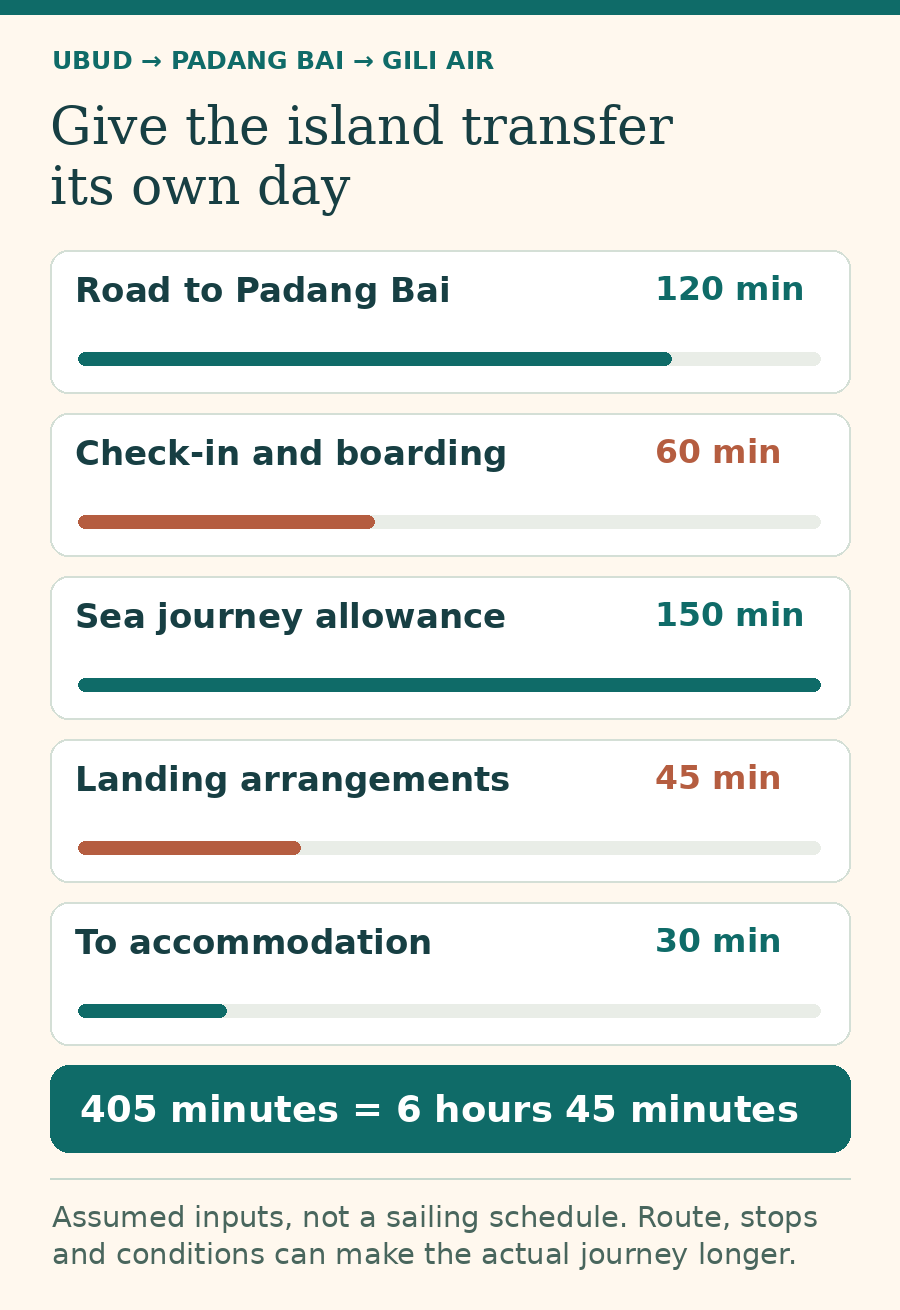
The working route is Ubud → Padang Bai → Gili Air. Ekajaya’s official timetable lists a Padang Bai service to Gili Air, but states that schedules can change. Other departures may call at additional stops. Confirm the particular voyage and its actual island landing arrangements rather than assuming the shortest advertised crossing applies. [3]
| Component | Illustrative allowance |
|---|---|
| Ubud accommodation to Padang Bai check-in | 2 hours |
| Check-in, waiting and boarding | 1 hour |
| Sea journey allowance, including scheduled stops | 2 hours 30 minutes |
| Disembarkation and any landing arrangements | 45 minutes |
| Luggage and onward walk/transfer to accommodation | 30 minutes |
| Hotel-to-hotel planning total | 6 hours 45 minutes |
This model explains why a 09:00 sailing can occupy the useful part of the day: a 06:00 hotel departure leaves room for the assumed road journey and an hour at check-in, and reaches the accommodation around 12:45 if every allowance holds. Delays can make it later. Plan lunch and settling in, not a paid activity shortly after arrival.
Compare Padang Bai–Gili Air options on 12Go with the operator’s own offering. Check whether the quote begins at your hotel, a meeting point or the port; land transfers and local charges can change the comparison. [12]
Ekajaya’s terms specifically flag earlier local arrangements for Gili Air and Gili Meno because of shuttle transfers. A large ferry in the booking photograph does not prove that every boarding stage uses the same vessel. Ask about the actual transfer if you have mobility needs, young children or difficulty handling bags. [9]
FCDO advice highlights variable ferry standards and rapidly changing sea conditions. Check lifesaving equipment and avoid a vessel whose condition or loading concerns you. [4] Keep essentials and documents accessible in a waterproof pouch, and agree how your accommodation will help with arrival luggage.
Days 6–8: three full days without changing islands
Day 6: find your everyday beach routine
Begin with breakfast and a short walk to understand the area around your room. Ask your accommodation which nearby sections currently suit a swim and what conditions to avoid. The appearance of the water is not a safety assessment. Leave the hottest part of the day for shade, lunch or a rest.
Choose one place for sunset rather than making a full-island circuit compulsory. The value of staying four nights is that you can return to a favourite place tomorrow. Pack a small light for the walk back and ask about the condition of the route before dark.
Day 7: an optional guided snorkelling outing
If conditions and your confidence allow, choose a guided outing with clear information about departure point, group size, life jackets, guide supervision and the plan if the water is unsuitable. Do not buy a package because it promises a particular animal sighting. A land-based day is an equally valid choice if conditions or your comfort do not suit.
Keep away from coral, do not feed fish or chase turtles, and follow the guide’s environmental briefing. Green Fins identifies these behaviours as central to responsible snorkelling. [7] Tell the operator your swimming ability and ask what flotation and assistance it can actually provide.
Two relevant options to compare are GetYourGuide’s Gili Air private or small-group outing and Viator’s Gili Air shared snorkelling trip. Both list meeting points on Gili Air. Compare the selected group size, duration, equipment, age or health restrictions and cancellation terms; the offers are not interchangeable. Check the current option before paying and confirm whether a wildlife stop is appropriate that day. [17] [18]
Day 8: protect the unplanned day
Repeat a favourite beach, take a short cycle if the surface and bike suit you, or spend the morning reading. A second-island outing is optional only when the local service and weather make sense. Returning to the same accommodation keeps your luggage and checkout out of the decision.
During the afternoon, reconfirm the next day’s island meeting time and Bali pickup. Save the instructions offline. If a forecast suggests disruption, discuss an earlier safe departure with the operator while there is still flexibility; do not wait for the final booked sailing to consider alternatives.
Back to top ↑Days 9–12: return to Bali before the final stretch
Day 9 is the return journey and road transfer to Sanur. Use the actual check-in or shuttle instruction for your island, not the departure time printed for a different stop. Ekajaya’s timetable has separate rows for the three islands, illustrating why a general “Gili return” time is insufficient. [3]
Plan no essential afternoon booking in Sanur. Unpack, eat nearby and settle into the final base. With three nights here, days 10 and 11 remain full days on Bali; the margin is useful if the return is delayed, although prolonged disruption can exceed it.
Day 10: a simple coast day
Use Sanur’s beachside path for a morning walk, with breaks rather than a distance target. The national tourism site identifies the promenade as one of the area’s main features. [11] Choose a short section, have lunch nearby and keep swimming dependent on current local conditions.
Day 11: choose one last activity, or none
Leave this day open until you know how the island travel has gone. A leisurely meal, a spa appointment you have checked independently or returning to a favourite beach can be enough. Avoid an excursion that requires a rushed late return to pack.
Day 12: leave from Bali
Book the airport car using the airline’s requested arrival time and a current local road estimate, with additional road contingency. If the flight is shortly after midnight on day 12, the airport journey takes place on day 11; adjust the room booking accordingly.
Once rooms are shortlisted, compare the full stay price and terms rather than the nightly headline. The Indonesia travel hub provides the wider country structure if you are weighing this route against a longer island journey.
Back to top ↑What the eleven-night plan could cost: an editable model
Use this as a worksheet for two adults sharing one room, not as a price promise. The unit rates below are chosen editorial allowances in rupiah. No room dates, live fares or activity availability have been priced. The aim is to make the total transparent before you replace the assumptions with your own quotations.
| Cost | Assumed calculation | For two |
|---|---|---|
| Accommodation | 11 room-nights × IDR 800,000 | IDR 8,800,000 |
| Meals and drinks | 2 people × 12 days × IDR 250,000 | IDR 6,000,000 |
| Bali point-to-point road transfers | One group allowance | IDR 2,400,000 |
| One Ubud sightseeing car day | One group allowance | IDR 1,000,000 |
| Return island boats | 2 people × 2 legs × IDR 450,000 | IDR 1,800,000 |
| One optional guided snorkelling outing | 2 people × IDR 350,000 | IDR 700,000 |
| Admissions and cultural activity fund | One group allowance | IDR 800,000 |
| Subtotal | IDR 21,500,000 | |
| Contingency | 15% of subtotal | IDR 3,225,000 |
| Model total | IDR 24,725,000 |
The equal share is IDR 12,362,500 per person. International flights, insurance, visas, applicable tourist and harbour levies, shopping, diving, spa treatments and premium workshops are excluded. The cultural activity fund is a pot to allocate, not a promise that every mentioned class fits. Check whether taxes, breakfast and local fees are already included in each offer before adding them separately.
A room costing IDR 200,000 more per night adds IDR 2,200,000 across the eleven nights, or IDR 2,530,000 with the same contingency. The optional snorkelling line can be removed if it does not suit you. A missed boat can create extra hotel and replacement-ticket costs beyond the model; keep funds available rather than treating 15% as a fixed maximum loss.
To use the Travel Budget Calculator, first convert actual quotations into GBP using your own payment rate. It is a GBP worksheet and does not convert rupiah. Set eleven room-nights and twelve spending days, then enter ferry and intercity costs separately. [15]
Back to top ↑Weather, disruption and the versions worth considering
Choose the trip using your tolerance for sea travel as well as the calendar. Check BMKG’s northern Lombok Strait marine information close to travel, then follow the harbour authorities and operator. A forecast is useful context, not personal clearance to sail. [8]
Ekajaya explains that sailings require harbour-master clearance and that weather or operational issues can lead to cancellations. Its published FAQ describes possible rescheduling, refund or alternative-transport options, but you must confirm the terms of the ticket actually bought. Do not assume the same treatment from another operator or a separate booking agent. [10]
If the outward crossing is cancelled
Use the flexibility in the Ubud and Sanur bookings to stay on Bali. Shorten the island block only if the revised journey still leaves useful time there. Two long transfer days for one hurried beach day are poor value for this particular holiday.
If the return becomes uncertain
Discuss the earliest suitable safe departure and notify the Sanur hotel. A route through mainland Lombok and its airport is an alternative to investigate only if the local boat, road journey and onward flight all work. It is not an automatic escape from poor weather: Gili Air still requires a sea crossing to Lombok. The tourism board describes the island’s boat connections with Bangsal and the onward road link to Lombok’s airport. [2]
If culture or beach time matters more
For more cultural time, use 5 Ubud + 3 Gili + 3 Sanur. That leaves two full island days. For more beach time, use 3 Ubud + 5 Gili + 3 Sanur. Both versions keep eleven nights and the final Bali stay. The Itinerary Pace Checker can highlight short stays once you enter your own realistic transfer hours; its score does not check routes or weather. [14]
Use the BMKG northern Lombok Strait marine forecast as one relevant weather input for a Gili-bound crossing; it is not a sailing clearance or a forecast for every section of the route. Verify the operator’s own departure decision and safety equipment on the day, including a suitable life jacket for each traveller. If the crossing is cancelled or the vessel seems unsafe, keep the Bali nights flexible rather than treating a pre-paid island hotel as a reason to board. [4] [8]
Back to top ↑Book the decisions that make the route work
- Confirm arrival and departure dates, including any flight after midnight.
- Choose one Gili island and a room with an acceptable route from its landing.
- Reserve the three accommodation blocks with terms you understand.
- Book both sea legs and confirm every port, check-in point and possible shuttle.
- Arrange Bali road transfers, including the return from Padang Bai to Sanur.
- Add a cultural activity and optional snorkelling only after the route is settled.
- Review official entry requirements, local charges and insurance coverage separately.
For messages to drivers and accommodation, compare your existing roaming plan with Airalo’s available eSIM plans. Select an Indonesia package and check your device, included networks and validity period; do not assume continuous reception offshore. Keep tickets and directions offline. [16]
The night allocation, daily choices, time allowances and budget are editorial planning judgements based on the public sources below. Adjust them to confirmed bookings and individual comfort.
Back to top ↑Questions before you book
Do twelve days leave enough time for all three Gilis?
You could visit another island during the four-night stay, but changing hotels repeatedly reduces the beach time this itinerary is designed to protect. Choose one base, then decide locally whether a second-island day trip is worthwhile.
Should I fly to Lombok instead of taking a fast boat from Bali?
Compare the whole chain: Bali airport transfer and check-in, the flight, Lombok airport-to-harbour road transfer and the final island boat. A short flight is only one component. It may suit some travellers, but it still does not remove all sea travel.
Could I add Nusa Penida between Bali and the Gilis?
That changes the trip into a more ambitious island circuit. Within twelve days, remove a meaningful block elsewhere rather than squeezing it into a transfer day. This route deliberately uses one Gili base and no Penida stop.
Is Gili Air automatically the quietest choice?
No. The recommendation here is a balance of practical convenience and slower days. Individual properties can be near busy paths, amplified sound or other disturbance. Ask about the exact room location; choose Meno if a quieter setting is the overriding priority.
Can this itinerary work without snorkelling?
Yes. The island block can be beach walks, reading, meals and relaxed time at the accommodation. Remove the optional activity cost and choose a hotel you would enjoy even if sea conditions keep you ashore.
The final decision
Keep the plan to three bases: Ubud for cultural time, one Gili island for the beach stay and Sanur for the finish. The four-night island block earns its place because it leaves three full days after the two major transfers are accounted for. Confirm the exact ferry and landing arrangements, retain flexibility if conditions deteriorate, and keep the final Bali nights intact.
Back to top ↑How this guide was prepared
This research-led guide uses official destination information and selected provider references; current service terms must be checked before booking. Route choices, transfer allowances and illustrative budgets are editorial planning judgements. Confirm current services and terms for your dates; no personal visit or booking test is implied.
Sources and research
Sources and references are provided for checking route details, access and provider terms. Timetables, availability, prices and conditions can change; check the relevant official or operator page for your travel dates.
- Indonesia Travel — Gili Trawangan and the Gilis
- Indonesia Travel — Gili Air
- Ekajaya Fast Ferry — official schedules
- FCDO — Indonesia safety and security
- ARMA — Cultural Workshops
- Indonesia Travel — Tirta Empul
- Green Fins — Environmental best practice for snorkellers
- BMKG — northern Lombok Strait marine information
- Ekajaya Fast Ferry — Terms and Conditions
- Ekajaya Fast Ferry — Frequently asked questions
- Indonesia Travel — Sanur Beach
- 12Go — Padang Bai to Gili Air
- Taylor’s Trailblazing Travels — Trip Itinerary Planner
- Taylor’s Trailblazing Travels — Itinerary Pace Checker
- Taylor’s Trailblazing Travels — Travel Budget Calculator
- Airalo — Indonesia eSIM plans
- GetYourGuide — Gili Air private or small-group snorkelling
- Viator — Gili Air snorkelling trip
Illustrations in this article were created for Taylor’s Trailblazing Travels. Third-party photographs, where used, are credited beside the image or in the source list.