 Bali · Plan your journey
Bali Surf Trip Itinerary: Two Coasts and a Flexible Swell Plan
Five nights on the west coast, four on the east, and room to change the session when the sea changes.
An original AI-generated coastal illustration, not a photograph of a named break or evidence of suitable surfing conditions.
A useful Bali surf trip itinerary starts with your ability and the conditions you can handle. The famous break names come later. This ten-day plan combines a Legian base on the west coast with Sanur on the east, giving you time to settle into each area without moving hotels whenever a forecast changes.
It is designed for travellers who want coaching or supported progression alongside a holiday. It is less suitable for experienced surfers whose only objective is a particular reef wave: they should organise a specialist guide and a base around that objective. No session in this plan is compulsory, and a land day remains a successful decision when conditions are unsuitable.
Some links in this guide are affiliate links. Taylor’s Trailblazing Travels may earn a commission when you book or buy through them, at no extra cost to you.
The route: two bases, nine nights
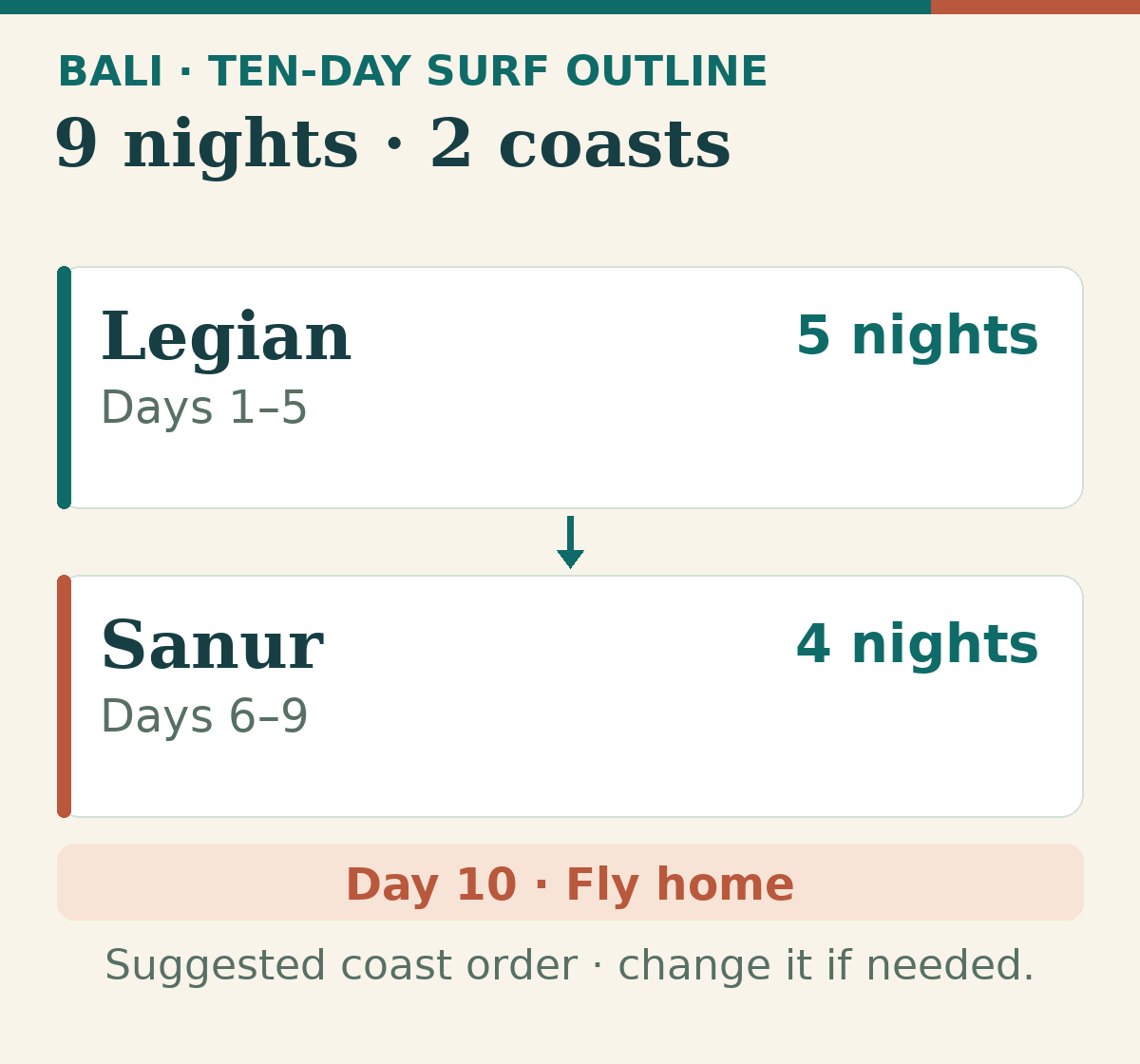
The working route is Legian for Nights 1–5, then Sanur for Nights 6–9. It deliberately leaves out island ferries and a separate Uluwatu or Canggu stay. Those additions would use time better spent repeating a suitable wave, reviewing technique or resting.
| Stage | Sleep | Main purpose | Keep flexible |
|---|---|---|---|
| Day 1 | Legian | Arrival, equipment check and coach briefing | No paid arrival-day session |
| Days 2–5 | Legian | Three possible sessions and one recovery day | Exact beach section and tide window |
| Day 6 | Sanur | Change coast and meet the next school or guide | Leave the transfer day free of commitments |
| Days 7–9 | Sanur | Three possible sessions, chosen for your level | Launch point, boat use and conditions |
| Day 10 | Departure | Dry equipment and travel to the airport | No final session to squeeze in |
Why these two bases?
Legian provides a practical starting point for organised coaching. For example, Rusdy Surf identifies its beach meeting point by Jalan Melasti and advertises both private and small-group lessons. That gives you a concrete place to arrange an initial assessment before choosing a hotel. [1]
Sanur adds a different coastal setting and boat-supported lesson options. Sanur Surf School advertises private coaching with a boat transfer, board and surf shirt. Its separate guiding product is aimed at intermediate and advanced surfers and excludes both the board and boat charge. These are different services, so compare what you will actually receive. [2]
Choose accommodation around the agreed meeting point, rather than around a generic map pin for “surfing”. A room near the beach can still be inconvenient if the school launches from another part of the coast.
Choose the version that matches your experience
- First-time or returning beginner: use a lesson for every session. Explain your swimming confidence and previous experience before paying. The coach must choose a suitable venue; a school taking beginners does not make every nearby break suitable.
- Improving surfer: ask for a technical assessment and a clear goal, such as catching unbroken waves independently, rather than automatically booking a sightseeing-style surf safari.
- Competent intermediate: a local guide can help with unfamiliar access and conditions, but you still need the ability to manage the chosen wave, current and exit.
To set your own arrival date and night split, enter the two bases in the Trip Itinerary Planner. Keep session names provisional; the planner organises your trip and does not assess surf conditions.
Choose the coast order, then let conditions decide
Bali operators describe a broad seasonal pattern: the west side is generally favoured during the main dry-season surf period, particularly May–September, while east-coast options become more useful with the wet-season wind pattern around November–March. April and October are transition months. Treat that as a starting hypothesis, not a rule for a particular morning. [3]
| Travel period | Starting plan | Reason to change it |
|---|---|---|
| May–September | Five Legian nights, then four Sanur nights | The chosen east-coast sessions do not suit your level or the forecast |
| November–March | Consider five Sanur nights, then four Legian nights | Your coach recommends another order, or rain and marine conditions disrupt plans |
| April or October | Keep the standard route and flexible booking terms | The forecast near departure gives a clear reason to reverse it |
Reversing the route keeps one hotel change and nine nights; the first coast gets five nights and the second four. Do not rearrange non-refundable hotels for a distant forecast. If you want the greatest possible amount of suitable surfing and have no interest in the second coast itself, a single base with a mobile school may be a better choice.
For the two-coast version, the purpose of the shorter block is to sample a different setting when conditions permit. If it becomes a quieter beach-and-coaching break with fewer water sessions, that is an acceptable result. A wet-season booking is not a promise of small waves or empty line-ups.
A surf school advertising lessons in Sanur does not make every offshore reef safe for a novice. Ask the instructor exactly which break is planned, how participants reach it, whether it is sand or reef, and what conditions would trigger a land-based alternative. If swell, tides, currents or equipment do not suit your ability, change the session or stay ashore; the itinerary should never require a dangerous wave.
The ten-day Bali surf trip itinerary
Day 1 — arrive in Legian and settle in
Arrange a vehicle that can carry your luggage and any board bags. Check in, eat and confirm tomorrow’s meeting point. Tell the coach what you can currently do without assistance, what you want to improve and whether you have surfed a reef before. Keep the evening simple; a tired arrival-day paddle adds little to a ten-day holiday.
Day 2 — use the first session as an assessment
Let the coach select the time, rather than insisting on sunrise. Agree a manageable session length, learn the entry and exit, and spend the afternoon reviewing one or two useful corrections. Beginners should stay within the supervised lesson plan. Improving surfers should resist changing to a smaller board just because one is available.
Day 3 — repeat a useful lesson
Repetition is the point today. If the same venue is suitable, return and work on yesterday’s goal. If conditions have changed, accept a different beach section, time or a cancelled session. Leave the rest of the day free for a relaxed meal, equipment drying and a short beach walk.
Day 4 — recovery or a rescheduled window
Keep this day uncommitted. Use it for rest if the first two sessions went ahead, or move one missed lesson here if the coach has an appropriate window. Avoid turning a lay day into a dawn-to-night excursion across Bali: that removes the recovery the schedule was built to protect.
Day 5 — consolidate before changing coast
Take the third planned west-coast session if conditions and your energy allow. Ask for a concise handover for the next instructor: the board used, the conditions managed independently and the main skill to continue. Pack after the equipment has dried as much as possible. A successful first block does not require a visit to a more powerful break.
Day 6 — transfer to Sanur
Reserve a three-hour block for packing, check-out, the drive and getting settled. That is a planning allowance for the whole move, not a promised driving time; traffic and room readiness can require more. Do not attach a prepaid boat departure to it. Meet the school, discuss the coming tide windows and confirm whether the next session includes a boat.
Day 7 — treat the new coast as a new assessment
A different instructor and setting deserve another careful start. Ask how you will reach the break, where the boat waits if used, how you signal a problem and what happens if conditions deteriorate. A lesson venue described as suitable on one day can be unsuitable on another. Keep the afternoon nearby.
Day 8 — choose one good session over a long chase
If the local option suits you, use it. If the guide proposes a longer drive, ask what improvement in conditions justifies the road time and whether that wave matches your ability. Be willing to keep a land day. A list of famous breaks is not a requirement to visit them all.
Day 9 — retain a final flexible window
This is the sixth planned surf opportunity, not a final exam. Repeat what has worked, use it to recover a missed session, or finish the trip on land. Confirm your airport vehicle and board-bag space. If hiring equipment, allow time for inspection and return before the operator closes.
Day 10 — depart without a tight surf connection
Have breakfast, settle any charges and leave with the traffic allowance advised locally plus your airline’s airport reporting time. Keep the final morning free. The value of one extra wave rarely matches the stress of rushing a wet board bag towards an international flight.
A daily plan for swell, tides and changing conditions
Use the forecast to shortlist a session, then check it locally. BMKG publishes a marine forecast specifically for waters south of Bali; verify the area, issue time and validity period. A regional marine wave value is not a promise about the wave breaking at your chosen beach. Surf-Forecast likewise explains that its Sanur prediction refers to near-shore open water and that less exposed locations may break smaller. [4] [5]

- Before booking the day: compare wind, swell size and direction, swell period, tide and any marine warnings. Look at the time of the proposed session, not just a daily score.
- With the coach or guide: match the forecast to your actual ability and the chosen entry and exit. Ask which change would make them cancel or move the session.
- At the shore or launch point: inspect what is happening, including larger sets, crowding and any difficult return route. A promising forecast cannot overrule unsuitable conditions in front of you.
- Before entering: agree the session boundary, support arrangements and how to signal. If the conditions, supervision or your fitness do not fit, change the time or venue, or stay on land.
Do not carry a universal “best tide” rule from one Bali break to another. Sanur Reef is a reef break with its own wind and swell requirements, not a beginner beach simply because it shares the town’s name. The spot guide describes it as intermittent and flags rocks. [5]
Stop the plan for a local closure, a relevant weather warning, lightning, a clearly unsuitable entry or exit, illness, exhaustion or conditions beyond your ability. Treat visibly polluted water and heavy runoff as reasons to stay out and obtain local advice. No booking price creates an obligation to enter the sea.
The RNLI’s general surfing advice supports checking weather and tides, knowing your limits, surfing with company, using a leash and respecting other water users. Apply those principles with the local beach team; do not assume UK flags or rescue services exist at a Bali break. [6]
Choose rooms and transport around the surf routine
A useful room is more than a beach address
Prioritise a quiet room, realistic access to the meeting point, breakfast that works around changing session times, a place to rinse and dry kit, and permission to store a board. Ask whether secure storage is indoors and whether a long board bag fits the stairs or lift. Request an all-in room price and read the cancellation deadline in the property’s local time.
Legian and Sanur are area choices here, not endorsements of every hotel within them. Before booking, send the hotel pin to your school. A slightly more expensive room that removes daily collection fees can be better value than a distant bargain.
Compare the actual rooms and cancellation terms for your dates: Legian stays on Agoda or Legian stays on Booking.com, then Sanur stays on Agoda or Sanur stays on Booking.com. These are area searches. Check the exact hotel pin with your school.
Once you have two quotes, use the Hotel Comparison Calculator with both amounts in the same currency, including any pickup or meal costs that differ.
Use one car move instead of a daily cross-island chase
Price the airport arrival, the Day 6 transfer and the airport departure as three clear journeys. Send the driver the number and length of board bags, passenger count and luggage count. Ask about waiting time, tolls, parking and whether a roof rack is required. A normal passenger booking does not establish that surfboards are accepted.
For this itinerary, a car with a driver is a practical default. The FCDO highlights motorcycle accident risks in Bali and the need for appropriate licensing and insurance before riding or driving. It also notes that severe localised flooding can disrupt Bali traffic. [7]
You can compare airport-to-Legian car transfers on 12Go alongside a quote from your hotel or school. Confirm the exact drop-off and board-bag capacity with the operator; the route listing does not guarantee either for every vehicle.
Bring your board or hire?
If you are learning, confirm a suitable board is included with the lesson before paying for airline transport. If you bring a familiar board, check every operating airline on the ticket: bag dimensions, weight, fees, advance approval and any small-aircraft restriction. Reconfirm vehicle space for both hotels and the airport.
For rentals, agree the model or size category, leash, fins, replacement terms and damage process. Photograph existing damage with the operator. Pack sun protection, a surf shirt and the small repair or spare items appropriate to your own equipment. Ordinary travel footwear does not make a reef entry safe.
What to budget for ten days
The example below is for two adult surfers sharing one twin or double room for nine nights, with six private lessons each. It uses IDR so you can compare local quotes without relying on a changing sterling conversion. Flights, visa costs, insurance, airline board fees, alcohol, shopping and extra paid activities are excluded.
On 2 November 2026, Rusdy Surf advertised a two-hour private lesson at IDR 450,000 and Sanur Surf School a two-hour private lesson at IDR 750,000. The latter includes the board, boat and surf shirt; its advertised duration includes briefing time. The model uses three lessons at each rate. These are published examples, not reserved availability or an endorsement of either operator’s safety performance. The model assumes no additional board-hire charge for these lessons; confirm that on the west coast and add any extra to the subtotal before calculating contingency. [1] [2]
| Item | Calculation | IDR per person |
|---|---|---|
| Accommodation assumption | 9 nights × 650,000 per room ÷ 2 | 2,925,000 |
| Meals and drinks assumption | 10 days × 250,000 | 2,500,000 |
| Six private lessons | 3 × 450,000 + 3 × 750,000 | 3,600,000 |
| Three main car journeys assumption | 1,200,000 per vehicle in total ÷ 2 | 600,000 |
| Extra local transport allowance | 600,000 shared allowance ÷ 2 | 300,000 |
| Bali foreign tourist levy | 150,000 each, where payable | 150,000 |
| Subtotal | Before contingency | 10,075,000 |
| Contingency | 15% × 10,075,000 | 1,511,250 |
| Planning total | Rounded from 11,586,250 | About 11,600,000 |
The provincial government states a foreign tourist levy of IDR 150,000 per person. Check payment and any exemption arrangements through the official Love Bali service before travel. [8]
Accommodation, food and transport rows are adjustable assumptions, not advertised rates. The unrounded two-person total including the reserve is IDR 23,172,500. Each additional IDR 200,000 per room per night adds IDR 900,000 per person over nine nights, before contingency. Travelling alone adds the other half of the room and shared-car costs: IDR 3,825,000 before contingency if all other assumptions stay unchanged.
Guiding is not automatically cheaper once extras are included. Compare the complete session price, including board, boat, transport and group size, rather than the smallest headline figure. Keep a little of the reserve available for changing transport or an extra night if your wider travel is disrupted.
What to arrange before committing
- Choose a coach or guide first. State your ability honestly, ask about training, first aid, group size and support at the intended venue, and request the cancellation or rescheduling terms in writing.
- Reserve the first coast’s room and suitable airport transport. Confirm board storage and bag capacity before paying.
- Book the second coast with terms that match how much flexibility you need. A refundable room is useful only if you can still cancel by the time you make the decision.
- Arrange the first session and ask how later sessions are confirmed. Avoid assuming an unused lesson becomes a refund; get that answer from the operator.
- Check travel administration and insurance. Read the current FCDO advice and linked entry requirements, and ask your insurer specifically about recreational surfing, guided reef sessions and any equipment you carry. The FCDO advises cover for your planned activities and emergency expenses. [9]
Allow the two coasts to offer different kinds of days. A smooth trip has clear reservations for beds and transport, then enough room around the water sessions to follow conditions. It does not need every hour booked before departure.
For another lesson comparison, check Tio Surf’s Legian lesson options on GetYourGuide. Select the correct ability level and group format, and read the cancellation and transfer details. Some options advertise motorbike pickup; arrange a suitable alternative if needed. This listing is separate from the two schools used in the budget example. [10]
If you want one-to-one beginner coaching, also compare UP2U’s private lesson on Viator. It is a different operator: compare the meeting point, equipment, physical requirements and cancellation terms for your date, rather than assuming the packages are equivalent. [11]
For coach messages and checking forecasts away from hotel Wi-Fi, compare your existing roaming allowance with an Indonesia data plan. If your phone supports eSIM and meets the provider’s requirements, browse Airalo and choose Indonesia, then check the package duration, activation terms and coverage. Mobile data is a planning convenience, not a substitute for local assistance or an emergency plan. [12]
Useful changes and unanswered questions
What if I have only seven days?
Use six nights: four on your preferred coast and two on the second. Plan two or three coached sessions in the first block and one optional session in the shorter block. If learning is the priority, keeping all six nights at one well-chosen base gives more continuity than adding a hotel change.
Can one traveller surf while the other does not?
Yes, if the non-surfer enjoys the chosen base independently. Book sessions that return to the same area and avoid making every day a vehicle trip to an unfamiliar beach. In the budget, remove that person’s lesson costs and add their own activities; keep the shared room and car costs.
Should I add a Nusa Islands day trip?
Only by replacing a surf or rest day. This plan deliberately has no boat connection between bases. Adding an island excursion creates another weather-sensitive commitment and makes it harder to reschedule a missed lesson. Keep it for a longer trip if your priority is steady surf practice.
What if the first coast is working well?
Check your cancellation terms and the second school’s assessment before moving. You can shorten or abandon the second block if that gives a better holiday, but do not make an expensive change solely from a distant swell forecast. A two-coast itinerary is a useful structure, not a rule that overrides your experience.
Is Uluwatu a required progression stop?
No. A coach should decide the next step from your demonstrated control and the conditions. Repeating an appropriate wave is a valid progression strategy. Famous reef breaks are not milestones you must attempt during a short holiday.
For a first Bali surf holiday, keep the nine-night Legian–Sanur structure, arrange an assessment on each coast and protect the recovery day. Spend your flexibility on finding an appropriate session and giving yourself time to learn. The best final itinerary is the one that still works when a surf window disappears.
For the wider country planning structure, return to the Indonesia travel hub.
Sources and further reading
Sources and references are provided for checking route details, access and provider terms. Timetables, availability, prices and conditions can change; check the relevant official or operator page for your travel dates.
- Rusdy Surf — Legian location, lesson formats and advertised pricesreferenced for context. Operator information; independent coaching quality was not tested.
- Sanur Surf School — private lessons, guiding and inclusionsreferenced for context. Private-lesson and guiding inclusions differ; reconfirm before booking.
- Rapturecamps — Bali seasonal surf overviewreferenced for context for broad seasonal coast tendencies, not a forecast or a universal ability rating.
- BMKG — marine forecast for waters south of Balireferenced for context. Reopen for current marine warnings and the correct validity period.
- Surf-Forecast — Sanur Reef guide and forecast limitationsreferenced for context for reef characteristics and forecast interpretation. No forecast values are reproduced.
- RNLI — surfing safety and etiquettereferenced for context for general surfing principles. UK flag systems and rescue coverage are not assumed to apply in Bali.
- FCDO — Indonesia safety and securityreferenced for context for driving, localised flooding and disruption advice.
- Bali Provincial Government — foreign tourist levy informationGovernment notice dated 16 May 2026; referenced for context. IDR 150,000 per foreign tourist.
- FCDO — Indonesia warnings and travel insurancereferenced for context. Check current advice, planned-activity cover and linked entry requirements before travel.
- GetYourGuide — Tio Surf lessons at Legian Beachreferenced for context for the listed lesson formats and pickup conditions. Check the selected option before booking.
- Viator — UP2U private surf lesson, Legian meeting pointreferenced for context for the one-coach-per-guest format, equipment and meeting point. No promotional price or availability is assumed.
- Airalo — Indonesia eSIM plans and compatibility informationreferenced for context. No price, signal or activation guarantee is made.
Illustrations in this article were created for Taylor’s Trailblazing Travels. Third-party photographs, where used, are credited beside the image or in the source list.