Takayama Travel Guide: Old Town, Markets and Hida Excursions
Give the markets a morning, the old town some time, and the mountains a day of their own.
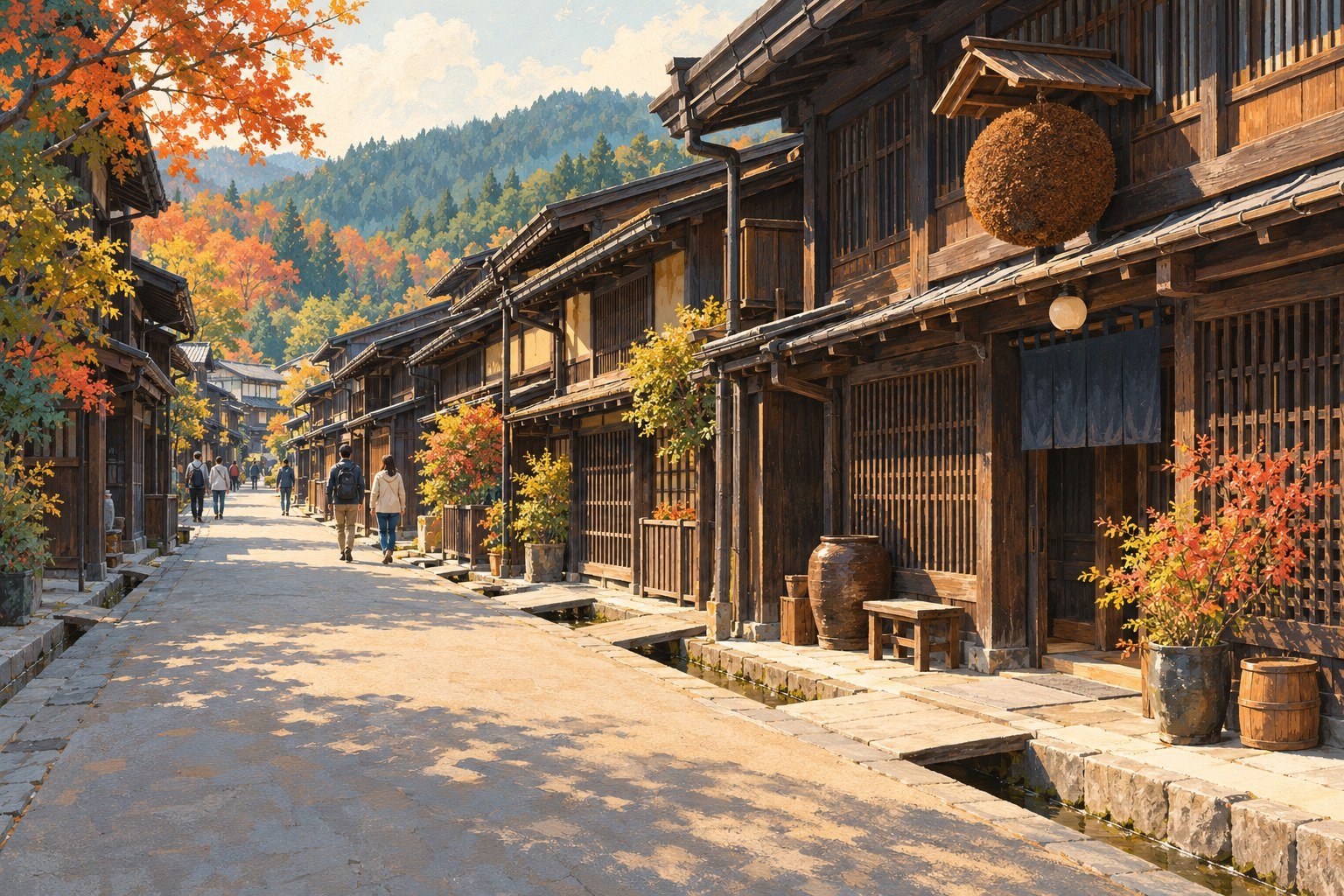
AI-created editorial illustration inspired by Takayama’s timber merchant streets; an illustrative scene, not a photograph of a verified street view.
A useful Takayama travel guide starts with the morning. The markets finish at noon, while the old merchant streets and nearby museums reward time on foot. Arriving in the afternoon and leaving early the next day can therefore miss a central part of the visit. [1][2][3]
For a first stay, allow two nights if your wider itinerary permits. Use Takayama as a city base, then choose between a short Hida outing and a full mountain day. Three nights give you two complete days: enough to enjoy the city properly and leave one for the Alps.
This article contains affiliate links. If you make a booking or purchase through them, Taylor’s Trailblazing Travels may receive a commission at no extra cost to you.
2 nights
A full day and two shorter periods, assuming an afternoon arrival and late-morning departure.
Before noon
Both markets finish at 12:00; their seasonal opening times differ. [2][3]
Choose a base for the journeys you will actually make
For a short visit, the useful choice is between easier luggage handling and immediate access to the historic streets. These are planning judgements based on the city’s layout, rather than a ranking of hotels. Check the walking route to the exact property. [1][7]
Scroll sideways to see all columns.
| Area | A good fit for | Check before booking |
|---|---|---|
| Station and streets towards the river | A short stay, early trains or several bus outings. | The station exit, luggage storage and walking distance to dinner. |
| Miyagawa riverside and old-town edge | Market mornings, architecture and returning to the historic streets between visits. | The walk with bags, room access and whether breakfast fits your morning plans. |
| Higashiyama side or outer-city hotels | A particular inn, larger property or accommodation experience. | Slopes, shuttle frequency, the last return and access to evening meals. |
A listing with a Takayama address can also be in Okuhida, around an hour or more away by bus. That can suit a hot-spring or mountain stay, but changes the plan for city sightseeing. If you mainly want old-town walks, keep the city as your base; if you mainly want baths and alpine scenery, consider allocating a separate night to Okuhida. [15]
After choosing the area, compare Takayama stays on Agoda and check Takayama accommodation on Booking.com. Compare the same occupancy, cancellation conditions and meal plan. Use the map to confirm city-centre access, and ask whether an advertised bath is communal, privately bookable or attached to your room.
For a ryokan dinner, confirm the required arrival time and dietary arrangements before fixing an afternoon excursion. On departure day, ask whether bags can stay at the accommodation while you visit the markets.
Plan the morning markets before the rest of the day
Miyagawa and Jinya-mae have different settings and slightly different seasons for their opening hours. Both are worth considering, but an afternoon arrival needs an overnight stay to make either part of the visit. [2][3]
Scroll sideways to see all columns.
| Market | Where and what to expect | Opening hours |
|---|---|---|
| Miyagawa | Along the river between Kajibashi and Yayoibashi bridges. Produce and pickles at stalls, with sweets and crafts among nearby shops. | April–November: 07:00–12:00. December–March: 08:00–12:00. |
| Jinya-mae | The square in front of Takayama Jinya. Growers’ vegetables and fruit, with handmade preserves and other goods. | April–December: 06:00–12:00. January–March: 07:00–12:00. |
Miyagawa offers the broader browsing mix. Jinya-mae is a useful choice if you are more interested in seasonal produce and the people selling it. Its association explains that stalls cannot use fire to cook beside the historic building, so arrange a separate breakfast if you need a full hot meal. [2][3]
A morning that links the sights naturally
Start with Miyagawa around 08:00, then walk south towards Jinya-mae. Allow roughly 60–90 minutes for browsing both and moving between them, with longer for shopping or conversation. This is an editorial allowance, not a timed tour. Continue inside Takayama Jinya afterwards, or reverse the order if your accommodation makes Jinya-mae the easier first stop.
Jinya adds the government side of the town’s history: administrative rooms, the official residence and the rice-tax granary complement the merchant streets. Allow about another hour for a focused visit. It opens at 08:45; adult admission is ¥500, checked 17 October 2026. [4][5]
Carry small cash and a bag for purchases, ask before photographing stallholders, and keep entrances clear. On a cold or wet morning, expect fewer stalls and make the market one part of a museum-and-café day. [2]
Explore the old town beyond its busiest street
Sanmachi’s appeal lies in the details: wooden lattice fronts, channels beneath the eaves and the cedar balls marking sake breweries. Walk the connecting streets as well as the main shopping stretch, then choose a building or museum that explains what you have been looking at. Shops and tasting rooms set their own hours, so an early street walk and a later shopping visit serve different purposes. [1]
Add context at the Museum of History and Art
The free Takayama Museum of History and Art occupies former merchant warehouses and covers the town, festivals and local culture. Its exhibition rooms are listed as open 09:00–19:00, subject to temporary closures, checked 17 October 2026. This gives an afternoon arrival a useful option after a shorter old-town walk. [6]
Walk towards the eastern temples
The Higashiyama temple quarter brings a change of setting east of the shopping streets. The full walking course is about four kilometres and includes higher ground. For a short visit, choose a smaller temple-street section rather than committing to the complete course; use the current visitor map and respect signed access restrictions. [7]
If historical interpretation is your priority, view the two-hour Takayama Old Town Walking Tour on GetYourGuide. Its listed route links the riverside, Sakurayama Hachimangu Shrine and merchant streets with an English-speaking guide. Check the departure time and current stops; a guided walk is a scheduled activity, and a market stop later in the day does not mean the stalls will still be trading. [8]
Make room for a proper meal
Hida beef, Takayama ramen and hoba miso are useful starting points for choosing local food. Decide whether you want a tasting-sized snack or a sit-down meal before joining a queue. The tourism association’s food directory can help identify restaurants by area and cuisine; confirm opening days and ingredients with the restaurant itself. [27]
If breakfast and dinner are included at your inn, a simple lunch may be enough. If dinner is not included, choose a couple of nearby possibilities before leaving on a long excursion, particularly when your return is late.
Choose the Hida outing that adds something different
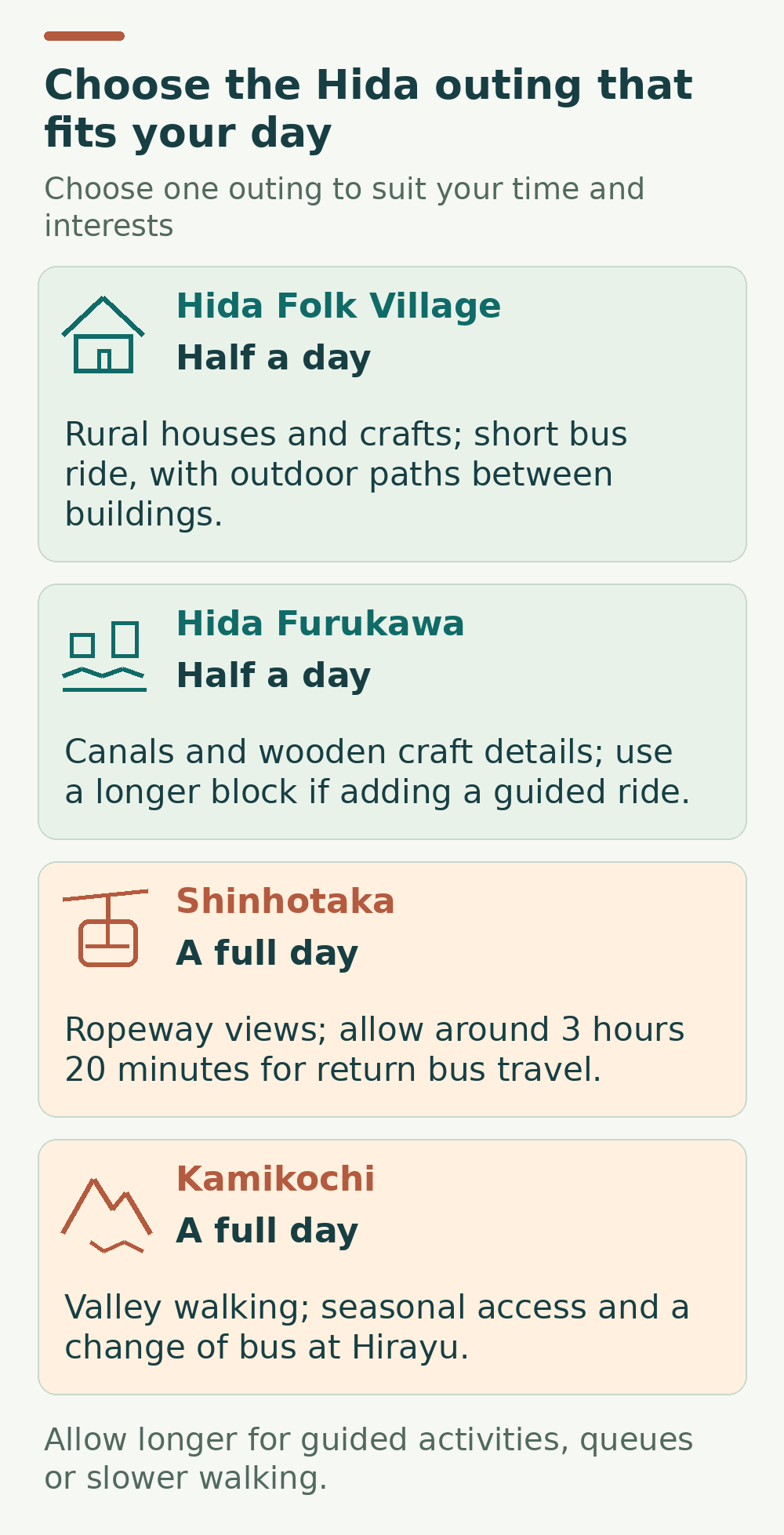
The most useful excursion is the one that gives you an experience the city has not already supplied. The allowances below include travel and a focused visit; they are editorial planning blocks, not a requirement to fill every hour.
Hida Folk Village: rural buildings close to the city
Hida no Sato is an open-air museum of relocated rural houses, with domestic objects and craft demonstrations. It suits travellers who want to understand mountain village life without committing to a longer intercity excursion. The published bus ride from Takayama’s station area is about ten minutes on the Sarubobo service. Check the return loop and departure before entering. [9][10]
Allow two to three hours including travel as a starting budget, adding time for a booked craft activity. Paths between buildings are outdoors, so persistent rain still affects the visit. Adult daytime admission is ¥700, with hours of 08:30–17:00, checked 17 October 2026. [9]
Hida Furukawa: canal streets and countryside
Hida City publishes a roughly 15-minute train journey from Takayama to Hida-Furukawa. Check an actual outward and return departure before setting off. From the station, the old town is close enough for a straightforward walking visit. [11]
Follow the white-walled storehouses beside the Seto Canal, looking for wooden craft details along the way. The carp are a seasonal feature, normally present from April to November; a winter visit has a different character. A half-day block leaves time for a walk and lunch, while preserving part of the day for Takayama. [12]
For a more substantial countryside outing, compare the private morning cycling tour in Hida Furukawa on Viator. SATOYAMA EXPERIENCE’s listed ride lasts about 3½ hours, with a guide, bicycle and helmet. The meeting point is in Furukawa, so add the train journey and arrival margin. A morning ride also uses the Takayama market window: put the markets on another day. [13]
The operator’s cycling season is 20 March–30 November. Riders need suitable cycling ability; check children’s sizes and the exact tour’s conditions directly, as shorter routes may suit some parties better. Weather can change or cancel the activity. Checked 17 October 2026. [14]
Where Shirakawa-go fits
Choose Shirakawa-go when visiting it is a specific priority, and give it its own excursion plan. Choose Hida Folk Village when your main interest is rural architecture within a short journey of Takayama. Trying to add both, Furukawa and the city to one day turns the visit into a series of transfers.
Give the mountains a day of their own
Shinhotaka and Okuhida
Nohi’s Takayama–Shinhotaka route reaches Hirayu in about an hour and the ropeway in roughly 1 hour 40 minutes, depending on the service. That means around 3 hours 20 minutes on buses for a return trip, before queues, ropeway rides or lunch. Treat it as the main outing of the day. [15]
Two connected ropeways reach the upper station at 2,156 metres. Choose this trip when the forecast and live camera suggest useful visibility, and take layers appropriate to the mountain conditions. The ropeway operates year-round subject to weather and maintenance; check its seasonal hours and the last descent before departure. [15][16]
Trail access needs a separate check. As checked on 17 October 2026, the operator’s notice closes the Soyoka no Mori nature trail at Nabedaira until further notice because of bear sightings and signs of their presence. This trail notice does not itself close the ropeway. Follow the current operator notice before planning a walk. [17]
A hot-spring stop in Okuhida can be worthwhile, but confirm the facility’s day-use hours and how it fits the bus timetable. If a long bath and a mountain visit are both central to the trip, an Okuhida overnight stay gives them more room. [15]
Kamikochi: a seasonal valley-walking day
Travel from Takayama to Hirayu, then change to the Kamikochi shuttle. The published journey is about 90 minutes of riding, with waiting and queues added. The 2026 shuttle season runs from 17 April to 15 November. Private cars cannot enter Kamikochi; driving to the transfer point still leaves a bus or taxi connection. [18]
Build the outing around valley walking near the Azusa River and Kappa Bridge, with a route that suits your party and the conditions. Give it its own day rather than adding the Shinhotaka ropeway to an independent first visit.
Check the whole return journey. In the timetable checked on 17 October 2026, the 17:30 shuttle from Kamikochi reaches Hirayu at 17:55, after the last 17:30 departure for Takayama. Choose an earlier connection with spare time for boarding queues. A last shuttle is not necessarily a last connection home. [18]
The Shinhotaka and Kamikochi lines are non-reserved. Buying a ticket does not hold a seat on a particular departure, and full services can mean waiting for the next bus. Keep mountain days clear of tight onward intercity connections. [19]
Build a realistic plan for one, two or three nights
One night: concentrate on the city
Arrive by early afternoon if possible. Leave bags, explore Sanmachi and visit the Museum of History and Art or Jinya. Give the next morning to the markets before departure. If your arrival is late and your onward train early, choose which city experience matters most; the number of hotel nights will not create extra visiting time.
Two nights: city time plus one nearby outing
Use the arrival afternoon for the merchant streets and a museum. On the full day, visit the markets and Jinya, have lunch, then choose Hida Folk Village or a focused Furukawa walk. Use the final morning for anything missed, breakfast and collecting bags. Check the Furukawa return train before committing to that afternoon option.
A full mountain day also fits a two-night stay, but it uses your only complete day. The city then depends on your arrival afternoon and departure morning. This works best when you can arrive early enough for a building visit and leave late enough for the markets.
Three nights: city and mountains with less compression
Reserve one complete day for the city and a nearby Hida outing, and the other for Shinhotaka or seasonal Kamikochi. Swap the full days if the forecast favours it. Keep any booked cycling tour or fixed departure in mind before changing the order.
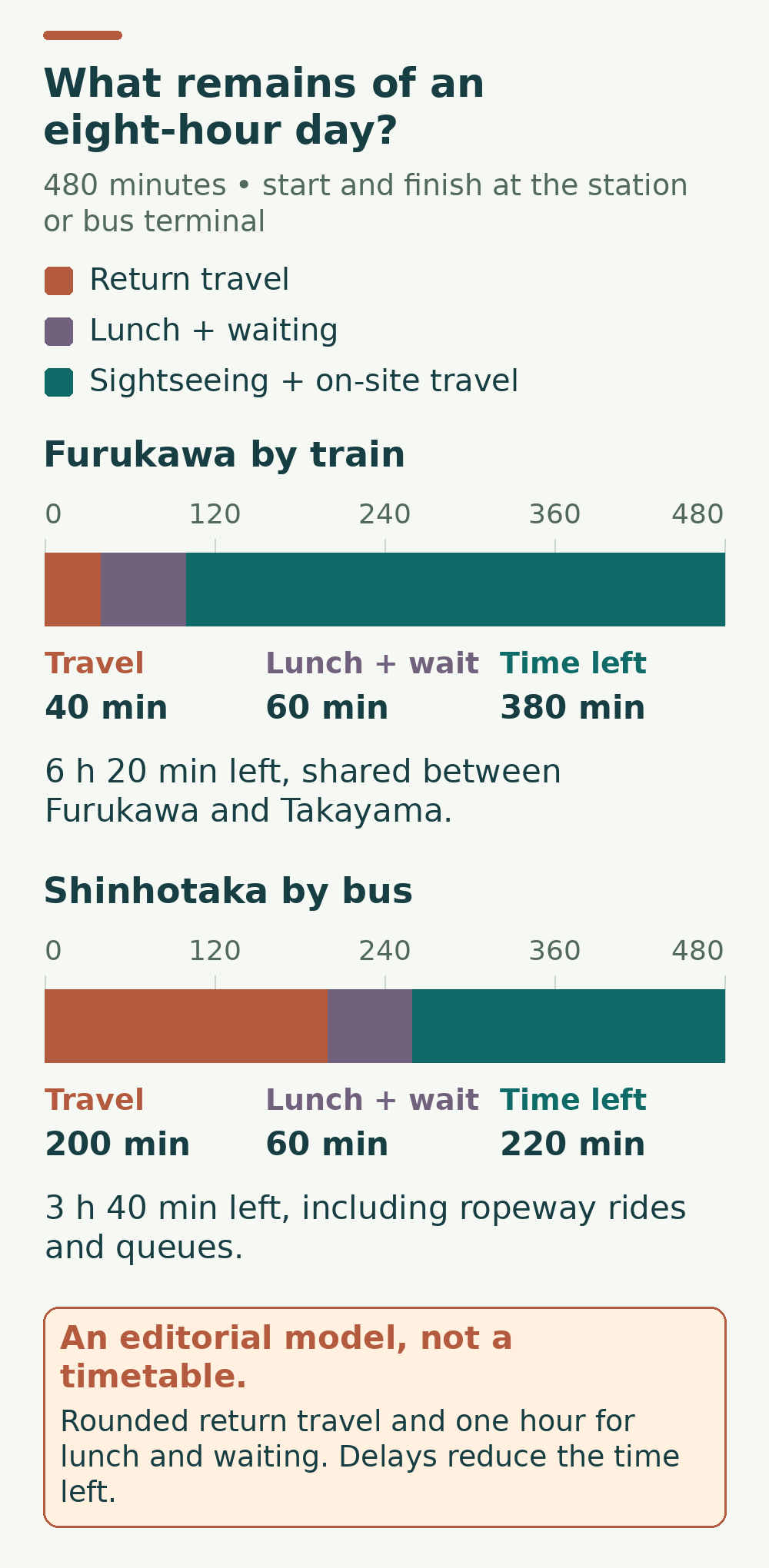
The graphic uses an assumed eight-hour window, starting and finishing at Takayama Station or the bus terminal. Allowing 40 minutes for return Furukawa trains and one hour for lunch and waiting leaves 6 hours 20 minutes to share between Furukawa and Takayama. Allowing 3 hours 20 minutes for Shinhotaka buses and the same one-hour allowance leaves 3 hours 40 minutes at the destination, including ropeway travel and queues. These are rounded planning assumptions informed by published journey times, not a timetable or a promise of available seats. [11][15]
If travel is disrupted or the mountains are obscured, a city day can combine Jinya, the Museum of History and Art, a meal and shorter street walks. Hida Folk Village remains largely an outdoor visit. In severe conditions, follow operator advice before making any excursion. [4][6][9][16]
Getting to Takayama and choosing tickets
Takayama is on the conventional railway, with the main rail approaches via Nagoya and Toyama. From Tokyo or Kansai, include the connection onto the Hida limited express when comparing journeys. A Shinkansen ticket to Nagoya only covers part of that trip. [20][21]
Scroll sideways to see all columns.
| Starting point | Practical approach | Planning implication |
|---|---|---|
| Nagoya | Hida limited express, roughly 2½ hours; or a reserved coach, roughly 2½–3 hours. [20][23] | Compare the whole fare and the exact station or bus boarding point. |
| Toyama / Hokuriku | Hida limited express from Toyama, roughly 1½ hours. [20] | Choose the onward Hida departure before fixing a connecting Shinkansen. |
| Tokyo | Rail via Nagoya, or a reserved coach from Shinjuku. Current daytime coach examples take roughly 5¾–6 hours. [20][22] | An overnight visit gives far more city time than travelling out and back in one day. |
| Kyoto / Osaka | Compare a Shinkansen connection at Nagoya with available through services. [20] | Judge actual departure and arrival times, rather than choosing solely by the fewest changes. |
| Matsumoto | Reserved bus via Hirayu, roughly 2½–2¾ hours in the current timetable. [24] | The road route is useful for an onward journey through the Alps; allow for delays. |
For a limited express, compare the basic fare plus the appropriate express ticket. If you have a rail or regional pass, check its exact trains, buses and reservation rules before paying separately. Reserve the intercity leg you need, especially when it determines a ryokan dinner or an onward connection. [21][23][24]
For the Nagoya approach, compare Nagoya–Takayama coach listings on 12Go alongside Nohi’s own booking information. Select the date and exact boarding point, and check that the product is an intercity journey ending in Takayama: the results can also include day tours. Use the operating company’s timetable for the journey itself. [23][25]
Costs, seasons and practical checks
Separate accommodation and food from the sightseeing you actually intend to buy. The old-town streets and markets can form a low-cost day, while a mountain excursion adds a substantial transport bill. The following figures are selected adult costs, not an all-inclusive daily budget.
Scroll sideways to see all columns.
| Visit or journey | Published cost | What it covers / time limit |
|---|---|---|
| Takayama Jinya | ¥500 | 08:45–17:00 April–October; 08:45–16:30 November–March. Last admission 30 minutes earlier. Closed 29 December–3 January, with possible temporary closures. [4] |
| Museum of History and Art | Free | Exhibition rooms 09:00–19:00; check temporary closures. [6] |
| Hida Folk Village | ¥700 | Daytime admission, 08:30–17:00. Bus fares and any ticket for a separately scheduled night opening are extra. [9] |
| Shinhotaka from Takayama | ¥8,200 example | Two ¥2,200 single bus fares plus a ¥3,800 full ropeway return. Meals and extras excluded; compare the operator’s combination tickets for your dates. [15][16] |
| Kamikochi from Takayama | ¥5,800 | Published return transfer ticket via Hirayu, valid for seven days within the operating season. [18] |
For that Shinhotaka return outing, the operator’s “Okuhida” 2-Day Free Plan from Takayama is ¥7,700: unlimited Nohi buses between Takayama and Shinhotaka plus one return on both ropeways. It saves ¥500 against the ¥8,200 separate-ticket example, even if you use it for one day. It is sold at Takayama Nohi Bus Center, Hirayu Bus Terminal and through the operator’s mobile-ticket link, with ropeway maintenance periods excluded. Check the current conditions before purchase. [16]
For example, Jinya, the free history museum and Hida Folk Village total ¥1,200 in adult admissions, before the local bus and meals. That is a different spending decision from the Shinhotaka outing. A transport bundle deserves comparison when it covers journeys you already want; unused inclusions do not improve the day.
Choose dates around the experience
The spring Takayama Festival takes place on 14–15 April, and the autumn festival on 9–10 October. If either is your purpose, secure accommodation and transport early and use that year’s event and road-restriction notices. A festival visit needs its own pacing; it is not an ordinary city itinerary with a parade added. [26]
In winter, use the later Miyagawa start and allow more time for cold-weather walking. Jinya requires shoes to be removed and has no heating; the operator recommends thick socks or indoor shoes for visitors concerned about the cold. Keep the ordinary Kamikochi outing within its published operating season. [2][4][18]
Cash, access and staying connected
Nohi’s current FAQ says local buses do not accept transport IC cards or other cashless payment on board. Buy the appropriate ticket at a counter where available, or carry coins and small notes. Some sightseeing buses require a wheelchair user to transfer to a bus seat; ask about the specific service before booking an outing. Historic interiors also merit an access check: Jinya describes dedicated-wheelchair and ramp arrangements that require assistance. [19][4]
Save your hotel access instructions and return timetable offline. If your existing mobile plan is unsuitable, compare Japan data options through Airalo; select Japan and check device compatibility, the plan’s validity and activation conditions. Mobile data can help with translation and service checks, but keep the offline details for your mountain day. [28]
For a first visit, settle three decisions before adding more stops: the morning you will spend at the markets, the location you can comfortably return to for dinner, and whether your main Hida outing needs half a day or a full one. Those choices make the rest of the itinerary much easier to fit.
Sources and planning notes
This is a research-led guide. Official tourism bodies, transport operators and attraction information inform the factual advice; base choices, pacing and explicitly labelled budget examples are editorial planning judgements. Sources checked on 17 October 2026. Recheck current prices, conditions and operating notices for your travel dates.
- Sanmachi Traditional Buildings Preservation Area — Takayama City
- Miyagawa Morning Markets — Takayama City
- About Jinya-mae Morning Market — market association
- Takayama Jinya: opening hours and admission — Gifu Prefecture
- Takayama Jinya: history and official notices — Gifu Prefecture
- Takayama Museum of History and Art — Takayama City
- Higashiyama Walking Course — Hida Takayama tourism association
- Takayama Old Town Walking Tour — GetYourGuide
- Hida Folk Village: official visitor information
- Hida Folk Village — Takayama City
- Hida-Furukawa Station — Hida City
- Shirakabe Dozogai Street — Hida City
- Private-group Morning Cycling Tour in Hida-Furukawa — Viator
- Satoyama Cycling, 3½ hours — SATOYAMA EXPERIENCE
- Takayama–Hirayu–Shinhotaka line — Nohi Bus
- Shinhotaka Ropeway: business information
- Soyoka no Mori trail closure — Shinhotaka Ropeway
- Takayama/Hirayu to Kamikochi — Nohi Bus
- Frequently Asked Questions — Nohi Bus
- How to get to Takayama — Takayama City
- Combinations of tickets — JR Central
- Takayama–Tokyo (Shinjuku) line — Nohi Bus
- Takayama–Nagoya line — Nohi Bus
- Takayama–Matsumoto line — Nohi Bus
- Nagoya–Takayama bus listings — 12Go
- About the Takayama festivals — Takayama Float Preservation Association
- Food and local products — Hida Takayama tourism association
- Japan eSIM plans — Airalo
Illustrations in this article were created for Taylor’s Trailblazing Travels. Third-party photographs, where used, are credited beside the image or in the source list.