Japan · Nagano day trips
Jigokudani Snow Monkey Park Guide: Access and Ethical Viewing
The journey, the forest walk and the responsibility of watching wild macaques.
Choose Jigokudani for an unrushed look at macaque behaviour, with enough time to reach the valley and walk out comfortably. The park attracts a free-ranging troop through controlled feeding; the monkeys can leave, and a ticket cannot promise their appearance or a hot-spring photograph.[1]
The practical challenge is often the journey around that encounter: selecting the correct seasonal bus, allowing for the walk beyond its stop and keeping a usable return plan. An overnight stay nearby can make those decisions easier.
Taylor’s Trailblazing Travels may earn a commission when you book or buy through an affiliate link in this guide, at no extra cost to you. This helps fund the research and upkeep of the site.
Time the whole approach
Budget the street approach, forest path and return walk, then add your viewing time.
Match tickets to dates
Admission changes on 1 December; the winter bus timetable begins on 5 December 2026.[5][7]
Observe without pressure
A worthwhile visit can be quiet watching; a particular photograph is an optional outcome.
Keep another option
Build a day you can still enjoy if the troop stays in the mountains.
Choose your starting point
For most first-time visitors, a Nagano-based outing gives the best balance of straightforward transport and room to change plans. Yudanaka or Shibu makes more sense when a hot-spring stay is part of the trip. Tokyo is feasible as a long excursion, but its extra travel makes an uncertain wildlife encounter a bigger commitment.
| Start | What it buys you | Trade-off |
|---|---|---|
| Nagano | A station-based day trip; easiest fit around onward rail travel. | You still need bus time and the complete walking approach. |
| Yudanaka | A useful local base at the railway terminus. | The park is another local-bus or taxi journey away. |
| Shibu Onsen | A traditional hot-spring stay to enjoy alongside the park. | Check the inn’s exact transfer arrangements; a nearby map pin does not remove the walk. |
| Tokyo | A visit without changing hotels. | Allow the whole day and accept that the animals may be absent. |
On a small screen, swipe inside the table to see every column.
Nagano Dentetsu trains terminate at Yudanaka; local buses continue towards the Snow Monkey Park stop. Shibu is a separate hot-spring town in the same Yamanouchi area.[13][22]
If you are travelling up from Tokyo the previous day, compare Tokyo–Nagano rail and coach offers on 12Go. Its route page includes both modes. Check the precise stations, arrival date, ticket-collection instructions and final total; a slower coach suits a positioning day better than a tight same-day park visit.[19]
Understand where the vehicle stops
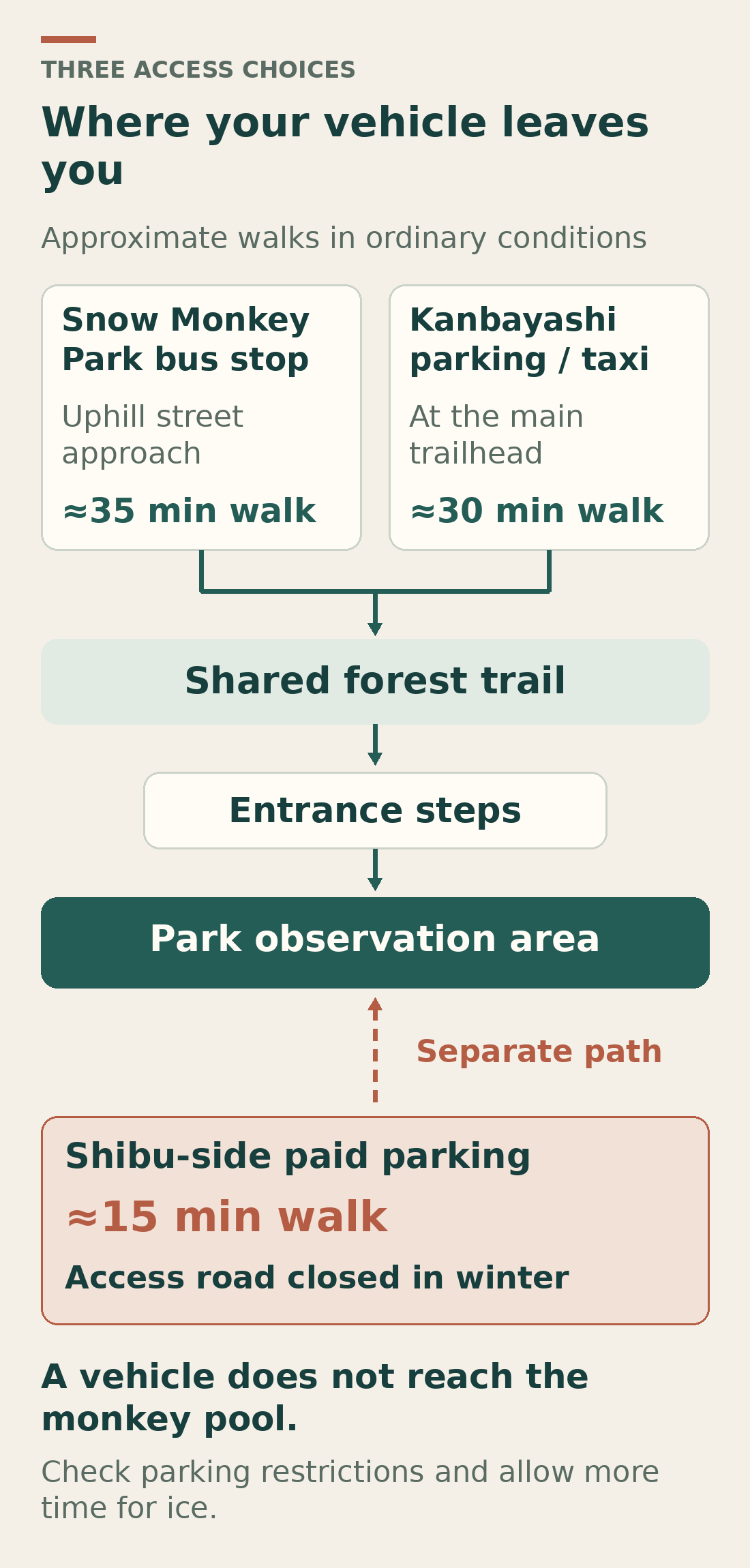
From the Snow Monkey Park bus stop, walk uphill through Kanbayashi to the Yumichi forest trail. A taxi to its trailhead removes the street approach, while the forest walk remains.[2]
Shibu-side Jigokudani paid parking gives a shorter, separate approach. Its narrow access road closes in winter; check its status before directing a driver there.[2]
Choose the main approach if you want the clearest year-round access plan. The park’s August 2026 notice also restricts some parking on winter weekends, public holidays and the New Year period, and asks visitors to favour public transport. A parking place should not be the foundation of a winter itinerary.[6]
Uneven ground and steps prevent wheelchair and pushchair access. Choose another outing if your party cannot manage the walk.[2]
Use the transport details for your travel date
Transport details below were checked on 18 October 2026. The seasonal change affects the route, boarding bay and buying process as well as the fare.
| Travel date | Nagano express-bus choice | Published fare and practical point |
|---|---|---|
| Through 4 December 2026 | Use the current combined Nagano–park–Shiga Kogen timetable. It includes direct park services and through-services. | ¥2,000 each way; scheduled outbound journeys take 50 minutes.[9] |
| 5 December 2026–5 April 2027 | Use Ex24 from East Exit bay 24. Winter Ex23 does not call at the park. | ¥3,000 each way; published Ex24 journeys take 50 minutes out and 55 minutes back.[7][8] |
On a small screen, swipe inside the table to see every column.
For the current network, Ex24 uses bay 24 and the Ex22/Ex23 through-services use bay 23. Match the service on your timetable to the sign, rather than boarding any bus marked Shiga Kogen.[26]
For winter Ex24, the operator directs passengers to buy the dated bus-and-admission set ticket online. Boarding is in queue order, and a full bus means waiting for the next departure; buying a ticket does not reserve a particular bus seat. Limited same-day sales at Nagano’s Aruyo office may stop when online capacity is reached. There is no onboard payment under the announced winter arrangement.[7]
Rail via Yudanaka
For the rail alternative, go to the separate Nagano Dentetsu station on basement level and take a train to Yudanaka. A limited express takes roughly 45 minutes; the local-bus stage is around 8–15 minutes before the walk, plus the connection wait.[13][2]
The Nagano–Yudanaka adult base fare is ¥1,660, with a ¥100 limited-express supplement; the current Kanbayashi local-bus fare between Yudanaka and the park stop is ¥390.[10][11][12]
For a same-day return during October or November 2026, compare the ¥2,820 Nagaden one-day rail pass, which includes unreserved limited-express travel, with two individual rail tickets. Add local buses and park admission separately. The older ¥4,800 train-and-park Snow Monkey Pass has a published sale period ending 30 September 2026; do not assume that product is available for an October trip.[10]
For one adult aged 18 or over visiting by 30 November, the rail-pass calculation is ¥2,820 + (2 × ¥390) + ¥800 = ¥4,400. The current express-bus equivalent is (2 × ¥2,000) + ¥800 = ¥4,800. That ¥400 saving buys an extra transfer each way; choose it for a rail-based day or another stop, rather than treating it as an automatic winner.[4][9][10][12]
Protect your return time before entering
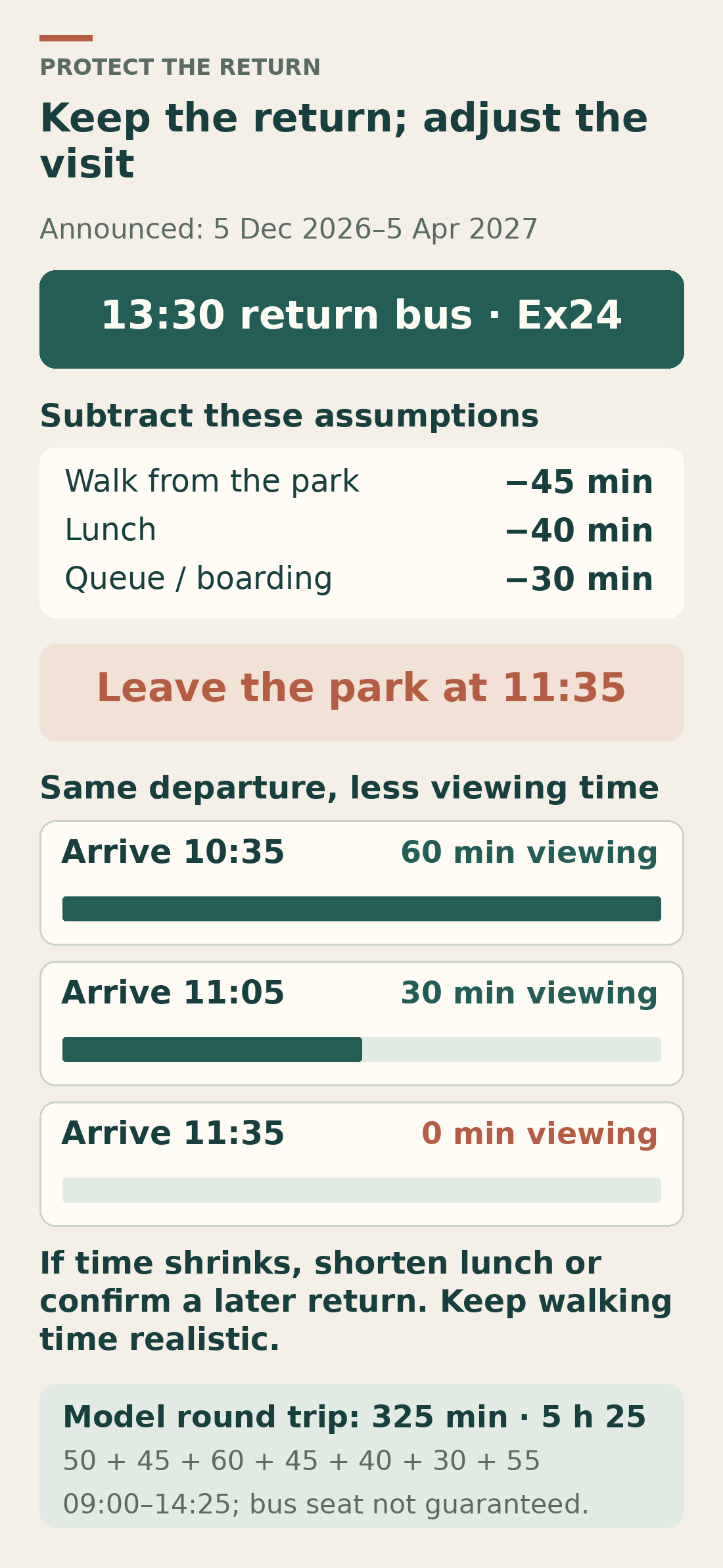
Start with a return departure you could comfortably catch, then work backwards. The example below uses the announced winter Ex24 timetable. Walking, viewing, lunch and queue times are original planning allowances, not measured performance or guaranteed connections.
| Time | Plan | Allowance |
|---|---|---|
| 09:00–09:50 | Bus from Nagano to the Snow Monkey Park stop. | 50 minutes, scheduled.[8] |
| 09:50–10:35 | Walk from the stop to the park. | 45 minutes. |
| 10:35–11:35 | Watch the monkeys, if present. | 60 minutes. |
| 11:35–12:20 | Walk back to the bus-stop area. | 45 minutes. |
| 12:20–13:00 | Lunch near the access area. | 40 minutes; choose a place that fits the time. |
| 13:00–13:30 | Be ready and queue for the return. | 30 minutes; this cannot guarantee a seat. |
| 13:30–14:25 | Bus back to Nagano. | 55 minutes, scheduled.[8] |
On a small screen, swipe inside the table to see every column.
Total: 325 minutes, or 5 hours 25 minutes, from Nagano departure to return. Add your hotel approach, time to buy or check tickets, and further delay margin. A Tokyo Station version that assumes a 90-minute train and 30-minute transfer in each direction adds four hours: about 9 hours 25 minutes before travel between your Tokyo hotel and the station. Select actual trains before relying on that estimate.
The key calculation is 13:30 minus 45 minutes walking, 40 minutes lunch and 30 minutes queueing: leave the park at 11:35. Arriving at the gate at 10:35 gives an hour of viewing; arriving at 11:05 gives half an hour. A later arrival means choosing a later return bus or shortening the meal, not hurrying along an icy path.
If your outward walk takes longer than 45 minutes, use that longer time for the return calculation. Check the park’s operating notice and leave before darkness; the park warns that the forest approach has no artificial lighting. Keep a later train option in reserve if road conditions or a full bus delay you.[14]
Buy admission for the correct date
December 2026 fee change: The operator has announced revised admission charges from 1 December 2026. Its general visitor-information page may still show the earlier ¥800 adult rate, so check the price displayed for your specific admission date rather than assuming that older amount applies.[5]
The park normally opens 08:30–17:00 from April to October and 09:00–16:00 from November to March. It has no regular closing day, but weather, natural hazards or monkey movements can trigger changes. Arrive at the park itself at least 30 minutes before closing and be ready to leave by closing time.[4]
| Visit and ticket type | Adult, 18+ | Child, school age |
|---|---|---|
| Current counter price, through 30 November 2026 | ¥800 | ¥400[4] |
| Counter price from 1 December 2026 | ¥1,000 | ¥500[5] |
| Online price announced from 1 December 2026 | ¥880 | ¥440[5] |
On a small screen, swipe inside the table to see every column.
Children under six enter free with a guardian. The park describes its child category as elementary to high-school age; transport and tour age bands can differ. Disability-certificate discounts require the local ticket window rather than the web-ticket option.[5]
Online tickets launched in August 2026. They are date-specific and can be bought up to three months ahead; on crowded dates, visitors without online tickets may face a wait or be refused entry. Follow the park’s current ticket link, choose the correct date and read change and cancellation conditions before paying.[6]
Check whether a bus bundle or guided tour already includes entry before buying twice. A dated ticket is a planning commitment to a wildlife site, so decide what you would do if the park closes or the troop stays away.
Make your viewing behaviour the ethical test
Jigokudani is a managed wildlife attraction. Staff use a regular feeding routine to encourage the macaques to visit, and people and monkeys share the observation area without separating fences. The park says it limits the food supplied so that it is not their entire diet; that is the operator’s description of its management, not an independent welfare certification. The bathing pool was built for the monkeys.[1]
That distinction lets you make an informed choice. If your priority is observing social behaviour at a managed site, visit with restraint. If you specifically want wildlife encounters without provisioning, this setting does not meet that preference. Neither a close photograph nor a tour booking proves an encounter is responsible.
| Situation | What to do |
|---|---|
| A monkey approaches | Step back and give it room. Never reach towards it, including a baby. |
| You have food with you | Keep it out of sight. Do not feed, offer a taste or use it to attract attention. |
| A face-to-face photograph | Avoid close eye contact and crowding; move your viewpoint back. |
| You want a different pose | Watch quietly. Do not call, shout or try to make the animal react. |
| A crowded edge of the pool | Wait for space; keep phones and cameras out of the bath. |
Drones and selfie sticks are prohibited, as are cameras placed in the water. Flash is currently permitted by the park; choosing available light is an editorial preference, not a claimed flash ban.[3]
For a photograph, use distance and cropping or zoom. If the image would require following an animal, leaning into its space or obstructing its route, let the photograph go. Give the troop a clear way past you and alert a member of staff if someone repeatedly disturbs it.
Watch more than the pool. Pausing to notice grooming, spacing and how animals move around one another gives the visit a purpose even when nobody is bathing. The park explains that bathing is only one part of their behaviour and that some monkeys rarely use the water.[1]
Choose the season and prepare for the trail
For a winter bathing scene, December to March offers the most relevant conditions, but snow cover, attendance and bathing behaviour remain variable. Spring and summer offer a different kind of visit; autumn brings plentiful food in the mountains and less predictable park attendance. Check the park’s own updates rather than treating the name “Snow Monkey Park” as a seasonal guarantee.[15]
There is a particularly strong autumn warning at this review date: the park’s forecast issued on 18 October 2026 says all-day absences are frequent and advises checking the live situation before departure. Its suggested arrival window for 20–27 October is conditional on the troop visiting. An early start by itself does not solve that problem.[14]
Wear supportive shoes suitable for an unpaved path; in winter, use warm waterproof footwear and appropriate ice grips. The park recommends winter boots and simple crampons. Check that any traction device fits your footwear and the day’s conditions. If footing is beyond your party’s ability, turn back.[15]
Carry warm layers, water and a small day bag. Leave bulky luggage at your accommodation or a suitable storage point; Nagaden’s Yudanaka bus office advertises storage at ¥500 per item, with its counter listed as open 09:00–22:00. Check collection arrangements before departing.[16]
Save your return timetable and the park’s status links before walking. If you need mobile data for your wider Japan trip, browse Airalo and select Japan. Japan plans are available, but you need a compatible, unlocked device. Check installation and activation instructions for the plan you choose, and keep offline route details because reception on the trail is not guaranteed.[23][24]
Decide what a guide would add
Go independently if you mainly want time with the monkeys and can manage the timetable and walking conditions. A guide earns their place by joining up transport, explaining behaviour and making useful adjustments. The forest approach remains part of the day either way.
Compare the Nagano Snow Monkeys, Zenkoji Temple and Sake Day Trip on GetYourGuide. Machinovate Japan’s shared tour combines the park with Zenkoji, lunch and a tasting; its advertised inclusions cover local transport, guiding, lunch and park entry. Select the Nagano departure if that is your base and check your confirmation’s exact meeting time. The day follows a group schedule and is listed as unsuitable for wheelchair users and people with mobility impairments.[17]
The operator’s direct itinerary places the park in the afternoon and excludes your Shinkansen ticket and optional inner-sanctuary admission at Zenkoji. Choose it if those other stops are part of what you want, rather than paying for a full sightseeing day solely to avoid a bus transfer.[27]
Compare the Japan Awaits private Nagano day tour on Viator if agreeing your own selection of stops matters. The listing distinguishes public-transport and private-vehicle options; choose the private-vehicle option if avoiding scheduled-bus connections is the reason for booking. Park and temple admission, meals and any onsen charge are extra. Confirm how much park time your chosen route leaves and how the itinerary changes if monkeys are absent.[18]
A private vehicle can simplify the day but cannot make the park wheelchair accessible. Ask about your particular walking needs before paying; broad “accessible” labels on a multi-stop tour do not describe every stop.[18]
Use a nearby stay to make the trip more flexible
An overnight stay is most useful when you want both a hot-spring town and the park. Choose it for that combined experience, rather than buying an extra night solely to guarantee monkeys. Shibu’s compact streets and inns give you another reason to be in the area if viewing plans change.[22]
Browse Agoda’s Yudanaka-area stays for a rail-based overnight stop; use the property map to check its actual distance from Yudanaka Station.[21] Compare Booking.com stays in Shibu Onsen for the hot-spring-town setting. These are area listings, so confirm the individual property’s location, meal arrangements, bath access and any station or trailhead transfer directly before booking.[20]
If the park advises against a visit, decide before committing to the final transport leg. In Nagano, a city and Zenkoji day is a straightforward fallback. If you already have an inn reservation, make the hot-spring stay the centre of the day and ask the inn for suitable local options. Only take another bus excursion once you have checked its own timetable; a spare afternoon is not a reason to squeeze in distant sights.
Frequently asked questions
Does the Japan Rail Pass cover the whole journey?
No. The national Japan Rail Pass covers eligible JR travel such as the Hokuriku Shinkansen to Nagano, but Nagano Dentetsu and Nagaden buses are separate operators outside that coverage. Budget for the onward transport and park admission. Check a regional pass separately rather than assuming its rules match the national pass.[25]
Can children visit?
Yes, provided an adult can supervise them throughout the walk and viewing area. Keep young children within reach and hold their hands as the park requests. Allow extra time and have a clear turn-back plan if they become cold or tired; pushchairs cannot complete the approaches.[4]
Can you bathe with the monkeys?
No. The park is a wildlife-observation facility and prohibits visitors from entering the monkeys’ bath. Arrange any human hot-spring experience separately.[4]
Can assistance dogs enter?
The park prohibits pets and assistance dogs, including guide and hearing dogs. Contact it before travel if this affects your access arrangements.[3]
The next planning step
Base the visit around a manageable walk, the correct seasonal transport and a return you can protect. A Nagano day trip suits most independent visitors; an overnight Yudanaka or Shibu stay works well when the town and its baths also interest you. Check the troop’s status before leaving, let the conditions set your pace and give the animals space to decide how the encounter unfolds.
Sources and further reading
Visitor information and booking conditions checked for this editorial review on 18 October 2026. Recheck the linked operators for your travel date; planning allowances are identified separately in the guide.
- Jigokudani Yaen-koen: the park, regulated feeding and bathing behaviour
- Jigokudani Yaen-koen: official access routes and walking approaches
- Jigokudani Yaen-koen: visitor rules and photography
- Jigokudani Yaen-koen: hours, current fees and entry conditions (Japanese)
- Jigokudani Yaen-koen: admission fee revision from 1 December 2026
- Jigokudani Yaen-koen: August 2026 online ticketing and winter parking notice
- Nagaden Bus: announced winter 2026–27 Snow Monkey Park service
- Nagaden Bus: Ex24 winter timetable, 5 December 2026–5 April 2027
- Nagaden Bus: Nagano–Snow Monkey Park summer timetable and fares, through 4 December 2026
- Nagano Dentetsu: tickets, pass sale periods and limited-express supplements
- Nagano Dentetsu: fares from Nagano, effective 1 December 2025
- Nagaden Bus: Kanbayashi line fare table, revised 1 October 2026
- Go! Nagano: Jigokudani Wild Snow Monkey Park guide
- Jigokudani Yaen-koen: monkey-arrival forecast for 20–27 October, issued 18 October 2026 (Japanese)
- Jigokudani Yaen-koen: first-time visitor guide and seasonal expectations
- Nagaden Bus: Yudanaka Station bus boarding, luggage storage and taxis
- GetYourGuide: Machinovate Japan Snow Monkeys, Zenkoji Temple and Sake Day Trip
- Viator: Japan Awaits private Nagano day tour and transport options
- 12Go: Tokyo–Nagano transport comparison page
- Booking.com: Shibu Onsen accommodation district
- Agoda: Yudanaka accommodation area
- Shibu Onsen Ryokan Association: the hot-spring town
- Airalo: Japan eSIM plans
- Airalo: device compatibility requirements
- Japan Rail Pass: official scope of validity
- Nagaden Bus: Nagano Station boarding bays and East Exit ticket office
- Snow Monkey Resorts: operator itinerary and inclusions for the Nagano group tour
Illustrations in this article were created for Taylor’s Trailblazing Travels. Third-party photographs, where used, are credited beside the image or in the source list.