Sendai and Matsushima Travel Guide: Exploring Miyagi
Give the city its own day, then choose a bay route that leaves time for temples, seafood and the water.
- Suggested time · 2 full days
- Default base · Sendai Station
- Bay approach · JR Senseki Line
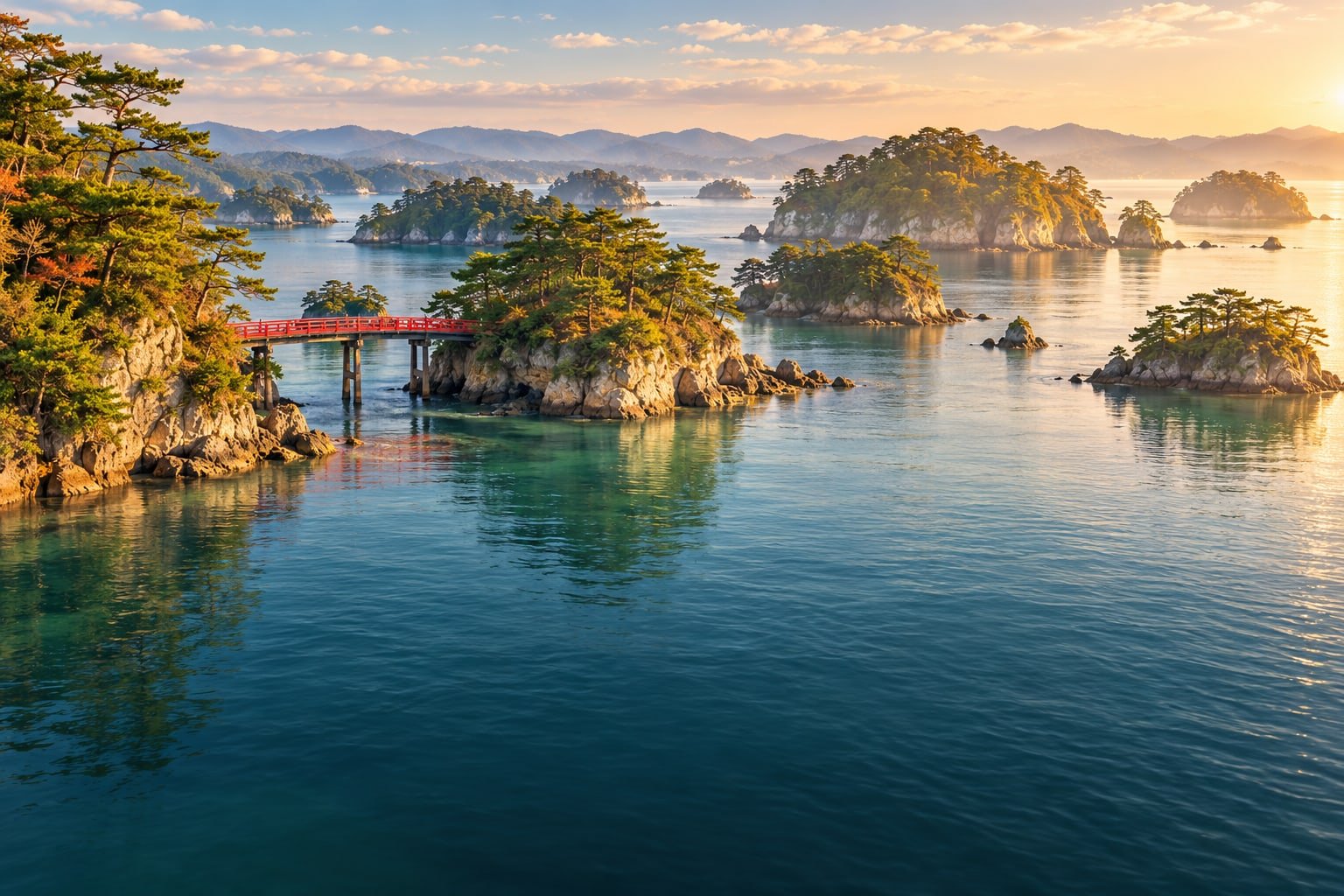
AI-generated editorial illustration inspired by Matsushima Bay in Miyagi; an imagined coastal composition, not a documentary photograph or exact viewpoint.
Sendai and Matsushima work well as a pair. Date family history connects the city’s wooded mausoleums and hilltop castle site with the bay’s temples, while the Senseki Line makes the coast a manageable journey from Sendai.[1]
The useful decision is how much of each place to give your attention. This guide recommends a full city day and a separate bay day, then shows where a third day adds something different. A cruise, two temples and an unhurried meal already make a substantial Matsushima outing.
This guide contains affiliate links. If you book or buy through them, Taylor’s Trailblazing may earn a commission at no extra cost to you.
Count usable days
Two nights work with an early arrival and late departure; arrive late and leave early, and three nights protect two full days.
Choose the bay journey
A return cruise keeps logistics simple. A Shiogama crossing adds a different town but uses time you would otherwise spend in Matsushima.
Give history a focus
Choose the castle view and mausoleum for an outdoor day, or give the City Museum more time when objects and historical explanation interest you.
Let the weather set the order
Put the bay on the better weather day and retain an indoor city alternative. Confirm boat operations before setting out.
Where to stay: city convenience or a bay overnight?
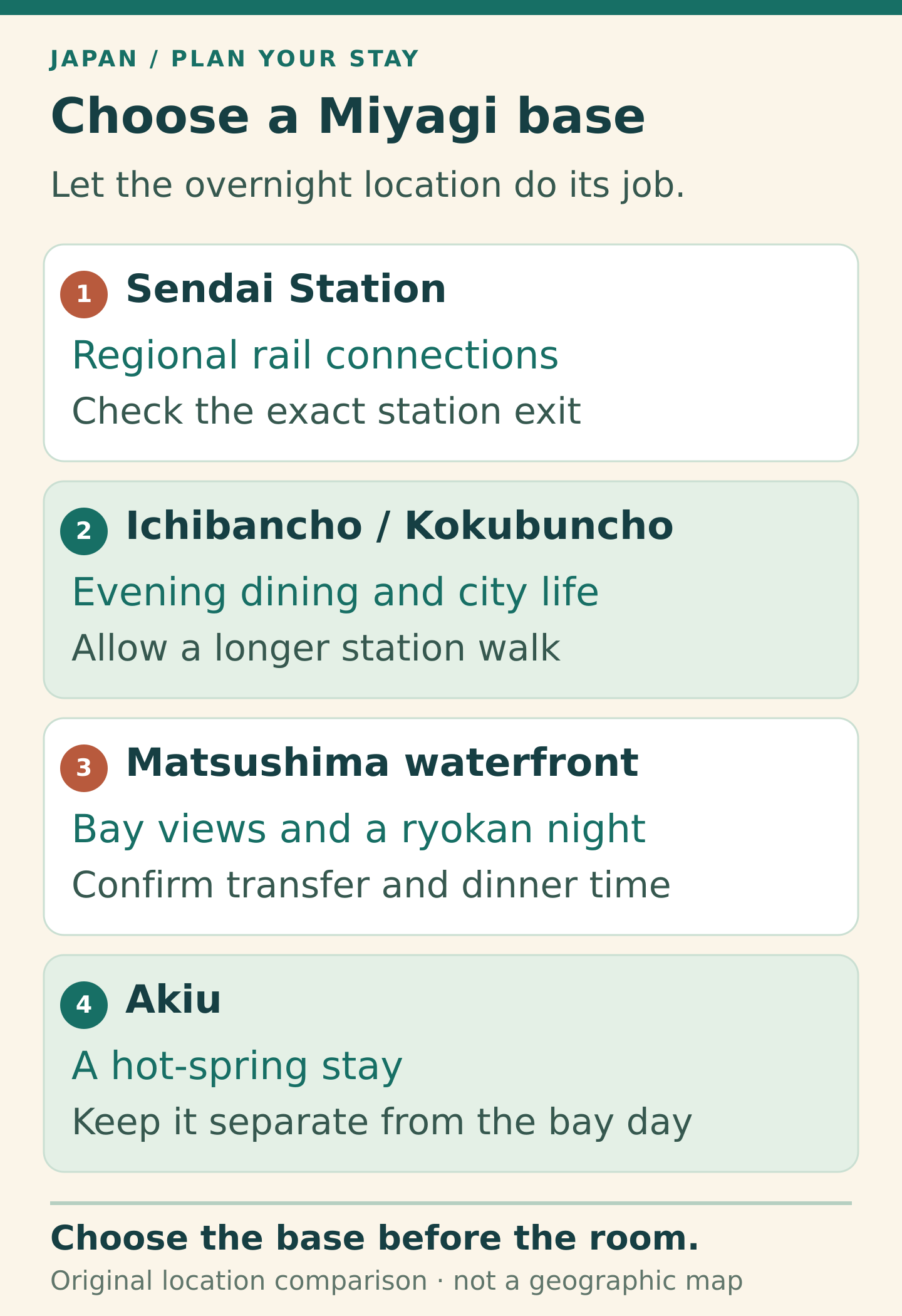
Choose your base by the evening and departure you want, then inspect the hotel’s actual entrance on a map. A station name in a listing is less useful than the walk with luggage, the nearest exit and the journey back after dinner.
| Base | Best fit | What to check |
|---|---|---|
| Sendai Station | A short stay with rail arrivals, a Matsushima day and onward travel. | Exact exit, luggage storage and walking distance; allow time to cross the station. |
| Ichibancho / Kokubuncho | Travellers who want dining streets and an evening walk to shape the stay. | The station journey and recent room-noise comments. |
| Matsushima waterfront | A bay view, a slower evening and a booked ryokan meal. | Whether the room really has a view; station transfer, dinner deadline and meal inclusions. |
| Akiu | A hot-spring night that is a planned part of the trip. | The correct bus or hotel shuttle and how the stay affects the city and bay days. |
For the city option, compare Agoda’s Sendai accommodation search with Booking.com’s Sendai accommodation search using the same dates, occupancy and cancellation requirements. For a coastal night, compare Agoda’s Matsushima-area search and Booking.com’s Matsushima search; check the map carefully because broader area results may place you outside the waterfront you had in mind.[2][3][4][5]
One hotel is usually the easier choice for two full days. Moving to Matsushima becomes worthwhile when you will use the evening and following morning there. A late check-in followed by an early train gives little return for the extra packing and transfer.
A Sendai day with a clear historical thread
Zuihoden: the Date family in a wooded setting
Zuihoden contains the reconstructed mausoleums of Date Masamune and his successors, with ornate carving and colour against the surrounding forest. The small museum adds excavated objects to what would otherwise be an architectural visit. It is a cemetery as well as an attraction, so leave space for quiet observation.[6]
Allow roughly an hour as an editorial starting point, longer if you read the displays carefully. The current adult admission is ¥570; opening finishes earlier in winter. Visitors who need a route with few steps should check access directly before committing to this hillside stop.[7]
Sendai Castle site: go for the setting
At Mount Aoba, the stone walls, reconstructed watchtower and equestrian statue of Masamune help explain the former castle’s position above the city. The main reward is the setting and view; this is a castle site, with no intact castle keep to explore.[8]
Pair it with Sendai City Museum if you want more about the Date clan and the city’s past. The museum gives the historical objects time to matter; choose it over a prolonged viewpoint stop when visibility is poor or indoor interpretation is your priority.[9]
Finish with modern Sendai
Move back towards Jozenji-dori and Sendai Mediatheque, Toyo Ito’s cultural building containing a library and exhibition spaces. Check the programme before expecting a particular show. The architecture and the city’s everyday cultural life make a useful change of pace after the Date sites.[10]
A workable order is Zuihoden in the morning, the museum and castle area around the middle of the day, then central streets and dinner. These are suggested time blocks, not a promise that every exhibition, bus and meal will fit. Choose one of the museum or castle stops for a slower day.
If historical explanation matters more than navigating alone, compare Viator’s six-hour Sendai tour with a licensed guide. The listing offers a customised walking day, with a licensed English-speaking guide and a selection of three or four sites. Transport fares, admissions and lunch are extra, and a private vehicle is not included. Agree a coherent city route before booking.[21]
What to eat, and how to give dinner enough room
Three local foods provide a useful starting point: gyutan is grilled beef tongue; zunda is sweetened edamame, often served with mochi or in drinks; and sasakamaboko is a fishcake shaped like a bamboo leaf. Choose gyutan for a sit-down meal, zunda for a small sweet break and sasakamaboko for a snack or food souvenir.[11]
Iroha Yokocho and Bunka Yokocho offer clusters of small eating and drinking places, while the Kokubuncho area supports a larger evening circuit. Individual businesses differ in hours, capacity and style. Pick an establishment whose menu and atmosphere suit you rather than treating every narrow lane as the same experience.[12]
For a short stay, organise two different dinners: one around a specific local dish and another around a neighbourhood you want to explore. Reserve a small restaurant if eating there is important, and ask about minimum orders, table charges and dietary requirements before sitting down. Fishcake, seafood and meat specialities are descriptions of ingredients, not guarantees that a wider menu suits an allergy or a vegetarian diet.
At Matsushima, leave the main meal for the bay day instead of snacking continuously on the way to lunch. If Shiogama’s seafood is the priority, make that the meal stop and reduce the number of Matsushima visits; the prefecture’s own route planning treats the two towns as a connected coastal outing.[19]
Matsushima: build the day around the bay and two temples
For the simplest rail approach, use Matsushima-Kaigan on the JR Senseki Line. Matsushima Station is on a different line and farther from the principal visitor area. Zuiganji gives walking estimates of about 10 minutes from Matsushima-Kaigan and 25 minutes from Matsushima Station.[16][14]
Choose the experiences that add something different
Zuiganji deserves proper attention indoors. Its current main buildings were commissioned by Masamune in 1609, and the National Treasure hall contains painted and carved decoration that explains the Date connection far better than an entrance photograph. The temple museum adds another layer of context.[13]
Entsuin contributes gardens rather than another version of the same interior visit. Its four garden areas make it a good partner for Zuiganji; the current adult daytime admission is ¥500. Godaido is a shorter waterfront stop, useful between the temples and the boat rather than as a separate half-day objective.[15][16]
A boat trip changes the viewpoint from shore to islands. Niomaru’s standard return cruise takes about 50 minutes and currently costs ¥1,500 for an adult. Check that day’s departures and conditions; the advertised 16:00 sailing does not run in winter. An upper-deck supplement buys a different seating area, not a different route.[17]
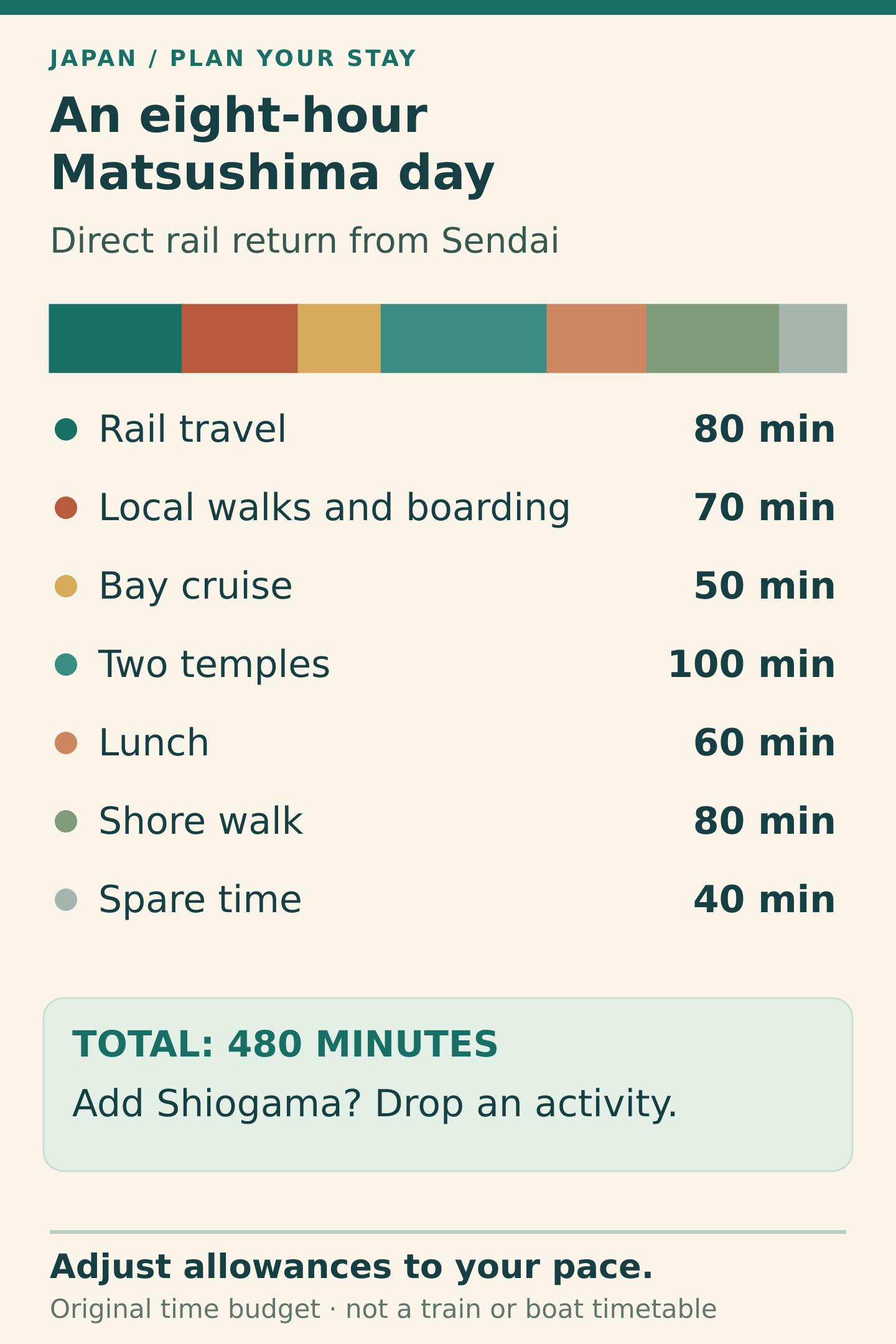
| Use of time | Allowance |
|---|---|
| Return rail journey from Sendai | 80 minutes |
| Local walks and boarding | 70 minutes |
| Bay cruise | 50 minutes |
| Zuiganji and Entsuin | 100 minutes |
| Lunch | 60 minutes |
| Shore walk and unplanned stops | 80 minutes |
| Spare time | 40 minutes |
| Total | 480 minutes / 8 hours |
The rail allowance uses the roughly 40-minute Senseki journey, and the cruise allowance follows the operator’s 50-minute sailing. The remaining allocations are editorial choices. Put the temples before their closing times, choose a boat that leaves room for lunch and shorten the shore walk first if queues use the spare time.[1][17]
When the Shiogama crossing is the better choice
Marubun’s Basho route runs one way between Shiogama and Matsushima, normally taking about 50 minutes, with a standard adult fare of ¥1,500. It works as transport and sightseeing together. Confirm the departure port, sailing direction and operating status: buying a Matsushima return cruise would not achieve the same journey.[18]
Use this version when visiting Shiogama is a priority. Add time for getting between the station, your chosen food stop and the pier, then drop either a lengthy shore walk or one temple. Trying to insert Shiogama into the eight-hour table without removing anything makes the afternoon fragile.
For a hosted version, compare the guided Matsushima day tour on GetYourGuide. The current eight-hour itinerary uses public transport, visits the temples and includes a cruise. The listing includes the English guide, return rail, attraction entry and matcha with sweets; lunch is extra. It involves several hours of walking and currently excludes wheelchair users and people over 70. Check participation conditions and the selected option’s cruise inclusions before paying.[20]
Getting to Sendai and using local transport well
Sendai is a practical stop on a northbound rail itinerary. Compare your actual Tokyo departure with onward plans rather than buying a pass simply because several trains appear in the itinerary. You can compare Tokyo–Sendai transport on 12Go alongside the railway’s direct booking options; check the total charge, arrival station, seat reservation, ticket delivery or collection and cancellation terms.[29]
From Sendai Airport, the access railway provides a direct journey to Sendai Station of approximately 25 minutes. Add the wait for the train and the walk to your hotel when judging an arrival-day plan.[25]
Loople: buy the ticket for the journeys you will make
Loople follows a one-way sightseeing circuit, taking roughly 70 minutes for a complete loop. Departures from Sendai Station run from 09:00 to 16:00; weekday and weekend frequencies differ. Plan the sequence of stops because the bus cannot reverse around its route.[26]
Adult fares changed on 1 October 2026: ¥300 for one ride, ¥700 for a Loople day ticket and ¥1,000 for the Loople-plus-subway ticket. Older itinerary pages may still show the previous day-ticket price.[26][27]
Two single rides cost ¥600 and three cost ¥900: the ¥700 day ticket saves at the third ride. The combined ticket adds ¥300; compare your planned subway fares. Ordinary city buses are excluded from the Loople-only ticket.[26]
For the central evening, walking and the subway may fit better than waiting for another loop. Keep a saved map of your hotel and the station exits. If your existing mobile plan is costly abroad, open Airalo and select a Japan eSIM after checking validity, data allowance and activation rules. Your phone must support eSIMs and be network-unlocked; a downloaded map remains useful even when you have mobile data.[30][31]
Two days, three days or a shorter stop?
| Time available | Plan that fits | What to leave for another visit |
|---|---|---|
| One full day | Choose the city’s Date sites and dinner, or the bay with one or two temples. | A complete Sendai day plus a complete Matsushima day. |
| Two full days | One city day and one bay day; swap their order for weather. | Akiu and further coastal excursions. |
| Three full days | Keep the two-day core and add Akiu or a separate coastal-history visit. | Multiple distant Miyagi areas on the same extra day. |
| Late arrival, morning departure | Two nights give one full day; three nights give two. | Counting check-in and check-out days as if both were available in full. |
Akiu is the strongest extra day when the purpose is a hot spring, crafts or a quieter meal outside central Sendai. The prefecture gives an indicative bus journey of about 50 minutes; check the particular stop, return service and any hotel shuttle. For an overnight bath-and-dinner stay, confirm the meal time and whether day-use bathing or a private bath needs a reservation.[22]
Arahama Elementary School is a different kind of extension. The preserved school and exhibits address the 2011 tsunami and the community’s experience. Give that coastal visit its own time for travel and reading, check the current opening calendar, and approach it as a place of learning and remembrance.[23]
If Miyagi is one part of a longer first visit, use the site’s guide to how many days you need in Japan to protect these usable days before adding another hotel stop.
Season, weather and access decisions
Choose festival dates deliberately. Sendai Tanabata takes place annually on 6–8 August, with decorated shopping streets at the heart of the event. Confirm the programme for your travel year and settle accommodation before building a tight sightseeing schedule around it.[24]
For an ordinary visit, autumn gardens and a bay cruise can work well together, but colour and weather are variable. Entsuin’s evening illuminations have their own dates and arrangements; a daytime visit is not automatically an evening ticket. In winter, organise the bay day around earlier attraction closures and the reduced late-afternoon sailing choice.[15][17]
Bad weather does not affect each plan equally. Rain can still leave an indoor temple visit worthwhile, while wind or sea conditions may change a cruise. Check the operator first and retain a shore-based version of the day. In Sendai, the museum and Mediatheque provide useful indoor anchors rather than relying entirely on a distant view.[18][9][10]
Access needs deserve attraction-specific checks. Zuiganji currently permits wheelchair access to its treasure museum but not its main hall or kuri. A tour labelled as sightseeing is not necessarily suitable for everyone; ask about steps, walking distance, seating and boat boarding in relation to the route you will use.[14]
What to budget and what to book first
| Plan component | Current amount | Interpretation |
|---|---|---|
| Loople day ticket + Zuihoden | ¥700 + ¥570 = ¥1,270 | Before any eligible attraction discount; other museum entries extra.[26][7] |
| Zuiganji + Entsuin + standard return cruise | ¥1,000 + ¥500 + ¥1,500 = ¥3,000 | A useful bay-day admissions baseline; add return rail and food.[14][15][17] |
| Optional meal allowance | Choose your own daily amount | For example, setting aside ¥2,500 gives a planning envelope; it is an assumption, not a surveyed average. |
On that illustrative food allowance, the listed city components total ¥3,770 and the bay components total ¥5,500 before rail, accommodation and extras. Use the arithmetic to identify what you have omitted rather than treating either number as a complete daily budget. Compare the wider trip in the Japan trip-cost guide for UK travellers.
Miyagi’s accommodation tax started on 13 January 2026. It is ¥300 per person per night when the room-only, tax-exclusive lodging charge is at least ¥6,000. This includes Matsushima. Within Sendai, the same ¥300 total consists of ¥100 prefectural tax and ¥200 city tax; do not add a second ¥300. Check whether your booking has already collected it.[28]
Book accommodation first when a festival, bay-view room or ryokan meal determines the stay. Next secure any guided activity that replaces an independent day. Ordinary city visits need less advance commitment, so leave their order flexible and check temple hours, the boat’s status and your return train close to departure.
Your Sendai and Matsushima questions answered
Can you visit Sendai and Matsushima in one day?
You can sample both, but the trade-off is substantial. For a single day, choose a compact Matsushima visit followed by dinner in Sendai, or concentrate on the city. A temple visit, cruise, travel and lunch already occupy much of a bay day; the full city route needs separate time.
Which station should you use for Matsushima?
Matsushima-Kaigan on the Senseki Line is the straightforward choice for the principal temples and waterfront. Matsushima Station is a different station on the Tohoku Main Line; Zuiganji lists walks of about 10 and 25 minutes respectively.[14]
Is an overnight stay in Matsushima worth it?
It is most worthwhile when you want to enjoy the hotel itself, a bay view or a ryokan dinner and an unrushed morning. Stay in Sendai if convenient onward trains and different city dinners are more important. Check that your chosen room, meal plan and transfer deliver the experience you are paying for.
Do you need a car for the main Sendai and Matsushima visit?
No car is needed for the city-and-bay core, which uses rail and Loople. Check Akiu’s bus or shuttle separately, and assess any countryside extension on its actual route.[1][26][22]
Is the Loople pass always the best value?
No. Two single rides cost less than the day pass; three cost more. Add the expected subway fares before choosing the combined version.[26]
Choose the plan that fits your trip
Start with two complete days and a base that makes your evenings and onward journey easy. Give Sendai a coherent history-and-food day, then choose either a direct Matsushima outing or a Shiogama crossing with fewer stops. Add Akiu or the coast only when there is another usable day to give it.
How this guide was researched
Written from official prefectural, tourism, attraction and transport information, with booking landings checked on 17 October 2026. Stay recommendations, route priorities and time allowances are editorial planning judgements. Current operator notices take precedence over older translated visitor pages; no first-hand visit is claimed.
Sources and checks
Official, operator and relevant booking information checked on 17 October 2026. Opening arrangements, fares and availability can change; recheck the linked source for your travel dates.
- Miyagi Prefectural Government — a first visit to Miyagi
- Agoda — Sendai accommodation search
- Booking.com — Sendai accommodation search
- Agoda — Matsushima accommodation search
- Booking.com — Matsushima accommodation search
- Miyagi Prefectural Government — Zuihoden mausoleum
- Zuihoden — official visitor information
- Sendai Tourism — Sendai Castle site
- Sendai Tourism — Sendai City Museum
- Miyagi Prefectural Government — Sendai Mediatheque
- Miyagi Prefectural Government — food and drink
- Miyagi Prefectural Government — yokocho culture
- Miyagi Prefectural Government — Zuiganji Temple
- Zuiganji — current admissions, hours and access
- Entsuin — official visitor information
- Japan National Tourism Organization — Matsushima Bay
- Matsushima Pleasure Boat — Niomaru timetable and fares
- Marubun Matsushima Kisen — one-way Basho cruise
- Miyagi Prefectural Government — Shiogama and Matsushima
- GetYourGuide — Matsushima day tour from Sendai
- Viator — Sendai private day tour with a licensed guide
- Miyagi Prefectural Government — Akiu retreat
- Miyagi Prefectural Government — Arahama Elementary School tsunami ruins
- Sendai Tanabata Festival — official information
- Sendai Airport Transit — airport rail overview
- Loople Sendai — current route and ticket information
- Loople Sendai — October 2026 fare change notice
- Miyagi Prefecture — accommodation tax notice
- 12Go — Tokyo to Sendai transport comparison
- Airalo — Japan eSIM plans
- Airalo — device compatibility
Illustrations in this article were created for Taylor’s Trailblazing Travels. Third-party photographs, where used, are credited beside the image or in the source list.