Beppu and Yufuin Travel Guide: Two Different Onsen Towns
Steam-filled streets, mountain walks and the overnight choice that shapes your trip.
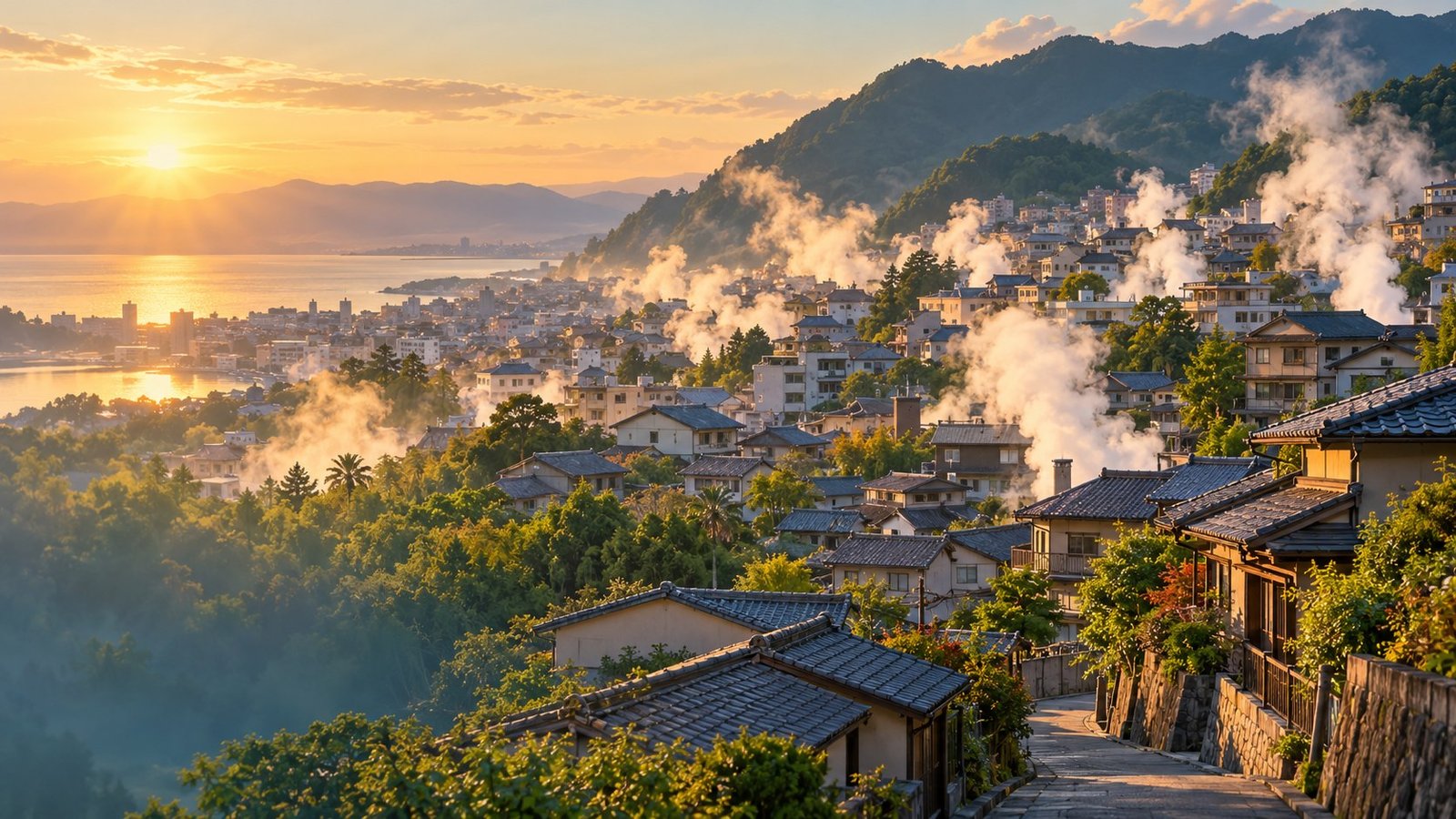
Original AI-created illustration inspired by Beppu; not a documentary photograph.
A hot-spring trip can revolve around the town or around the place you stay. Beppu rewards curiosity: choose the baths and geothermal sights that interest you, then connect them. Yufuin rewards a slower accommodation decision: the room, meal plan and time you leave yourself at the inn can matter as much as the sightseeing list.
This Beppu and Yufuin travel guide helps you decide where to sleep, how to move between the two and what to leave out. The suggested plans assume independent travel at a moderate pace. They are planning recommendations based on the sources below, with room for lunch, luggage and the occasional change of weather.
Some links in this guide are affiliate links. Taylor’s Trailblazing Travels may earn a commission if you book or buy through them, at no extra cost to you.
Steam and variety
Beppu
Build a day around the hells, a real bath and time in Kannawa.
A slower overnight
Yufuin
Give a ryokan evening and a morning stroll room in the plan.
One base or two?
Choose the evening
Move hotels only when the second overnight is part of the experience.
Booking priority
The bath and meals
Check the room, bathing arrangements and dinner time together.
Beppu or Yufuin: choose the experience you want
Beppu makes hot-spring culture the activity: viewing geothermal pools, trying a bathhouse, eating food cooked with steam and exploring Kannawa’s steaming streets. Yufuin combines bathing with mountain scenery, cafés and time at a ryokan. Both have traditional inns; the distinction is how you want to spend the hours between baths. [1] [2]
| Your priority | Stronger starting choice | The trade-off |
|---|---|---|
| Several different bathing experiences | Beppu, with time in Kannawa | Allow for travel between districts; a station hotel is not beside every bath. |
| A special inn, dinner and a quiet morning | Yufuin | Protect time at the accommodation when planning sightseeing. |
| Easy arrival and a varied short stay | Central Beppu | Mountain scenery becomes an outing rather than your immediate setting. |
| Lake walks and browsing between soaks | Central Yufuin | Confirm how far your chosen inn is from the station–lake walking route. |
| Privacy or specific access requirements | Whichever property confirms them | The exact bath and room matter more than the town’s reputation. |
For a first visit with three nights, two in Beppu and one in Yufuin is a useful starting allocation. Reverse it if the ryokan is the main reason for travelling. With one night, choose one town and enjoy it properly; trying to give both equal attention can leave very little time for the stay itself.
Getting there: the mountain bus and the railway take different routes
From Hakata in Fukuoka, look at JR Kyushu’s Sonic service for Beppu. For Yufuin, Yufuin no Mori is a sightseeing-train option taking roughly two hours and a quarter from Hakata. All its seats are reserved; check the operating calendar and your actual service before building a trip around it. [7] [6]
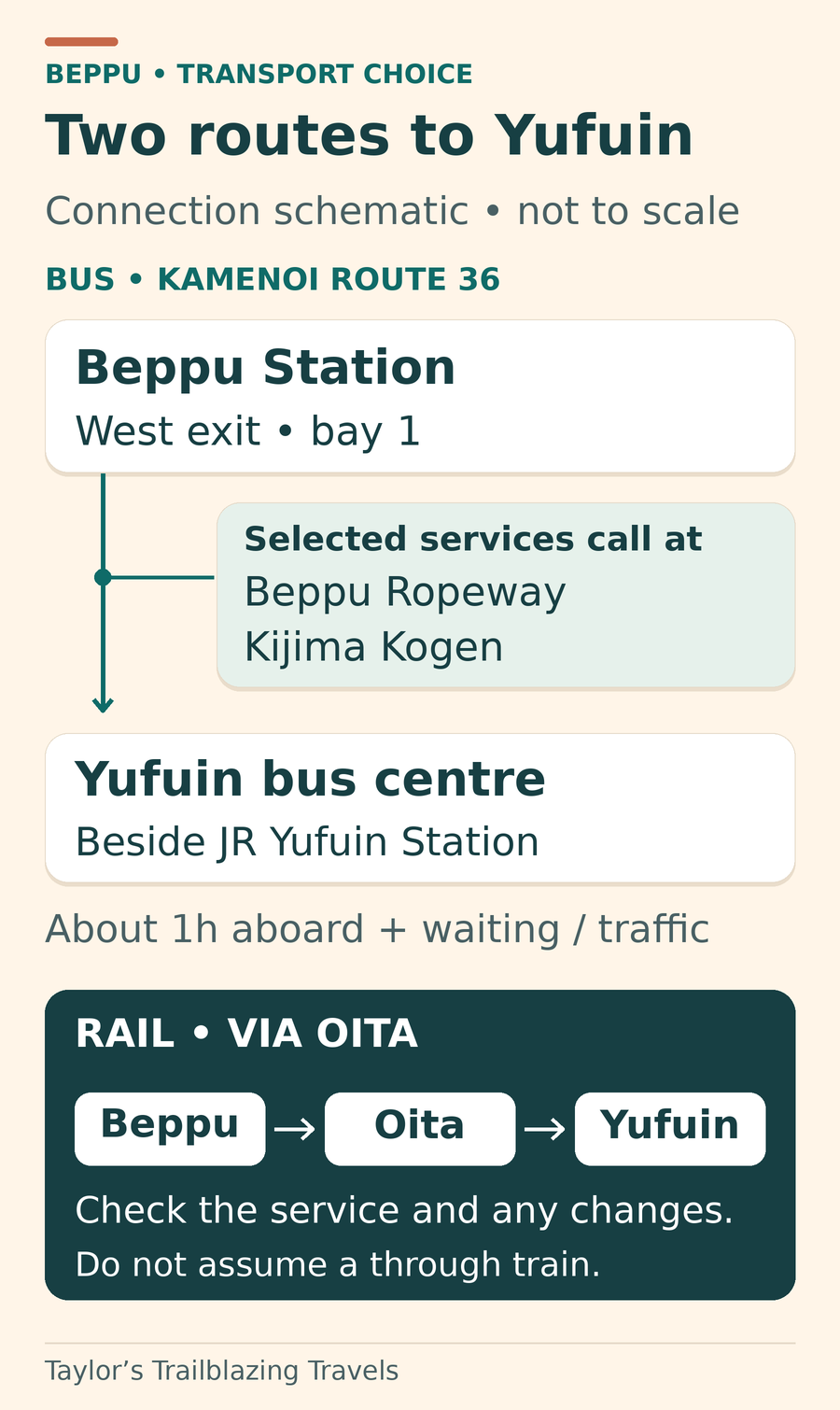
Between the towns, Kamenoi’s ordinary Route 36 leaves Beppu Station’s west exit, bay 1, and runs over the mountains to Yufuin’s station-side bus centre. The published weekday and weekend timetables generally allow about an hour aboard. Waiting, traffic and the walk to your hotel are additional. Some early or late services do not call at the ropeway. [3] [4] [5]
The rail route goes through Oita. JR’s current Yufuin no Mori timetable includes a through Beppu service, but many departures terminate at Yufuin; other rail combinations can require a change. Compare the complete journey for your date, especially if you already hold a rail pass. Do not assume the train follows the direct mountain-road corridor or that every departure is interchangeable. [6]
If flying into Oita Airport, compare the airport bus with your accommodation’s actual position. The airport publishes approximately 53 minutes to Beppu Station on the station-bound route and 55 minutes to Yufuin. Other Beppu-bound buses serve Kitahama without continuing to the station. Check the stop, current timetable and flight margin. [8]
On a phone, swipe the diagram sideways to read its labels.
Where to stay, and what an onsen room actually includes
Beppu: station convenience or Kannawa atmosphere
Start around Beppu Station if onward trains and a straightforward arrival matter most; consider Kitahama when the airport-bus stop suits your plans. Choose Kannawa when the hells, steam cooking and nearby bathing are the centre of the stay. Visit Oita allows roughly 20–30 minutes by bus from Beppu Station to the hells area, so these are meaningfully different bases. [8] [9]
Compare Beppu accommodation on Agoda and Beppu stays on Booking.com using the map. The destination label covers a wider area than the station neighbourhood. Decide whether an inn’s setting justifies extra transfers before comparing its nightly price.
Yufuin: walking convenience or a retreat
A central location suits a car-free stay built around the station, shops and Lake Kinrin. A more distant inn can work beautifully when you intend to stay in, but confirm its collection service, booking conditions and final return time. Lake Kinrin itself is approximately a leisurely 30-minute walk from the station. [17]
Use Yufu-area accommodation on Agoda alongside Yufuin Onsen district stays on Booking.com. Agoda’s Yufu search includes the wider area; the Booking.com link targets the Yufuin Onsen district. Check the property’s exact address and access instructions in either case.
Compare the complete stay
Put the same dates, adults and children into every quote. Check whether dinner and breakfast are included, when dinner starts, whether late arrival is accepted, and whether the quoted room has beds or futons. Request dietary arrangements before committing to a meal plan.
A private bathroom may simply mean an en-suite bathroom. A reservable family bath is a timed facility; an in-room hot-spring bath belongs to the booked room category. Ask which you are buying, whether bathing costs extra, and whether everyone in your party can use it. For access needs, request details of steps, bed height and the bath entrance rather than relying on one general accessibility label.
Beppu: combine selected hells with the life around them
The famous jigoku, or hells, are geothermal viewing attractions. Their steaming pools are not bathing pools: Umi Jigoku’s blue water is around 98°C. Bathing belongs at a separate onsen facility, or at a designated footbath where provided. [12]
The seven-site circuit has two clusters. Five lie within walking distance of one another around Kannawa; Chinoike Jigoku and Tatsumaki Jigoku are about three kilometres away, with a bus or car recommended between the areas. The red pool at Chinoike and the geyser at Tatsumaki add variety, but the second cluster needs its own transport allowance. [11] [12]
The official combined ticket costs ¥2,400 for adults of high-school age and above, or ¥1,200 for elementary and junior-high-school pupils. It allows one visit to each of the seven sites on the purchase day and the following day. Published hours are 08:00–17:00. Check the operator’s current fees before buying. [10]
Choose between two approaches. For a compact introduction, select a few hells around Kannawa, have a steam-cooked meal and leave time for a bath. For a dedicated geothermal day, include both clusters. The combined ticket’s two-day validity also lets you divide the circuit around other plans; it is permission to slow down, not a requirement to complete seven stops.
Jigoku-mushi cooking uses hot-spring steam for ingredients such as vegetables, fish and meat. Make it a proper lunch stop rather than something squeezed between bus departures. [1]
For a different view of the city, Space Beppu’s arts, crafts and onsen-culture walk on Viator connects the station area with bamboo craft and contemporary creative spaces. The listed duration is about two to two-and-a-half hours. It suits readers wanting guided cultural context; review its walking requirements and current inclusions before booking. [20]
Choose your bath before choosing more attractions
Takegawara and Hyotan solve different needs. Takegawara gives a central Beppu bathhouse experience; Hyotan provides public bathing and private family-bath options in Kannawa. A hotel bath may already satisfy your main bathing wish, leaving public facilities as an optional extra. [13] [14] [15]
| Bath option | Published reference price | What to plan around |
|---|---|---|
| Takegawara regular bath | ¥300, junior-high-school age and above [13] | Approximately ten minutes on foot from Beppu Station; bring or buy the amenities you need. |
| Takegawara sand bath | ¥1,500 [13] | A separate sand-bathing experience; reception is on site and waiting may be necessary. |
| Hyotan large public bath | ¥1,160, age 13 and above [14] | Public bathing, with towels and sand-bath clothing charged separately. |
| Hyotan family bath | ¥2,400 for 60 minutes, including up to three adults [14] | A private timed bath; confirm the selected bath, party size and reservation. |
There is a useful price comparison for two adults: two Hyotan public admissions total ¥2,320, only ¥80 below the published 60-minute family-bath charge. These are different products, with different space and time limits, but privacy need not require a costly overnight room upgrade. This calculation excludes optional extras. [14]
Hyotan publishes telephone booking from one week ahead for family baths. Confirm the exact bath and slot, particularly when privacy or step-free access is essential; do not make an unconfirmed bath the fixed centre of a transfer day. [15]
For ordinary onsen bathing, wash and rinse before entering, keep towels and long hair out of the water, and leave phones and cameras outside the bathing area. Bathing is normally without swimwear. Visit Oita lists Hyotan as tattoo-friendly; check your chosen facility’s current tattoo and children’s rules before arrival. Take short soaks and breaks rather than treating the visit as an endurance exercise. [1] [16]
Yufuin: leave space between the lake walk and the ryokan
Yufuin works well with a simple structure: walk towards Lake Kinrin, allow time for shops or a café, then return to the inn with enough afternoon left to enjoy it. The station-to-lake walk is about 30 minutes at a leisurely pace before browsing and meal stops. Cold winter mornings can bring mist over the lake, where hot-spring and fresh water meet; the effect depends on conditions. [17]
For a day visit, allow roughly four to six hours in town as a planning choice, including lunch and one optional activity. This is not a minimum opening-time requirement or a measured tour duration. Choose a day-use bath only after confirming its admission window; a town walk does not automatically include access to a ryokan’s facilities.
For an overnight visit, give the room, bathing and dinner their own unhurried block. If you pay for a special inn but arrive immediately before its dinner deadline, you have given away much of the reason to stay. Save some browsing for the next morning, with breakfast and check-out time kept in view.
COMICO ART MUSEUM YUFUIN adds contemporary art to the visit. Reserve a time if it matters to your day: the museum says walk-ins depend on capacity, and temporary closures are possible. It is a useful alternative when the mountain view is obscured, provided admission is available. [18]
Two nights or three: a practical split without needless backtracking
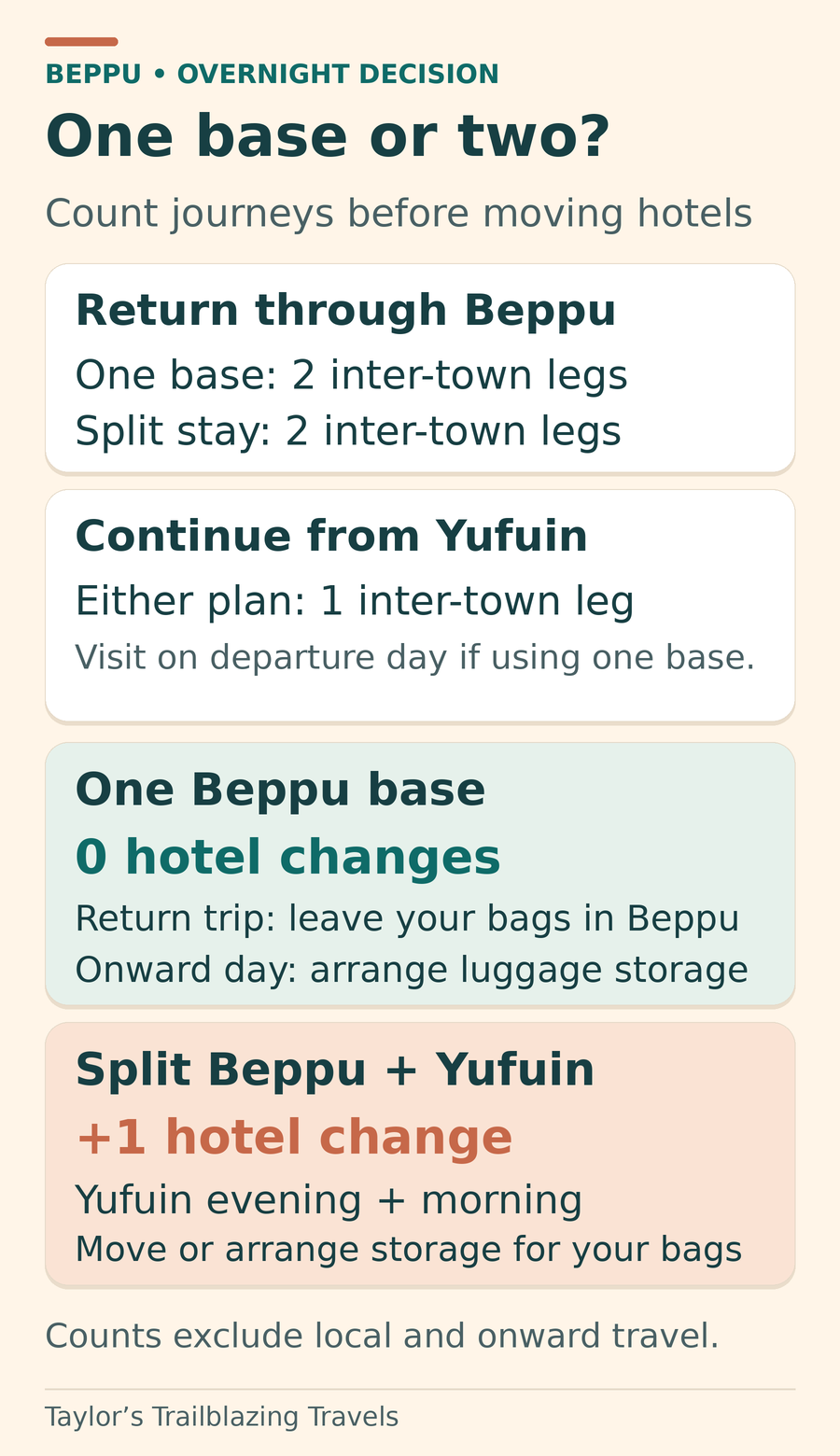
Choose your overnight pattern after deciding where you enter and leave the area. Changing hotels buys a different evening and morning; it does not automatically reduce transport.
| Journey assumption | One base in Beppu | Split between Beppu and Yufuin |
|---|---|---|
| Arrive and depart through Beppu; visit Yufuin once | Two inter-town legs for the day trip; no hotel change. | Two inter-town legs, plus one hotel change; gain a Yufuin evening and morning. |
| Arrive in Beppu, continue from Yufuin; visit Yufuin on the final day | One inter-town leg; arrange luggage storage while sightseeing. | One inter-town leg, plus one hotel change; gain time at a Yufuin inn. |
These counts exclude local travel within each town and any further journey after leaving. They assume one visit to Yufuin and no return to collect luggage.
Two nights: use one base if moving feels like work
Two nights in Beppu can work for both towns if you arrive early enough for a useful first afternoon. Put selected Kannawa sights on that afternoon, give the following day to Yufuin, and keep the final morning for central Beppu or departure. This assumes a confirmed return bus and enough time before the hells close.
If you arrive late and leave early, you have only one full day. Choose Kannawa and bathing, or Yufuin’s town walk, as the main outing. Add a third night if seeing both comfortably is essential. Travelling onwards from Yufuin? Move its visit to the departure day only when your onward service and luggage arrangements leave enough time.
Three nights: two in Beppu, one in Yufuin
Use arrival day for settling into Beppu and a suitable bath. Give the first full day to Kannawa, with a deliberate choice between selected hells and the complete circuit. Transfer to Yufuin the next morning, spend the afternoon in town and keep the evening for the inn. Leave after breakfast and a final walk on day four, according to your onward connection.
For a retreat with one Beppu introduction, reverse the overnight balance. Two consecutive Yufuin nights give you a day without packing or a check-out deadline; that can be worth more than adding another attraction.
On a phone, swipe the diagram sideways to read its labels.
Weather, mountain views and a sensible fallback
Beppu Ropeway is the weather-dependent addition to this trip. It reaches the Mt Tsurumi area at around 1,300 metres, with views towards Beppu Bay in suitable conditions. Services can stop for weather or maintenance. Check the operator’s current notices and conditions before travelling uphill. [19]
It can fit between Beppu and Yufuin because Route 36 serves the corridor, but adding it means waiting for another bus and solving luggage storage. If the view is the reason for going and the mountain is hidden, continue to Yufuin or spend longer in Beppu. Do not hold dinner or a reserved onward train hostage to an optional ropeway ride. [3] [4]
On an ordinary rainy day, use an available bath, a longer lunch or a pre-booked museum visit. During severe weather or transport disruption, follow local instructions and confirm travel before setting off. In winter, choose warm layers for early walks; treat Lake Kinrin’s mist as a possible bonus, not the condition that makes the overnight worthwhile. [17] [18]
What to book, and where spending makes a difference
Set the accommodation budget around what you will use: meals, bath privacy, room type and time at the inn. A basic room plus a chosen public bath can be the better purchase for an active sightseeing trip; a meal-inclusive ryokan makes more sense when you keep the afternoon and evening free.
Book the stay and any essential bath arrangement first, then secure a must-have reserved train. Add optional activities around those commitments. Compare transport passes against your actual journeys and eligibility; the short Beppu–Yufuin section alone is not a reason to buy a multi-day rail pass.
If you are staying in Fukuoka and cannot add an overnight, Fukuoka–Yufuin and Beppu day-tour options on GetYourGuide offer a compact introduction. The listing gives roughly 9½–10 hours overall, with a brief Beppu stop and longer Yufuin time depending on the selected course. Check meeting point, admissions and the exact itinerary. Choose this for an organised sightseeing day; a full bathing-and-ryokan experience needs more time. [21]
For maps, bus updates and accommodation messages, compare mobile-data options with Airalo. The link opens Airalo’s general landing page: select Japan and check the package’s data allowance, validity and activation conditions. Your phone must support eSIMs and be unlocked for other networks. Compare it with your existing roaming allowance before buying, and save key bookings offline. [22] [23]
Useful questions
Can you see Beppu and Yufuin in one day?
You can sample both, especially when starting nearby or taking an organised excursion from Fukuoka. That means choosing a few sights and checking the transport carefully. A full hells circuit, an unhurried bath and substantial Yufuin time are better spread across more than one day. The linked Fukuoka tour devotes only a brief stop to Beppu. [21]
Can couples or families bathe together?
A private family bath is the clearest option to investigate. Ordinary public bathing areas are generally separated by gender, and each facility sets its own children’s rules. Confirm who can use the booked bath, the time limit and any extra charge. Hyotan has private family baths; an overnight room booking is not necessary to use that day facility. [15] [16]
Do you need a car for Beppu and Yufuin?
A car is not necessary for the core trip in this guide. Beppu’s main districts have bus connections, Route 36 links the towns, and central Yufuin lends itself to walking. A remote inn or several extra countryside stops changes the calculation. Confirm that accommodation’s transport before booking. [3] [9] [17]
Make the next planning decision
Choose the overnight that you would still enjoy if one view disappeared into cloud. Then reserve a bath you actually want to use, place Yufuin on a sensible day in your wider route, and leave the remaining space for the town. Beppu and Yufuin work together best when each gets a clear role in the trip.
Sources and checks
Research-led planning guidance, with original itinerary and decision analysis. Sources below were consulted on the dates shown. Recheck operating information, prices, access rules and booking terms for your travel dates.
- Visit Oita: Kannawa OnsenChecked 17 October 2026.
- Visit Oita: Yufuin OnsenChecked 17 October 2026.
- Kamenoi Bus: routes and boarding points for sightseeingChecked 17 October 2026.
- Kamenoi Bus: Route 36 weekday timetable, 14 March 2026Checked 17 October 2026.
- Kamenoi Bus: Route 36 weekend and holiday timetable, 14 March 2026Checked 17 October 2026.
- JR Kyushu: Yufuin no Mori timetable and reservationsChecked 17 October 2026.
- JR Kyushu: Sonic services and current timetableChecked 17 October 2026.
- Oita Airport: airport bus routes and journey timesChecked 17 October 2026.
- Visit Oita: public-transport connections around Beppu and YufuinChecked 17 October 2026.
- Beppu Jigoku Association: admission, hours and ticket validityChecked 17 October 2026.
- Beppu Jigoku Association: the two hells areas and accessChecked 17 October 2026.
- Visit Oita: Beppu Jigoku TourChecked 17 October 2026.
- Beppu City: Takegawara OnsenChecked 17 October 2026.
- Hyotan Onsen: public and family-bath chargesChecked 17 October 2026.
- Hyotan Onsen: private family baths and reservationsChecked 17 October 2026.
- Japan National Tourism Organization: onsen etiquetteChecked 17 October 2026.
- Visit Oita: Lake KinrinChecked 17 October 2026.
- COMICO ART MUSEUM YUFUIN: visiting and reservationsChecked 17 October 2026.
- Visit Oita: Beppu RopewayChecked 17 October 2026.
- Viator: Space Beppu arts, crafts and onsen-culture walkChecked 17 October 2026.
- GetYourGuide: Fukuoka, Yufuin and Beppu tour optionsChecked 17 October 2026.
- Airalo: Japan eSIM plansChecked 17 October 2026.
- Airalo: device compatibilityChecked 17 October 2026.
Illustrations in this article were created for Taylor’s Trailblazing Travels. Third-party photographs, where used, are credited beside the image or in the source list.