
Uluwatu or Nusa Dua: South Bali Hotel Areas Compared
Clifftop drama or a resort-centred shore? Start with access, not the view.
Illustrative South Bali coastal settings, not a photograph, map or view from a named hotel.
The choice between Uluwatu or Nusa Dua often looks obvious in photographs: cliffs on one side, a beach resort on the other. The harder question is what those settings mean for an ordinary holiday day, especially with children, luggage or limited mobility.
This guide compares hotel-area choices rather than listing every South Bali attraction. It separates the broad location from the exact property, then uses access, transport, meals and outdoor priorities to reach a practical decision. Hotel examples are research references, not reports of personal stays.
Some links in this guide are affiliate links. Taylor’s Trailblazing Travels may earn a commission if you book or buy through them, at no extra cost to you.
Scenery and surf
Best when the setting is worth planning journeys around.
Resort convenience
Best when beach, pool and meals are the daily core.
How do I reach the sand?
Ask about every stage, including steps and return transport.
Area equals access
The exact hotel and room category decide the practical experience.
Uluwatu or Nusa Dua: what should decide it?
The strongest distinction is the role of the hotel. In a Nusa Dua resort holiday, the property can be the centre of most days. In an Uluwatu stay, the coastal setting, particular beaches or surf plans may justify more deliberate movement between places. That is a planning judgement based on the resort-enclave and surf-coast character described by the relevant tourism sources. [1][2][3]
| Priority | Begin with Uluwatu | Begin with Nusa Dua |
|---|---|---|
| Main attraction | Cliff scenery, surf focus, a distinctive retreat | Beach-and-pool time with resort facilities |
| Daily rhythm | A smaller number of purposeful outings | More time around the same hotel grounds |
| Beach access | Investigate stairs, slopes and vehicle arrangements | Investigate the exact path, tide and frontage |
| Meals | Check what is genuinely close or available on site | Compare dining inclusions and realistic alternatives |
| Mobility needs | Do not infer accessibility from luxury status | Do not infer accessibility from the area name |
| A single Uluwatu sunset visit | No need to move hotels just for this | A separate outing may preserve an easier base |
Make two non-negotiables before comparing room photographs. Examples are “no necessary stairs”, “pool and easy meals every day” or “close to the surf arrangements already chosen”. A property that fails a non-negotiable should leave the shortlist even when it wins on view or price.
This approach is more useful than declaring one coast romantic and the other suitable only for families. Both areas contain different hotel styles; what matters is the experience that your booked room and location actually deliver.
The area names are broader than the hotel experience
ITDC’s The Nusa Dua is a managed tourism estate. A search for “Nusa Dua hotels” can also describe a broader accommodation area, so establish whether the property is within the main estate or elsewhere along the coast. Do not assume that two hotels sharing the label share the same beach walk or nearby facilities. [1]
For Uluwatu, work from the actual address and desired coastline rather than treating the name as a compact town centre. The tourism board describes a destination associated with surf breaks and a range of accommodation, not a single self-contained resort precinct. [2]
Ask for the useful map
A property location pin is necessary but insufficient. Ask the hotel to identify the arrival entrance, the room block or villa area, the pool, the beach access point and the nearest realistic place to eat outside. The route between them is the holiday geography that matters.
A cliff-facing room can be wonderfully atmospheric without being a practical base for repeated trips to the sand. Conversely, a beachfront resort may require a longer walk through its grounds than expected. Those are not defects when chosen knowingly; they become problems when the booking was based on a different assumption.
Research one nearby outing from the proposed hotel, then one ordinary evening. This usually exposes more than an ambitious island-wide day-trip list.
Follow the complete route from room to beach
Break “beach access” into separate stages: leaving the room, crossing the grounds, reaching the beach entrance, using the sand and deciding whether the water is suitable. A promotional photograph normally shows only the most attractive stage.
For a traveller using a pushchair or avoiding steep steps, request a description of the whole room-to-sand route for the specific property, including lifts, ramps, ground surfaces and any separate vehicle leg. Do not assume Nusa Dua is step-free because it has resorts, or that a Uluwatu ocean-view room provides convenient beach access. This is an individual-hotel check, not an accessibility rating for either area.
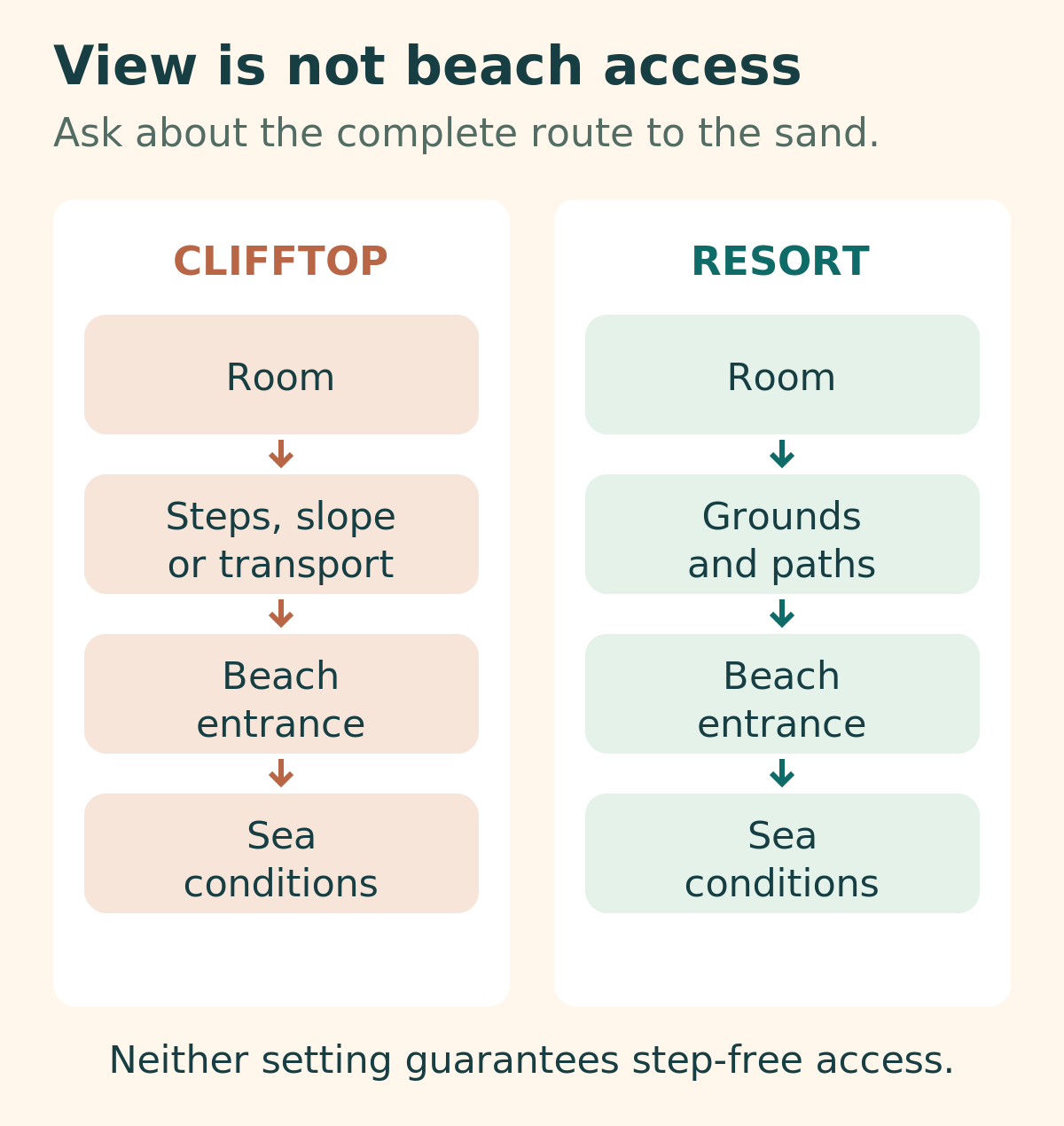
Read this graphic
Two schematic routes show room, paths or steps, beach entry and sea conditions; neither clifftop nor resort setting guarantees step-free access.
Clifftop and villa stays
For an Uluwatu candidate, ask whether beach access involves steps, a steep path, a road journey or a separately operated facility. Establish whether it remains available at the times you expect to use it. A shuttle is useful only when its hours, waiting arrangements and return journey suit your plans.
Resort-frontage stays
For Nusa Dua, ask which section of shoreline the hotel uses and what the beach is like at different tides. Check whether the room category is in the part of the property shown in the photographs. Being inside a resort estate is not a substitute for these details.
Neither area guarantees suitable sea conditions. Follow local warnings and do not treat a sheltered-looking shoreline as proof of safe swimming. [6]
For families, perform the same audit with a tired child, a pushchair and beach bags in mind. A route that is an enjoyable one-off outing may be inconvenient when repeated several times a day.
Two real hotel examples that clarify the difference
Alila Villas Uluwatu is presented by Hyatt as a clifftop property. That makes it a useful example when researching a scenery-led retreat, but the cliff setting should prompt questions about the actual beach journey rather than assumptions about direct sand access. [4]
Grand Hyatt Bali publishes an address within the ITDC Nusa Dua tourism area. It is a useful point of comparison for a resort-estate stay. Nevertheless, investigate the proposed room category, grounds, dining and route to the shore; the official address alone does not establish suitability for every guest. [5]
These two examples are deliberately not a luxury-hotel ranking. A smaller property may be the better choice for budget, atmosphere or proximity to a particular activity. The purpose is to show how to interrogate the setting before committing to a style of holiday.
Send the shortlisted properties the same short enquiry. Ask about the room-to-beach route, food options, planned works and transport to the one outing that matters most. Comparable answers are more valuable than trying to compare differently worded promotional descriptions.
Keep the written reply with the booking confirmation. Where a feature is essential, clarify whether it applies to the booked room and stay dates rather than the property in general.
Meals, transport and the cost of convenience
A resort-centred holiday works best when its dining choices and prices fit your group. Before selecting a meal plan, check what is included, which venues participate and whether drinks, special dinners or children’s meals change the total. “Breakfast included” is not the same product as half board.
For an Uluwatu stay, count how many evenings you realistically expect to leave the property. Two special outings need a different transport plan from two car journeys every day. Ask about pickup access and late returns before assuming a secluded villa will be effortless.
A break-even calculation, not a price prediction
Suppose a more self-contained option costs an extra £25 per night for six nights. Its premium is £150. It is financially worthwhile on convenience alone only when it saves more than £150 in other costs you would otherwise incur. For example, six avoided £20 transport days save £120, leaving £30 still to justify through meals or the personal value of less travelling.
Those are invented demonstration values, prepared on 1 November 2026, not real Bali transfer or hotel quotes. The calculation deliberately avoids claiming either area is inherently cheaper. Replace each input with your actual options and leave out costs that would occur in both.
Use the hotel comparison calculator to compare your own room rates and extras in one currency. It does not fetch live rates or convert currencies. [9]
Time is a separate consideration. A slightly more expensive stay may still be preferable when it removes journeys the group would dislike. Keep that preference explicit rather than disguising it as a cash saving.
Visit the other coast without automatically changing hotels
A traveller staying in Nusa Dua can make Uluwatu a purposeful outing rather than a second hotel stop. Similarly, an Uluwatu guest need not move to Nusa Dua simply to experience a different dinner or resort setting. Decide whether the second place offers several days of genuinely different value.
A temple-and-Kecak excursion is one way to organise an Uluwatu visit. Check the actual option selected: pickup coverage, entrance tickets, performance admission, dinner and cancellation terms may differ. The example listing below explicitly states that it is not wheelchair-accessible, so it is not an appropriate shortcut for travellers who need a step-free excursion. [7]
Allow the outing to occupy its own part of the day instead of attaching it to a tightly scheduled arrival or flight departure. Confirm the current return arrangement before leaving; a successful visit includes the journey back.
For a five- or six-night South Bali holiday, one strong base is often the simpler recommendation. Split the stay when the hotels themselves provide distinct experiences you value, and when the transfer day does not consume a disproportionate share of the trip.
A scenic stay followed by a resort-centred stay can be a coherent plan. Two short stays chosen only because both names appear on a “best areas” list are less persuasive.
Airport arrival and the booking details to settle
Obtain a current transfer quote for the exact hotel, not just “Uluwatu” or “Nusa Dua”. Confirm passenger and luggage capacity, the meeting arrangement, included waiting time and whether the final approach is accessible to the proposed vehicle.
12Go has an airport-to-Nusa Dua taxi comparison page. It is a useful second point of comparison alongside a property-arranged transfer, provided you check the destination coverage and final quote. A route page is not proof of availability for your dates or of a guaranteed journey duration. [8]
For a late arrival at a villa or smaller hotel, verify that someone will be available and that the driver has usable directions. Save the address and arrival contact offline before flying.
On departure, take the driver’s current timing advice and add the airline’s required airport check-in allowance. Do not recycle a favourable arrival journey as the promised duration of the return trip.
During wet weather, reconsider non-essential outings rather than trying to preserve every booked stop. Local warnings override an itinerary. [6] The practical benefit of a comfortable hotel becomes especially clear when the sensible decision is to remain there for part of a day.
Which choice fits your actual group?
Families wanting beach-and-pool days
Start with Nusa Dua properties that make the daily routine manageable. Assess room layout, shade, meals and pool supervision before chasing a prestigious name. Check all beach stages rather than assuming the ocean can be used every day.
Couples prioritising a memorable setting
Start with Uluwatu when the cliff outlook or villa experience is worth spending substantial time at the property. Choose Nusa Dua instead when romance means fewer arrangements, easy meals and a resort-centred week. Neither preference is less adventurous; they simply buy different kinds of time.
Surfers and mixed-interest groups
An Uluwatu base can be logical when the chosen surf arrangements fit the group’s ability. Non-surfers need their own workable day plan, however. Do not make the rest of the party dependent on the surfer’s transport or schedule.
Older relatives or travellers with limited mobility
Use the property’s written access information as a hard filter. A resort-estate search may provide useful candidates, but no area label is an accessibility certification. When the key answers remain vague, choose a better-documented property rather than hoping the route will be manageable.

Read this graphic
Decision rules favour Uluwatu for cliffs and surf, Nusa Dua for beach and pool convenience, and property-level checks for accessibility.
The final decision and frequently asked questions
Is Nusa Dua only for families?
No. Its resort-centred format can also suit couples, friends and travellers who want rest without arranging several journeys a day. The choice is about preferred routine, not a fixed traveller stereotype.
Does a beachfront hotel guarantee easy swimming?
No. Beachfront describes a location. Access from the booked room, the shoreline at the relevant tide and conditions in the water are separate checks.
Can you choose Uluwatu without hiring a scooter?
Yes, by choosing accommodation around your priorities and budgeting for cars where needed. Do not select a difficult location on the assumption that you will learn to ride after arriving.
Is moving hotels worthwhile for one sunset?
Usually not as a default plan. Compare a single outing with the packing, checkout and check-in involved in a move. A split stay makes more sense when you want several days of a different hotel experience.
The Indonesia accommodation hub is the next step when comparing this South Bali stay with other parts of the trip.
Sources and research notes
Initial source review: 1 November 2026; editorial update: 2 November 2026. Recheck changing advice, terms and conditions before travel.
This Uluwatu–Nusa Dua comparison draws on official estate and hotel descriptions. The room-to-beach route test is original editorial analysis, not an accessibility certification or personal property inspection. Actual room access, evening transfers and bookable prices remain specific to each hotel and date.
- ITDC – The Nusa DuaOfficial context for the managed tourism estate.
- Indonesia Travel – UluwatuSurf setting and broad accommodation context; old timing claims are not used.
- Indonesia Travel – Nusa DuaResort-enclave and coastal context, not a daily swimming assessment.
- Hyatt – Alila Villas UluwatuOfficial clifftop property identity and location.
- Hyatt – Grand Hyatt BaliOfficial property address within the ITDC Nusa Dua area.
- FCDO – Indonesia safety and securitySwimming, road and weather precautions.
- GetYourGuide – Uluwatu temple and Kecak private tourExample excursion listing and its stated wheelchair-access limitation.
- 12Go – Denpasar Airport to Nusa DuaAirport-to-area taxi comparison page; no fare or date-specific availability quoted.
- Taylor's Trailblazing Travels – Hotel Comparison CalculatorComparison of user-entered accommodation costs.
Illustrations in this article were created for Taylor’s Trailblazing Travels. Third-party photographs, where used, are credited beside the image or in the source list.