Bali · Plan your journey
Two Weeks in Bali: South Coast, Highlands and Northern Villages
A 14-day island circuit with room for village walks, changing weather and the journey back south.
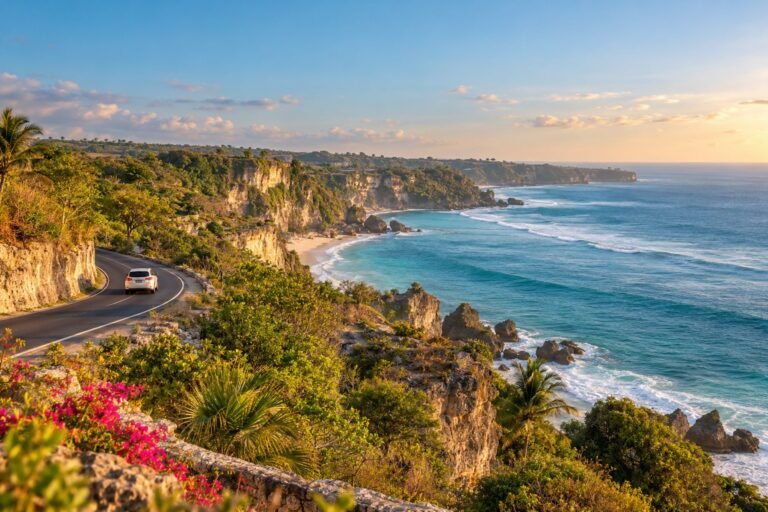
An original illustration inspired by the plantation hills and villages of northern Bali. It is not a photograph or an exact viewpoint.
Two weeks in Bali gives you time to see the island change: a coastal promenade, Ubud’s art and food, cooler plantation hills, then the villages along the north coast. The useful decision is how many times to unpack. This route uses five stays, including a practical final night near the airport, and treats the longer drives as part of the holiday.
It suits travellers who enjoy a varied landscape and are comfortable changing hotels four times. Walkers get three nights in the Munduk area; those who want mostly pool time can use the four-base alternative below. The suggested days are an original planning framework, with activities deliberately left replaceable.
Some links in this guide are affiliate links. Taylor’s Trailblazing Travels may earn a commission when you book or buy through them, at no extra cost to you.
Your two weeks in Bali: route and nights
This is a 14-day stay in Bali, starting with arrival at Ngurah Rai Airport (DPS) on day 1 and departure on day 14. A flight from Britain may leave the previous calendar day. Count the hotel nights on your tickets before copying the route.
| Days | Sleep here | Main purpose |
|---|---|---|
| 1–3 | Sanur · 3 nights | Recover from the flight; enjoy the coast without a long first drive. |
| 4–7 | Ubud · 4 nights | Art, one cultural workshop and a flexible countryside day. |
| 8–10 | Munduk area · 3 nights | Highland scenery, a guided walk and weather flexibility. |
| 11–12 | Lovina · 2 nights | North-coast villages and a quieter coastal pause. |
| 13 | Jimbaran · 1 night | Return south before your departure day. |
| 14 | Fly home | Leave time for the airport process your airline requires. |
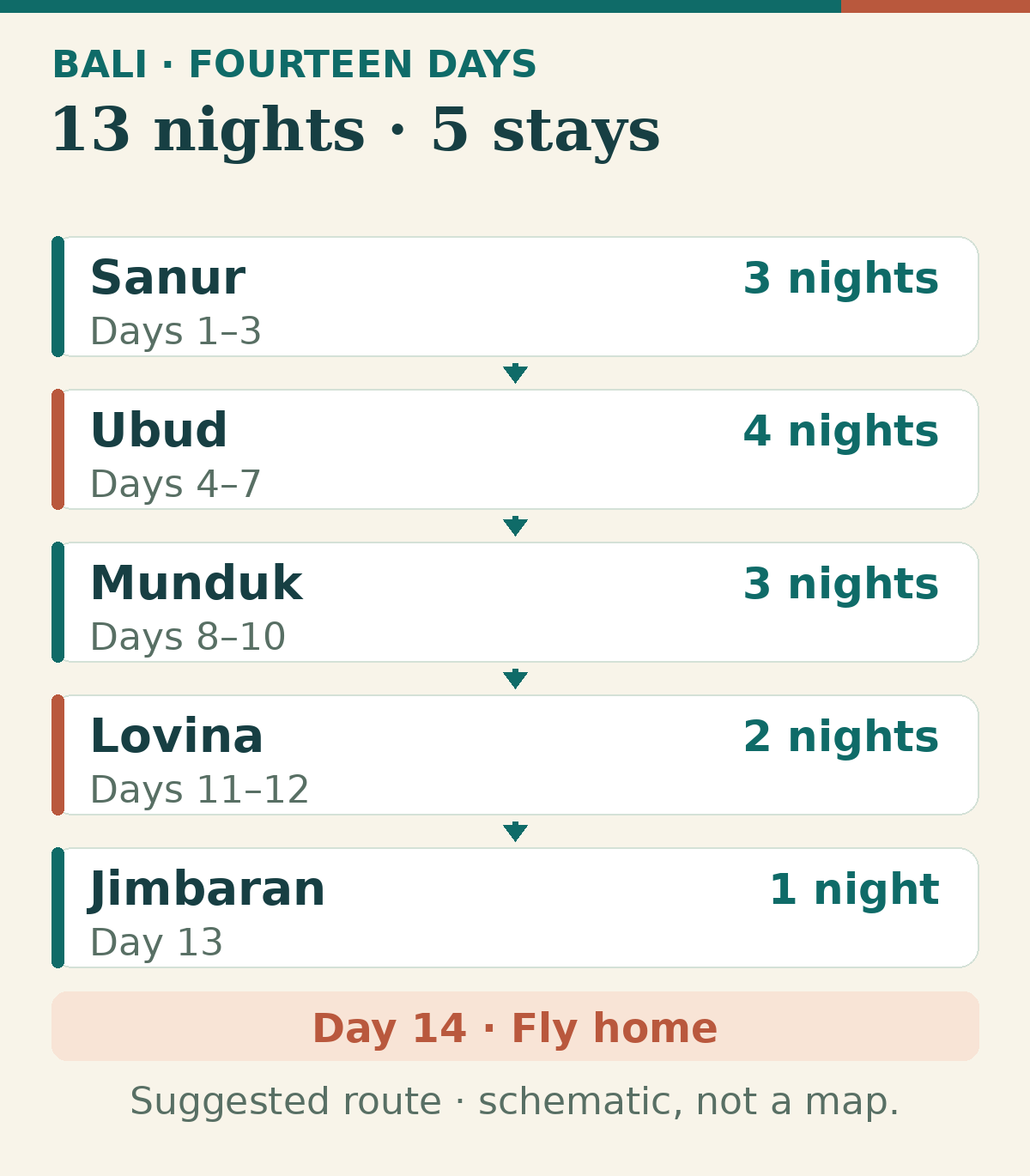
The route is a loop rather than a set of day trips from one southern hotel. That avoids repeating the highland drive, but it requires four check-outs. The last stay is deliberately short; its purpose is to make departure easier, rather than to claim that one night is enough to explore all of Jimbaran.
Put the stops and your actual dates into the Trip Itinerary Planner. It organises your choices; confirm journeys and reservations separately.
Days 1–7: settle on the coast, then give Ubud time
Day 1: arrive and stay in Sanur
Arrange a car to your hotel and leave the evening free. Indonesia’s tourism ministry describes Sanur’s beachfront pedestrian path and gives an airport drive of about 30–45 minutes, depending on traffic. For planning, reserve 45–90 minutes after you have left the terminal, with immigration and baggage time added separately. [1]
Days 2–3: a coastal start with an uncommitted afternoon
On day 2, take a short morning promenade walk, find a café and use the hottest part of the day for a pool break. Day 3 can be another beach-and-food day, or a single local outing arranged through your hotel. Starting gently keeps the route workable after a poor night’s sleep. Check beach conditions locally before swimming; a sheltered-looking shore does not establish that the water is safe.
Day 4: move to Ubud
Have breakfast before leaving. Keep lunch and check-in as the main appointments, then explore only the immediate hotel neighbourhood. A retreat marketed as “Ubud” may be outside the town centre: establish the exact vehicle access and restaurant options before you book.
Day 5: art and a compact town visit
Use ARMA Museum as the cultural anchor. Its collection and visual-and-performing-arts programme offer a more focused visit than trying to cover every town attraction in an afternoon. Pair it with one nearby lunch stop, rather than a drive to the opposite side of Bali. Check the museum’s current visitor arrangements directly. [2]
Day 6: choose a hands-on experience
A cooking or craft class gives the day a clear purpose. ARMA lists workshops including cooking, offering making and gamelan; ask which session is operating and suitable for your interests. [3] When comparing other providers, check the class location, dietary arrangements, group size and whether a market visit lengthens the outing.
You can compare Ubud cooking classes on GetYourGuide or browse Ubud cooking classes on Viator. These are category searches, so check the individual class and collection area.
Day 7: keep a countryside day adjustable
Choose one short guided walk or a nearby village visit after discussing terrain, rain and access with your accommodation. Alternatively, stay at the hotel and keep the day quiet. A spare Ubud day is useful if a class changes time or a downpour moves your outdoor plans; it need not become another full-day excursion.
Days 8–10: Munduk, the lakes and northern village walks
Day 8: make the journey north the main outing
Travel from Ubud towards Munduk through the highlands. Ulun Danu Beratan, on Lake Beratan, is a logical single sightseeing stop to discuss with your driver. It is an active temple complex; follow the visitor boundaries and local dress instructions. Confirm the day’s access and charges rather than building the transfer around an old ticket price. [4]
Allow a generous travel day if stopping for lunch and the temple. Adding several waterfalls, a photo gate and a rice-terrace detour would change this from a manageable move into a lengthy tour. Ask the driver to quote the agreed stops and waiting time.
Day 9: one walk matched to the weather
Choose a guided waterfall or plantation walk after asking about steps, gradients and the return climb. The direct activity information from Munduk Moding Plantation illustrates the range: its short plantation walk is listed at 60–90 minutes, while waterfall options differ in distance and difficulty. These are provider descriptions, not a promise that every path around Munduk is easy or open. [5]
A path that looks short on a map can still have steep, wet steps. Ask for an easier alternative before paying if anyone has limited balance or stamina. Carry a light rain layer, water and footwear with suitable grip; skip river crossings and closed trails.
Day 10: explore a village, or use the weather reserve
Arrange a short village or coffee-related visit through a local guide, with permission for any private land or home visit. The tourism ministry identifies Munduk as a highland village associated with coffee plantations and winding roads. Overnighting here makes a slower morning possible. [6]
If day 9 was too wet, use this day for the walk instead. Otherwise, keep the afternoon for the view and an early meal. Staying for three nights is the route’s deliberate investment in flexibility; it avoids demanding that the best weather arrive during a single afternoon.
Days 11–14: Lovina, then return south before flying
Day 11: descend towards Lovina
Leave Munduk after breakfast and settle into a coastal base around Kalibukbuk. Lovina is a stretch of northern coastal villages, rather than a single enclosed resort, and its beach has dark volcanic sand. That makes it a different coastal experience from the south. [7]
Choose one modest stop only if it fits the drive and current conditions. After check-in, get your bearings, confirm the route to dinner and leave the rest of the afternoon open. A place that is quiet on a map can still be a long walk along a busy road from restaurants.
Day 12: enjoy the north without a compulsory dawn boat trip
Use the morning for a shore walk, a locally arranged village visit or time at your accommodation. This plan does not depend on dolphin watching. If you consider a wildlife trip, ask how the operator prevents chasing, crowding and feeding animals; decline a trip whose methods are unclear. A quiet day ashore remains a complete day of the itinerary.
Day 13: return to Jimbaran
Keep the north–south drive as the day’s major commitment. A transport marketplace lists Lovina–Jimbaran journeys around three to five hours; this guide allows four to six hours of road time before optional stops, recognising the effect of traffic and exact hotel locations. Confirm your driver’s current estimate. [8]
Arrive, repack and have a simple dinner. Jimbaran’s coastal setting and proximity to the airport make it a useful final base; the ministry’s destination guide describes its beach and seafood restaurants. Avoid treating its short promotional driving estimate as a guaranteed airport transfer. [9]
Day 14: leave a clear airport window
Arrange the collection time with your hotel and add the check-in time requested by your airline. For an early departure, ask whether a hotel even closer to the terminal is the more practical final stay. Keep a late-afternoon flight day free of distant sightseeing: luggage storage and a nearby lunch are easier to adjust if traffic worsens.
Transfers: plan the whole moving day
The following allowances are editorial planning ranges checked against route geography and available transport information on 1 November 2026. They are not live navigation results or timetables. They cover driving only; check-out, breaks, sightseeing, check-in and airport formalities take additional time.
| Leg | Allow for driving | How to use the day |
|---|---|---|
| Airport → Sanur | 45–90 minutes after terminal exit | No pre-paid activity on arrival. |
| Sanur → Ubud | 1½–2½ hours | Make lunch and check-in the main commitments. |
| Ubud → Munduk | 2½–4 hours without sightseeing | One highland stop; reserve most of the day if stopping. |
| Munduk → Lovina | 1–2 hours | Arrive early enough to settle before dinner. |
| Lovina → Jimbaran | 4–6 hours before stops | Leave in the morning; stay south overnight. |
| Jimbaran → airport | 30–60 minutes as a planning allowance | Add the airline’s required airport arrival margin. |
A pre-arranged car with driver is the practical default for this circuit. Agree the complete hotel addresses, vehicle size, seat belts, luggage space, stops, tolls, parking and overtime in writing. If taking shared transport, verify collection points and the final transfer to your accommodation.
For the longest move, compare Lovina–Jimbaran transport on 12Go alongside a quote from your hotel or a licensed local driver. Confirm whether the price is per vehicle or passenger. A marketplace search result is not confirmation that every listed option serves your exact hotel.
Choose accommodation for the route you will actually use
Prioritise the last part of the journey to each hotel. A lower room price can lose its advantage if every meal requires a paid car or the driveway is unsuitable for your luggage and mobility needs.
| Base | Useful location test | Trade-off to check |
|---|---|---|
| Sanur | Comfortable access to the promenade and restaurants | Ask about road crossings and the actual route to the beach. |
| Ubud | Choose either town access or a retreat with dependable transfers | A valley view may mean steps and paid evening journeys. |
| Munduk | Confirm restaurant hours, vehicle access and walk collection | A remote view can reduce independence after dark. |
| Lovina | Map the hotel against Kalibukbuk and your dinner choices | “Lovina” covers several villages, not one compact centre. |
| Jimbaran | Choose the airport journey and room comfort over sightseeing reach | Avoid an extra-long final drive to a distant peninsula hotel. |
Start by comparing Ubud accommodation on Agoda and checking Munduk-area stays on Agoda. For a second booking comparison, search Munduk on Booking.com. These links open area searches, not a personally tested hotel shortlist.
Compare like-for-like room types, total taxes, breakfast, cancellation deadlines and transfers. The Hotel Comparison Calculator can compare the offers you enter in one currency; it does not fetch room rates.
A transparent two-person budget you can change
This worked example is for two adults sharing one room for 13 nights, with 14 local spending days and private road transfers. Hotel, food and transport figures are illustrative planning inputs selected on 1 November 2026, not advertised offers or a claim about average prices. Enter actual quotes before booking.
| Cost for two adults | Calculation or allowance | IDR |
|---|---|---|
| Accommodation | 13 nights × 900,000 per room | 11,700,000 |
| Meals and everyday drinks | 14 days × 400,000 for two | 5,600,000 |
| Main road transfers | Six airport/base journeys combined | 3,400,000 |
| Local outings, guides and admissions | Shared allowance; replace with chosen activities | 2,800,000 |
| Bali tourist levy | 2 × 150,000, where payable | 300,000 |
| Subtotal | 23,800,000 | |
| Contingency | 10% of subtotal | 2,380,000 |
| Total for two | 26,180,000 |
The tourist levy of IDR 150,000 per foreign visitor is stated in current UK government entry advice; confirm any applicable exemption and official payment route. [10] Everything else in the table is an adjustable assumption. The total is IDR 13.09 million per person, or IDR 1.87 million per local day for the pair, including the reserve.
Accommodation is the strongest lever: adding IDR 200,000 to each nightly room rate adds IDR 2.86 million to the final total after the same 10% reserve. Adding IDR 100,000 to the pair’s daily food budget adds IDR 1.54 million. Keeping the arithmetic visible is more useful than calling the whole island “cheap”.
For a sterling comparison, divide the rupiah total by the actual IDR-per-£ rate your bank or card will provide, then include conversion fees. The Travel Budget Calculator uses GBP throughout, so convert the inputs before entering them and add flights, visas and insurance separately.
Season, pace and the simpler four-base version
Indonesia’s tourism ministry broadly describes April–October as the drier period in Bali and November–March as wetter, while warning that seasons vary. That is a starting point for planning, not a forecast. Highland rain can change a walk even during a generally drier month. [11]
For a wetter visit, keep the three Munduk nights so there is a second opportunity to walk, or shorten the highland element if that uncertainty would spoil the holiday. Choose accommodation you would enjoy on a rainy afternoon. Ask about ceremony-related access changes when confirming drivers and attractions.

Prefer three hotel moves?
Use Sanur 3 nights, Ubud 4, Munduk 4 and Jimbaran 2. This removes Lovina and keeps 13 nights, with a fourth highland night for nearby village walks. It suits travellers who value fewer check-outs more than a separate north-coast stay. Do not automatically replace Lovina with a long out-and-back day trip; the point is to recover time.
Have 14 nights rather than 13?
Add one night to Jimbaran for a complete final coastal day, or to Munduk if walking is your priority. Keep your international departure date fixed while adjusting the hotel arithmetic.
Want an island excursion as well?
A Nusa Penida or other offshore visit brings another transport system into the plan. Replace part of this circuit with a separately researched island stay, including a mainland buffer before flying. Adding it to the Sanur rest day changes the pace and introduces sea-condition and boat-transfer questions this road itinerary does not resolve.
Book the essentials, then leave the useful gaps
- Confirm the 13 hotel nights against your arrival and departure dates, then book the first and last stays.
- Choose the Munduk accommodation and a transfer plan before filling the Ubud activity days.
- Obtain written vehicle quotes with the exact hotel addresses and any planned stops.
- Reserve one high-demand cultural activity if you have a fixed preference, while keeping an alternative day free.
- Check passport, visa, arrival declarations and current travel advice for your nationality; use official government links. [10]
Keep driver messages, hotel pins and booking confirmations available offline. If you need mobile data, browse Airalo’s eSIM options and select an Indonesia plan only after checking your phone’s eSIM support, network lock, coverage and activation terms. The link opens Airalo’s general store. [12]
Can you do this without renting a scooter?
Yes. The plan assumes cars between bases and locally arranged transport for outlying activities. Walking remains useful for selected promenades, town areas and guided trails; it does not replace every road journey.
Are five accommodation stays too many?
It is a moderately active touring pace. Four stays is the better choice if packing is tiring, you need predictable rest periods or you intend to work remotely. Keep the five-stay version if the change from highlands to north coast is an important part of your trip.
Should you drive from Lovina straight to the airport?
The suggested itinerary returns south the previous day. A same-day crossing removes that buffer and makes the flight dependent on a long road journey. A late flight can make it possible, but the driver’s current advice and your tolerance for disruption should decide.
What should you cut first if the days feel full?
Remove optional transfer stops, then reduce day outings. Preserve the nights that make the north worthwhile and the final south-coast buffer. A holiday with fewer stops and more usable afternoons is still a complete two-week Bali trip.
Keep this route if you want a gradual change of landscape and can enjoy the journeys. Choose the four-base version if your strongest wish is to settle in: it retains coast, culture and northern highlands while giving back a check-out day.
Sources and further reading
Research reviewed on 1 November 2026. Check current conditions, opening arrangements and booking terms before travelling.
- Indonesia Ministry of Tourism — Sanur BeachPromenade and airport-distance context; consulted 1 November 2026.
- ARMA — MuseumMuseum collection and cultural remit; consulted 1 November 2026.
- ARMA — Cultural WorkshopsExamples of operator-advertised workshops, not confirmed sessions.
- Indonesia Ministry of Tourism — Ulun Danu BeratanTemple location in the Bedugul highlands; consulted 1 November 2026.
- Munduk Moding Plantation — TrekkingProvider descriptions illustrating walk durations and terrain. Confirm access and conditions directly.
- Indonesia Ministry of Tourism — North Bali trip ideasMunduk highland-village context; consulted 1 November 2026.
- Indonesia Ministry of Tourism — Lovina BeachVillage geography and dark volcanic sand; wildlife promotion is not adopted as an itinerary requirement.
- 12Go — Lovina Beach to JimbaranMarketplace road-journey context; no dates, seats or fares reserved.
- Indonesia Ministry of Tourism — JimbaranCoastal and airport-location context; promotional driving times are not treated as guarantees.
- UK FCDO — Indonesia entry requirementsLevy and official entry-check starting point; checked 1 November 2026.
- Indonesia Ministry of Tourism — Weather, Climate & SeasonsBroad climate pattern only, not a travel-date forecast.
- Airalo — Indonesia eSIMsCountry-plan availability and compatibility checks; no package price quoted.
Illustrations in this article were created for Taylor’s Trailblazing Travels. Third-party photographs, where used, are credited beside the image or in the source list.