Where to Stay in Sanur: Beachfront, Town Centre or Ferry-Port Area
Choose the address that makes your everyday holiday easier — and treat the ferry departure as a separate journey.
- Beachfront vs short walk
- Four researched hotel examples
- Ferry check-in explained
AI-generated editorial illustration of Sanur; not a photograph of a named hotel or evidence of current beach conditions.
Where to stay in Sanur depends less on a hotel’s star rating than on how often you want to move between your room, the beach and dinner. A hotel can be both central and beachfront; another can carry a Sanur address while leaving you with a road journey to the promenade.
Sanur’s sunrise-facing shore and pedestrian path make the seafront an important part of a stay. This guide compares everyday access, then deals separately with the northern ferry-port area and the booking details that a map pin cannot settle. [1]
Affiliate disclosure: Some links in this guide are affiliate links. If you book through them, Taylor’s Trailblazing Travels may earn a commission at no extra cost to you.
Several relaxed nights
Start centrally
Compare the room-to-beach route and your evening food choices together.
Frequent room returns
Value direct access
A shorter route matters when swimming, changing or resting several times daily.
One night before a boat
Check the meeting point
The boat company’s office may matter more than the harbour entrance.
Before payment
Price the whole stay
Match room occupancy, breakfast, transfers and cancellation terms.
Where to stay in Sanur: match the area to your routine
Use these as practical search zones, not official neighbourhood boundaries. Beachfront describes access to the shore; town centre describes access to services. They overlap, so there is no reason to give up nearby restaurants simply because you want a beachfront resort.
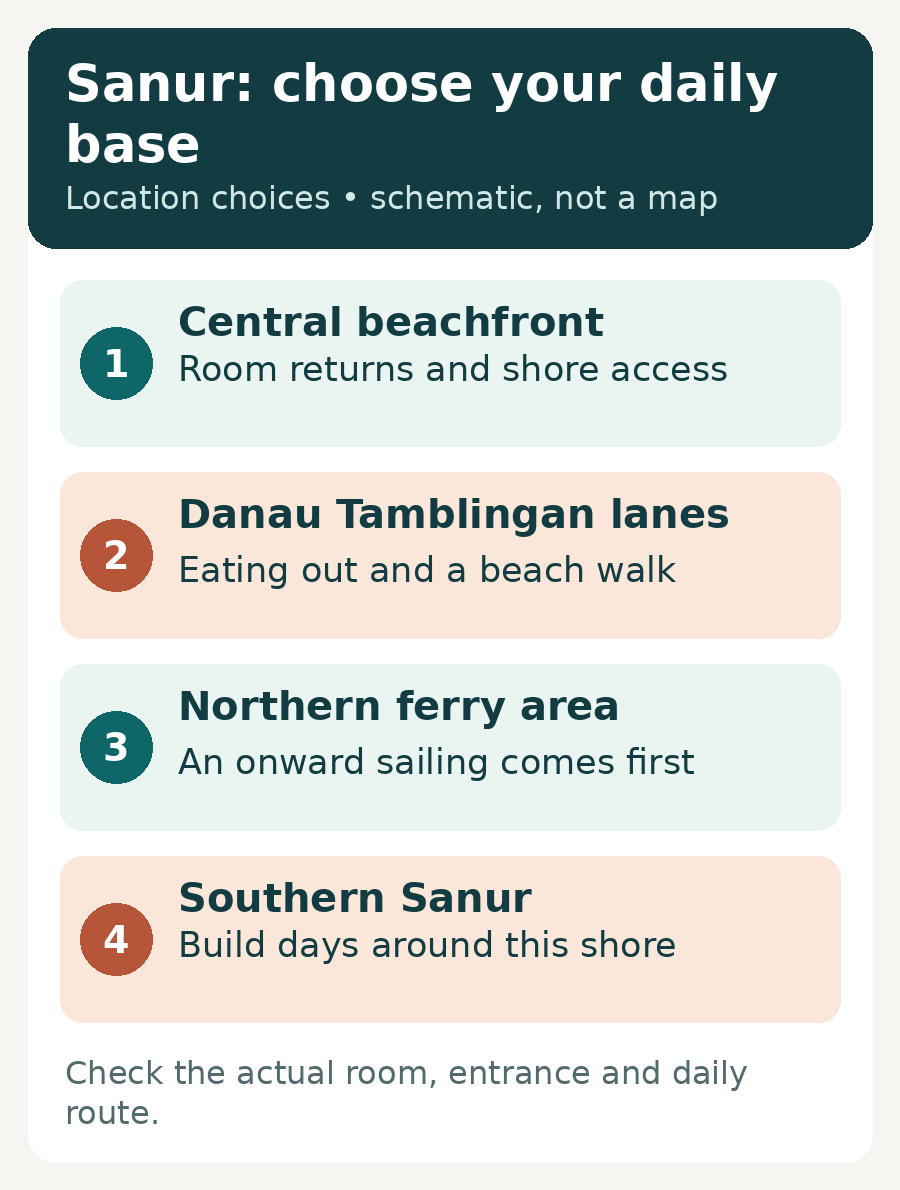
Editorial area comparison: check the exact entrance and walking route for every property.
Swipe or scroll sideways to see all columns.
| Search zone | Choose it for | Trade-off to check |
|---|---|---|
| Central beachfront | Beach walks, resort time and regular returns to the room | Room-to-shore distance inside the grounds; a beachfront address does not promise an ocean-view room |
| Danau Tamblingan and nearby lanes | Eating out and comparing smaller hotels with larger resorts | The public route to the beach, crossings and the final lane after dark |
| Northern Sanur / Hang Tuah / Matahari Terbit | A short stop organised around a Nusa-island sailing | Actual office or terminal check-in; luggage handling and early transport |
| Southern Sanur / Semawang / Mertasari side | A beach-and-hotel routine centred on the southern shore | How far your preferred restaurants and any northern ferry meeting point are from the hotel |
The contrast is visible in hotel information: Maya Sanur lists direct beach access from its central Danau Tamblingan address, while Prime Plaza Hotel Sanur gives separate walking distances to the beach and harbour. That is why a hotel map should be read as a sequence of actual journeys rather than a single distance to “Sanur”. [2][5]
Make the last hundred metres part of the decision
Locate the entrance used by guests, the route to a public beach access point and the places where you expect to eat. An attractive pool does not answer whether a pushchair can negotiate the lane, whether a beach gate stays open in the evening or whether the room is up stairs. Ask for current photographs or a short route description when that detail will determine whether the stay works.
Put a value on the trips you repeat
A beach hotel earns its premium through journeys you avoid as well as views you enjoy. To compare two real candidates, write down your likely routine: one morning walk, two swims with a change of clothes, a midday rest, or most days away sightseeing. The same address can be excellent for one routine and poor value for another.
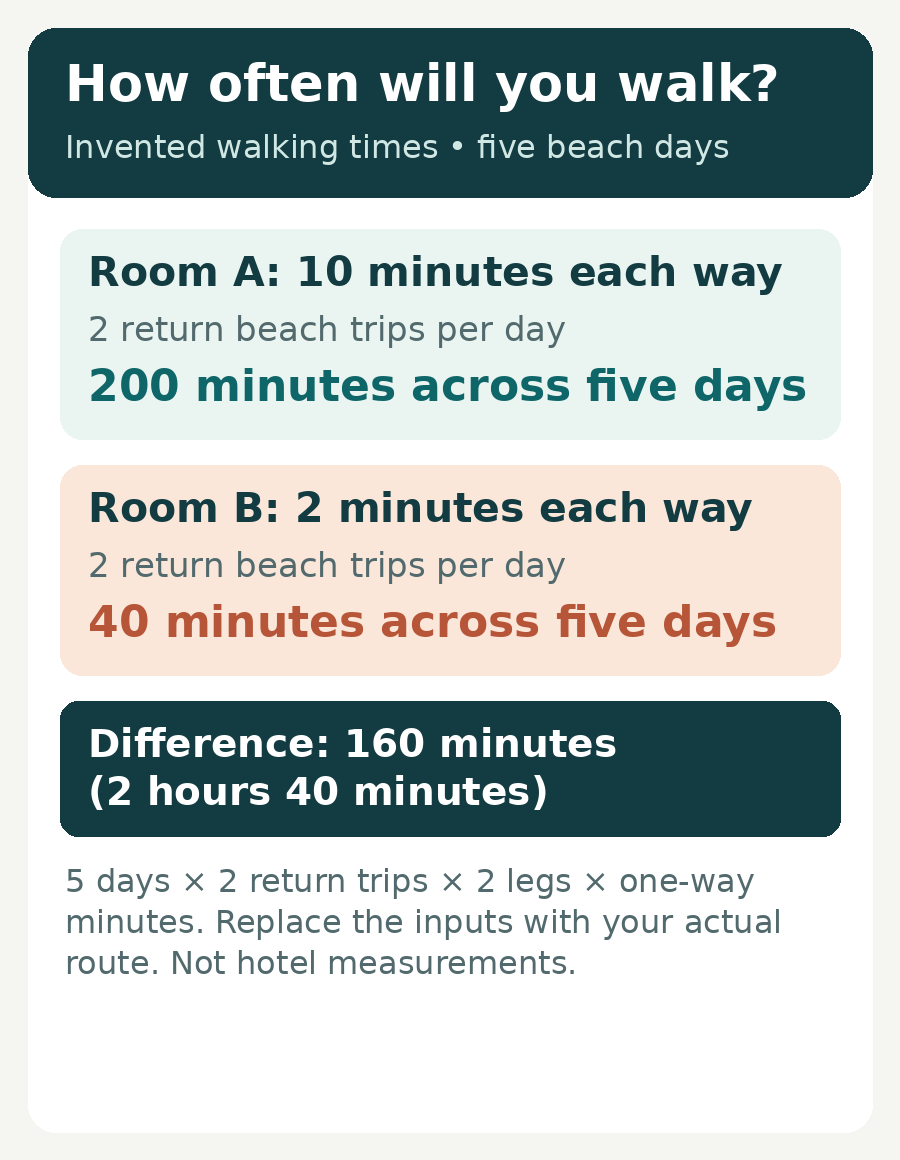
A five-day walking example
Suppose one shortlisted room is a ten-minute walk from the beach and another is two minutes away. If you make two return trips on each of five beach days, the first generates 200 minutes of walking and the second 40 minutes: a difference of 160 minutes, or two hours and forty minutes. These are invented route times for demonstrating the calculation, not measured times for the hotels below.
The calculation is five days × two return trips × two one-way legs × the one-way walking time. Replace those inputs with your own route and plans. If you will visit the beach only once daily, the difference falls to eighty minutes. If the stroll is part of the pleasure, it is not automatically time lost.
For a family with naps, or anyone who wants frequent breaks, repeat access can outweigh a modest nightly saving. A couple who expect long outings may prefer the cheaper room and spend the difference elsewhere. A single departure morning rarely justifies compromising five otherwise comfortable holiday days.
Three questions that settle most shortlists
- Which trip will you make most often: room to beach, room to restaurants or room to a pickup point?
- Can the least mobile person in your party comfortably manage that route in the heat and after dark?
- What premium remains once comparable breakfast, room size and cancellation terms are included?
Four hotels that illustrate the location choices
These examples were selected to show contrasting access arrangements, not ranked by review scores or commission. Property information was checked on 2 November 2026; no dates, room availability or live prices were tested. Compare the exact room category and conditions on both services.
Hyatt Regency Bali — a substantial beachfront base
Hyatt describes a Sanur beachfront resort in nine hectares of gardens, with three pools and a Danau Tamblingan address. That combination makes it a useful starting point for travellers who want resort time without choosing an isolated coastal address. Its room information distinguishes garden outlooks from partial ocean views, so beachfront should not be read as a promise about your room. [3]
The trade-off is the scale of the grounds: ask where the proposed room sits relative to the pool, breakfast and the beach gate. Families should secure the necessary bed arrangement rather than rely on a general family-friendly label.
Compare Hyatt Regency on AgodaCheck Hyatt Regency on Booking.com
Maya Sanur Resort & Spa — central beachfront with different pool arrangements
Maya’s location page confirms direct access to Sanur Beach from Jalan Danau Tamblingan. Its accommodation range includes guestrooms and suites, with direct lagoon-pool access in some categories. It illustrates how central dining access and a beachfront stay can belong to the same booking. [2][4]
Choose the room layout deliberately. A pool-access category may appeal to confident adults, while a family with small children may prefer a room without an immediate water edge. Confirm the actual category, barriers and route to the main facilities; a pool photograph alone does not establish suitability.
Compare Maya Sanur on AgodaCheck Maya Sanur on Booking.com
Parigata Resort & Spa — a central stay with a short beach approach
Parigata Resort & Spa lists its address at Danau Tamblingan 87, Batujimbar, and describes the beach as a short walk away. Its official information also lists an outdoor pool and restaurant. It is an alternative for people who want to stay close to the shore while comparing a smaller hotel with the large beachfront resorts. [6]
Treat the published walking estimate as the hotel’s description, then check the route for your group. Also distinguish this property from Parigata Villas Resort: the similar names refer to different accommodation.
Compare Parigata Resort on AgodaCheck Parigata Resort on Booking.com
Prime Plaza Hotel Sanur — a northern base to investigate before a ferry
The hotel’s own location page lists Sanur Beach as a 400-metre walk and Sanur Harbour as an 850-metre walk. Those advertised distances make it a relevant northern option, while also making clear that it is not directly on the sand. The hotel has a separate sister property called Prime Plaza Suites Sanur, so check the full name and address. [5][7]
Do not translate “near the harbour” into “easy with every suitcase”. Ask about the road route, pickup point and early departure arrangements. For several leisure days, also compare its position with the restaurants and beach section you intend to use most.
Compare Prime Plaza Hotel on AgodaCheck Prime Plaza Hotel on Booking.com
When a ferry-port hotel is worth choosing
Sanur Harbour is in the northern Matahari Terbit area. The port received new dock facilities in the 2022 upgrade. These facilities do not determine the boarding arrangements at your island destination or your operator’s check-in location. [8][9]
For example, Setia Fast Ferry’s timetable currently tells Sanur-to-Lembongan passengers to check in at its Sanur office forty-five minutes before departure; it then transfers passengers and luggage to the harbour. That is an operator-specific instruction checked on 2 November 2026, and your ticket’s current directions should control the journey. [10]
Work backwards from check-in, not sailing time
Start with the required office or terminal arrival time. Subtract both the transfer time agreed with the hotel and an extra margin for finding the right counter and handling bags. A short distance is useful, but a confirmed pickup can matter more than nominal proximity.
- For one night before an early sailing, prioritise a staffed late check-in, a quiet enough room, an agreed morning pickup and breakfast timing.
- For several beach nights followed by one sailing, keep the more useful holiday base unless the actual departure logistics justify moving.
- If you are returning to the same hotel, ask whether luggage storage is available, what it costs and who takes responsibility for stored items.
Compare the actual operator, meeting point, baggage allowance and cancellation conditions when looking at Sanur Harbour–Nusa Penida ferry options on 12Go. A route search is a comparison starting point; availability and the departure point depend on the selected service. [11]
Airport arrivals, beach conditions and getting around
Indonesia’s tourism information gives an approximate thirty-to-forty-five-minute airport-to-Sanur journey, dependent on traffic. Use that as broad orientation, not a pickup guarantee or a flight check-in calculation. Your hotel entrance, arrival time, congestion and the airport process all change the usable journey. [1]
For a late arrival, arrange a named meeting point and confirm what happens if the flight is delayed. A driver needs the full property name, since similarly named hotels can be at different addresses. For departure, ask the hotel for a current road allowance and add the airline’s required airport arrival time separately.
Walking the seafront and reaching the seafront are different tasks. Check the route from the entrance, the suitability of crossings, gradients, steps and access after dark. A hotel’s accessible-room label does not establish that the entire journey to the beach is suitable.
Keep a pool in the shortlist if swimming every day matters. A sheltered-looking beach is not a promise about the tide, depth, current or water conditions on your visit. Follow local warnings and check conditions at the exact beach section; young children still need close supervision.
Compare the booking you will actually use
Once two or three locations work, put the full stay on the same basis. The Hotel Comparison Calculator can compare the figures you enter for rooms, breakfast, extra fees and transport. It uses your inputs rather than live hotel prices.
- Enter the same dates, number of rooms and actual adult and child occupancy. Check whether an extra bed is included or simply permitted.
- Compare final payable totals, including taxes and compulsory charges, in one currency. Do not add breakfast or taxes again if already included.
- Read the exact room name, view, pool access and building position. Save any written assurance about connecting rooms or step-free access.
- Check cancellation deadlines, deposit timing and late-arrival rules. If a ferry connection is important, consider how a changed sailing would affect each booking.
- Ask which services continue after checkout, including luggage storage, showers or pool access, instead of assuming a late flight grants an extra day of room use.
A useful final test is to describe tomorrow morning and tomorrow evening from each hotel. If one option repeatedly needs transport you hoped to avoid, the cheaper room is buying a different holiday.
Questions that can change the final choice
Does beachfront mean a private beach or an ocean-view room?
No. It describes the property’s position, while the booking must specify the room view and any exclusive facilities. Hyatt’s published room descriptions, for example, include garden views as well as some partial ocean views. Ask about the beach gate and what is available to guests. [3]
Should I move to the ferry-port area for my last night?
Only if the confirmed departure arrangements make the move worthwhile. Packing, checkout and a second check-in take effort. If your existing hotel can arrange the required pickup comfortably, staying put can be the simpler choice.
Is the town centre a poor choice for a beach holiday?
It depends on the actual route. A well-positioned lane hotel with a convenient beach approach may suit a daily walk very well. Someone returning for naps, changes of clothes or mobility breaks should give direct access more weight. Central Sanur also includes beachfront hotels, so the two labels are not opposites.
The practical choice
Start with central Sanur for a mixed beach-and-dining stay. Buy beachfront access when repeated room returns make it valuable. Investigate the northern ferry area for a departure-led overnight, after checking the operator’s instructions. For the southern shore, choose a specific hotel and daily routine rather than assuming every Sanur address is equally convenient.
For the wider trip, use the Indonesia travel hub to organise the next planning steps.
Sources and editorial approach
Source information reviewed on 2 November 2026. Provider information can change; confirm the details that matter for your dates and room category.
- Indonesia Ministry of Tourism — Sanur Beach and airport orientation
- Maya Sanur — location and direct beach access
- Hyatt Regency Bali — beachfront setting and room outlooks
- Maya Sanur — rooms and suites
- Prime Plaza Hotel Sanur — beach and harbour walking distances
- Parigata Resort & Spa — official property description and address
- Prime Plaza Hotel Sanur — property and sister-hotel identity
- Indonesia Ministry of Transport — Sanur harbour at Matahari Terbit
- Indonesia Cabinet Secretariat — Sanur port opening and dock facilities
- Setia Fast Ferry — Sanur office check-in instructions
- 12Go — Sanur Harbour to Nusa Penida ferry comparison
How this guide was researched
Area recommendations are research-led editorial judgements based on access and daily routines. Hotel examples illustrate different choices; they are not a ranked list or accounts of personal stays. Published provider details were checked on 2 November 2026. The walking calculation is an original illustration using stated hypothetical inputs.
Illustrations in this article were created for Taylor’s Trailblazing Travels. Third-party photographs, where used, are credited beside the image or in the source list.