
Ubud Travel Guide: Rice Fields, Culture and Nearby Villages
Trade the ten-stop day tour for a thoughtful inland stay, with art, working landscapes and time between visits.
An original scene inspired by Ubud's rice landscapes; the path and shrine are illustrative, not a named walking route.
This Ubud travel guide starts with a choice that photographs rarely explain: do you want to walk out for dinner, or stay somewhere deliberately removed from town? Both can make a good holiday, but a secluded room and a town-centred programme are not automatically a good combination.
Ubud is inland in central Bali, with a cultural scene that includes galleries, museums and performance, alongside nearby rice landscapes. [1] The most rewarding plan is usually not the one with the longest attraction list. It is the one that leaves enough time for a museum, a village visit or a landscape walk to become more than a transfer stop.
A quiet room is useful only if its transport needs suit you.
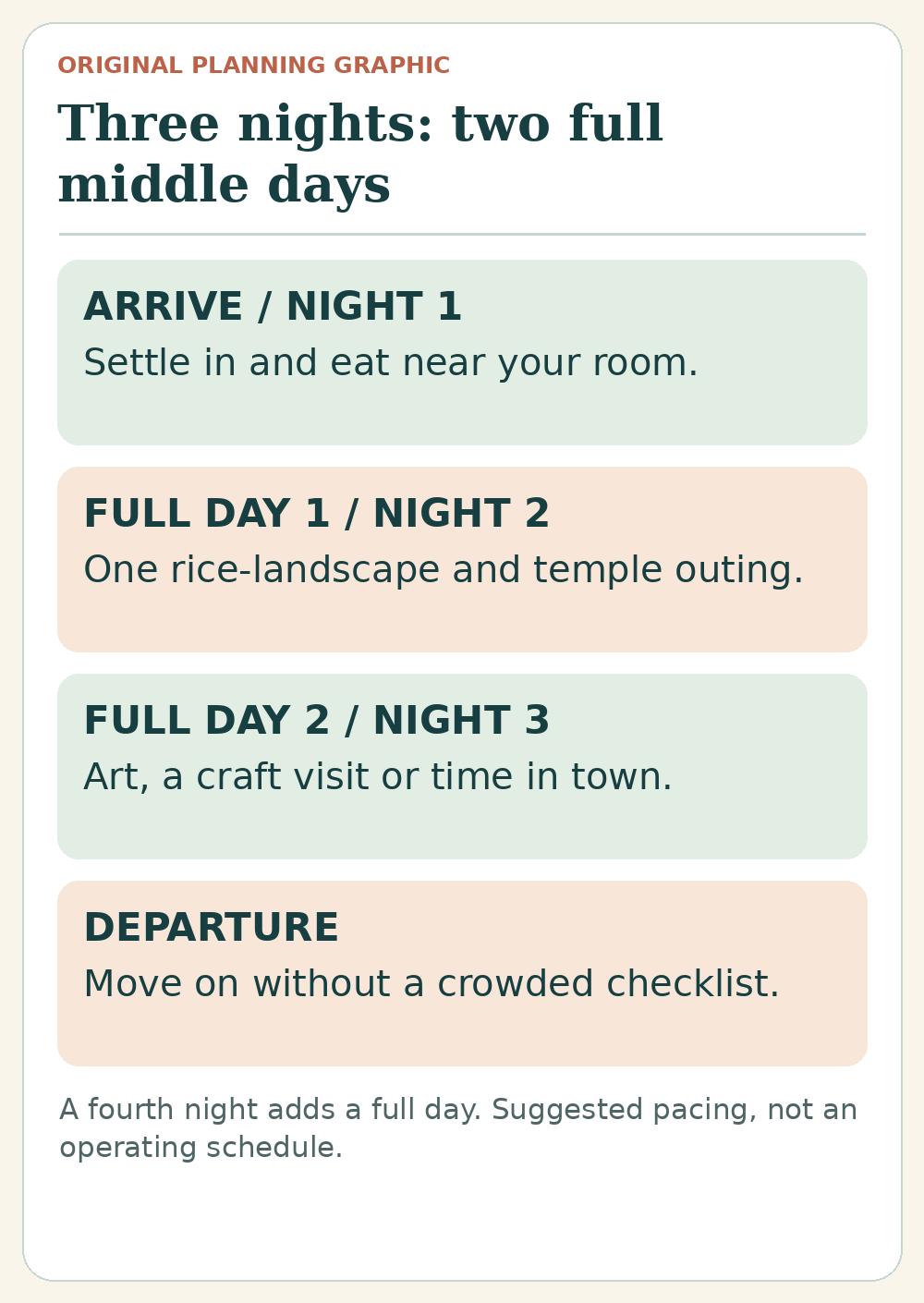
Three nights allow arrival, two full days and departure.
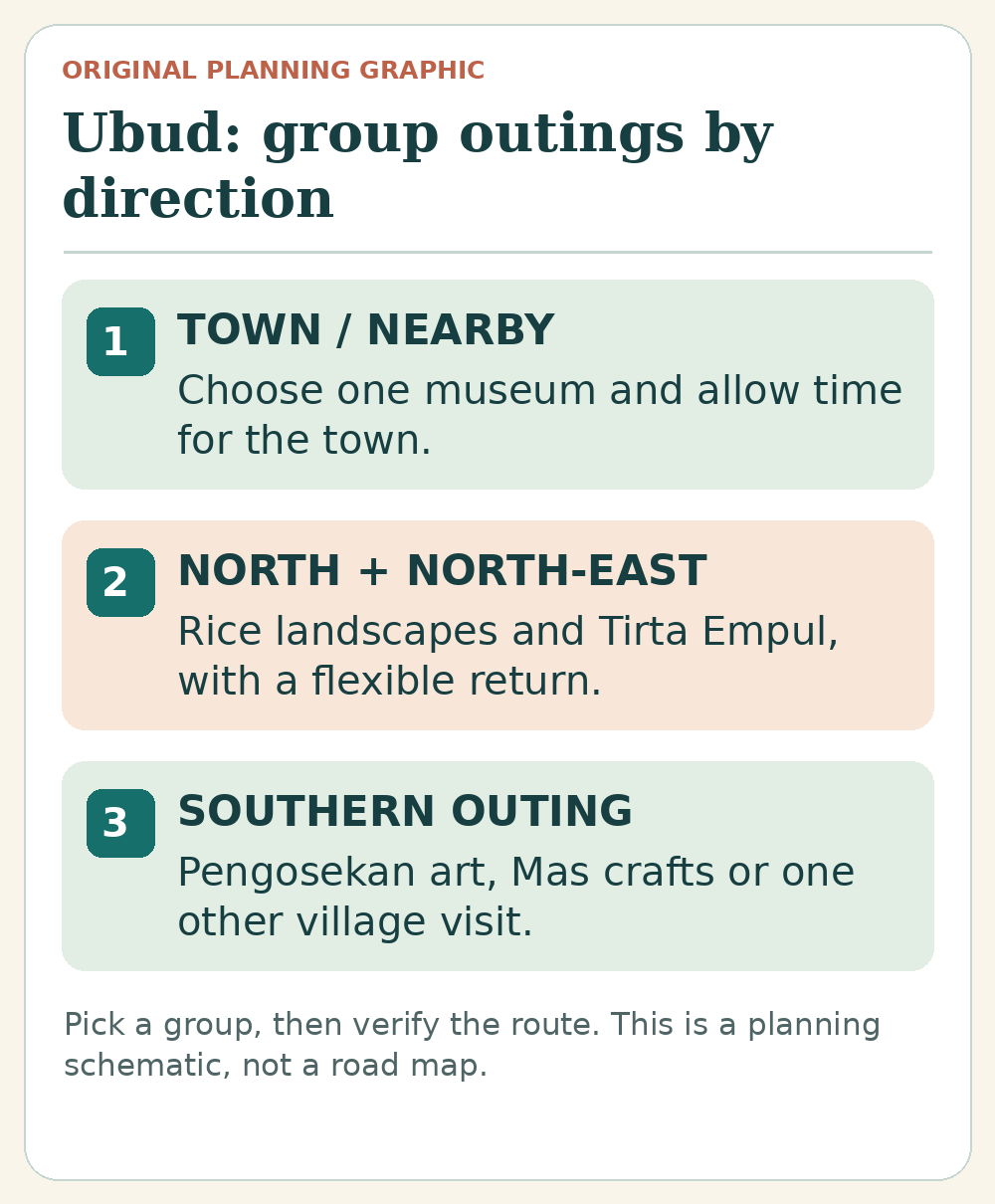
Group visits by area instead of chasing a long checklist.
Ask about paths, access charges and photography permission.
Ubud travel guide: pick a base that matches the day
The term Ubud can describe a central town stay or accommodation well outside the streets you expect to use. Before comparing pools and views, pin the entrance and ask how you would get to dinner, an early pickup and your first planned activity.
| Location style | Who it suits | Question before booking |
|---|---|---|
| Central town / Monkey Forest corridor | Travellers who want nearby meals and short town outings. | Is the room protected from road or venue noise, and is the walking route usable? |
| Pengosekan / southern approach | Visitors combining an art museum with town access. | Can you comfortably reach your regular meals without a daily car? |
| Campuhan / north-western side | An art-and-landscape stay with some planned driving. | Are there slopes, steps or awkward road sections between the hotel and your plans? |
| An outlying village or valley retreat | A slower stay with the accommodation as a destination. | Are shuttles frequent enough, and what do extra journeys cost? |
ARMA identifies its location in Pengosekan, while Neka’s location information places it on Ubud’s north-western side. [2] [3] Those are useful anchors, not a promise that every nearby hotel is walkable. A short line on a map may still involve a steep lane or an unpleasant stretch of road.
For a car-free stay, shortlist the everyday needs before the room: two dinner choices, a breakfast option, a shop and a safe place for pickup. For a retreat stay, ask the hotel for its actual shuttle timetable and return arrangements, not merely whether a shuttle exists.
Rice fields: choose the experience, then the entrance
Tegallalang is one of the rice-landscape outings highlighted by Indonesia’s tourism board; the same guidance also points to other fields around Ubud. [1] Decide whether you want a short viewpoint visit, a guided explanation of farming or a longer walk before choosing an entrance.
A hillside photo stop and a working-field walk are different products. Ask which paths are included, whether extra areas charge separately, whether the route returns to the same entrance and how muddy or steep it is. Avoid buying a swing package when your actual interest is understanding the landscape.
The cultural significance extends beyond the shape of the terraces. UNESCO’s Bali inscription recognises a specific cultural landscape associated with subak, the cooperative irrigation system, and its water temples. [4] Do not assume that every terrace advertised near Ubud is individually UNESCO-listed.
Make the walk fit the traveller
Start with the shortest useful route for your group’s heat tolerance and mobility. Allow a turnaround option rather than making the farthest viewpoint compulsory. Check access conditions on the day; a narrow field edge should not be treated as a formal pavement.
Stay on authorised paths, avoid damaging crops, ask before photographing workers closely and do not step into a field simply because another visitor did. Paying the stated access charge is different from having permission to enter every surrounding plot. A local guide can add value when the guide explains farming and community life rather than only taking photographs.
Use a museum to put the rest of Ubud in context
Choose one museum that matches your interests, then leave room to look properly. ARMA presents traditional and contemporary work, including Kamasan and Batuan painting traditions, at its Pengosekan site. [2] Neka’s collection includes different Balinese painting styles, making it another useful introduction to the visual culture. [3]
For a first visit, selecting one is more useful than rushing through both to claim completion. Afterward, a gallery or craft stop becomes easier to approach with questions: who made the work, which materials were used, and how does the style relate to what you have just seen?
The palace and market area offers a different town experience. Combine it with nearby meals or a booked performance rather than treating the centre as something to cross between distant attractions. Where a dance performance is part of your plan, confirm the venue and the current night’s programme locally; do not assume that an old online schedule still applies.
A better shopping question
Ask what you are buying and who made it. A low-priced souvenir and an individually made piece can both be valid purchases, but they are not the same proposition. Agree the final price clearly, check whether photography is allowed, and ask how fragile items can travel home.
A gallery visit is not an obligation to buy. Similarly, a guided tour’s craft stop should be explained in advance: workshop, demonstration, retail showroom or a combination. That distinction helps avoid spending your cultural afternoon in places that do not match your interests.
Temple visits and the Monkey Forest are different decisions
Tirta Empul is a sacred water temple at Manukaya near Tampaksiring, rather than a central-Ubud attraction. [5] Pair it with a northern or north-eastern outing, and approach the religious setting respectfully. Observing is a legitimate visit; taking part in a ritual should be an informed choice, not an automatic photo activity.
Ask staff or an appropriate local guide about dress, restricted areas and what visitors may do. Follow the site’s rules and allow worshippers room. Someone in the group who does not wish to enter the water should not feel that they have missed the only meaningful experience.
The Sacred Monkey Forest Sanctuary has a different set of practical considerations. Its published guidance says not to touch or pick up monkeys, to avoid direct eye contact and to protect small belongings. Food and drink are not permitted inside. [6] This is not a setting for animal-handling photographs.
Skip the sanctuary if close encounters with animals would make your group uncomfortable. Ubud has enough art, landscape and village options that no single stop is compulsory. If an animal bite or scratch occurs, seek immediate medical assistance rather than deciding it is too small to matter. [7]
Nearby villages: make the visit specific
Mas is associated with woodcarving, and Indonesia’s tourism guidance describes village-based craft activities and galleries. [8] A visit is more worthwhile when you know whether you want to watch a demonstration, book a hands-on workshop or compare completed pieces.
Two other craft interests can justify a different outing: Celuk is associated with gold and silver work, while Batuan is known for painting. The tourism ministry identifies these specialisms alongside Mas woodcarving. [9] Choose the craft that interests you rather than treating the villages as interchangeable shopping stops.
| Village | Interest | Useful question |
|---|---|---|
| Mas | Woodcarving | Can I watch or join a specific workshop, rather than only browse a showroom? |
| Celuk | Gold and silver craft | What material, weight allowance and instruction does a class include? |
| Batuan | Painting traditions | Is the visit to an artist, a studio or a retail gallery, and is the artist available? |
A specialist village visit should replace another stop when it adds substantial travel. For instance, a morning museum visit followed by one prearranged craft appointment has a clearer purpose than squeezing all three villages into the same afternoon.
Contact the workshop or ask your guide what will actually happen. For a practical session, check its length, the material, whether beginners can participate, age restrictions and whether the finished object can be taken away that day. A workshop booking is not interchangeable with a free showroom stop.
A village name is not a single attraction with one entrance and one timetable. Avoid describing the whole community as a display for visitors. Walk respectfully, do not enter family compounds uninvited and ask before photographing religious or domestic activity.
For a three-night stay, choose one craft-focused outing rather than trying to combine every village named in a brochure. A useful pairing is an art museum and a booked craft visit on the same side of town, with a proper lunch between them. The time to talk is part of the experience, not time lost from the schedule.
Activity listings vary substantially in their stops, duration and pickup coverage; read the individual description rather than relying on the search-page title. [10]
An original three-night plan without the zigzagging
This plan uses three geographical groups and one main commitment per half-day. It is a pacing framework, not a timed tour. Check actual opening arrangements and local road conditions before fixing the order.
| Day | Main plan | Keep flexible |
|---|---|---|
| Arrival / night 1 | Check in, locate dinner and settle into the neighbourhood. | Only a short local walk if arrival and energy permit. |
| Full day 1 / night 2 | Rice-landscape visit plus Tirta Empul, when both interest you. | Lunch and the afternoon length; remove a stop rather than rushing. |
| Full day 2 / night 3 | One museum, then a booked craft visit or a town afternoon. | An evening performance only after confirming the current programme. |
| Departure | Transfer to the next base with luggage arrangements agreed. | A short stop only when it genuinely fits the transfer. |
For a first full day, reserve a generous morning for the northern outing instead of promising a fixed return minute. On the second day, choose ARMA and a southern craft visit, or Neka and a north-western afternoon; do not automatically drive between all of them.
A fourth night buys an additional full day. Use it for a cooking class, an easier landscape walk, the Monkey Forest when suitable, or simply time at the accommodation. It does not have to become another long-distance excursion. Travellers with children or limited stamina may find that extra flexibility more valuable than another destination.
Transport: arrange the difficult journeys, walk the useful ones
From Bali’s airport, pre-arrange a transfer to your exact address when arriving late, carrying substantial luggage or staying outside the centre. 12Go provides an airport-to-Ubud search, but you should check the actual product’s meeting procedure and drop-off coverage. [11]
For a village or temple outing, agree the route and stop allowance before setting off. Ask whether parking, entrance tickets and waiting are included and what happens if you want to shorten the day. A driver is not necessarily a specialist cultural guide; book the expertise you actually need.
Walking is useful for selected town journeys, but do not infer accessibility from a short distance. Request recent photographs of the entrance route, steps and paths when those details matter. A car should be able to reach an agreed pickup point without requiring you to carry bags along an unsuitable lane.
There is no need to learn scooter riding on holiday. Check the proper licence and insurance before riding any motorbike; the FCDO highlights serious road risks. [12] A central base and a few organised car journeys can make a no-scooter stay straightforward.
For messages and directions, compare roaming with a compatible Indonesia eSIM. Airalo offers country plans, but check the device, activation rule and coverage before purchase. [13] Browse Airalo’s store and select Indonesia; keep the hotel address offline too.
When a cheaper retreat costs more in practice
Compare accommodation through the programme you intend to follow. A peaceful outlying property can be excellent value when you spend time there. It may be less economical when you want three separate trips into town each day.
Consider a three-night example with invented, round figures: a central room at IDR 900,000 per night costs IDR 2,700,000. An outlying room at IDR 700,000 costs IDR 2,100,000, saving IDR 600,000. If that second location adds two paid return outings at IDR 300,000 each, the room saving disappears before you count the extra time.
This is a break-even illustration, not a claim about current Ubud room or taxi prices. It shows which questions to ask: how often will you leave, what is included, and would you still choose that property at the full trip cost? Enter your own comparable quotes in the Hotel Comparison Calculator.
Keep a separate allowance for museum or temple admissions, workshops, meals and optional guide services. Do not assume a single terrace entrance or an advertised tour price includes every activity pictured. When a price is important to your decision, obtain the current inclusive quote rather than relying on a general travel article.
Weather, etiquette and practical mistakes to avoid
Bali’s wetter period is broadly November to March, with a generally drier April-to-October period; neither guarantees the day’s conditions. [14] Keep an indoor cultural option for rain and ask locally about slippery paths before a field walk. A museum is an alternative worth enjoying, not merely a consolation prize.
Before travelling, use the current official Indonesia entry guidance for your passport, visa and arrival formalities. Ubud does not have a separate international entry process. The final accommodation choice also needs a current check on building work and noise.
The most avoidable mistake is expecting every Ubud stay to offer both a secluded landscape and effortless walking to town. Another is adding waterfalls, temples, terraces and craft villages to the same day without asking how much time remains outside the car. Finally, do not confuse a resort’s commercial activity menu with a description of all the cultural experiences available nearby.
Ubud questions worth settling before booking
Is an Ubud day trip enough?
A day trip can introduce one or two experiences, but it does not reproduce the freedom of an overnight stay. Use it for a focused purpose rather than trying to fit the entire guide into one outing. Several nights are better when cultural visits are a central reason for travelling.
Are all rice-field routes suitable for children or limited mobility?
No universal suitability claim is reliable. Ask about the exact route, steps, surface, shade and turnaround points. A viewpoint visit may be a better match than descending a steep or muddy path.
Must I visit the Monkey Forest?
No. Its animal environment will not suit everyone. A museum, craft session or a carefully chosen field walk can fill the time without leaving an essential gap in an Ubud holiday.
Should I book every cultural experience in advance?
Reserve small-group workshops or the specific guide you want, especially when the day is fixed. Leave some town time unbooked and confirm performance details close to the date rather than filling every evening from an old schedule.
Can I visit a village on a transfer day?
Sometimes, when the location genuinely lies along the agreed route. Confirm secure luggage arrangements and stop charges with the driver. Do not add a complex detour before a time-critical flight or connection.
Build the stay around two days you genuinely want
Choose a practical base, one landscape-and-temple outing and one art-or-craft day. That is already a coherent three-night stay. Add a fourth night for space to follow an interest further, not to turn the visit into an attraction race.
Use the Itinerary Pace Checker with your own transfer estimates when fitting Ubud into a larger route, and return to the Indonesia travel hub for the wider country-planning structure. The simplest next decision is whether your accommodation should bring town closer or give you a reason to stay away from it.
Sources & editorial approach
The source list identifies tourism, government and operator references used for this research-led guide; specific opening times, prices and booking conditions can change. The area choices, sample days and explicitly labelled calculations are original planning judgements, not measured journeys, personally tested visits or live offers. Recheck changeable rules and booking terms for your dates.
- Indonesia Ministry of Tourism: Ubud orientation and cultural attractions.
- ARMA: museum collection and Pengosekan location.
- Neka Art Museum: collections.
- UNESCO: Cultural Landscape of Bali Province and the subak system.
- Indonesia Ministry of Tourism: Tirta Empul.
- Sacred Monkey Forest Sanctuary: visitor guidelines.
- FCDO: animal bites, scratches and health precautions in Indonesia.
- Indonesia Ministry of Tourism: Mas village and woodcarving.
- Indonesia Ministry of Tourism: Gianyar craft villages and traditions.
- GetYourGuide: Ubud activities and booking options.
- 12Go: Denpasar Airport to Ubud route search.
- FCDO: Indonesia safety, transport and natural hazards.
- Airalo: Indonesia eSIM plans and device-check links.
- Indonesia Ministry of Tourism: weather, climate and seasons.
Illustrations in this article were created for Taylor’s Trailblazing Travels. Third-party photographs, where used, are credited beside the image or in the source list.