
Where to Stay in Ubud: Centre, Penestanan or Rice-Field Outskirts
A room among rice fields is only a bargain when the location suits the days you want.
Original Ubud-inspired landscape illustration; not a photograph of any featured hotel or its room view.
Choosing where to stay in Ubud means deciding how often you want to leave the property. Someone planning breakfast out, a midday return and dinner in town needs a different location from someone booking a private pool and two quiet days. The same beautiful villa can be excellent for one trip and inconvenient for the other.
This guide separates the centre, Penestanan and outlying stays without pretending they have rigid boundaries. It uses official destination and property information, then adds an original daily-movement test and a cost calculation. No property has been personally inspected or booked for this review.
This article contains affiliate links. Taylor’s Trailblazing Travels may earn a commission from qualifying bookings or purchases, at no extra cost to you.
Best starting point for frequent town outings.
A location-specific compromise, not a guarantee of walkability.
Choose the retreat deliberately and price the journeys.
The same brand may sell more than one accommodation location.
Where to stay in Ubud: three different daily routines
Ubud is an inland cultural destination, but the accommodation sold under its name ranges from town addresses to surrounding landscapes. The useful distinction is not “touristy versus authentic”. It is whether the place makes your intended day comfortable and affordable. [1]
| Location style | Strongest fit | Trade-off | Decisive question |
|---|---|---|---|
| Central Ubud | Frequent meals out, short visits and returning to the room | Noise, traffic and access differ between streets and rooms | Can I comfortably reach my actual destinations from this entrance? |
| Penestanan | A west-of-centre village setting with chosen local cafes or a particular villa | A nearby map pin does not prove a convenient walking or vehicle route | What is the real route, including the final approach? |
| Rice-field outskirts | A property-led stay with scenery and fewer town trips | Transport, meals and pickup arrangements need budgeting | Would I still choose this place if I went into town only once daily? |
| Valley retreat, such as Sayan | A landscape-focused resort stay | Not interchangeable with a central room or a rice-field cottage | Am I booking the river-valley experience or merely a cheaper room? |
These are planning categories rather than official district boundaries. Sayan, for example, includes a river-valley resort setting; it should not be used as a synonym for every rice-field location. Four Seasons explicitly describes its Sayan property in the Ayung River Valley. [5]
A two-night stay generally makes convenience more valuable because there is less time to settle into transport arrangements. A longer stay can justify a more self-contained property when you will actually use it. Those are pacing judgements, not minimum stay rules.
The centre: choose the street, then the room
For a first shortlist, inspect the Jalan Raya Ubud, Monkey Forest Road, Hanoman and Bisma corridors on a map against the places you expect to visit. “Central” should mean convenient for your own meals and activities, not merely inside a search website’s destination boundary. Ubud’s cultural and visitor facilities cluster around a town centre, but accommodation extends beyond it. [1]
A central address works especially well when your day includes a pause at the hotel. You can plan a modest outing, return to change or rest, then head out again without feeling that every movement needs a driver. The benefit depends on the actual access route and your walking tolerance; do not assume continuous level pavements.
Convenience does not have to mean a main-road room
Ask where the room sits within the property. A street-facing room, a garden room reached by steps and a villa approached by a separate lane can create different experiences at the same address. Request information about stairs, vehicle drop-off, nearby building work and evening noise rather than assuming a courtyard photograph settles them.
Bisma Eight is one useful address-level example: its official site lists Jalan Bisma and differentiates hotel suites from villas around 500 metres away. That distinction matters more to a location decision than a shared brand name. Check the exact accommodation type in the rate you are considering. [2]
These links open broad Ubud searches, not a hand-selected list of central hotels. Move the map, inspect the entrance pin and verify the route before relying on a central-location label.
Penestanan: assess the last part of the journey
Penestanan can suit travellers who want a particular local setting rather than constant access to the busiest central streets. Devi’s Place, for example, identifies its address as Penestanan Kelod and describes nearby village amenities, with a choice of villas and simpler cottages. That supports a location enquiry, not a claim that every Penestanan property offers the same routine. [3]
The crucial question is often the final approach. Ask whether a car can reach the entrance, whether bags must be carried along a narrower path, how the route is lit after dark, and whether steps are unavoidable. These are questions to verify for the chosen property, not an assertion that all Penestanan accommodation lacks road access.
Test an evening, not only a daytime map
Pick one restaurant you would genuinely use and ask the property to describe the return route after dinner. Someone content with that route may find the location ideal. Someone expecting effortless door-to-door access in all weather may prefer another property, even within the same broad neighbourhood.
Do not solve a poor fit by assuming you will start riding a scooter. A convenient village routine, arranged drivers or a central address are all valid choices. Riding requires the appropriate licence, insurance and competence; it is not a default accommodation amenity. [8]
Use Booking.com’s Penestanan search as a shortlist tool, then check the individual pin. Search categories are useful filters, but not proof that a place has the access, quietness or proximity you need. [6]
Rice fields and valleys: book the retreat, not the label
Outlying accommodation makes most sense when the setting is part of what you are buying. A pool afternoon, breakfast at the property and a limited number of planned outings can be a coherent holiday. Repeated spontaneous trips into town create a different proposition, even when the room rate looks attractive.
Ask for the named village and the route to your intended destinations. A view across fields does not establish walking access, and a room described as “Ubud” can serve a different daily pattern from a central hotel. Do not infer that a river-valley property, a rice-field villa and a roadside guesthouse share the same surroundings. [1][3][5]
What you should price before paying
Request the normal transport arrangement, a quoted return journey to your chosen town meeting point, any minimum waiting charge, and the last practical return. Ask about on-site meals, breakfast hours, delivery access and what happens when you choose not to go out. Keep the answers with the room quotation.
A shuttle can be useful without making the location equivalent to the centre. Check the timetable, reservation requirements, seats, pickup point and final return. Ibah publishes a scheduled town shuttle, for example; the existence of that service does not establish a timetable that fits your dinner or eliminate the need for a paid alternative. [4]
A rural-looking image cannot establish noise levels, neighbouring construction, seasonal views or privacy. Ask specific questions about the chosen room and current surroundings. A fully cancellable initial booking can be more useful than a speculative bargain.
Try the three-movement test
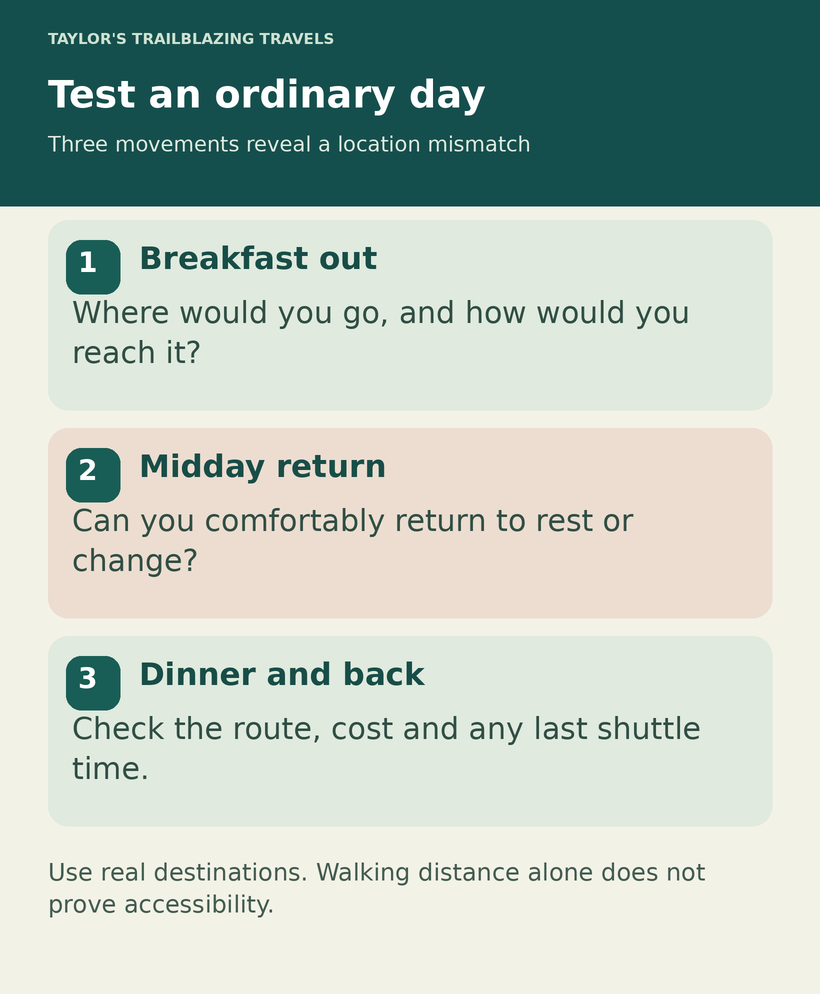
Before comparing decor, write down one ordinary holiday day. Use three moments: breakfast out, a midday return to the room, and dinner followed by a comfortable trip back. For each, record the intended destination, walking or vehicle route, realistic cost and any dependence on a schedule.
| Movement | Central stay | Penestanan stay | Outlying stay |
|---|---|---|---|
| Breakfast out | Check a real nearby option | Check the chosen local pocket | Decide whether breakfast at the property is preferable |
| Midday return | Value the ability to pause between visits | Check the route in the conditions you expect | Count a separate vehicle trip if necessary |
| Dinner and return | Check the room’s noise trade-off and route | Check lighting, access and your comfort after dark | Confirm transport or a workable shuttle return |
There is no numerical pass mark. One answer can outweigh the others: a family needing a regular rest may value the midday return highly, while a couple planning long hotel afternoons may barely use central access. Assign importance according to the party, not the hotel advertising.
This also avoids a common mistake: paying for central convenience and then taking an all-day excursion every day, or paying for a secluded retreat and spending every waking hour elsewhere. Choose the accommodation pattern you will actually use.
When a cheaper outlying room stops saving money
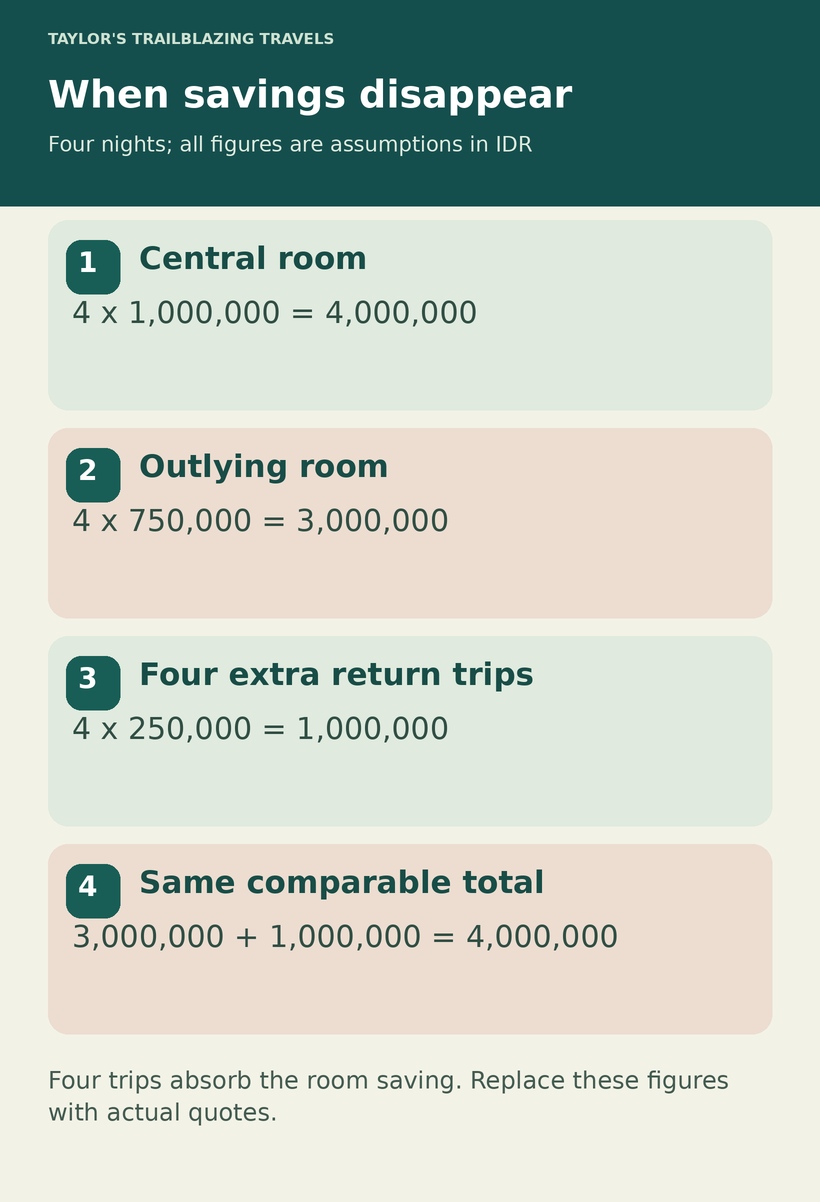
The following original example isolates room and town-transport costs for four nights. It uses invented round numbers in Indonesian rupiah, dated 1 November 2026, to show the method. They are not hotel quotations, taxi tariffs or exchange-rate estimates. Meals, activities and airport transfers are assumed identical and excluded.
| Item | Central option | Outlying option |
|---|---|---|
| Nightly room assumption | 1,000,000 | 750,000 |
| Four-night room total | 4,000,000 | 3,000,000 |
| Town transport in this example | 0 additional cost | 4 return trips x 250,000 = 1,000,000 |
| Comparable total | 4,000,000 | 4,000,000 |
The room saving is IDR 1,000,000 across the stay. At an assumed IDR 250,000 per return trip, four trips use all of that saving. Two trips would leave a saving of IDR 500,000; six would make the outlying option IDR 500,000 more expensive. Replace every input with your own quotes and do not assume a central stay has zero transport costs for your itinerary.
Time belongs beside the money. At an illustrative 50 minutes per return trip, four trips add 200 minutes, or three hours 20 minutes. That is not a measured Ubud journey time; it is a reminder to compare the experience of the stay as well as its invoice.
Enter your real figures into the Hotel Comparison Calculator, using one currency and the same number of nights and travellers. Add breakfast, compulsory fees and transport consistently. A rate that is cheaper only because one quote excludes taxes is not a genuine saving.
Divide the total room saving by the expected cost of one additional return journey. The result is the number of such journeys that absorbs the saving. Where other inclusions differ, adjust the saving first.
Four property examples that clarify the geography
These examples illustrate location and product differences, not a best-hotel ranking. They were selected from official property information reviewed on 1 November 2026. No live room inventory, independent inspection or price comparison was performed.
| Property | Why it helps the comparison | Question before booking |
|---|---|---|
| Bisma Eight | Jalan Bisma hotel suites and a separate villa product. [2] | Which pin, room type and facilities does this rate buy? |
| Devi’s Place, Ubud | Penestanan Kelod villas and cottages, with different accommodation styles. [3] | Is this the intended Ubud property and does this unit have a private pool? |
| Ibah | A Campuhan-address property with a published scheduled town shuttle. [4] | Will the actual room access and current shuttle arrangements suit the party? |
| Four Seasons Resort Bali at Sayan | A deliberately landscape-led Ayung River Valley stay. [5] | Will we spend enough time at the resort to value this location? |
For Bisma Eight, view the specific Booking.com listing alongside the official site and inspect the selected room description. The listing also describes accommodation variants; do not stop at the name at the top of the page. [7]
For the other reference points, consult Devi’s Place, Ibah’s service details and Four Seasons Sayan directly. Devi’s Place also advertises a separate Tejakula beach house: that is not the Ubud accommodation. [3]
There is no reason to force the same budget category across this comparison. A simpler cottage may be the better fit for someone using local cafes; a more expensive resort may be the better fit for someone intentionally staying in. The decision is about matching the purchase to the day.
Make access and arrival concrete
Send the property a short description of your needs and ask for explicit answers. Can the arrival vehicle reach reception? How many steps lead to the booked room? Is the bathroom suitable? How is luggage handled? Can a driver find the entrance at night? Broad claims such as “easy access” are less useful than a description of the actual route.
For walking, use footwear already comfortable for you and suited to the surfaces you expect. Grip, fit and stability matter more than buying something new immediately before the flight. Avoid treating ordinary trainers as specialist hiking equipment. UK travellers actively comparing everyday footwear can also browse the Skechers UK Outlet; no particular model is assessed or medically recommended here.
For a late arrival, pre-arrange the meeting point and confirm how delayed flights affect check-in. Save the property’s location and contact details offline. A booking confirmation saying only “Ubud” is not enough for the driver to identify a small lane or a separate villa entrance.
When travelling with children or limited mobility, ask about unfenced pools, room-to-facility access and supervision arrangements before committing. Do not infer suitability from the size of the room or the price bracket.
Choose the version of Ubud you will use
Is Penestanan within walking distance of the centre?
Some individual routes may suit you; others may not. Ask about the exact entrance, destination and conditions rather than using a broad neighbourhood distance as a promise. A return after dark can be a different decision from a daytime stroll.
Is a rice-field view worth paying more for?
Yes when you will enjoy it from the property and the access trade-off is acceptable. It adds less when your schedule has you out early and back late every day. Ask what view belongs to the exact room, not only to the property’s promotional images.
Should you split a short Ubud stay between town and a retreat?
Usually not as a default. For two or three nights, the packing and move may consume too much of the benefit. For a longer stay, a split can work when the two parts have different purposes and you deliberately keep the retreat days quiet.
What is the strongest starting choice?
For a first visit with frequent town outings, begin centrally. Move the search to Penestanan when its local routine genuinely appeals, or to the outskirts when the property is a destination in its own right. Then apply the daily-movement test and replace the sample costs with your real figures.
Would this location still appeal if the room photograph disappeared? When the answer is yes, the property is more likely to serve the holiday rather than complicate it.
Sources and editorial method
Sources consulted on 1 November 2026. Provider statements describe their advertised services, not an independent inspection. Comparisons, checklists and worked examples are original editorial analysis; illustrative inputs are labelled where used.
- Indonesia Tourism: Ubud destination overview
- Bisma Eight: hotel suites, separate villas and address
- Devi's Place: Penestanan villas, cottages and separate Tejakula property
- Ibah: services, scheduled town shuttle and Campuhan address
- Four Seasons Resort Bali at Sayan: Ayung River Valley setting
- Booking.com: Penestanan area listings
- Booking.com: Bisma Eight Ubud listing and accommodation variants
- FCDO: Indonesia road safety and driving requirements
Illustrations in this article were created for Taylor’s Trailblazing Travels. Third-party photographs, where used, are credited beside the image or in the source list.