Nikko Toshogu and Shrine Complex: Visiting Guide
Choose what to enter, allow time to look closely, and keep transport passes separate from admission.
- Toshogu and its neighbours
- A realistic five-hour plan
- Separate tickets explained
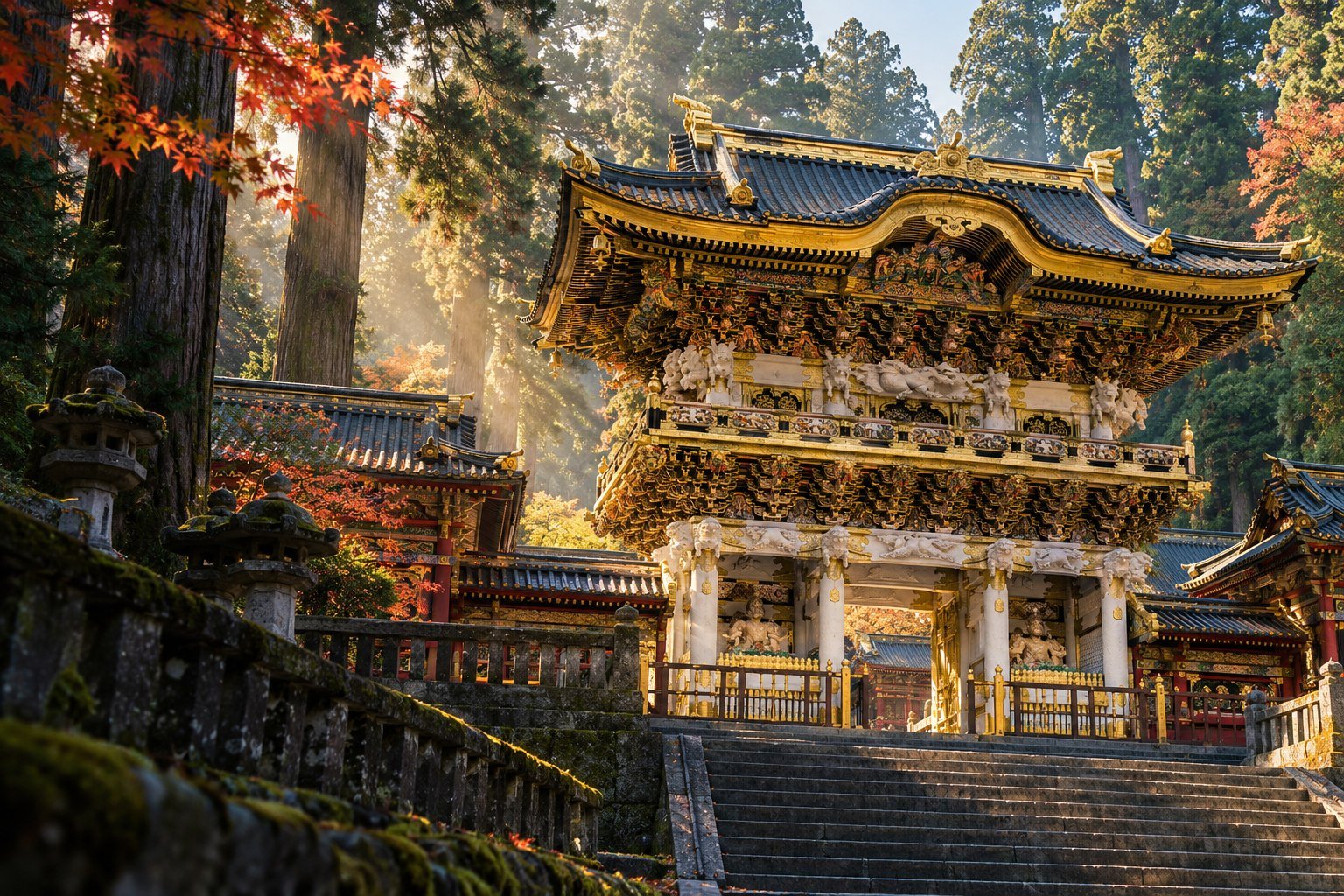
AI-generated original editorial illustration inspired by Yomeimon at Nikko Toshogu; it is not a documentary photograph.
Nikko rewards attention. The temptation is to count gates, halls and carved animals, then hurry to the next famous place. A more satisfying plan gives Toshogu a proper visit and adds the neighbouring temple or shrine that interests you most.
This Nikko Toshogu visiting guide focuses on that compact religious district: which admissions to buy, how the seasonal opening times affect the order, and when to shorten the route. The five-hour model is a planning allowance, not a promise about queues or a record of a personally tested walk.
Taylor’s Trailblazing Travels may earn a commission when you book or buy through links in this guide, at no extra cost to you. This helps support the site’s research and upkeep.
Choose the main visit
Make Toshogu the anchor if its architecture and carvings brought you to Nikko.
Add a distinct interest
Choose another temple, a garden or a collection because you want that experience.
Protect the return
Calculate the bus, station and train margin before choosing the last admission.
Plan around access
Ask about the exact route and assistance you need before paying for a tour.
Understand what the shrine complex includes
The World Heritage property brings together two Shinto shrines, Toshogu and Futarasan, and the Buddhist temple Rinnoji. They form a historic religious landscape, with buildings on wooded slopes, rather than one attraction with a single admission gate. [1]
Toshogu is associated with Tokugawa Ieyasu, founder of the Tokugawa shogunate. His grandson Iemitsu developed the elaborate setting visitors recognise today. Yomeimon Gate and the carved animals are part of that story, not detached photo stops. [3] Taiyuin is Iemitsu’s mausoleum and belongs to Rinnoji; it is a separate visit from Toshogu. [4]
| Your interest | A useful choice | Allow it to replace |
|---|---|---|
| Elaborate gates and carved detail | Spend longer at Toshogu. | A hurried extra admission. |
| Buddhist halls and the shoguns’ family story | Add Sanbutsudo and Taiyuin. [4][5] | A same-day excursion to the lake. |
| A quieter garden or collection | Consider Rinnoji’s Shoyoen and treasure house, or Toshogu’s separate museum. [3][5] | One of the other paid interiors. |
| Mountain worship and the wider sacred setting | Include Futarasan; decide separately about its paid Shinen garden. [7] | An assumption that every visitor needs every ticket. |
Swipe or scroll sideways to read the full table.
The red Shinkyo Bridge is another Futarasan structure at the edge of the district. Crossing the paid bridge is optional: decide whether being on it matters to you, rather than treating it as compulsory admission to the entire World Heritage area. [8]
Choose admission before buying a transport pass
Fees, hours and ticket-sales rules were checked on 18 October 2026. Prices are for individual adults. “Museum” means different institutions in different tickets; read the facility names when comparing offers.
| Ticket | Price | What it covers |
|---|---|---|
| Toshogu shrine | ¥1,600 | The main shrine admission. [3] |
| Toshogu shrine and museum | ¥2,400 | The shrine plus its separate treasure museum; museum alone is ¥1,000. [3] |
| Rinnoji two-site ticket | ¥900 | Sanbutsudo and Taiyuin; separately ¥400 and ¥550. [5] |
| Rinnoji three-facility set | ¥1,000 | Those two visits plus the treasure house and Shoyoen garden. [5] |
| Futarasan Shinen garden | ¥500 | The paid sacred garden area. [7] |
| Shinkyo crossing | ¥300 | Entry onto the bridge. [8] |
Swipe or scroll sideways to read the full table.
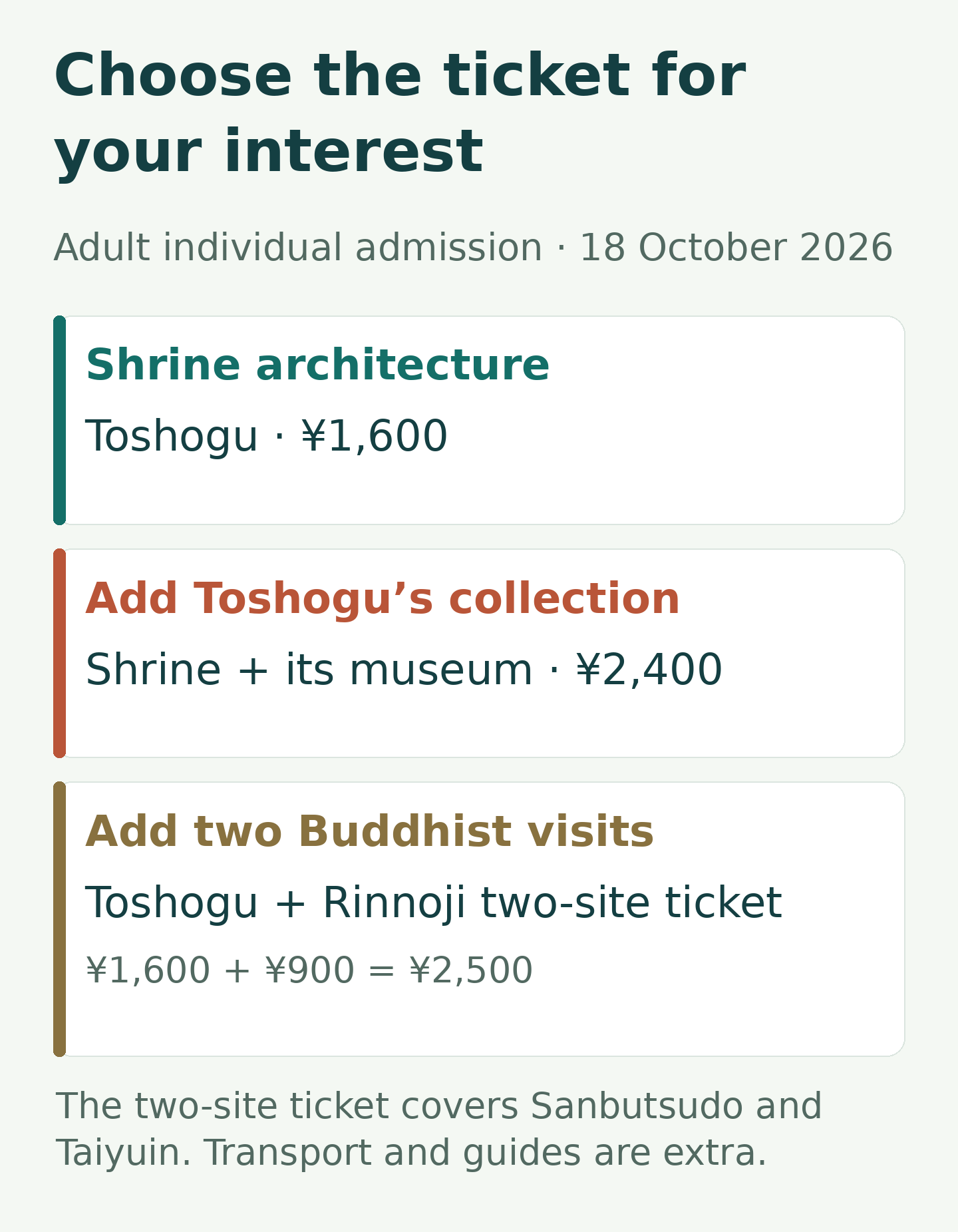
The comparison shows why a combination ticket should follow your interests. The extra ¥100 for Rinnoji’s broader set can be good value when you want the collection and garden and have time for them. A low supplement is still wasted if it buys a visit you rush or abandon.
Opening time and ticket cut-off are separate constraints
Toshogu opens 09:00–17:00 from April to October and 09:00–16:00 from November to March, with admission ending 30 minutes before closing. [2] Rinnoji opens an hour earlier, at 08:00, and has the same seasonal closing times and half-hour final-entry margin. Its two-site ticket has a much earlier sales cut-off: 14:30 in April–October and 13:30 in November–March. Buy that combination before the cut-off, not just before a hall closes. [6]
Obtain Rinnoji’s three-facility set online through its designated outlet or at the lower Sanbutsudo ticket office before visiting the other entrances. The old shared shrine-and-temple ticket remains suspended. The treasure house and garden close on specified dates, including 25 November 2026; check your date. [6]
Futarasan’s published hours are 08:00–17:00 in April–October and 09:00–16:00 in November–March; last entry is 30 minutes earlier. Shinkyo has its own shorter hours: 08:30–16:30 and 09:30–15:30 respectively. [7][8] Late afternoon therefore works best for one chosen visit.
Build a five-hour visit that leaves room to look
Start the clock when you reach the religious district. This model allocates 120 minutes to Toshogu, 105 minutes to Sanbutsudo and Taiyuin together, 30 minutes to walking between visits, 20 minutes to a pause and 25 minutes to flexible margin: 300 minutes in total.
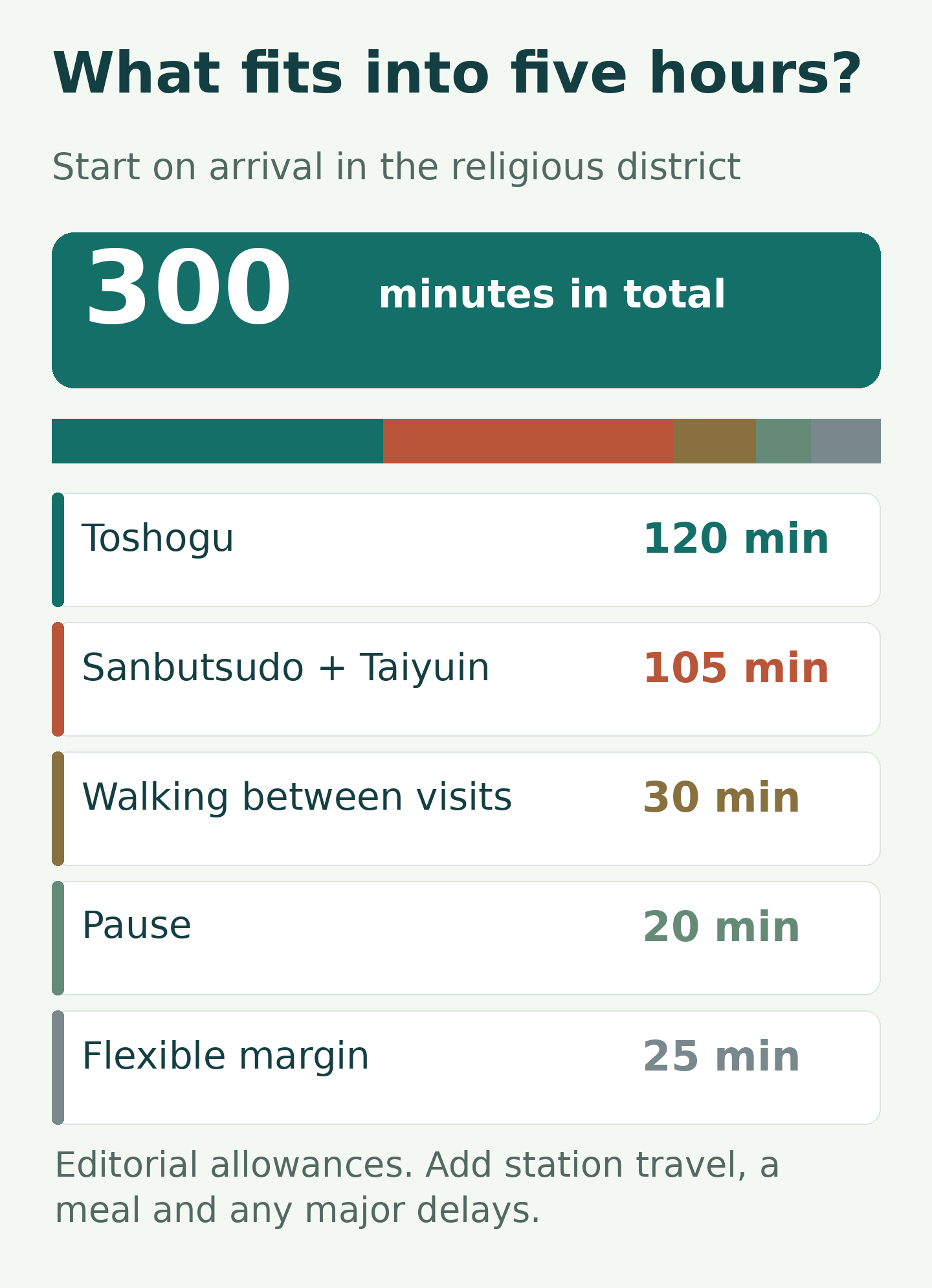
The 105-minute Rinnoji allowance sits within the temple’s published 90–120-minute indication for its two-site ticket. The remaining allowances are editorial estimates. They are not an official route duration, and significant queues or access arrangements can need much longer. [6]
- Use Toshogu as the first main visit if you arrive at opening. Follow the signed route and give the principal gates and halls attention before deciding about extra stairs or museum time.
- Move towards the Futarasan and Taiyuin side of the district, then make Sanbutsudo part of your return towards the lower approach. Check the on-site map and the ticket office needed for your chosen combination.
- Keep the pause separate from the queue margin. Add a proper meal outside this five-hour allocation.
- Count backwards from your train departure to the bus stop and your final exit. End the last interior visit early enough to absorb that whole journey.
If you are already nearby before 09:00, Rinnoji can provide an earlier start. That swaps the order; it does not create another hour of effortless sightseeing. If you add Shoyoen and the treasure house, use a longer overall allowance: Rinnoji suggests two to two-and-a-half hours for its three-facility set. [6]
Test the plan against a delay
Under this model, an extra 45 minutes of queues uses the 25-minute margin and still needs another 20 minutes. Extend the visit by at least 20 minutes or remove an optional stop. Do not preserve every admission by deleting the pause or risking the train connection.
With only three hours in the district, reserve them mainly for Toshogu, local walking and a break. With five hours, the neighbouring temple visits become a more reasonable prospect. Reaching the lake as well is a different day plan: leave that decision to your wider Japan trip-length plan.
Give Toshogu a visit beyond the best-known carvings
The shrine ticket includes the route through Omotemon and Yomeimon, the worship halls, the Sleeping Cat passage, the inner shrine and Honjido, known for the Crying Dragon. These are within the shrine admission; the separate treasure museum is the additional ticket choice. [2]
Choose a few things to notice as you go: how the gates frame the next space, the density of the carving, and the contrast between architectural detail and the cedar setting. Read the interpretation before joining a photo queue. At a busy carving, one considered look can be more rewarding than waiting solely to reproduce a familiar image.
The inner-shrine ascent is optional. Check the steps and your energy before committing, particularly if the weather has made surfaces slippery. The point of the two-hour allowance is to permit choices; it should not become a requirement to complete every part of the site.
Toshogu offers an audio guide in English, Japanese and Chinese for ¥500 per day. It is hired after Omotemon; the published rental window ends at 16:00 in April–October and 15:00 in November–March. This is a useful middle choice between reading signs independently and paying for a private guide. [2]
Choose the booking method that fits your arrival
Buying at the shrine is straightforward for visitors who want to decide on arrival, but take yen: the city’s current visitor information says the ticket counter accepts cash only. [3]
A shrine ticket collected at the station
Compare the Toshogu admission voucher on GetYourGuide if you want to arrange the shrine ticket before travelling. This listing requires exchange at Tobu-Nikko Station Tourist Center, open 08:20–17:00; the shrine entrance cannot perform the exchange. A live smartphone usage screen is required, with screenshots and printed copies not accepted. [12]
That can suit a station arrival. It is less convenient if you are already staying beside the shrines, and it is not a promise of shorter queues inside. Read the selected option’s validity and cancellation terms before paying.
The tourism association also offers free outdoor introduction tours on selected dates. Its autumn 2026 programme runs on Tuesdays, Thursdays and Saturdays in October and November, with reception near Sanbutsudo from 10:00 to 13:00, subject to guide availability. The roughly one-hour tour introduces the sites from outside; admissions afterwards remain your choice. Check the actual operating date and join on the day, as reservations are not taken. [18]
For more interpretation, compare a private Nikko tour with a licensed guide on Viator. The listed tour starts locally and can be customised around your chosen sites; the basic service is on foot, with no private vehicle included. Shrine admission and local transport need separate budgeting. Ask for a shrine-focused route and agree the meeting point, pace and access arrangements. [13] A guide earns the extra cost when context or a tailored pace matters to your group.
These products solve different tasks: one supplies admission, the other supplies interpretation and planning. A tour description that lists both Toshogu and distant natural sights is not a reason to squeeze all of them into your own day.
Allow for the station-to-shrine journey
Tobu runs services towards Nikko from Asakusa, with limited express journeys taking roughly two hours. Another approach is the Tohoku Shinkansen from Tokyo or Ueno to Utsunomiya, followed by the JR Nikko Line. Choose the route from your actual Tokyo base and any pass you already hold, then check the specific trains. [10]
Arrival at Tobu-Nikko or JR Nikko is not arrival at Toshogu. The World Heritage bus serves the district; Omotesando is a useful stop for Toshogu, while Taiyuin/Futarasanjinja-mae suits that side. Scheduled running time is only part of the transfer: add waiting and the walk from the stop. [3][7] The local World Heritage bus pass is listed at ¥600 per adult; compare the journeys you will actually make with its covered area. [11]
As checked on 18 October 2026, the ¥3,000 adult NIKKO PASS World Heritage Area covers two days, one Asakusa–Shimo-Imaichi return journey and designated local railway and bus travel. Limited express supplements and shrine or temple admissions are extra. It is offered to foreign travellers, with provision for accompanying Japanese nationals. It does not cover every Nikko bus excursion. [9]
Compare Tokyo–Nikko pass options on 12Go if an advance travel pass would help you. The checked route page mainly listed multi-day passes, not ordinary point-to-point tickets. [20] Compare the covered journeys, validity and any separate limited express charge with the operator’s own options. A longer pass is not automatically better value for a shrine-only day trip.
For a Tokyo day trip, protect one substantial day in your itinerary. If you arrive later than planned, shorten the admissions list first. The shrine district deserves more than the time left over after a late train, an unplanned voucher collection and a full lunch.
Plan for steps, worship and other visitors
The approach contains gravel, cobbled surfaces, slopes and steps. Japan Guide Agency’s access survey describes some assisted alternatives but also barriers around Yomeimon. Treat that as a reason to ask about your precise route, not as confirmation that the complete site is accessible. Contact Toshogu on +81 288 54 0560 before travelling if you need step-free access or assistance. [14][2]
Explain the equipment you use, the distance and gradients you can manage, whether a companion is with you and which spaces you particularly want to see. A tour platform’s broad accessibility label cannot answer all of those questions. For reduced stamina or young children, select fewer interiors and make the optional uphill sections a decision on the day.
Wear shoes with reliable grip and socks suitable for interiors where footwear must be removed. Keep voices low near worship, let ceremonies proceed and follow staff instructions about where to stand. Put the camera away wherever signs prohibit photography; an outdoor photo opportunity does not establish permission inside a hall. [15]
Shinto and Buddhist prayer customs differ. JNTO describes bowing and clapping at shrines, while temple prayer does not require clapping. You can also observe quietly without imitating a ritual you do not understand. Follow local signs and guidance, and leave worshippers room to approach. [15]
Carry water and keep a weatherproof layer accessible. Leave room in the plan for a change of pace: cold hands, wet paving, a child who has finished looking or a visitor who needs a seat are practical reasons to pause or leave. None requires completing the original list first.
Use an overnight stay only when it improves the visit
A nearby overnight can remove the pressure of travelling from Tokyo before the first admission, or make a separate lake day possible. For this visit, compare the actual address with the stations and the shrine district. Nikko’s wider accommodation area also includes places such as Kinugawa and Okunikko, which are different bases. [16]
Use Booking.com’s Nikko accommodation search and Agoda’s Nikko accommodation search to compare suitable stays. Open the map, calculate the journey to the entrance you will use, and check cancellation terms, meals and check-in times. A hotel appearing under “Nikko” is not enough evidence of a walkable shrine location.
If you need mobile data for maps and a live ticket screen, check Airalo’s available plans. Select Japan coverage and confirm that your phone supports eSIM and is unlocked before buying; consider whether your existing roaming allowance already covers the task. [17][19] A charged phone and accessible booking email still matter even with a data plan.
Before leaving, check the chosen admissions, current notices, train reservation, station transfer and weather. Take the amount of yen your route requires and keep the return departure visible in your plan. Use the Japan budget planner for the wider trip costs; the prices here cover this specific visit.
Questions before you go
Is a rainy day a reason to cancel?
Rain changes the walking and waiting more than it changes the purpose of the visit. Check weather and operational notices, use a shorter route if surfaces or exposure are a concern, and prioritise the halls or collection that interest you. The outdoor connections remain part of the day, even when the main attraction is indoors.
Choose the day that gives your priorities enough time
For most first visits centred on Toshogu, the strongest starting plan is one main shrine visit followed by a deliberately chosen addition. Use the five-hour allocation when Sanbutsudo and Taiyuin both matter, and a shorter list when mobility, children, weather or a late arrival reduce the available time.
Buy the ticket that matches that plan, then arrange transport and any guide around it. Leaving one museum or garden for another visit is a sound decision when it protects the attention you wanted to give the place in the first instance.
Sources and research
Sources checked on 18 October 2026. Recheck opening times, prices, access arrangements and booking conditions for your travel date.
- UNESCO — Shrines and Temples of Nikko
- Nikko Toshogu — official admission, seasonal hours and audio guide
- Nikko City Tourism Association — Toshogu visitor information and ticket arrangements
- Nikko City Tourism Association — Taiyuin Temple
- Nikko City Tourism Association — Rinnoji facilities and admissions
- Rinnoji — official admission rules, opening times and notices
- Nikko City Tourism Association — Futarasan shrine information
- Nikko City Tourism Association — Shinkyo Bridge
- Tobu Railway — NIKKO PASS World Heritage Area coverage and conditions
- Nikko City Tourism Association — Getting Here and Around
- Tobu Bus — World Heritage area bus pass and model route
- GetYourGuide — Toshogu ticket with exchange at Tobu-Nikko Station
- Viator — customised private Nikko tour with a licensed guide
- Japan Guide Agency — Toshogu access survey
- JNTO — Shrine and Temple Traditions
- Nikko City Tourism Association — first-time visitor planning and areas
- Airalo — Japan eSIM options
- Nikko City Tourism Association — free guided introduction tours
- Airalo — eSIM compatibility and unlocked devices
- 12Go — Tokyo to Nikko pass comparison
How this guide was researched
This guide uses shrine, temple, transport-operator and tourism-authority information checked on 18 October 2026, with commercial listings used only for their booking arrangements. The five-hour allocation, delay test and interest-based ticket comparison are original editorial planning tools. They are not measured averages or a personally tested itinerary. Replace the walking, queue and break allowances with your own needs, and recheck admissions and notices for your travel date.
Illustrations in this article were created for Taylor’s Trailblazing Travels. Third-party photographs, where used, are credited beside the image or in the source list.